


 by Tom Gurney
Tom Gurney BSc (Hons) is an art history expert with over 20 years experience
Published on June 19, 2020 / Updated on November 25, 2026
Email: tomgurney1@gmail.com / Phone: +44 7429 011000
Frank Dicksee Paintings: Introduction
In Frank Dicksee’s Harmony, a woman at an organ has a listener who seems more intent on her than on the music. In The Crisis, a man keeps vigil beside a woman’s bed. Both pictures ask us to read one person’s feelings through their attention to another. Yet the first places its figures beneath stained glass, while the second makes a Victorian bedroom the setting for a drama of its own. The National Portrait Gallery places Dicksee’s quasi-historical scenes in the later Pre-Raphaelite tradition while also recognising his work in contemporary melodrama. The two paintings show how closely those interests could sit together. [1] [2] [3]
One way into Dicksee’s paintings is to ask where he makes the viewer stand. Harmony is a tall painting that brings us close to a pair of figures, with the organ and the window pressing in around them. Our eye can move up from the woman’s hands at the keyboard to the faces and then to the coloured light. The Crisis makes room for a different kind of looking. The bed stretches sideways across the canvas, and following its length makes us take in the woman’s stillness before we read the man’s response. The shapes of the canvases help set the pace at which each scene unfolds. [1] [2]
The two pictures also give us different evidence about what has just happened. In Harmony, the player’s touch and the man’s attention are enough to suggest a meeting already under way. In The Crisis, we arrive after the event that has brought the man to the bedside. The room has the specificity of a place someone lives in, but the painting leaves us to imagine the hours before this vigil. That openness is worth keeping in mind when we come to Dicksee’s literary pictures, where a well-known story can supply the events the canvas leaves outside the frame. [1] [2]
Frank Dicksee’s paintings on film
See how Dicksee moves between medieval stories and intimate encounters.
TheHistoryOfArt. An illustrated overview of Dicksee’s work. Watch on YouTube.
At a Glance
- Romance and literatureRomeo and Juliet, Paolo and Francesca and La Belle Dame sans Merci turn episodes from Shakespeare, Dante and Keats into scenes the viewer can read through gestures and objects.
- Contemporary lifeThe House Builders portrays a real couple planning a house. The Crisis gives an anxious bedside vigil the scale of an Academy picture.
- PortraitureCommissions became more prominent around the turn of the century. Dicksee was still sending pictures of courtly romance to the Royal Academy in 1921.
- Where to lookPublic collections in Britain and Australia hold important paintings. Exhibition catalogues and sale records help identify works that passed through private hands. An object number and medium help distinguish an oil from a later version or a print.
Contents
- The early paintings, from music to Shakespeare
- Victorian rooms and stories from the past
- Portraits and the persistence of romance
- Finding the paintings and their records
The early paintings, from music to Shakespeare
In the 1877 Harmony the organ divides the narrow space. Its player and her listener are close enough to touch. She plays and he listens. Her hands give the scene its visible action, and his attention provides its emotional suspense. The glowing window and costume suggest a world set apart from everyday Victorian life without requiring a named literary source. Reviewing the 1877 Royal Academy exhibition, F. G. Stephens admired the rich colour and solemn light in The Athenaeum while finding the effect sentimental. The trustees of the Chantrey Bequest bought the painting, now in Tate’s collection, from that exhibition. [1] [3]
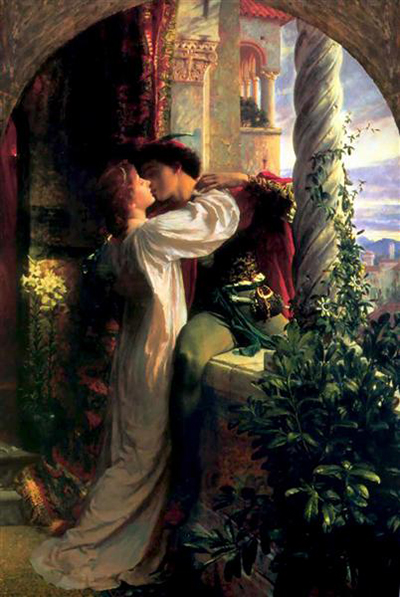
Romeo and Juliet, exhibited in 1884 and now at Southampton City Art Gallery, gives a moment of parting the scale of a tall exhibition canvas. Romeo is already poised to descend while Juliet leans out for the kiss. The stonework gives their bodies something to press against and puts a visible edge on their time together. Where Harmony leaves the lovers’ next move open, Shakespeare’s play lets a viewer know exactly why this meeting cannot last. Southampton connects the oil to Dicksee’s work on a luxury edition of the play. The large oil treats the lovers’ farewell at dawn in Act III. The Dahesh Museum of Art holds a small monochrome oil on joined pieces of wood that Dicksee made for a different illustration, of the lovers’ earlier meeting in Act II. The 2024 Pre-Raphaelite exhibition in Forlì identified the Southampton oil by its 1884 date and lender. The two paintings share a title and a balcony, with a different moment of the play, scale and purpose in each. [4] [5] [6] [7]
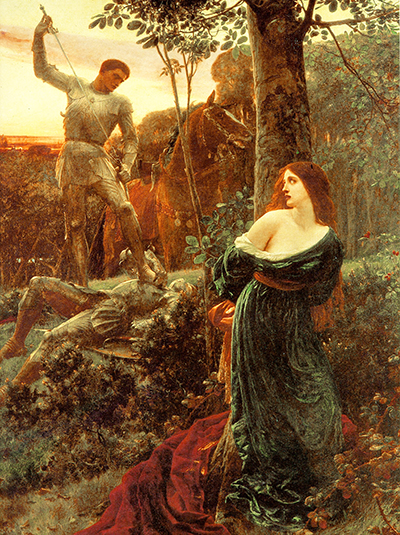
A year later Chivalry again used costume and gesture to make a relationship intelligible at first glance. A woman bound to a tree lifts her eyes while the victorious knight and the fallen figure disclose what has happened behind her. The standing figure in the foreground is the person whose fate matters, yet the encounter has been decided by men. That arrangement illustrates the promise of rescue and the restrictions of the role given to the woman. Christie’s records the large oil, with an indistinct signature and date of 1885, as a commission from Sir John Aird and lists its appearance at that year’s Royal Academy. A separately catalogued pencil, watercolour and bodycolour study shows Dicksee working out the composition on a sheet just under 34 centimetres high. [5] [8]
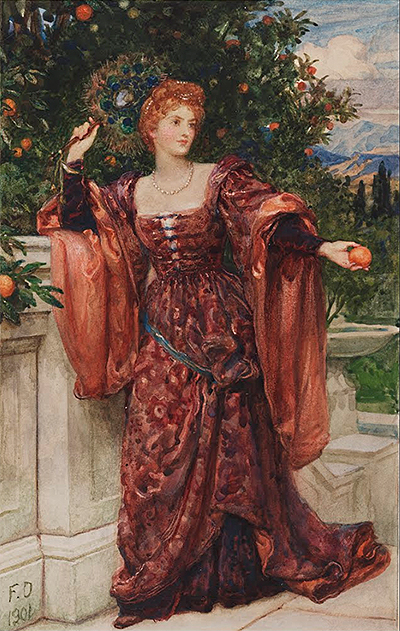
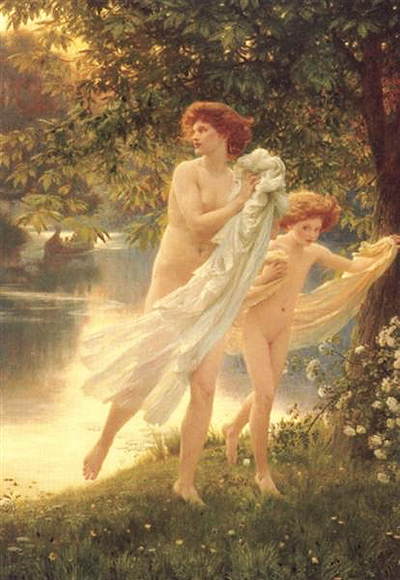
Dicksee could also give a literary or mythological figure the stillness of a portrait. In Hesperia, the 1887 oil in the Harris collection, the figure’s brocade and peacock-feather fan give her the bearing of a formal sitter, while the golden fruit identifies her with the garden of the Hesperides. Dicksee returned to the figure in a small watercolour, signed in 1901 and now at the Art Gallery of New South Wales. It is a useful point of comparison with his later portraits, where dress and objects can supply much of a figure’s identity. [9] [10]
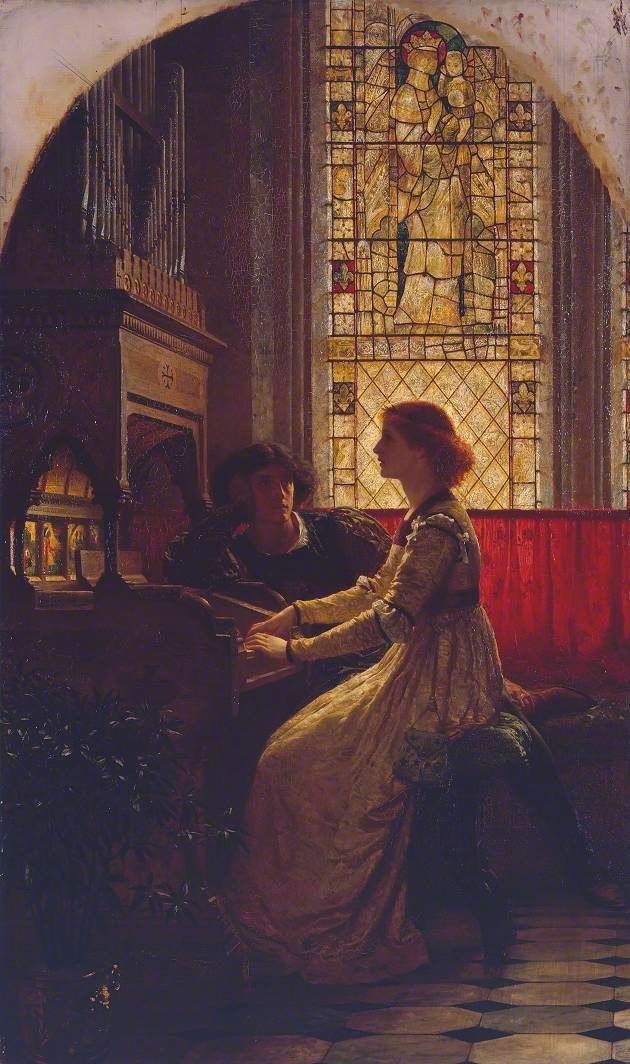
Harmony, the 1877 Tate canvas, N01587. Image source. Public domain.
Explore Dicksee’s paintings
Victorian rooms and stories from the past
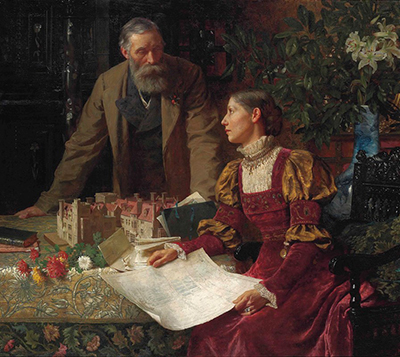
The period settings can obscure how early Dicksee began to paint his contemporaries. The House Builders of 1880 is a double portrait commissioned by Sir William Welby-Gregory. Sir William and Lady Welby-Gregory are shown considering the model and drawings for Denton Manor, then under construction in Lincolnshire. On the sheet Lady Welby-Gregory holds, Dicksee painted the architect Arthur Blomfield’s initials and the date 1879. The embroidery, porcelain and flowers give the room the richness of an Aesthetic interior, but the model makes this a specific occasion in their lives. The sitter’s occupation of the foreground gives her a part in that occasion. F. G. Stephens in The Athenaeum admired the skill with which Dicksee rendered the table covering and still thought it too conspicuous. The review identifies a tension that runs through these paintings. A lovingly painted object can draw the eye away from the people, or it can give their actions meaning. [11]
In The Crisis a richly furnished room contains a very different kind of uncertainty. The prone woman and the man close beside her occupy a horizontal painting. Broad stretches of bedding make the figures seem still. The sense of an outcome hangs on a change that has yet to happen. The 1891 canvas was signed and shown that year at the Royal Academy. It went straight from the exhibition to the National Gallery of Victoria, where it was acquired on the advice of Hubert von Herkomer. The purchase shows that an episode of modern domestic distress could have an institutional audience far beyond the room it depicts. [2]
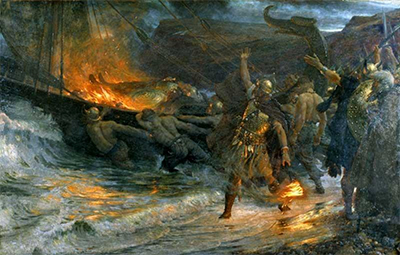
Three Royal Academy exhibits give a sense of the ground Dicksee covered in the early 1890s. The Crisis was exhibited in the year he became a full Academician. Startled, his diploma work, is dated 1892 by the Academy and depicts a pair whose attention has been caught by an approaching ship. The Academy’s 2024 exhibition Entangled Pasts interpreted the pale figures and the longship in relation to Victorian racial ideas about classical bodies and Nordic identity. That reading, offered by the Academy in its modern exhibition guide, gives the imagery a historical context beyond the immediate drama. The Funeral of a Viking (1893), now in Manchester Art Gallery’s collection, makes a ship and the watching figures into a public spectacle. In place of the uncertainty of a single bedside, its light and movement draw the eye between the mourners and the burning vessel. The painting belongs to Victorian imaginings of the past, and its ship gives a visible form to a community’s farewell. [2] [12] [13]
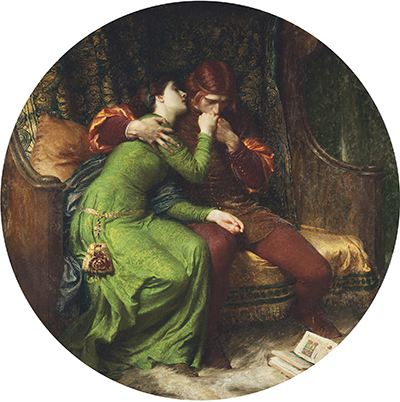
The range was visible in a single exhibition. At the 1895 Royal Academy, Dicksee showed Paolo and Francesca alongside a scene of modern life called A Reverie and two Devonshire landscapes. The signed oil of Paolo and Francesca is dated 1894. Dicksee chooses the encounter that Francesca recalls in Dante’s Inferno, when reading a romance together changes the relationship between her and Paolo. The open book supplies the reason for their closeness. The bodies have turned towards one another, and the book, still in the picture, is losing the attention it once held. Critics admired the colour or the balance of the grouping while questioning whether the painting conveyed the force of the lovers’ predicament. The variety of his four exhibits makes that exhibition a snapshot of how freely he moved between genres. The reviews of Paolo and Francesca also show how differently viewers could judge the colouring and the storytelling of a single picture. [14]
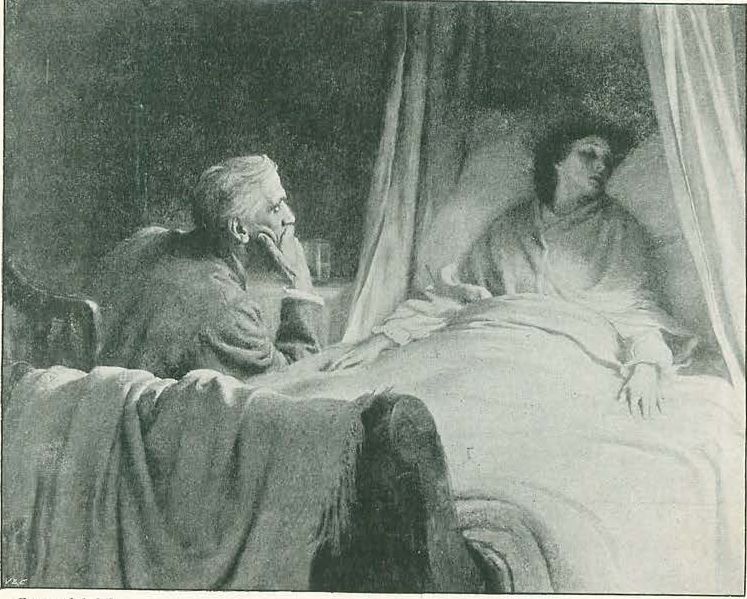
The Crisis, photographed by Dixon and reproduced in The Windsor Magazine in vol. 5, p. 389. A photograph credited to Dixon after Frank Dicksee, The Crisis. The Windsor Magazine, 1897, p. 389. Image source. Public domain.
Portraits and the persistence of romance
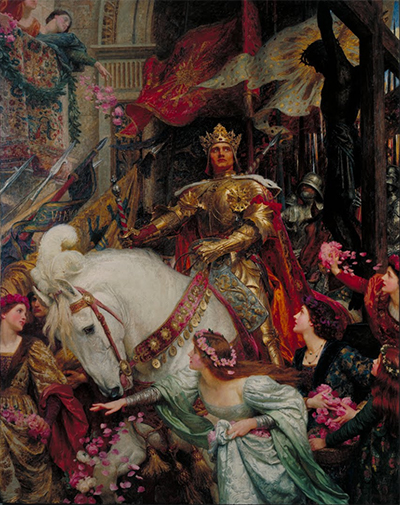
Compare The Two Crowns (1900) with the 1885 Chivalry. The early picture makes armed victory part of the rescue. In The Two Crowns, the armoured rider is at the centre of a public triumph, yet his attention turns away from the crowd. The golden crown and armour catch the light as his gaze travels towards the crucifix and Christ’s crown of thorns. The ostentation has a purpose because the two crowns are so unequal as objects and carry such different claims to authority. Like Harmony, the oil was bought for the national collection under the Chantrey Bequest. Across those two Tate paintings, Dicksee moves from a tightly framed exchange between two figures to a procession in which a single turn of the head redirects the whole crowd scene. [1] [3] [15]
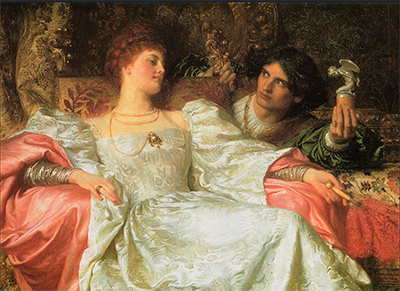
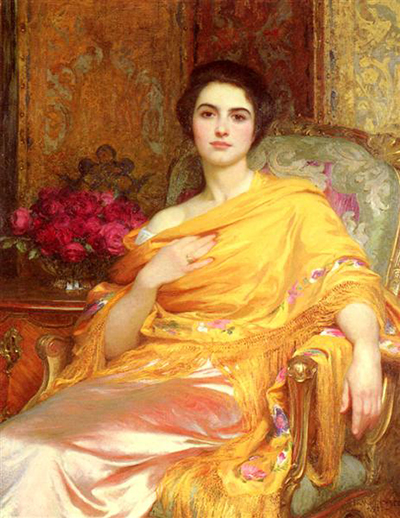
A different kind of gold gives the signed 1901 portrait of Alice Anne, Duchess of Buckingham and Chandos, its presence. The sitter wears gold brocade and ermine against a tapestry at Tatton Park. Position, texture and dress give an account of her rank without the need for a scene of action. Another wealthy patron, William Knox D’Arcy, owned Paolo and Francesca. Dicksee’s 1902 portrait of D’Arcy’s second wife Nina sets the sitter amid patterned textiles and furnishings, as he had done for Lady Welby-Gregory more than twenty years earlier. Her still pose and sidelong gaze give the room a centre. Portraiture made increasing use of skills cultivated in the narrative paintings, from painting fabrics at close range to arranging objects so they would reveal something about the figure. [11] [14] [16] [17]
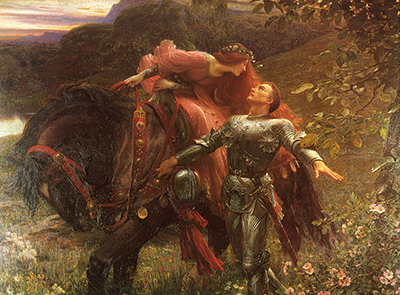
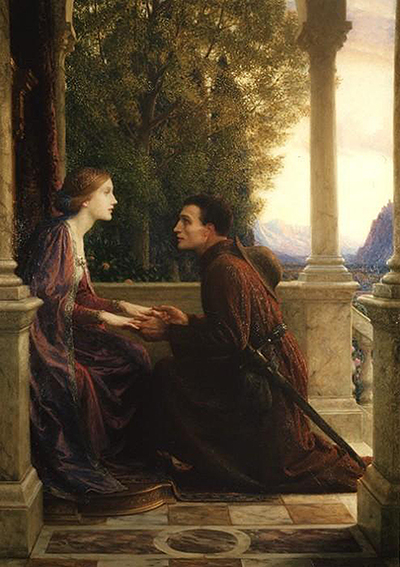
Dicksee also continued to exhibit the old subjects. The 1902 Royal Academy included both Mrs D’Arcy’s portrait and La Belle Dame sans Merci, which Bristol Museums dates to about 1901. In the latter, the woman bends from a saddle towards the armoured knight. The 1902 illustrated Academy volume identifies the painting as exhibit No. 13 and recounts the knight’s enchantment. Bristol’s account draws attention to the withered leaves brushing his arm, a small forewarning of the fate Keats gives him. Two decades later Dicksee showed The End of the Quest at the Royal Academy. The knight’s armour still belongs to the world of Chivalry, but here the figures are absorbed in a quieter encounter. The 1921 exhibition date places this study in courtly feeling well within the later portrait years and helps explain why those years are better read as a change in emphasis across his work. [8] [14] [17] [18] [19] [20] [21]
One of the less imposing portraits from those years is Portrait of Camille, daughter of Sutton Palmer. The small oil on board is signed and dated 1913 and appeared the following year at the Royal Academy, as No. 783. Christie’s identifies Dicksee as Camille’s godfather and traces the picture from the sitter through family descent and later sales. Its scale and the family relationship give this portrait a different place in his work from the imposing seated likeness at Tatton Park. Both made it onto Academy walls. [16] [22]
Finding the paintings and their records
Begin with the object record when several images circulate under the same title. Harmony can mean the 1877 Tate oil (N01587), the smaller painted version at Towneley Hall in Burnley (BURGM:paoil150), or the composition as known through Charles-Albert Waltner’s print. The Metropolitan Museum of Art identifies its object as an etching proof, dates it to 1880 and credits Waltner as etcher after Dicksee. That tells us who made the object in New York. On a portrait hunt, the National Portrait Gallery’s record for the Duchess of Buckingham and Chandos uses the same distinction. Its object D32302 is Frederick John Jenkins’s heliogravure after Dicksee. For the signed oil, follow National Trust Collections to Tatton Park and look up object 1298219. [1] [16] [23] [24]
An exhibition history records where a painting was seen at a given time. The Art Gallery of New South Wales displayed Chivalry in Victorian Visions in 2010 as part of a show drawn from the John Schaeffer Collection. Christie’s records the loan in its 2012 sale catalogue, whose provenance begins with Sir John Aird. Contrast that with the Melbourne record of The Crisis, which lists the 1891 purchase as well as exhibition appearances. The same distinction applies to dates. Paolo and Francesca was signed in 1894 and exhibited in 1895. Its different dates describe making and showing, both of which help identify the canvas. [2] [8] [14] [25]
For a work known largely from private ownership, an old label, a signature, dimensions and the medium often identify the object more securely than the title alone. Christie’s entry for Camille’s portrait, for instance, records the initials on the board, its dimensions and the 1914 exhibition number, as well as a reference to Simon Toll’s Frank Dicksee 1853–1928: His Art and Life. The Rijksmuseum library record identifies Toll’s 2016 book as a catalogue raisonné, a useful starting point for tracing paintings through earlier titles or scattered records. For works in public collections, an accession number and the latest display information are separate things to look up. Taken together, collection records and historical catalogues give a fuller picture of Dicksee’s range than any one exhibition or gallery can show. [4] [22] [26]
Frank Dicksee artworks directory
Browse documented paintings, studies, illustration designs and prints. Where an article is available, the title opens it. Simon Toll’s catalogue
| Name | Date | Medium |
|---|---|---|
| A Love Story | 1882 | Painting |
| A Reverie | 1895 | Painting |
| An Offering | 1898 | Painting |
| Chivalry | 1885 | Painting |
| Dawn | 1897 | Painting |
| Elijah Confronting Ahab and Jezebel in Naboth’s Vineyard | By 1875 | Painting |
| Harmony | 1877 | Painting |
| Harmony, etching by Charles-Albert Waltner after Dicksee | 1880 | |
| Harmony, the smaller Towneley version | Late 1870s | Painting |
| Hesperia | 1887 | Painting |
| Hesperia, watercolour version | Late 1880s | Painting |
| Italian Coast from La Mortola | 1925 | Painting |
| La Belle Dame sans Merci | c. 1901 | Painting |
| Memories | 1886 | Painting |
| Paolo and Francesca | 1894 | Painting |
| Portrait of Camille Sutton Palmer | 1914 | Painting |
| Portrait of Elsa | 1927 | Painting |
| Portrait of the Duchess of Buckingham and Chandos | 1901 | Painting |
| Romeo and Juliet | 1884 | Painting |
| Romeo and Juliet, monochrome design on joined wood | c. 1880s | Painting |
| Sir Edmund William Gosse, collotype after Dicksee | 1912 | |
| Startled | 1892 | Painting |
| Study for Startled | Early 1890s | Drawing |
| The Confession | 1896 | Painting |
| The Crisis | 1891 | Painting |
| The Daughters of Eve | 1925 | Painting |
| The Embarkation | 1879 | Painting |
| The End of the Quest | 1921 | Painting |
| The Funeral of a Viking | 1893 | Painting |
| The House Builders | 1880 | Painting |
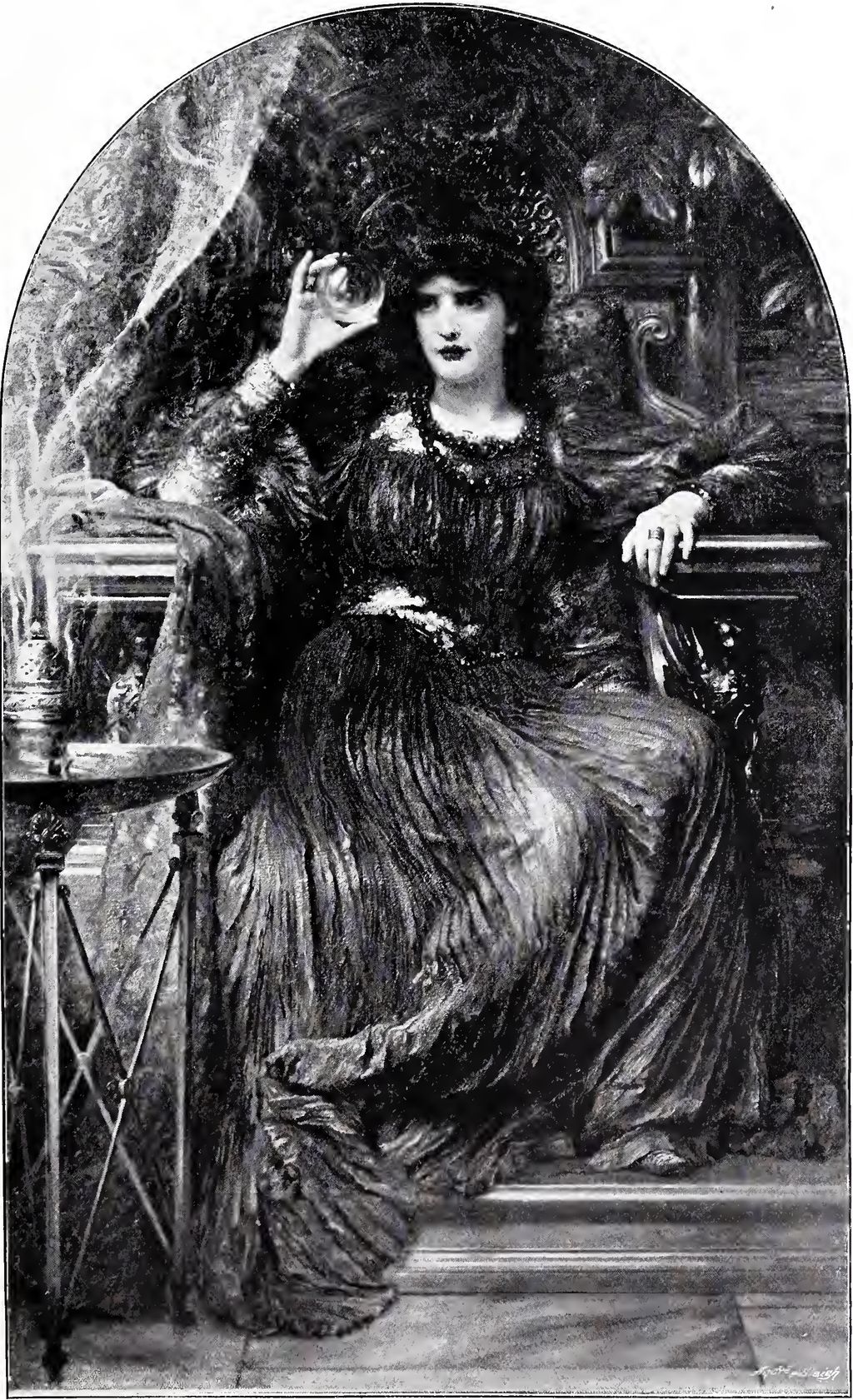
| The Magic Crystal | 1894 | Painting |
| The Passing of Arthur | 1889 | Painting |
| The Redemption of Tannhäuser | 1890 | Painting |
| The Symbol | 1881 | Painting |
| The Two Crowns | 1900 | Painting |
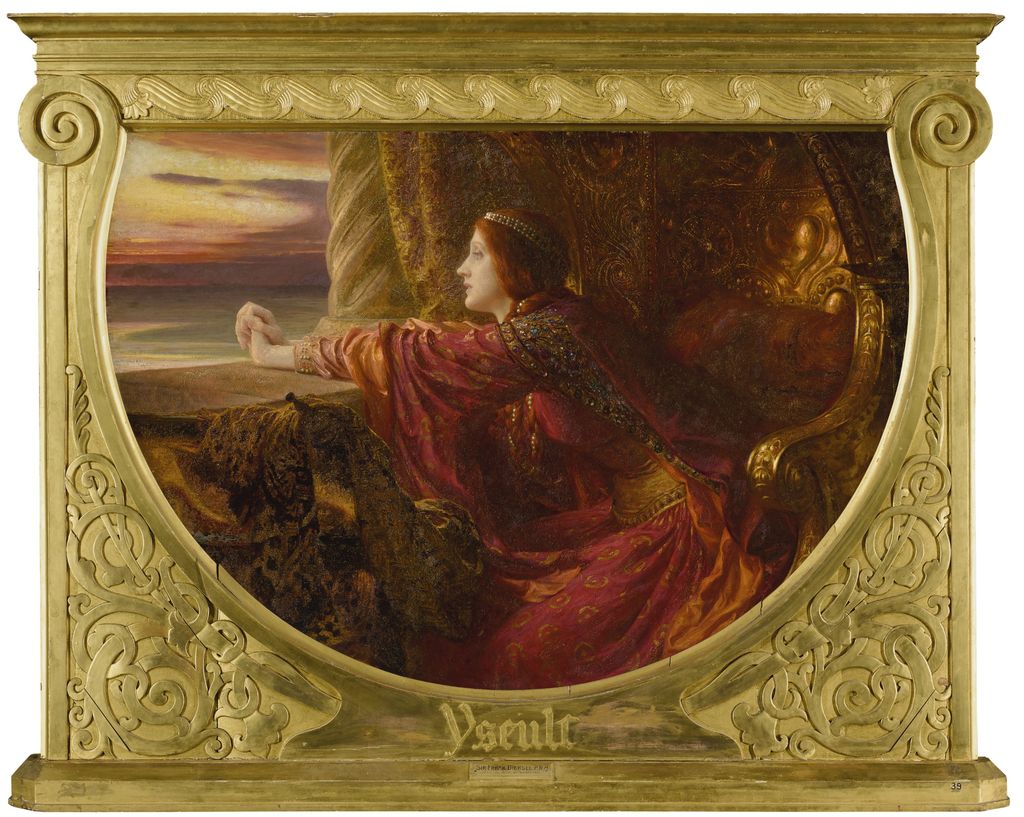
| Yseult | 1901 | Painting |
Discussion
Look again at the images and ideas explored in Frank Dicksee Paintings. These editorial prompts invite your observations.
Reader Insights
Where does your eye go first in Harmony and The Crisis? How do the setting and light bring you back to the figures?
How does the architectural model in The House Builders tell a different story from the book in Paolo and Francesca?
What does armour tell you about the figure’s role in Chivalry, The Two Crowns and The End of the Quest?
Join the Conversation
Which pairing changed your sense of Dicksee’s work? Share the two paintings and the detail that drew your attention.
References
- Dennis T. Lanigan, Harmony, object comparison and contemporary Academy reception. View source.
- National Gallery of Victoria, The crisis, accession p.396.2-1. View source.
- National Portrait Gallery, Frank Dicksee, artist profile and object roles. View source.
- Southampton City Art Gallery, Romeo and Juliet, accession SOTAG 1006. View source.
- Christie’s, Composition study for ‘Chivalry’, lot 4051766. View source.
- Dahesh Museum of Art, Romeo and Juliet, object 1999.18, comparing the two Shakespeare illustration projects and the 1884 oil. View source.
- Musei San Domenico, Forlì, Preraffaelliti. Rinascimento moderno, 2024 exhibition archive, Romeo e Giulietta. View source.
- Christie’s, Chivalry, lot 5631457. View source.
- Art Gallery of New South Wales via Google Arts & Culture, Hesperia, 1901 reworking in watercolour and bodycolour. View source.
- Dennis T. Lanigan, Hesperia, Harris oil PRSMG:P819 and 1887 Academy exhibition. View source.
- Christie’s, The House Builders, lot 5631467, including the 1880 exhibition and reviews. View source.
- Royal Academy of Arts, Entangled Pasts, 1768–now, exhibition guide, Gallery 4, Startled, 2024. View source.
- Manchester Art Gallery via Art UK, The Funeral of a Viking, object image and collection credit. View source.
- Christie’s, Paolo and Francesca, lot 5161181, including the 1895 exhibition and reviews. View source.
- Tate Britain via Google Arts & Culture, The Two Crowns, accession N01839. View source.
- National Trust Collections, Alice Anne Graham-Montgomery, Duchess of Buckingham and Chandos and Countess Egerton of Tatton, object 1298219. View source.
- Christie’s, Portrait of Mrs W. K. D’Arcy, lot 5451347, including the 1902 exhibition and survey of portraiture. View source.
- Bristol Museums, Galleries and Archives, La Belle Dame sans Merci, object K328. View source.
- Bristol Museums, Galleries and Archives via Google Arts & Culture, La Belle Dame sans Merci, collection interpretation. View source.
- Royal Academy Pictures, 1902, La Belle Dame Sans Merci, no. 13 and illustration p. 115. View source.
- Leighton House via Bridgeman Images, The End of the Quest, collection image and caption. View source.
- Christie’s, Portrait of Camille, daughter of Sutton Palmer, lot 6048661. View source.
- The Metropolitan Museum of Art, Charles-Albert Waltner after Frank Dicksee, Harmony, etching proof. View source.
- National Portrait Gallery, Frederick John Jenkins after Frank Dicksee, Alice Anne (née Montgomery), Duchess of Buckingham and Chandos (later Lady Egerton), D32302. View source.
- Art Gallery of New South Wales, Victorian Visions: 19th-Century Art from the John Schaeffer Collection, 2010 exhibition archive. View source.
- Rijksmuseum Research Library, Simon Toll, Frank Dicksee 1853–1928: His Art and Life, ACC Art Books, 2016, catalogue record. View source.