 by Tom Gurney
Tom Gurney BSc (Hons) is an art history expert with over 20 years experience
Published on June 19, 2020 / Updated on November 25, 2026
Email: tomgurney1@gmail.com / Phone: +44 7429 011000
Chivalry: Introduction
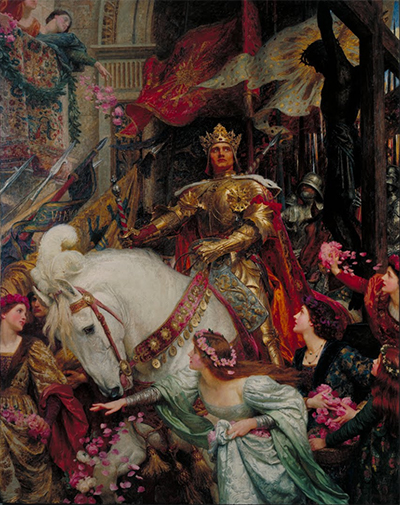
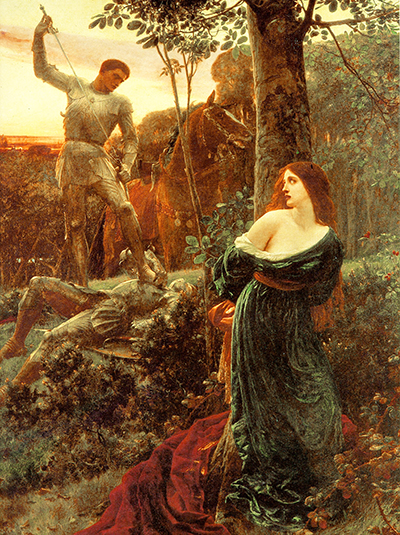
In Frank Dicksee’s Chivalry, the fight has ended but the woman is still tied to the tree. She turns towards the victor, whose raised sword is poised above its scabbard. His defeated opponent lies at his feet. Dicksee chose the few seconds when danger appears to have passed and the rescue is still incomplete. On a canvas nearly six feet high, the angle of a blade, the movement of a hand and the direction of a glance carry as much of the story as the armour and the sunset. [1]
Knights in Victorian painting
See how Victorian artists used armour and medieval stories.
The Bowes Museum. The gallery tour considers the appeal of knighthood to artists and collectors. Watch on YouTube.
At a Glance
- ArtistFrank Dicksee
- Date and medium1885, oil on canvas, with an indistinct signature and date at lower right
- Dimensions182.7 × 136.6 cm
- CommissionJohn Aird, later Sir John Aird
- First exhibitionRoyal Academy, London, 1885, catalogue no. 53
- Documented later historyShown from the Schaeffer Collection at the Art Gallery of New South Wales in 2010 and sold at Christie’s in 2012. The buyer is unnamed in the published record. [1] [2]
This work across Frank Dicksee’s career
Contents
- A rescue still in progress
- How Dicksee developed the scene
- Armour and the Victorian idea of chivalry
- What the Academy critics saw
- From Aird’s collection to Sydney
- Annotated details
A rescue still in progress
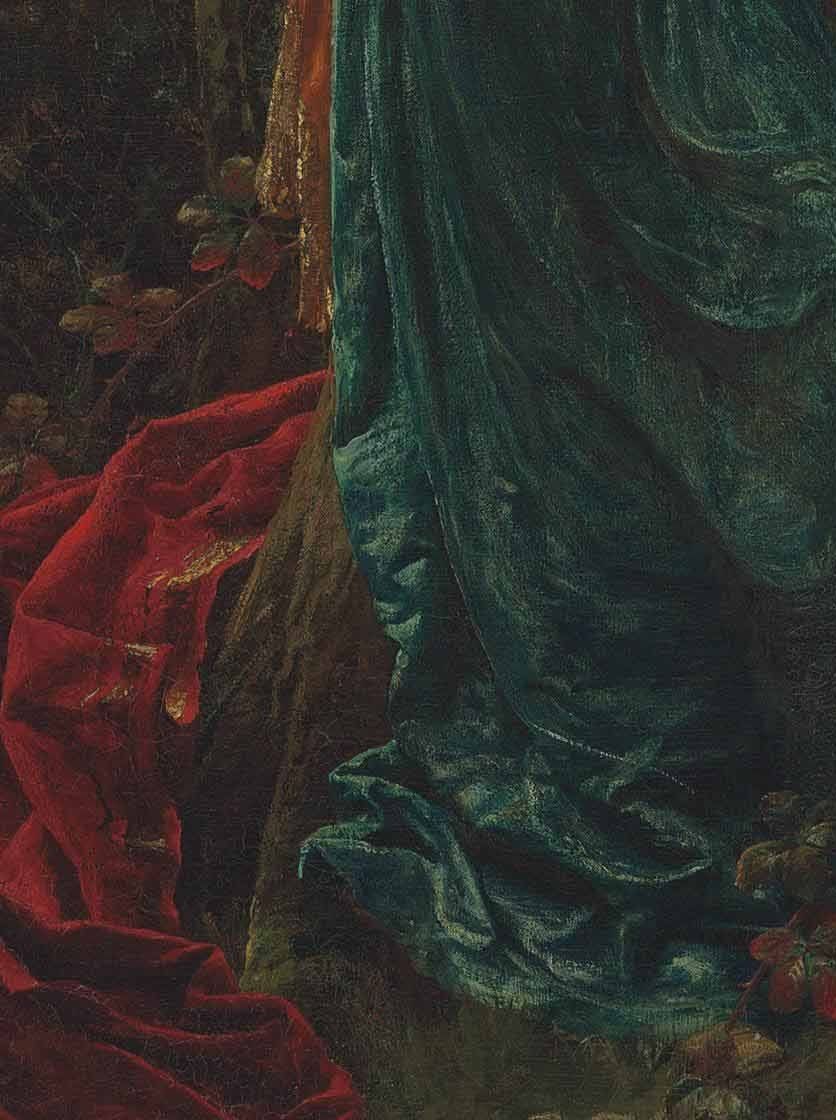
The woman occupies the lower right, where the trunk and her blue-green gown make a broad foreground shape. Her arms disappear behind the tree. A strip of white fabric shows at the displaced neckline, leaving one shoulder bare, and a reddish sash gathers the heavy cloth at her waist. Farther down, a red cloak spreads across the grass. The turn of her head takes the eye across the clearing to her rescuer. [1] [3]
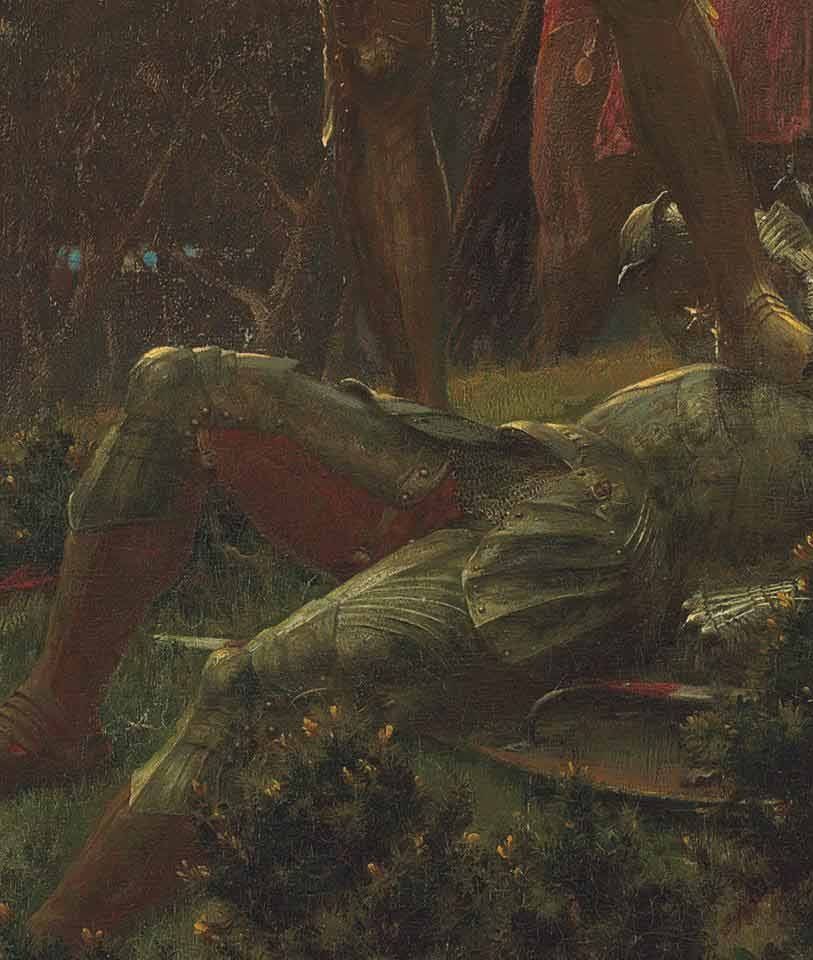
Across the clearing, the rescuer is bareheaded beside a horse with red trappings. His breastplate catches the evening light and the fine pattern of mail breaks up the metal surfaces below his waist. The plates on his shoulders and thighs take on the contour of his long, poised figure, while the fallen man’s suit bends awkwardly with his folded leg. The thin blade stands out against the yellow sky. Lower down, the red of the horse’s gear picks up the colour of the cloak on the grass. The person who physically dominates the scene is further away than the woman whose peril gives it a purpose. [1]
The opponent’s hand complicates the ending. The Art Gallery of New South Wales press release described him as slain, as did some Victorian critics. In the gallery’s audio tour, Richard Beresford drew attention to his raised hand at the victor’s foot and read the sheathing of the sword as mercy. The blade is still raised high, and the painting gives the viewer the gesture of putting it away before it gives any reassurance that the danger is fully past. Beresford’s reading makes the decision to end the fight the deed that earns the painting its title. [3] [4]
How Dicksee developed the scene
Christie’s records a small composition study in pencil, watercolour and opaque bodycolour, heightened with gum arabic and worked by scratching out. The catalogue gives the sheet as 33.6 × 25.1 cm. A later catalogue gives slightly different measurements, 33.3 × 25 cm, for the study with the same Maas Gallery provenance and identifies it as lot 82 in the 2003 Forbes sale. The Forbes sale listed the finished canvas separately as lot 35. On the sheet Dicksee could establish the relative height of the figures, the position of the tree and the distribution of broad shadow and sky at a scale familiar from illustration. On the much larger canvas he could make the figures’ surfaces and expressions do more of the storytelling. [1] [5] [6]
The composition may have a precedent in Dicksee’s own magazine work. Christie’s credits Amanda Kavanagh with tracing the design to an illustration for R. D. Blackmore’s Erema; or, My Father’s Sin. The January 1877 Cornhill Magazine opens with the print, captioned I Made All Haste to Get Away. In the accompanying instalment, Erema recoils from the man she calls Uncle Sam, who stands over a dead enemy and restrains his impulse to kick the body. Dicksee could carry that arrangement of threatened, upright and fallen figures from a modern novel into an imagined Middle Ages. In both versions the man in a position of power pauses over his fallen adversary. [1] [7]
Tintoretto’s Saint George and the Dragon offers another comparison. The National Gallery’s painting puts the princess near the viewer and George and the dragon further away. Christie’s draws attention to that kinship in design and to Dicksee’s admiration for Venetian painting, which he saw on his visit to Venice in 1882. In both pictures colour and lighting give the foreground figure an importance that the title alone might lead a viewer to assign to her rescuer. Tintoretto places the princess in flight with the encounter behind her. Dicksee keeps the woman at the tree and makes her turn back towards the action. Dicksee gives a familiar rescue scene depth while leaving its participants anonymous. [1] [8]
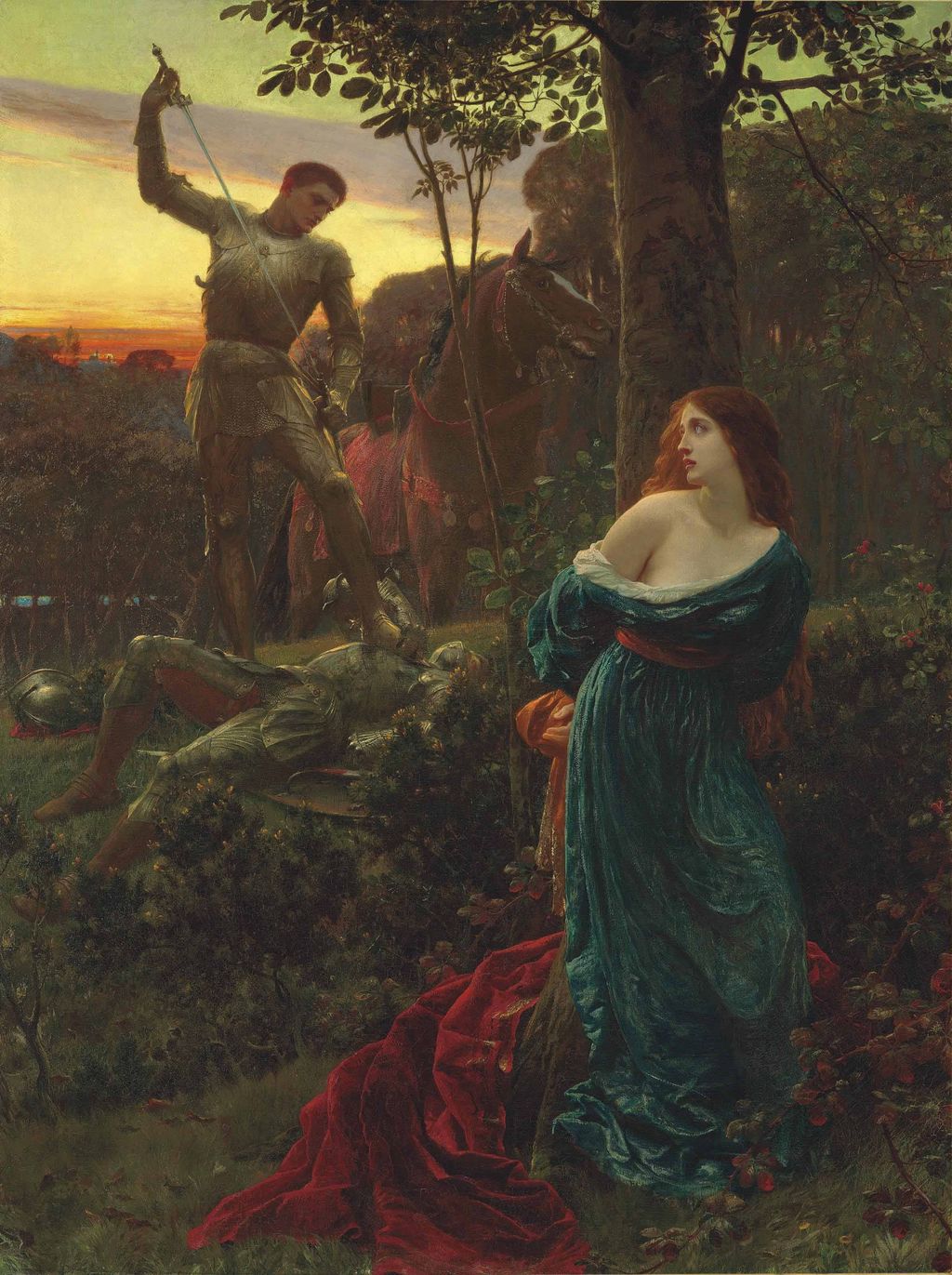
The signed Aird canvas, exhibited at the Royal Academy in 1885. Image source. Public domain.
Annotated Details from Chivalry
The numbered points identify visible features discussed in this article. Return from each detail to the numbered overview. An armoured knight and a bound woman look across a wooded scene. Image source. Public domain.
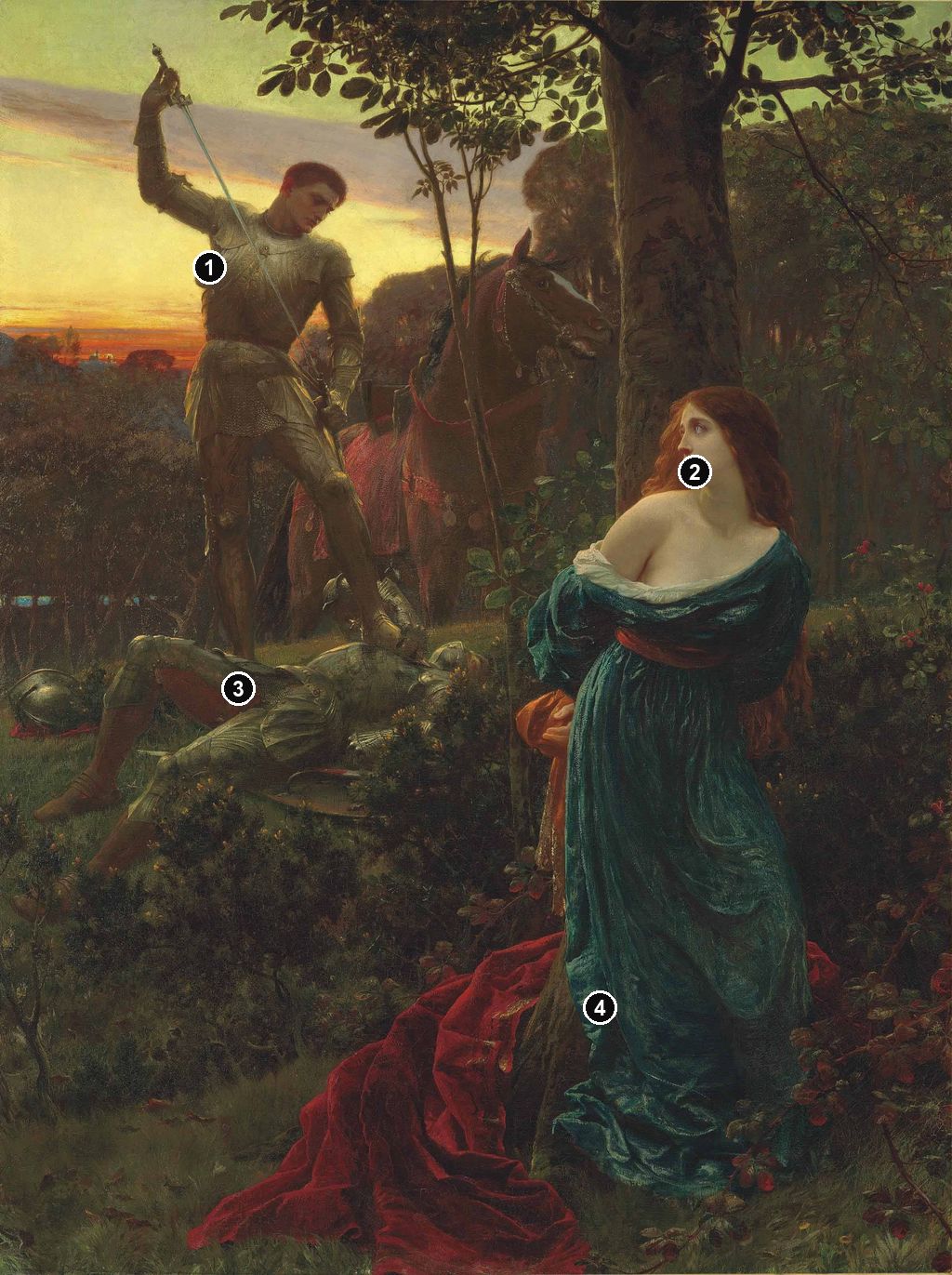
Details from CHIVALRY
Compare the cropped details with the source images above. Notice how their colours, shapes and positions contribute to the larger compositions.
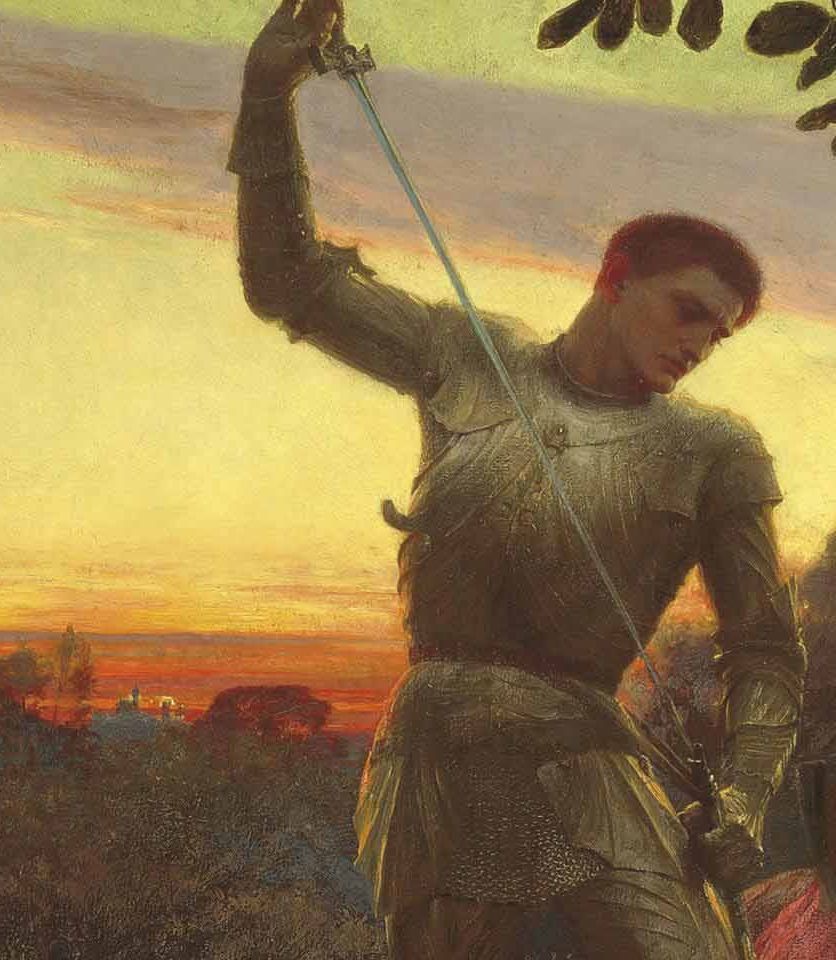
The raised arm
The knight raises his arm against the bright western sky. Small highlights trace the armour while the outline of his figure carries the action across the shadowed clearing.
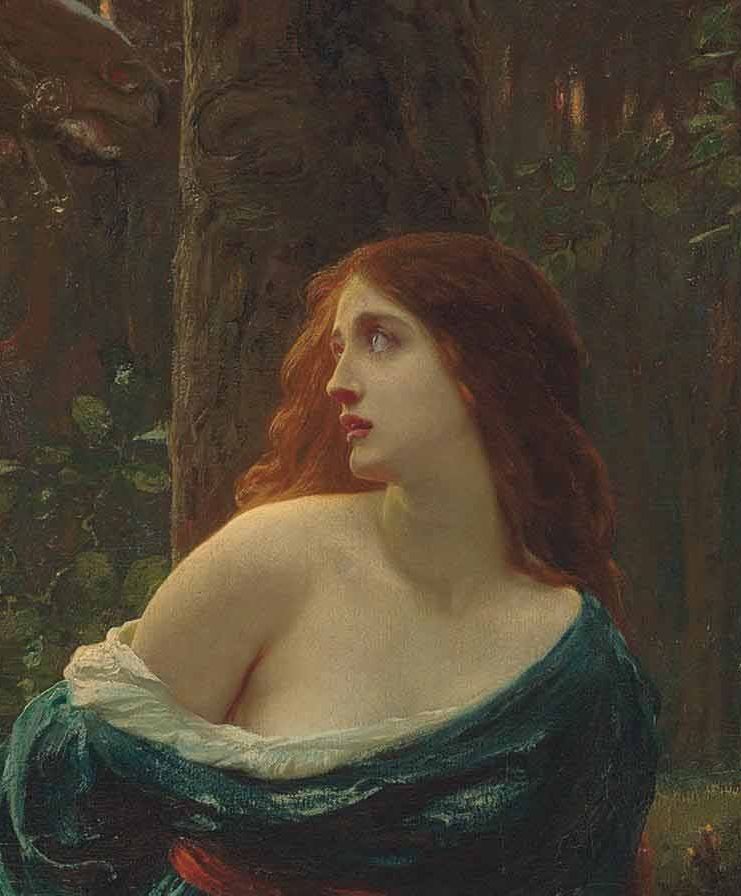
The woman’s turning head
Her face catches the light beneath the leaves. The direction of her gaze draws a line across the open foreground to the armoured figure.
The fallen figure
The defeated figure stretches diagonally through the lower part of the clearing. The low position sets him apart from the standing figures.
Dress and undergrowth
Dark teal and red folds pick up the colours of the wooded setting. Broad areas of cloth make the standing woman a prominent part of the picture even at a distance.
Armour and the Victorian idea of chivalry
In John Everett Millais’s The Knight Errant, exhibited in 1870, an armoured rescuer stands next to the tree and uses his sword to cut the bonds of a naked woman. Millais supplied a statement for the Academy catalogue about a knight’s duty to widows, orphans and women in distress. There is little space between sword, rope and body. The woman in the revised painting turns her face away. Dicksee leaves the bonds in place, dresses the captive and lets her look towards the rescuer while he attends to the outcome of the fight. The distance makes her gaze across the clearing the strongest connection between the two figures. [9] [10]
In her study of armour in nineteenth-century art, Judith Rauser treats Chivalry as an example of how painters could dress the endangered woman again after Millais’s conspicuously exposed nude and still imply the threat posed to her. The suggestion in Dicksee’s painting rests on the slipped neckline, the discarded cloak and the captive’s inability to move freely. Rauser also considers how the enclosing surfaces of armour in Millais give form to a Victorian expectation of male self-control. In Dicksee the figure’s firm outline and the space he keeps between himself and the captive lend that expectation a different visual form. His harness makes him capable of force, but his conduct is what distinguishes him from another man dressed for combat. [9]
The title gave an 1885 audience an idea to recognise without supplying a verse, a scene number or a character’s name. Victorian viewers encountered related virtues in settings as public as William Dyce’s Arthurian paintings for the Queen’s Robing Room at Westminster. There the stories of the Round Table gave recognisable characters and deeds to virtues such as mercy and courtesy. [11]
In Edmund Blair Leighton’s The Accolade of 1901, a woman in white presides over an indoor ceremony and holds the sword above the kneeling man’s shoulder. Witnesses flank the encounter. In Dicksee’s woodland the woman is prevented from acting, and the sword indicates what the victor will do with his power. Leighton gives the woman the decisive gesture and makes the sword an instrument of public honour. [1] [12]
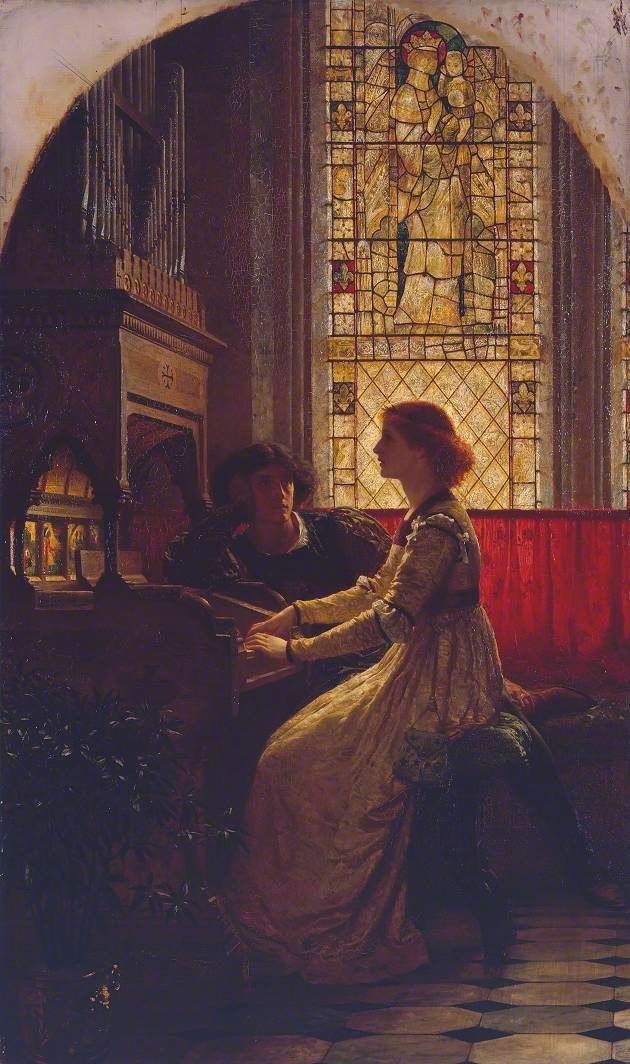
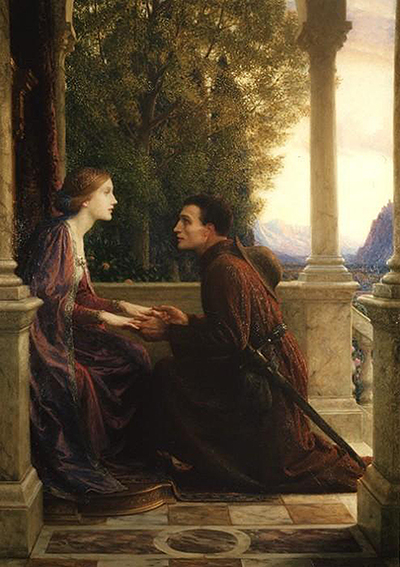
Dicksee himself returned to armoured romance in The End of the Quest, a 1921 painting in the collection at Leighton House. Christie’s places the two works in a line of development from the earlier Harmony, where coloured light is already a principal means of setting the emotional register. In the later work the knight kneels and takes the woman’s hand. The two figures occupy the same immediate space, the very intimacy that Chivalry holds in abeyance. Both pictures leave an encounter’s resolution open, one with a sword still in motion and the other with a touch. [1] [13]
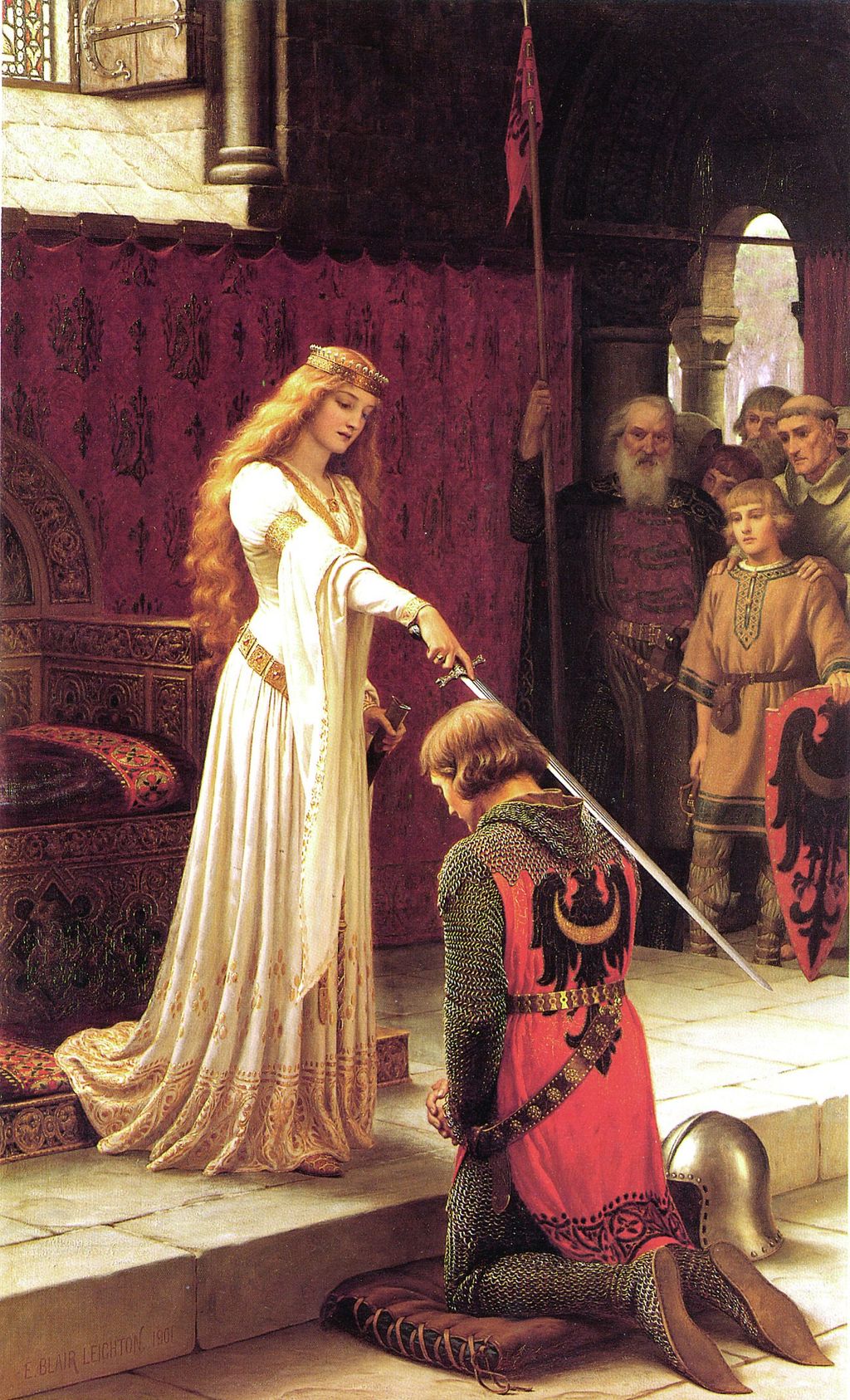
Edmund Blair Leighton, The Accolade, a later Victorian vision of knighthood. Image source. Public domain.
What the Academy critics saw
The first reception was mixed. The reviewer in The Portfolio found the design well conceived and the feeling unified, yet judged the colour unconvincing and the action implausible. The Spectator praised the brushwork and foliage before taking the knight’s unusually long sword and his effort to get it into the sheath as comedy. The sword stretches a small act to the scale of an Academy exhibit. A viewer could find suspense in that lingering movement or see it as an awkward pose. [14] [15]
Other reviewers were more receptive to the Venetian colour. The Art Journal welcomed the attempt to bring Venetian colour and a medieval sense of mystery into a modern painting, while finding more to hold its interest in a canvas by John Bagnold Burgess about contemporary Spanish life. Writing in The Magazine of Art in 1887, Sidney Hodges admired the warm evening light behind the knight and saw the rich colour as a return to qualities in Dicksee’s earlier work, even while he found the theme conventional. [16] [17]
From Aird’s collection to Sydney
John Aird, the contractor whose firm would later build the Aswan Dam, commissioned Chivalry in 1885. In 1891 J. F. Boyes saw the picture over the fireplace in Aird’s Hyde Park Terrace house. He reported that an early tortoiseshell frame had already been replaced and that the lower shadows still looked heavy in that position. The expanse of evening sky could read at a distance, while the fallen figure and his raised hand asked for good light. A. G. Temple still identified the picture as Aird’s in 1897. [1] [18] [19]
The painting was sold in London in 1935 and in New York in 1971, then shown as part of the Forbes collection. A 1982 exhibition at the Yale Center for British Art placed it among images of Victorian womanhood. It toured Japan in The Pre-Raphaelites and their Times in 1985 and appeared in a survey of British Victorian painting at Mexico’s Museo Nacional de San Carlos in 1997. The Yale and Japanese shows in particular offer two ways of approaching the same picture, through the role assigned to the captive and through the revival of medieval subjects by Victorian painters. [1]
The Art Gallery of New South Wales included the canvas in Victorian Visions: Nineteenth-Century Art from the John Schaeffer Collection from 20 May to 29 August 2010. The gallery’s object caption credits the Schaeffer Collection and gives the same date and dimensions as Christie’s. Christie’s records the Sydney exhibition as a loan. The painting sold in London in December 2012. [1] [2] [4]
Frank Dicksee artworks directory
Browse documented paintings, studies, illustration designs and prints. Where an article is available, the title opens it. Simon Toll’s catalogue
| Name | Date | Medium |
|---|---|---|
| A Love Story | 1882 | Painting |
| A Reverie | 1895 | Painting |
| An Offering | 1898 | Painting |
| Chivalry | 1885 | Painting |
| Dawn | 1897 | Painting |
| Elijah Confronting Ahab and Jezebel in Naboth’s Vineyard | By 1875 | Painting |
| Harmony | 1877 | Painting |
| Harmony, etching by Charles-Albert Waltner after Dicksee | 1880 | |
| Harmony, the smaller Towneley version | Late 1870s | Painting |
| Hesperia | 1887 | Painting |
| Hesperia, watercolour version | Late 1880s | Painting |
| Italian Coast from La Mortola | 1925 | Painting |
| La Belle Dame sans Merci | c. 1901 | Painting |
| Memories | 1886 | Painting |
| Paolo and Francesca | 1894 | Painting |
| Portrait of Camille Sutton Palmer | 1914 | Painting |
| Portrait of Elsa | 1927 | Painting |
| Portrait of the Duchess of Buckingham and Chandos | 1901 | Painting |
| Romeo and Juliet | 1884 | Painting |
| Romeo and Juliet, monochrome design on joined wood | c. 1880s | Painting |
| Sir Edmund William Gosse, collotype after Dicksee | 1912 | |
| Startled | 1892 | Painting |
| Study for Startled | Early 1890s | Drawing |
| The Confession | 1896 | Painting |
| The Crisis | 1891 | Painting |
| The Daughters of Eve | 1925 | Painting |
| The Embarkation | 1879 | Painting |
| The End of the Quest | 1921 | Painting |
| The Funeral of a Viking | 1893 | Painting |
| The House Builders | 1880 | Painting |
| The Magic Crystal | 1894 | Painting |
| The Passing of Arthur | 1889 | Painting |
| The Redemption of Tannhäuser | 1890 | Painting |
| The Symbol | 1881 | Painting |
| The Two Crowns | 1900 | Painting |
| Yseult | 1901 | Painting |
Discussion
Look again at the images and ideas explored in Chivalry. These editorial prompts invite your observations.
Reader Insights
Does the fallen knight’s gesture change how you understand the sword being put away?
What changes if you begin with her face, then work back through the painting to piece together the fight?
Join the Conversation
Which detail makes the interval between victory and rescue most vivid for you?
References
- Christie’s, Chivalry, 13 December 2012, lot 11, object, provenance, exhibitions and catalogue essay. View source.
- Art Gallery of New South Wales, Victorian Visions audio tour, object no. 10, credit and dimensions. View source.
- Richard Beresford, Art Gallery of New South Wales, Victorian Visions audio tour transcript, no. 10, Chivalry. View source.
- Art Gallery of New South Wales, Victorian Visions, exhibition announcement and dates. View source.
- Christie’s, Composition Study for ‘Chivalry’, Forbes Collection, lot 82. View source.
- Christie’s, Composition Study for ‘Chivalry’, later record, lot 282. View source.
- R. D. Blackmore and Frank Dicksee, Erema; or, My Father’s Sin, The Cornhill Magazine, January 1877, frontispiece and chapter XIII, ‘The Sawyer’s Prayer’. View source.
- Nicholas Penny, National Gallery, Jacopo Tintoretto, Saint George and the Dragon, NG16, catalogue entry. View source.
- Judith Rauser, Körper in Eisen, University of Hamburg, 2017, pp. 149–154 and fig. 51. View source.
- John Guille Millais, The Life and Letters of Sir John Everett Millais, vol. I, 1899, p. 225. View source.
- UK Parliament, ‘Works of art in the Palace’, William Dyce’s Robing Room paintings. View source.
- Christie’s, Edmund Blair Leighton, God Speed, comparative discussion of The Accolade, fig. 2. View source.
- Leighton House Museum, collection photograph of The End of the Quest, LH0060, via Art UK and Wikimedia Commons. View source.
- The Portfolio, ‘Art Chronicle’, vol. XVI, 1885, pp. 124–125, Smithsonian Libraries scan. View source.
- The Spectator, ‘Art. The Royal Academy’, 13 June 1885, pp. 784–785. View source.
- The Art Journal, ‘The Royal Academy Exhibition III – Figure Painters’, 1885, pp. 257–258. View source.
- Sidney Hodges, ‘Frank Dicksee, A.R.A.’, The Magazine of Art, vol. X, 1887, p. 219. View source.
- J. F. Boyes, ‘The Private Art Collections of London: Mr. John Aird’s, in Hyde Park Terrace’, The Art Journal, 1891, pp. 138–139. View source.
- A. G. Temple, The Art of Painting in the Queen’s Reign, 1897, p. 206. View source.