 by Tom Gurney
Tom Gurney BSc (Hons) is an art history expert with over 20 years experience
Published on June 19, 2020 / Updated on November 25, 2026
Email: tomgurney1@gmail.com / Phone: +44 7429 011000
Frank Dicksee’s Biography: Introduction
In 1872 Frank Dicksee won a silver medal for drawing from the antique at the Royal Academy Schools. In December 1925 he stood before the students at Burlington House to hand out their prizes. He urged them to study the Old Masters, a practice that had helped shape his own career. In the years between, pictures such as Harmony and The Two Crowns had made him famous well beyond the Academy. His life shows how a Victorian painter built a public through exhibitions, illustrated books and reproductions, and what happened when he came to lead an institution whose authority he had felt since childhood. [1] [2] [3] [4]
At a Glance
- Full nameSir Francis Bernard Dicksee, known professionally as Frank Dicksee. [5]
- Lifetime27 November 1853 to 17 October 1928. Born in London. [1]
- TrainingFirst taught by his father, Thomas Francis Dicksee. The Royal Academy records his studentship from 23 January 1871. [1] [2]
- BreakthroughHarmony, exhibited in 1877 and purchased under the Chantrey Bequest. [2] [6]
- Royal AcademyAssociate in 1881, full Academician in 1891 and president from 1924 until his death. [1]
Frank Dicksee in context
Victorian Britain
1837–1901Pre-Raphaelite Brotherhood
1848–1853Edwardian Britain
1901–1910John Everett Millais
1829–1896Frederic Leighton
1830–1896Henry Holiday
1839–1927John William Waterhouse
1849–1917Harmony
1877Romeo and Juliet
1884Chivalry
1885Startled
1892The Two Crowns
1900Contents
- A family of artists and the Royal Academy Schools
- Harmony and the audiences he found in the 1870s and 1880s
- Full membership and the studio in the 1890s
- Public acquisitions, private portraits and later work
- President of the Royal Academy, 1924 to 1928
- Death and the changing reputation of his work
A family of artists and the Royal Academy Schools
Dicksee told the writer Mary Angela Dickens that his earliest memory was of his father’s studio. He had drawn so much as a boy, he recalled, that he had got through much of the drudgery of learning before he recognised it as such. The drawing that gained him admission to the Royal Academy Schools was made in that same studio when he was seventeen. His father, Thomas Francis Dicksee, painted portraits and Shakespearean subjects. Thomas’s Ophelia, now in Bilbao, offers an example of what Frank could learn at home. His father gave a character the viewer knew from a play a face and bearing that could sustain attention on their own. [2] [7] [8]
His younger sister Margaret Isabel Dicksee chose episodes from the lives of artists for her own paintings. She exhibited Miss Angel at the Academy in 1892, imagining the painter Angelica Kauffmann visiting Joshua Reynolds’s studio. Frank’s uncle John Robert Dicksee also exhibited at the Academy. John’s son Herbert, Frank’s cousin, became known for his animal subjects and etchings. The family gives a sense of the choices open to artists who shared a surname, an exhibition venue and some of the same professional connections. Margaret made painters and musicians the subjects of her historical scenes, while Herbert developed a reputation for observing animals and carrying those observations onto the printing plate. [7] [9] [10] [11]
The Academy records Frank as a student from 23 January 1871. The National Gallery of Victoria dates his attendance from 1870 to 1875. The interview with Dickens puts the admission drawing at age seventeen, which he reached in late November 1870. January 1871 is the Academy’s documented date for his studentship. At the Schools he won the 1872 silver medal for a drawing from the antique. Three years later the gold medal went to his painting Elijah Confronting Ahab and Jezebel in Naboth’s Vineyard. The prize was awarded in 1875, and the painting was exhibited at the Academy in 1876, his debut there. The medals rewarded different skills, from studying the forms of classical sculpture to organising figures in a story. [1] [2] [8] [12]
The Schools were one part of a busy apprenticeship. In the early 1870s Dicksee joined the Langham Sketching Club, where he could develop his life drawing. Dickens records Dicksee working on decorative designs and stained-glass cartoons with Henry Holiday on alternate days, taking illustration work and drawing from his own models after evening classes. A stained-glass cartoon is a working design for the pieces that will make up a window. It calls for decisions about where a contour falls and how the figure will read once coloured light passes through it. The practice gave Dicksee a way to think about detailed surfaces at the same time as he was learning to draw the human body. [8] [13]
Four stages of Frank Dicksee’s career
Training, exhibiting, portrait commissions and illustration overlapped during Dicksee’s career.
Learning in the studio and at the Academy
Dicksee began in his father’s studio, trained at the Royal Academy Schools and prepared designs for stained glass. [8]
From Harmony to the literary pictures
Harmony brought national attention. The expanding practice encompassed illustration, portraits and subject painting. [5]
Harmony and the audiences he found in the 1870s and 1880s
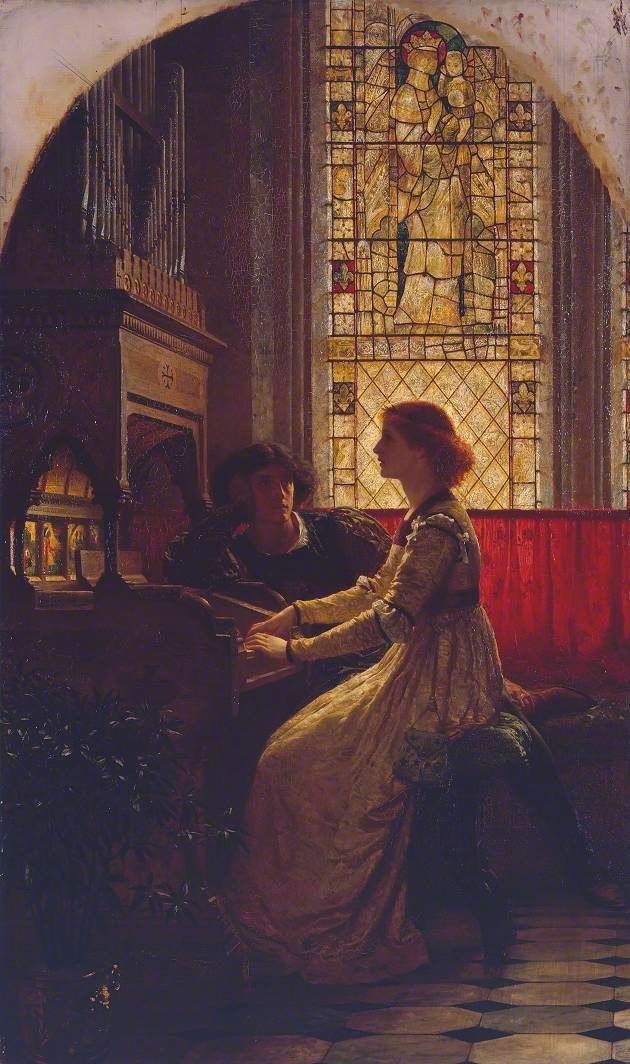
Dicksee was twenty-three when he exhibited Harmony in 1877. A woman plays an organ in a medieval interior while a young man watches her. The figures are close, but their attention is directed differently. The stained glass and the organ give the small room much of its character. Dicksee drew on a window at St Mary’s in Westwell, Kent, for the painted glass. The Academy’s Council bought the painting under the Chantrey Bequest for £367 10s. Success at Burlington House immediately gave him a place in a national collection. [2] [5] [6] [10]
A second audience encountered the design in print. The Metropolitan Museum of Art holds a proof of Charles-Albert Waltner’s 1880 etching after Dicksee’s composition, published by Thomas Agnew & Sons. The proof lets us see how a printmaker translated the painting’s differences of texture and light into marks that could be reproduced. The painted glass or richly worked fabric survives as a pattern of dark and light on paper. The picture could thus circulate under Dicksee’s name through someone else’s skilled work on the plate. [2] [6]
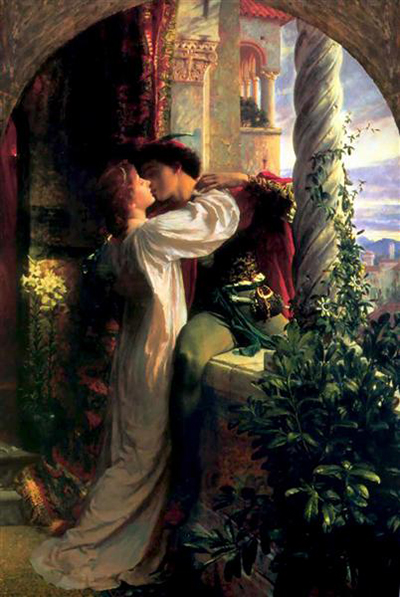
In other projects Dicksee supplied the illustrations himself. His work for Cassell included Longfellow’s Evangeline and Shakespeare’s plays. In her studio profile, Dickens recalls that a design made for the Longfellow illustrations was developed into a painting. The exchange could go either way. A painting could be reproduced for a print buyer, and a design made for a reader could grow into an exhibition picture. The 1884 oil Romeo and Juliet shows what Dicksee did with a moment he could count on many of his viewers to recognise. The lovers’ movement towards one another takes place across a balcony that Romeo must leave. As Romeo prepares to descend, his body tilts back towards Juliet. The long embrace and the precarious footing give the scene its urgency. [8] [14] [15]
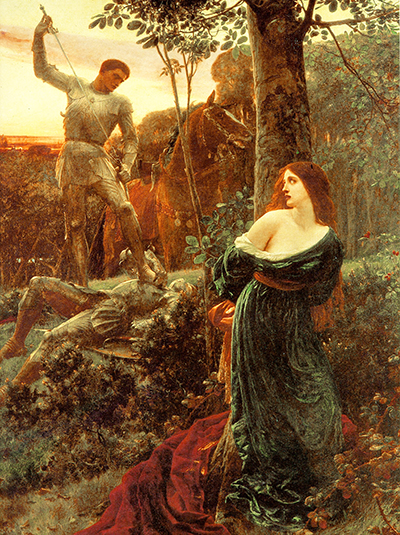
Dicksee was elected an Associate on 20 January 1881, at twenty-seven. The National Gallery of Victoria describes him as the youngest member at the time. He was also developing relationships with private buyers. The engineer and contractor John Aird commissioned Chivalry, which Dicksee showed in 1885. Its mounted knight intervenes in a violent encounter and gives the exhibition audience a whole drama to reconstruct from a single instant. An earlier double portrait, The House Builders, exhibited in 1880, shows Sir William and Lady Welby-Gregory looking over the designs for Denton Manor. The couple’s positions around the plans make the act of looking and making decisions the subject of their portrait. An artist whose public identity was taking shape around romance could also represent the very particular interests of his sitters. [1] [12] [14] [16]
Full membership and the studio in the 1890s
By the mid-1880s Dicksee was living in an artist’s house on Peel Street, Campden Hill. Photographs helped convey the identity of a painter whose works already reached the public in reproduction. A photogravure after Joseph Parkin Mayall’s photograph of Dicksee was published in 1884. Another portrait, by Ralph Winwood Robinson in 1889, shows him at the Peel Street house. The young exhibitor had become a person readers and collectors might recognise, and the surroundings in which he worked had begun to attract interest of their own. [5] [17]
The 1891 Academy exhibition gave Dicksee several opportunities to show the range of his work. He sent The Mountain of the Winds, drawings for Othello and a modern drama called The Crisis. A visitor leans over a woman on a bed in the latter canvas. The situation is urgent and the outcome is withheld. That year Luke Fildes exhibited The Doctor, a more explicit account of what happens in a sickroom. The paintings drew different kinds of attention. Hubert von Herkomer, advising the National Gallery of Victoria, saw emotional conviction in Dicksee’s treatment and arranged for it to be bought directly from the exhibition. His decision sent a London exhibition picture to Melbourne in the year it was painted. Dicksee was elected a full Academician on 23 June while the exhibition was still open. [1] [12]
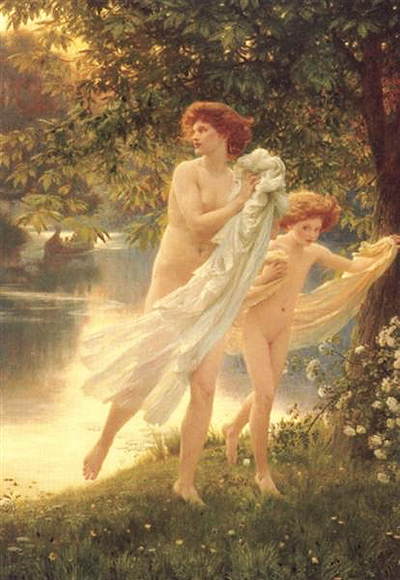
Dicksee marked his election with the diploma painting Startled, shown in 1892. The Academy also preserves a preparatory study. The exhibition publication Royal Academy Pictures described the two figures at the river as surprised by an approaching boat and praised the handling of the light and colour. It is easy to see why those details held a Victorian reviewer’s attention. The elder figure’s hair catches the light against the leaves, and the child turns with her, hand in hand. Because the Academy kept the picture, later curators could put the same canvas before visitors and ask different questions about the ideal of beauty it presents. [1] [18] [19]
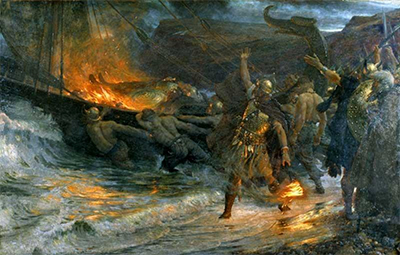
When Mary Angela Dickens profiled Dicksee in The Windsor Magazine, she described the studio as both a backdrop and a workshop. She noticed the quiet colour of the room and the gleam of a full suit of armour. The armchairs were there for visitors and for a painter taking a break from work. In the same profile she told how he tried to find the view over water that he needed for The Funeral of a Viking. A bathing machine and then a plank proved unsatisfactory. The episode gives a measure of the physical problems behind a picture that invites the viewer to imagine a remote past. Dicksee could construct a scene with costumes and furniture indoors, but he also wanted his setting to feel like water, sky and distance observed for himself. [8]
That range was visible when he exhibited Paolo and Francesca, A Reverie and two North Devon coast scenes at the Academy in 1895. The annual exhibition brought pictures of very different kinds into the same public room. Readers of the illustrated profiles, meanwhile, saw selected reproductions and descriptions of the artist at work. Those accounts helped establish the public image of a patient artist with materials close at hand and stories ready to be put into paint. [2] [8]
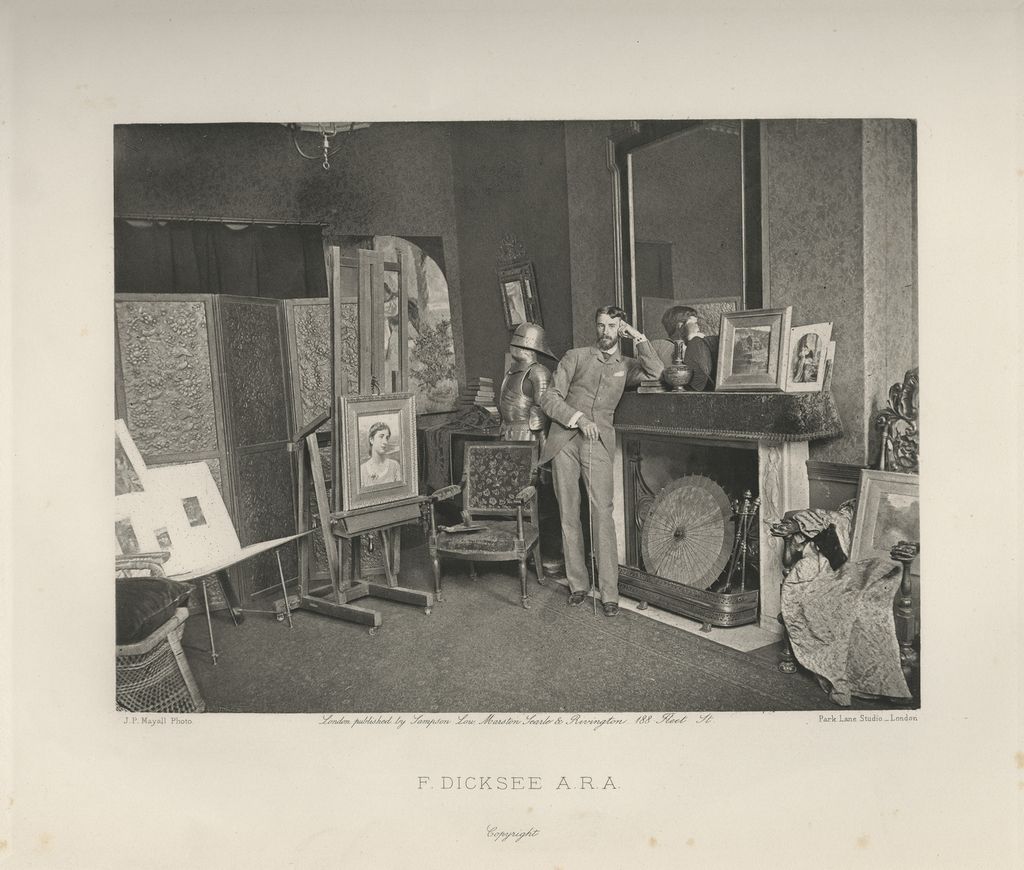
Studio portrait of Frank Dicksee by Joseph Parkin Mayall. Image source. Public domain.
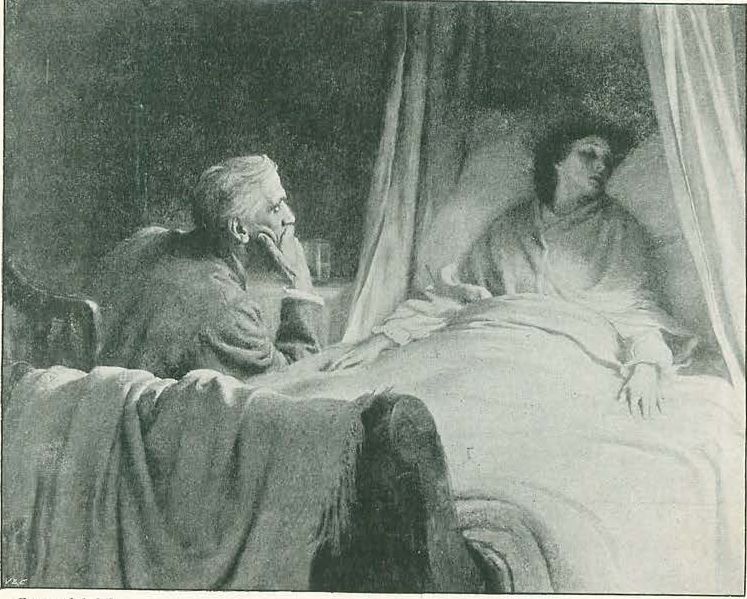
The Crisis as reproduced from a photograph credited to Dixon in The Windsor Magazine, vol. 5, p. 389. A photograph credited to Dixon after Frank Dicksee, The Crisis. The Windsor Magazine, 1897, p. 389. Image source. Public domain.
Public acquisitions, private portraits and later work
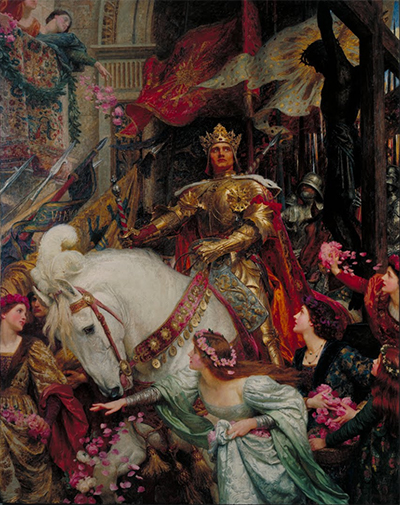
In 1900 The Two Crowns became Dicksee’s second major success under the Chantrey Bequest. Tate records that it was bought from the Academy exhibition for £2,000. Dicksee invented the encounter between a magnificently dressed ruler and the image of Christ wearing a crown of thorns. The crowd and procession advertise the king’s standing, while his attention moves away from them. The commission-driven specificity of The House Builders had given objects a role in explaining who the people were. Here precious materials and emblems invite the viewer to weigh the kind of power those objects represent. In the same year, a survey of British painting published for the Paris Exposition called many of his works ordinary but admired the unexpected grace and colour of Dawn, a figure on a hill veiled in rosy drapery. Praise and reservation could sit in the same account even at the height of his success. [4] [16] [20]
Portraiture occupied a larger place in public accounts of Dicksee’s later career. The London correspondent reporting his election as president named Lady Aird, the Duchess of Buckingham and Chandos and the Duchess of Westminster as memorable sitters. The same report tells of parents who asked him to paint their daughter after her death. Dicksee described working from photographs and meeting the parents’ wish for a happy likeness. The anecdote shows how a portrait patron might ask for something quite different from what an exhibition visitor expected of a historical picture. The painter still had to assemble expression, colour and setting into a convincing presence, but the commission answered a family’s very particular memory. [21]
Dicksee’s Portrait of Lady Hillingdon is a signed work of 1905, commissioned by the sitter and her husband and exhibited at the Academy that year. Sotheby’s records that Lady Hillingdon sat in his Greville Place studio in St John’s Wood. Dicksee could arrange the furnishings and light of a formal portrait in his own studio, just as he arranged the settings for his historical canvases. The sitter’s expression and the handling of her dress mattered more than an exact record of rooms in which she lived. The catalogue also cites the 1905 Art Annual profile, whose author had already noticed how much of Dicksee’s exhibited work was turning to portraiture. [22]
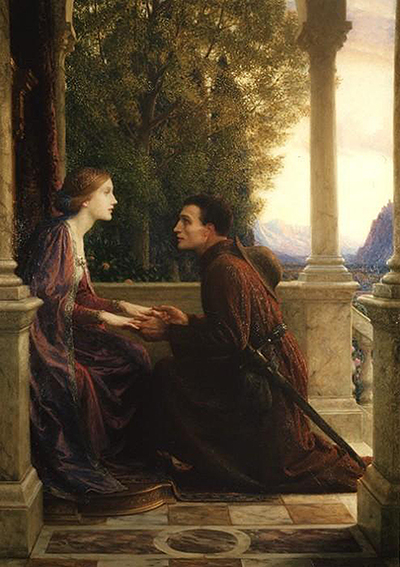
Painting in costume continued alongside the portraits. The End of the Quest, exhibited in 1921, returns to courtly love. A chalk study of hands in the Academy collection provides a small record of the work behind the scene. Dicksee was also exhibiting landscapes. An oil signed and dated 1925, Italian Coast from La Mortola, was shown at that year’s Academy, passed from Frank to Herbert and Ella Dicksee, and appeared at the Academy’s 1933 commemorative exhibition. The painting’s history connects the landscape painter, the family and the institution through a single object. [1] [14] [23] [24]
President of the Royal Academy, 1924 to 1928
Dicksee was seventy-one when he succeeded the architect Sir Aston Webb. A cable dated 11 December 1924 was already reporting the election. The fuller account in the Otago Daily Times of 27 January 1925 came from a London dispatch dated 16 December. The two dates show how a London election reached the New Zealand press first by cable and then in a fuller account of the man and his work. His knighthood was announced in the 1925 New Year honours. He became an honorary member of the Royal Scottish Academy that year, and in June 1927 he was appointed Knight Commander of the Royal Victorian Order. [1] [21] [25] [26] [27] [28]
The December 1924 interview gives a sense of the authority Dicksee thought the Academy should exercise. He said it ought to guide public taste and recalled having pressed for women students to be given opportunities to study from life, including the nude. The wider campaign lasted decades. Women students pressed for the same training their male peers received, and in 1893 the Academy provided a life class for women, with restrictions on how much male models could reveal. A photograph published in 1925 shows students working from a female model in the women’s Large Life Room. Dicksee’s interview gives his own account of a change that mattered to generations of students. [21] [29] [30]
Dicksee’s address to the Schools at the prize distribution of 10 December 1925 gives a dated instance of that restriction. The report in The Architects’ Journal records his advice to study Old Masters. In the printed discourse, as transcribed by Vassil Yordanov, Dicksee also insisted on white European standards as the ideal of beauty and invoked imperial rhetoric to defend them. He reiterated racial prejudice in his public criticism of modern art at the Schools’ 1927 prize-giving, as documented in the Academy’s exhibition history. In 2024 the Academy included Startled in Entangled Pasts, where curators read its pale figures and the longship in the background in relation to racial ideals of the classical body. That is a modern interpretation of an 1892 painting. The 1925 and 1927 statements supply direct evidence of the views that Dicksee chose to express as president. [3] [19] [31] [32]
During his presidency the Academy also became the venue for a major exhibition of Flemish and Belgian art. Historian Ulrich Tiedau traces how Dicksee helped persuade the Council to make the galleries available to the Anglo-Belgian Union after earlier proposals had foundered. The exhibition opened at Burlington House in 1927 and brought together works across six centuries. At the same time, the Academy’s stewardship of the Chantrey Bequest was generating friction with the Tate over proposed purchases of modern work. The Bequest made no purchases in 1927 or 1928. The scheme that had established Dicksee’s public reputation as a young painter had become a point of disagreement over how institutions should represent newer British art. [33] [34] [35]
Death and the changing reputation of his work
A letter published in The Times after Dicksee’s death recalled a task he took on in his final year. Winifred Holiday wrote that after her father Henry died, Dicksee found room in his studio for Henry’s tinted statue Sleep, arranged for it to be cleaned and restored colour where the cleaning had removed it. The former apprentice still had a personal interest in the work of a teacher whose practice had been so different from the drawing exercises of the Academy Schools. [18]
Dicksee died on 17 October 1928. The Academy arranged for the first part of his funeral to take place at Westminster Abbey on 23 October, with burial afterwards at Hampstead Cemetery in Fortune Green. The Times recorded that the King and Prince of Wales were represented at the Abbey. The ceremony had the public standing of a service for the serving president of a national institution. Shortly after his election the New Zealand report had looked back on his romantic paintings as an earlier phase of his career and remarked on how widely reproductions of Evangeline had reached. [1] [18] [21]
The Academy’s 1933 commemorative exhibition showed the Italian landscape as well as The House Builders. In 1985 Chivalry toured Japan in an exhibition on the Pre-Raphaelites, and in 1997 the same painting appeared in a survey of Victorian British painting at Mexico City’s Museo Nacional de San Carlos. Simon Toll’s 2016 book brought together a catalogue of Dicksee’s work and a study of his life. More recent exhibitions have put individual pictures into different histories. The 2024 exhibition in Forlì placed his 1884 Romeo and Juliet within the legacy of Pre-Raphaelitism and explored the movement’s relationship with Italian art. The Academy’s reassessment of Startled that same year took its own collection as a starting point for a discussion of race and empire. He was born after the original Pre-Raphaelite Brotherhood was founded and trained for a life at the Academy. He gave older stories such specific bodies, fabrics and places that people wanted to live with their reproductions. The institution that rewarded his abilities also entrusted him with a public platform from which he defended an explicit racial hierarchy of beauty. The records of how the paintings were made, bought and shown help explain both their appeal and the authority Dicksee came to exercise. [1] [14] [15] [16] [19] [23] [31] [36] [37] [38]
Frank Dicksee artworks directory
Browse documented paintings, studies, illustration designs and prints. Where an article is available, the title opens it. Simon Toll’s catalogue
| Name | Date | Medium |
|---|---|---|
| A Love Story | 1882 | Painting |
| A Reverie | 1895 | Painting |
| An Offering | 1898 | Painting |
| Chivalry | 1885 | Painting |
| Dawn | 1897 | Painting |
| Elijah Confronting Ahab and Jezebel in Naboth’s Vineyard | By 1875 | Painting |
| Harmony | 1877 | Painting |
| Harmony, etching by Charles-Albert Waltner after Dicksee | 1880 | |
| Harmony, the smaller Towneley version | Late 1870s | Painting |
| Hesperia | 1887 | Painting |
| Hesperia, watercolour version | Late 1880s | Painting |
| Italian Coast from La Mortola | 1925 | Painting |
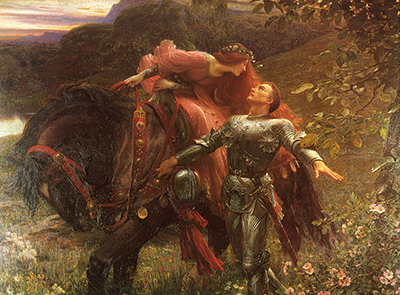
| La Belle Dame sans Merci | c. 1901 | Painting |
| Memories | 1886 | Painting |
| Paolo and Francesca | 1894 | Painting |
| Portrait of Camille Sutton Palmer | 1914 | Painting |
| Portrait of Elsa | 1927 | Painting |
| Portrait of the Duchess of Buckingham and Chandos | 1901 | Painting |
| Romeo and Juliet | 1884 | Painting |
| Romeo and Juliet, monochrome design on joined wood | c. 1880s | Painting |
| Sir Edmund William Gosse, collotype after Dicksee | 1912 | |
| Startled | 1892 | Painting |
| Study for Startled | Early 1890s | Drawing |
| The Confession | 1896 | Painting |
| The Crisis | 1891 | Painting |
| The Daughters of Eve | 1925 | Painting |
| The Embarkation | 1879 | Painting |
| The End of the Quest | 1921 | Painting |
| The Funeral of a Viking | 1893 | Painting |
| The House Builders | 1880 | Painting |
| The Magic Crystal | 1894 | Painting |
| The Passing of Arthur | 1889 | Painting |
| The Redemption of Tannhäuser | 1890 | Painting |
| The Symbol | 1881 | Painting |
| The Two Crowns | 1900 | Painting |
| Yseult | 1901 | Painting |
Discussion
Look again at the images and ideas explored in Frank Dicksee’s Biography. These editorial prompts invite your observations.
Reader Insights
Where can you see the habits of a stained-glass designer in Harmony or a later painting?
What might have changed when Harmony moved from an Academy exhibition to a print that someone could live with at home?
What do the reviews of Startled in 1892 and its exhibition in 2024 ask you to notice?
Join the Conversation
Which episode in Dicksee’s working life changed how you look at one of his paintings? Share the work and the detail that caught your attention.
References
- Royal Academy of Arts, Sir Frank Dicksee PRA (1853–1928), profile and collection register. View source.
- Cassell’s Universal Portrait Gallery, “Mr. Frank Dicksee, R.A.”, p. 346. View source.
- The Architects’ Journal, “Royal Academy Schools Prize Distribution”, 23 December 1925, p. 937. View source.
- Tate Britain, The Two Crowns, 1900, N01839, collection text published by Tate on Google Arts & Culture. View source.
- National Portrait Gallery, Frank Dicksee, MP15212, artist and sitter profile. View source.
- The Metropolitan Museum of Art, Charles-Albert Waltner after Frank Dicksee, Harmony, 1880, etching proof, 46.140.7. View source.
- Museo de Bellas Artes de Bilbao, Thomas Francis Dicksee, Ofelia, c. 1864, object and artist record. View source.
- Mary Angela Dickens, “A Popular Painter: Mr. Frank Dicksee, R.A.”, The Windsor Magazine, vol. 5 (December 1896–May 1897), pp. 385–391. View source.
- Christie’s, Margaret Isabel Dicksee, Miss Angel, signed and dated 1892, lot 1009906. View source.
- Algernon Graves, The Royal Academy of Arts: A Complete Dictionary of Contributors and Their Work, vol. 2, entries for the Dicksee family. View source.
- Nicholas Price Fine Art, Herbert Dicksee: Big Cats, introduction and catalogue, on the Dicksee family and Herbert’s etching practice. View source.
- Ted Gott and the National Gallery of Victoria, The Crisis, 1891, P.396.2-1, collection entry, accession history and curatorial essay. View source.
- Dennis T. Lanigan, Sir Frank Dicksee, 1853–1928, on the Langham Sketching Club, training and studio chronology. View source.
- Christie’s, Frank Dicksee, Chivalry, 1885, lot 5631457, provenance, exhibitions and career note. View source.
- Southampton City Art Gallery, Frank Dicksee, Romeo and Juliet, 1884, SOTAG 1006. View source.
- Christie’s, Frank Dicksee, The House Builders, signed and inscribed 1880, lot 5631467. View source.
- National Portrait Gallery, Ralph Winwood Robinson, Frank Dicksee, 1889, published 1892, NPG x7361, note on the Campden Hill house. View source.
- Paul Ripley, The Obituary of Frank Dicksee, including extracts from Royal Academy Pictures (1892) and The Times (19, 20 and 24 October 1928). View source.
- Royal Academy of Arts, Entangled Pasts, 1768–now: Art, Colonialism and Change, 2024 exhibition guide, Startled gallery text. View source.
- Exposition universelle, 1900: The Chefs-d’œuvre, “Great Britain”, p. 89, on Dicksee and Dawn. View source.
- Otago Daily Times, “The Royal Academy”, 27 January 1925, p. 4, London dispatch dated 16 December. View source.
- Sotheby’s, Frank Dicksee, Portrait of Lady Hillingdon, signed and dated 1905, lot 27, London, 2015, signed object, provenance and catalogue note. View source.
- Bellmans, Frank Dicksee, Italian Coast from La Mortola, signed and dated 1925, 28 March 2024 sale, lot 1352. View source.
- Royal Academy of Arts, Study of hands for The End of the Quest, c. 1921, 09/2073. View source.
- Otago Witness, “News by Cable”, 16 December 1924, Royal Academy item datelined London, 11 December. View source.
- The Edinburgh Gazette, New Year honours list, 2 January 1925, p. 2. View source.
- The London Gazette, Royal Victorian Order, birthday honours supplement, 3 June 1927, p. 3608. View source.
- Royal Scottish Academy, Sir Frank Bernard Dicksee KCVO PRA HRSA, record of honorary membership in 1925. View source.
- Royal Academy of Arts, archival photograph of students in the women’s Large Life Room with exhibition text on access to life drawing. View source.
- Annette Wickham, “A Mainly Female Studentship”, British Art Network, January 2022, on life classes at the Academy, with Winifred Broughton Edge’s 1917 drawing. View source.
- Vassil Yordanov, University of East Anglia MPhil thesis, pp. 68–69 and n. 142, transcription from Dicksee’s Discourse to the Students of the Royal Academy on the Distribution of the Prizes (1925), p. 13. View source.
- Tim Barringer, “1927: Dod Procter’s Morning”, The Royal Academy of Arts Summer Exhibition: A Chronicle, Paul Mellon Centre, 2018, citing The Times, 12 December 1927, p. 19. View source.
- Ulrich Tiedau, “Dutch and Belgian Artistic and Intellectual Rivalry in Interwar London”, Canadian Journal of Netherlandic Studies, 40.1 (2021), p. 9, on the Anglo-Belgian Union and the 1927 exhibition. View source.
- Royal Academy of Arts and the Anglo-Belgian Union, Catalogue of the Loan Exhibition of Flemish & Belgian Art, Burlington House, London, 1927, Library of Congress copy. View source.
- Paul Mellon Centre, “1925: Compromise Art”, The Royal Academy of Arts Summer Exhibition: A Chronicle, 2018, including note 9 on the Chantrey Bequest. View source.
- Fondazione Cassa dei Risparmi di Forlì, Preraffaelliti: Rinascimento moderno, Museo Civico San Domenico, 2024 exhibition and works selection. View source.
- Rijksmuseum Research Library, catalogue record for Simon Toll, Frank Dicksee 1853–1928: His Art and Life, ACC Art Books, 2016. View source.
- CiNii Books, Japanese institutional catalogue, ラファエル前派とその時代展 / The Pre-Raphaelites and Their Times, 1985. View source.