


 by Tom Gurney
Tom Gurney BSc (Hons) is an art history expert with over 20 years experience
Published on June 19, 2020 / Updated on November 20, 2026
Email: tomgurney1@gmail.com / Phone: +44 7429 011000
Hokusai’s Brush Paintings
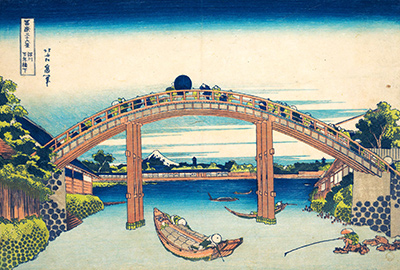
Two dark carp share a long, shallow stretch of paper in Katsushika Hokusai’s Carp and Turtles. Their bodies overlap, while smaller turtles occupy the loose space around them and an inscription closes the composition at the left. The sweep of each fish is visible in the changing density of the ink. In the famous Great Wave, the similarly rounded back of a wave breaks into hundreds of sharply articulated tips. The carp were painted by brush and the wave was printed from woodblocks. Both are Hokusai’s work, but the kind of object we are looking at makes a difference to what we see. [1] [2] [3]
The Japanese term nikuhitsu-ga describes pictures made directly by brush. In Hokusai’s case these include works mounted as scrolls, folding screens and paintings intended for the ceilings of festival floats. His woodblock designs survive in many forms too, from colour prints sold as separate sheets to books in which one opening leads to the next. Each format gave him a different way to put a fish, a moving body or the profile of Mount Fuji before a viewer. [4] [5] [6]
At a Glance
- ArtistKatsushika Hokusai
- ScopeBrush paintings, scrolls, folding screens and festival float panels
Contents
The painted carp and the printed carp
The painted surface of Carp and Turtles is about 27 centimetres high and 92 centimetres wide. Dating it to 1813, the Saitama Prefectural Museum of History and Folklore identifies it as a painting in colour on paper. Its height barely accommodates the turning bodies of the carp, while its breadth gives the animals room to move sideways. The fish sit close together, but their outlines and differences in tone let the eye follow them separately. A smaller turtle takes up little space and can still change the apparent scale of everything near it. The spaces between the animals carry the suggestion of water with very little descriptive work. [1] [2]
Hokusai returned to the pairing of fish in the 1831 Two Carp, represented in the Rijksmuseum by a woodblock print with a fan-shaped outline. Again, one fish overlaps the other and there is open space around their bodies. Here the curved boundary of the sheet encourages the eye to follow the fish around an arc. The upper and lower margins of the Saitama painting press the fish into a long, horizontal course. In the fan design, the opening above the bodies is itself curved, and the changing distances between fins, tails and the edge help the two fish hold together as a single design. [1] [2] [7]
The Rijksmuseum identifies the black lines and the printed colours in its fan sheet. Seen at a distance in reproduction, the detail can resemble the work of a fine brush. Seen up close, the catalogue’s account of the object helps explain the division between the detailed contours and the broad passages of colour. The painting in Saitama has its own distribution of light and dark, made directly on the support. Looking at the two works side by side makes clear how much the direction of a fish, the space around it and the proportions of the object contribute to the result. Carp offered Hokusai a subject he could adapt to the way each picture would be seen. [2] [7]
Hanging scrolls and folding screens
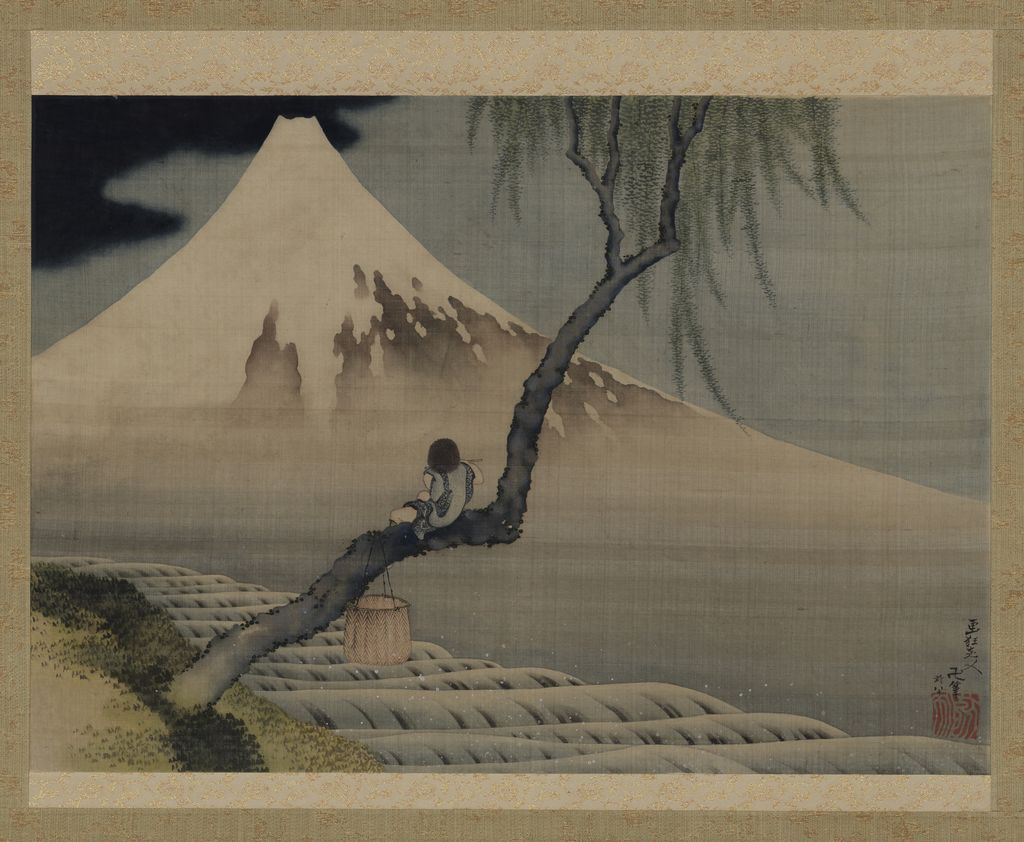
In the Smithsonian’s Boy Viewing Mount Fuji, painted in ink and colour on silk in 1839, a boy sits on a curved willow branch, flute in hand. Fuji rises on the other side of the composition. The branch is near enough for its arc to dominate the boy’s small figure. The mountain’s pale shape appears at a distance, with a pictorial silence quite different from the surrounding contours of boats and water in the Great Wave. The Smithsonian calls attention to Hokusai’s thin washes of colour and his sparing use of outline. The delicacy of the mountainside gives the viewer a sense of distance even with so few marks between the boy and the peak. [3] [8]
The painted image measures about 36 by 51 centimetres. At that scale the dipping willow can still feel momentous. Its bend sets the height from which the boy looks out and frames his view of the mountain, while the rushing stream below draws the eye back down into the foreground. Hokusai’s Country Scenes and Mount Fuji, a pair of six-panel folding screens at the Smithsonian, lets a viewer approach Fuji across a much wider surface. The museum dates the pair to about 1830–32 and lists ink, colour and gold on paper. In a view of the open screens, low stretches of country lead the eye across several panels before it returns to the peak. The spread of the forms makes the joins visible as part of the object, and their angles change as the screens are opened. The mountain appears within a landscape that can occupy a considerable part of a room. [8] [9]
Together these two paintings show why it helps to ask how a work was mounted. The scroll establishes a concentrated field around one figure. In the screens, the eye can travel several times from the foreground through stretches of open country and back to Fuji. Hokusai used the recognisable profile of the mountain to hold each composition together without giving it the same position, size or visual weight in every picture. [8] [9]
Paintings on festival floats in Obuse
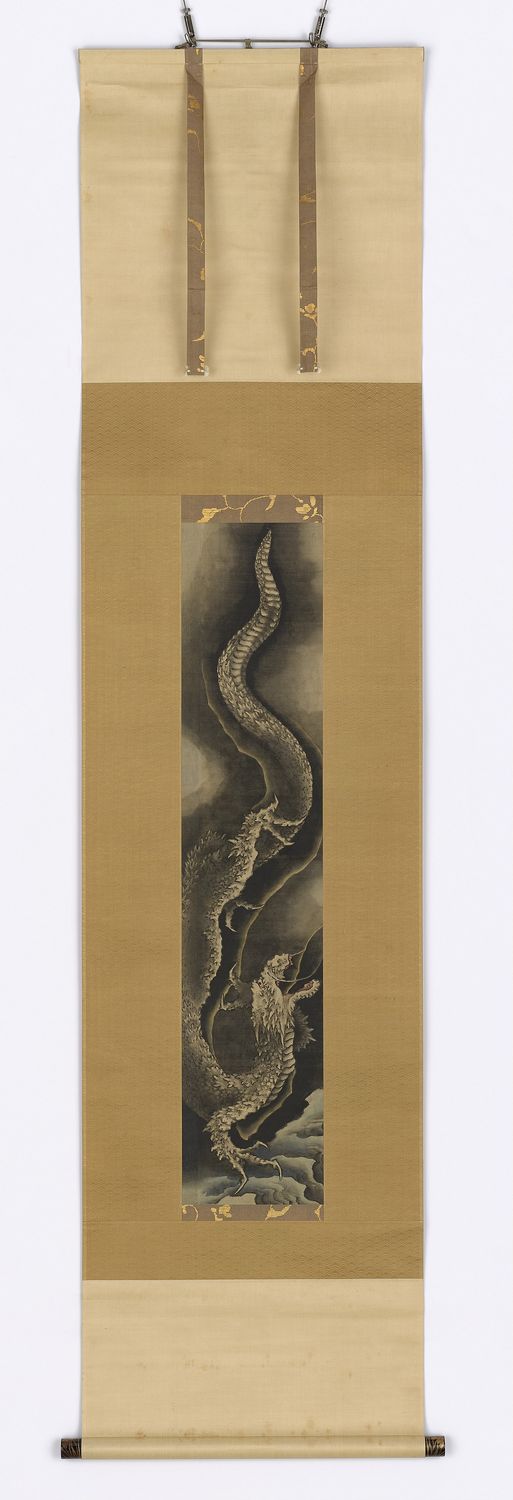
The Dragon and Phoenix in the Hokusai Museum in Obuse belong to the Higashimachi festival float. The museum dates the two paintings to 1844 and associates Hokusai’s work in Obuse with the patron Takai Kōzan. These pictures were intended for ceiling panels. The relation between figure and frame is immediate. The dragon’s body bends back on itself and repeatedly changes direction in a confined space. In the adjoining painting the bird spreads wings and feathers into the field around it. Against the strong colour of the surrounding design, each animal stays legible as a mass as well as in its smaller details. [10] [11]
It is worth imagining the panels overhead. With a print or book in hand, the reader chooses its distance and orientation. The float’s structure establishes the plane of the picture, and a viewer looking up can meet the panel from more than one position. The way the dragon doubles back and the way the phoenix occupies the surrounding field give the eye more than one starting point. Much of the motion is carried by the big turns of the silhouettes. The edges of the panels also keep the figures in sight when they might otherwise seem to fly out of the picture. [10]
Obuse preserves another pair of ceilings on the Kanmachi float. The works known as Masculine Wave and Feminine Wave use water alone to organise the panel. The Higashimachi pair places the bodies of two creatures inside their respective frames. In the Kanmachi panels, the bends and foam of the waves give shape to almost the entire field. A reader who knows the Great Wave can recognise Hokusai’s insistent interest in the turning crest, then see what changes when water is given the full space of a painted ceiling. The famous print brings the crest into relation with boats and a far mountain. The ceiling waves keep the eye within the water’s own motion. [3] [10] [11]
Image comparison
Many familiar Hokusai images, including The Great Wave and Red Fuji, are woodblock prints. For examples from separate impressions and the people who made them, see Woodblock prints and their impressions.
Explore the two Fuji projects, Hokusai Manga and his other printed books in the Series & Books directory.
Hokusai Paintings
How to recognise a brush painting in a collection record
Japanese museums often use nikuhitsu-ga for a picture painted with the brush. A conventional English title such as Phoenix or Carp may tell you very little about whether the object is painted on silk, printed from carved blocks or made to fit a ceiling. Start with the medium and support. Then check the mounting record: a hanging scroll, folding screen, handscroll or festival float panel controls the space and time available to look at the work. Two images reproduced at the same size on a screen may originally have had entirely different relations to a body or a room. [21] [22]
Brush lines can carry information through the way they begin, end and change direction. A brush rinsed to a different strength can carry a soft tone far beyond its edge. On a carved block that particular variation has to be recovered through decisions about carving and printing. There are beautiful effects in both, and it helps to distinguish them. A printed book can bring a brush-like line to a distant reader. A painted scroll gives direct evidence of the handling of colour on an individual support. It can carry small actions and textures whose life in reproduction is very different from the mounted original.
It is useful to follow a subject through formats without losing the material differences. The paintings of water from Obuse and the printed waves in the landscape series do not need to be treated as attempts at the same design. A main visual problem of the print is how to place boats and a distant mountain next to a single immense moving curve. A painted wave on a float has a bounded ceiling and needs to be read from below. It can still be compared with the crest on a flat sheet, particularly through the ends of the foamy lines. The comparison helps say which part of an effect can move across formats and which starts anew in each. [23] [24]
Patrons, painters and the occasion of a work in Obuse
The four visits to Obuse in the 1840s described by the Musée d'histoire de Nantes help place the paintings in a record of people and buildings. The visits connected Hokusai with Takai Kōzan and with decoration of local floats. A float panel, once separated from its structure or seen within a museum, can lose obvious clues to why its painting is shaped as it is. The earlier relation to the float can still explain several decisions. A forceful outline can keep the animal or wave identifiable from different positions. A composition rising above the eye needs to remain clear when different parts are nearer and farther away. [24] [25]
The ownership of the float paintings is revealing. Sumida's loan account distinguishes the neighbourhood councils, which own them, from the museum in Obuse where they are on deposit. That detail gives a preservation story alongside an attribution. A float painting can remain part of a community's history even when displaying it under a different roof offers the best chance to see it. Museum loans in Japan and the 2025 Nantes exhibition provide further examples of how images associated with one town entered a wider history of display. A viewer's experience of the object can vary considerably from its first appearance in the context of the local festival. [26]
The Nantes exhibition also demonstrated the limits of thinking about painting as a single last phase. Its catalogue records two beauties with a Gakyōjin Hokusai signature around 1803–04 and a dancer signed with a transition to Iitsu in 1820. These are two dated opportunities to put painting alongside work of his earlier decades. The move toward significant projects at Obuse did not require him to invent a practice of brush painting in old age. It gave some techniques a new setting, an unusual scale and a living relation to figures and structures far outside the Edo print market. [27]
Comparing figure painters in the Katsushika circle
Japanese exhibitions on Hokusai’s depictions of beautiful women bring out an array of models for faces, bodies and patterns of clothing. During the Sōri years, one sort of figure might appear within a print made for readers of poetry. A full-length painted beauty can bear the relation between the weight of a sleeve and a turn of the face over a larger vertical surface. The Sumida exhibition compares named artists and places the work of Ōi in this lineage. It gives a set of alternatives to a generic label “Hokusai school.” When a picture is known only by such a school attribution, comparison can reveal differences that the shared name conceals. [28]
Paintings in the same household also raise harder questions. The Nantes record lists Chrysanthemums under both Hokusai and Ōi, while the inscriptions name Manji, Hokusai's late name. This is a much more specific case for discussion than an assumption that any skilful handling of flowers or light gives away a second artist. It also makes a reader ask which evidence is reliable for a shared object. The surviving scroll and names printed in the modern exhibition catalogue can be compared. A claim about who made a particular stroke remains a different kind of assertion. [27]
Ōi's independently credited paintings make the comparison more fruitful. In Night Scene in the Yoshiwara it is possible to follow a signed painter's selective use of light. In Three Women Playing Musical Instruments an ensemble of people can be recognised through the weight of each gesture. In Operating on Guan Yu's Arm a complex story can be read through the gestures of people responding to the same event. These are three ways for a hand painter to decide what makes action legible. Comparison with Hokusai is now one among several questions. It can show how an artist inherited or varied a choice without collapsing either career into the other. See the Katsushika Ōi article [29] [30]
Discussion
Look again at the images and ideas explored in Hokusai’s Paintings, Prints and Illustrated Books. These editorial prompts invite your observations.
Reader Insights
How do the scroll and the print use space around Mount Fuji?
Which object would you look at differently after seeing how it was displayed?
Join the Conversation
Share a detail, comparison or question about Hokusai’s Paintings, Prints and Illustrated Books below.
References
- City of Saitama, Saitama Prefectural Museum of History and Folklore, English museum profile and image of Carp and Turtles. View source.
- Saitama Prefectural Museum of History and Folklore, fiscal 2024 annual report, catalogue entry for Carp and Turtles (紙本着色 鯉亀図). View source.
- The Metropolitan Museum of Art, Under the Wave off Kanagawa, JP1847. View source.
- The Sumida Hokusai Museum, All about Hokusai, permanent gallery introduction and forms of Hokusai’s work. View source.
- The Metropolitan Museum of Art, Woodblock Prints in the Ukiyo-e Style. View source.
- British Museum, Fugaku hyakkei, volume three, 1979,0305,0.454.3, catalogue discussion of the book and the colour Fuji series. View source.
- Rijksmuseum, Two Carp, RP-P-1960-3. View source.
- Smithsonian National Museum of Asian Art, Boy Viewing Mount Fuji, F1898.110. View source.
- Smithsonian National Museum of Asian Art, Hokusai: Japanese Screens, exhibition and reproductions of Country Scenes and Mount Fuji. View source.
- Hokusai Museum, Obuse, Higashimachi Festival Float, collection entry for Dragon and Phoenix. View source.
- Hokusai Museum, Obuse, Hokusai’s Evolution, exhibition account of the Obuse festival floats. View source.
- The Metropolitan Museum of Art, The Sumo Wrestlers Takaneyama Yoichiemon and Sendagawa Kichigorō, JP741. View source.
- National Museum of Western Art, Tokyo, Čiurlionis and Hokusai, exhibition account of the Iuchi Collection’s Mount Fuji prints. View source.
- The Metropolitan Museum of Art, Kajikazawa in Kai Province, JP2986. View source.
- The Metropolitan Museum of Art, Kajikazawa in Kai Province, JP1327. View source.
- National Diet Library, Japan, One Hundred Views of Mount Fuji, Image Bank and publication chronology. View source.
- The Metropolitan Museum of Art, One Hundred Views of Mount Fuji, three illustrated books. View source.
- Suntory Museum of Art, Hokusai from the British Museum, exhibition checklist, no. 15, Fuji from the Sea. View source.
- The Metropolitan Museum of Art, Hokusai Manga, 15 volumes. View source.
- The Metropolitan Museum of Art, Hokusai Sketchbooks, volume three, JIB81.3. View source.
- Sumida Hokusai Museum, Sumida Hokusai Museum, brush paintings collection. View source.
- Sumida Hokusai Museum, Sumida exhibition on media. View source.
- kyuhaku.jp, Kyushu National Museum exhibition of prints and paintings. View source.
- chateaunantes.fr, Nantes and Hokusai-kan exhibition. View source.
- obusekanko.jp, Obuse local account of Hokusai and the festival floats. View source.
- Sumida Hokusai Museum, Sumida report on works from Obuse. View source.
- chateaunantes.fr, Nantes French exhibition dossier, entries 42 and 43. View source.
- Sumida Hokusai Museum, Sumida Japanese exhibition on the lineage of Hokusai's beauties. View source.
- Museum of Fine Arts, Boston, MFA exhibition. View source.
- Cleveland Museum of Art, Cleveland collection record. View source.







