



 by Tom Gurney
Tom Gurney BSc (Hons) is an art history expert with over 20 years experience
Published on June 19, 2020 / Updated on November 20, 2026
Email: tomgurney1@gmail.com / Phone: +44 7429 011000
Sazai Hall at the Temple of the Five Hundred Arhats
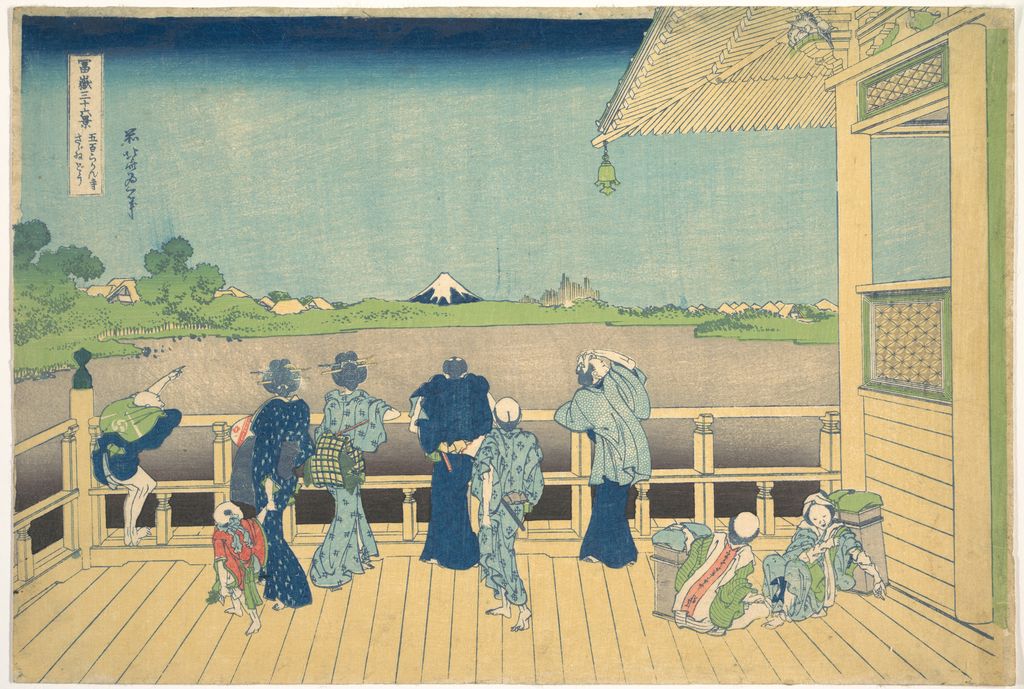
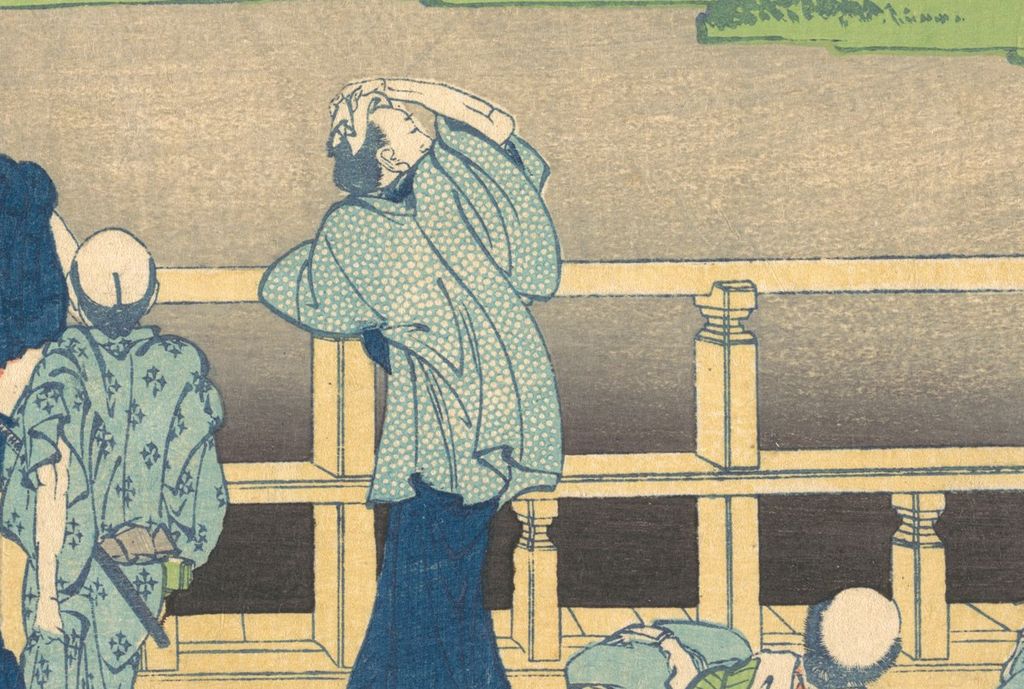
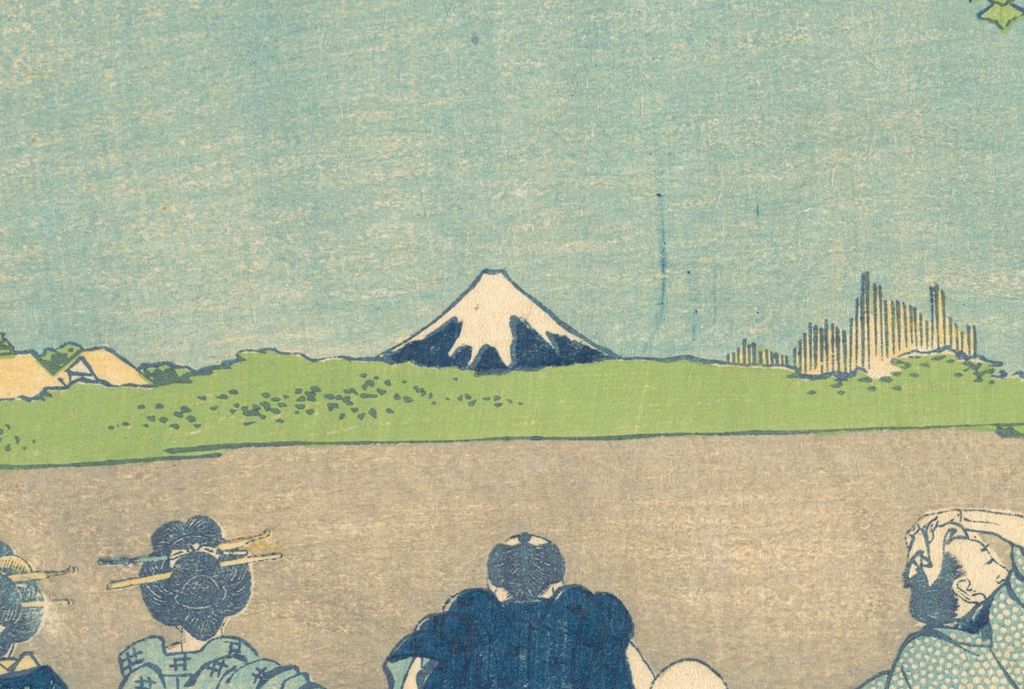
Mount Fuji appears through the gap between a tiled roof and the visitors on a terrace in Katsushika Hokusai’s Sazai Hall at the Temple of the Five Hundred Arhats. It is small enough to miss until someone on the balcony seems to show us where to look. At left, a visitor raises an arm toward the landscape. Near the centre, a figure at the rail stands nearly beneath the mountain, while another to the right lifts a hand near the brow. We see almost everyone from behind or in profile. Hokusai gives us a position among the visitors, close enough to make out details of clothing and posture, and lets the view open beyond them. [1] [2]
At a Glance
- ArtistKatsushika Hokusai
- Dateca. 1830–32
- MediumColour woodblock print
- SeriesThirty-six Views of Mount Fuji
Contents
From the floorboards to Fuji
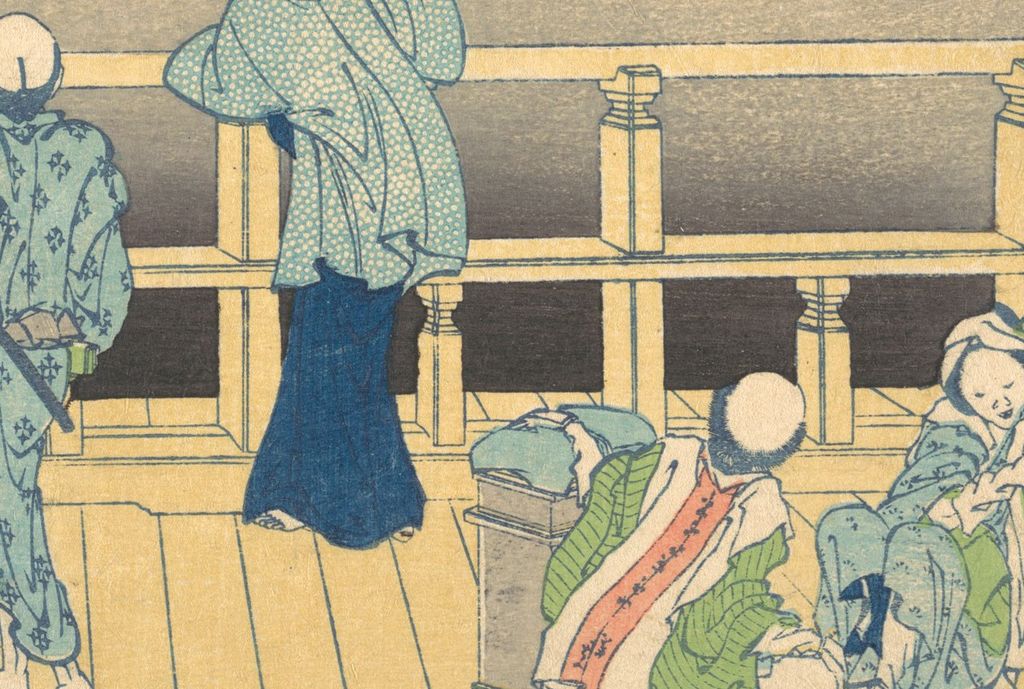
Begin at the lower edge. Long narrow boards cross the floor, some running almost straight away from us, others more sharply angled near the sides. They come to an end at a low balustrade with squared posts and short uprights. At left the railing bends back toward the foreground, giving us a view of the corner where two sides meet. The long section across the middle holds the people together in a narrow band. Beyond that band, there is room to look across open ground to a thin strip of roofs and trees. At the horizon, Fuji’s pale peak fits into a small break above the green strip. [1]
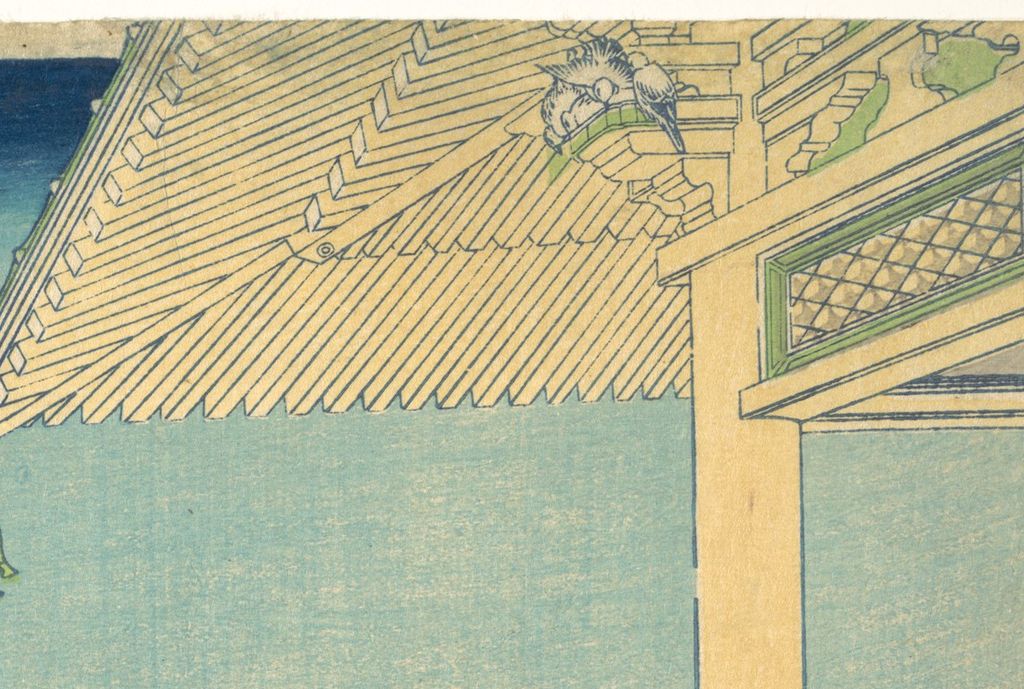
The roof works from the opposite direction. It enters high at the right and projects into the sky, with closely spaced lines describing the underside. A small hanging ornament marks the projecting corner. Below and farther right, the upright post and the lattice panel give the terrace another edge. Hokusai draws these elements with enough precision to make the building feel very near, then lets the canopy of trees at far left and the ridge of Fuji reduce to a handful of shapes. There is open sky between the tree line and the eaves, and the unfussy space around the summit keeps it visible. [1] [2]
The Met describes Fuji as nearly a vanishing point and the figures below as spread like a fan. It is easy to see why when following the different angles of shoulders and backs. The floor seams, left return of the railing and roof also lead the eye inward. Their lines give depth to the terrace without requiring the little summit to sit at the exact intersection of every architectural edge. By comparison, the top rail and the distant line of trees hold almost level across the sheet. The combination lets us read two things at once: the short space in which people are standing, and the great extent of land they have come to see. [1] [2]
How the visitors look
The person at the far left presents an especially active outline. A raised arm extends diagonally above the railing and into the plain field beyond it, while the pale legs reach into the open spaces between the rails. Near the centre, the dark blue back of another visitor forms a tall, still shape, with the hands held low behind the body. To the right, the visitor with a cloth around the head inclines toward the view. These gestures turn the strip of people into an account of looking. Each figure reaches the landscape from a slightly different position, and the place where a gesture ends is often the point at which the level lines of the background become easier to notice. [1]
Not everyone is occupied with the mountain. A child in red and green appears close to the lower left group, with the face turned across the terrace. Two visitors sit low near the wall at the right, below the lattice and next to several bundled shapes. The person in the long pale patterned robe nearer the centre has space around the feet and seems to be crossing the boards. If we follow that person’s line through the group, we return to the highest point of the mountain, only to come back again to the dark robes just below it. Hokusai gives the act of stopping to look several rhythms, including the slower activities of people who have settled for a moment away from the rail. [1]
Look at the clothes beside the posts. One dark robe carries small pale marks at regular intervals, while another has broad coloured fields with few internal divisions. A visitor beside them wears a checked sash, which stands out even though it covers a small area. Near the right wall, there are stripes and irregular curved patterns. All these marks are large enough to hold attention, in contrast to the stippled trees and tiny triangular roofs in the distance. The difference in the amount of information Hokusai gives a garment and a house helps establish how much intervening space the scene contains. [1]
The hall in Edo
The Temple of the Five Hundred Arhats was Gohyaku Rakanji. Rakan is the Japanese name for Buddhist arhats, the enlightened disciples associated with the temple’s name. The Sazai Hall shown here was erected in 1741 in the temple precinct at Honjo Itsutsume, in what is now Ōjima in Tokyo’s Kōtō ward. The National Diet Library records that the hall was formally called Sansōdō, or hall of three circuits. Visitors could follow the spiral interior around its three levels, with separate routes for going up and down. Its popular name, Sazaidō, compares this shape to a turban shell. It is the unusual interior that accounts for the nickname, even though Hokusai shows us the upper balcony and the view outward. [1] [2] [3] [4]
The temple’s account describes a hall devoted to one hundred images of Kannon, arranged to represent three pilgrimage circuits. The routes brought together places of devotion that a pilgrim would otherwise have travelled considerable distances to visit. An upper gallery with rails extended around the third level. That layout helps explain why the print can depict a variety of people on one viewing platform. It also explains how an Edo place of worship came to be known for the view it offered. The two kinds of experience could follow one another on the same visit, even though the architecture Hokusai gives us here is seen from one particular side. [3] [4]
The Edo hall suffered damage from storms and the Ansei earthquake and no longer stands. The temple later moved, eventually settling in Meguro. Another building called Sazaedō survives at Aizu-Wakamatsu in Fukushima Prefecture. Built in 1796, the hall at Aizu has its own distinctive double spiral and its own history of Kannon pilgrimage. The date and site of the Edo structure, and the name of the temple in the print’s title cartouche, identify the building Hokusai chose. The shared nickname reflects an architectural resemblance. [3] [4] [5]
Two impressions of the view
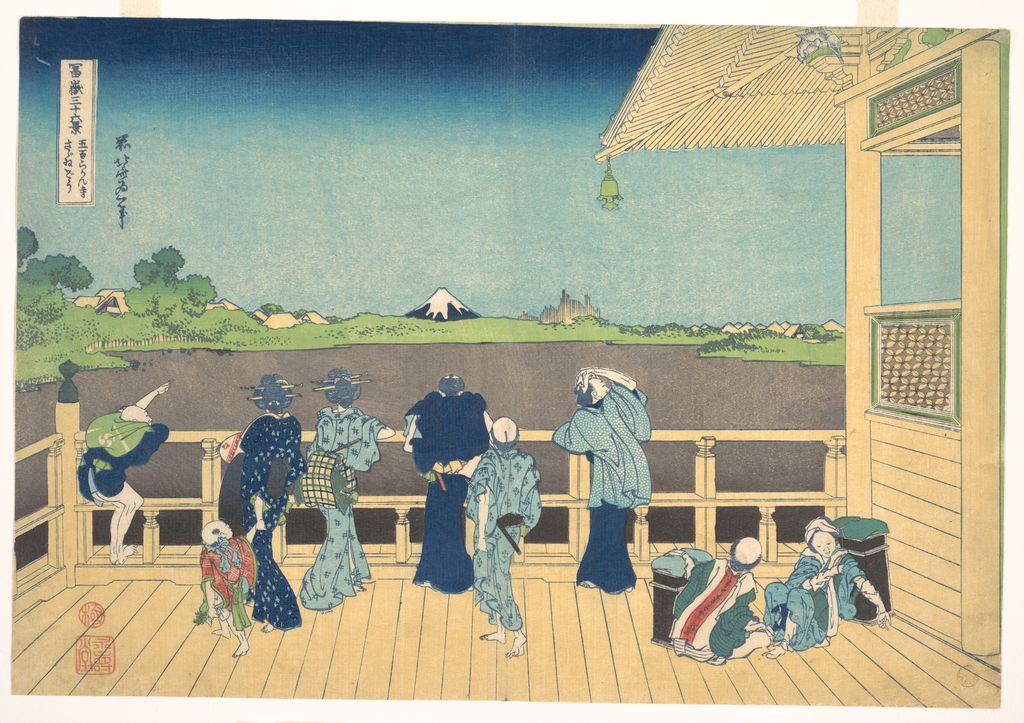
The Metropolitan Museum of Art dates JP2984 and JP1335 to about 1830–32. It measures the first sheet at 26 by 38.7 centimetres and the second at 25.6 by 37.1 centimetres. The Japanese and English checklist for the National Museum of Western Art’s Iuchi Collection exhibition records the same design as no. 38, under the English title Turban Shell Hall of the Five Hundred Arhat Temple. Each impression lets us trace the same profile at the eaves, the same group at the railing and the same little cap of snow above the plain. [1] [6] [7]
There are differences visible in the Met’s photographs. Compare the top edge and the wide area below it. The dark blue band extends farther down in JP1335 before giving way to the lighter sky. There is also a deeper tone across the open ground in JP1335, which makes the near rail stand out more strongly against it. Two red marks appear over the floor at lower left in JP1335. The corresponding area of JP2984 leaves the joints between the floorboards easy to follow. Looking back and forth shows how much a change in large areas of colour can affect the tiny intervals between the visitors. The catalogue photographs do not by themselves establish the sequence in which the sheets were printed. [1] [6]
A different height above Edo
Surugadai in Edo also places viewers on high ground in the city with a view of Fuji. In that print, the height is felt chiefly in the incline of the land next to the road. Figures at different levels across the foreground help us read the slope, and a pitched roof occupies one side. The viewer here has a very different position. The level balustrade is close enough to reach and the eaves hang overhead, so the height feels like a property of the building and the way visitors use it. At Sazai Hall, Hokusai lets us meet the mountain through the architecture of a popular destination. The building takes up a large part of the design, yet the small piece of open sky it leaves around Fuji is the point at which much of the picture comes together. [1] [8]
Hokusai’s Thirty-six Views of Mount Fuji often makes finding the peak part of looking at the print. Here three different scales help you find it again. Look first at the spread of floorboards under a visitor’s feet. Then follow the scattered pale roofs along the horizon and see how little space each one takes up. The snow cap beyond them occupies less space than the broad shape of any visitor’s back, but the repetition of pale triangles makes the distant outline easy to pick out once you know where to look. [1]
Where this work sits in Hokusai’s career
Hokusai Manga
From 1814Sazai Hall at the Temple of the Five Hundred Arhats
ca. 1830–32Annotated Details from The Sazaidō Hall of the Gohyaku Rakanji Temple
The Metropolitan Museum of Art, JP2984. [1]
Details from THE SAZAIDŌ HALL OF THE GOHYAKU RAKANJI TEMPLE
Select a detail to look closely.
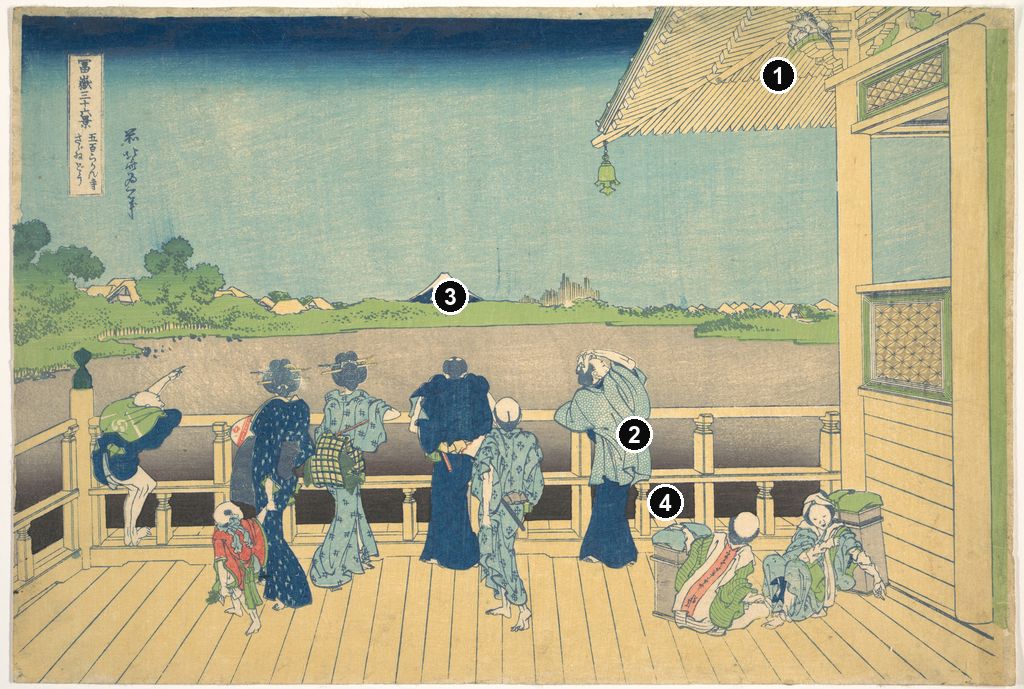
The projecting roof frames the view
The eaves fill the upper right corner. The lines below lead back towards the horizon. [1]
A visitor stands at the railing
Figures at the edge of the balcony turn towards the open landscape. Their size makes the distance beyond feel expansive. [1]
Fuji occupies a small interval
The white summit appears above a horizontal line of vegetation. The conspicuous balcony makes its remoteness felt. [1]
The railing divides near and far
The horizontal rail holds the foreground figures in one shallow space, above the expanse of land. [1]
What a visitor could do inside the Sazai Hall
Japan's National Diet Library dates the building of the hall to 1741 and explains its other name, sansōdō. The route wound through three levels. Visitors could go up and down without retracing the same passage. The spiral suggested a shell and gave rise to the alternative name familiar from prints. The library links the route to stations associated with Kannon. A circuit inside the building could stand for a longer pilgrimage. Connecting these features explains why a picture of people gathered high above Edo concerns the history of popular devotional practice as well as landscape. [3]
The building is lost, but a near-contemporary printed guide offers a way to think about it as a whole. The library links views of the exterior and passages from Edo meisho zue, an illustrated account of Edo's notable places issued in two groups in the 1830s. The guide gives a reader context about the precinct and the building that Hokusai's terrace scene largely leaves out. Its attention to the same place gives the picture a setting that can be researched independently of its title. If the aim is to identify what the internal circuit did, read the guide and the library's explanation. If the aim is to understand what it meant to arrive at an outlook over Edo, study how the print places the viewer among the people already standing there. [9] [10]
One way into the picture is to imagine having just completed the spiral. The body keeps turning inside a tight enclosure and then encounters the depth of the sky outside. Hokusai does not attempt to show those movements directly. A repeated arrangement of bodies at the rail gives a sense that looking outward is part of the visit. It also makes it possible to imagine arriving at the view later than some of the people farther away. Observation is a social activity. One person can stay close to a companion while another can point or turn. The mountain becomes a reason to gather and an object still reachable only through sight.
Distinguishing the temple, the hall and the mountain
Kōtō City places the old temple at Honjo Itsutsume, in the vicinity of present-day Ōjima. Its account distinguishes the hundreds of arhat statues for which the temple was known from the view made possible by the hall. The two were reasons to visit one precinct, and different things for a visitor to see. A title referring to the Five Hundred Arhats names both a religious subject and a location. It does not make the people on the balcony depictions of arhats. The smaller figures are visitors within the pictorial view of the site. [11]
The library records damage from a severe storm in the 1840s and the Ansei earthquake, and says the temple moved to Meguro in the Meiji period. The Edo spiral hall no longer stands. A modern photograph of the relocated temple can document the continuation of the institution. It cannot supply a matching image of Hokusai's vantage point. A photograph of a different surviving spiral hall may help explain what a succession of levels does to a body in motion, as long as its location and identity remain explicit. The early guidebook and the print are much closer evidence for this particular place. [3] [12]
Fuji stands deep behind the people and terrace. The position of its form and the number of marks around it are carefully judged. More detail on the lower slopes would make the mountain compete for attention with the people alongside the rail. A still smaller or less distinct silhouette could read as a gap rather than a distant object. Compare the physical height of the terrace, where the nearest viewers stand, with the apparent height of the last and highest feature of the view. The human structure determines where we can look from. The mountain determines how far the look can go.
Other prints of the hall and the landscape within the frame
The National Diet Library collects several images of the hall under one place name, including work by Hiroshige. In a larger group of views the same building may be noticed for its height, its surroundings, the architecture inside it or the opening it offers toward other places. A comparison helps prevent a viewer from treating Hokusai's particular interest as a full account of the site. It also offers a way to tell what choices the artist has made. The chance to look over other people or to stand behind them is much more pronounced where the drawing uses a strong stretch of floor to place those figures within reach. [3]
Reading forward from the near floor in Hokusai's sheet, the viewer meets a series of barriers, gaps and changes of scale. The hard edges and dark lines give the foreground a sturdy relation to the body. The low emphases farther out preserve the continuity of the ground toward Fuji. Those decisions make perspective an active part of the picture. Compare Under Mannen Bridge, where the division between near structure and distant mountain is made by a low viewpoint, and Fuji View Field, where a barrel gives an almost closed perimeter to a similarly distant sight. Each view makes the mountain visible through something man-made. Each offers a different account of what people are doing in its presence.
Explore Hokusai’s works
Discussion
Look again at the images and ideas explored in Sazai Hall at the Temple of the Five Hundred Arhats. These editorial prompts invite your observations.
Reader Insights
Where does the balcony lead your eye?
How does the group at the railing frame the view?
Join the Conversation
Share a detail, comparison or question about Sazai Hall at the Temple of the Five Hundred Arhats below.
References
- The Metropolitan Museum of Art, Sazai Hall at the Temple of the Five Hundred Arhats (Gohyaku Rakanji Sazaidō), impression JP2984, collection record and photograph. View source.
- The Sumida Hokusai Museum, Wow, Hokusai! See, Examine, and Discover Ukiyo-e, exhibition interpretation of the Sazaidō Hall print. View source.
- National Diet Library, Sazaidō, Japanese exhibition entry on the hall’s structure, uses, location and loss. View source.
- Gohyaku Rakanji, An Inquiry into the Sansōdō, part 12, Japanese account of the Edo hall’s architecture and images. View source.
- City of Aizu-Wakamatsu, The Sazaedō at Aizu-Wakamatsu, Japanese cultural property record. View source.
- The Metropolitan Museum of Art, Sazai Hall at the Temple of the Five Hundred Arhats (Gohyaku Rakanji Sazaidō), impression JP1335, collection record and photograph. View source.
- National Museum of Western Art, Japanese and English exhibition checklist for the Iuchi Collection, no. 38. View source.
- The Metropolitan Museum of Art, Surugadai in Edo (Tōto Sundai), impression JP2995, collection record and photograph. View source.
- National Diet Library, NDL, account of Edo guidebooks. View source.
- National Diet Library, NDL catalogue for Edo meisho zue. View source.
- city.koto.lg.jp, Kōtō City account of the temple and the hall. View source.
- city.koto.lg.jp, Kōtō City, comparison with the temple today. View source.






