


 by Tom Gurney
Tom Gurney BSc (Hons) is an art history expert with over 20 years experience
Published on June 19, 2020 / Updated on November 20, 2026
Email: tomgurney1@gmail.com / Phone: +44 7429 011000
The Mitsui Shop at Surugachō in Edo
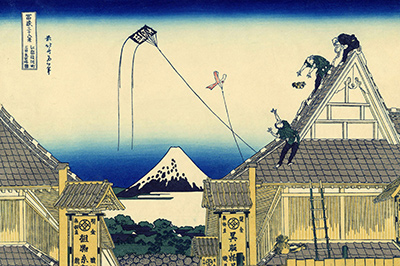
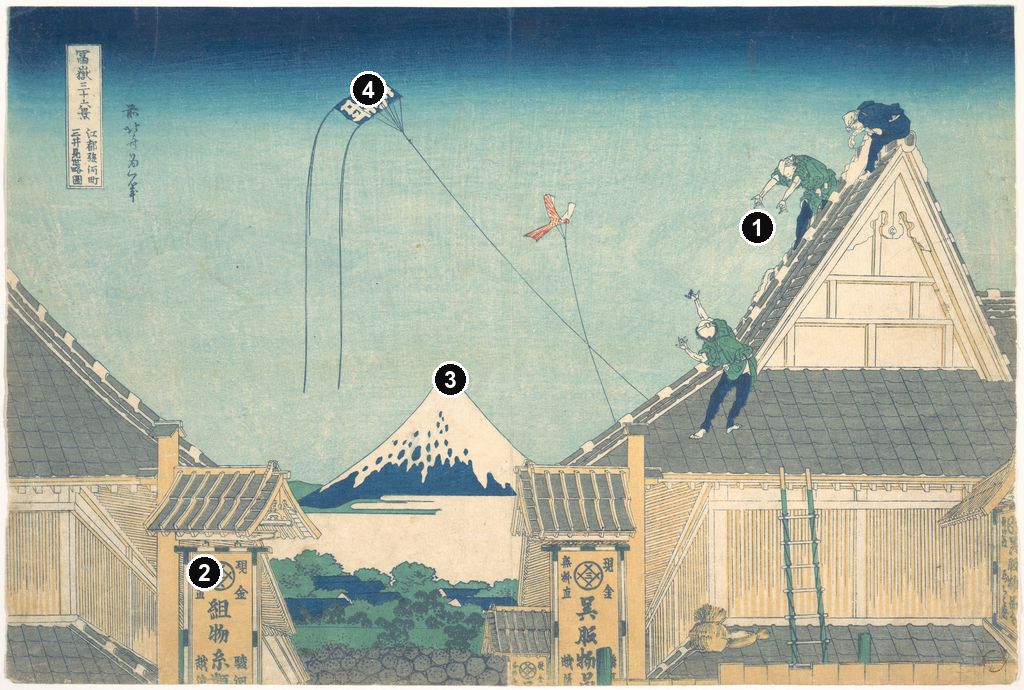
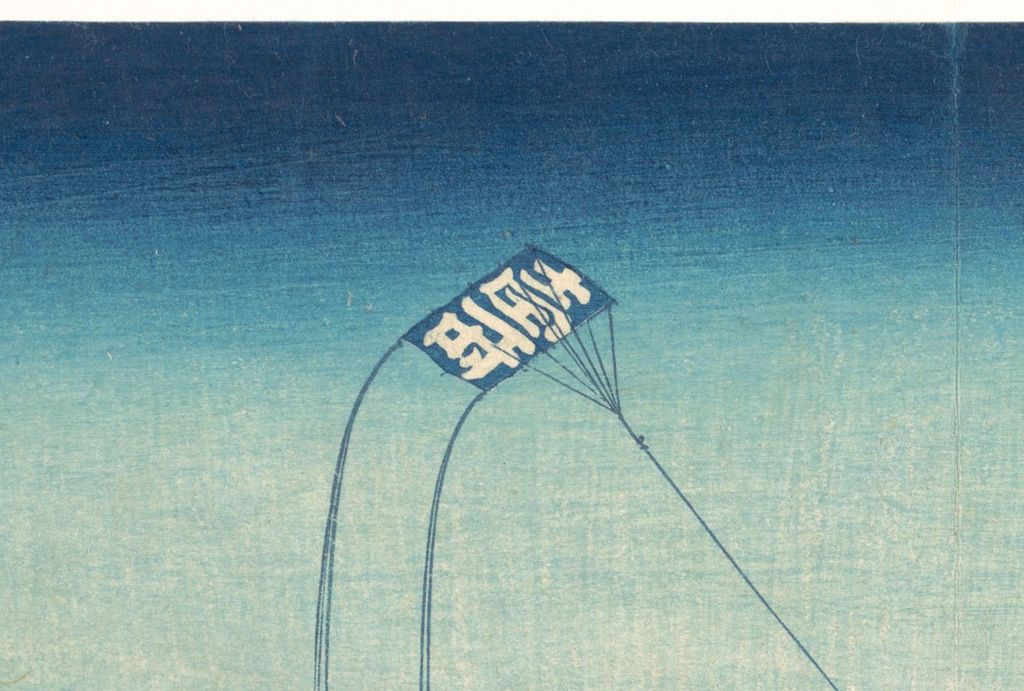
Three men have taken their work onto the tiled roof of the Mitsui shop. One crouches near the ridge, another leans down the slope, and a third reaches towards a bundle in the air. Behind them, a kite rides high enough for its trailing ribbons to hang against the open sky. The street at the centre of Hokusai’s print is largely out of sight. Two signs tell us which buildings border it, while a pale Mount Fuji rises in the gap between their roofs. [1] [2]
The Metropolitan Museum of Art dates its impression JP1329 to about 1830–32. It is a colour woodblock print measuring 25.4 by 38.1 centimetres. The Japanese title, 江都駿河町三井見世略図, names the Mitsui shop at Surugachō in Edo. The National Museum of Western Art in Tokyo lists a separate impression in the Iuchi Collection as item 36. Its English title describes the view as a rough impression of the shop. The word ryaku zu, also translated as a simple sketch, suits the selection of details in the finished design. Hokusai gives the signs and the roof work room to be seen, while leaving most of the frontage below the edge of the sheet. [1] [3] [4]
At a Glance
- ArtistKatsushika Hokusai
- Dateca. 1830–32
- MediumColour woodblock print
- SeriesThirty-six Views of Mount Fuji
Contents
A street defined by two roofs
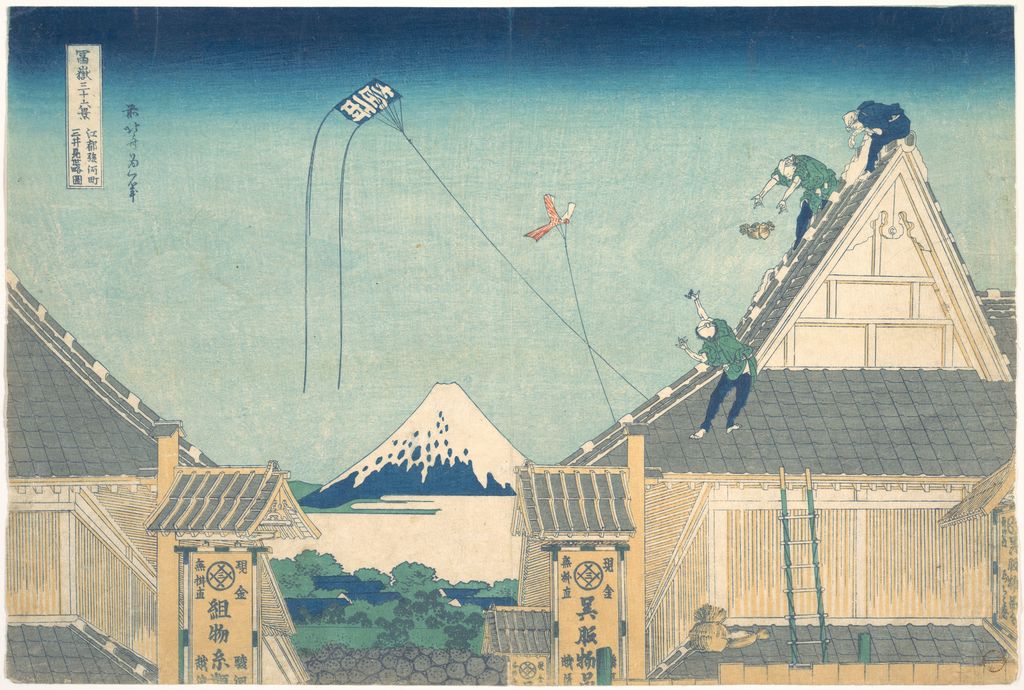
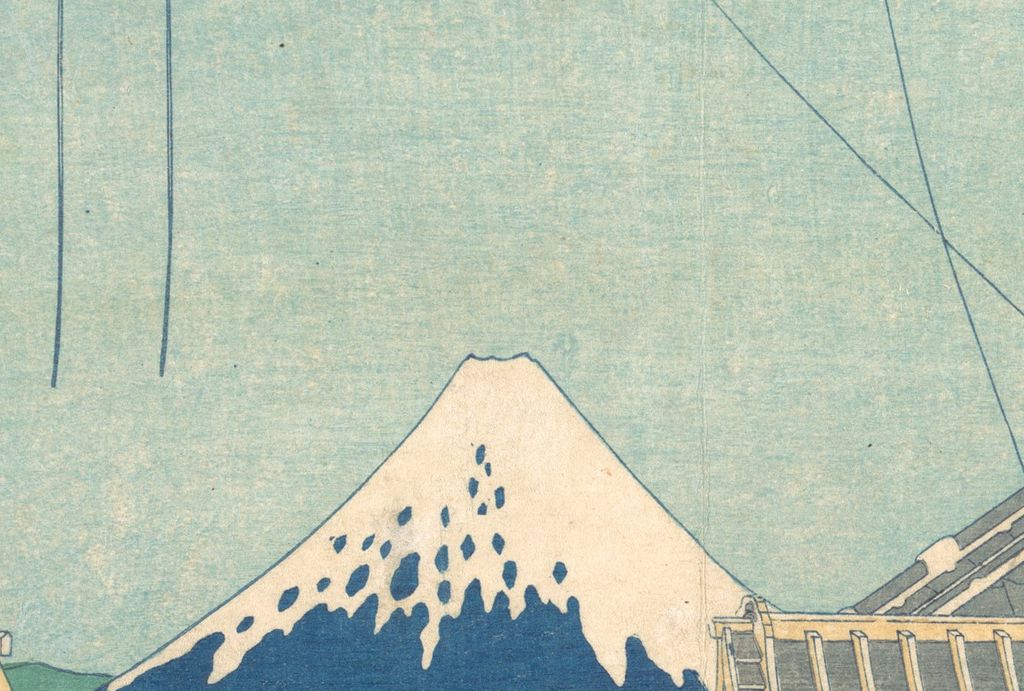
At left, part of a tiled roof cuts into the sheet on a steep diagonal. On the right, a much larger roof presents an entire triangular gable. Pale beams cross its face and give the triangle a visible structure. The nearest rows of tiles run across the picture beneath it, while the tiles along the sloping edge catch the light in a broken strip. Follow that strip down and it leads towards Fuji. The mountain’s pale summit and blue flank repeat the triangular form in outline, at a smaller scale and on a lower part of the sheet. [1] [5]
The lower edges of the roofs bring the view into the narrow interval between the shops. Below Fuji are dark roofs partly covered by tree canopies and, lower still, the round shapes of stones in a wall. The Allen Memorial Art Museum identifies Edo Castle in that intervening distance. Hokusai renders the middle ground in strips across the gap, using a much finer scale for the distant trees and roofs than for the timber and tiles at either side. The Met describes a high viewpoint over the street. The Sumida Hokusai Museum also points out how the perspective makes the buildings seem to tower above us. There is space to look beyond the shops even as the nearest gable draws the eye upwards. [1] [4] [5]
Surugachō was an Edo neighbourhood north of Nihonbashi, in what is now Nihonbashi Muromachi in Tokyo. It was known for a view of Fuji down the length of the street. The Tokyo Fuji Art Museum locates the Echigoya textile shop in the area of present-day Muromachi 3-chōme and identifies it as the predecessor of Mitsukoshi. The series also names Suruga Province in several landscapes outside Edo, and uses the name Surugadai for a separate Edo neighbourhood. [5] [6]
What the shop signs say
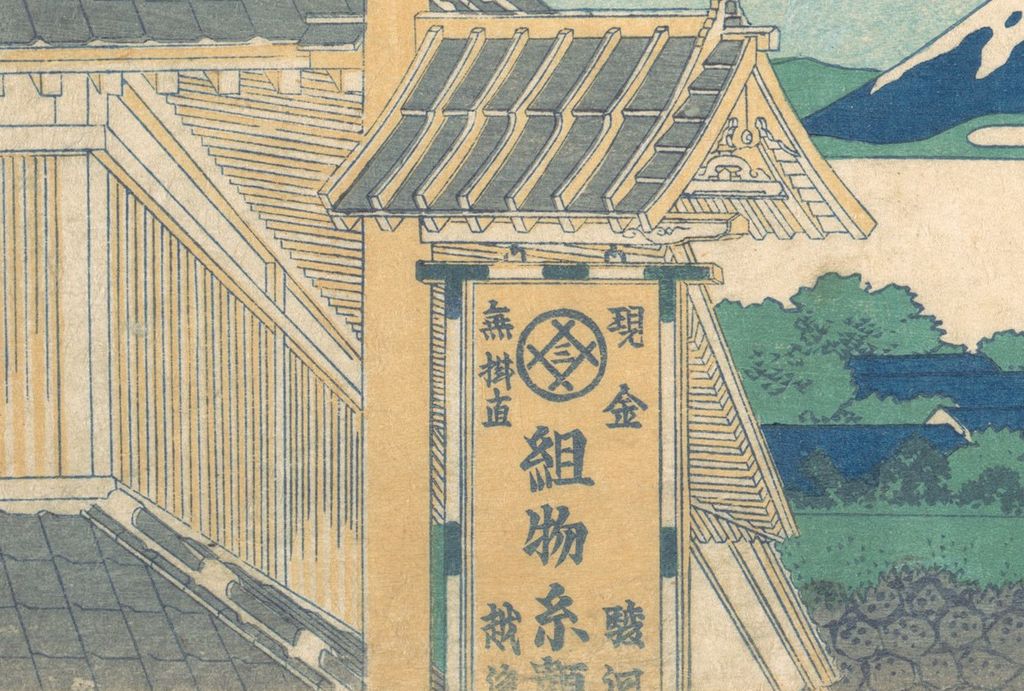
The two largest signs have narrow tiled canopies of their own. The board on the left advertises kumimono ito, braids and thread, and the one on the right bears the characters 呉服物 for kimono fabrics. A smaller board farther back carries the same circular device. Inside the circle, the three strokes of the character for three are surrounded by the angled bars of a well frame. The device gives a visual reading of the name Mitsui. At the top of each large board the slogan appears in two columns, with 現金 for cash on the right and 無掛直 on the left for the absence of a marked-up bargaining price. The repeated marks identify the buildings as parts of the same business. [1] [2] [7] [8] [10]
The Mitsui Archives explains the familiar reading of the slogan, genkin kakene nashi, as cash sales at fixed prices. Its account cites the Shōbaiki, completed in 1722 by Mitsui Takaharu, the third son of the founder, Mitsui Takatoshi. The family record describes a system intended to make cloth buying more accessible to customers unfamiliar with the usual bargaining over prices and quality. It also gives a sense of what the business wanted remembered about its beginnings. Hokusai’s print, made more than a century after the record was completed, shows the terms of trade surviving as prominent shop lettering, where someone approaching either building could see them. [7]
Mitsui’s first Edo shop opened in Honchō in 1673. The company archive describes a street frontage of about 2.7 metres and reproduces shop rules from that year. Those rules address employees of the new shop and already prohibit certain sales on credit. It also preserves a later memorandum by the Edo manager Wakita Tōemon describing the move to Surugachō in 1683, after a major fire the previous year. By Hokusai’s time the business occupied buildings on both sides of the street. Repeating the emblem on both sides gives the viewer a quick way to recognise a single shop across the gap where Fuji appears. [1] [10]
The signs make an unusually solid frame for the landscape. Their upright sides emphasise the distance between the sides of the street, and their canopies form two small tiled roofs beneath the larger ones. On the Met impression, the large lettering is dark enough to distinguish from both the crest and the tighter rows of smaller characters. The bottoms of the boards disappear at the lower edge. Their full text is less important to this view than the parts we can read at a glance, which establish who the buildings belong to and what customers can purchase there. [1] [2] [7]
Roof tiles and kite strings
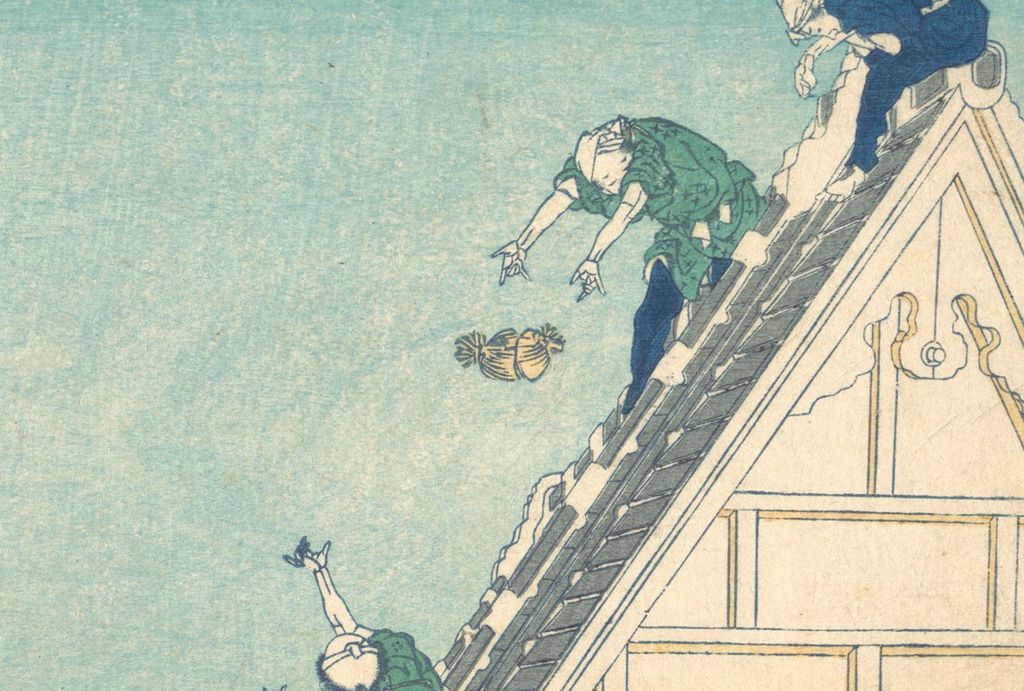
On the right-hand roof, Hokusai sets the workers at three heights. The man below the sloping edge extends an arm, the bundle hangs briefly above him, and the figure farther up reaches towards it. The Allen Memorial Art Museum identifies the load as a bundle of tiles. The man crouching near the ridge completes the progression of figures up the roof. Lower down, a ladder leans against the building and ends just below the eaves. Its straight rails add a vertical measure beside the steep tiled slope, and its rungs make it easy to imagine the climb. [1] [4]
The kite strings are finer than any of the architectural lines. From the large kite, a diagonal string crosses the sky towards the shop, while two long curves trail down from the kite itself. The smaller kite hangs nearer the gap over the street. One slope of Fuji rises at a comparable angle to a kite string, and the other leads down towards the foreground roofs. Between the kite and the tile bundle there is enough open space to follow the different kinds of movement. The workers are braced on the slope, the bundle travels between them, and the kites pull against lines that lead out of sight. [1] [4] [5]
Two impressions of the same design
The Met’s JP2994 records the same title cartouche, roof workers and shop signs on a second sheet, 25.7 by 37.8 centimetres. In the museum photograph of JP1329, a deep blue band at the top lightens into a greenish blue that persists almost to the roofs. The corresponding sky in JP2994 is warm and pale below the top band. A separate strip of deep blue runs across the horizon behind Fuji. The workmanship reads differently in these two settings. The thin kite strings run across a more even field in JP1329, while the horizon in JP2994 gives Fuji’s pale upper slopes a firmer outline. [1] [9]
The roof work, circular shop marks and pale gable remain in the same positions on both sheets. That makes it possible to start from a fixed detail, such as the dark left roof, and compare the colours immediately around it. The area of colour against that roof in one photograph corresponds to an extensive pale area in the other. Some contrasts may also be affected by the condition or photography of the sheets. Their appearance is enough to tell the impressions apart in the museum images. It leaves the order of printing and the identity of individual pigments open. [1] [9]
Two ways of picturing the district
In Nihonbashi Bridge in Edo, another design in Thirty-six Views of Mount Fuji, the canal and lines of white-walled warehouses set the direction of the view. There, the heads cropped along the bottom make the crowd on the bridge part of the foreground. The shop view assigns that space to signs and tiles. Its people appear chiefly overhead, and the paths into depth are marked by the roof edges and the sloping sides of Fuji. The two designs bring the distant mountain into different kinds of city space. [1] [2]
Utagawa Hiroshige returned to the shop’s street in Suruga-chō, published in 1856 as part of One Hundred Famous Views of Edo. The Brooklyn Museum’s impression shows the Mitsui crest and opens the view down the street, making people and storefronts visible beneath a bank of clouds. Fuji is high in the vertical image, above the central axis between the shops. In Hokusai’s horizontal view, its summit is low enough for the roof workers and kites to rise above it. Both versions let the buildings narrow the view towards the same landmark. Hokusai’s close roofline gives the tile workers nearly as much claim on the eye as the mountain. [1] [8]
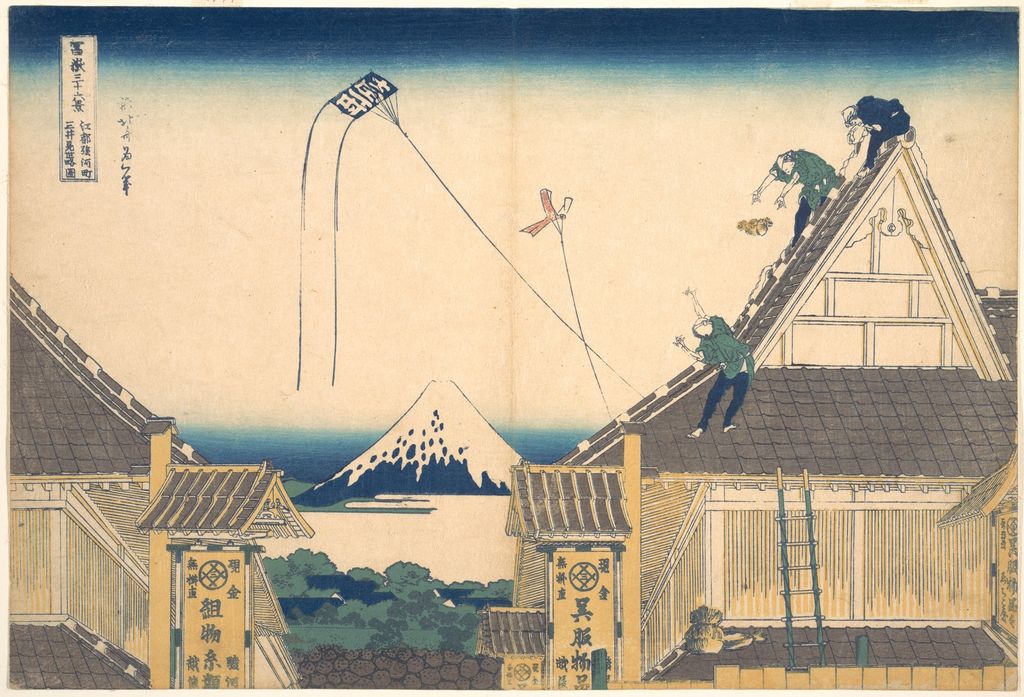
Image comparison
Where this work sits in Hokusai’s career
Annotated Details from The Mitsui Shop at Surugachō in Edo
The Metropolitan Museum of Art, JP1329. [1]
Details from THE MITSUI SHOP AT SURUGACHŌ IN EDO
Select a detail to look closely.
A small bundle appears beside the roof
Look between the workers on the steep roof at right. Their actions extend the building into a patch of otherwise open sky. [1]
The shop sign faces the street
Vertical lettering marks a tall rectangle below the eaves. The sign puts the viewer between two occupied buildings. [1]
Fuji sits in the gap
Buildings on either side leave room for the peak. Their steep roof edges echo its rising slopes. [1]
A kite crosses the sky
The small shape has open space around it. Its line leads back down towards the buildings. [1]
Explore Hokusai’s works
Discussion
Look again at the images and ideas explored in The Mitsui Shop at Surugachō in Edo. These editorial prompts invite your observations.
Reader Insights
Which roofs lead your eye to Fuji?
Where do you see signs of work above the street?
Join the Conversation
Share a detail, comparison or question about The Mitsui Shop at Surugachō in Edo below.
References
- The Metropolitan Museum of Art, Mitsui Shop at Surugachō in Edo, accession JP1329, collection record and photograph. View source.
- MOA Museum of Art, Japanese commentary on the Mitsui shop and Nihonbashi prints, entries 65 and 69. View source.
- National Museum of Western Art, Tokyo, Hokusai: Thirty-six Views of Mt. Fuji, Iuchi Collection exhibition checklist, item 36. View source.
- Allen Memorial Art Museum, A Simple Sketch of the Mitsui Cloth Shop at Surugacho in Edo, collection record and commentary. View source.
- Sumida Hokusai Museum, The Mitsui Shop at Surugachō in Edo, Japanese collection record and commentary. View source.
- Tokyo Fuji Art Museum, The Mitsui Shop at Surugachō in Edo, Japanese collection record and commentary. View source.
- Mitsui Archives, “Genkin Kakene Nashi,” with a translation from the Shōbaiki and details of shop signs in prints. View source.
- Brooklyn Museum, Suruga-cho, no. 8 in Hiroshige’s One Hundred Famous Views of Edo, accession 30.1478.8, collection record and photograph. View source.
- The Metropolitan Museum of Art, Mitsui Shop at Surugachō in Edo, accession JP2994, collection record and photograph. View source.
- Mitsui Archives, “The Advance into Edo,” including the 1673 shop rules, the logo and a memorandum on the move to Surugachō. View source.







