


 by Tom Gurney
Tom Gurney BSc (Hons) is an art history expert with over 20 years experience
Published on June 19, 2020 / Updated on November 20, 2026
Email: tomgurney1@gmail.com / Phone: +44 7429 011000
Cuckoo and Azaleas
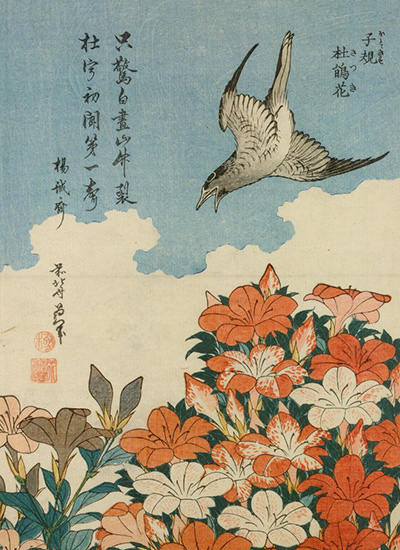
In Katsushika Hokusai’s Cuckoo and Azaleas (Hototogisu satsuki, 子規 杜鵑花), a bird passes over a bank of blooms. Its tail sweeps right, its wings rise and its bill points left and down. Below the bird a pale interval follows a scalloped edge, leaving room between the flight and the azaleas. Two upright columns of verse occupy the blue field at upper left. The poem gives the bird’s passage a sound to go with its sharp turn across the sky. The RISD Museum dates its impression 34.486.2 to about 1834. Tokyo National Museum catalogues its own sheet as a nineteenth-century colour woodblock print in the chūban, or medium-sheet, format. [1] [2] [3]
At a Glance
- ArtistKatsushika Hokusai
- DateEarly 1830s
- MediumColour woodblock print
- SeriesSmall Flowers
Contents
A bird that changes direction
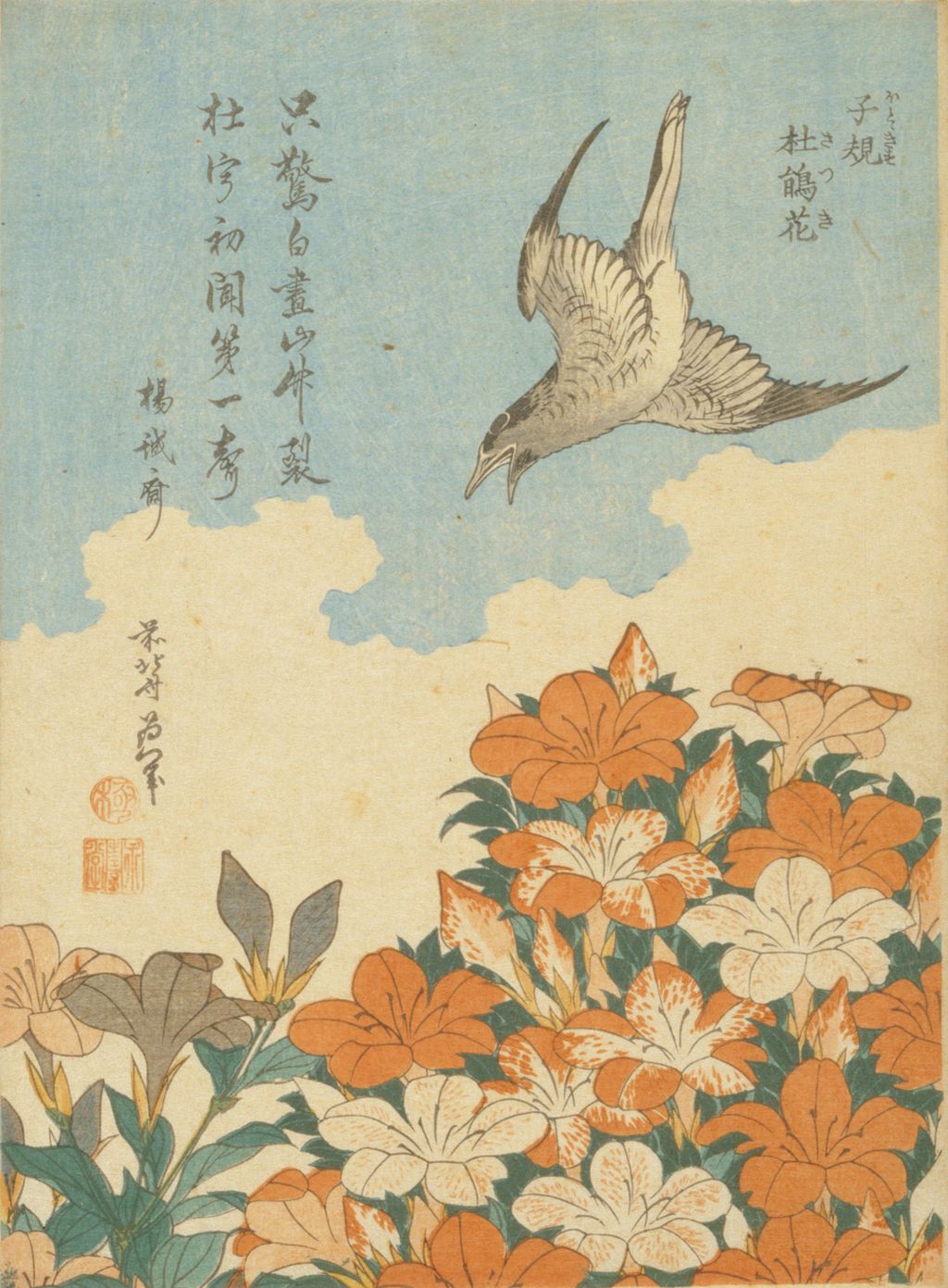
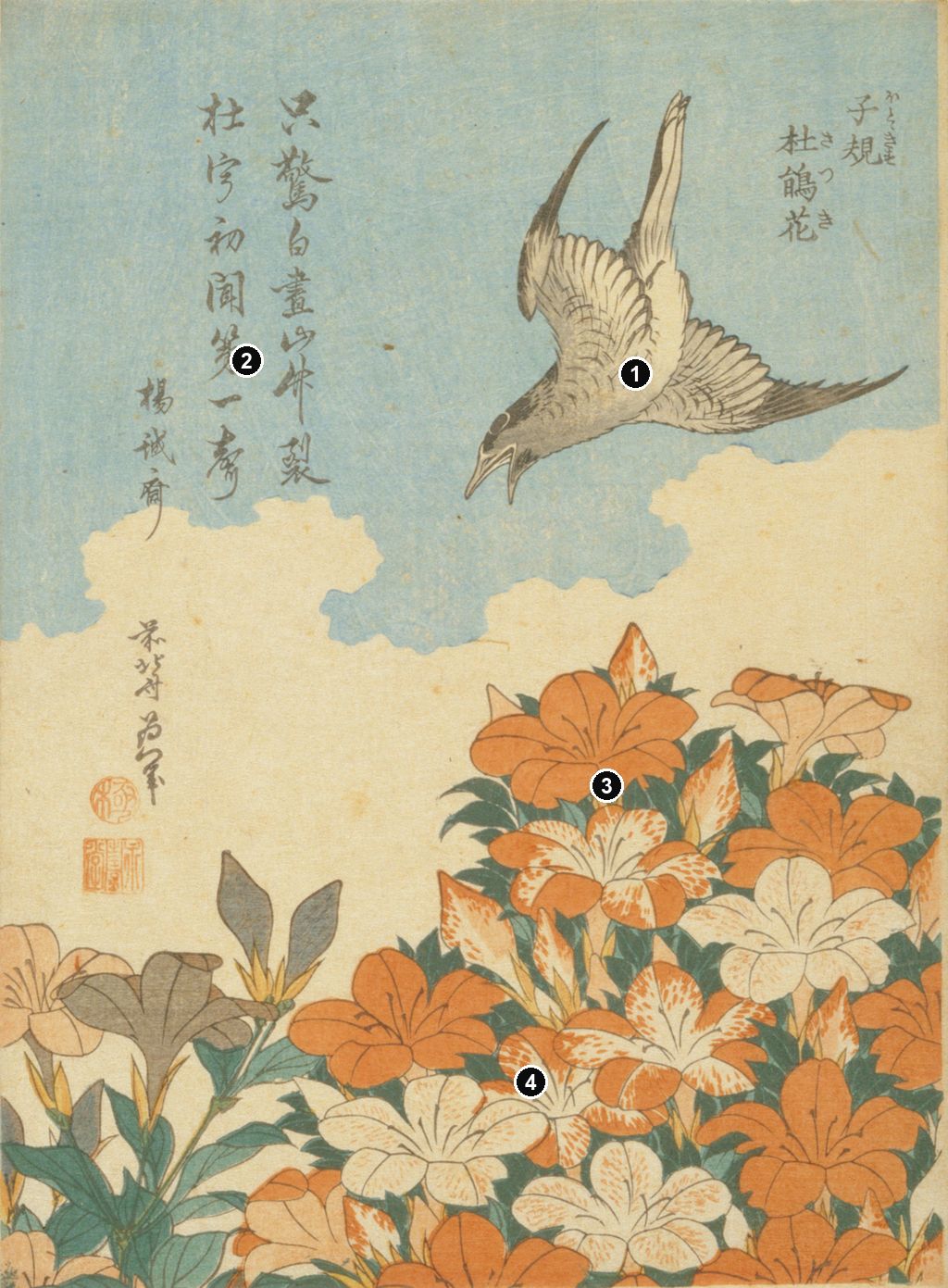
The cuckoo is about midway between the top of the page and the highest blooms. Its wings reach more steeply upward than its tail. Their uneven spread makes the bird look as if it is banking. The eye can follow the narrow tip of one wing down through a succession of feather contours to the shoulder. From there it can take the low line of the head and bill or sweep along the slimmer tail. The silhouette has several pointed ends, and only the head and the slight downturn of the bill give a clear indication of where the bird is going. [1] [3]
The short dark lines across the pale underside bend with the form of the body. They are closer together where the plumage turns away. The extended wing tips are easier to read against an uninterrupted blue field, and the bill and feet remain distinct at the lower edge of the bird. Hokusai lets some of the contour read as a clear boundary and uses small changes within it to make the bird feel rounded. The feet hang beneath the body without finding a support. That little detail contributes as much to the sense of a passing instant as the wider sweep of the wings. [1] [3]
The right edge leaves relatively little space beyond the tail. In the direction of the bill there is a larger interval, and the vertical writing sits some distance beyond that. The bird thus seems to arrive from one edge of the sheet with somewhere still to travel. The pale opening below it is widest to the left, where the larger group of flowers falls away. Part of the force of the flight comes from that opening. The viewer can follow the cuckoo’s downward line before encountering either a character of the poem or the outline of a petal. [1] [3]
How the azaleas gather below
The plants fill the lower part of the print from side to side. Their highest group rises at the right, directly beneath the bird’s tail. A second group reaches into the lower left. Between them the stems and foliage leave narrow openings through which the pale ground can still be seen. Where the stems reach the bottom edge they carry on out of sight. The abrupt cropping gives the impression of standing close enough that the plants continue below the viewer, while the uninterrupted air above them keeps the cuckoo in a space of its own. [1] [3]
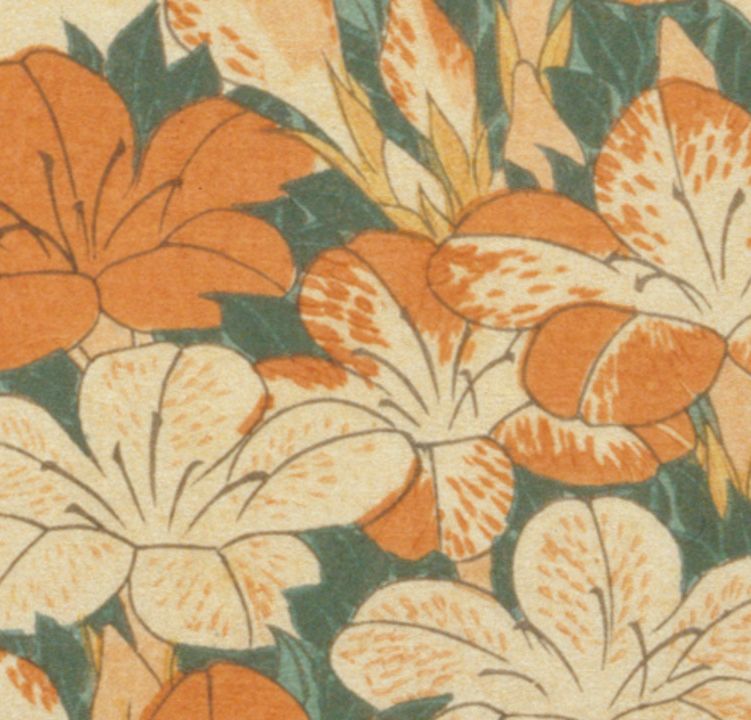
Some azalea flowers face outward, their petals spreading from a concentrated centre. Others sit edge-on near the crest of the taller group. At the right edge, truncated flowers and tips of petals carry the pattern past the border. Within the larger clusters, lighter flowers interrupt the darker patches of orange or red. Across the silhouettes, broad petals meet narrow pointed leaves. This gives the foliage and the flower heads quite different edges, even where they are tightly compressed. The centres, stamens and fine petal marks are visible at a scale far smaller than that of the bank of flowers as a whole. [1] [3]
Satsuki is the azalea named in the title. RISD’s exhibition label describes it as a later-blooming azalea that flowers into early summer and connects the lesser cuckoo’s cry with the same season. Japan Search’s survey of the bird traces that association through Japanese poetry and notes the attention given to its first call of the year. The pairing can suggest a point in the calendar without a date written into the scene or a landmark that fixes a place. The blossoms give the season material form while the bird supplies a signal that listeners would recognise. [1] [4]
An interruption in the poem
The inscription at the upper left brings Chinese verse into the design. RISD transcribes the two lines as 只驚白晝山竹裂 and 杜宇初聞第一聲, with the attribution 楊誠斎, Yang Chengzhai. Chengzhai was the literary name of the Southern Song poet Yang Wanli. The lines close the third of six poems on passing through the Zhenyang Gorge. The received text in volume 15 of Yang’s collected works begins that poem with a narrow view of blue sky and an exceptionally still river. Those first two lines are outside the excerpt on Hokusai’s sheet. They supply the quiet in which the sudden sound would have been heard. [1] [5]
In the RISD exhibition label’s translation, a speaker is startled in daylight by the sound of mountain bamboo cracking and hears the cuckoo’s first cry. The print gives neither bamboo nor a river a visible place. It sets out the call’s occasion instead through a bird in motion above crowded blossoms. The open space and the compact shape of the bird can suggest the same quick change of attention as the verse. A reader who entered the picture through the mass of flowers has to look up, just as the calm earlier lines of the poem yield to an abrupt sound. [1] [3] [5]
The writing also plays a part before it is read. Its two vertical strokes of dark, densely spaced characters hold the left side of the blue against the bird at right. The shorter attribution drops below the principal columns. The title naming the bird and flower sits high at the right, near the pointed tail and wing. Lower down at the left, the artist’s signature and red seals fall over quieter ground. RISD records a signature using Iitsu and identifies the Eijudō publisher’s seal of Nishimuraya Yohachi and the kiwame censor’s seal on 34.486.2. Reading those marks separately makes it possible to distinguish the design’s title, the poet’s name and the names associated with making and publishing the print. [1] [3]
The same design in different impressions
Compare the reproductions of Tokyo National Museum’s A-10569-668 and RISD’s 34.486.2. The soaring wing, the hooked pale edge below it and the flower heads at the upper right of the plant mass align closely. The RISD photograph shows a dark band of blue across the very top and a more forceful separation of warm and light flowers. In the Tokyo photograph the highest part of the sky is much less strongly banded, and several flowers read as orange rather than red. Tokyo’s picture also gives the light spaces between the blossoms a warmer cast. The differences are visible in the photographs. The colour of a photographed impression depends on what was printed, what has happened to the sheet since then and how the photograph was made. [1] [2] [3]
The outline where the pale forms meet the blue gives a useful point of comparison. Below the cuckoo the rounded edges step down to the left, then rise again towards the writing. A viewer can recognise that irregular boundary even in a small reproduction. The colours within the boundaries vary more visibly than the shapes themselves. Looking at the two sheets this way shows which parts of Hokusai’s design remain recognisable when the tonal balance shifts. [1] [3]
RISD exhibited another impression, 34.486.1, alongside 34.486.2 and invited visitors to compare them. The object record for 34.486.1 includes print scholar Roger Keyes’s note identifying it as a later impression on the evidence of a seal printed on the block. The National Gallery of Victoria lists an impression from the Japan Ukiyo-e Museum in Matsumoto whose design is dated about 1834 and whose printing is placed in the late nineteenth century. Museum catalogues therefore use dates in two different ways here. An approximate design date describes when the image originated, while a printing date concerns an individual sheet. Assigning other impressions to a sequence requires evidence specific to those sheets. [1] [6] [7] [8]
Small Flowers and Large Flowers
The Matsumoto impression was exhibited as part of the untitled group known as Small Flowers. The National Gallery of Victoria describes the group as a set of medium-sized prints that combine named birds and flowering plants with Japanese or Chinese poems. In Cuckoo and Azaleas, the tall sheet gives distinct places to the flower bank, the flight and the lettering. The printed words occupy a substantial part of the sky. They also specify the plant and bird and bring a second place, the gorge in the poem, to mind. The azaleas instead keep the view close to an immediate encounter with a flying bird. [1] [5] [7]
Hokusai used the wider dimensions of the Large Flowers prints to different effect. In Poppies, the bowed stems and weight of the blossoms make the wind visible across a horizontal sheet. In Hydrangea and Swallow, the descending bird almost meets the mound of very small florets, so that the narrow gap between wing and flower acquires much of the picture’s tension. The cuckoo has a wider opening in front of it and a more distinct separation from the plants below. Hokusai fills part of that opening with lines about an abrupt call. The verse asks a reader to pause where the picture itself suggests that the bird will be gone in another moment. [1] [7] [9] [10]
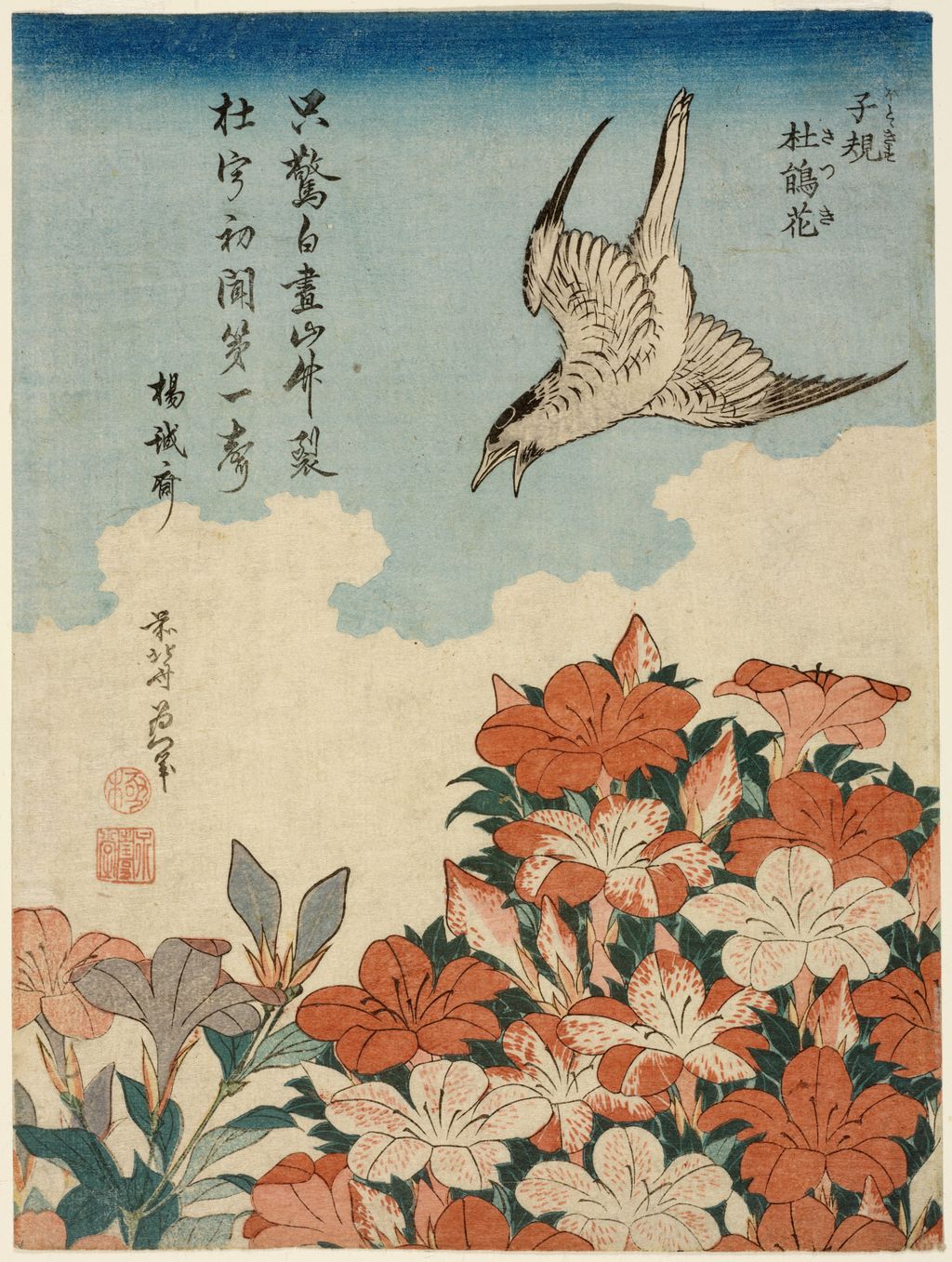
Image comparison
Where this work sits in Hokusai’s career
Annotated Details from Cuckoo with Satsuki Azaleas
Tokyo National Museum via ColBase, A-10569-668. Adapted with markers and detail crops under the ColBase terms. [3]
Details from CUCKOO WITH SATSUKI AZALEAS
Select a detail to look closely.
The bird turns towards the flowers
Extended wing feathers and the narrow tail divide the space around the bird. Its body carries the eye towards the ground below. [3]
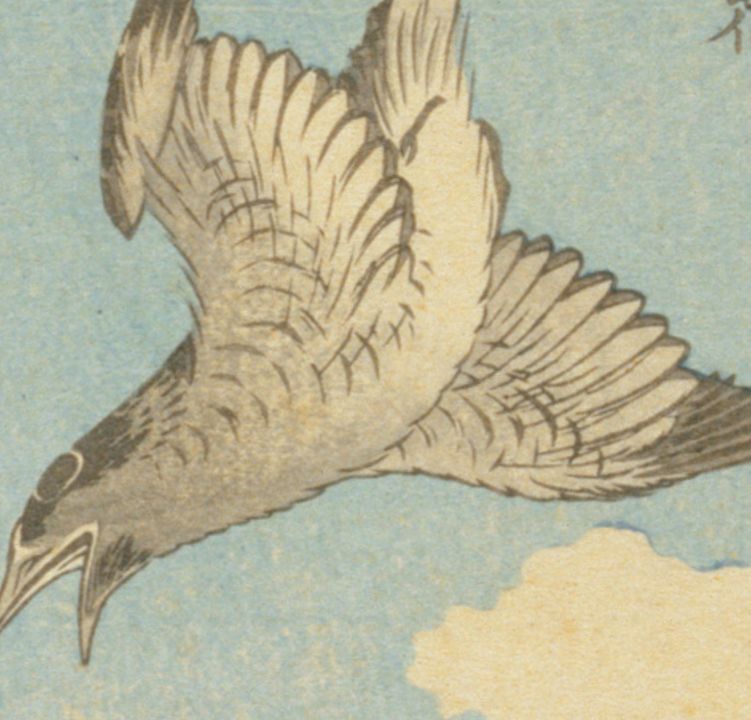
Writing draws the eye down the sky
Vertical writing occupies open space beside the bird. The spacing leaves room to look from the characters to the spread of the wings. [3]
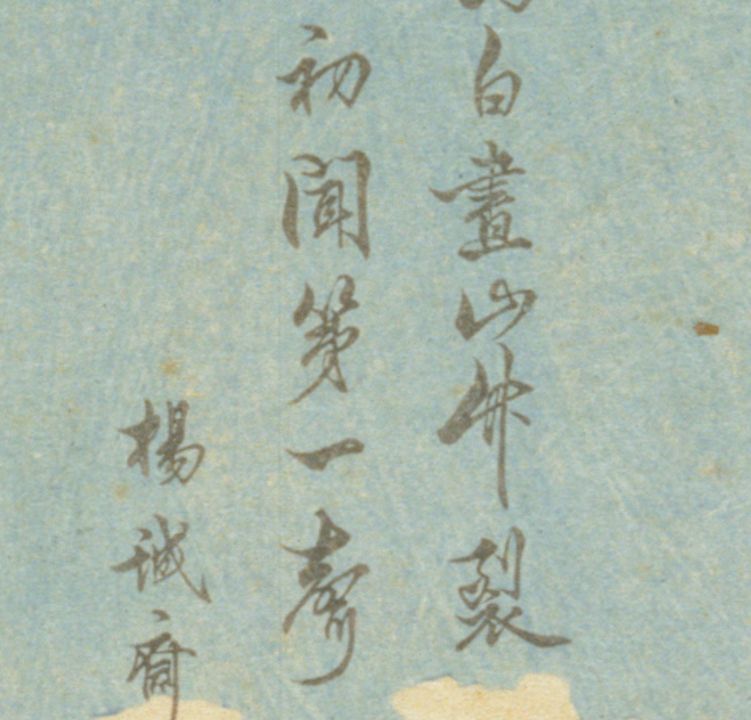
A shelf of orange blossoms
The top of the planting rises on the right. Orange petals cross the lighter ground below the bird and begin a dense field of flowers. [3]
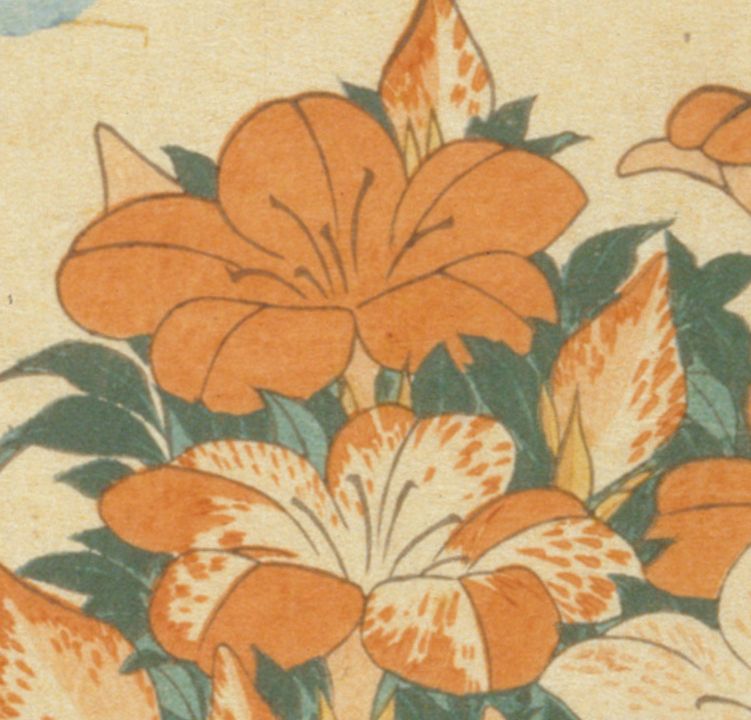
Light blooms leave openings below
Pale flowers are folded in among the darker foliage. They give the eye small points of relief in the lower part of the sheet. [3]
Explore Hokusai’s works
Discussion
Look again at the images and ideas explored in Cuckoo and Azaleas. These editorial prompts invite your observations.
Reader Insights
How does the vertical sheet shape the bird’s flight?
Where do you shift your attention between the poem and the flowers?
Join the Conversation
Share a detail, comparison or question about Cuckoo and Azaleas below.
References
- RISD Museum, Cuckoo and Azaleas, accession 34.486.2, object record, inscription and exhibition label. View source.
- Art Platform Japan, Cuckoo with Satsuki Azaleas, Tokyo National Museum accession A-10569-668. View source.
- Tokyo National Museum, Cuckoo with Satsuki Azaleas, digitisation C0083284 via ColBase. View source.
- Japan Search, Lesser Cuckoo (Hototogisu), curated digital gallery. View source.
- Yang Wanli, Chengzhai ji, Siku quanshu edition, volume 15, third poem in Passing through the Zhenyang Gorge (過真陽峽). Read the text. View source.
- RISD Museum, Cuckoo and Azaleas, accession 34.486.1, object record and notes on the seal. View source.
- National Gallery of Victoria, Hokusai, exhibition labels, Birds and flowers section and Japan Ukiyo-e Museum impression of Cuckoo and Azaleas. View source.
- RISD Museum, Feathers, Flowers, Talons and Fangs, exhibition checklist, accessions 34.486.1 and 34.486.2. View source.
- The Metropolitan Museum of Art, Poppies in the Wind, accession JP1860. View source.
- Art Platform Japan, Hydrangea with Swallow, Tokyo National Museum accession A-10569-2788. View source.







