


 by Tom Gurney
Tom Gurney BSc (Hons) is an art history expert with over 20 years experience
Published on June 19, 2020 / Updated on November 20, 2026
Email: tomgurney1@gmail.com / Phone: +44 7429 011000
Ushibori in Hitachi Province
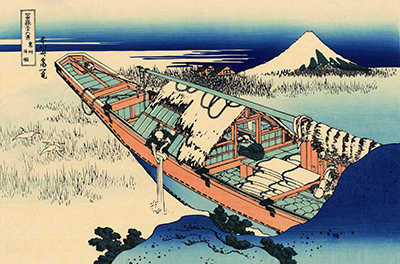
The boat in Katsushika Hokusai’s Ushibori in Hitachi Province is so close that its far left end runs out of the picture. Its long, slanting hull takes up much of the water, and a low shelter occupies the deck. At the other end, a mound rises from the lower right and interrupts the view just below a figure leaning over the side. Beyond the boat are pale water, a fringe of reeds and the snow-covered summit of Mount Fuji. The mountain gives the print its greatest distance, but the boat gives us our place within the scene. The shore in front of us cuts across the hull as it might if we had come upon the vessel from nearby. [1]
At a Glance
- ArtistKatsushika Hokusai
- Dateca. 1830–32
- MediumColour woodblock print
- SeriesThirty-six Views of Mount Fuji
Contents
A boat seen from the bank
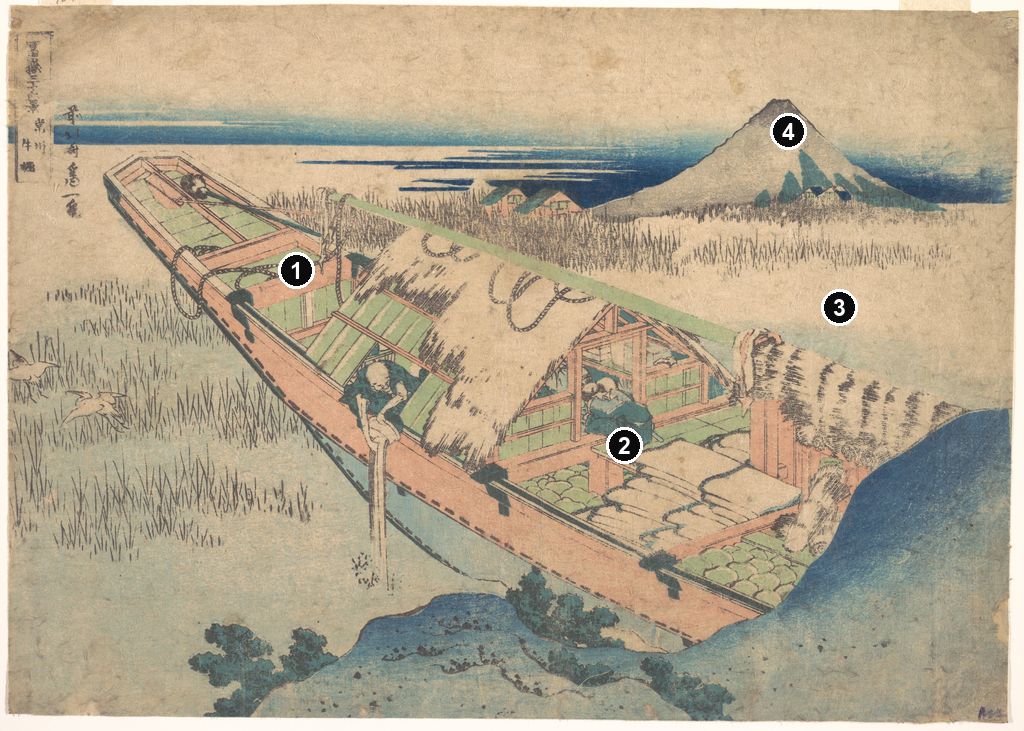
The long side of the hull runs from the left edge toward the bottom of the print. The deck and the ridge of the shelter follow much the same direction, making the boat’s angle apparent at several heights. There is room above the left end for open sky, and beneath it for a narrow strip of water. Near the right end, the deck approaches the mound and the water nearly disappears. The mound’s irregular upper edge, with its dark tufts and small projections, meets the largely straight edges of the boat. That meeting is enough to suggest an immediate foreground even though we see little of the shore itself. [1]
The shelter makes the vessel look like a place where people spend time. Thin upright supports break the opening beneath the roof into separate spaces. Small rectangular shapes show through the opening, while the covering hangs unevenly over its edge. The slope of the roof catches more light than the shaded opening below. On the exposed deck at left, the repeated lines of the planks lead back toward the shelter. These details are most closely spaced on the largest object in the print. Beyond it, there are whole reaches of water and sky with very few marks, a difference that helps make the near and far parts of the scene feel separated. [1]
The Sumida Hokusai Museum proposes that this is a takasebune, a large freight boat of the Tone River waterway. It identifies the protected part of the vessel as a space where people could cook and sleep. The MOA Museum of Art describes the boat by another feature, its straw-covered shelter. The activity Hokusai shows takes place at the shelter’s exposed end, where a person can reach over the side. A boat of this size could carry goods across a region, yet this particular view lets us see how little space a person takes up while attending to a task on board. [2] [3]
Water at several distances
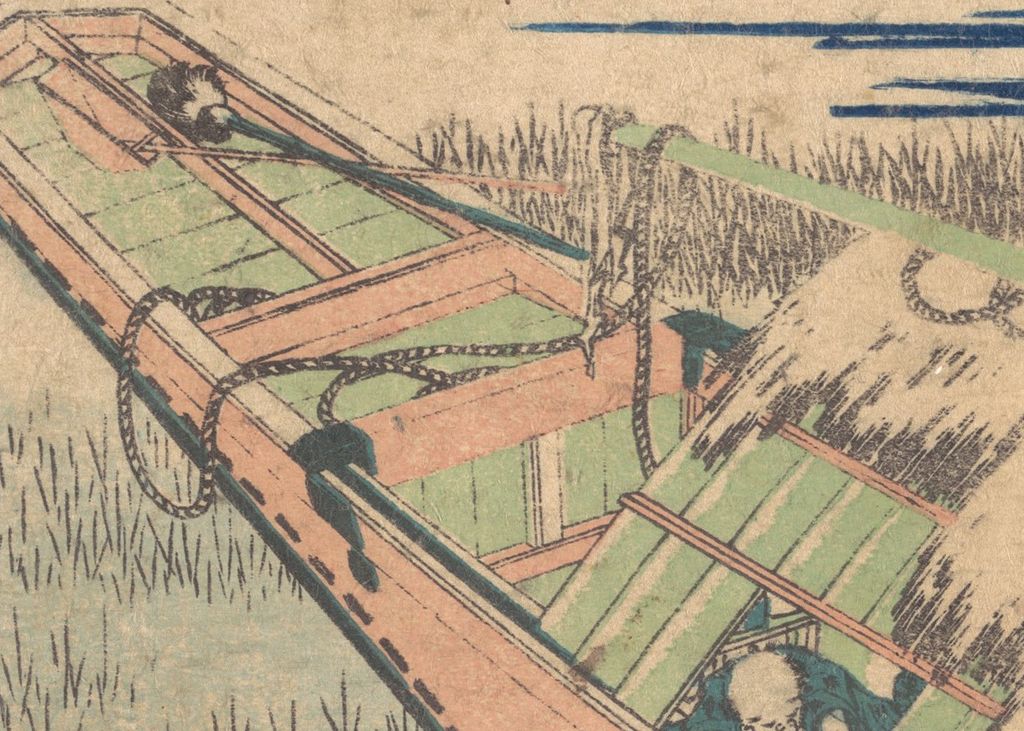
Below the leaning figure, a thin, pale line of water drops past the hull. Hokusai gives the movement very little space. The body angles over the edge, and the falling stream leads the eye downward just where the boat itself is about to pass behind the mound. The Sumida Hokusai Museum suggests that the figure is pouring away water used to rinse rice. That explanation comes from the museum’s reading of the action and the vessel’s use. The stream and the person’s posture are plain to see, even at a scale where the contents of the vessel are impossible to make out. [1] [2]
Two pale birds rise on the left. One has its wings spread more broadly, while the other turns at a steeper angle. Their silhouettes are small enough that they can be missed on a first look, especially beside the much larger hull. Once noticed, they open up the space to the left of the boat. The Metropolitan Museum of Art identifies them as herons. The MOA Museum of Art connects their flight with the sound of the poured water. The print leaves the interval between those events open. The abrupt change in direction from the sloping boat to the beating wings is visible in a single glance. [1] [3]
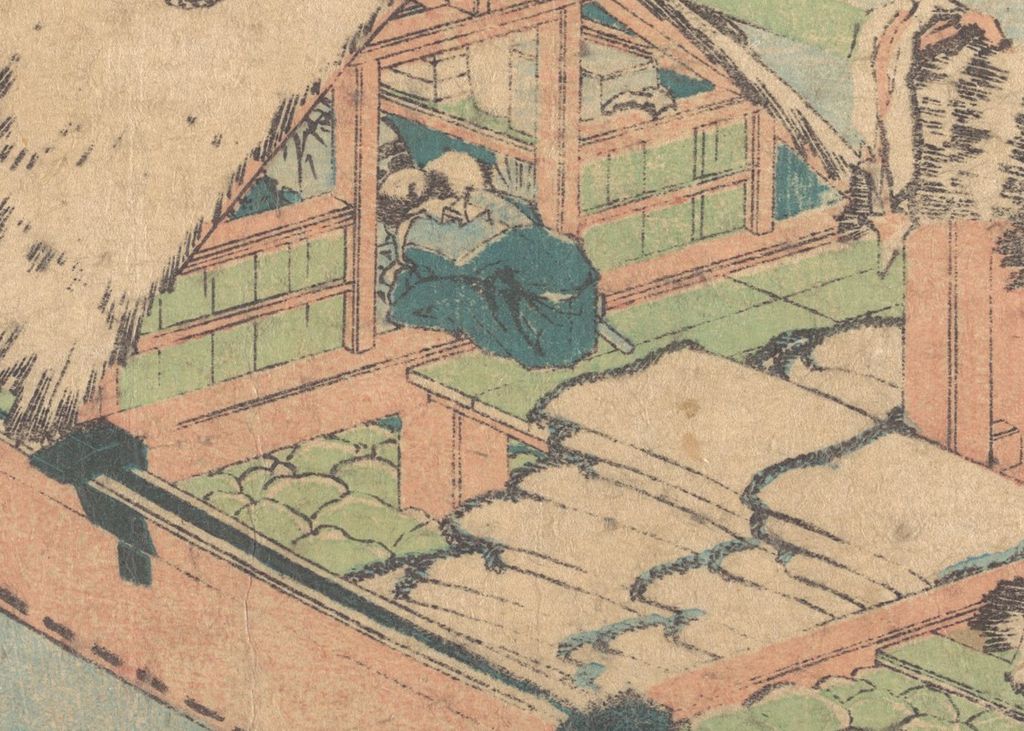
The water extends well past that little disturbance. Behind the boat, narrow pale bands are broken by darker lines of reeds. Farther away, the reed marks draw so close together that they look like a continuous fringe. Around the boat we can still distinguish the water beneath an exposed stretch of hull from the wet ground at the edge of the mound. Across the shallows, separate details become harder to pick out. The long horizontal divisions carry our attention past the boat and establish the distance between the near shore and the base of Fuji. [1]
Ushibori lay near the outlet of Lake Kasumigaura, in what is now Itako in Ibaraki Prefecture. The Sumida Hokusai Museum places the village on a water transport route connected with the Tone River. The museum explains that crossing the lake could be difficult in strong winds and suggests that the vessel may be waiting for suitable weather. In Hokusai’s view the water has few visible ripples and the boat remains close to the bank. With the journey suspended in the museum’s reading, there is time for the ordinary work of preparing food, and space for a small movement to catch our attention across the water. [2]
The same lines in different impressions
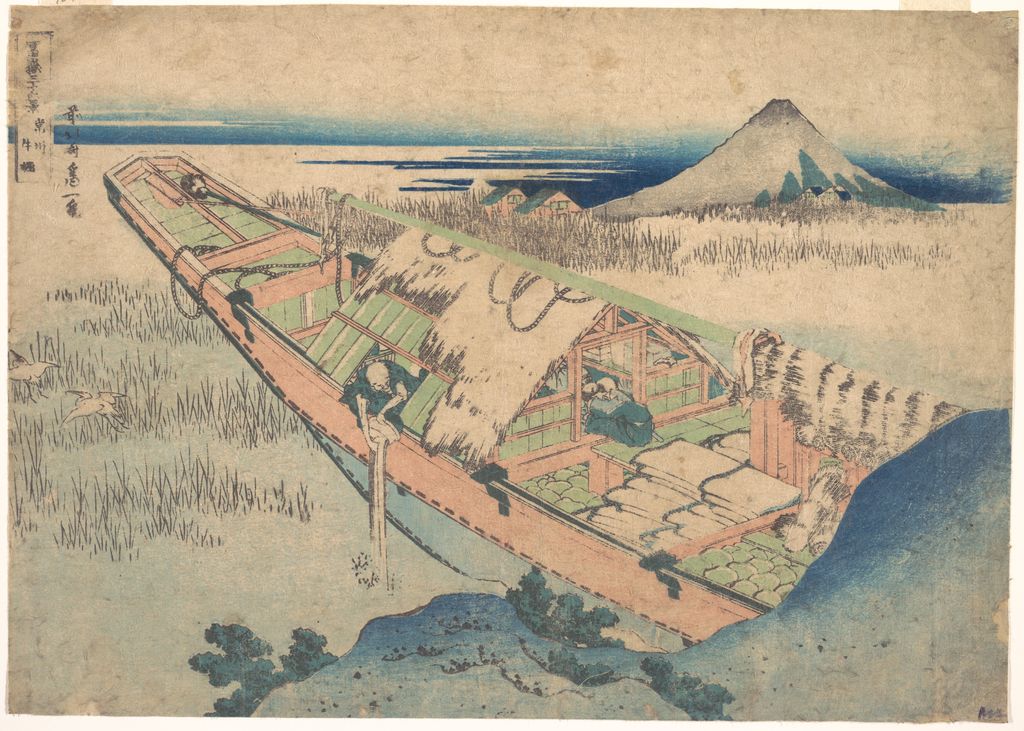
The Metropolitan Museum of Art dates its impression JP1848 to about 1830–32. The sheet measures 24.9 by 35.2 centimetres and entered the museum with the H. O. Havemeyer Collection in 1929. In the museum’s photograph, a warm, irregular tone spreads across the pale sky and part of the mountain. A narrow blue strip lies near the horizon. The hull has a pinkish orange band running across much of its visible length, while dabs of green show around the shelter and a dark blue follows the near bank. The broad wash of warm colour behind the reeds lowers the contrast around Fuji, so that the boat takes precedence even when we look toward the mountain. [1]
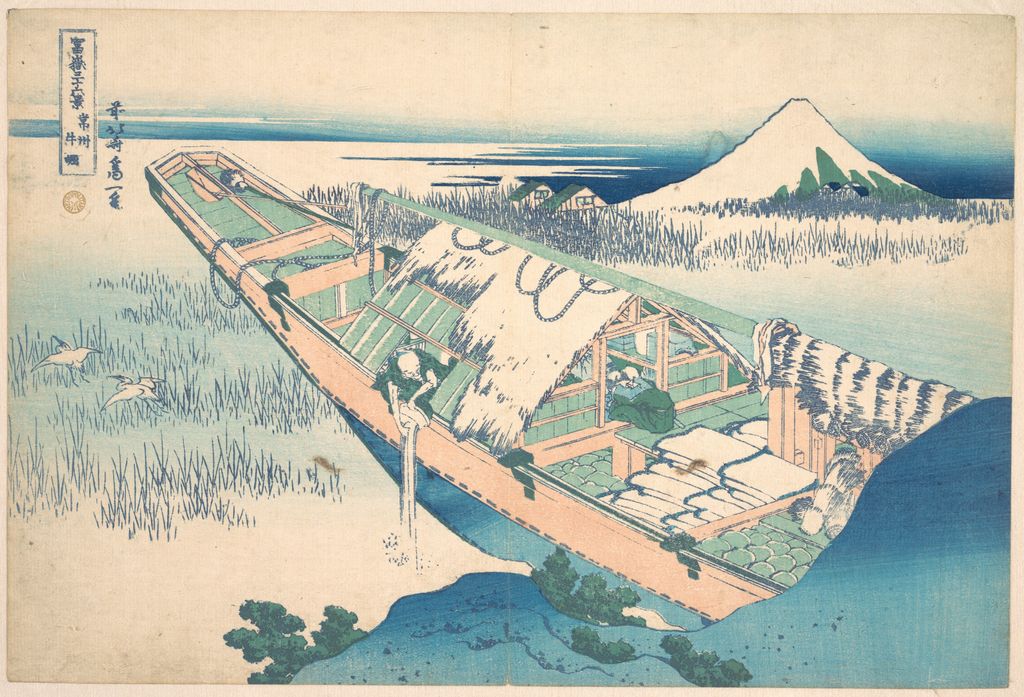
The Met’s Ushibori JP27, acquired through the Rogers Fund in 1914, measures 24.6 by 36.7 centimetres. In that photograph, the summit stands out more clearly against the sky. The print’s blue-green areas are more apparent at the right of the boat and along the lower bank of reeds. The pink of the hull is lighter, and the right-hand stretch of water reads as a larger area of colour. The title cartouche and the small round mark underneath it are easier to pick out. The placement of boat, birds and mountain holds steady between the two sheets. What changes for the viewer is how quickly those elements come forward, particularly the summit and the pale expanse below it. [1] [4]
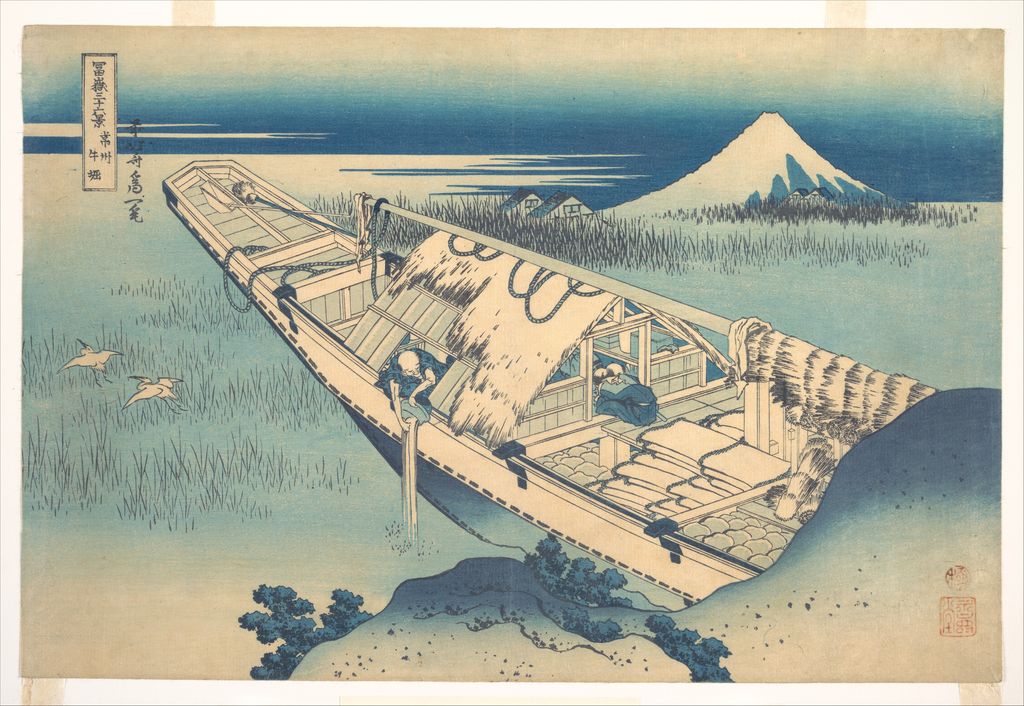
A third Met impression, JP2565, has a deeper band of blue in the upper sky, graduating toward the pale area around Fuji. More blue-green is visible among the reeds, and the two birds stand apart from the dark marks bordering the water. Near the mound, the blue makes the bank easier to follow against the hull. In each of the three museum photographs, we can trace the same long slope of the roof and the same break in the view where the mound comes up in front of the boat. Colour and condition affect how those lines read, while the encounter between the hillock and the hull survives every change of emphasis. [1] [4] [5]
The Museum of Fine Arts, Boston, has published an analysis of a different impression, accession 21.5363. Its measurements identify indigo and Prussian blue together at two sampled points, Prussian blue at two others, and indigo with the yellow pigment orpiment at another. This testing establishes the colourants present at those points on the Boston sheet. In the Met photographs, the various blues can be compared by eye for their depth and the space they occupy. The Boston evidence gives a material example of how varied the palette could be even within a single impression of this design. [6]
Fuji across the shallows
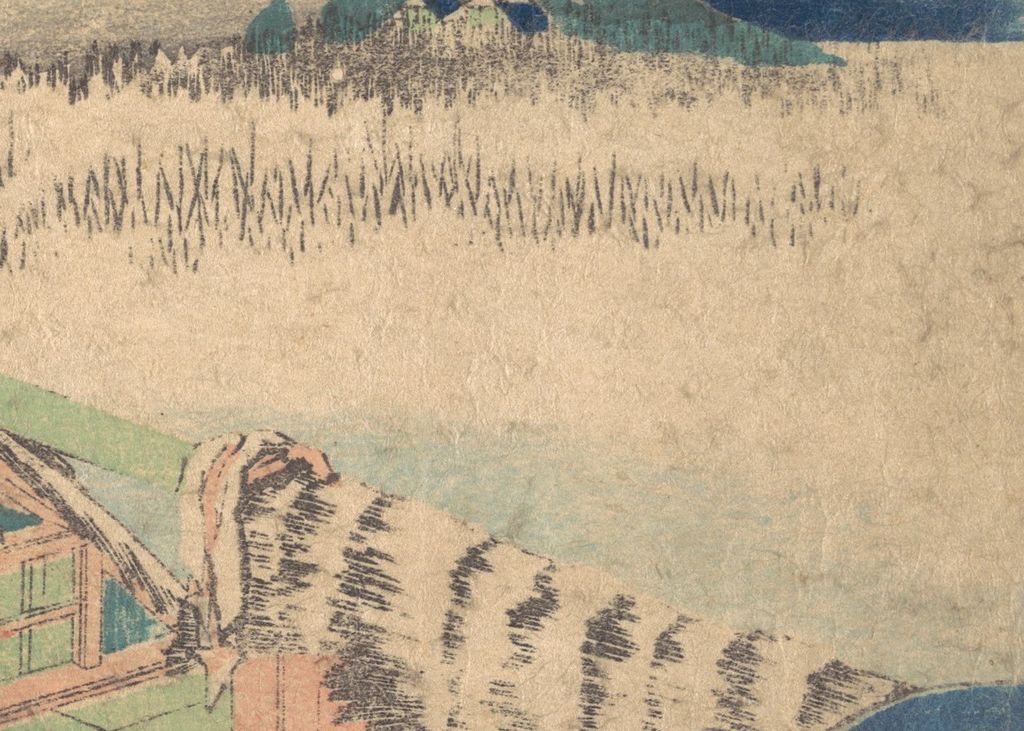
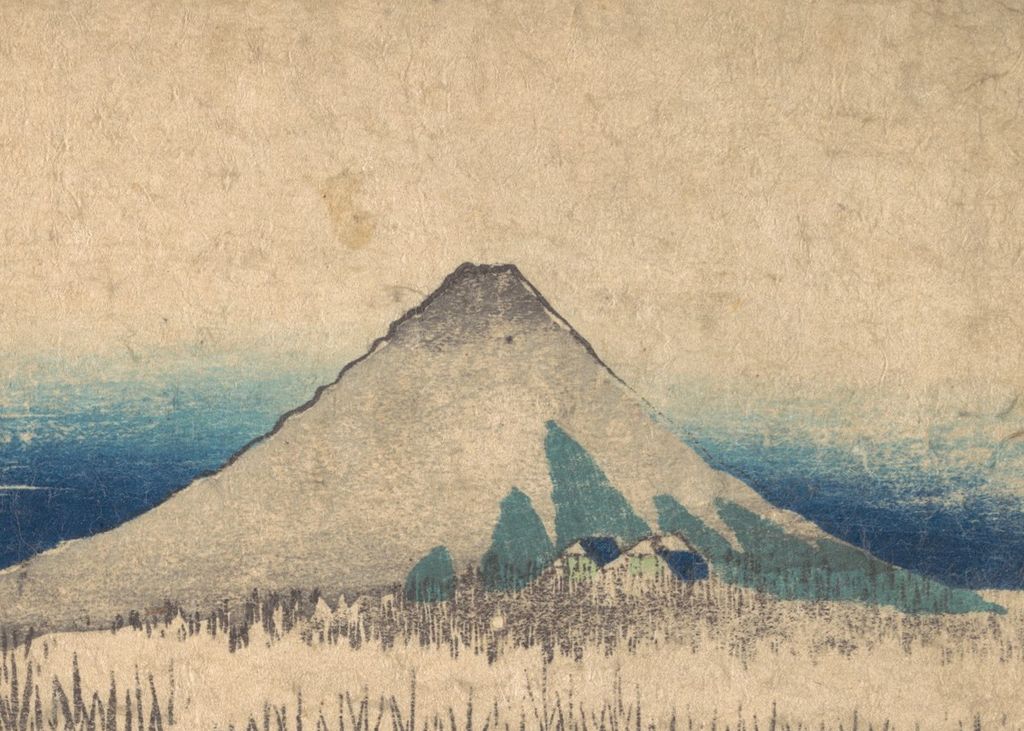
Fuji stands right of centre, low enough that there is a large expanse of sky above the summit. From the nearer water, the horizontal reed bands lead to the mountain’s lower slopes. Only then does the eye rise again along the sides of the cone. The distance makes the summit look modest next to the vessel. Its relatively simple profile also differs from the shelter, where we can follow individual uprights and changes along the edge of the covering. We recognise the snow on Fuji by the broad light shape alone. The mountain is far away in a sense that has as much to do with the sparseness of its marks as its apparent size. [1] [4]
The National Museum of Western Art’s Iuchi Collection checklist lists Ushibori in Hitachi Province as no. 15 among Hokusai’s Thirty-six Views of Mount Fuji. The series brings the mountain into views of working waterways with different foreground scales. In Shore of Tago Bay, Ejiri, people in two long boats work against rising water, and the hull of the nearest vessel runs across much of the lower edge. The slanting shelter at Ushibori brings us in close to one boat, and the reeds set it within a quieter stretch of water. The boats make the viewer’s position legible in both pictures. At Tago Bay the waves reach along the nearest hull while several figures tend the boat. At Ushibori one person stoops near the edge of the bank, and the interruptions of the view make the space around that figure feel close enough to step into. [1] [7] [8]
Where this work sits in Hokusai’s career
Annotated Details from Ushibori in Hitachi Province
The Metropolitan Museum of Art, JP1848. [1]
Details from USHIBORI IN HITACHI PROVINCE
Select a detail to look closely.
The boat begins with a sharp diagonal
The long near edge sweeps towards the bottom of the print. It divides the quiet water and reeds into different areas. [1]
A figure leans near the side
The small movement at the side of the vessel becomes clear because the boat takes up such a large part of the view. [1]
Birds cross the low shore
Small strokes rise above the water. Their spacing makes them readable against the low, closely repeated forms behind them. [1]
The distant mountain rises above the reeds
Fuji sits beyond several low horizontal bands, with just enough space around its peak to remain legible. [1]
Explore Hokusai’s works
Discussion
Look again at the images and ideas explored in Ushibori in Hitachi Province. These editorial prompts invite your observations.
Reader Insights
How does the near boat divide the surface of the water?
Which detail makes the distant setting feel quiet?
Join the Conversation
Share a detail, comparison or question about Ushibori in Hitachi Province below.
References
- The Metropolitan Museum of Art, Katsushika Hokusai, Ushibori in Hitachi Province, ca. 1830–32, JP1848, The H. O. Havemeyer Collection. View source.
- The Sumida Hokusai Museum, Katsushika Hokusai, Jōshū Ushibori (常州牛堀), Peter Morse Collection. View source.
- MOA Museum of Art, Katsushika Hokusai, Jōshū Ushibori (常州牛堀), gallery interpretation. View source.
- The Metropolitan Museum of Art, Katsushika Hokusai, Ushibori in Hitachi Province, ca. 1830–32, JP27, Rogers Fund, 1914. View source.
- The Metropolitan Museum of Art, Katsushika Hokusai, Ushibori in Hitachi Province, ca. 1830–32, JP2565, The Howard Mansfield Collection. View source.
- Museum of Fine Arts, Boston, Conservation and Art Materials Encyclopedia Online, Ushibori in Hitachi Province, materials analysis for accession 21.5363. View source.
- The National Museum of Western Art, Iuchi Collection exhibition checklist, no. 15, Ushibori in Hitachi Province. View source.
- The Metropolitan Museum of Art, Katsushika Hokusai, Tago Bay near Ejiri on the Tōkaidō, JP2976. View source.







