


 by Tom Gurney
Tom Gurney BSc (Hons) is an art history expert with over 20 years experience
Published on June 19, 2020 / Updated on November 20, 2026
Email: tomgurney1@gmail.com / Phone: +44 7429 011000
Reflection in Lake at Misaka in Kai Province
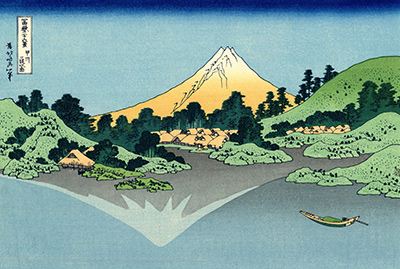
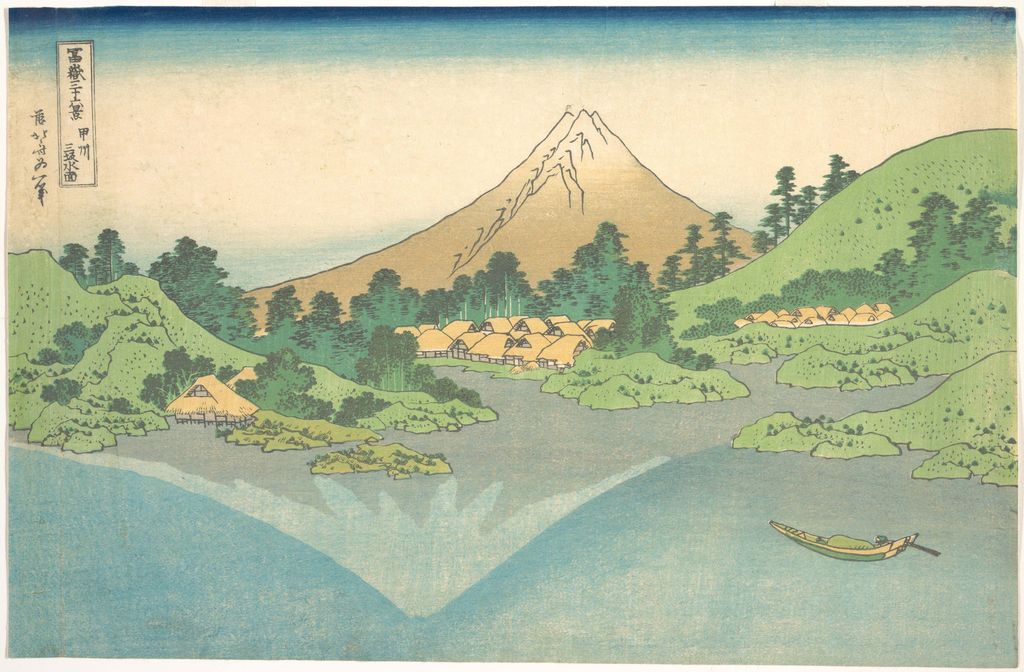
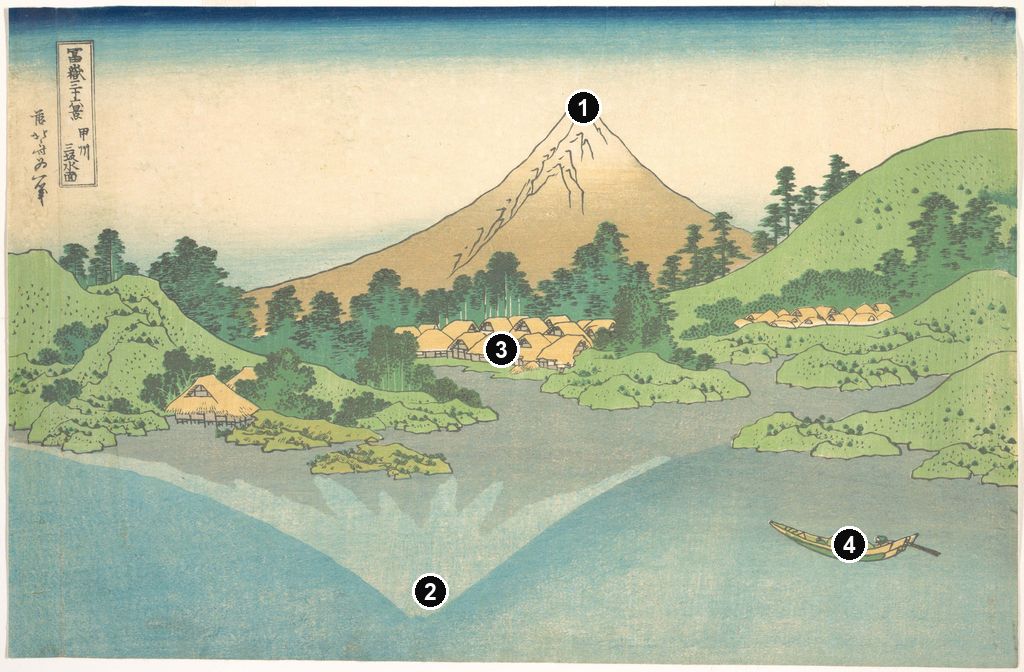
Mount Fuji rises above a wooded shore in Katsushika Hokusai’s Reflection in Lake at Misaka in Kai Province. Its slopes are warm brown and its summit is scored with fine lines. Below the shore, a second summit points down into the blue water. It sits well to the left of the peak above and carries a broad pale area that reads as snow. The differences are easy to pass over because the principal shapes look like a mountain and its mirror image. Once you look at their tips separately, the surface of Lake Kawaguchi becomes the most surprising part of the print. [1]
The Metropolitan Museum of Art dates its colour woodblock impression JP2969 to around 1830–32. The Japanese title, 甲州三坂水面 (Kōshū Misaka suimen), names the water’s surface, Misaka and the historical province of Kai. The National Museum of Western Art lists the design as item 30 in its Iuchi Collection checklist. The Tokyo Fuji Art Museum’s English title names Lake Kawaguchi directly. All three records identify the print as one of Hokusai’s Thirty-six Views of Mount Fuji. [1] [2] [3]
At a Glance
- ArtistKatsushika Hokusai
- Dateca. 1830–32
- MediumColour woodblock print
- SeriesThirty-six Views of Mount Fuji
Contents
Two summits on different axes
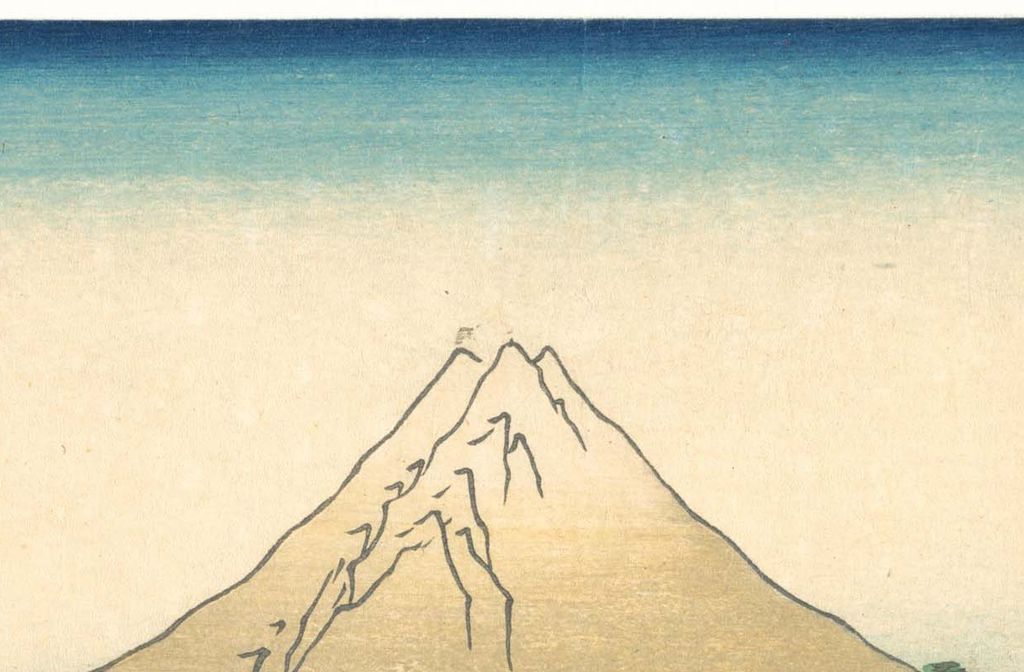
Find the upright summit a little to the right of the centre of the sheet. Its ridge is irregular, with closely spaced peaks and dark strokes running down the face. The slope on the left unrolls gradually behind the trees. On the other side, the incline descends more abruptly towards a steep green hill. The lines on the mountain itself concentrate near the top, where the angle of the ridge changes several times in a small space. From there the lower slopes open out into areas of warm colour that give the mountain breadth. [1]
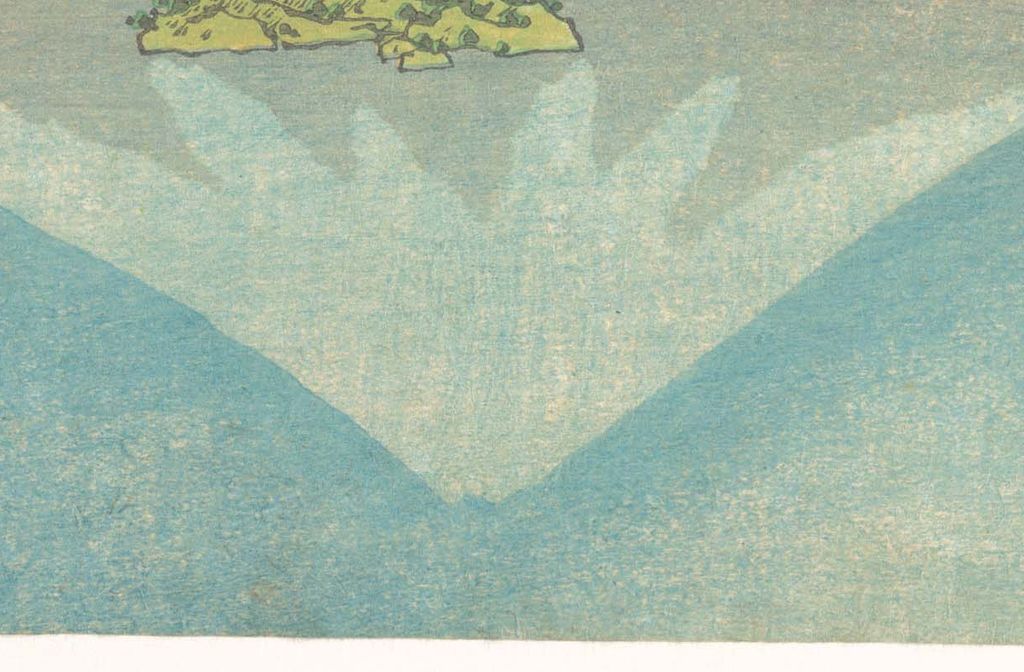
Now look for the point where the inverted mountain comes closest to the lower edge. The tip has moved well to the left and the surfaces have changed. The upside-down mountain has a rounded sweep to its flanks, with branches of pale colour reaching into the darker area just below the shore. The jagged strokes of the upright summit have no clear counterparts in the water. The reflection repeats the recognisable mass of Fuji while giving its ridge and slopes a different character. [1]
An imaginary vertical line through the upright peak meets the water to the right of the reflected tip. This shift lets the larger pale shape occupy a deep part of the left foreground, while the broad reach on the right holds a small boat. Look at the triangle as an area of light as well as a reflected object. Its left side follows the edge of the blue across much of the foreground, where the water would otherwise offer few marks to guide the eye. The National Gallery of Victoria reads the shift as a means of producing asymmetry. The effect is visible in where the picture puts its weight, whether or not we can recover Hokusai’s reason for putting it there. [1] [4]
A shoreline broken into intervals
The middle distance is much busier than the water nearest the viewer. Low tongues of green run out into the lake on both sides. Between them, bands of grey-blue extend inland and turn around the ends of the land. The small indentations at those edges interrupt the long sweep of the shore. The large reflection passes among the same channels and meets several green silhouettes, making it harder to point to a single line where land ends and reflection begins. [1]
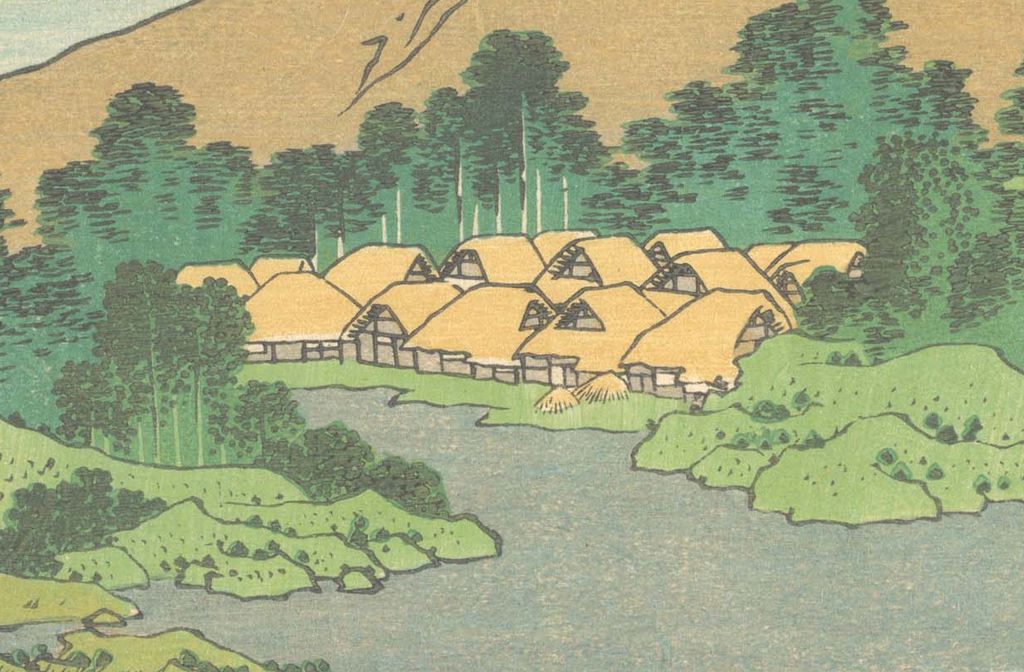
Hokusai groups the houses in pale clusters among the dark trees. Several roofs sit directly below Fuji, a low house appears at the left near the water, and a thinner row extends across the slope to the right. Seen from further back, the roofs give the middle of the print a series of small warm notes related to the colour of the mountain. Seen close up, they have their own directions and profiles. The eye can follow one group to another before returning to the broad shape in the foreground. The size of the houses also makes it possible to register the scale of hills that occupy very little space on paper. [1]
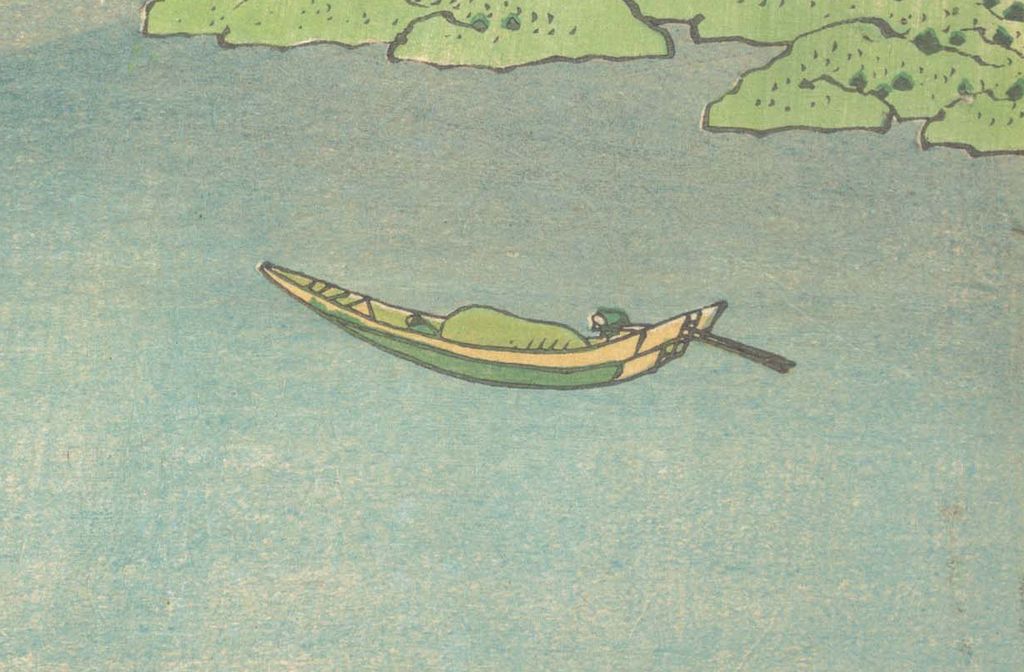
There is one open boat towards the lower right. Its thin, curved hull sits at a shallow diagonal, and a long stroke extends beyond its raised end. The Met identifies a lone fisherman. The boat is small enough that it could easily be missed among the shapes of the shore, so giving it open water makes a difference. Its warm colour catches the eye in the blue, as the roofs catch the eye among the trees. It is also something perceptibly on the surface, a useful point of reference in a print that asks the viewer to distinguish the water from the scene apparently within it. [1]
Summer and winter in one view
The Met proposes that the two forms of Fuji may represent different seasons and suggests that the snowy mountain in the water would have been the more familiar image. The Tokyo Fuji Art Museum and the MOA Museum of Art read the summer and winter contrast more directly. Both describe a mountain with its slopes exposed above the lake and a winter mountain reflected below. The National Gallery of Victoria emphasises the reduction of rocky detail as well as the snow, comparing the brown, lined slopes above with the smooth form in the water. Each reading starts from visible differences, while the Met leaves the seasonal explanation open. [1] [3] [4] [5]
The colours support that reading in JP2969. The upper mountain takes warm colour nearly to the summit, while the inverted mountain takes a pronounced wash of pale blue. At the same time, the reflection is a different drawing of the mountain. Its snow has a shape and extent of its own, and its tip has moved sideways. Gradation alone would not account for those differences. It is possible to notice one season in each version and still find the more interesting question in the interval between them. A proper mirror would make those two mountains coincide, while the print gives the viewer enough space to read each one as a separate form. [1] [3] [4]
Misaka Pass and Lake Kawaguchi
The Met locates the view at Misaka Pass and describes an approach by the Isawa road. Japan’s Kanto Regional Development Bureau also associates the picture with the pass, noting both the rocky detail Hokusai gives Fuji and the leftward shift of the reflection. The bureau offers the contrast between a real view and an imagined one as a possible explanation. The print title provides the place name, but the sites from which the different components of the scene could be seen are a separate question. [1] [2] [6]
The Sumida Hokusai Museum identifies the water as Lake Kawaguchi and describes a different proposal. Its account notes that the reversed Fuji is not visible from the old Misaka Pass and points to the angles of the mountain’s ridges, the neighbouring hills and the outline of the shore as evidence for a view from the lakeside or from the water. That proposal takes the small shapes as seriously as the famous summit. It also helps explain why naming the lake and historical area is easier than placing the viewer at an exact spot. The debates about location and season address different parts of the image: one asks where the elements of the view come from, while the other asks how Hokusai made those elements work together in the print. [1] [6] [7]
Comparing two Met impressions
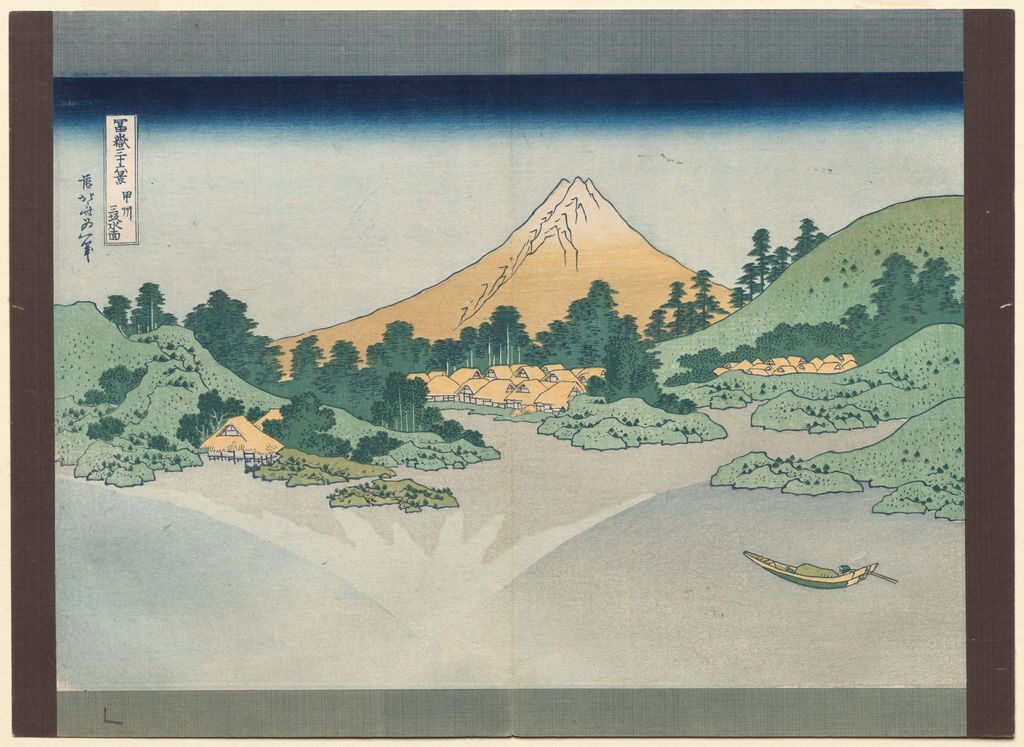
The Met’s JP2969 measures 24.4 by 37.5 centimetres. Its JP14 is a separate impression of the same design, measuring 24.9 by 37 centimetres. The summit lines, the houses and the shape of the boat establish the match across the two photographs. Line up the upper peak first, then follow the same landmarks down to the end of the small left peninsula. The relative positions of the two summits hold even as the differences in colour make each impression feel like a slightly different view. [1] [8]
The pale triangle below the shore separates readily from the stronger blue water in JP2969. The corresponding outline in the photograph of JP14 is much softer against the grey-green surface, so the boat can be easier to notice before the reflection. The passage between the dark upper strip and the slopes of the mountain also changes in appearance. In JP2969, a warm pale interval opens under the blue. In JP14, cool colour extends further down through the sky. The darker strip near the top still holds the same relationship to the cartouche at the left. Against that firm upper edge, the softer boundary of the reflected mountain in JP14 makes the unequal balance of the two halves less apparent at first glance. Those are differences visible in the two museum photographs. They give us different ways to read the design without establishing a production sequence or identifying the pigments. [1] [8]
The same series offers a useful contrast in The Lake at Hakone in Sagami Province. There the near hillside rises steeply on one side and the lake is held among the slopes. At Misaka the foreground water opens towards the lower edge and there is room to look into it. Compare where the eye goes after finding Fuji in each work. At Hakone it can follow the broad hillside down to the lake. At Misaka the lake asks for a second look at the mountain itself. [1] [9]
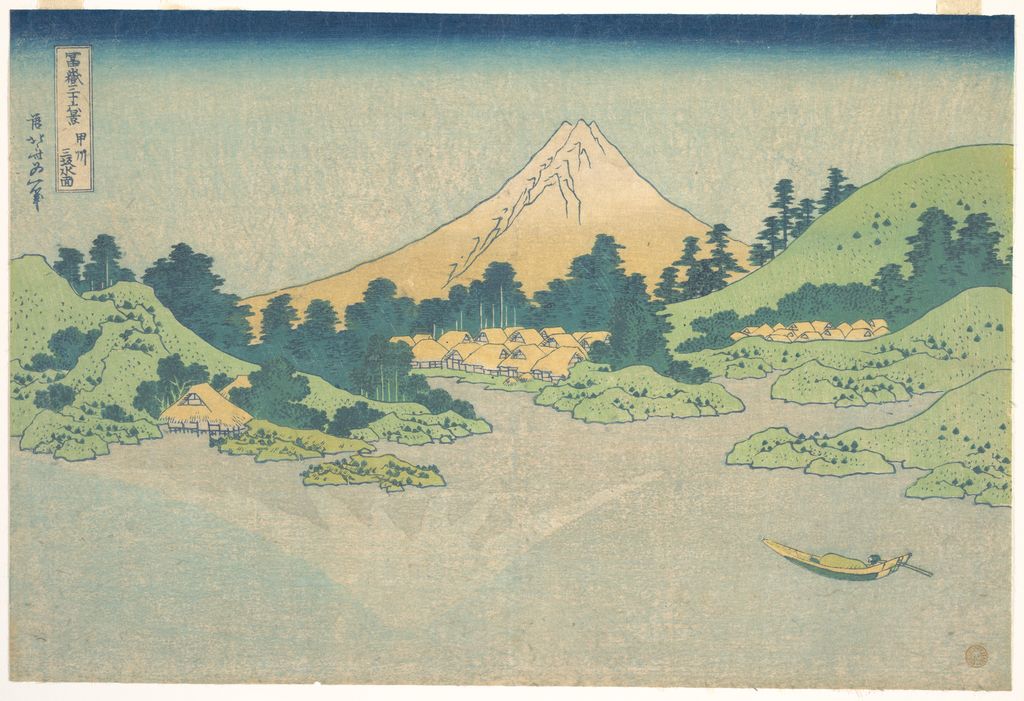
Image comparison
Where this work sits in Hokusai’s career
Hokusai Manga
From 1814Reflection in Lake at Misaka in Kai Province
ca. 1830–32Annotated Details from Reflection in the Surface of Lake Misaka
The Metropolitan Museum of Art, JP2969. [1]
Details from REFLECTION IN THE SURFACE OF LAKE MISAKA
Select a detail to look closely.
The mountain rises above the trees
Short lines break the light surface near the top. Lower on the slope, repeated contours lead down towards the shore. [1]
An inverted mountain appears in the water
The reflection descends across the lower field. Its point falls to the left of the mountain’s peak above. [1]
The shore divides the two mountains
Trees and horizontal bands anchor the waterline between the upright mountain and the inverted form. [1]
A small boat interrupts the quiet water
The long low shape stands out on the right. Its presence helps the lower half of the sheet read as water. [1]
Explore Hokusai’s works
Discussion
Look again at the images and ideas explored in Reflection in Lake at Misaka in Kai Province. These editorial prompts invite your observations.
Reader Insights
How do the mountain and its reflection differ?
What joins the two sides of the composition at the waterline?
Join the Conversation
Share a detail, comparison or question about Reflection in Lake at Misaka in Kai Province below.
References
- The Metropolitan Museum of Art, Reflection in Lake at Misaka in Kai Province (Kōshū Misaka suimen), impression JP2969, collection record and photograph. View source.
- The National Museum of Western Art, Iuchi Collection checklist, item 30, 甲州三坂水面. View source.
- Tokyo Fuji Art Museum, Mt. Fuji Reflected in Lake Kawaguchi in Kai Province, Japanese collection record 06144. View source.
- National Gallery of Victoria, Hokusai exhibition labels, Reflection in Lake Misaka in Kai Province, Japan Ukiyo-e Museum impression. View source.
- MOA Museum of Art, Japanese commentary on Thirty-six Views of Mount Fuji, 甲州三坂水面. View source.
- Kanto Regional Development Bureau, Ministry of Land, Infrastructure, Transport and Tourism, Japanese account of Fuji in ukiyo-e, section 122 on Misaka. View source.
- The Sumida Hokusai Museum, 甲州三坂水面, Japanese collection record and discussion of the viewpoint. View source.
- The Metropolitan Museum of Art, Reflection in Lake at Misaka in Kai Province (Kōshū Misaka suimen), impression JP14, collection record and photograph. View source.
- The Metropolitan Museum of Art, The Lake at Hakone in Sagami Province (Sōshū Hakone kosui), impression JP2980, collection record and photograph. View source.







