


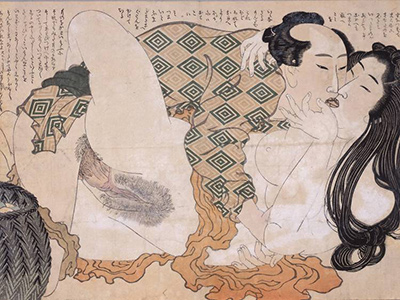
Illustrated-book image. Its precise folio and surviving copy remain unidentified.
Buy Art Prints Nowfrom Amazon
* As an Amazon Associate I earn from qualifying purchases.
 by Tom Gurney
Tom Gurney BSc (Hons) is an art history expert with over 20 years experience
Published on June 19, 2020 / Updated on November 20, 2026
Email: tomgurney1@gmail.com / Phone: +44 7429 011000
Hokusai and Shunga
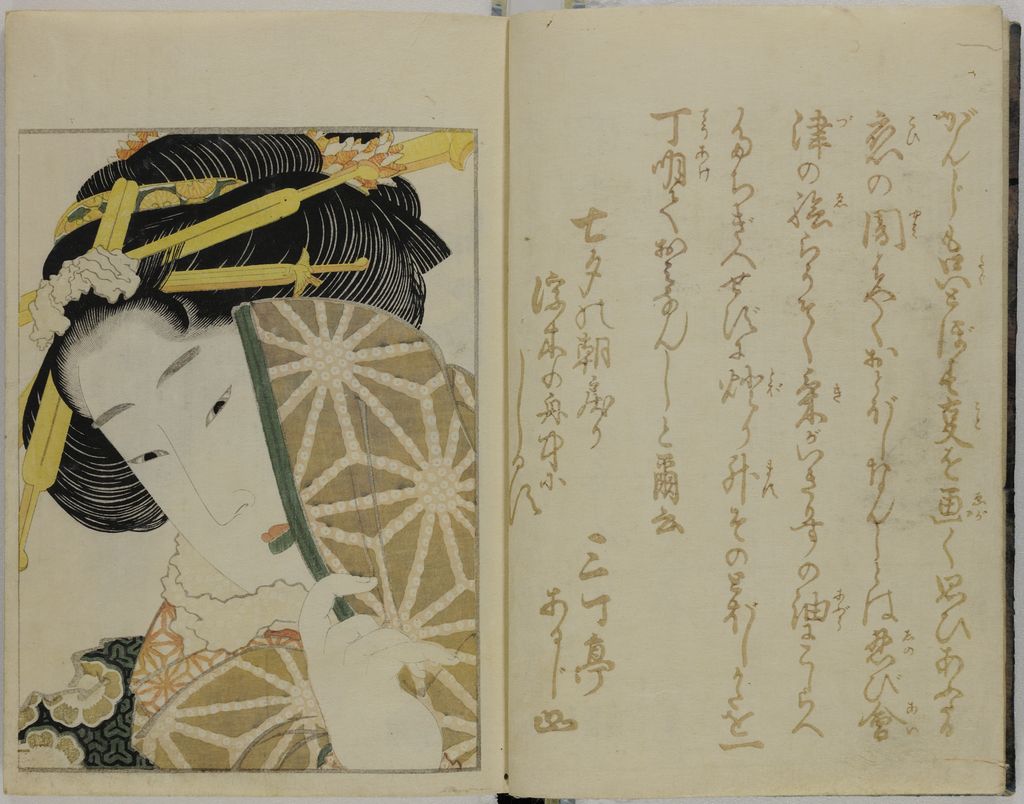
The first volume of Katsushika Hokusai’s Kinoe no komatsu opens with a woman holding patterned cloth against her face. In the Smithsonian’s copy, the cloth takes up much of the left page, while columns of writing fill the page on the right. The two pages share a margin at the fold. Viewed together, they introduce a book that asks its reader to move between pictures and words. The three volumes are an example of shunga, Japanese erotic art, made through the same woodblock publishing trade that brought Hokusai’s drawing manuals and illustrated fiction to readers. [1] [2] [3]
At a Glance
- ArtistKatsushika Hokusai
- ScopeIllustrated books and Edo-period print culture
Contents
What shunga meant in Edo Japan
Shunga (春画) literally means “spring pictures,” with spring carrying an erotic association. Other terms circulated in the Edo period. Warai-e, or “laughing pictures,” points to the humour that readers could find in these works. Shunpon refers specifically to erotic books, a useful term when covers, prefaces and sequences of pages form part of the evidence. The broader category also takes in individual prints and paintings, including handscrolls. A book opening, a loose published sheet and a handscroll produce different experiences for the viewer even when all three are described as shunga. [2] [4] [5]
The distinction also matters when identifying Hokusai’s work. The Japanese title 喜能会之故真通, written 喜能會之故真通 in Princeton’s record, is read Kinoe no komatsu. The Mori Art Museum’s bilingual exhibition checklist offers Languishing for Love and Young Pine Saplings as English titles for the work. Princeton records a lower-volume title slip written partly in hentaigana, variant forms of kana. Searching only by an English title can therefore miss records for the same book, and looking up an individual illustration will often return a title supplied by a later collector or curator. [6] [7] [8]
What the surviving books establish
The Smithsonian’s National Museum of Asian Art holds three volumes in the Freer Gallery of Art Study Collection, accession FSC-GR-780.4.1–3. Each volume is 22.1 centimetres high and 15.7 centimetres wide. The depth of the first is nine millimetres, while the other two measure eight millimetres each. The museum records woodblock printing in ink, colour and metallic pigment on paper, with paper covers. The dimensions put the volumes close to the hanshibon, or half-sheet book, a size widely used for illustrated books and long fiction as well as for shunpon. Three separate sewn volumes make a modest bundle, easy to hold and open one at a time. [1] [2] [6]
The date is usually given as about 1814, the eleventh year of the Bunka era. The Smithsonian calls its set undated and gives the approximate year in brackets with a question mark. Princeton also supplies 1814 provisionally. Its catalogue notes that the first volume’s preface, attributed there to Shiun’an, contains a reference to the first spring of a Year of the Dog, which could point to 1814. The Japanese record for a surviving upper volume in the International Research Center for Japanese Studies identifies a printed title slip as its source for the title and credits Hokusai and the date on the authority of the centre’s bibliography. All three records distinguish the bibliographic attribution from the information they can read directly on their copies. The publisher remains unidentified in these records. [1] [6] [7] [9]
That upper volume in Kyoto holds further evidence of how the work was read. Its catalogue counts fourteen physical leaves. It records a preface, a half-page frontispiece, seven double-page illustrations, another half-page illustration and a separate five-leaf text section. These details describe the surviving volume, rather than a uniform sequence that can be assumed for every loose illustration. The dramatic change in scale from a single-page portrait to an image that runs across a full opening was part of the reader’s experience. Turning the page also changed the balance between looking and reading as the book moved towards its text-only section. [2] [9]
Reading the Smithsonian opening
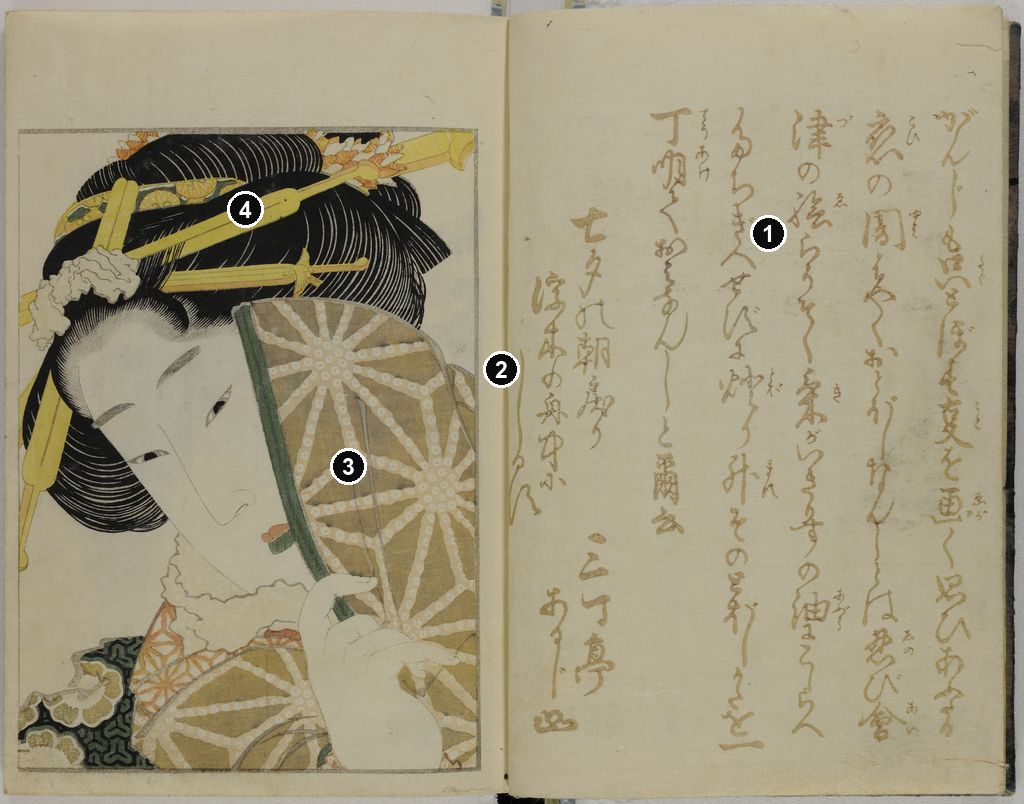
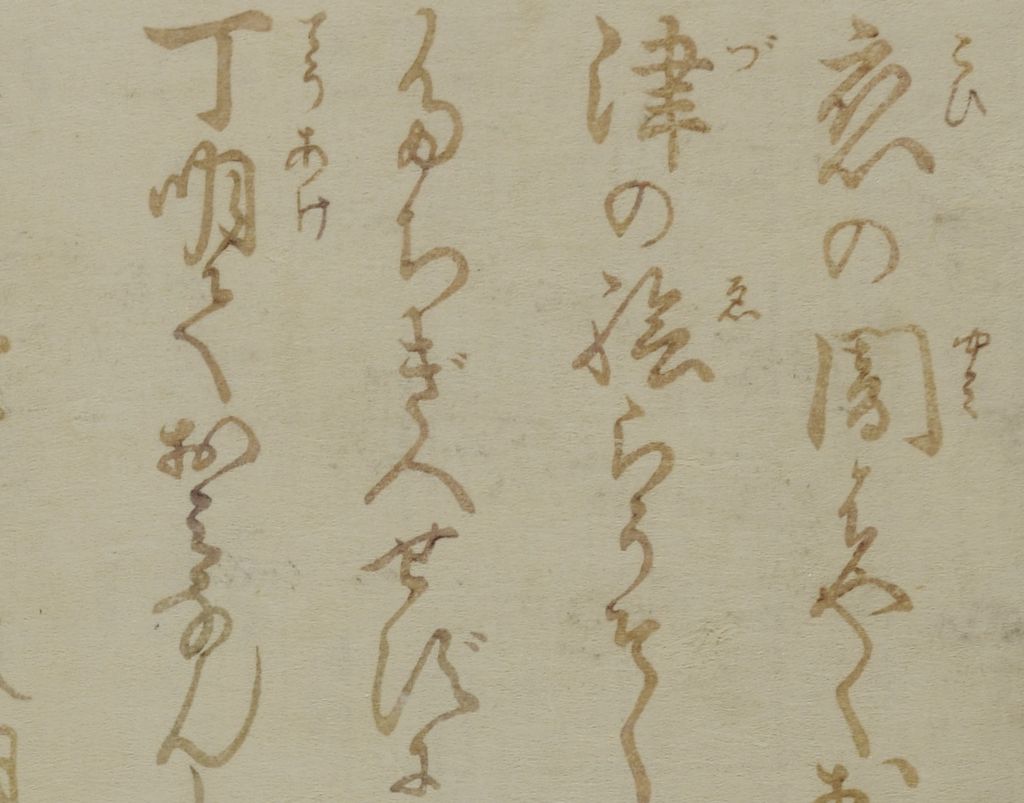
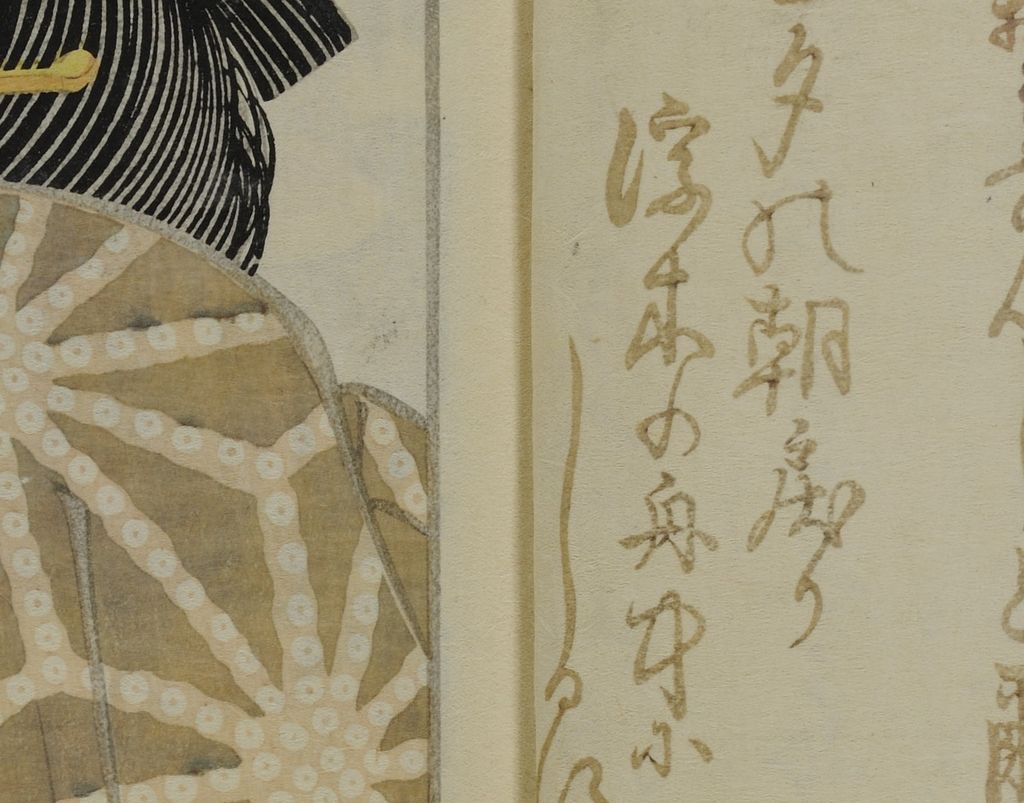
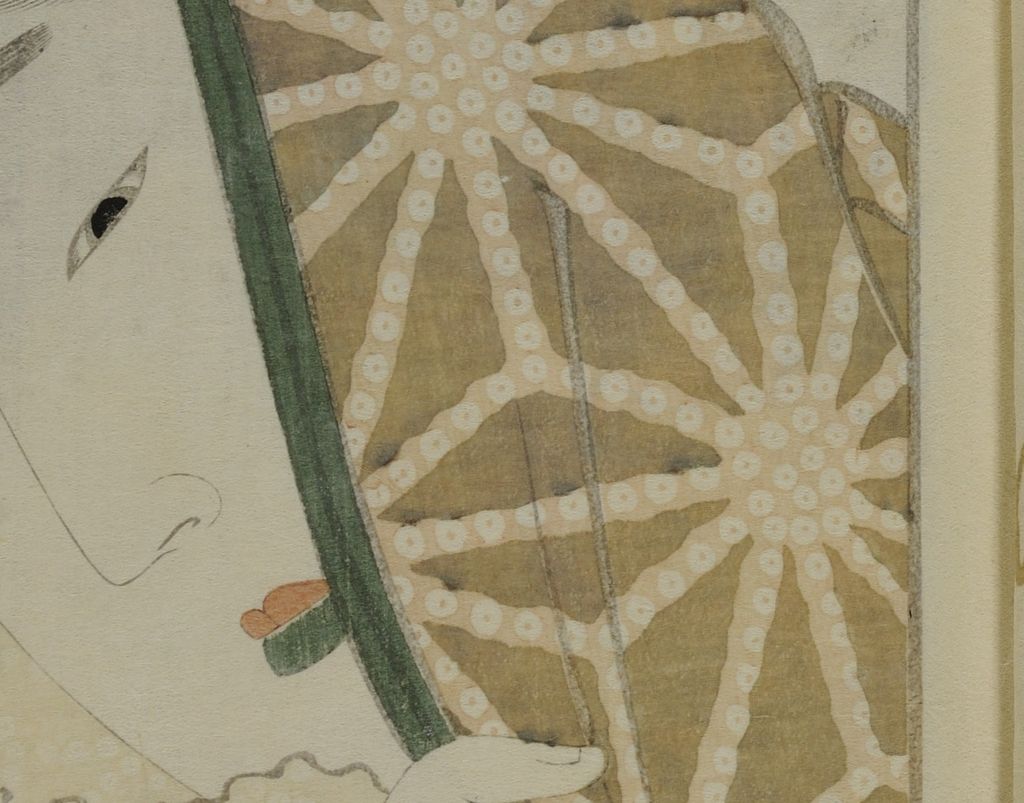
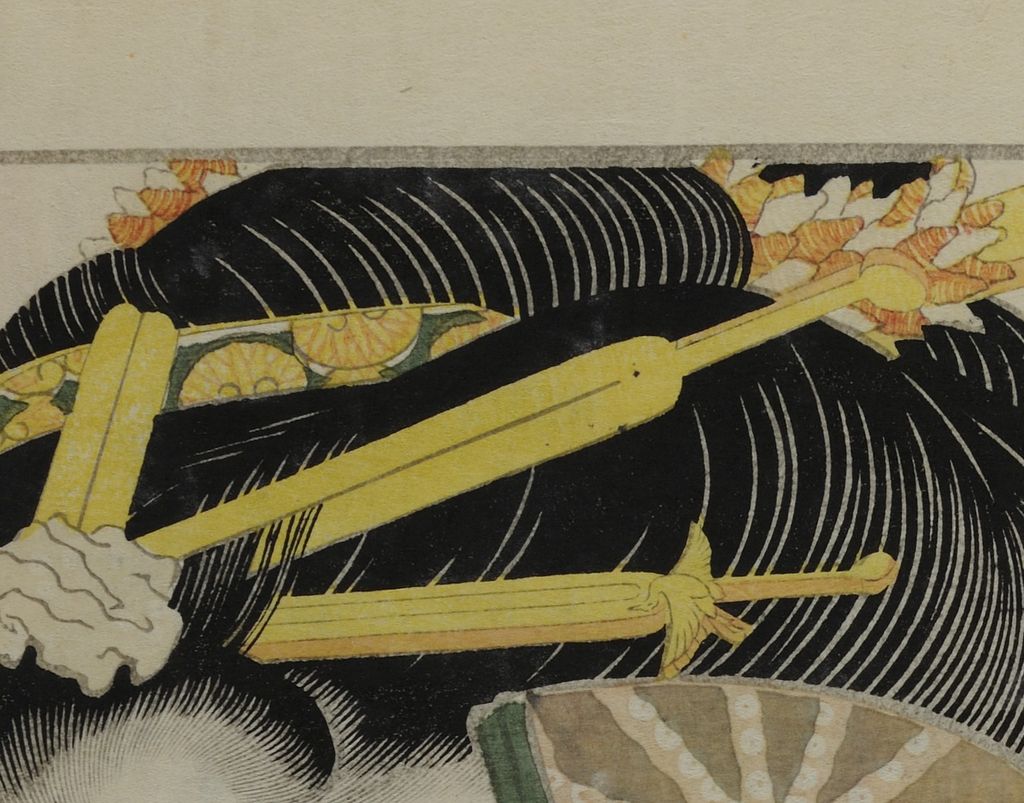
In the Smithsonian photograph, fine black lines curve along the woman’s hair, following the silhouette of the head rather than the vertical lines of the writing. Long hair ornaments cut across those arcs. The patterned cloth introduces another rhythm, made from straight bands and a repeating geometric pattern. Its upper edge crosses the cheek diagonally. This places the ornament close enough to the face for the viewer to take in both the design on the cloth and what it conceals. The left page gives the portrait its own ruled border. On the right, strokes in warm-toned ink form uneven columns with open space between them. [1]
The gutter makes it possible to read the composition at the scale of the book. The writing and portrait face one another, yet the boundary between them is physical. In ordinary fukurotoji, or pouch binding, a sheet was printed on one side and folded with that side facing out. The open edges were fastened together at the spine, and the folds formed the free outer edge of each leaf. Two facing pages in a sewn book therefore meet at the inner edge, even when they make up one design. A printmaker planning an illustration across that opening had to allow for this join. In the photographed opening the portrait’s border and the writing both stop short of it. [1] [2] [6]
The catalogue’s identification of metallic pigment applies to the Smithsonian set. The warm ink of the writing and the yellow ornaments are visible in the digital image, but the photograph alone gives a limited account of surface effects. A viewer handling the book could change the angle of a leaf and see how any reflective pigment responds to light. The digitised opening instead makes the paths of individual lines easier to compare, including the curves in the hair, the rigid geometry of the cloth and the different thicknesses of the strokes in the preface. [1] [2]
Publishers, printers and readers
Book production depended on specialists. Hokusai supplied designs, block cutters translated the drawn lines into printable surfaces, and printers brought ink and colours into alignment on the paper. For a book, the order of impressions mattered alongside the precision of individual lines. Text had to be cut as well as images, and the sheets then folded and bound in sequence. Ellis Tinios’s study of the commercial trade documents the care publishers sometimes put into paper, printing and covers. He also traces the reuse of blocks and images between editions. Such practices can complicate comparison when two surviving illustrations look much alike but the surrounding text, paper or binding differs. [2] [3] [10]
The Tokugawa government banned erotic books in 1722. Production nevertheless resumed by the late 1740s, as Tinios documents, and continued through the remainder of the Edo period. Omitted publication details are common in the books that survive. An unnamed publisher in a modern catalogue tells us where the evidence runs out for a particular volume. Establishing which shop issued it would require separate evidence, such as a surviving imprint, documents from the trade or a securely traced history of the blocks. The blank in Kinoe no komatsu’s publishing record leaves open how the venture was financed and who arranged its distribution. [1] [2] [6] [9]
Books circulated through both sales and lending. Monta Hayakawa draws on literary and documentary evidence for itinerant lenders, or kashihon’ya, who carried illustrated books from house to house. He finds evidence for women as customers as well as men and for circulation beyond customers who could afford to buy elaborate books. That makes it possible to distinguish the readership of the genre from the owners who happen to appear in later catalogues. Individual Edo-period borrowers of Kinoe no komatsu remain unnamed in the copies discussed here. A later collector’s inscription can establish a stop in a book’s life, while saying little about who read the work a century earlier. [1] [2] [4] [6]
How three volumes became an album
Princeton’s copy survives in a different shape. Its catalogue describes the leaves of three volumes as trimmed and pasted into an accordion-fold album, or orihon, with a brocade cover. The album preserves title slips, the preface and other text. When images from this volume are displayed in sequence online, the sequence is evidence of the object that Princeton holds, including how a collector or binder remounted it. The book’s surviving title slips help retain the identities of the constituent volumes even after the original format changed. The compact paper-covered set at the Smithsonian gives a second way to understand the scale and grouping of the work. [1] [6]
The Princeton album also has a documented nineteenth-century owner. Its catalogue records two handwritten inscriptions about the gift of the album by Paul Bonnetain to Edmond de Goncourt in 1884. The Smithsonian set followed a separate path through the collection of Dr. and Mrs. Gerhard Pulverer in Germany and was purchased by the Freer Gallery of Art in 2007. These are episodes in the lives of specific copies. They can help explain how some books reached American research collections while preserving different physical arrangements. A cover, the pattern of trimming and a gift inscription can be as helpful in distinguishing the copies as the printed image. [1] [6] [11]
Japan’s modern reception followed its own course. Aki Ishigami’s study of newspapers and censorship records traces renewed policing in the Meiji period and more vigorous enforcement around 1895–1905, when many examples were confiscated and destroyed. Much later, the International Research Center for Japanese Studies built a collection of illustrated erotic books and created a database of their bibliographic records and page images. The centre’s Japanese catalogue for the upper volume preserves details that a reproduction of one celebrated scene could not show, including the order of the illustrations, the title slip and signs of repair. [5] [9] [12]
Hokusai as an illustrator
Kinoe no komatsu belongs to the same broad working life as Hokusai Manga and One Hundred Views of Mount Fuji. The three works reward different kinds of attention. A drawing manual invites a reader to follow and compare separate studies. A volume of Fuji views repeatedly changes the setting around a recognisable mountain. In Kinoe no komatsu, a preface, a close view of a face and the changing dimensions of the illustrations set the pace. Looking at a preserved opening brings that pace into view. The edge of the cloth leads to the woman’s face, the fold slows the eye, and the first line of writing sends the reader back to the opposite page. [1] [2] [3] [9]
Works across Hokusai’s career
Kinoe no komatsu
Generally dated 1814Hokusai Manga
From 1814Ōiko Pouring Sake for a Warrior
1820 or 1829 in collection recordsAnnotated Details from Preface opening of Kinoe no komatsu, volume one
Smithsonian National Museum of Asian Art, FS-FSC-GR-780.4.1_003. CC0. [1]
Details from PREFACE OPENING OF KINOE NO KOMATSU, VOLUME ONE
Select a detail to look closely.
The preface runs in vertical columns
The lines occupy their own page. The reader can begin with writing before crossing to the facing image. [1]
The gutter divides the two pages
The fold keeps the portrait and the writing apart while the open book puts them in view at once. [1]
A pattern crosses the cloth
The geometric pattern draws attention to the fabric raised beside the face. [1]
Ornaments extend from the hair
The horizontal forms give the silhouette a different rhythm from the printed columns opposite. [1]
Explore Hokusai’s works
Discussion
Look again at the images and ideas explored in Hokusai and Shunga. These editorial prompts invite your observations.
Reader Insights
How are illustration and text arranged across the opening?
What can the binding reveal about how a surviving book was read?
Join the Conversation
Share a detail, comparison or question about Hokusai and Shunga below.
References
- Smithsonian National Museum of Asian Art, Kinoe no komatsu, FSC-GR-780.4.1–3. Collection record, provenance and volume-one image FS-FSC-GR-780.4.1_003. View source.
- Ellis Tinios, “Japanese Illustrated Erotic Books in the Context of Commercial Publishing, 1660–1868,” Japan Review 26, 2013, pp. 83–96. View source.
- British Museum, Hokusai: The Great Picture Book of Everything, large-print guide, section on Hokusai’s published illustrated books. View source.
- Hayakawa Monta, “Who Were the Audiences for Shunga?” Japan Review 26, 2013, pp. 17–36. View source.
- Ishigami Aki, “The Reception of Shunga in the Modern Era: From Meiji to the Pre-WWII Years,” Japan Review 26, 2013, pp. 37–55. View source.
- Princeton University Library, Kinoe no komatsu, Marquand Library, NE1321.85.S58 K39 1814. Catalogue notes on the preface, title slips, binding and provenance. View source.
- Princeton University Library, digitised Marquand copy of 喜能會之故真通. View source.
- Mori Art Museum, LOVE: The First Decade Highlighted by 100 Works, exhibition checklist, Uragami Mitsuru copy of Kinoe no komatsu, volume one. View source.
- International Research Center for Japanese Studies, 喜能会之故真通 3巻 (存1巻), KC||172||Ka, 00583947. Japanese item-level catalogue via CiNii. View source.
- The Metropolitan Museum of Art, “Woodblock Prints in the Ukiyo-e Style,” on the roles of artist, publisher, cutter and printer. View source.
- Princeton University Library, East Asian Library and the Gest Collection Annual Report 2019–20, Marquand Library acquisitions. View source.
- International Research Center for Japanese Studies, 艶本資料, scope of the illustrated book database. View source.







