


 by Tom Gurney
Tom Gurney BSc (Hons) is an art history expert with over 20 years experience
Published on June 19, 2020 / Updated on November 20, 2026
Email: tomgurney1@gmail.com / Phone: +44 7429 011000
Chōshi in Shimōsa Province by Katsushika Hokusai
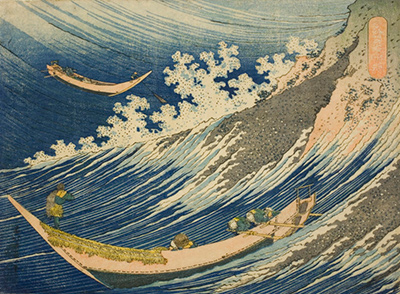
The fishing boat that crosses the front of Hokusai’s Chōshi in Shimōsa Province carries several people, but the water makes it difficult to count them at a glance. The prow comes up high at the left. A figure stands behind it, with a dark curve of water rising just beyond him. At the other end, the crew bend low over the side, where their oars run across the fine lines of the waves. A second boat appears farther away. Water fills the space between them and rises all the way to the upper edge of the print. [1] [2] [3]
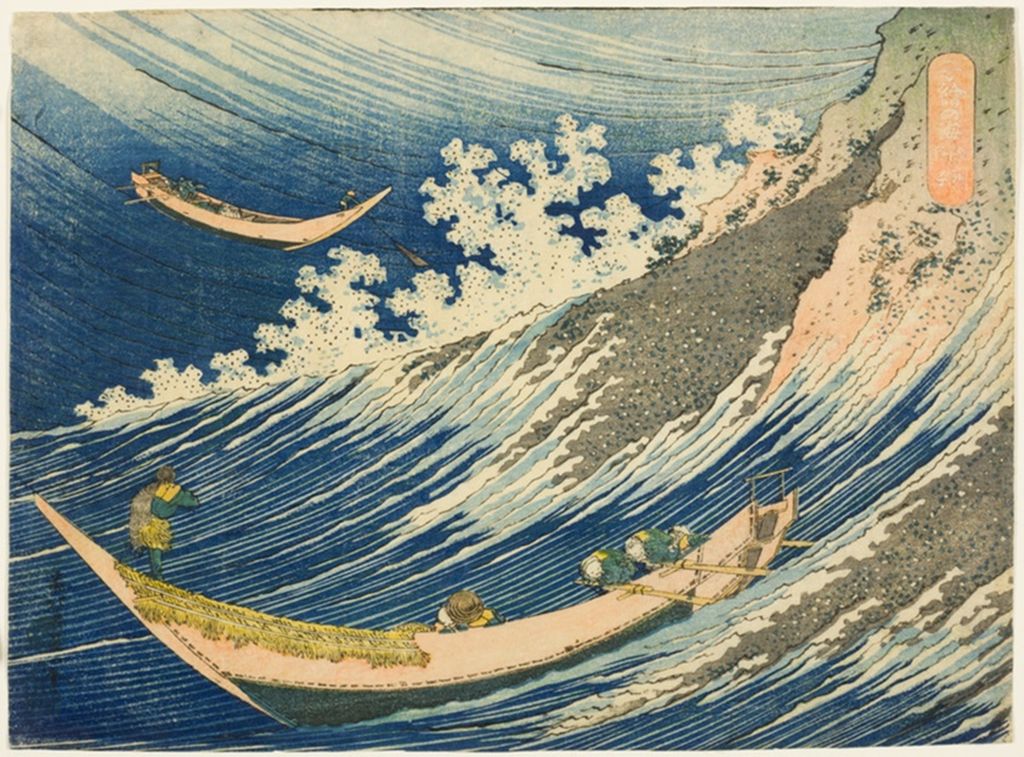
Hokusai designed the colour woodblock print around 1833 for One Thousand Pictures of the Ocean (Chie no umi), a series about fishing and life on the water. The Art Institute of Chicago identifies its impression as Fishing Boats at Chōshi in Shimōsa and dates it to about 1833–34. The Museum of Fine Arts, Boston, gives about 1833, and a Museum of Kyoto exhibition checklist gives about 1832–33. These ranges place the design in the early 1830s, close to the period of his better-known views of Mount Fuji. [1] [2] [4]
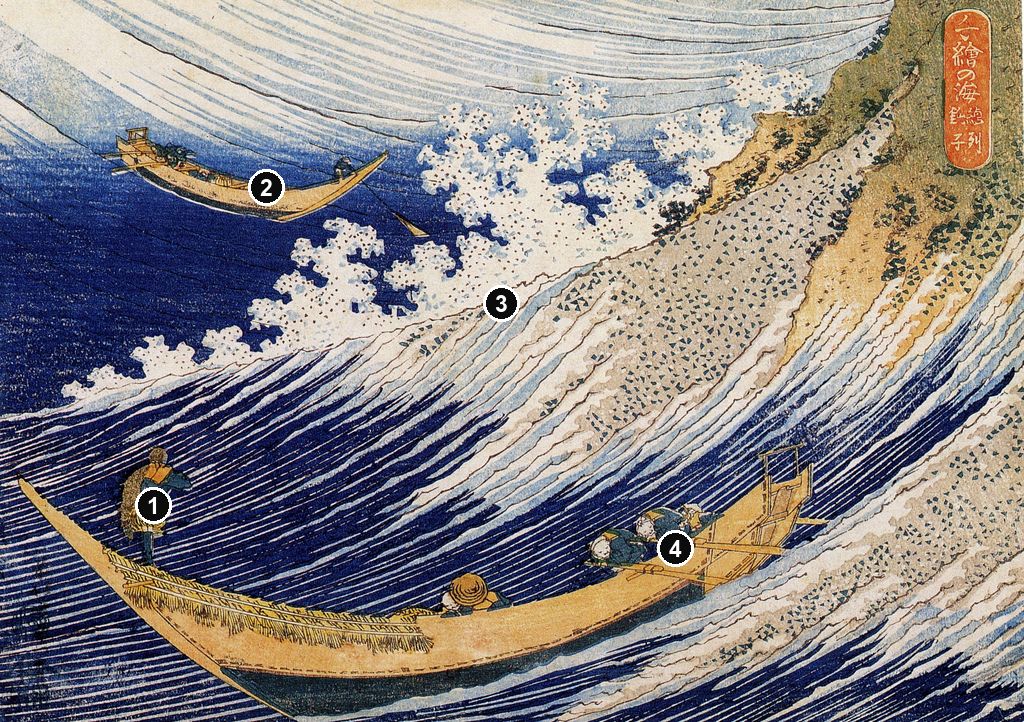
The annotated image shows a further impression of the design whose current holding is unidentified. Follow the boats and the spacing of the waves there. The descriptions of colour and paper in the Chicago and Boston comparison refer to those museums’ documented sheets. [1] [2] [9]
At a Glance
- ArtistKatsushika Hokusai
- DateEarly 1830s
- MediumColour woodblock print
- SeriesOne Thousand Pictures of the Ocean
Contents
The fishing boats among the breakers
The near hull stretches across most of the lower half. Its upper edge sweeps down from the pointed bow before rising again at the stern. Long dark lines follow the sweep of the wood and make the side of the boat easy to recognise among similarly curved lines in the water. A narrow band immediately below the upper edge gives the hull some depth. The stern rises into a short, comparatively straight construction above the boat’s curving underside. That juxtaposition of straight beams and sweeping curves shows up clearly in the Chicago impression, where the timber is warm against the blue water. [1]
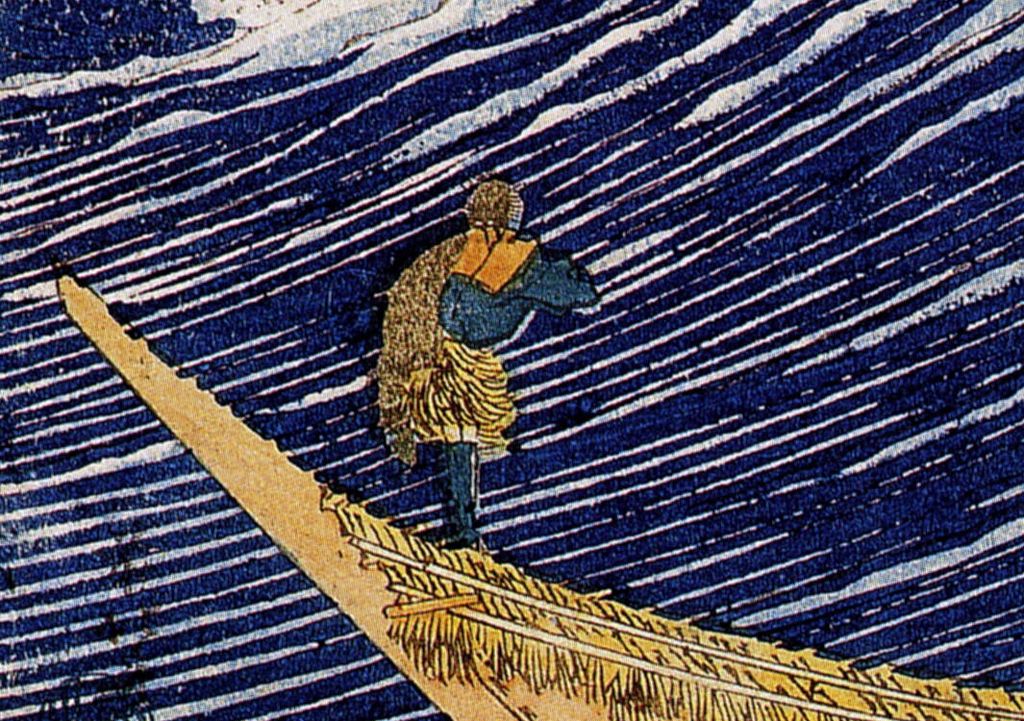
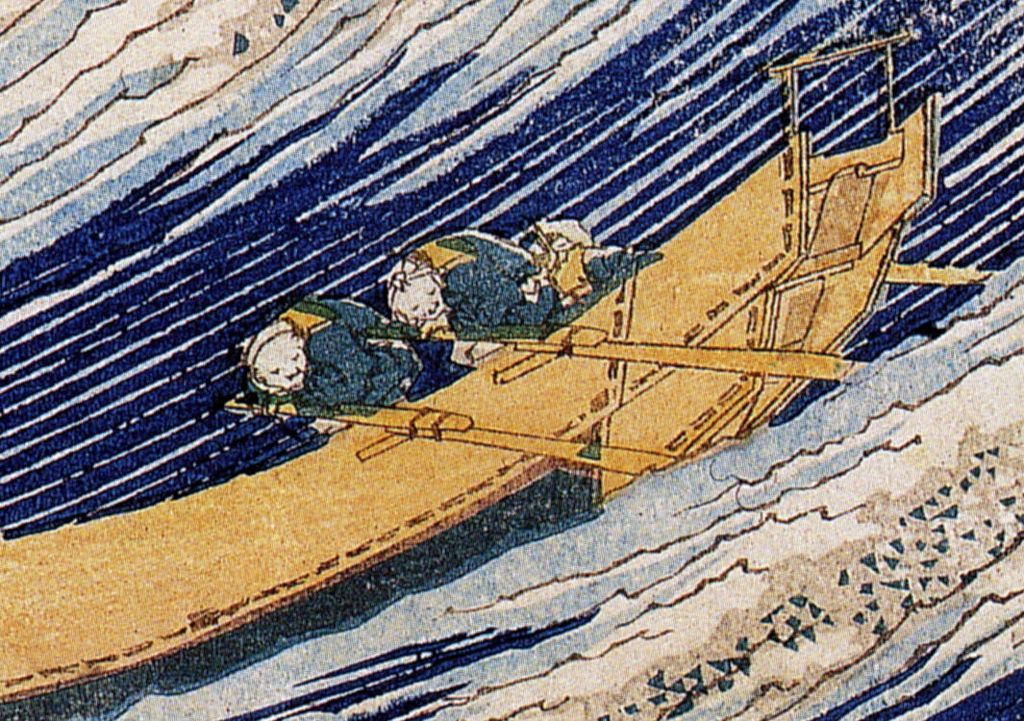
Look first at the standing figure near the bow, framed by the upward point of the hull and the curl behind his shoulder. He provides a vertical measure against the boat’s length. A little to his right, a low figure has a dark ring at head level that reads quite clearly as a hat. Farther aft, rounded backs and bent arms bunch together. Long shafts leave the crowded stern and angle past the pale strands of the sea. The arrangement makes the crew’s physical effort visible even in such a small print. At a distance the boat seems to rise and dip as a unit. Up close its occupants occupy quite different positions, from the almost upright figure near the bow to those bent low near the stern. [1] [2]
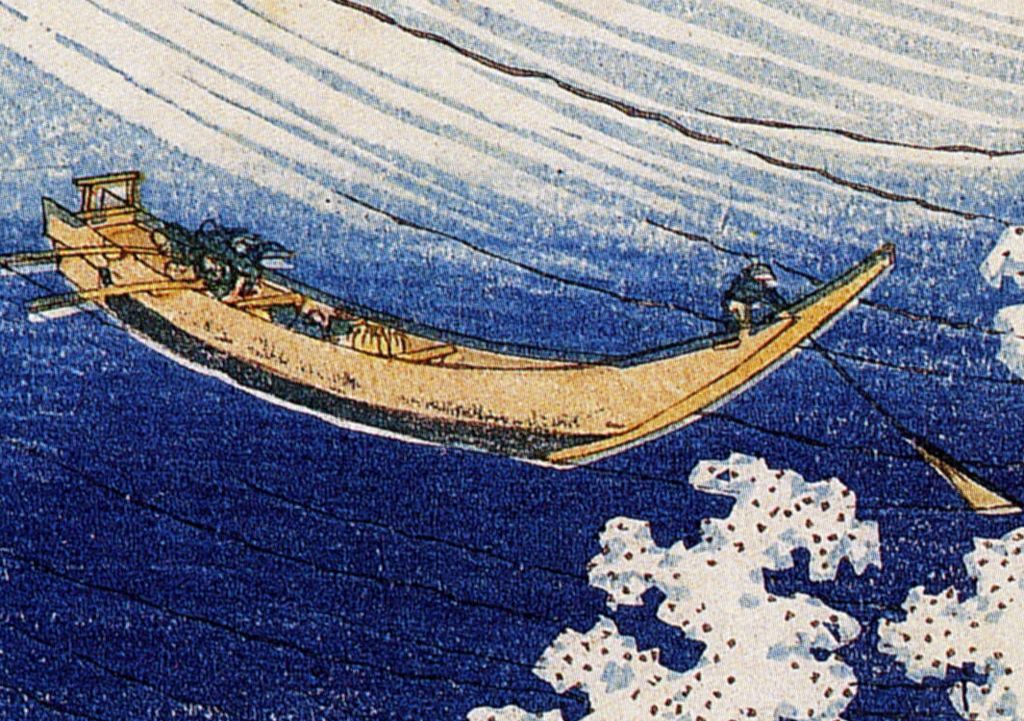
The second boat is easy to miss. Look above the main prow and then to the right. A pale, tapered hull briefly emerges from a band of blue. Little of its side is visible, and the people occupy only a small patch of the surrounding water. The two boats give the eye a measure of distance even though Hokusai supplies no visible line where sea meets sky. The Chiba City Museum of Art draws attention to that absence of sky and to the broken texture of the waves and rocks. The distance between the boats is filled with things to look at, so the eye has to work its way over one band of surf after another to find the smaller vessel. [1] [2] [3]
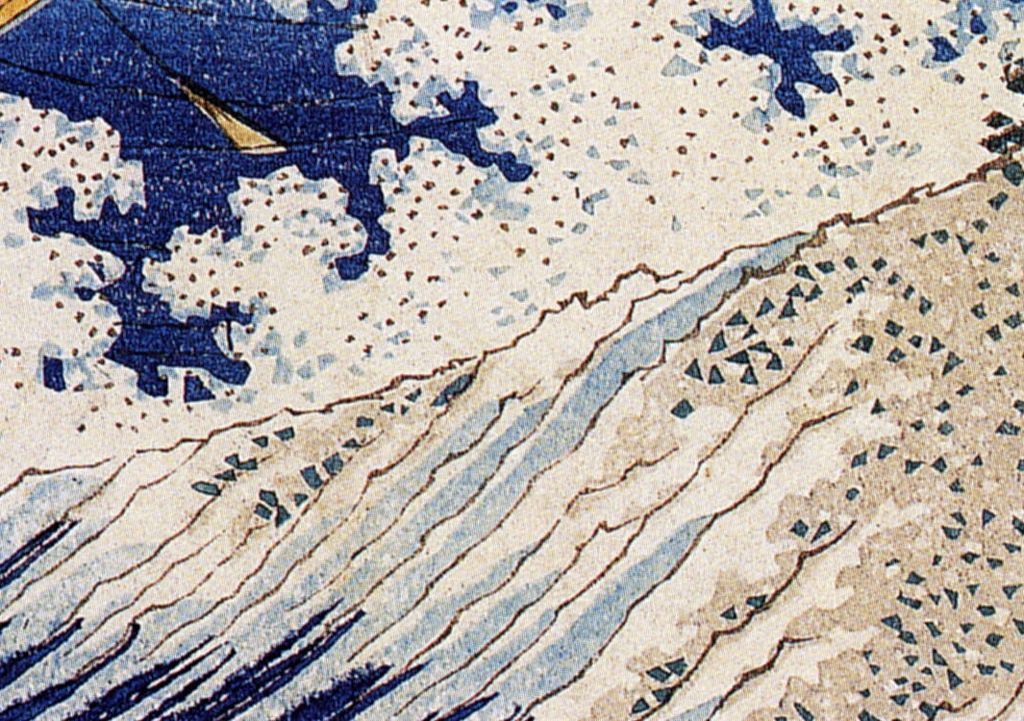
Along the bottom, thin pale lines travel in groups. Some curl back on themselves as the darker mass underneath folds over. Farther up, broken pale shapes emerge as flecks. Where the wave rises behind the boat near the middle of the print, the tightly spaced lines concentrate the blue, leaving narrow gaps that follow the changing slope. Around the upper and right edges the marks break into a more irregular dotted texture. James Ulak, writing about the Chicago impression, describes Hokusai’s use of alternating shades of Prussian blue. The changing density and direction of the marks remain visible in reproduction even when the hue varies. [1] [3]
Chōshi at the mouth of the Tone River
Chōshi lies on the Pacific coast at the mouth of the Tone River, in present-day Chiba Prefecture. The original place title, printed vertically at the upper right, is Sōshū Chōshi (總州銚子). The historical reference to Shimōsa in English museum titles places the port in the province known by that name in Hokusai’s time. The geographic label gives a setting to the breakers, although the image itself offers little in the way of buildings or a shoreline from which to locate the boats. Public collections identify the place with the help of the inscribed title. [1] [2] [3] [5]
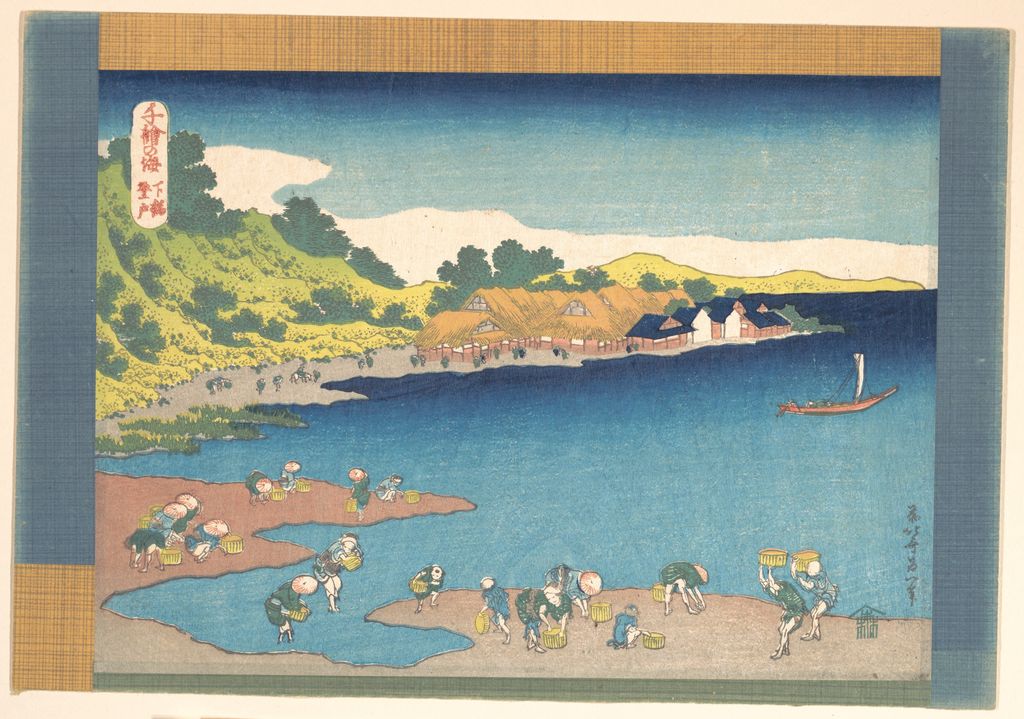
The Sumida Hokusai Museum shows how differently the same artist could approach these waters in another design for the series, The Tone River in Shimōsa Province. Its subject is the river and the fishing that goes on there. The Chiba museum also points to Noboto in Shimōsa Province as a third subject connected with the Bōsō area. Together they show how a geographic name in the series can refer to quite different work and conditions near the water. The sea at Chōshi gives the long boats an uneven surface to negotiate, while the river and shore designs make different activity visible. The recognisable action in Chōshi is the crew handling the boat in the swell. With so little of the fishing gear visible, the print leaves the exact catch uncertain. [2] [3] [5] [6]
The Chicago and Boston impressions
The Art Institute of Chicago’s impression is accession 1983.583, published in colour in Ulak’s account of the museum’s Buckingham ukiyo-e acquisition. The Museum of Fine Arts, Boston, holds 21.6701, which it records as a horizontal chūban measuring 19.2 by 27.8 centimetres. It was given by William S. and John T. Spaulding in 1921 after they bought it at the F. May sale in 1918. Chiba City Museum of Art records its own impression, 1000001, as a horizontal colour chūban measuring 17.8 by 25 centimetres. The format describes a relatively compact Japanese sheet. Overall dimensions can vary between surviving sheets, so use the placement of the boats, foam and title to match the design across records. [1] [2] [3]
The Boston record transcribes the artist’s signature as Saki no Hokusai Iitsu hitsu (前北斎為一筆), “brush of Iitsu, formerly Hokusai.” Iitsu was a name Hokusai used at this point in his career. The inscription helps identify the designer and sits within the printed composition alongside the title. The word “brush” is the language of the signature on a work made by printing from woodblocks. The guide to ukiyo-e woodblock prints explains how designs passed from artist to carver and printer. In this case the wood of the boats, the thin foam and the outlines of the crew can all be traced across multiple impressions. [1] [2]
In the Chicago photograph the larger boat’s side has a yellow-orange cast, with darker bands below the men. The title occupies a pale, warm panel that blends with the passage of stippled colour around it. In the Boston photograph the hull looks pinker. The inscription in the more strongly red title panel is easier to pick out against the surrounding grey-blue. Boston also shows more pale paper beyond the design, particularly along the top and bottom. The smaller hull, crest behind the figure at the bow and long oblique shafts behind the rowers fall in the same places. Place those parts of the two images side by side and the change in the weight of the warm colour is more obvious than it is from the blues alone. The images record these appearances, while evidence for printing sequence or the precise colourants in either sheet would need to come from the impressions themselves. [1] [2] [7]
Water and work in One Thousand Pictures of the Ocean
Suntory Museum of Art identifies ten confirmed designs in One Thousand Pictures of the Ocean and also discusses surviving proofs of designs for Kazusa and Shinagawa. The title evokes the breadth of the subject across coastal and inland waters. Suntory explains that the title also plays on the Japanese word for wisdom. Written with different characters, the words suggest wisdom as deep as the sea, a sense preserved in the alternative English title Oceans of Wisdom. Ten is the number of completed designs identified by Suntory, while the surviving proofs show that Hokusai explored at least two others. The Chicago museum acquired three of the series together in 1983. Ulak discusses Fishing by Torchlight in Kai Province (1983.581), Whaling off Gotō (1983.582) and Fishing Boats at Chōshi in Shimōsa (1983.583) as a group. The Museum of Kyoto’s checklist likewise places Chōshi near the torchlight design, listing them as v-2 and v-5. [1] [4] [6]
The Fishing by Torchlight in Kai Province design puts the visible source of light near the centre of the fishing activity. The glow gives the dark water a particular point to look towards. At Chōshi, the bands of pale foam lead the eye away from the crew and then pull it back along the curve of the hull. By following the movement out from the boat, it becomes possible to make out the other vessel in the distance. Seen together, the two prints show how a small horizontal format accommodates people doing demanding work and leaves room for the surrounding water to determine what the viewer can see. [1] [4] [6]
Image comparison
How Chōshi differs from the Great Wave
In the Great Wave off Kanagawa, a tall breaker rolls over three boats, with the distant triangular summit of Mount Fuji visible through the space beneath the curl. The Metropolitan Museum of Art catalogues that design as part of Thirty-six Views of Mount Fuji. The small peak and the open sky let the viewer look beyond the immediate action even as the boats draw attention back to the base of the wave. At Chōshi, Hokusai fills the upper half with water and leaves the title as the conspicuous interruption near the upper right. The Boston and Chicago impressions both preserve a sequence of smaller breaks across the field of the print. Those breaks lead into and out of the space occupied by the foreground boat, so the crew appears to be negotiating waves that have already passed as well as those still arriving. [1] [2] [3] [8]
The Chiba museum places the two prints side by side in its discussion of Hokusai’s treatment of water, drawing attention to the rough quality of the Chōshi breakers. Their rounded bands and small flecks make the sea look difficult to cross in several directions at once. The long curl off Kanagawa gives that design an immediately recognisable silhouette. At Chōshi the line of the foreground hull does almost as much to orient the viewer as the water does. Start at its raised prow, follow the timber back to the bent figures and then look again for the low boat between the crests. The first boat’s size and clarity seem less secure once the second has shown how quickly a whole crew can disappear into the pattern of the sea. [1] [2] [3] [8]
Where this work sits in Hokusai’s career
Hokusai Manga
From 1814Chōshi in Shimōsa Province by Katsushika Hokusai
Early 1830sAnnotated Details from Chōshi in Shimōsa Province
Wikimedia Commons reproduction, holding unidentified. Public Domain Mark 1.0. [9]
Details from CHŌSHI IN SHIMŌSA PROVINCE
Select a detail to look closely.
A figure stands by the prow
His upright stance gives the eye a vertical measure against the curved hull. [9]
A second boat emerges from the swell
The upper boat’s smaller hull and partly obscured crew give the scene a sense of distance. [9]
Foam breaks into flecks
Irregular pale marks interrupt the closely packed lines in the dark water. [9]
The crew work low at the stern
Rounded backs cluster where long shafts cross the edge of the hull. [9]
Explore Hokusai’s works
Discussion
Look again at the images and ideas explored in Chōshi in Shimōsa Province by Katsushika Hokusai. These editorial prompts invite your observations.
Reader Insights
How does the second boat show distance?
Where do the changes in the water interrupt the lines of the hull?
Join the Conversation
Share a detail, comparison or question about Chōshi in Shimōsa Province by Katsushika Hokusai below.
References
- Art Institute of Chicago, Fishing Boats at Chōshi in Shimōsa, accession 1983.583, collection data. James T. Ulak, “Japanese Works in The Art Institute of Chicago: Five Recent Acquisitions,” colour plate 4 and fig. 8, museum acquisition study. View source 1. View source 2.
- Museum of Fine Arts, Boston, Chōshi in Shimōsa Province, accession 21.6701, collection record, signature, sheet dimensions and provenance. View source.
- Chiba City Museum of Art, Sōshū Chōshi, accession 1000001, Japanese catalogue essay, object photograph and dimensions. View source.
- The Museum of Kyoto, Hokusai and Hiroshige exhibition checklist, section V, items v-2 and v-5. View source.
- Sumida Hokusai Museum, The Tone River in Shimōsa Province, Japanese collection entry. View source.
- Suntory Museum of Art, chapter 3 of the Japanese exhibition text for Hiroshige Vivid: The Hara Yasusaburo Collection, with discussion of the series title and design proofs. View source.
- Museum of Fine Arts, Boston, colour photograph of accession 21.6701 in the museum's print catalogue. View source.
- The Metropolitan Museum of Art, Under the Wave off Kanagawa (Kanagawa oki nami ura), also known as The Great Wave, accession JP1847. View source.
- Wikimedia Commons, public-domain reproduction of the Chōshi design, current holding unidentified. View source.







