



 by Tom Gurney
Tom Gurney BSc (Hons) is an art history expert with over 20 years experience
Published on June 19, 2020 / Updated on November 20, 2026
Email: tomgurney1@gmail.com / Phone: +44 7429 011000
Kirifuri Waterfall at Kurokami Mountain in Shimotsuke
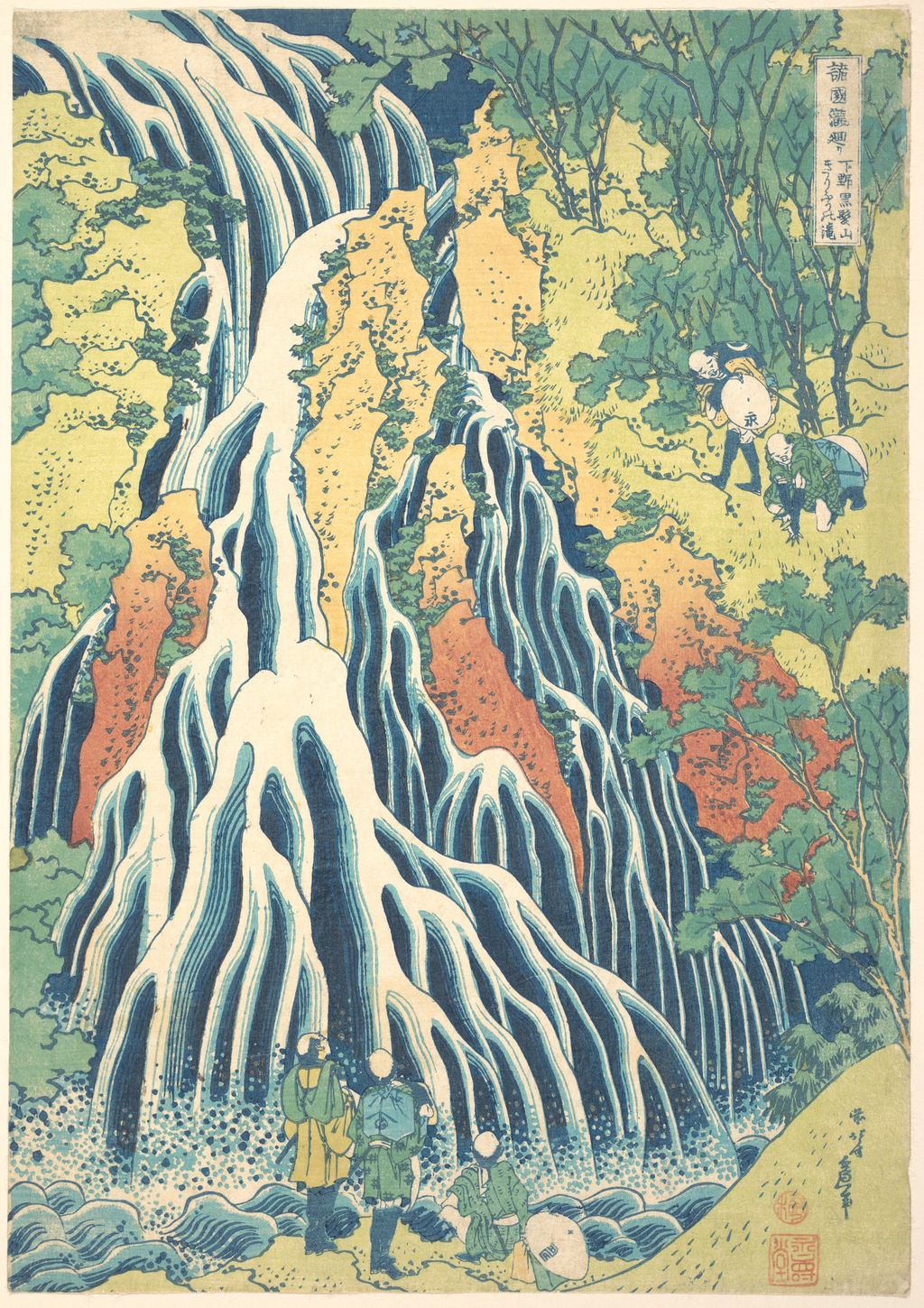
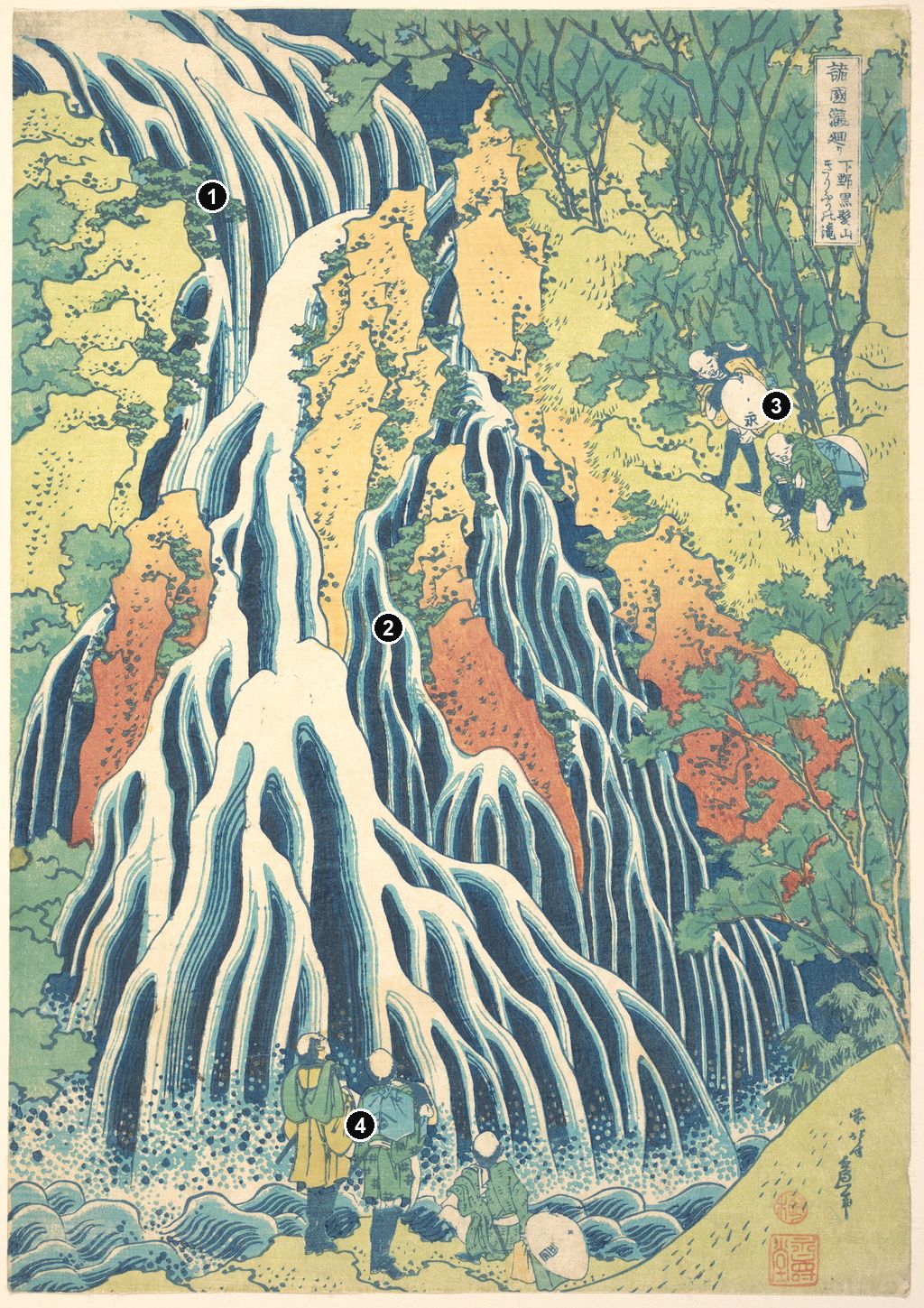
A man standing at the foot of Kirifuri Waterfall raises a hand to his forehead. Behind him, the fall divides into pale, fingerlike streams, each edged with blue. Another visitor has reached a clearing high on the right, where the water is still gathering speed. The distance between the two gives Katsushika Hokusai's woodblock print its first measure of height. The fall continues beyond the top of the sheet and comes so close to the bottom that there is barely room for the people looking at it. [1]
Hokusai made the design for A Tour of Waterfalls in Various Provinces, a series of eight colour prints. The Metropolitan Museum of Art dates its impression, JP2924, to about 1832, and the Shimane Art Museum dates its impression to about 1833. The full title, Shimotsuke Kurokamiyama Kirifuri no taki (下野黒髪山きりふりの滝), names the old province, the mountain and the waterfall. Kirifuri is near Nikkō, where the water makes two main drops. The fine spray that rises as it strikes the rocks gives the falls their name, often rendered in English as Falling Mist. [1] [2] [3]
At a Glance
- ArtistKatsushika Hokusai
- Dateca. 1832
- MediumColour woodblock print
- SeriesA Tour of Waterfalls in Various Provinces
Contents
The cliff divides the water
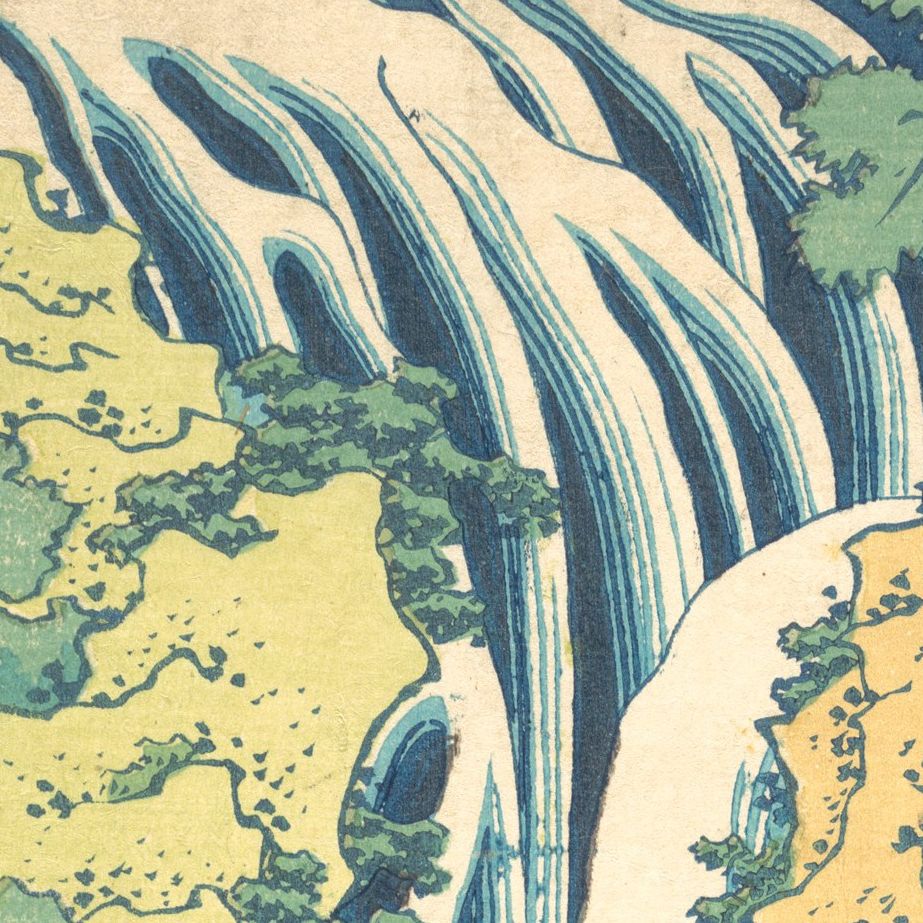
In the Met sheet, the first streams enter from the top and upper left. Some are almost parallel, with thin, tapering lines running along their length. At that height the sheet gives us almost no glimpse of open sky. Rock, forest and moving water occupy the picture all the way to its upper edge, so the eye first encounters the streams already in motion. They begin to separate where the rock projects into their course. A pale sheet of water rounds a spur and contracts into several narrower strands. On the next ledge it spreads again. A thin blue line can be followed for a surprising distance before it is lost against the other streams. Following one thread exposes how carefully Hokusai has varied the intervals between these divisions. [1]
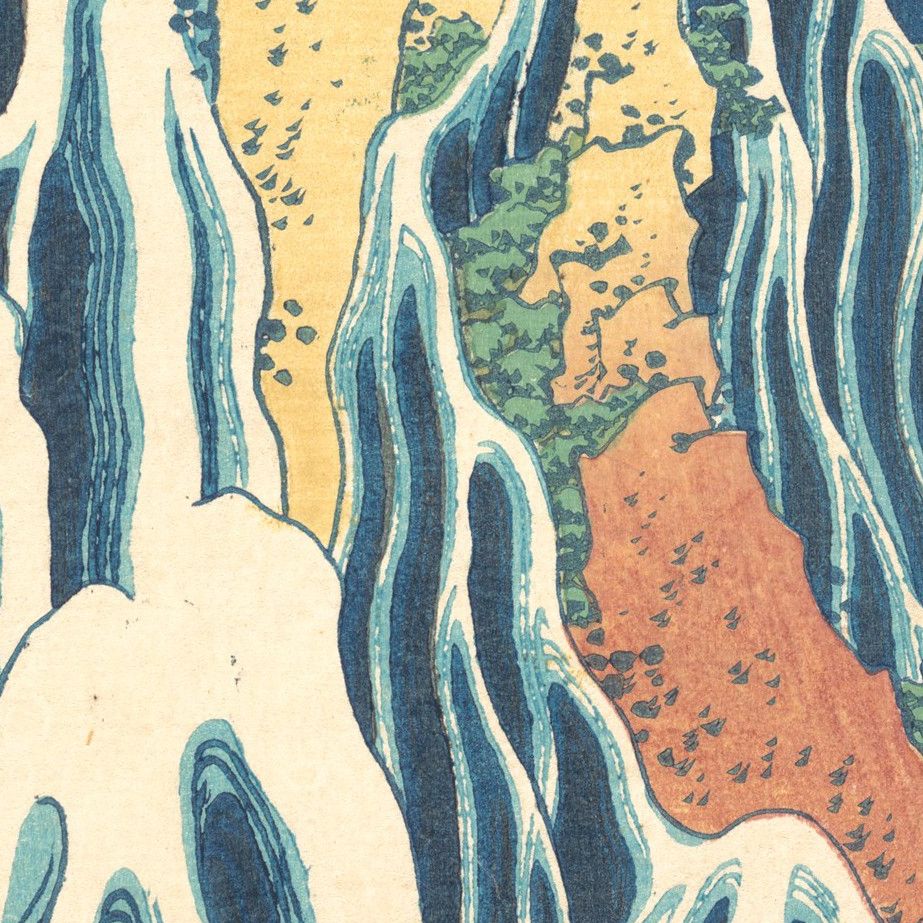
The rock keeps interrupting that downward reading. Near the middle, a pointed outcrop pushes up between separate channels, its yellow upper portion giving way to red-orange faces lower down. Short strokes and speckles across those surfaces give them an irregular texture. Next to them the water is drawn in smooth curves. Look at where a broad pale current ends in a sharp point beside the rock and a dark blue strip widens beyond it. The dark patch can register as shadow before the slender lines inside it show that this, too, is water on the move. [1]
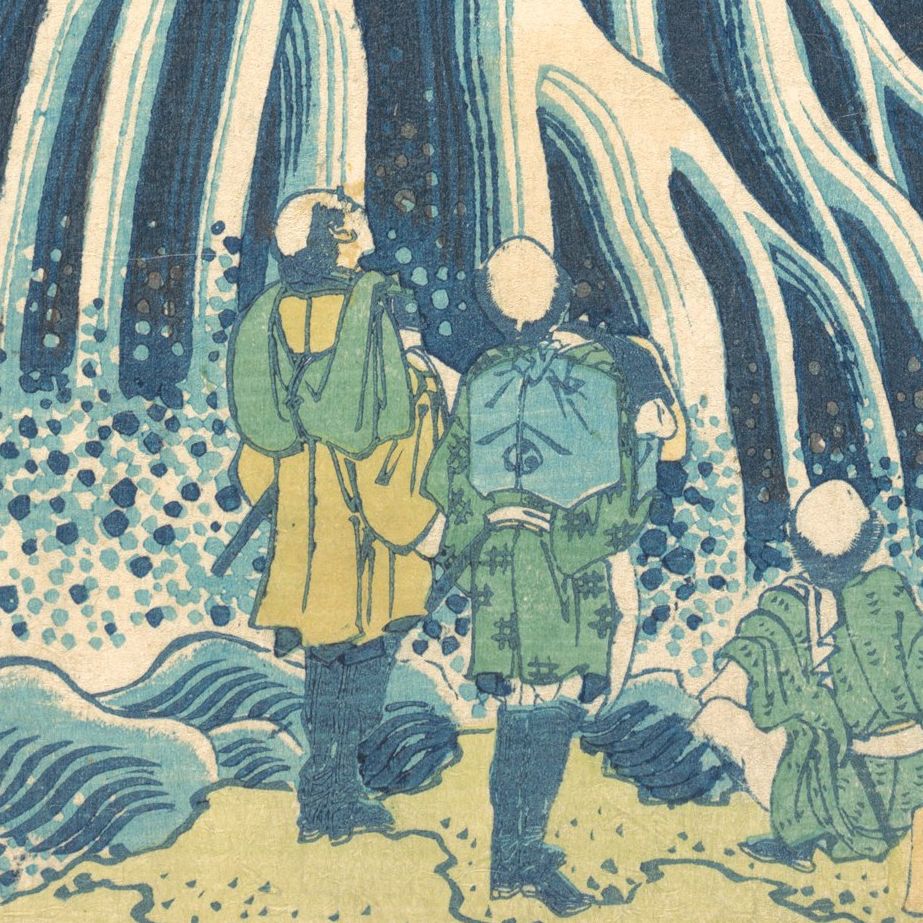
The lowest part of the fall needs a different language of marks. The films and threads of water break into dots around the visitors' heads and shoulders. Lower still, short parallel curves gather into waves that roll behind their feet. The columns of water connect the top and bottom of the design, but these low waves carry the eye sideways across the pool. By changing the direction of the marks, Hokusai gives the descent an impact and shows the water moving on after it strikes. [1]
Vegetation also guides the reading. The foliage at the upper right builds a dark screen around the cartouche and opens around the two visitors. At the lower right, branches reach across the running water. Their fine stems resemble the smaller divisions of the fall, but their leaves gather into solid patches. In a print full of moving forms, those few overlapping branches make it possible to sense which parts of the cliff project towards us. [1]
Five visitors and several points of view
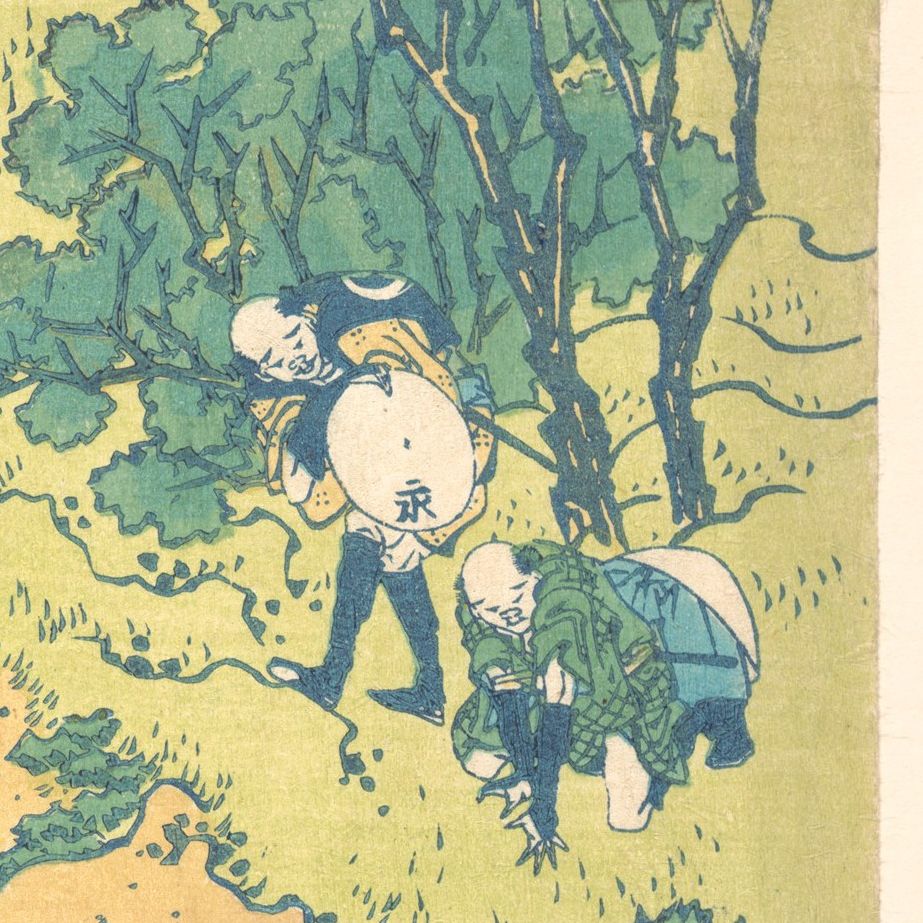
The five small figures carry or wear travelling gear. At the bottom, two stand close to the water and another crouches beside a round hat. Higher on the right, one visitor bends over with a large hat slung against the body, while a companion stays lower on the slope. The upper pair can look across or down at the fall. The figures below have to look up to take in the same stretch of rock. Hokusai lets the eye move between positions that an actual visitor would have to reach separately. The steepness becomes something the viewer can imagine negotiating. [1]
Sarah E. Thompson, writing for the Museum of Fine Arts, Boston, identifies the visitors as probable pilgrims. She relates the falls to journeys to the nearby Tōshōgū shrine, the burial place of Tokugawa Ieyasu. The hats, packs and stops along the slope suggest the pauses of a journey. Thompson also points to an 1831 drawing of a different waterfall in the Nikkō area, subsequently published in an illustrated book, as evidence that Hokusai may himself have made the journey. That drawing makes the possibility worth considering. The print alone leaves his presence at Kirifuri uncertain. [4]
Most of the travellers are angled away from us, their attention directed into the scene. They offer indications of where to look without interrupting the view. The figure with a raised arm gives us a sense of how little ground there is between the bottom of the fall and the lower edge of the print. The visitors higher up do something different. The gap between them and the water establishes a distance that would be hard to judge from the shape of the rock alone. Seen together, the two groups show how close a visitor can get to the water and how far away it still seems from a different ledge. [1]
The publisher among the travellers
The people's equipment rewards a closer look for another reason. Thompson identifies three allusions to the publisher, Nishimuraya Yohachi, and his firm, Eijudō. One character appears on a hat at the upper right and another on the hat near the bottom edge. A trademark is worked into the pack of the second figure from the left. The characters evoke the first two syllables of Eijudō. They are distributed across the scene so that a viewer has to follow some of the same changes in level that the travellers make. The print could carry the publisher's identity inside the picture, on articles a traveller might plausibly be carrying. [4]
The National Gallery of Victoria's impression documents the conventional marks separately. Its catalogue identifies the kiwame censor's seal and the publisher's seal among the inscriptions. Those formal signs occupy a different role from the marks on the baggage. They connect the woodblock to the business of issuing it, while the smaller details allow the brand to take part in the fiction of the landscape. Looking in both places gives a fuller account of how an Edo print could announce where it came from. [5]
What colour printing makes possible
The Met's JP2924 measures 37.1 by 26.2 centimetres and is printed in ink and colour on paper. Shimane describes its example as an ōban nishiki-e, a large-format colour woodblock print. The vertical arrangement lets Hokusai keep the head of the fall and its pool within one narrow field, with enough space on the right to show visitors high on the slope. In the Met impression, dark and lighter blues are closely spaced within the downward courses. The exposed stone introduces warm colours between them, and pale areas allow the separate courses to read at a glance. [1] [2]
A published woodblock print was made by several people. As the Sumida Hokusai Museum explains, an artist supplied the design, a carver cut the blocks, and a printer transferred the image to paper under a publisher's direction. Separate blocks for colour have to align with each other. The divisions here show why that work mattered. A fine blue edge has to stay next to the paper or the adjoining colour for a ribbon of water to retain its shape. The printer also affects how strongly a colour registers. Differences in the appearance of two museum photographs can reflect printing, the condition of the sheet or the photography itself. The blues and warm areas described here belong to JP2924. [1] [6]
One waterfall among eight
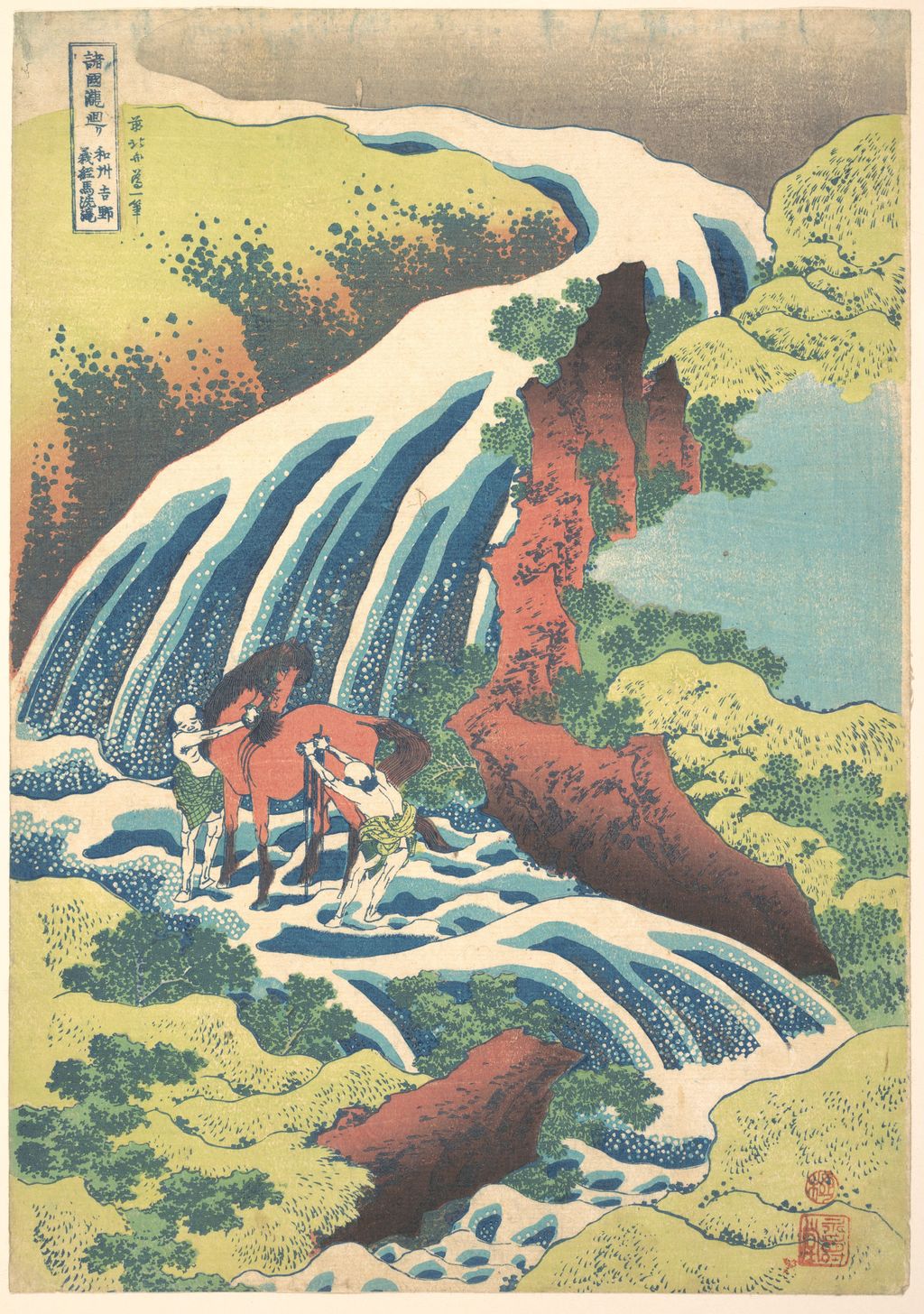
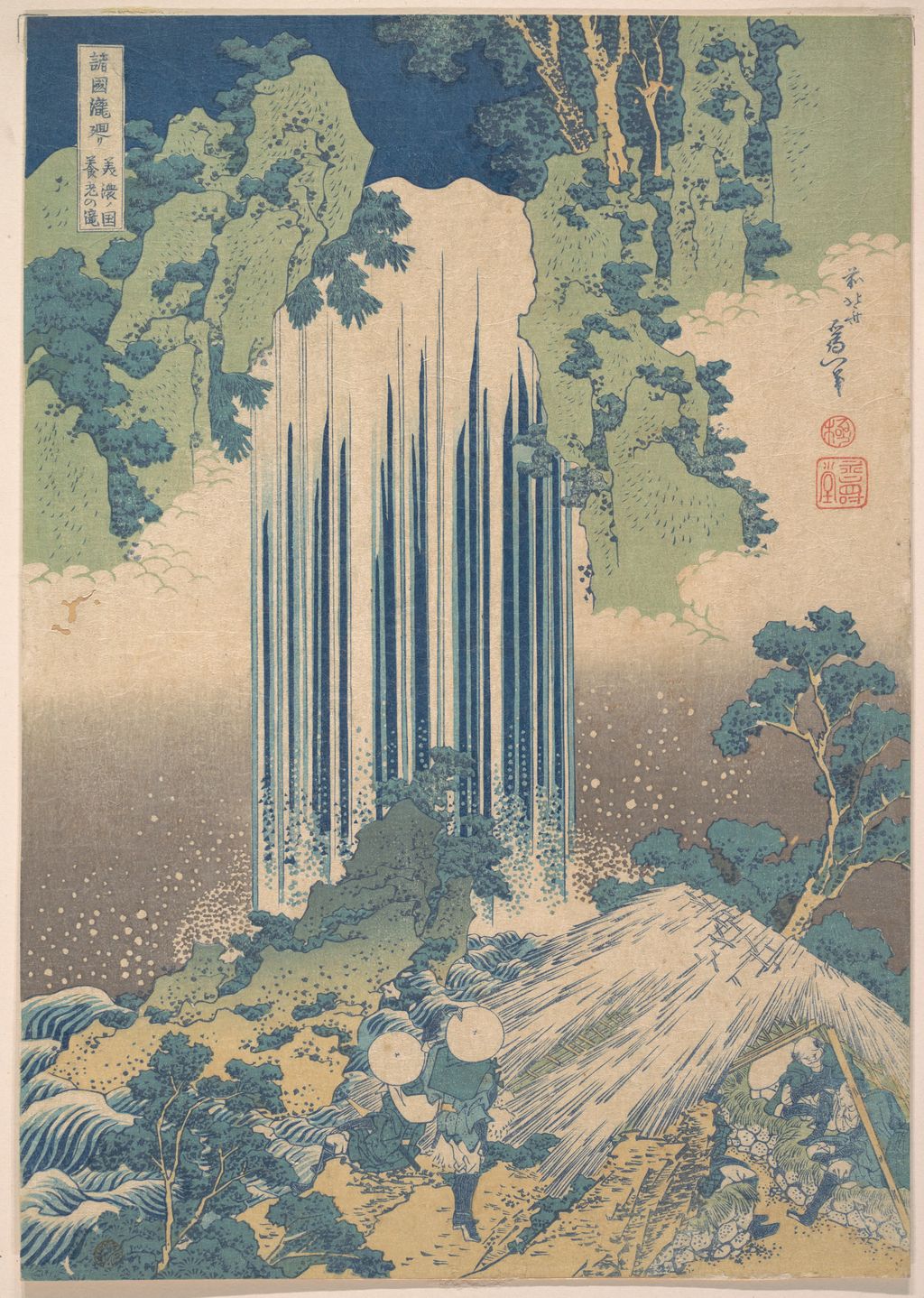
The eight designs gave Hokusai room to investigate how different falls behave. In Yoshitsune's Horse-washing Falls at Yoshino, an oblique fall leads to a horse and people in the water, and the title names the episode that gives them significance. Kirifuri offers several viewing positions and emphasises water spreading across the rock. In Yōrō Waterfall in Mino Province, which the Met also holds, a largely continuous column drops through a dark cleft. There the eye can follow the main drop in a single movement before it reaches the small people and buildings below. At Kirifuri, the larger watercourse repeatedly divides, encouraging a slower passage from ledge to ledge. [1] [2] [7] [8]
The rectangular title panel offers a quieter place to linger. It stands among upright trunks on the right, where the dark branches make the pale inscription easy to pick out. The fall comes down beside it, and the signature and seals sit much farther below on the sloping bank. The distance between those groups of marks is part of the pleasure of holding the whole print at once. The title identifies a place at one end of the design, while a viewer can start from the people by the bank and piece together what it feels like to stand there. [1] [5]
Where this work sits in Hokusai’s career
Hokusai Manga
From 1814Kirifuri Waterfall at Kurokami Mountain in Shimotsuke
ca. 1832Image comparison
Annotated Details from Kirifuri Waterfall
The numbered view uses the Metropolitan Museum of Art’s impression JP2924. Look for the same features in the complete sheet before opening the details below. [1]
Details from KIRIFURI WATERFALL
The details show how the parts of the design work together.
Where the fall enters
Water enters near the upper left, in narrow streams that run alongside one another before the rock divides them. [1]
Water divides around the rock
Ochre and red projections break the water into branches. Pale threads and darker channels carry the motion past each ledge. [1]
Visitors above the pool
Two visitors on the right look across at the fall from above the other group. Their position makes the steepness legible. [1]
Spray beside the visitors
The long lines of falling water become short curves and dots near the pool, where the standing visitors give the spray a human scale. [1]
Explore Hokusai’s works
Discussion
Look again at the images and ideas explored in Kirifuri Waterfall at Kurokami Mountain in Shimotsuke. These editorial prompts invite your observations.
Reader Insights
Where does the fall first divide around the rock?
How do the visitors at different heights affect your sense of scale?
Join the Conversation
Share a detail, comparison or question about Kirifuri Waterfall at Kurokami Mountain in Shimotsuke below.
References
- The Metropolitan Museum of Art, Kirifuri Waterfall at Kurokami Mountain in Shimotsuke, accession JP2924. View source.
- Shimane Art Museum, The Kirifuri Fall at Mt. Kurokami in Shimotsuke Province, from Tour of the Waterfalls in Various Provinces. View source.
- Nikkō City Tourism Association, Kirifuri Falls, Nikkō Official Guide. View source.
- Sarah E. Thompson, Hokusai's Landscapes: The Complete Series, Museum of Fine Arts, Boston, pp. 90–91. View source.
- National Gallery of Victoria, Misty Kirifuri Waterfall at Kurokami Mountain, collection work 22009. View source.
- Sumida Hokusai Museum, Wow, Hokusai! See, Examine, and Discover Ukiyo-e. View source.
- The Metropolitan Museum of Art, The Waterfall Where Yoshitsune Washed His Horse at Yoshino in Yamato Province, accession JP2927. View source.
- The Metropolitan Museum of Art, Yōrō Waterfall in Mino Province, collection work 55025. View source.






