


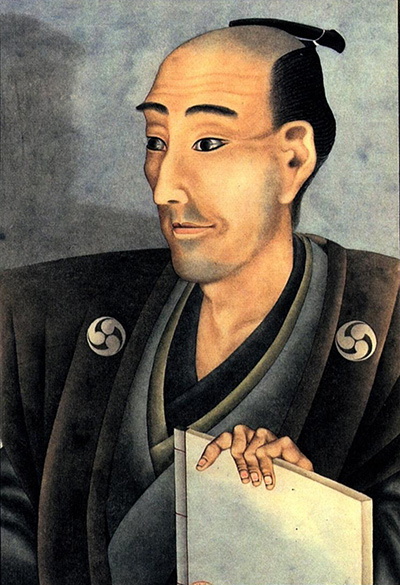
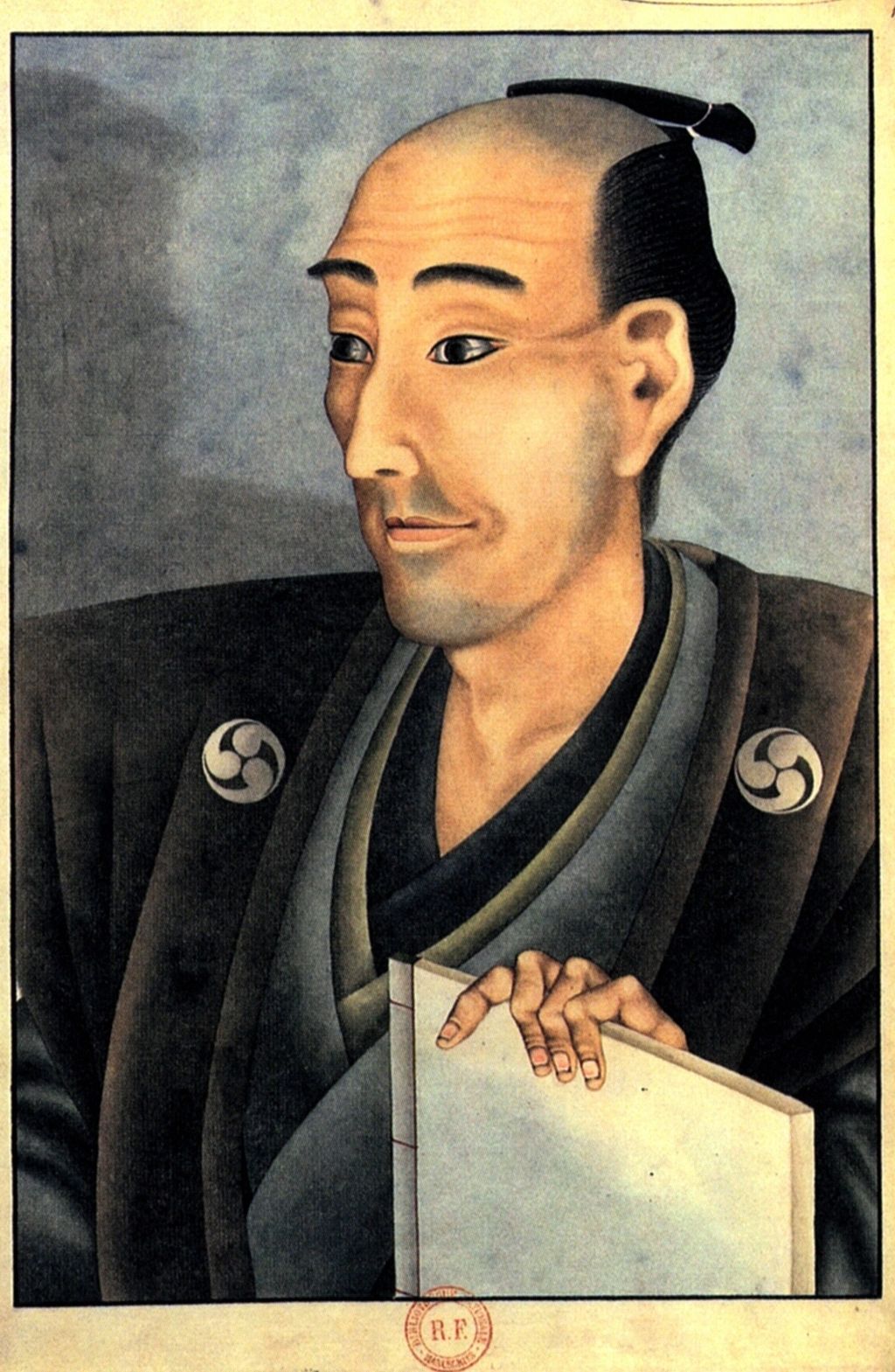
Warrior (Guerrier), school of Hokusai. Bibliothèque nationale de France, Japonais 382 (1).
Buy Art Prints Nowfrom Amazon
* As an Amazon Associate I earn from qualifying purchases.
 by Tom Gurney
Tom Gurney BSc (Hons) is an art history expert with over 20 years experience
Published on June 19, 2020 / Updated on November 20, 2026
Email: tomgurney1@gmail.com / Phone: +44 7429 011000
Warrior with a Book, from the School of Hokusai
A man turns his head to our left while his hand curls over a pale, book-like object. Two circular emblems stand out against his dark outer garment. The top of his head is shaved, and his hair is gathered into a short knot that projects against the grey-blue background. The Bibliothèque nationale de France (BnF) calls the work Guerrier, or Warrior. Its exhibition identifies the unsigned colour wash as a nineteenth-century work of the school of Katsushika Hokusai. The portrait has also circulated under the English title Portrait of a Man of Noble Birth with a Book. The French label identifies a social type and leaves the man’s name and particular rank open. [1] [2]
The BnF keeps the painting in its Department of Manuscripts under the shelfmark Japonais 382 (1), within the former collection of Johan Willem de Sturler. Other images in the same group show a merchant, a merchant’s daughter and a warrior’s wife. That setting helps explain the attention given to what the man wears and holds. It also gives us a way to compare the attention to costume with the unusually close treatment of the face. [1] [3] [4] [5]
At a Glance
- ArtistSchool of Hokusai
- Date19th century
- MediumColour wash
- CollectionJaponais 382 (1), Bibliothèque nationale de France
Contents
The hand and the pale cover
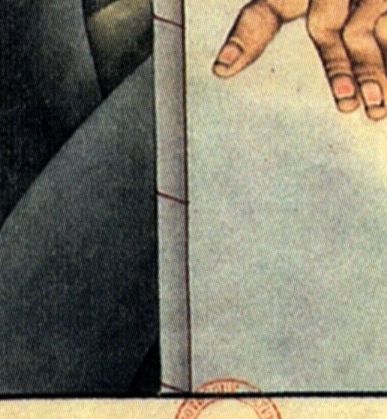
The object at the lower edge has the proportions and appearance of a bound booklet. A narrow strip runs down its left side. Small dark strokes meet that edge at intervals, like marks where a binding crosses a fold. The cover angles towards the viewer, and one side has a thin band of warmer colour. The title, contents and exact kind of binding remain unknown. The painter has given the cover enough solidity to register against the clothes while leaving its broad surface almost empty. [1] [2]
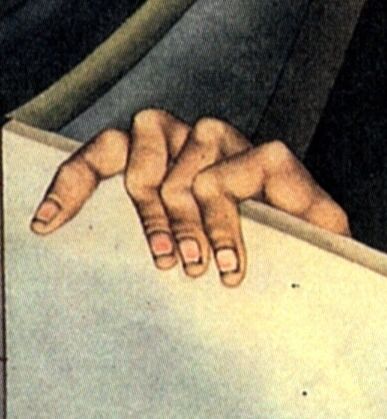
One finger extends down and to the left while the others bend more tightly over the top. Compare the tips and short strokes at the knuckles with the wider shadows across the robes. The fingers have individual outlines, yet the shadows beneath them make the whole hand curve around the edge. The gesture fixes the object in position. The man’s gaze runs sideways, away from the surface he holds, so the picture shows him with a book while leaving the action of reading outside the frame. [1] [2]
The position of the object also changes the balance of the portrait. The face occupies the upper half, surrounded by open space, and the pale cover presses into the lower right. The rest of the bottom edge is largely dark. The slant of the upper edge of the book meets the line of the nearer arm, while the almost vertical binding interrupts the sloping bands of the collar. The painter uses those changes of direction to give the hand and its burden a place of their own in a picture otherwise built around the head. [1] [2]
The crests and layered dress
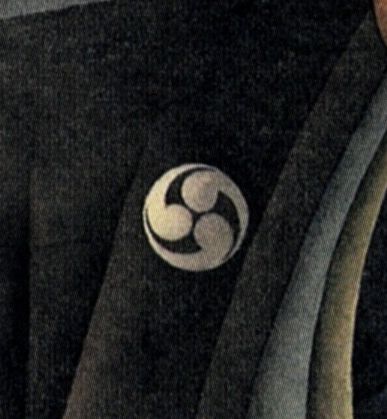
Two pale roundels are placed high on the outer garment, one toward either shoulder. Each contains a curling design with three parts. They make a nearly balanced pair even though the figure turns, and they stand out as clearly as the face against the surrounding dark colour. Between them the collar is made up of several layers with distinct edges. A blue-grey strip comes up beside the neck, and a warmer narrow edge follows it into shadow. Where those bands cross, small differences in tone make one layer appear to sit over another. [1] [2]
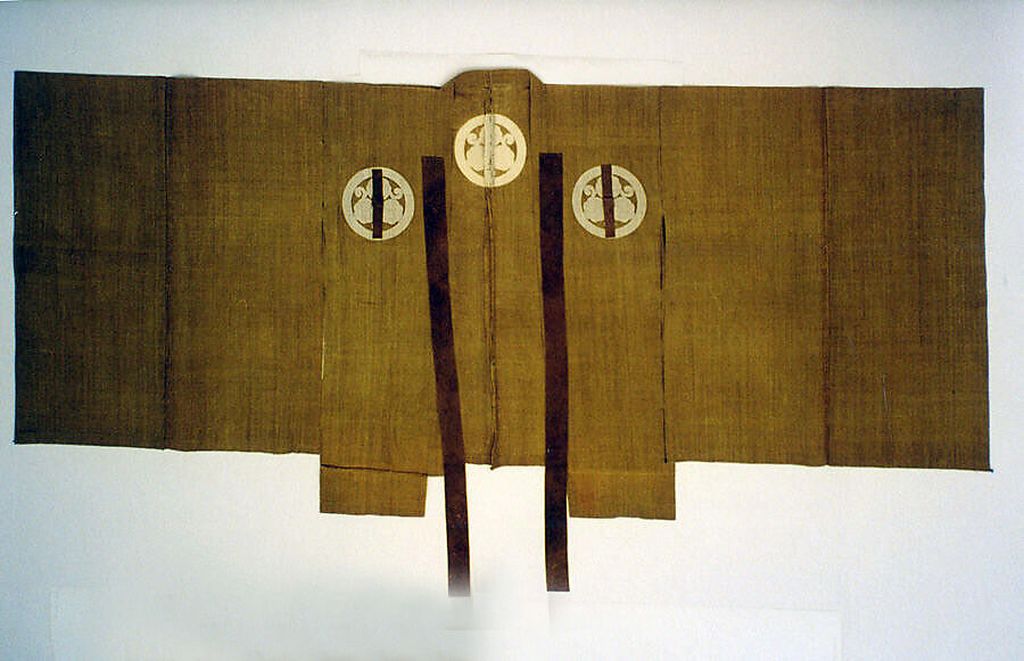
Family crests, or mon, can be seen on surviving garments worn by samurai. A nineteenth-century jacket and trousers in the Metropolitan Museum of Art offer a specific comparison. Pale circular emblems are placed against the darker cloth of the jacket. The museum describes the motifs as a form of tripod oak, with three leaves, and records that the family associated with the crest on that garment remains unidentified. The design in the BnF portrait is different. The Met garment shows how a repeated emblem can be a prominent part of dress even when the family behind one object remains unknown. The portrait alone gives too little information to identify the sitter from his emblems. [1] [6]
The crests first catch the eye as spots of light. Their internal shapes become legible only when we look closely. The painter sets them on surfaces that tilt away differently, giving the one on the viewer’s right a slightly different relation to the folds. Their arrangement across the body helps establish the breadth of the shoulders, which run nearly to the edges. As the shoulders spread out beneath him, the man’s head seems to turn independently. The effect depends as much on the disposition of cloth as on the drawing of the eyes. [1] [2]
Turning the head in light
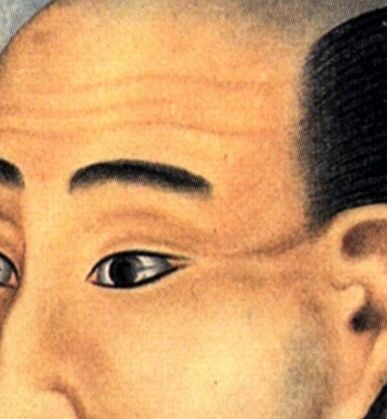
The face is shown in three-quarter view. The near ear is fully visible, while the nose projects against the background on the opposite side. The two eyes are unequal in size and each is framed by a dark upper line. Look at the near eye after tracing the eyebrow. A small change in the direction of the iris draws the gaze to the left, where the artist has left an open strip of background. The closed mouth has a much softer edge. A little reddish colour at the lips and a shadow beneath them give definition without competing with the eyes. [1] [2]
Modelling is particularly evident around the forehead and cheek. A warm patch passes across the forehead and near temple. Cooler colour collects below the cheek and in the lower part of the face. At the ear, the wash changes over a short distance as it turns into the dark edge of the hair. The compact hair knot stands out almost as a single dark shape. The background remains softly varied. It gives the outline room to emerge and leaves the man’s surroundings unspecified. The BnF’s description of colour wash identifies a painted work. The stronger outlines around individual features account for only part of what the eye sees. [1] [2]
The choice to fill the frame with one figure can be tested against Hokusai’s documented Portrait of Chino Hyōgo. The Nagano Prefectural Art Museum identifies Hyōgo by name and dates that painting to about 1810–12. There the book lies open on a low desk and the man lowers his gaze toward it. A hawk, a clock and writing implements help define the particular figure and his surroundings. In Warrior the large book edge stays close to the body and the face takes up the space that furnishings occupy in the other portrait. Both pictures use a book to organise attention. Only the Chino portrait comes with an identified sitter. [1] [7] [8]
The Sturler paintings
The BnF exhibition presents Warrior under a collective title for paintings of portraits, customs and occupations. The companion sheet Fille de marchand depicts a merchant’s daughter with a fan. It uses a close view with an object whose shape is cut off by the bottom edge. In Marchand, the man’s head tilts and his arms disappear into a much larger fold of dark clothing. The similarly compact format gives each figure space for a different gesture. Placing the paintings side by side also shows why a general category such as warrior or merchant can describe the figure without supplying a biography. [1] [3] [4]
The Institut national d’histoire de l’art describes the Sturler paintings as a commission associated with Johan Willem de Sturler, head of the Dutch trading post at Dejima from 1823 to 1826. Its account notes the use of Western painting techniques in the group. In Warrior, the sense of rounded volume is easiest to see in the turn from the lit forehead to the shaded side of the face and in the colour transitions around the chin. These are features to observe in the sheet itself. The commission context places the group in the 1820s, while the individual BnF exhibition entry gives the nineteenth century and credits the school of Hokusai. The name used for the commission and the attribution of any particular unsigned sheet operate at different levels. [1] [5] [9]
The paintings give different weights to the evidence of social life. The merchant’s daughter is recognised by the label attached to her image and shown with an open fan. The merchant is represented without a counter or a transaction. In another sheet, the BnF identifies figures at work as makers of Buddhist statuary. Those artisans are intelligible through their activity, while the warrior’s image gives the viewer no corresponding scene of combat or official duty. The group includes enough kinds of image for those differences to be deliberate features of what we see. In a close portrait like this one a few details carry much of the information that a more crowded scene can give through a setting. The emblems, the neatly controlled pose and the book are all visible at once, but the painting leaves their relationship to a named individual implicit. [1] [3] [4] [10]
The library records that the material entered as a gift from Sturler’s son, Willem Louis, on 29 August 1855. That history supplies names for the former owner and the donor, while the warrior remains anonymous. The contrast helps explain what the portrait can still offer. It gives a distinct face to a figure known by a general title, and it lets the book, crests and deliberately framed gaze carry the picture without identifying the person who posed, if the painter worked from a sitter at all. [1] [5] [9]
Where this work sits in Hokusai’s career
Hokusai Manga
From 1814Warrior with a Book, from the School of Hokusai
19th centuryAnnotated Details from Warrior (Guerrier)
School of Hokusai. Bibliothèque nationale de France, Japonais 382 (1). Reproduction via Wikimedia Commons, Public Domain Mark 1.0. [2]
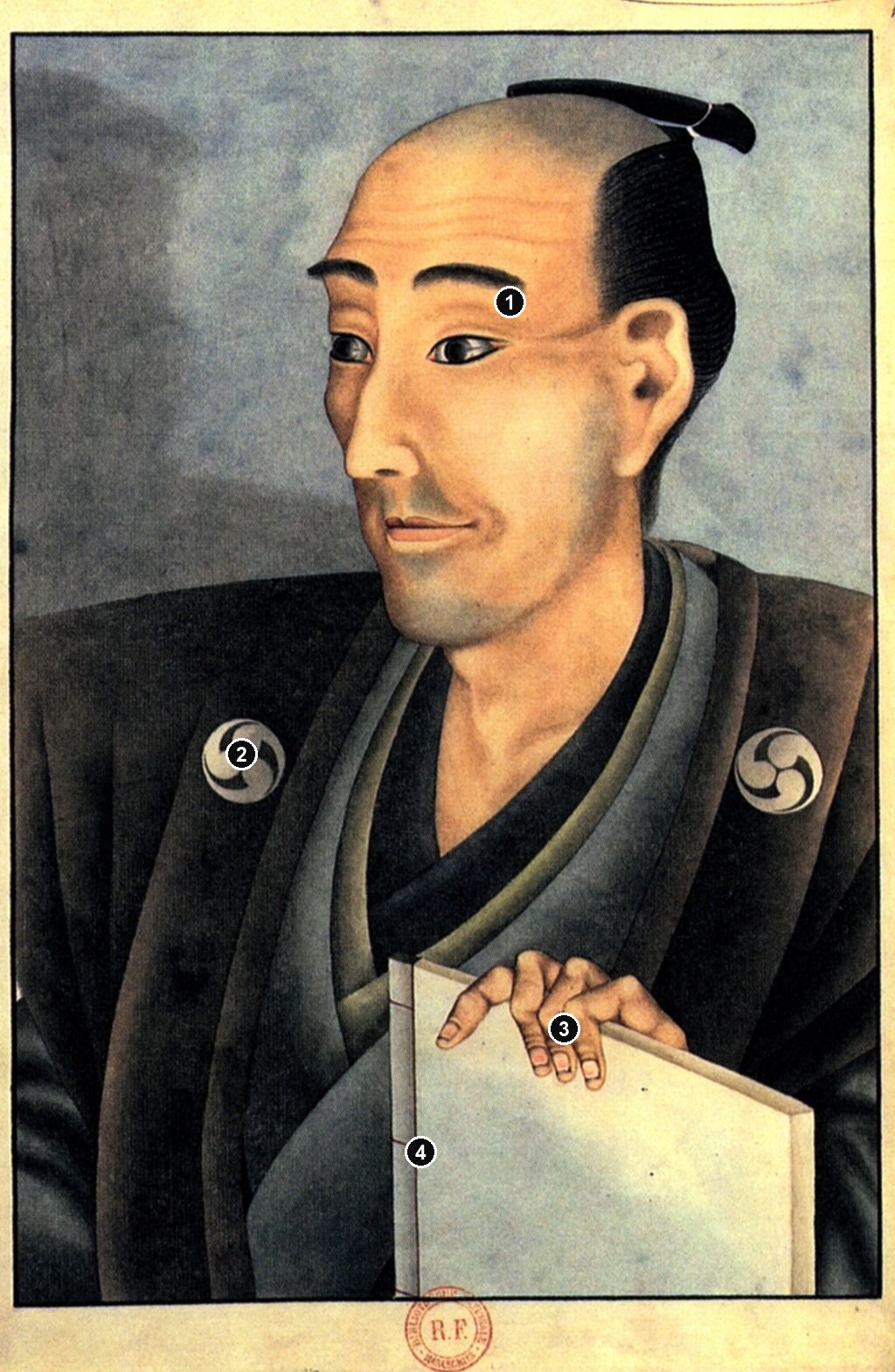
Details from WARRIOR (GUERRIER)
Select a detail to look closely.
Soft shadow models the forehead
The tonal transitions around the eye and brow turn the face towards the light. [2]
A circular crest stands out on the shoulder
A light roundel remains visible against the darker robe. Its form alone leaves the warrior’s identity open. [2]
Fingers curl over the book
The light edges of the fingers interrupt the long straight top of the object. [2]
The object has a visible bound edge
The pale plane has a narrow margin. Its facing surface carries no writing that identifies the sitter. [2]
Explore Hokusai’s works
Discussion
Look again at the images and ideas explored in Warrior with a Book, from the School of Hokusai. These editorial prompts invite your observations.
Reader Insights
Where do the crests and book draw your eye?
What can a portrait establish about its sitter?
Join the Conversation
Share a detail, comparison or question about Warrior with a Book, from the School of Hokusai below.
References
- Bibliothèque nationale de France, Guerrier, Japonais 382 (1), from Peintures de portraits, de mœurs et métiers divers. Title, exhibition attribution, medium and reproduced image. View source.
- Wikimedia Commons, independent digital reproduction of the same work, distributed under the alternative English title Portrait of a Man of Noble Birth with a Book. Compare visible details with the BnF image. View source.
- Bibliothèque nationale de France, Marchand, Japonais 382 (2), companion painting. View source.
- Bibliothèque nationale de France, Fille de marchand, Japonais 382 (3), companion painting. View source.
- Bibliothèque nationale de France, Japonais 382, collection metadata via Biblissima, with donor, former owner and date of entry. View source.
- The Metropolitan Museum of Art, Jacket (suo) and trousers (nagabakama), 1999.247.3a, b. Crest description and historical dress context. View source.
- Nagano Prefectural Art Museum, Katsushika Hokusai and the Three Shinanos, exhibition checklist, entry for Portrait of Chino Hyōgo. View source.
- Japan Ukiyo-e Association, A Personal Handbook of Katsushika Hokusai, p. 429, description and detail of the Chino portrait. View source.
- Institut national d’histoire de l’art, “Hokusai à la rencontre de l’Occident,” BnF and INHA conference with Véronique Béranger, Nathalie Buisson and Christophe Marquet, 23 January 2018. The collection, commission and painted technique. View source.
- Bibliothèque nationale de France, Artisans de statuaire bouddhique, Japonais 382 (18), a workshop scene in the same group of paintings. View source.







