


 by Tom Gurney
Tom Gurney BSc (Hons) is an art history expert with over 20 years experience
Published on June 19, 2020 / Updated on November 20, 2026
Email: tomgurney1@gmail.com / Phone: +44 7429 011000
Tago Bay near Ejiri on the Tōkaidō
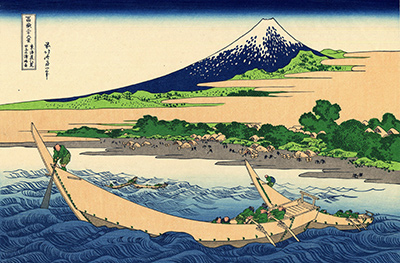
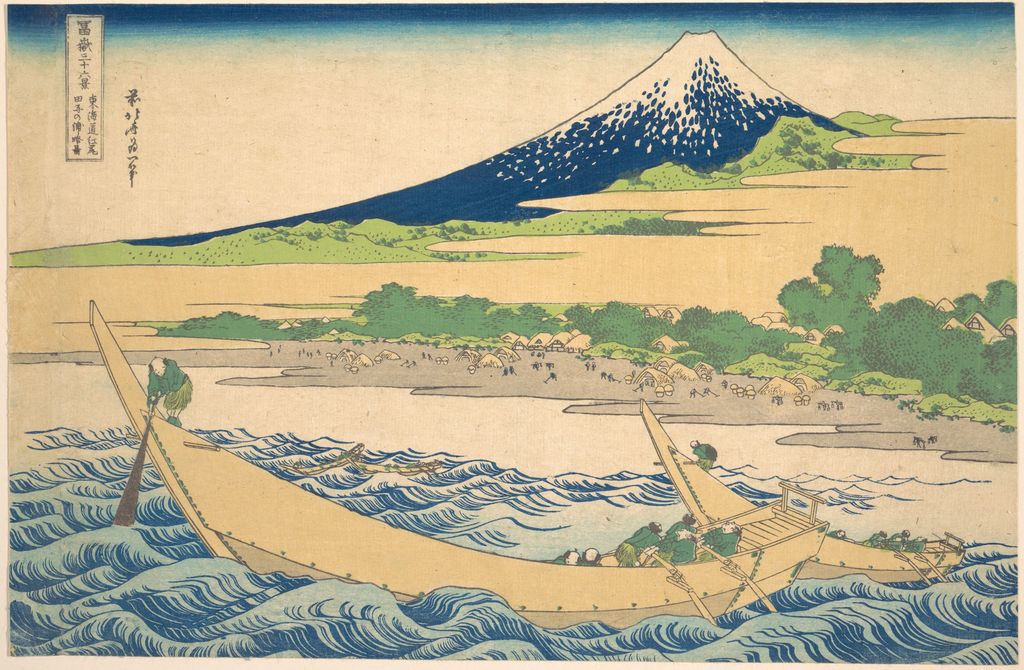
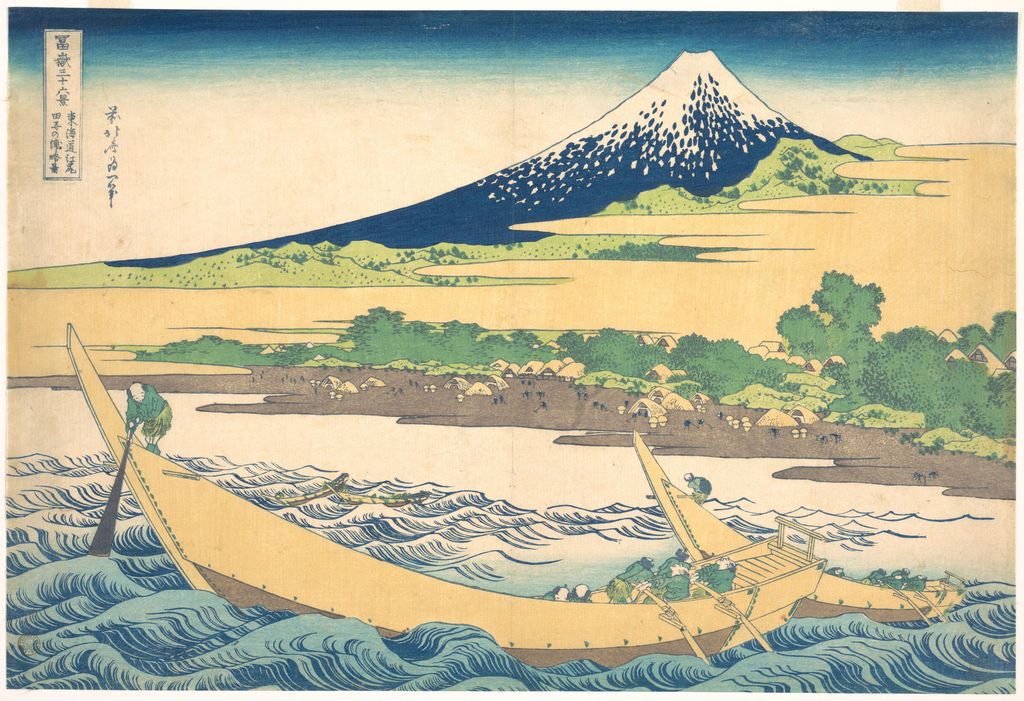
A long wooden boat climbs across the lower part of Hokusai’s Tago Bay near Ejiri. The waves rise high enough to cover sections of its hull, but the bow ascends well above them. A person working near the bow looks down towards the blue water. Another boat, set farther back, repeats the upward thrust at about half the height. Beyond both craft there is a stretch of open water and a shore crowded with small figures. Mount Fuji, occupying much of the upper part of the design, seems to bear none of the strain of the scene beneath it. [1] [2]
The Metropolitan Museum of Art dates its impression JP2976 to about 1830–32. It is a colour woodblock print on paper, 24.8 by 37.5 centimetres, from Thirty-six Views of Mount Fuji. The title names Ejiri, Tago Bay and the Tōkaidō road. Its last word, ryakuzu, presents the view as a sketch or abbreviated picture. The Sumida Hokusai Museum places Ejiri around present-day Shimizu in Shizuoka and explains that the name Tago once covered a wider stretch of coast than it commonly denotes today. That helps explain how the same title can join a road station with a broad view across the water. [1] [3] [4]
At a Glance
- ArtistKatsushika Hokusai
- Dateca. 1830–32
- MediumColour woodblock print
- SeriesThirty-six Views of Mount Fuji
Contents
Two boats in moving water
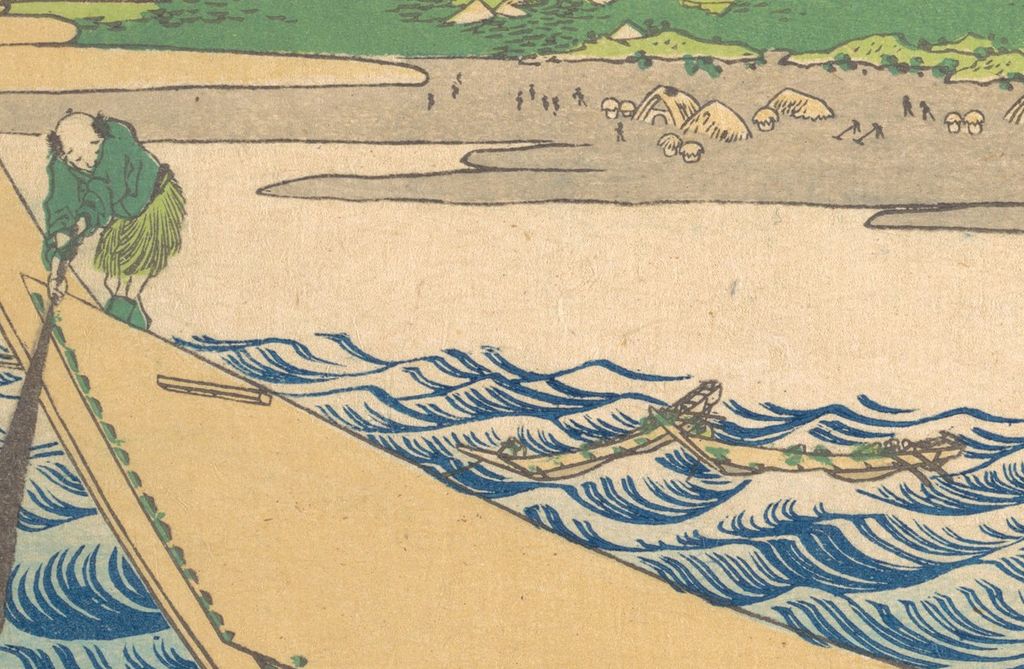
The near boat gives us a way to read the waves. Start with the tall bow on the left. Its long, fairly straight edges pass through a band of uneven crests. The hull dips towards mid-sheet and bends upwards again near the right, where the planks of a raised deck come into view. Below it, a succession of overlapping waves holds the viewer close to the surface. Their lines curl, break and begin again. The regular course of the boat’s edge reappears between them, so a viewer can trace a single solid shape even where the water conceals part of it. [1]
Hokusai makes the occupants visible in short glimpses. The person at the bow leans out with a long implement reaching into the water. Farther back, a row of heads and bent backs barely clears the high side of the boat. Long oars or poles cross the hull at an angle and reach down towards the lower edge. The gaps between the figures let each appear busy with his own work without making the crew fully visible as a group. In the second boat, the standing figure behind the raised bow repeats the forward lean at a different point in the composition. That smaller likeness lets the two boats belong to the same stretch of rough water. [1]
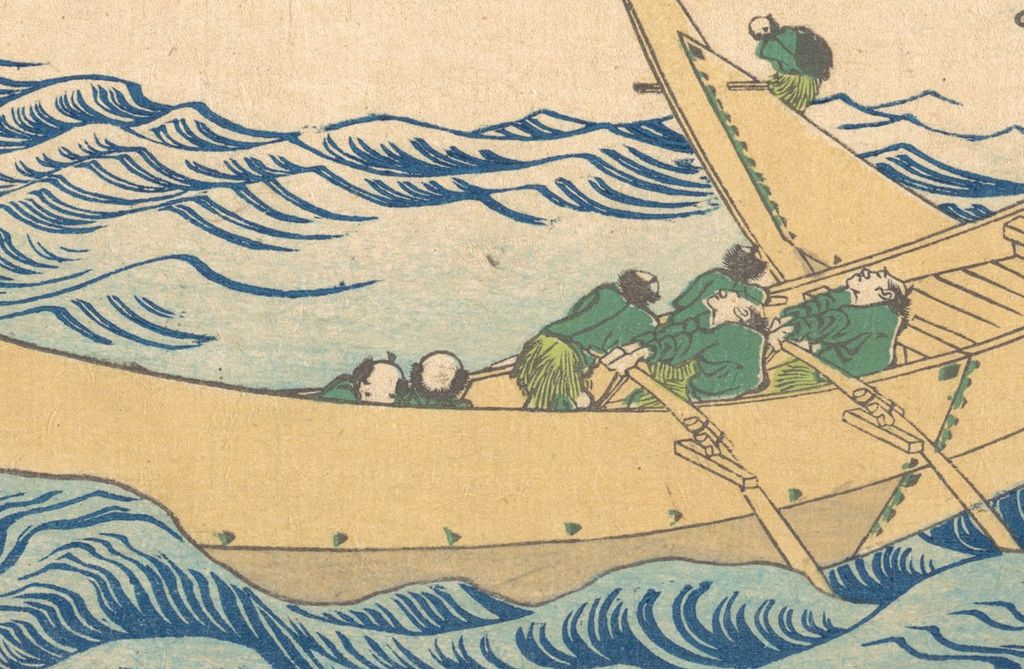
The Met’s account of its other impression, JP1288, describes crews steering through strong currents and a fisherman casting a net. In JP2976 you can see how the narrow implements and other small forms among the crests share the direction of the action. The close water has many blue lines, while stretches of paper remain open between more distant crests. Some ridges seem to run almost parallel to the length of the hull. Others cut into it. This alternation makes it possible to imagine the changing pressure around each boat as it moves. The blue is doing much more than describing the local colour of water. Its repeated edges tell us how the surface is moving. [1] [2]
Work on the other shore
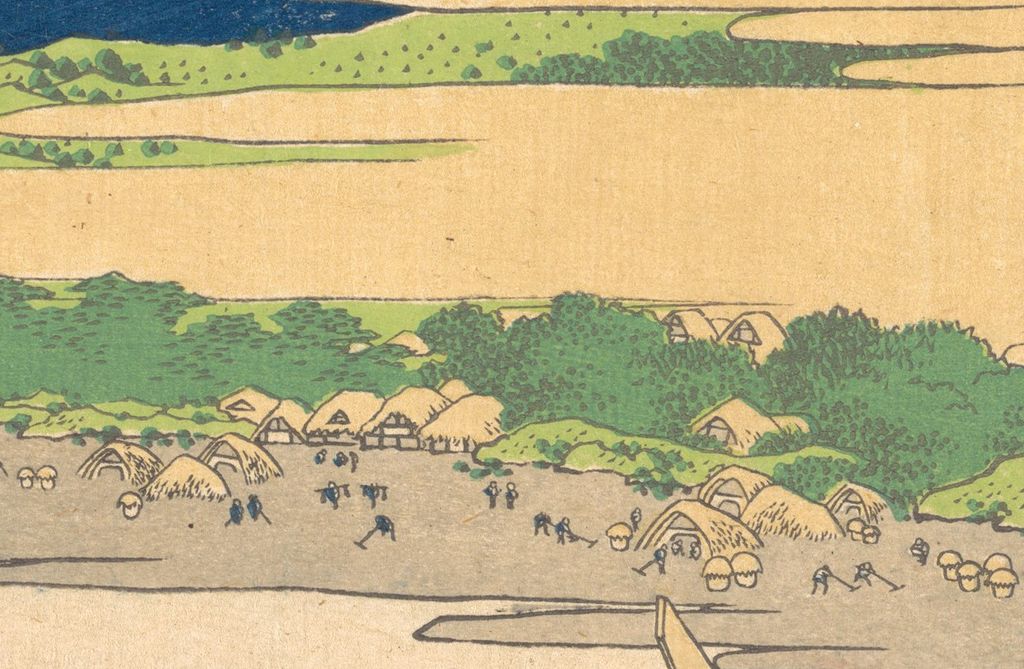
Look beyond the second bow and the curves begin to flatten. Water still occupies the space in front of the shore, but the large crests are far enough away that the edge of the beach can run across the sheet in long strips. Behind them are low buildings, packed trees and small patches of open land. Many of the people here are barely taller than the marks used to show items set on the ground. Their scale makes the figures in the boats look very close. It also gives a better sense of how much country lies between the working boats and the mountain. [1] [3]
The Sumida museum and the RISD Museum both identify activity along the shore as salt-making. Sumida calls attention to the dozens of people Hokusai shows working there. Rounded and angular forms sit on the flat ground between groups of figures, many of whom appear as only a few strokes. The more closely you look, the more of the apparently quiet background turns out to be occupied. RISD identifies the people in the boats as fishermen and discusses the work as part of an exhibition about food in Edo-period Japan. In this print the crews and the shore workers share a view, while the composition gives each kind of work a different pace. The salt makers spread along the length of the shore and the rowers appear intermittently where the tall hull leaves room for them. [1] [3] [5]
Tago was also a recognised place for viewing Fuji and a site with longstanding poetic associations, as Sumida explains. Hokusai retains the long view of the mountain while requiring us to see it across a shore where people earn their living. The activities take up little area compared with the great slope. Their placement between the boats and the peak matters more than their size. The fields of green behind the shore and the repeated strips of open sand let the eye travel sideways across the activity before it moves up. Fuji becomes part of an extensive coastal landscape in which a viewer can still pick out individual tasks. [1] [3] [5]
How the sea leads to Fuji
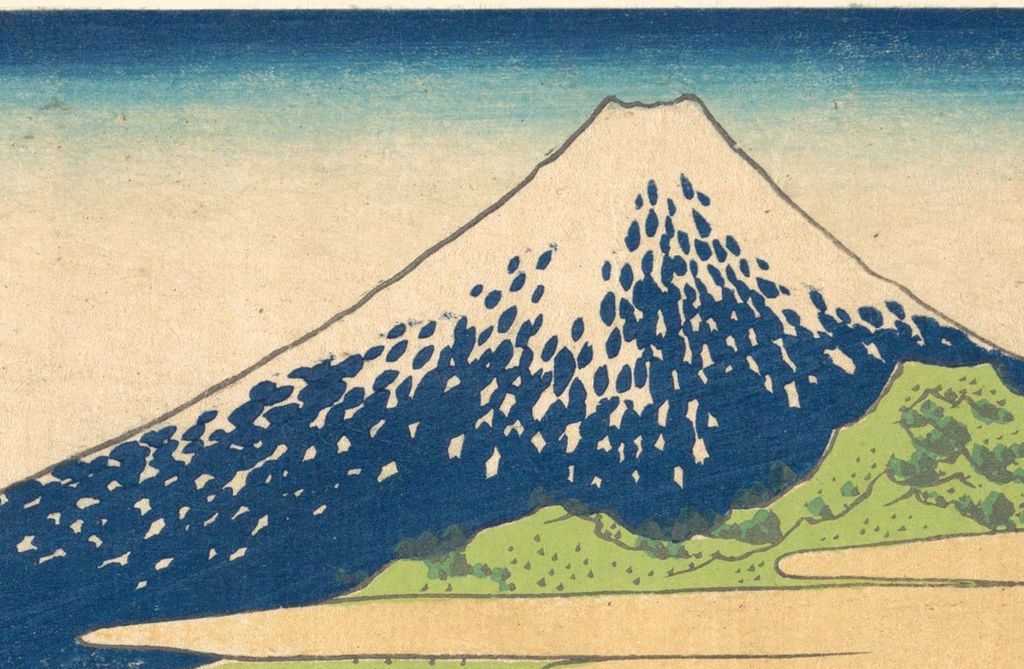
From the top of the larger bow, follow the broad curve of the hull to the right. Now travel in the opposite direction down the long flank of Fuji. The Met calls attention to an echo between the shapes of the mountain and the boats. The direction of one curve makes the other easier to find. Above the band of coastal greens, Fuji’s dark left flank changes height continuously until it reaches the snow. Below it, the boat begins well above the water, descends almost to it, and comes up again through the gear at the stern. The shapes hold different parts of the picture together even when the waves are the first lines a viewer notices. [1] [2]
The long strips of pale colour also affect that reading. Some of them seem to lie in front of the lower slopes of the mountain, while others divide the fields from the water. Their relative stillness lets the busy foreground stand out. The snow is especially distinct where the white breaks into short marks at the transition to the dark slope. In Ejiri in Suruga Province, Hokusai leaves Fuji as a fine outline while blown papers and bent trees supply the visible signs of a gust. That print shares the name Ejiri but has its own Japanese title, Sunshū Ejiri, and depicts people travelling on foot. Here the fuller shape of the mountain and the clustered waves give us a different way to see a place connected to the same road station. [1] [6]
What changes from sheet to sheet
The same structure remains visible across the three reproductions at the Met and Keio University Libraries. In the Met’s JP2976, warm horizontal bands and yellow hulls play against a dark blue mountain and a closely patterned sea. Its JP1288 photograph makes the low shore read as a more definite dark horizontal strip. The lighter interval between the shore and the boats consequently stands out more clearly. In the Keio photograph, the wave marks and greens look more subdued, while the outline of the raised bow still takes the eye from the water up to the shore. These are comparisons of the images as reproduced. Differences of lighting, electronic colour, paper condition and printing can contribute to the appearance of any single sheet. [1] [2] [7]
Keio records its example as an ōban nishiki-e, a large-format colour print, and gives measurements of 24.9 by 35.6 centimetres. It attributes publication to Nishimuraya Yohachi and transcribes Hokusai’s signature as 前北斎為一筆, naming him by his then-used name Iitsu alongside Hokusai. The Bibliothèque nationale de France also names Nishimuraya Yohachi and his publishing house Eijudō. Its record identifies the rectangular title cartouche near the upper left and assigns the example to about 1831–34. The Met dates both of its sheets to about 1830–32. These are overlapping catalogue ranges for prints with the same composition. [1] [2] [7] [8]
On the Met and Keio images the cartouche hangs down from the top near the edge, with the signature just to its right. Both sit above the open part of the sky, where the mountain has yet to rise into view. From the narrow column of text it is possible to follow the print almost straight down to the raised bow. The title names the route and locality before this sequence of features gives them a visible setting. [1] [2] [7] [8]
The Library of Congress offers a different kind of comparison. Its record identifies its copy as a Takamizawa reprint and dates it broadly between 1890 and 1940. The catalogue still describes the same boats, shoreline settlement and distant Fuji. Those features identify the design even when the sheet itself belongs to a later printing. In Hokusai’s picture, the central relationship survives that change of date and impression. The closer we look at the work of steering a boat or at the figures on the shore, the more striking it becomes that the view gives so much room to a single uninterrupted mountain slope. [1] [4]
Where this work sits in Hokusai’s career
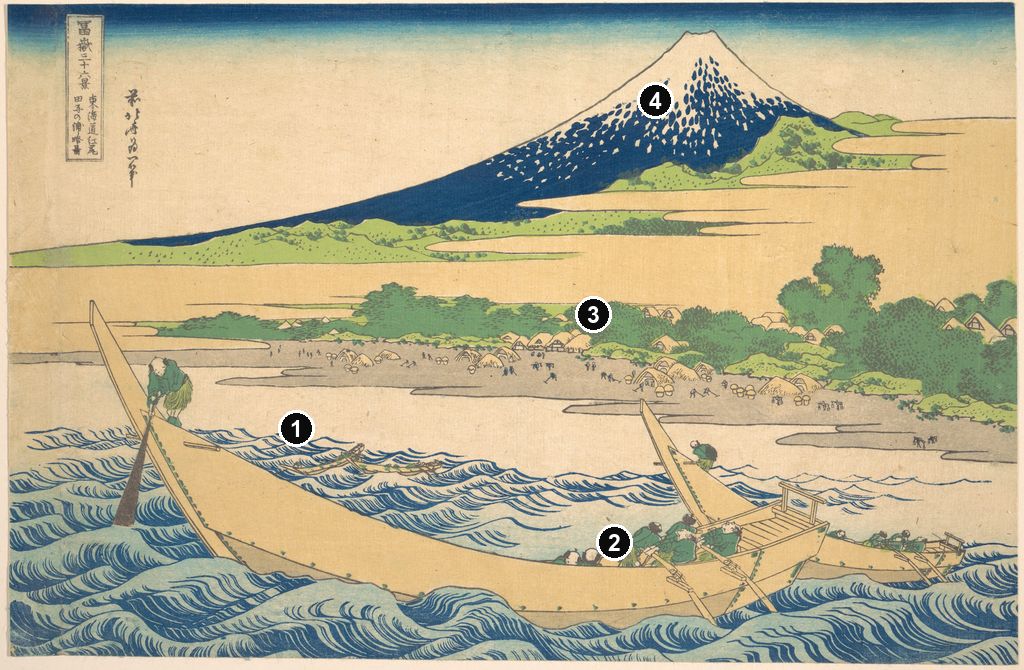
Annotated Details from Tago Bay near Ejiri on the Tōkaidō Road
The Metropolitan Museum of Art, JP2976. [1]
Details from TAGO BAY NEAR EJIRI ON THE TŌKAIDŌ ROAD
Select a detail to look closely.
A boat stretches across the current
The long curved hull interrupts the repeated movement of the waves. Small crew figures help establish the scale of the vessel. [1]
The sea gathers at the lower edge
The darker and lighter wave shapes overlap at the foreground. Their repetition carries movement between the two banks of colour around the boats. [1]
A narrow strip of shore
Behind the water, the bank is compressed into a succession of narrow fields. Small shapes at the shoreline interrupt this long horizontal passage. [1]
Fuji’s blue slope and pale crest
The dark lower slope gives way to a pale summit. The mountain occupies the distance, while the lines on the water read as close and moving. [1]
Explore Hokusai’s works
Discussion
Look again at the images and ideas explored in Tago Bay near Ejiri on the Tōkaidō. These editorial prompts invite your observations.
Reader Insights
Where do the boats interrupt the repeated lines of the water?
What distinguishes the rising slopes of Fuji from the coastline?
Join the Conversation
Share a detail, comparison or question about Tago Bay near Ejiri on the Tōkaidō below.
References
- The Metropolitan Museum of Art, Tago Bay near Ejiri on the Tōkaidō, JP2976. View source.
- The Metropolitan Museum of Art, Tago Bay near Ejiri on the Tōkaidō, JP1288, object record and curatorial description. View source.
- Sumida Hokusai Museum, Thirty-six Views of Mount Fuji: Tago Bay near Ejiri on the Tōkaidō, Japanese collection entry and curatorial description. View source.
- Library of Congress, Tōkaidō ejiri tago no ura ryakuzu, FP 2 – JPD, no. 2069, translated title and Takamizawa reprint note. View source.
- RISD Museum, Eating in Edo, p. 5, label for Tago Bay near Ejiri on the Tōkaidō, 20.1199. View source.
- The Metropolitan Museum of Art, Ejiri in Suruga Province, JP12. View source.
- Keio University Libraries, The Bay of Tagonoura at Ejiri on the Takaidō Highway, Takahashi Ukiyo-e Collection, 200X@4-19, and linked IIIF image. View source.
- Bibliothèque nationale de France, Tōkaidō Ejiri Tago no ura ryakuzu, FRBNF42188486. View source.







