


 by Tom Gurney
Tom Gurney BSc (Hons) is an art history expert with over 20 years experience
Published on June 19, 2020 / Updated on November 20, 2026
Email: tomgurney1@gmail.com / Phone: +44 7429 011000
Five Fans by Katsushika Hokusai
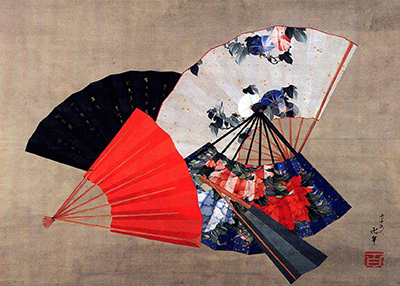
In Katsushika Hokusai’s Five Fans, the ribs of a bright red fan converge towards a point on the left. On the other side of the picture, two decorated fans open in opposite directions. The pale one rises towards the upper edge and the darker one spreads out towards the lower right. Between the open fans, quieter shapes and narrower lines disclose parts of the others. The pleasure of the painting comes partly from working out how much of each fan is visible and how much disappears beneath its neighbours. The Tokyo National Museum catalogues the work as Fans (Senmen chirashi zu, 扇面散図), a hanging scroll in colour on silk, dated 1849. [1] [2]
At a Glance
- ArtistKatsushika Hokusai
- Date1849
- MediumColour on silk
- FormatMounted hanging scroll
Contents
How the fans overlap
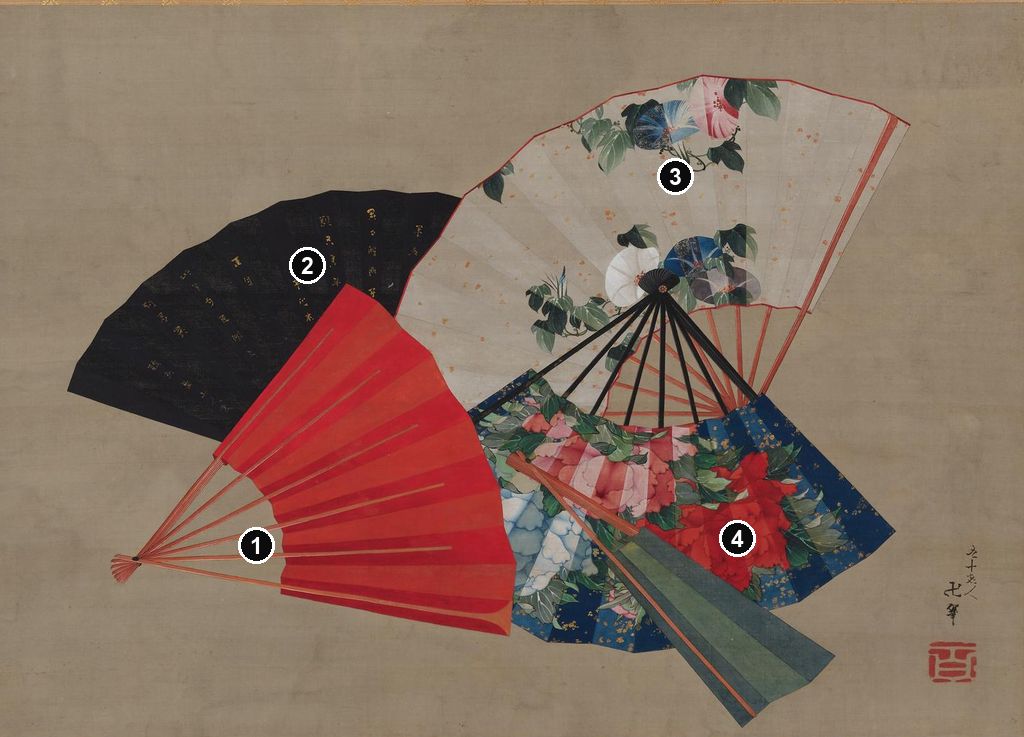
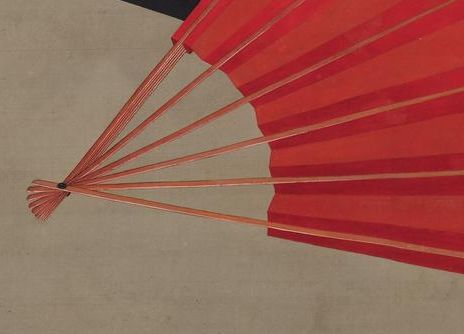
The red fan makes the clearest starting point. Its small pivot sits low and to the left, outside the broad sweep of its painted paper. Thin ribs spread from that point and cross a wedge of open space before reaching the red field. Once they reach the paper, some of their paths continue as changes of tone. The warmer stripes and darker bands spread farther apart as they approach the wide edge. That widening makes the paper seem to stretch between the ribs. The lower edge runs down towards the right, while the opposite edge reaches up into the dark fan behind it. The red shape establishes both the fan’s opening and the angle at which it lies. [1] [3]
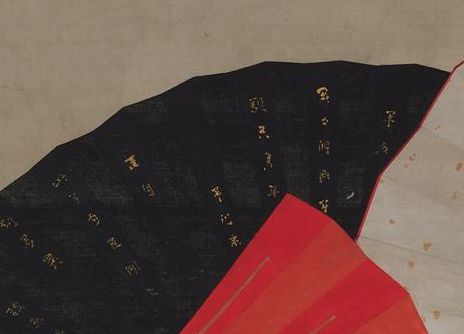
Part of the dark fan remains visible above the red one. Its outer edge steps along the crests of the folds, and one side disappears under the pale fan at the top. Fine marks in gold sit in lines across the dark paper. The museum’s conservation report identifies them as a Chinese poem. The writing is easiest to follow across the exposed folds, where it breaks the surface into small points of light. Some of the gold comes very close to the red edge. The abrupt interruption there helps locate the dark fan behind the red one. [1] [3]
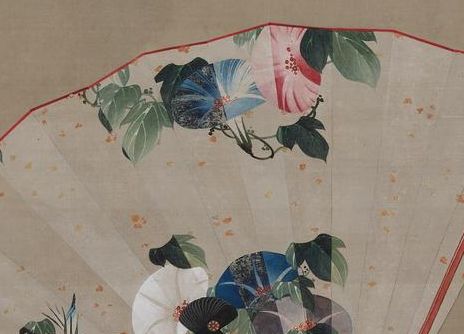
At the upper right, the large pale fan offers a different view of the structure. The paper opens wide and carries leaves and blue and pink blossoms. The strong lines beneath it draw attention to the central crossing of the fans. Several of the dark ribs belong to the fan opening downwards, while finer reddish ribs lead away into the pale upper fan. The picture asks for a closer look at which lines continue across which surfaces. The bottom edge of the pale sheet stays sharp where it meets the ribs, and a thin red line traces the outer edge of the paper. The light field lets both sets of ribs remain visible in a compact space. [1] [3]
The lowest slanting form is much narrower than the open fans above it. A strip of green lies alongside a darker blue-green passage, and the straight edges carry the eye past the flowers towards the bottom right. Its visible surfaces are close together. At the left of this downward movement, the ribs of the red fan are spread as far apart as its shape will allow. The group therefore lets the eye follow several degrees of opening across the same cluster. The blank silk makes this easier to see. There is space around the ends of the fans, and the diagonal at the lower right comes forward without touching the edge of the painting. [1] [3]
Painting folds and patterns
The painted paper changes shade where it turns. This is particularly easy to see on the red fan, where each narrow change of colour extends all the way out towards the edge. On the pale fan, similar shifts are subtler. The flower and leaf forms cross the pale areas, and the folds still register through those changes in the surface. The Agency for Cultural Affairs singles out this modulation of light and dark as the source of the fans’ three-dimensional effect. Hokusai uses shading inside the forms as well as overlap between them. The first makes the papers bend, while the second gives the bent objects a place in the pile. [1] [2] [3]
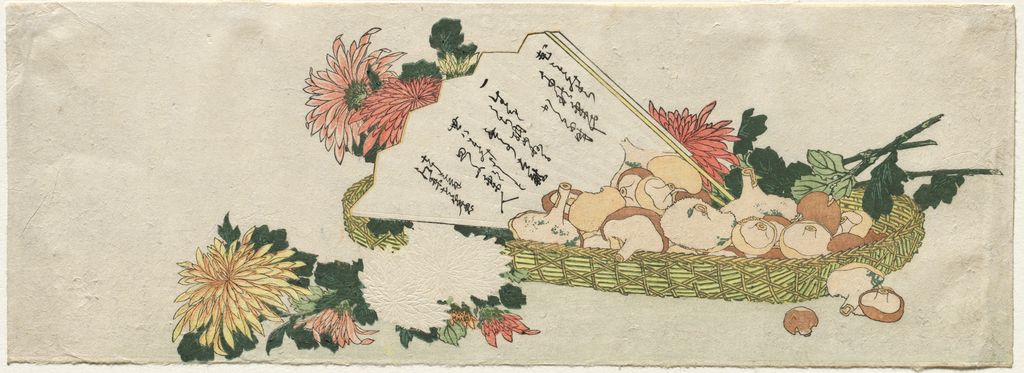
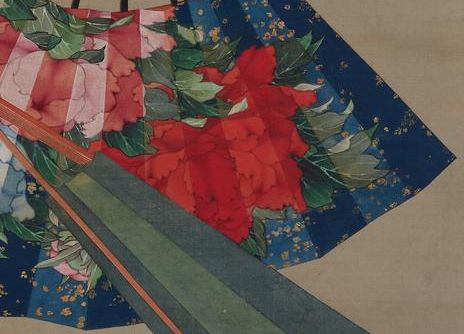
The conservation report identifies morning glories on the white fan and peonies on the indigo one. The morning glories are spaced apart, with stretches of light paper between the flowers and leaves. In the blue panel below, the large blossoms occupy most of the open field and push against the edges. Red petals gather near the lower right, while paler flowers sit close to the part concealed by the red fan. Peonies also occupy a large part of Hokusai’s colour woodblock print Peonies and Butterfly. In Five Fans the visible flowers stop at the edge of the decorated paper, and a viewer can trace those edges back towards the ribs. The flower pattern helps identify a particular fan within the group. [1] [3] [4]
The Tokyo National Museum’s exhibition on fans describes these objects as surfaces for pictures as well as functional implements. Its examples include both decorated fans and fan-shaped images in larger works. The curved upper edge and the narrow base can give a design two very different kinds of space within a small area. Hokusai makes use of that inherited shape more than once within a single rectangle. Some sectors are broad enough to show a dense field of flowers. Other shapes admit only a strip of paper, a fan rib or a few written characters. The recognisable shape of a partly folded fan makes those small remnants intelligible. [1] [5]
The painted silk and its mounting
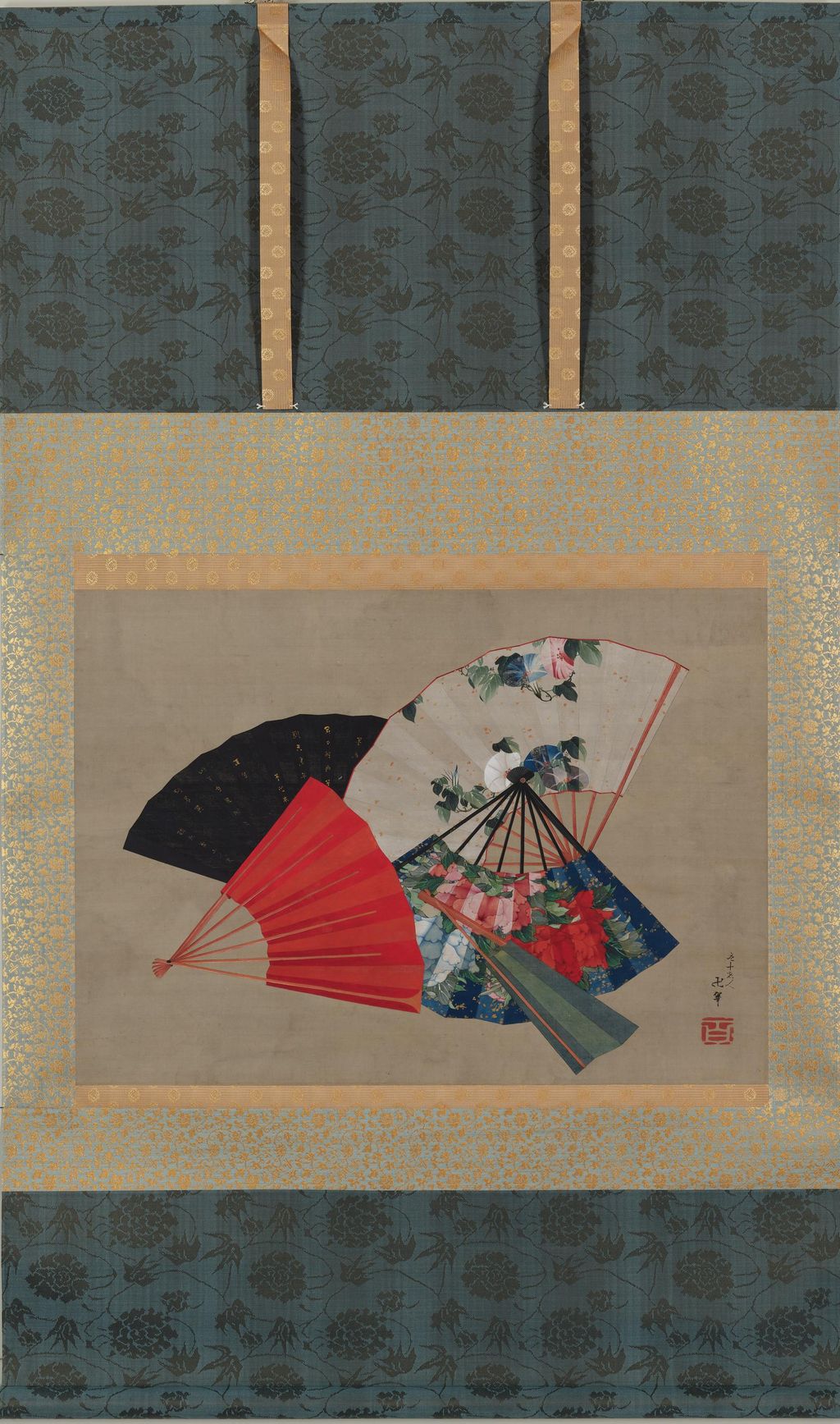
The whole scroll has a vertical profile. The painted silk is a horizontal rectangle set into that taller mounting, between passages of patterned textile. In the museum’s full photograph, the cluster appears low in this larger expanse, and the long bands of the mount give a sense of the height of the hanging object. Look closely at the painted area and the scale changes. The five fans fill much of the rectangle, leaving just enough open silk for the curves and pivots to remain legible. The record published by the Agency for Cultural Affairs gives the painted area as 51.5 by 71.4 centimetres. The conservation report records 51.0 by 71.3 centimetres for the painted support after treatment and 140.4 by 86.6 centimetres for the remounted scroll overall. [1] [2] [3]
The distinction matters among Hokusai’s paintings because their viewing conditions vary. In the Smithsonian’s Boy Viewing Mount Fuji, another hanging scroll painted in ink and colour on silk, a willow branch carries attention from the flute player towards the distant mountain. The unoccupied parts of the painted surface help suggest the distance between them. Here the open silk sets off a group of familiar objects close enough to examine for slight changes in shade. The two works also reward a closer view, where the thin washes of the earlier landscape and the fine differentiation of the fan papers can be seen. Hokusai’s Dragon belongs to a different support and position. The Obuse museum identifies it as a ceiling painting for the Higashimachi festival float, so its painted field was designed to be seen from below. [1] [3] [6] [7]
What conservation revealed
The Tokyo National Museum recorded horizontal creases in the silk and areas where paint had begun to lift. A Japanese painting mounted as a scroll has layers behind the painted surface that help it endure handling and display. As part of treatment, conservators reinforced vulnerable areas and removed the old first backing. The removal made it possible to study the reverse of the silk using microscopy and photographs, including records made with infrared light. The report says that this examination did not confirm colour applied to the back. Its account of the effects of light and shade is grounded in observations of the painted face and its visible changes of tone. [2] [3]
The report also explains how much the support behind the image can affect the way it looks. The previous first backing was pieced together from four sheets of dark-toned paper. Its seams affected the appearance of the work from the front. Conservators used a single sheet of dyed kōzo paper for the new first backing and chose a dark grey tone that would lighten the appearance slightly while keeping it close to the earlier one. The before-and-after photographs show the painted field and the whole scroll separately. This makes it possible to examine both the subtle shifts across the silk and the way the scroll now holds it for display. [3]
The signature beside the fans
Low on the right, a short vertical inscription and a red seal occupy a gap beside the pointed green form. The Agency’s record transcribes the inscription as 九十老人卍筆, which identifies the brush of the ninety-year-old Manji. The age follows the traditional reckoning reflected in the Japanese museum records. The square seal bears the character for a hundred. The signature and seal are small beside the fan papers, but the clear stretch of silk around them leaves them room to be read. They also give the viewer another way to register the scale of the fan shapes just to their left. [1] [2] [8]
Manji and a stated age also appear in the signature of the Smithsonian’s 1839 scroll, where Hokusai identifies himself as eighty. The inscriptions give a dated point of comparison for looking at the two works. In the later painting, marks on the fans themselves range from heavy red accents to very fine gold characters. The artist’s own writing sits outside those decorated fields, closer to the level of the green fan’s edge. A viewer can move from the name back into the painted group and follow the crossing lines again, this time with the brushwork on the silk as much in mind as the objects it represents. [1] [2] [6]
Image comparison
Where this work sits in Hokusai’s career
Fans
1849Annotated Details from Fans
Tokyo National Museum via ColBase. A-12347. The overview shows the painted area. Markers and cropped details are adaptations under the ColBase terms. [1]
Details from FANS
Select a detail to look closely.
The red fan’s ribs spread from one point
Fine straight ribs lead into increasingly broad areas of red. Alternating tones suggest paper creased over the ribs. [1]
Gold marks follow the folds of the dark fan
The dark fan remains distinct behind the red one. Its small gold marks are visible as the pleated surface turns and catches light. [1]
A pale fan opens above them
The pale paper gives the painted morning glories room. Subtle shifts in tone continue the folds beneath the flowers. [1]
Peonies interrupt the dark pattern
The clearest petals occupy an indigo field. The fan’s curved edge keeps that flower pattern separate from the neighbouring fans. [1]
Explore Hokusai’s works
Discussion
Look again at the images and ideas explored in Five Fans by Katsushika Hokusai. These editorial prompts invite your observations.
Reader Insights
Which painted fold makes a fan seem to project from the silk?
Where do the five fans separate when you follow their ribs and edges?
Join the Conversation
Share a detail, comparison or question about Five Fans by Katsushika Hokusai below.
References
- Tokyo National Museum via ColBase, Fans (扇面散図), A-12347, mounted scroll photograph E0120677. View source.
- Agency for Cultural Affairs, Japan, Fans (扇面散図), Tokyo National Museum work record with date, dimensions, signature and interpretive note. View source.
- Tokyo National Museum, Conservation Report for Fiscal Year 2021, no. 23, pp. 19–21, measurements, examination, treatment and photographs of A-12347. View source.
- Agency for Cultural Affairs, Japan, Peonies and Butterfly (牡丹に蝶), Tokyo National Museum colour woodblock print. View source.
- Tokyo National Museum, Fans, Japanese Gallery exhibition on painted and decorated Japanese fans. View source.
- National Museum of Asian Art, Smithsonian Institution, Boy Viewing Mount Fuji, 1839, F1898.110, collection record and signature. View source.
- Hokusai Museum, Obuse, floor guide and catalogue summary for the Higashimachi festival float ceiling paintings. View source.
- Sumida Hokusai Museum, The Life of Hokusai (北斎の生涯), chronology and account of Hokusai’s final year. View source.







