


 by Tom Gurney
Tom Gurney BSc (Hons) is an art history expert with over 20 years experience
Published on June 19, 2020 / Updated on November 20, 2026
Email: tomgurney1@gmail.com / Phone: +44 7429 011000
Tenma Bridge in Settsu Province
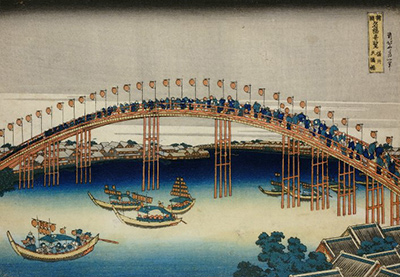
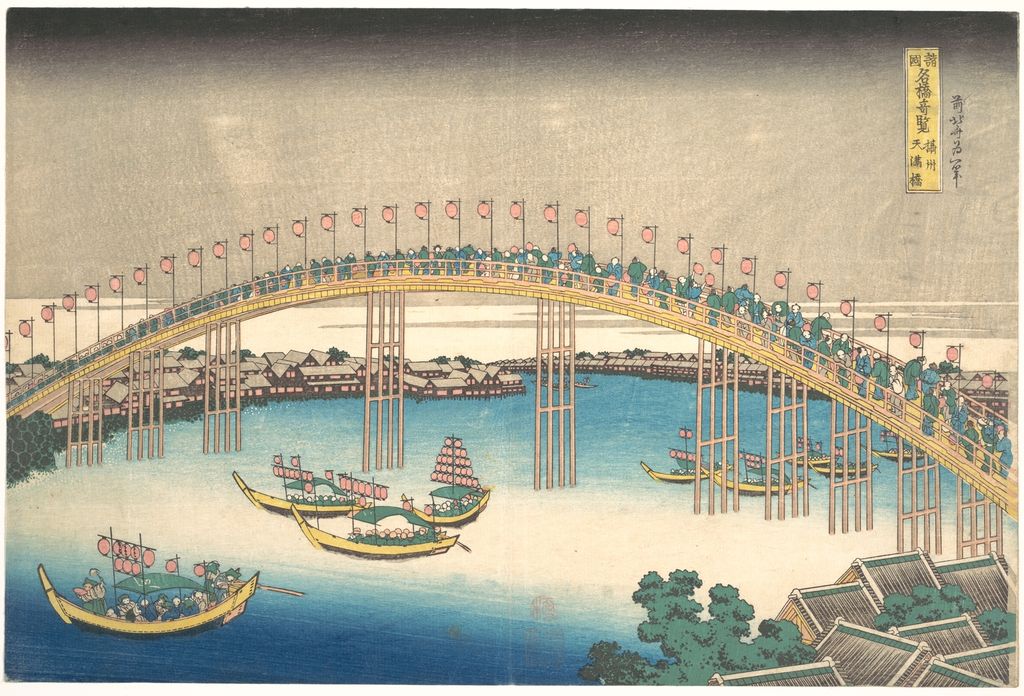
A long row of lanterns rises and falls with the deck of Tenma Bridge. Below it, boats have room to turn in the open river. Katsushika Hokusai brings the street and the water together in one broad view, seen from above the rooftops at the lower right. A crowd fills the bridge from end to end, but much of the water immediately below it is left open. Look first at the lanterns against the sky, then at the lights carried on the boats. The distance between the two rows is part of the picture’s account of a festival. [1] [2]
The title on the sheet identifies Tenma Bridge in Settsu Province, the region in which Osaka stood. Hokusai made the design for Remarkable Views of Bridges in Various Provinces (Shokoku meikyō kiran). The Izumi City Kubosō Memorial Museum of Arts dates it to around 1833 in an exhibition on Osaka’s famous places. The Chester Beatty publishes its impression under the title Festival of Lanterns on Temma Bridge and gives it an 1827–30 date. The two titles put the emphasis on different parts of the same design. One names the crossing. The other draws attention to the occasion that has filled it with people. [1] [2] [3] [4]
At a Glance
- ArtistKatsushika Hokusai
- DateEarly 1830s
- MediumColour woodblock print
- SeriesRemarkable Views of Bridges in Various Provinces
Contents
The bridge and the boats
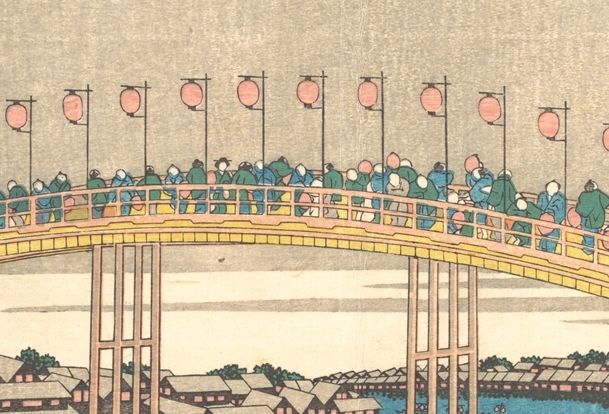
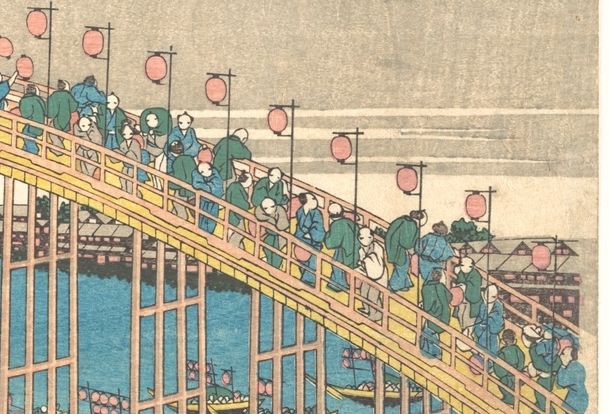
The bridge enters the picture low on the left and climbs by degrees to a high, nearly level middle. Its descent to the right is steeper in the image and brings the crowd close to the viewer. At the top of the span the people reduce to a low band. Down the right approach they are tall enough to see individually, and you can pick out the differences between the hats and shoulders. The lantern poles keep their upright direction all the way down. They measure the changing level of the deck even where bodies hide the rail. [1] [2]
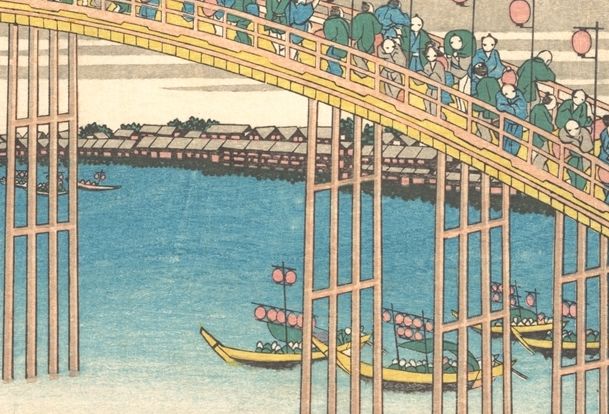
The supports below carry the upright rhythm a step further. They come in slim groups, with the far bank and patches of blue water still visible between them. Just to the right of centre, the legs reach well down into the lighter water. Farther to the right, one of the boats appears in small pieces between the timbers. Those repeated interruptions give the bridge thickness. You can trace the deck continuously across the paper while the boat appears and disappears behind the supports. [1] [2]
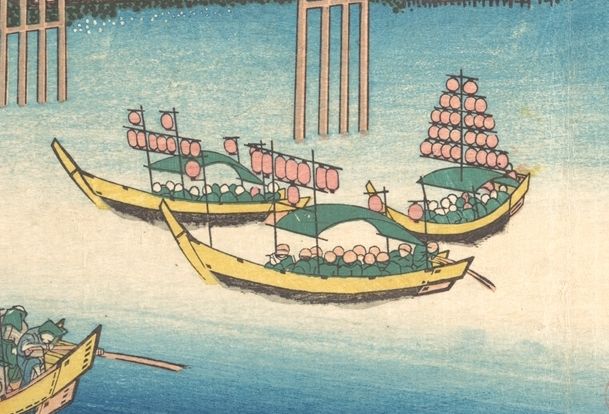
The boats at the centre and lower left give the river its own directions. The two that lie close together just left of centre turn towards the left, their raised bows and coloured hulls making separate curves. Behind them a vessel carries small shapes arranged in narrowing tiers. The low boat nearest the viewer has a cluster of people and a horizontal row of lights, with a long oar extending out beyond its stern. Together, the different heights and shapes give the small vessels as much variety as the uninterrupted crowd above. [1] [2]
Along the far shore, low buildings stretch across the gaps between the piers. Their roofline is almost parallel to the bottom of the sheet. In the near right corner, a group of larger roofs tilts into the composition at several angles. Hokusai gives the eye enough of both banks to judge the space between them. The bridge remains the obvious route from one side to the other. At the same time, the sweep of open water makes it easy to imagine the boat crews following a course different from that of the people above. [1] [2]
An evening at the Tenjin festival
Osaka’s museum service identifies the print as an evening scene from Tenjin Matsuri, the festival of Osaka Tenmangū, and reads the boats passing under the bridge as the river procession. Tenmangū’s festival honours Sugawara no Michizane, the scholar and statesman revered as Tenjin. In the festival today, the funatogyo, or river procession, follows the land procession and includes boats bearing portable shrines. Hokusai gives the viewer the crowded crossing, the decorated vessels and the lights. These details establish the setting without requiring each boat to be assigned a particular place in the ritual. [1] [5] [6]
Lanterns give the festival a scale that is easy to grasp. Most of the people on the bridge take the form of small dark marks, yet the repeated lights separate clearly against the broad field of sky. A single lantern tells little about the number of people present. A succession of them from bank to bank suggests the extent of the gathering. There is a quieter passage above the far roofs, where pale horizontal bands pass behind the dark bridge. That open sky matters to the effect. It gives every small light a space of its own. [1] [2]
The late eighteenth-century printmaker Utagawa Toyoharu depicted the same Osaka festival in a work that Bristol Museums catalogues as a perspective picture. In Bristol’s impression, a dark sky speckled with stars stretches over the bridge. Several boats fill the front of the scene, and buildings crowd towards the two ends of the crossing. The boats’ lanterns and the lights above the bridge occupy separate bands, as they do in Hokusai’s design. Toyoharu puts more activity directly in front of the viewer and makes the city press in from both banks. Hokusai’s broad, relatively empty water opens a larger gap beneath the lanterns on the bridge. The two prints show how room for the boat procession and the spectator crowd can be apportioned within the same view of Osaka. They also show that the festival had entered the repertoire of printmakers well before Hokusai depicted the bridge for his own series. [1] [3] [7]
Osaka’s municipal history calls Tenma Bridge one of the Three Great Bridges of Naniwa, together with Tenjin Bridge and Naniwa Bridge. In the Edo period the shogunate directly administered all three. They joined parts of the city on opposite sides of the river and were important to daily travel. The historical Tenma crossing stood somewhat east of the present one. In Hokusai’s view a crossing used for everyday travel is also a place where a crowd can gather above the festival. The print makes the value of that position visible through the relatively high deck and the long stretches of water that can be seen from it. [1] [5] [8]
Two impressions of the festival
Keio University Libraries records its impression, 200X@4-48, as a large-format colour woodblock print, an ōban nishiki-e, about 25.4 by 38.1 centimetres. The catalogue names the publisher Nishimuraya Yohachi and transcribes the signature as Saki no Hokusai Iitsu hitsu. Hokusai signed as Iitsu while also referring back to the name by which readers knew him. The vertical title panel and the signature can both be seen near the upper right. Their position away from the deck helps the series and place names remain legible. [1] [2]
The Metropolitan Museum of Art’s JP2949 impression measures 25.7 by 38.4 centimetres. Its photograph shows a distinctly bright blue-green below the far shore. The corresponding band in Keio’s reproduction is paler, close in value to the water around the boats. In both, a much darker blue gathers along the nearer edge, leaving the region around the central vessels conspicuously pale. The contrast is especially clear where the bow of the lowest boat crosses the darker blue. It brings out the curve of the hull the way the pale sky brings out the curve of the bridge. [1] [2]
Many lines can be followed from one impression to the other. The same oar projects from the nearest boat, the same foreground roofs interrupt the lower corner, and the highest lanterns occupy the same portion of the arch. The visible difference in the water belongs to the particular sheets and photographs used in this comparison. Their appearance alone does not determine which was printed first. In a colour woodblock print, line and areas of colour offer different kinds of evidence. Here the outlines make the design recognisable across the two reproductions. The tones alter how readily the river reads as a space behind the bridge. [1] [2] [9]
Other ways to picture a crossing
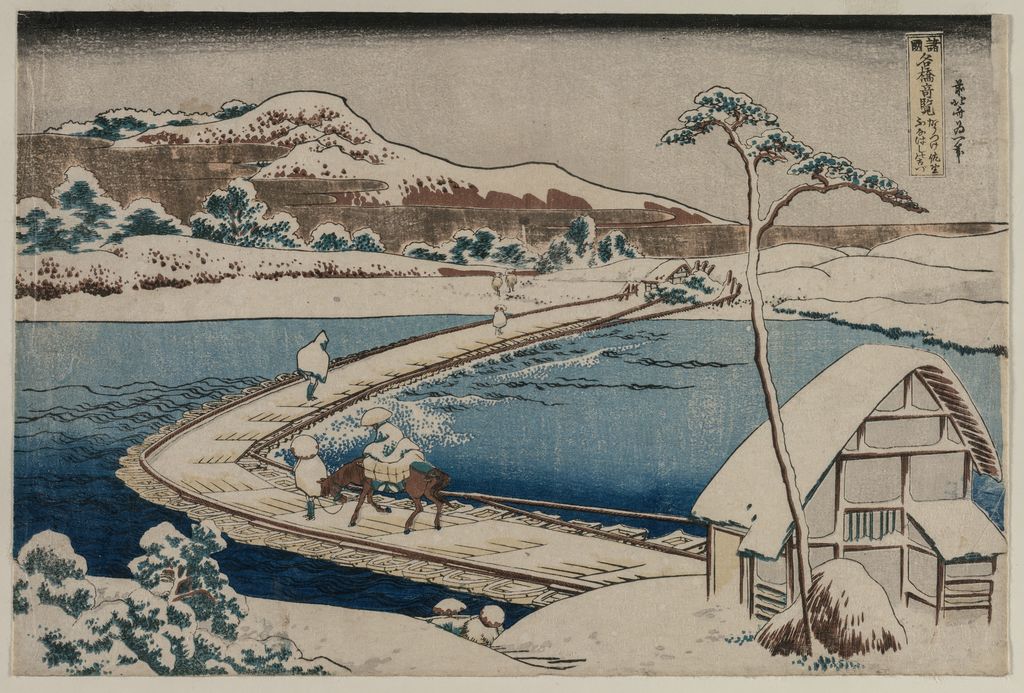
Hokusai gave the bridges in this series markedly different proportions. In the Metropolitan Museum of Art’s impression of The Arched Bridge at Kameido Tenjin Shrine, a short wooden crossing curves steeply over a pond and a few figures punctuate its climb. Their distances from one another let you read individual steps and pauses. At Tenma, the arch stretches across an urban river. People fill the span almost continuously and the evenly spaced lantern poles do much of the work that individual figures do at Kameido. The two sheets make it possible to see how the same architectural form can shape a gathering of very different size. [1] [2] [10]
In Under Mannen Bridge at Fukagawa, from Thirty-six Views of Mount Fuji, Hokusai brings the underside of the bridge close enough to cut across the top of the view. The far mountain appears through the opening. At Tenma the top of the bridge stays below the sky and the sightline passes over the lanterns as well as under the deck. A route through the image can begin on the crown of the crossing, descend with the spectators, then return along the river with the boats. Hokusai uses each bridge to decide which parts of a place the viewer can see together. [1] [11]
Image comparison
Where this work sits in Hokusai’s career
Annotated Details from Tenman Bridge at Settsu Province
The Metropolitan Museum of Art, JP2949. [1]
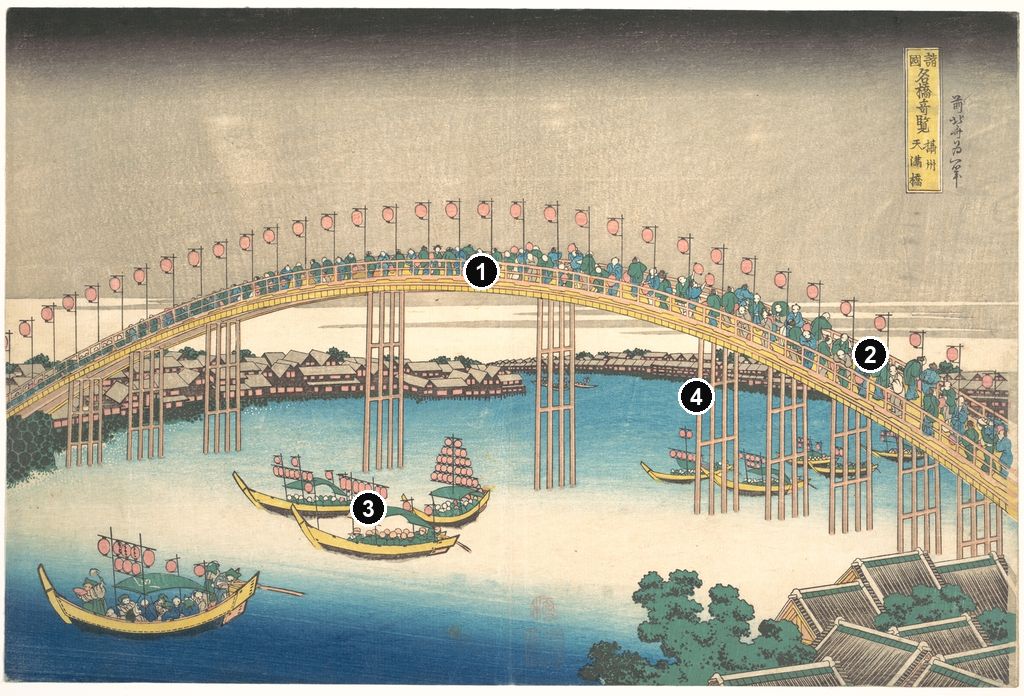
Details from TENMAN BRIDGE AT SETTSU PROVINCE
Select a detail to look closely.
A row of lanterns over the arch
Tall stems rise above the crowd and follow the curve of the bridge. They make the course of the procession visible at a distance. [1]
People descend towards the bank
The bodies at right pass from the arch towards the approach. The downward slope distinguishes this group from the crowd nearer the crest. [1]
Vessels beneath the crossing
Curved hulls gather in a light stretch of water beneath the span. Nearer boats sit against a stronger blue close to the bottom edge. [1]
A dark strip along the far bank
Small shapes are compressed along the distant shore. Dark forms separate the shore from the bright water and keep the arch distinct above it. [1]
Explore Hokusai’s works
Discussion
Look again at the images and ideas explored in Tenma Bridge in Settsu Province. These editorial prompts invite your observations.
Reader Insights
How can you follow the procession across the sheet?
What does the open space below the bridge contribute to the view?
Join the Conversation
Share a detail, comparison or question about Tenma Bridge in Settsu Province below.
References
- The Metropolitan Museum of Art, Tenman Bridge at Settsu Province (Sesshū Tenmanbashi), JP2949. View source.
- Keio University Libraries, 諸国名橋奇覧 摂州天満橋, Takahashi Ukiyo-e Collection, 200X@4-48. View source.
- Izumi City Kubosō Memorial Museum of Arts, Welcome to Osaka, Welcome to Japan, exhibition checklist, item 1. View source.
- Chester Beatty, Impressionists and Japonisme, caption for Festival of Lanterns on Temma Bridge, J 2755, pp. 34–35. View source.
- Osaka Museums, Japanese collection note for Hokusai’s 摂州天満橋, in Osaka City’s lifelong learning bulletin, April 2022, p. 13. View source.
- Japan National Tourism Organization, Tenjin Festival, description of shrine observances and the land and river processions. View source.
- Bristol Museums, The Tenma Tenjin Festival at Night in Osaka, a Perspective Picture, by Utagawa Toyoharu, collection image and record via Google Arts & Culture. View source.
- City of Osaka, Kita Ward, 天満橋 (Tenmabashi), bridge history by Kenji Myōchin, curator of the Osaka Museum of Housing and Living. View source.
- Sumida Hokusai Museum, Wow, Hokusai! See, Examine, and Discover Ukiyo-e, permanent exhibition guide to colour woodblock printing. View source.
- The Metropolitan Museum of Art, The Arched Bridge at Kameido Tenjin Shrine (Kameido Tenjin Taikobashi), JP2947. View source.
- The Metropolitan Museum of Art, Under the Mannen Bridge at Fukagawa (Fukagawa Mannenbashi shita), JP2983. View source.







