


 by Tom Gurney
Tom Gurney BSc (Hons) is an art history expert with over 20 years experience
Published on June 19, 2020 / Updated on November 20, 2026
Email: tomgurney1@gmail.com / Phone: +44 7429 011000
In the Mountains of Tōtōmi Province
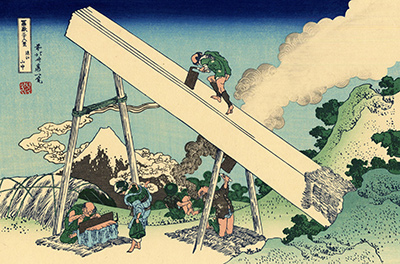
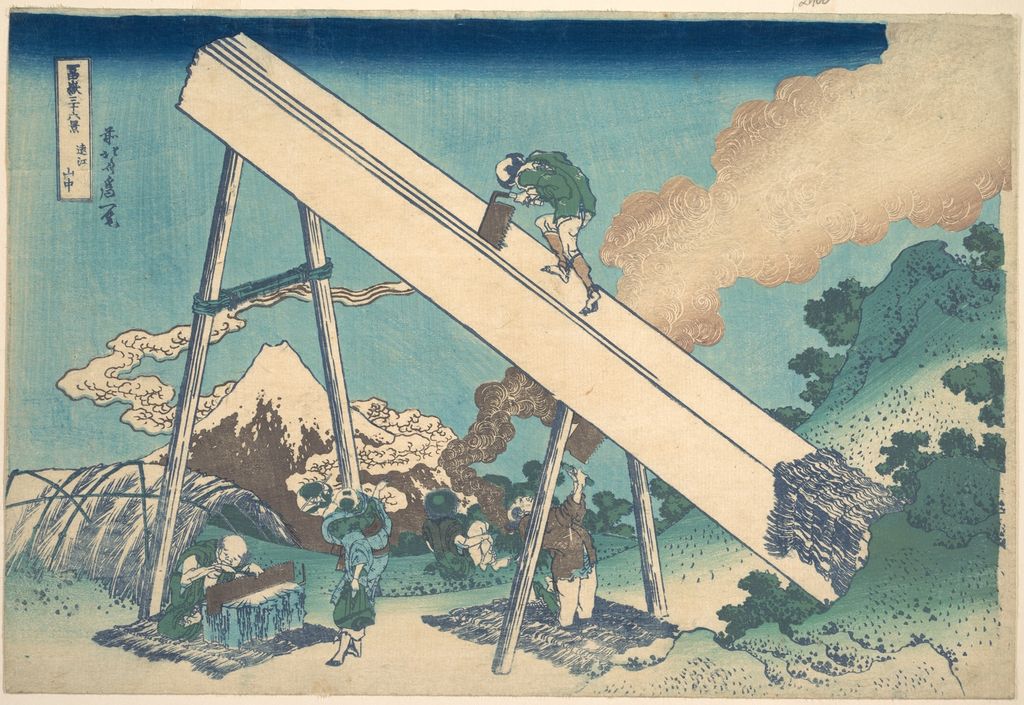
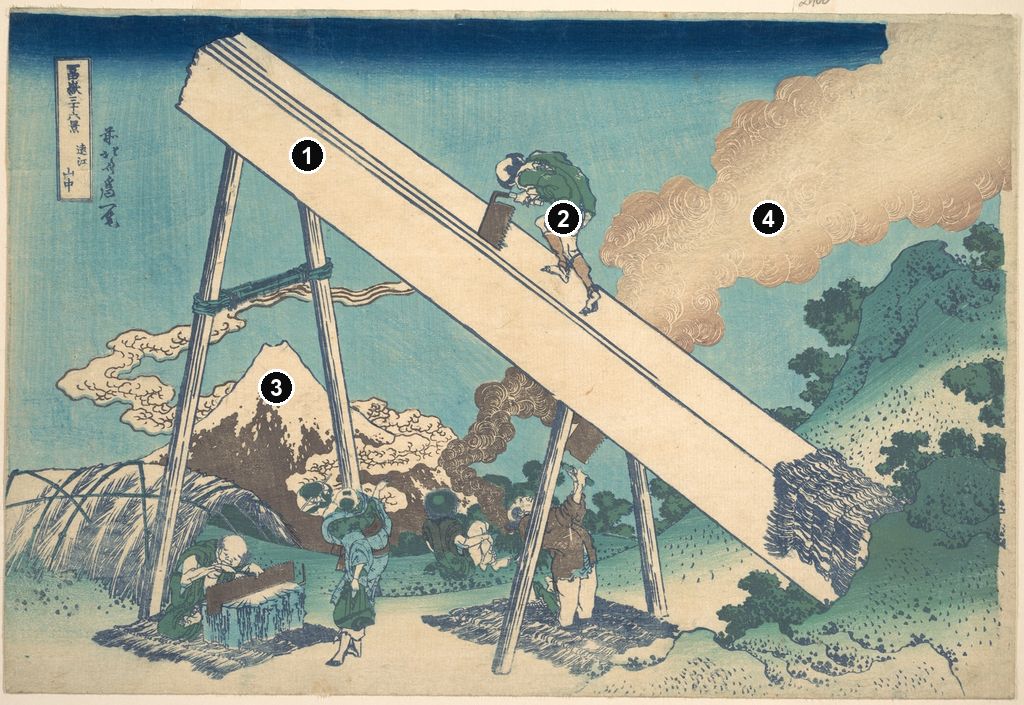
A timber crosses Hokusai’s print from high on the left to low on the right. It passes so close to us that individual lines on its surface are longer than the whole outline of Mount Fuji. A worker crouches on top, another stands below, and their tools reach the same enormous piece of wood. The mountain is visible beyond them, inside the triangle made by the left-hand support. Look for the pale summit just above the dark trees. The equipment that lets the men work on the timber gives us the opening through which we see Fuji. [1] [2]
The Japanese title, 遠江山中 (Tōtōmi sanchū), places the scene in the mountains of Tōtōmi, the old province in what is now western Shizuoka Prefecture. The National Museum of Western Art lists the design as In the Totoumi Mountains, entry 18 in its Iuchi Collection exhibition checklist. The Metropolitan Museum of Art dates its impression JP2966 to about 1830–32 and records it as a colour woodblock print on paper measuring 26.4 by 38.7 centimetres. That sheet shows how even a small landscape print can make an object seem almost too large for the space that contains it. [1] [2] [3]
At a Glance
- ArtistKatsushika Hokusai
- Dateca. 1830–32
- MediumColour woodblock print
- SeriesThirty-six Views of Mount Fuji
Contents
Two men at the timber
The face of the timber is a broad, light surface between dark lines. Follow its upper edge from the squared end at the top left towards the worker perched partway along it. He bends close to the surface, his rounded back distinct against the sky. The blade meets the wood beneath him. The other sawyer stands on a small rectangular bed under the timber, with his arms raised towards its underside. The two men fit into very different spaces. The one above can lean into the open sky, while the worker below has to reach into a space bounded by supports, wood and ground. [1] [2]
The Tokyo Fuji Art Museum describes the men cutting into the timber from above and below with specialised, large-toothed saws. The Sumida Hokusai Museum identifies them as kobiki, craftsmen sawing wood into usable lumber. In its account of the development of Japanese saws, the Takenaka Carpentry Tools Museum distinguishes saws that cut along the grain from those made to cut across it and describes the broad-bladed maebiki ōga used to convert timber. That history helps explain the significance of the long lines Hokusai gives the wood. The work is happening along the length of the raised timber. The narrow lines of the timber and the positions of the sawyers make that direction clear even if the teeth of the tools are difficult to distinguish. [2] [4] [5]
Their rise and reach also show why the timber has been raised. The upper man has a surface to crouch on, and the height gives the lower man room to stand under it. On the left the upright poles spread apart and are joined by a crosspiece. Their feet come down on either side of the people near the shelter. The other set of poles picks up the weight closer to the low end. It is easy to read the log first as a single stripe across the page. Reading the supports and the two bodies in relation to it makes clear how much of the scene is organised around holding that stripe in place. [1] [2]
Beneath the supports
The Sumida Hokusai Museum identifies a third craftsman sharpening a saw, a woman carrying a baby and a child tending a fire below the beam. The Smithsonian also describes the sharpening and identifies the small structure on the left as a straw lean-to. These figures are harder to separate than the two sawyers. Their clothes and the tones of the shelter, trees and soil cluster close together. The visible edge of the shelter makes a lower arc against the steep uprights. Hokusai gives the people around it just enough open space to register as a gathering beneath the suspended timber. [1] [4] [6]
Sharpening is a second kind of labour in the same picture. The sawyer below the timber stretches upward with his tool, while the maintenance work near the shelter keeps closer to the ground. The picture lets us notice the people around these jobs as well. The woman, her small passenger and the child by the fire give the site a scale and texture beyond the task of cutting wood. Hokusai distributes the figures across the print by what they are doing. Some are outlined against the sky or the face of the timber, and others emerge only after the eye has settled on the more crowded ground. [1] [4] [6]
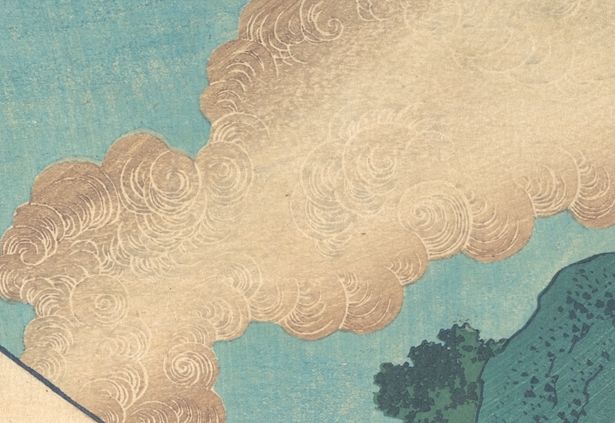
The smoke helps the eye travel from the child’s part of the scene to the sky. It begins in a tight, dark cluster below the beam, disappears behind the timber and spreads in a broad mass towards the upper right. The Tokyo Fuji Art Museum draws attention to the way its course balances the diagonal of the timber. That explanation is especially useful when looking at JP2966. The wood’s sides stay straight, while the visible edge of the smoke comes in uneven rounded shapes. The two forms cross at an angle, but texture as much as direction distinguishes them. [1] [2]
A view through the scaffolding
The triangle enclosing Fuji takes shape in stages. One support rises steeply from the lower left. Another angles across the sky, and a short crosspiece cuts through the opening. Closer to the ground, the sharply sloping edge of the timber limits the view from above. Further back, the mountain’s own slopes make a smaller triangle. Dark trees rise in front of the snow and briefly compete with it. The summit stays readable because it occupies a patch where the darker forms leave a space. [1] [2]
Fuji looks especially small after the eye has followed the log from end to end. Its distance depends partly on that change in scale and partly on what appears in front of it. The nearest support is dark and narrow enough to remain legible across several different colours. The mountain, by contrast, is worked into the succession of blue, pale cloud and foliage in the distance. The most conspicuous object in the print is also the one that instructs the eye how to find the smallest. By following the timber to the poles holding it up, we arrive at the landscape behind the work. [1] [2]
The same relationship plays out differently in other designs from Thirty-six Views of Mount Fuji. In Fujimigahara in Owari Province, a cooper bends inside a great round tub whose opening isolates the distant summit. Its curve surrounds the view on almost all sides. The Tōtōmi equipment instead breaks the view into angular spaces, and the timber crosses one of them. At the Waterwheel at Onden, the wheel makes a dark and busy form close to the left edge, while the mountain sits further to the right beyond stretches of open ground. Compare where the workers stand in each design and then look at the path your eye takes to the peak. In each case the practical demands of the work are visible in the arrangement of the view. [1] [7] [8]
Two impressions of the same design
The Met also holds JP24, a separately catalogued impression that measures 24.1 by 37.1 centimetres. Comparing the museum photographs makes the design easier to read. The space between the two sets of supports, the outline of the crouching worker and the shape of the smoke repeat even as their colours change. In JP2966, a nearly continuous band of dark blue sits across the top of the printed sky until the plume enters it. The wide face of the beam is pale yellow. The broad smoke mass also looks light, especially at the top, where the plume and the timber meet the blue sky with very different edges. [1] [9]
The sky in JP24 also darkens along the upper edge, but the light beneath it fades further towards cream behind the worker and his tool. The face of the beam is a stronger salmon colour, and the smoke to its right is a denser grey-brown. The darker plume becomes much easier to follow across the width of the sky. Those differences change which parts catch the eye first. On JP2966 it is easy to follow the uninterrupted run of pale timber. On JP24 the contrast of the coloured timber and the dark plume is more pronounced. Fuji keeps its small place in the supporting frame across both sheets. [1] [9]
The dimensions describe individual sheets, and dates and colours in the records need the same care. The Met dates both its sheets to about 1830–32. The Tokyo Fuji Art Museum gives the same approximate range for its own 24.8 by 37.5 centimetre print. Photographs alone do not establish printing order. A photograph lets us see how colours are distributed and where lines recur, but the way a sheet was printed, its subsequent condition and the way it was photographed can all affect how it looks on a screen. Start with the repeated forms if you are looking across impressions, then see what the different contrasts make easier to pick out. Here, the alternating diagonals of timber and smoke and the quiet position of Fuji remain the best guides to the scene. [1] [2] [9]
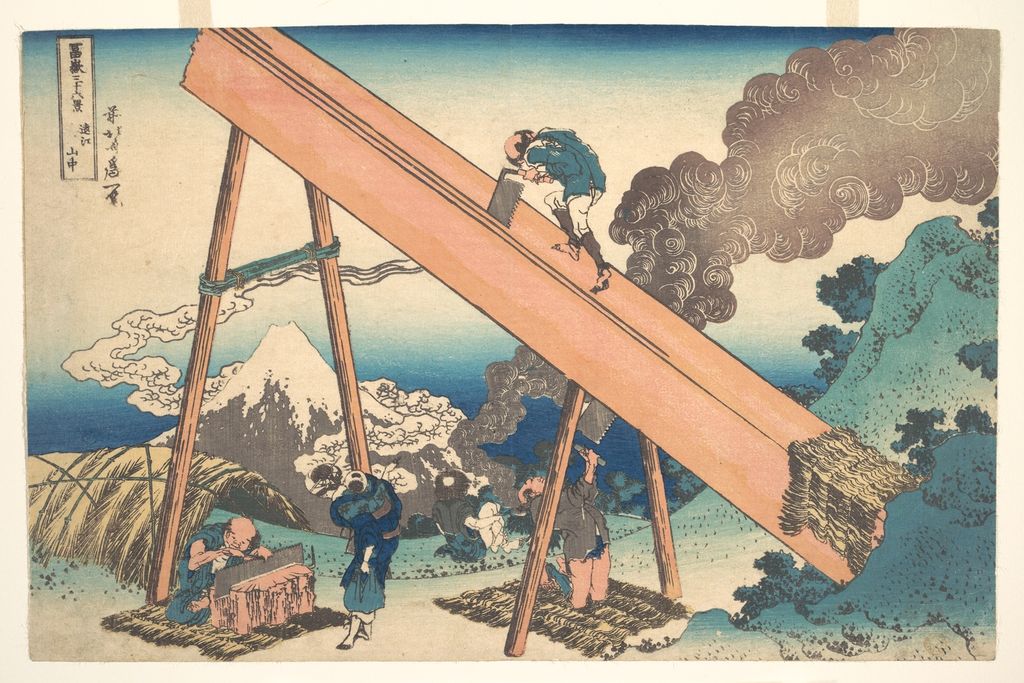
Image comparison
Where this work sits in Hokusai’s career
Annotated Details from In the Mountains of Tōtōmi Province
The Metropolitan Museum of Art, JP2966. [1]
Details from IN THE MOUNTAINS OF TŌTŌMI PROVINCE
Select a detail to look closely.
The timber cuts diagonally across the view
Long parallel lines define the beam’s broad faces. Its slope connects the top of the print to the crowded worksite below. [1]
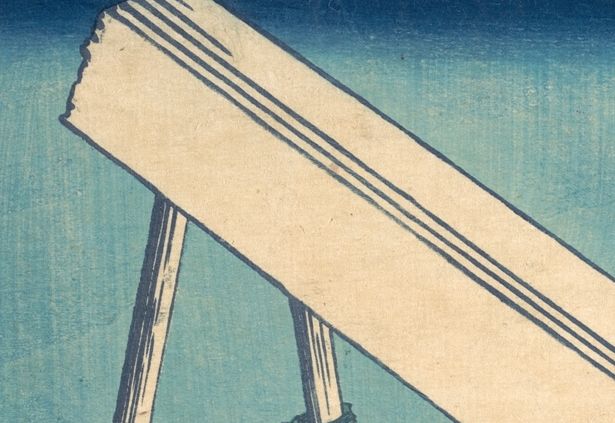
A sawyer works on the raised beam
A worker leans over the cut. The high placement and small bent figure show the scale of the timber and the awkward position it demands. [1]
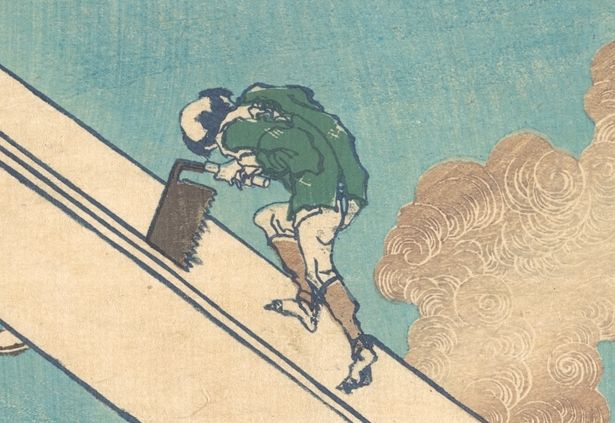
Fuji fits beneath the beam
The small high point of the distant mountain appears inside the open space underneath the timber and its support. [1]
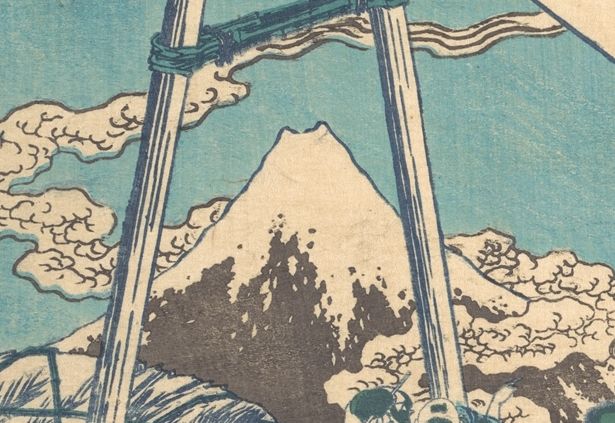
Smoke rises behind the workers
Smoke crosses the sky in a broad diagonal behind the timber. Its diffuse edges distinguish it from the straight faces of the wood. [1]
Explore Hokusai’s works
Discussion
Look again at the images and ideas explored in In the Mountains of Tōtōmi Province. These editorial prompts invite your observations.
Reader Insights
Where does your eye cross the length of the timber?
How does the scale of Fuji change your sense of the worksite?
Join the Conversation
Share a detail, comparison or question about In the Mountains of Tōtōmi Province below.
References
- The Metropolitan Museum of Art, In the Mountains of Tōtomi Province (Tōtomi sanchū), JP2966. View source.
- Tokyo Fuji Art Museum, Thirty-six Views of Mount Fuji: In the Mountains of Totomi Province, collection record 06155 and curatorial description. View source.
- National Museum of Western Art, Tokyo, Hokusai: Thirty-six Views of Mt. Fuji, exhibition checklist, entry 18. View source.
- Sumida Hokusai Museum, Thirty-six Views of Mount Fuji: In the Mountains of Tōtōmi Province, collection record and curatorial description. View source.
- Takenaka Carpentry Tools Museum, History of the Development of Saws (鋸の発達史), museum collection catalogue commentary. View source.
- Smithsonian National Museum of Asian Art, In the Mountains of Totomi Province, S2004.3.211, collection record and exhibition history. View source.
- The Metropolitan Museum of Art, Fujimigahara in Owari Province (Bishū Fujimigahara), JP2956. View source.
- The Metropolitan Museum of Art, The Waterwheel at Onden (Onden no suisha), JP2967. View source.
- The Metropolitan Museum of Art, In the Mountains of Tōtomi Province (Tōtomi sanchū), JP24. View source.







