


 by Tom Gurney
Tom Gurney BSc (Hons) is an art history expert with over 20 years experience
Published on June 19, 2020 / Updated on November 20, 2026
Email: tomgurney1@gmail.com / Phone: +44 7429 011000
Ōiko Pouring Sake for a Warrior
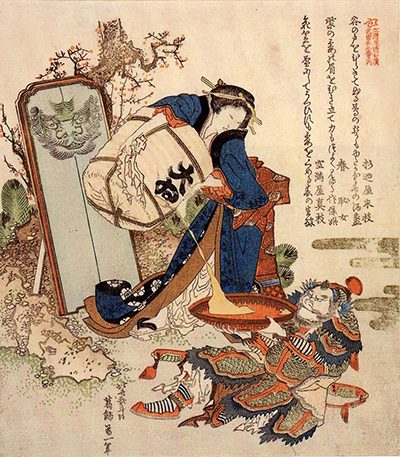
Katsushika Hokusai gives Ōiko a cask so large that it almost hides her upper body. She tips it towards a shallow red bowl, while the warrior holding the bowl leans back among the folds of his armour. Behind her rises a tall shield. The cask, the bowl and the shield set up a joke about size: the largest object in the encounter is in the hands of the person serving the drink. Harvard Art Museums calls the print Oiko Pouring Sake for a Warrior. The Spencer Museum of Art names both figures in its title, Ōiko and Fan Kuai. Ōiko is the strong woman of Japanese legend. The warrior she faces comes from early Chinese history. [1] [2]
At a Glance
- ArtistKatsushika Hokusai
- Date1820 (Spencer); 1829 (Harvard)
- MediumColour woodblock print
- SeriesJapanese and Chinese Heroes for the Soramitsuya Circle
Contents
The weight of the cask
In the Harvard impression, the broad face of the cask angles forward towards the viewer. Pale bands turn around its sides, while bold black characters take up much of the exposed surface. Ōiko’s hands are small by comparison. One emerges from above the vessel, the other appears lower down on the side nearest the warrior. Together they make sense of its tilt. The white stream widens as it runs into the red bowl, carrying the eye across the gap between the two figures. The Spencer impression preserves these same relations. The outline of the vessel and the shape of the stream make the gesture legible even where the printed colours are less distinct in the photograph. [1] [2] [3]
The position of Ōiko’s body makes the load seem weightier. The cask projects out on one side while her sleeves and skirt descend towards the other. A long hem sweeps down and back towards the lower left, giving her stance a width that her upper body alone would lack. Around the cask, the garments break into smaller patches of ornament. The contrast between that patterning and the large blank face of the container makes the cask seem solid and unwieldy. At the same time, the curve of her back and the inclination of her head give the gesture the concentration of a person carrying out an everyday task. [1] [2] [3]
Fan Kuai occupies the lower part of the sheet. His armour opens out into a series of repeated bands and plates, with the edges of one layer passing across the next. The bend of his body and the broad spread of the decorated garment give him visual weight even though his head is below Ōiko’s. His face turns up towards the bowl. The tilted cask and his slanting body would pull the image in different directions on their own. The almost horizontal rim of the bowl brings them together. It is the place where her strength and his appetite meet. [1] [2] [3]
Behind Ōiko, the nearly upright shield supplies a third direction. Its dark border follows a long straight edge before turning at the rounded top, where a face or mask looks out from the flat surface. Its size gives the cask a visual counterpart on the left. The two objects are separated by only a narrow interval, yet Hokusai gives each its own outline. The shield rises behind the figure and stays nearly vertical. The cask comes forward and turns. Flowering branches and broken patches of ground prevent these strong shapes from closing the figures inside a rigid frame. [1] [2] [3]
Two kinds of strength
Stories about Ōiko circulated as setsuwa, short tales about striking episodes and encounters. The medieval collection Kokon chomonjū includes an account of how Saeki Ujinaga met Ōiko of Takashima and discovered her exceptional strength. A much later print by Tsukioka Yoshitoshi, in the Worcester Art Museum, gives another version of the encounter: Ōiko overpowers the man by holding his arm. That comparison helps explain the restraint in Hokusai’s design. His Ōiko has no need to grapple with the person opposite her. The size of the vessel and her grip tell us what she can do. [1] [2] [4] [5]
Fan Kuai is associated with the banquet at Hongmen, an episode in Sima Qian’s Records of the Grand Historian. In that account he rushes in with a shield, receives wine from Xiang Yu and uses his shield as a surface on which to cut up meat. The shield and drink in Hokusai’s print bring some of the story’s most recognisable objects into close company. The Japanese strong woman supplies the wine here, bringing a new partner and a new scale to the act of drinking. The result is a meeting of two traditions, with a Chinese hero presented in a situation shaped by a Japanese tale of extraordinary strength. [1] [2] [6]
Hokusai returned to Fan Kuai in different formats. Art historian Ryōko Matsuba traces the shield through a wide perspective print of the Hongmen story, dated to Hokusai’s early career, and illustrations made decades later. In the early composition the warrior carries the shield under his arm as he enters the enemy camp. In one of the later illustrated books he uses both arms to open a gate and his shield stands to the side. The artist also gave the warrior a seated pose in the fourth volume of Hokusai Manga. Those variants help explain how much a change of posture can do to a familiar figure. Here the great shield is nearly the height of the standing Ōiko and the warrior directs his attention to the bowl in front of him. The oversized objects still describe his world, but Ōiko determines how they are arranged around the action. [1] [2] [7]
The Spencer Museum catalogues the print as one of three Japanese and Chinese Heroes for the Soramitsuya Circle. Its title describes a series built around the comparison of bravery. The Sumida Hokusai Museum identifies Hokusai’s Benkei and a Chinese Woman as another design in that group. Benkei’s pairing puts a Japanese male hero alongside a Chinese woman. In this sheet the balance is reversed, and a Japanese woman handles the largest burden in the picture. The pairings encourage the eye to consider what each figure does, what each carries and how the comparison changes when the figures share one sheet. [2] [8]
A small print with room for writing
Harvard describes its sheet as a shikishiban surimono: a colour woodblock print on paper in a compact, nearly square format. It measures 21.6 by 18.4 centimetres. The Spencer sheet is close in size at 21.8 by 18.7 centimetres. The setting occupies only spare stretches of the paper, with some flowering branches behind the shield and low forms behind the warrior. At the upper right the vertical columns of writing set an even rhythm against the uneven arrangement of the figures. The space beneath the writing is where the bowl and the warrior’s face meet. A reader looking down the columns therefore comes back to the act of pouring. [1] [2] [3]
Surimono were privately published prints, and exhibitions at the Spencer and RISD museums document how they were made for circles that exchanged poetry and pictures. The spaces occupied by writing are part of the organisation of those prints. Compare Hokusai’s Horse Pattern at the Metropolitan Museum of Art, a surimono from a separate series. Its catalogue identifies the artist’s playful signature and explains details of the design in relation to the name of the series. The visual tone of the Ōiko print is far more crowded, but it too asks for the kind of close viewing that makes a short stretch of text, a sliver of ground or a line on a sleeve part of the experience. [1] [2] [9] [10]
The print also offers a smaller-scale comparison with The Great Wave. Both make a change of scale immediately visible. The huge crest in the landscape is made legible by the boats and the distant mountain, while the cask in this scene is made legible by the hands that tip it and the bowl receiving the stream. The woodblock printing process could serve both compositions. Here the dark outlines of several overlapping objects and patterns need to be legible within a much more intimate area of paper. [1] [2] [3]
Looking at the Harvard and Spencer impressions
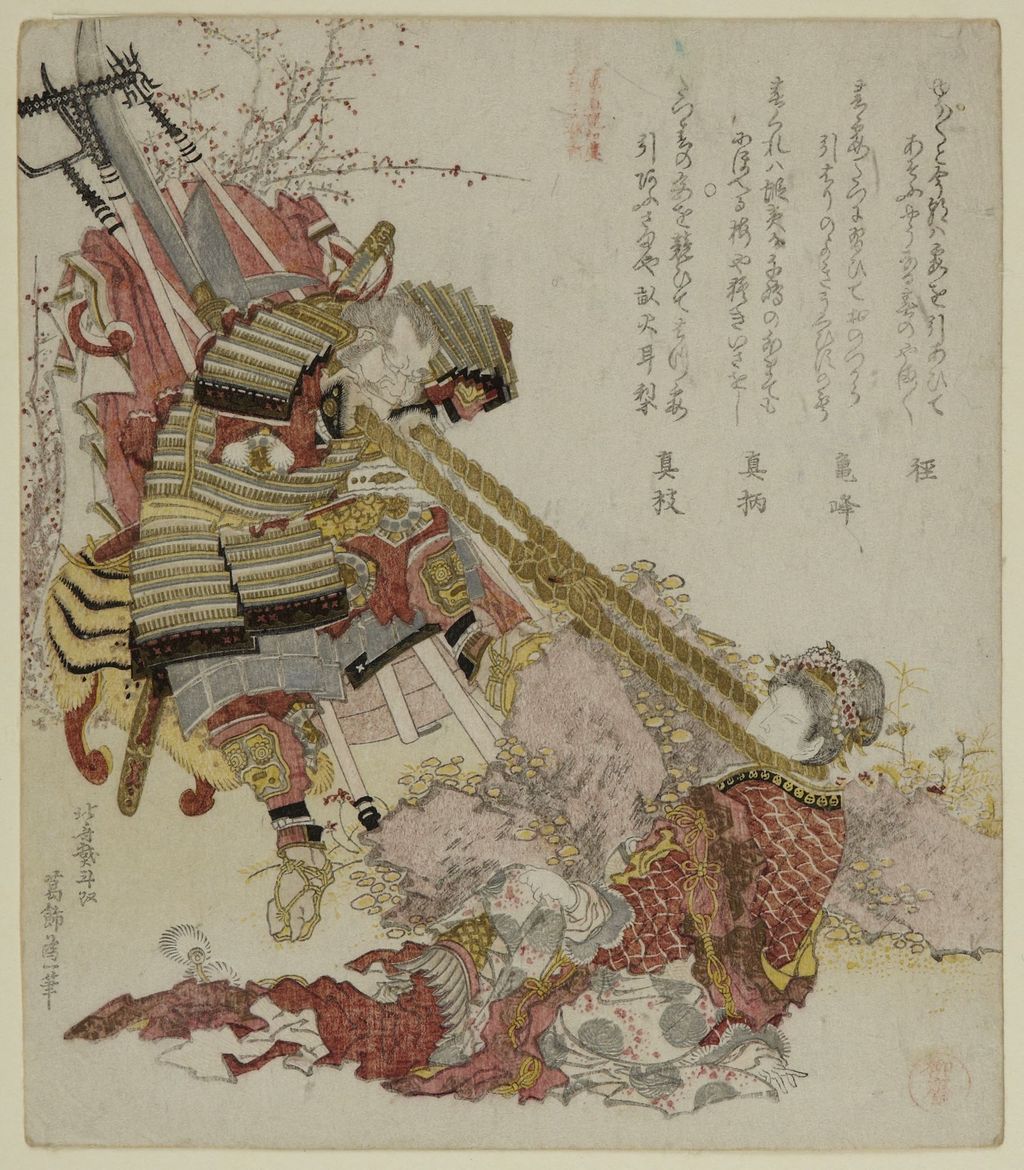
Harvard dates its sheet to 1829. The Spencer Museum dates its own to about 1820 and places it in the series for the Soramitsuya circle. The Sumida checklist independently dates the companion Benkei and a Chinese Woman to 1820. That provides a point of comparison for the dating of the series, while the two catalogues give different dates for their individual objects. The common outlines in the photographs establish that the two sheets carry the same design. They give little basis for deciding the sequence in which the sheets were printed. [1] [2] [3] [8]
The Harvard photograph shows stronger contrasts in the turquoise areas of Ōiko’s robe, the red bowl and individual pieces of the warrior’s armour. The Spencer photograph has a quieter field of grey and tan, against which the tall dark edge of the shield is still easy to follow. Some lines of writing also appear lighter in the Spencer image. Harvard records metallic pigment on its impression. A screen image gives limited access to the way that pigment catches and releases light as the paper is turned. The effect of printing, the condition of the sheets and the photography all matter when comparing the museum reproductions. The tilt of the vessel, the red rim below and the two figures absorbed in the pour remain visible across those changes. [1] [2] [3]
Where this work sits in Hokusai’s career
Hokusai Manga
From 1814Ōiko Pouring Sake for a Warrior
1820 (Spencer); 1829 (Harvard)Explore Hokusai’s works
Discussion
Look again at the images and ideas explored in Ōiko Pouring Sake for a Warrior. These editorial prompts invite your observations.
Reader Insights
How does the cask compare in scale with the figure who holds it?
What does the position of the bowl add to the exchange?
Join the Conversation
Share a detail, comparison or question about Ōiko Pouring Sake for a Warrior below.
References
- Harvard Art Museums, Oiko Pouring Sake for a Warrior, Arthur M. Sackler Museum accession 1933.4.1781. View source.
- Spencer Museum of Art, Ōiko and Fan Kuai, accession 0000.1398, object record and reproduction. View source.
- Harvard Art Museums via Ukiyo-e Search, reproduction of accession 1933.4.1781, photograph HUAM-DDC106451. View source.
- Tachibana Narisue, Kokon chomonjū, “How Saeki Ujinaga Met Ooiko, a Very Strong Woman of Takashima,” translated by Burton Watson in Haruo Shirane (ed.), The Demon at Agi Bridge and Other Japanese Tales, Columbia University Press. View source.
- Worcester Art Museum, Tsukioka Yoshitoshi, Ōiko Squeezing the Arm of a Wrestler, object record and gallery label. View source.
- Sima Qian, Records of the Grand Historian (史記), chapter 7, Annals of Xiang Yu (項羽本紀), Hongmen banquet episode. View source.
- Ryōko Matsuba, “近世期の画像資料にみる門破り図像の受容と展開” (study of early modern imagery of breaking through gates), pp. 712–713, figs. 10–14. View source.
- Sumida Hokusai Museum, Hokusai and the Samurai World, exhibition checklist, no. 58, Benkei and a Chinese Woman. View source.
- RISD Museum, Marking the Occasion: Surimono from Edo and Osaka, exhibition text. View source.
- The Metropolitan Museum of Art, Katsushika Hokusai, Horse Pattern (Koma shōbu), accession JP1393. View source.







