


 by Tom Gurney
Tom Gurney BSc (Hons) is an art history expert with over 20 years experience
Published on June 19, 2020 / Updated on November 20, 2026
Email: tomgurney1@gmail.com / Phone: +44 7429 011000
Watermill at Onden
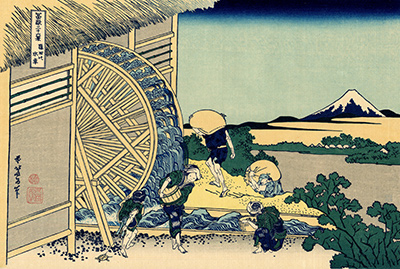
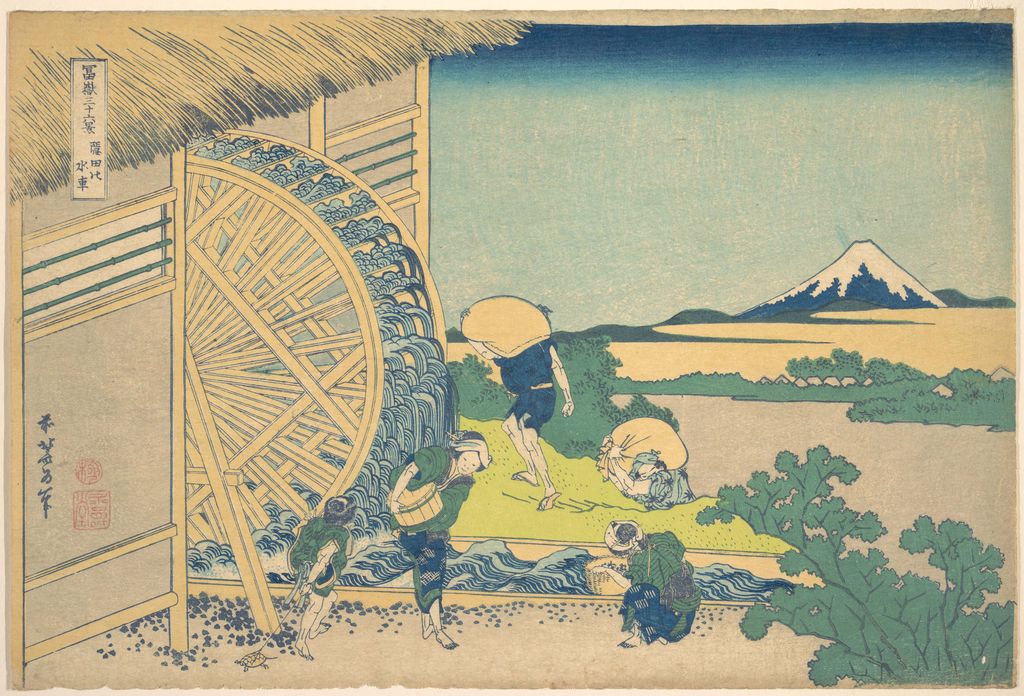
In Katsushika Hokusai’s Watermill at Onden, the wheel rises almost to the eaves of the building that houses it. Its pale wooden spokes cross at several angles, and thick blue curves run down one side towards the channel. Fuji is much smaller. Its snowy summit clears the low ground at the right, beyond the wheel, the working figures and the rooftops among the trees. Hokusai gives the mill enough space to compete with the mountain, even though the mountain is the reason the picture belongs to the series. [1]
The Japanese title, Onden no suisha (隠田の水車), names the wheel and its location. The Metropolitan Museum of Art dates its JP2967 impression to about 1830–32. It records a colour woodblock print on paper measuring 26 by 38.7 centimetres. The Edo-Tokyo Museum dates its own impression to 1831–34 and names Nishimuraya Yohachi as the publisher. The two records place the work in the early 1830s and describe separate sheets of the same design. [1] [2]
At a Glance
- ArtistKatsushika Hokusai
- Dateca. 1830–32
- MediumColour woodblock print
- SeriesThirty-six Views of Mount Fuji
Contents
How the wheel sets the picture in motion
The building is close enough that its roof and walls run out of the picture. At the upper left, the shading of the thatch comes from closely spaced lines drawn at a slant. The lines above the wheel appear to overlap its arc. Beneath them, the upright posts and horizontal slats make the structure look firmly planted. Against those straight boundaries, the curve of the rim is especially clear. The shadowy wedge between the wheel and the wall lets the spokes stand forward in the picture. [1]
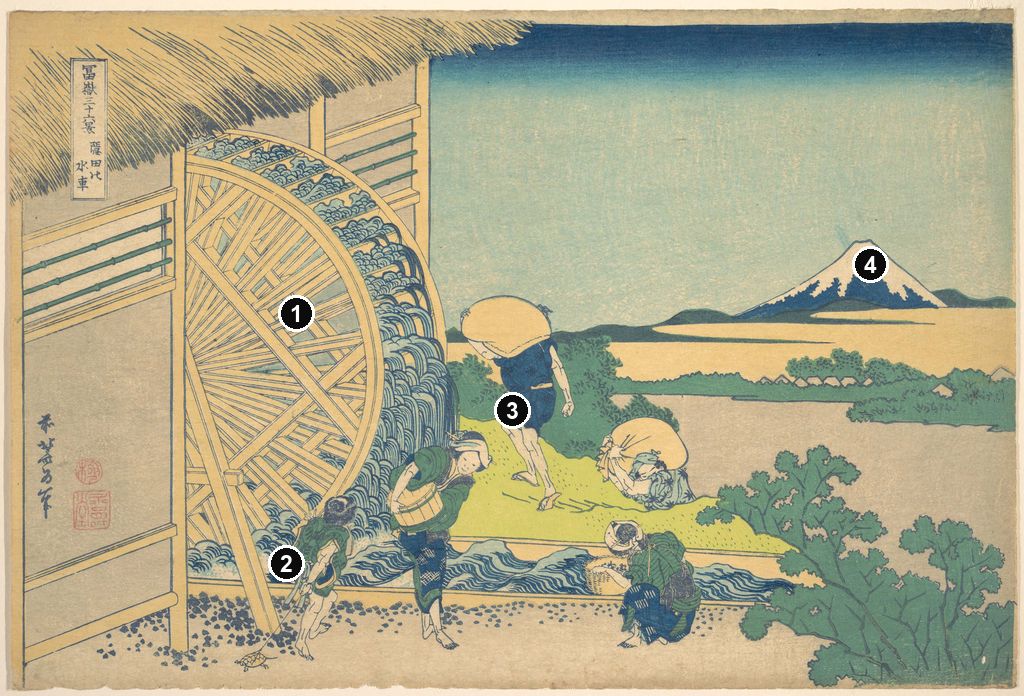
Inside the rim, the thin spokes fan out from behind a group of timbers. Some appear as pairs of straight lines and some cross at abrupt angles. Their crowded pattern lets us follow the circle even where part of it is hidden by the near edge of the building. Outside the rim, the water has a different pattern. Small curls repeat along the top and turn into much taller, more tightly packed strokes on the downward side. This change of shape does much of the work of suggesting motion. It gives an eye travelling around the wheel a different pace at the crest, at the side and at the point where the blue lines break apart near the bottom. [1]
The stream continues across the foreground. One of its dark ridges stands between the central figure and the person crouching over a container at the right. On either side of the ridge, lighter lines follow the same bends. Where the water is crowded against the wheel, the pale passages are small and broken. In the open stretch they lengthen into strips. Hokusai uses the same vocabulary of hooked lines and changing widths to show how water behaves differently over a mechanism and through a narrow channel. In Kirifuri Waterfall, he gives the falling water a different scale by placing the branching streams against a cliff. At Onden the wall, wheel and channel tell us how close we are to the movement. [1] [3]
Five figures and a turtle
Look below the wheel to find one of the smallest forms in the print. Near the boy’s feet, the turtle approaches the lower edge of the sheet. A line leads from it towards the boy’s hand. Its outline is easy to miss among the dark marks on the ground. Once it comes into view, it changes the scale of the foreground. The wheel is so large that a person beside it can seem small, and the turtle offers another step down in size. In its account of impression JP1336, the Met connects the turtle with longevity. That association adds a possible meaning to the animal, whose presence also makes a concrete difference to the way we read the ground at the foot of the wheel. [1] [4]
The other figures give the banks different uses. On the near side, a standing figure leans with a round wooden container held at the hip. A figure at the right crouches over another vessel beside the flow. The Met describes women washing herbs here. Across the stream, two figures are bent under bulky loads. One is in mid-stride. The shape of the bundle nearly erases the upper body, so much of the action is carried by an arm, a bent knee and the forward set of the leg. The other figure is low against the slope, with a smaller portion of the body visible beneath a similarly rounded load. [1] [4]
The path those two figures take ranks among the clearest light shapes in the foreground. It slopes towards the channel before vanishing behind the foliage and the crouching figure. Hokusai distributes the people around the wheel in a way that opens several routes through the print. We can follow the uphill walk, look along the bank past the containers or move with the water itself. The print gives each action its own room without requiring a separate scene for it. The mountain belongs to a farther set of routes, accessible to the eye across the fields. [1]
From Onden to the distant summit
Tokyo Fuji Art Museum places the former Onden village in the vicinity of today’s Harajuku, in Jingūmae, Shibuya. It describes the area in Hokusai’s time as rural and identifies the watercourse as the Shibuya River, locally known as the Onden River. The museum notes that the river near the site now runs underground. The print names a recognisable locality for its early audience. Its layout also invites people who know little about the place to work out the connection between the houses, the watercourse and the land beyond. [5]
A narrow group of roofs sits partway across the sheet among low green shapes. Above it are longer and flatter stretches of field. The eye can follow those horizontal forms as far as the broken edge of the lower hills. Fuji then rises in a movement as simple as anything in the picture. The profile climbs slowly before turning up to a point and cutting steeply back down. Dark shapes reach into the pale area high on its slopes. The outlines are visible over intervening ground without taking any of the attention away from the people at their tasks. [1]
The Thirty-six Views of Mount Fuji repeatedly put a familiar summit into a new relation with foreground objects. In Fuji View Field in Owari Province, a worker bends inside a vast vessel. Its circular opening encloses a small peak as part of the view through it. At Onden, the wheel and the mountain sit in widely separated areas of the sheet. An uninterrupted view across the fields keeps Fuji in sight, even as the wheel draws the eye back to the near side of the scene. Each print shows how equipment used for everyday labour can organise an entire landscape. [1] [6]
What changes from one impression to another
In the Met’s JP2967 photograph, a deep blue strip along the upper edge grades into a mottled blue-green sky. The photograph of JP1336 shows the same arrangement of dark blue at the top, but a paler field beneath it. JP1336 also shows a small round mark near the lower left, in the space bounded by the lowest rails of the wall. Outside the printed area, small pieces project beyond the upper edge of the sheet in that photograph. These are differences in the objects and the way they are presented. The repeated forms of the wheel, figures and distant rooftops identify them as impressions of the same design. [1] [4]
The Met’s JP1846 reproduction makes the comparison more striking. An orange band lies close to the horizon and the upper sky looks light, with a visible vertical line running through it near the middle of the sheet. The title panel still appears beneath the thatch and the pale outer edge of the wheel retains the same sweep. This impression can make the mountain’s outline stand out more firmly against the sky. The blue gradation of JP2967, on the other hand, gives the sky more weight above the open fields. Such changes make the atmosphere worth comparing side by side. Examination of the printing and condition of the sheets would be needed to explain why their skies look different. [1] [7]
The placement of the title also helps orient an impression. Its narrow rectangle sits high at the left, entirely inside the stretch of straw. It contains the name of the series as well as that of this individual view. The Chiba City Museum of Art catalogues its own sheet as a horizontal ōban nishiki-e, a large-format colour print. At 26.2 by 38.8 centimetres, the Chiba impression is close in size to JP2967. The width gives the title room to sit over the mill while the distance to the mountain occupies almost the whole of the right half. [1] [8]
Those comparisons offer a way to return to the image as a whole. Start with the sky and look down until Fuji comes into view. Follow the fields towards the close bank and see how many changes in scale separate the turtle from the summit. Then go the other way, travelling up along the wall and around the wheel. The picture accommodates the distance between those two ends of the scene without ever losing its concentration on the water that keeps the mill turning. [1] [4] [7]
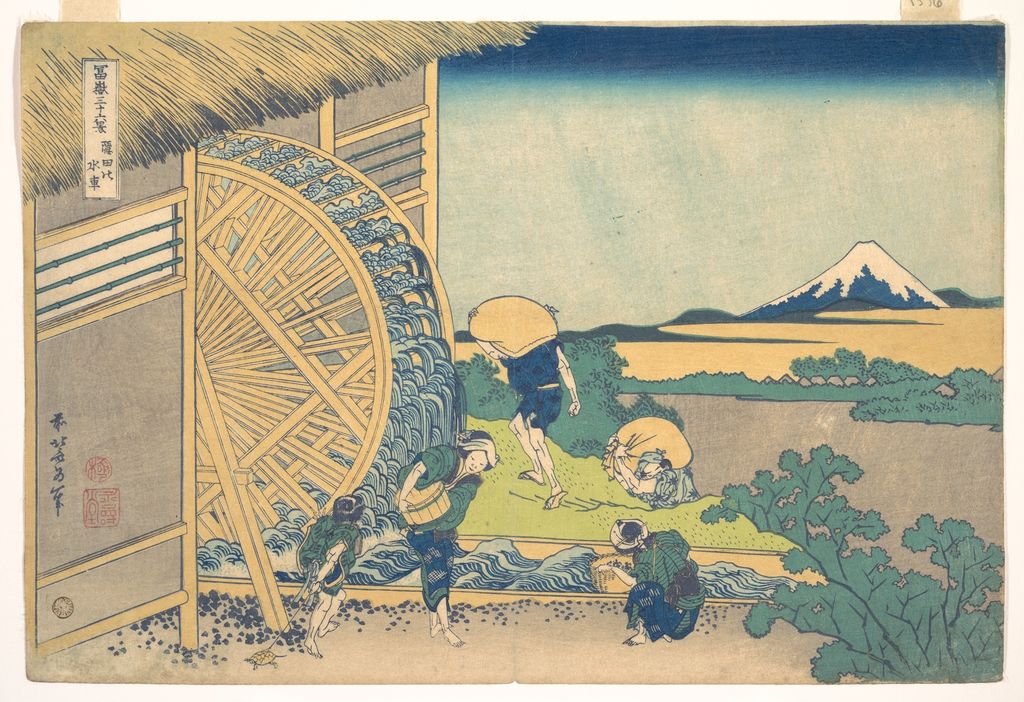
Image comparison
Where this work sits in Hokusai’s career
Annotated Details from Waterwheel at Onden
The Metropolitan Museum of Art, JP2967. [1]
Details from WATERWHEEL AT ONDEN
Select a detail to look closely.
The mill’s spokes
Thin spokes run from the hub to the outer rim. Their repeated diagonals distinguish the wheel from the long planks around it. [1]
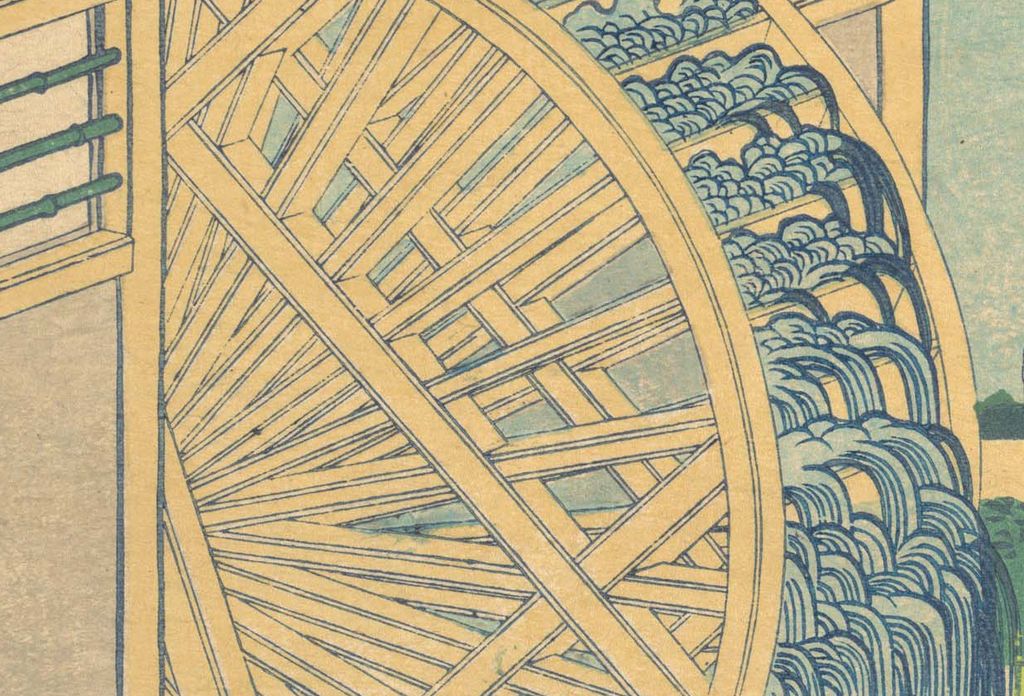
Water breaks below the wheel
Short curls and pale splashes gather at the bottom of the wheel, interrupting the long blue channel on the right. [1]
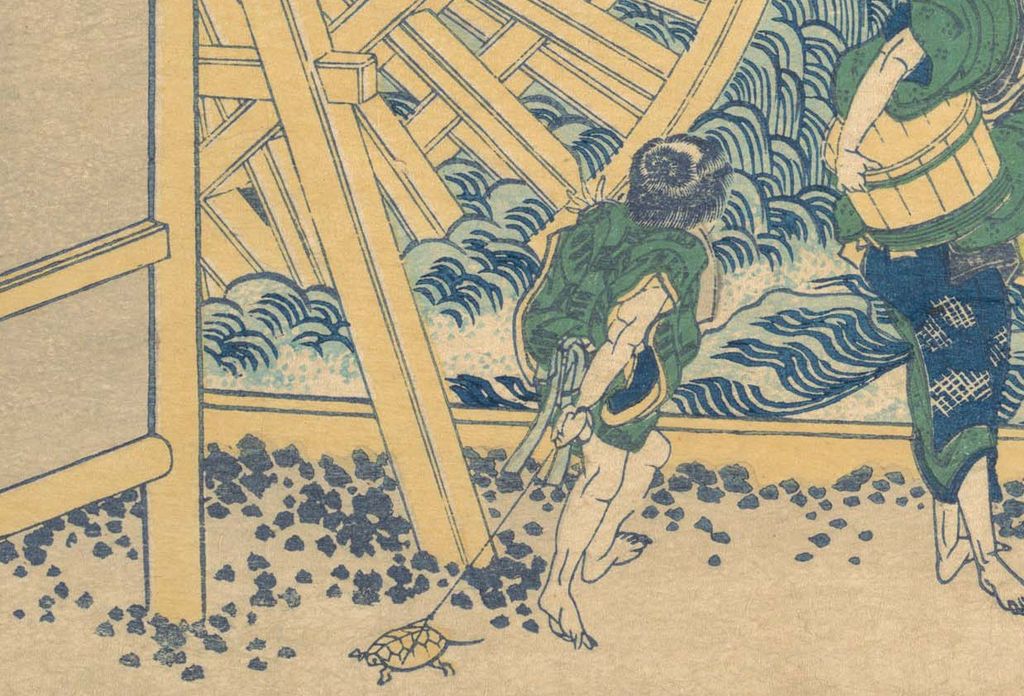
A load passing the mill
A worker’s broad hat and the load at shoulder height draw attention to the narrow passage among the mill, channel and fields. [1]
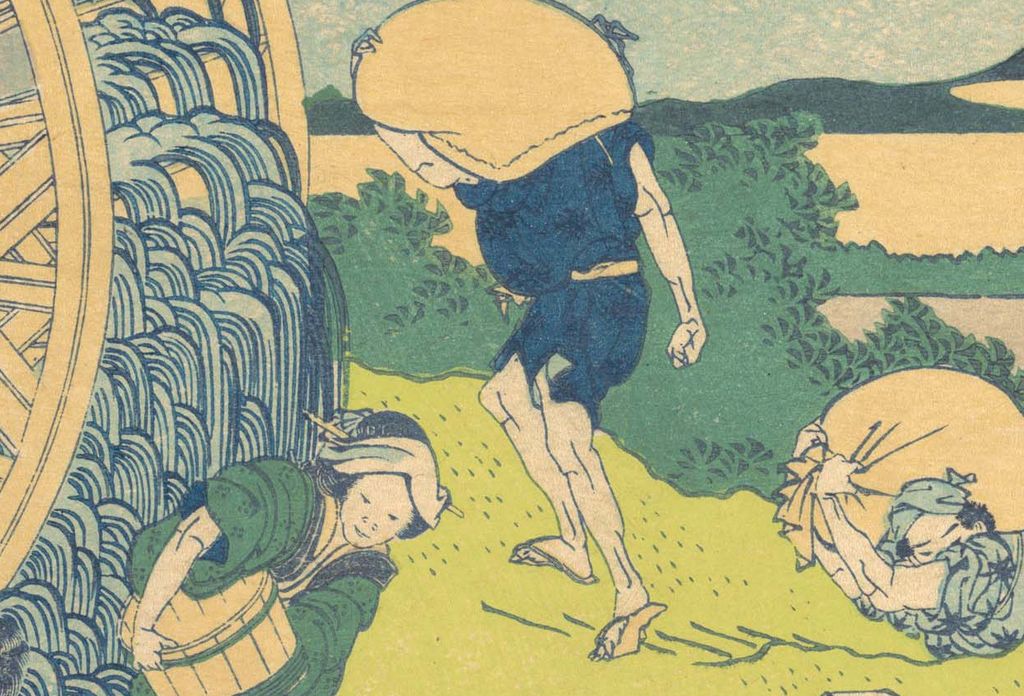
Fuji beyond the open ground
The small white peak sits beyond fields that run horizontally across the view. Its outline gives a distant point of reference for the much larger mill. [1]
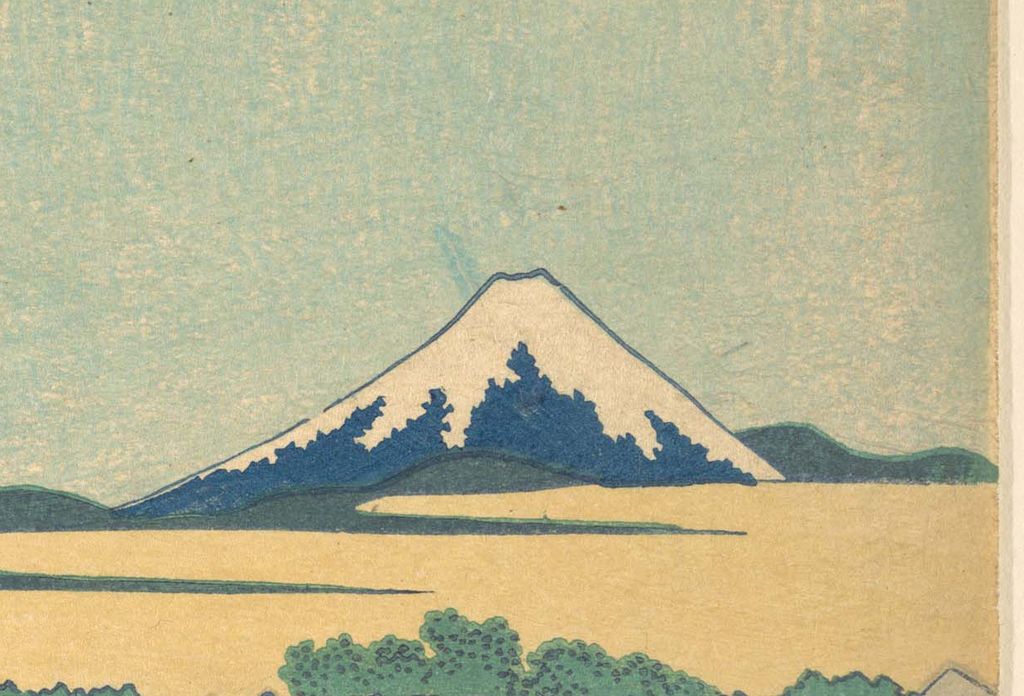
Explore Hokusai’s works
Discussion
Look again at the images and ideas explored in Watermill at Onden. These editorial prompts invite your observations.
Reader Insights
Which figures help you judge the size of the wheel?
How does the water lead your eye from the foreground towards Fuji?
Join the Conversation
Share a detail, comparison or question about Watermill at Onden below.
References
- The Metropolitan Museum of Art, The Waterwheel at Onden (Onden no suisha), JP2967. View source.
- Edo-Tokyo Museum, Thirty-six Views of Mt. Fuji: Waterwheel at Onden, 92202768. View source.
- The Metropolitan Museum of Art, Kirifuri Waterfall at Kurokami Mountain in Shimotsuke, JP2924. View source.
- The Metropolitan Museum of Art, The Waterwheel at Onden (Onden no suisha), JP1336, catalogue and interpretation. View source.
- Tokyo Fuji Art Museum, Thirty-six Views of Mount Fuji: Watermill at Onden, Japanese catalogue record and commentary. View source.
- The Metropolitan Museum of Art, Fujimigahara in Owari Province, JP2956. View source.
- The Metropolitan Museum of Art, The Waterwheel at Onden (Onden no suisha), JP1846. View source.
- Chiba City Museum of Art, Waterwheel at Onden, from the series Thirty-six Views of Mt. Fuji, 2933011, Japanese catalogue record. View source.







