


 by Tom Gurney
Tom Gurney BSc (Hons) is an art history expert with over 20 years experience
Published on June 19, 2020 / Updated on November 20, 2026
Email: tomgurney1@gmail.com / Phone: +44 7429 011000
Fuji Seen in the Distance from Senju Pleasure Quarter
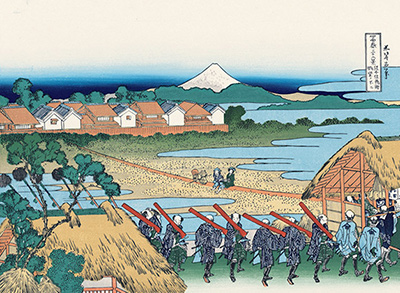
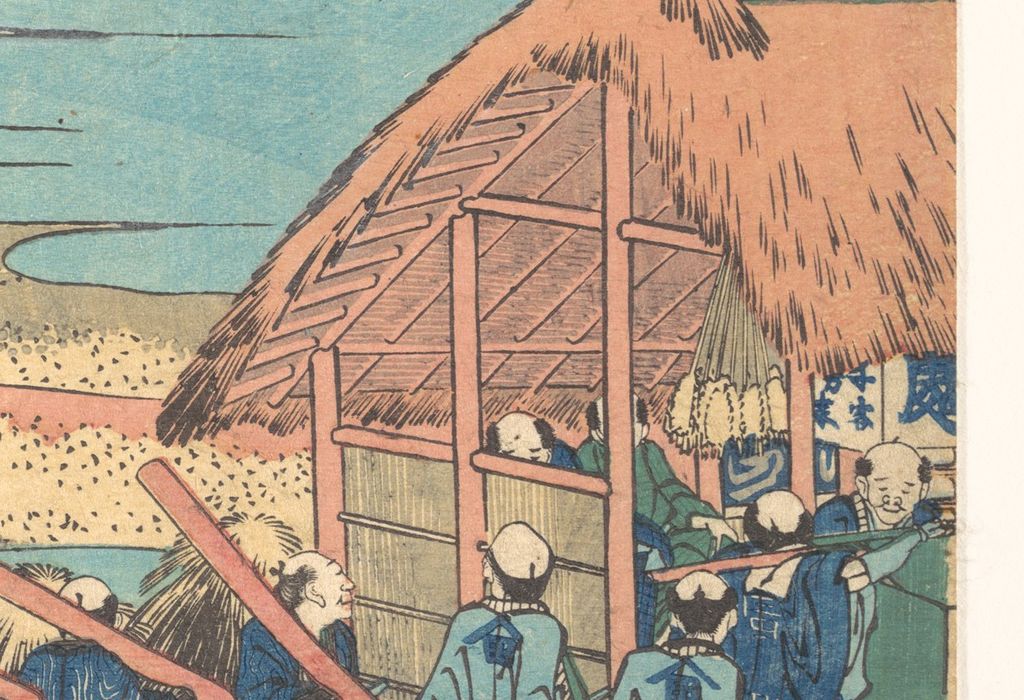
A line of men walks across the bottom of Katsushika Hokusai’s print. Dark garments and bright red shafts recur from one figure to the next, and tall white shapes rise behind a thatched roof at the right. A little farther back, two people beside a field appear to have stopped and turned towards the road. Mount Fuji is farther off again, a small pale peak above a row of buildings. Hokusai gives the procession the largest figures in the scene and the mountain the clearest outline on the horizon. The difference in scale lets us register what is passing before us and what will remain in view after the people have gone. [1] [2]
The Metropolitan Museum of Art calls the print Fuji Seen in the Distance from Senju Pleasure Quarter and dates its impression JP1326 to about 1830–32. Its Japanese title is 従千住花街眺望ノ不二, Senju kagai yori chōbō no Fuji. The near road, the fields and the distant settlement take up much of the sheet. Those intervals are part of the subject. The distant view of Fuji depends on where we think we are standing and on what lies between us and the mountain. [1] [2]
At a Glance
- ArtistKatsushika Hokusai
- Dateca. 1830–32
- MediumColour woodblock print
- SeriesThirty-six Views of Mount Fuji
Contents
A procession marked by red
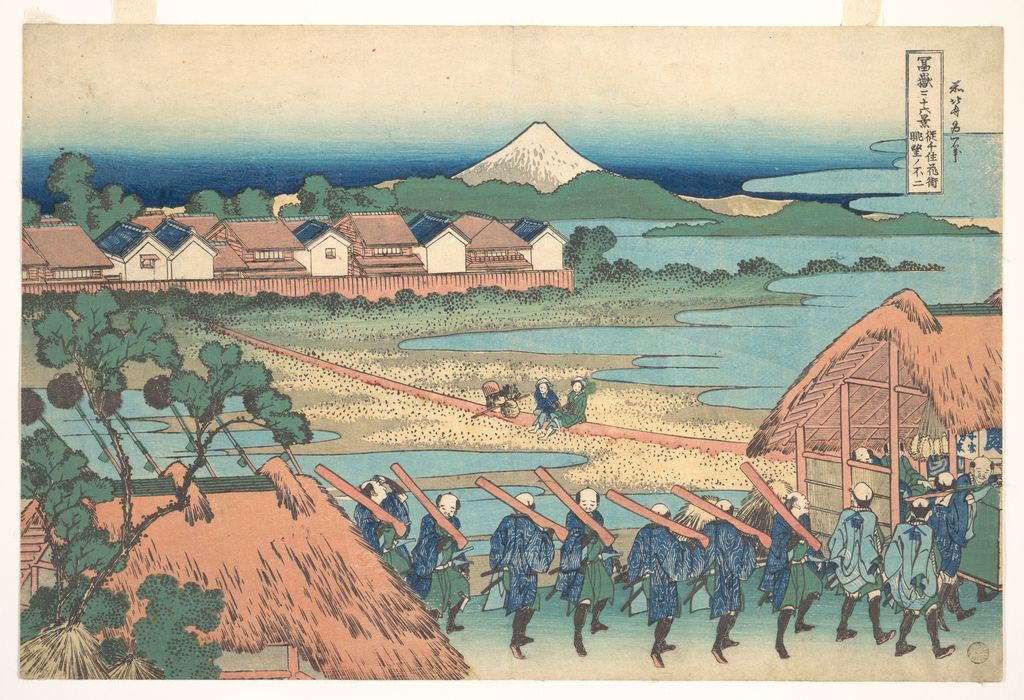
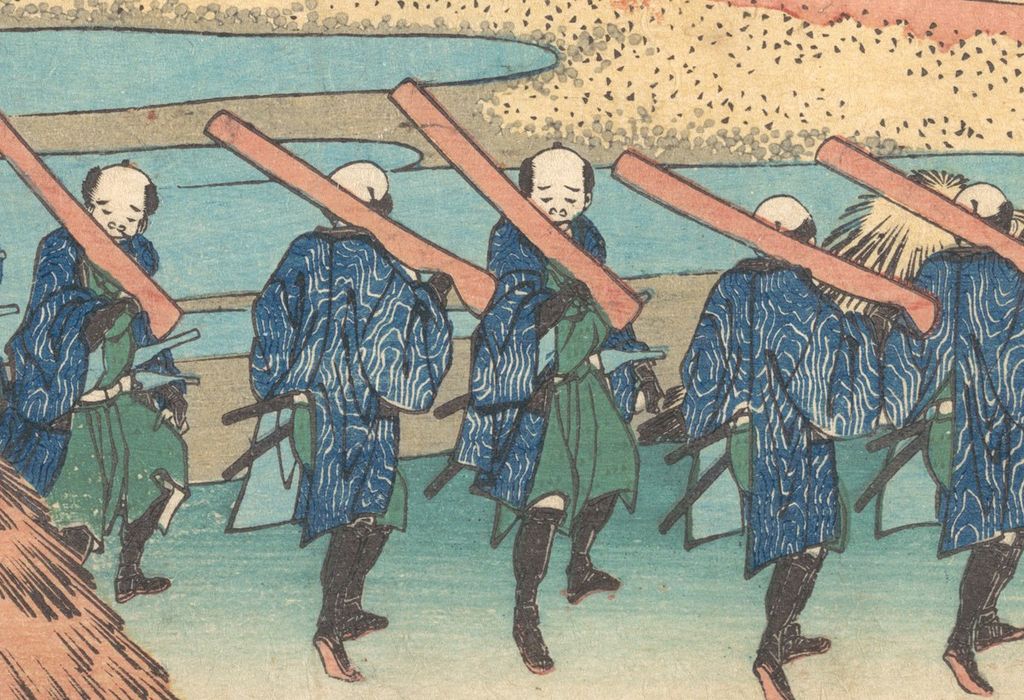
Follow the line of men from the left, where part of the procession is hidden by the nearer roof. As their bodies come into view, repeated slanting lines make their arrival feel more extended than the width of the picture. We see eyes and faces at different angles, and the legs fall into slightly different positions. The dark outlines and lighter blue folds let us pick out one person after another even where shoulders and equipment overlap. The Tokyo Fuji Art Museum identifies the group as part of a daimyō procession returning towards its domain and describes the guns and spears among its equipment. It particularly draws attention to the recurring red cases that mark the line. [1] [2]
The walkers are arranged in a close band, but it is possible to see through them at intervals. The gaps between the feet make the pale road visible and show how narrow the stretch of foreground is. At the right a second kind of repetition begins, with short pale upright forms appearing beyond the thatched building. The Tokyo Fuji Art Museum’s catalogue description on Cultural Heritage Online identifies the gun-bearing group in front and the spear-bearing ranks continuing beyond the hut. The edge of the roof interrupts the view without interrupting the march. In a scene where we can see so much open ground, the partly hidden procession is a useful reminder of how much remains outside our view. [1] [3]
The diagonal red forms have their own relation to the rest of the sheet. Together they give the movement a regular beat, while each red accent is short enough to remain attached to one walker. Behind the group the water is laid out in blue stretches that turn sharply at the edges of fields. Those bends are wider and much flatter than the red diagonals. A line on the road and a line in a field may point in different directions, but the difference is easy to follow because Hokusai gives each its own pace. [1]
Two smaller figures make a pause in that movement. The Tokyo Fuji Art Museum describes them as women resting on a bank between the rice fields after the harvest and watching the procession. They occupy a narrow yellow strip at some distance from the road, just beyond the long red accents. Their scale establishes how much ground separates them from the men. The people in the procession invite us to look along the road; these two watchers give us a position from which to look back at it. The museum’s catalogue also notices that some members of the procession appear to return their gaze. [1] [2] [3]
From the thatch to the horizon
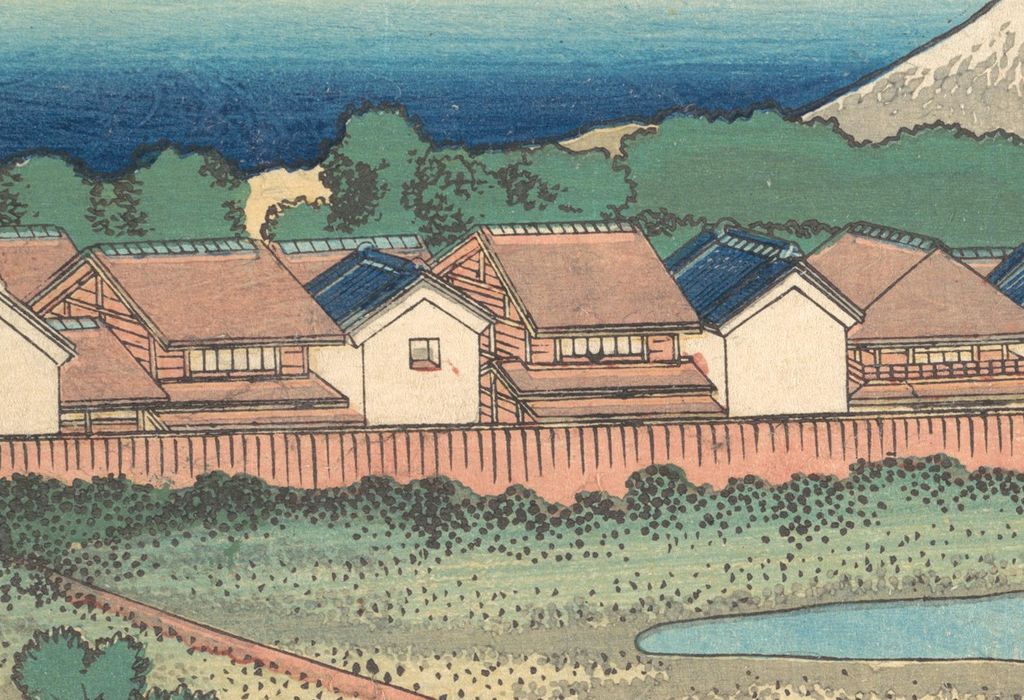
The two thatched roofs at the lower left and right create a near threshold for the view. On the left, individual marks descend along the slope of the roof, with tree foliage stopping and breaking that pattern. At right, the end wall shows a more regular framework, while the straw along the roof edge projects in short, uneven strokes. These are some of the most emphatic surfaces in the print. Between them, the distant buildings are reduced to a low succession of gables, pale walls and rows of parallel lines. That change in the size and density of the marks makes the settlement read as separate from the buildings beside the road. [1]
The Tokyo Fuji Art Museum places the viewpoint in Sanya, in present-day Taitō, looking towards Shin-Yoshiwara. Its account describes Senju as the first post station on the Nikkō highway and locates Sanya to its south. The museum’s catalogue description on Cultural Heritage Online also interprets the distant district through the title’s reference to a pleasure quarter. The title locates the view by a place name, and the museum’s reconstruction gives a more specific relationship between the viewer and the district across the fields. The print itself offers a route across open ground, the distant line of buildings and the mountain. Exact modern features cannot be traced from those forms alone. [1] [2] [3]
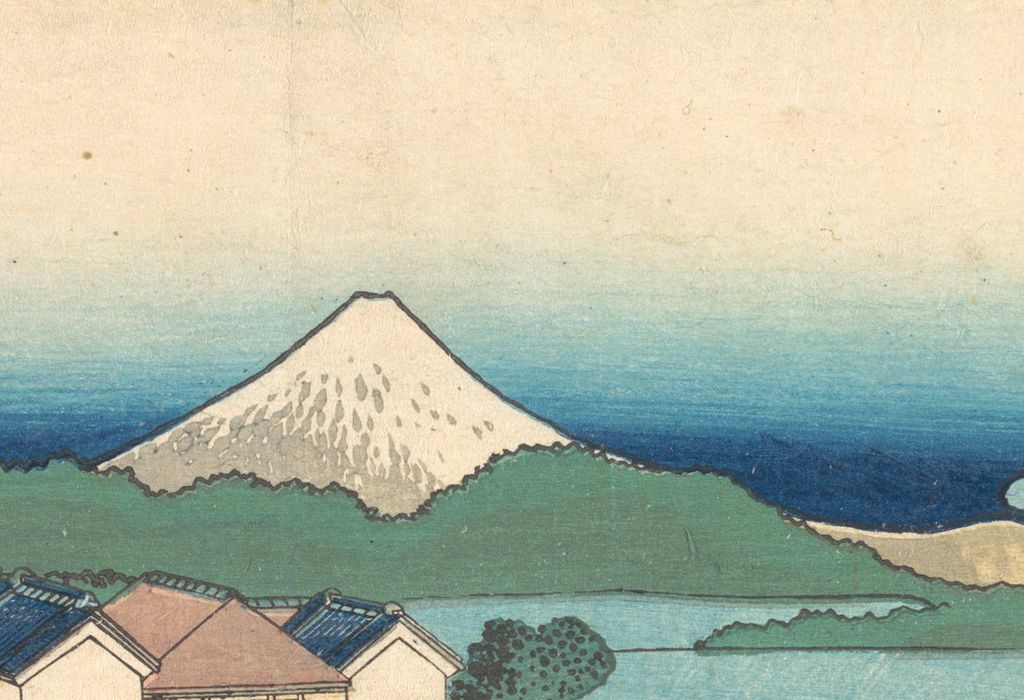
Fuji takes up a relatively small space above the buildings. Its light summit starts and stops with a short outline, partly screened below by a long low swell. On the Met’s JP1326 the dark blue near the horizon is particularly important. The colour sits behind the far ground, and the lightest part of the mountain shows above it. At the right, pale long shapes cross the blue and point back towards the slopes. Below the horizon the water has different edges. It flattens beside patches of land and narrows around their corners. In one of the pale horizontal shapes, the curved left end is visible while the rest extends out of the right edge. That simple form carries the eye beyond the sheet. The scene moves from a world of recurrent short marks along the road towards broad areas of colour that need only a few lines. [1]
That progression is particular to this design in Thirty-six Views of Mount Fuji. In Sekiya Village on the Sumida River, riders gallop along a winding embankment, where a pine leans over the course of the road. A few figures create a strong sense of speed. In Senju in Musashi Province, the horse and the tall upright structures have a different relation to the distant peak, breaking up the way we see it. The pleasure-quarter view uses a long band of walkers to move the eye across the foreground, and then opens a broad middle distance where we can pause with the two seated watchers. The three prints give related place names distinct visual identities. [1] [4] [5]
Comparing impressions
The Met records JP1326 as 25.1 by 37.5 centimetres and its separate impression JP2989 as 26 by 38.7 centimetres. Both are catalogued as colour woodblock prints on paper from about 1830–32. In their photographs, the procession has the same posture and the same red slanting forms, but the ochre and brown passages around it change. The straw in JP1326 appears pink-brown in places, particularly on the large roof at lower left. The corresponding area on JP2989 is yellower. The red equipment stands out more sharply from the lighter ground in that photograph. In both, the people beside the field are small but distinct, and the horizontal transition into blue keeps Fuji visible over the line of houses. [1] [6]
The larger measurements of JP2989 record the size of that particular sheet. The photographs also show differences in the paper visible around the printed design. The Tokyo Fuji Art Museum notes that its own impression is cropped close at the right and bottom and says that some owners trimmed prints to fit frames. It reports variants in the writing of the characters 前 and 為 in the artist’s signature. Close attention to such details can help compare specific impressions. The differences in colour in two photographs, by themselves, cannot establish an order of printing. Changes in printing, preservation and photography can all affect what we see. [1] [3] [6]
The Edo-Tokyo Museum’s object 92202780 is another impression of the same subject, catalogued with a range of 1831–34. The National Museum of Western Art lists the Iuchi Collection’s impression as number 40 in its exhibition checklist, where the title distinguishes this design from both Sekiya Village and Senju in Musashi Province. Dates and exhibition numbers refer to the particular catalogue records. The repeated order of the figures, the shapes of the roofs and the place of Fuji allow us to recognise the design across a set of separate physical sheets. [5] [7] [8]
Look finally at how the figures disappear. The nearest roof hides part of the procession; the line continues beyond the right edge of the sheet. The field across the road gives the watchers a wider view of the march, but they too occupy only a small stretch of the landscape. Each position carries a different sense of what can be seen at once. Fuji holds its place above the settlement throughout these changes of scale. Hokusai makes it possible to see the fleeting action of a single procession and the larger distances of the view without losing sight of either. [1] [6]
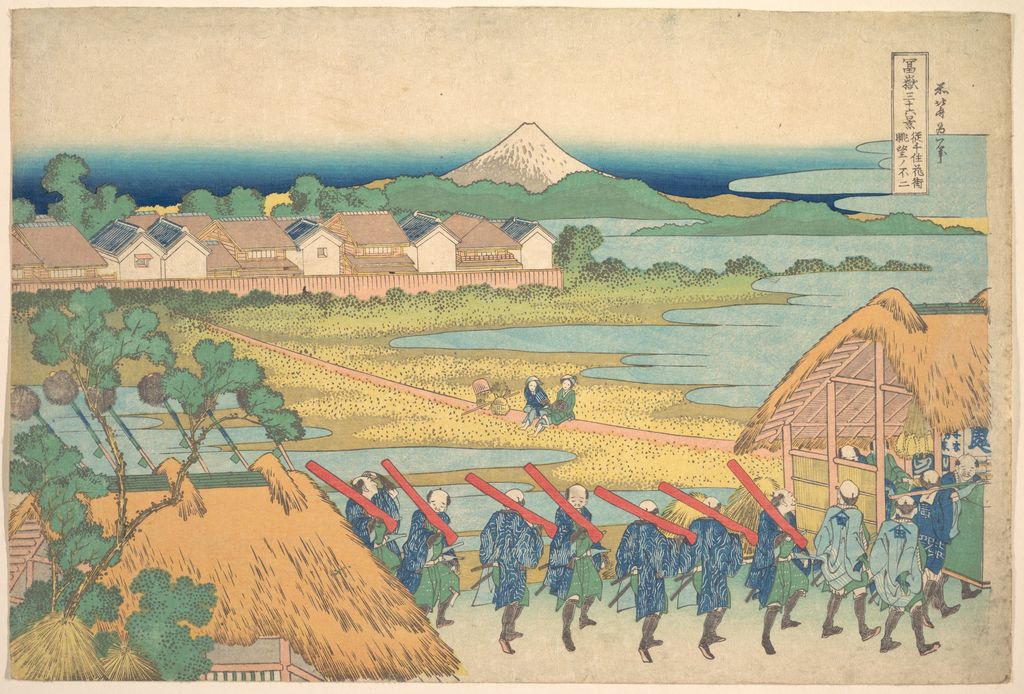
Image comparison
Where this work sits in Hokusai’s career
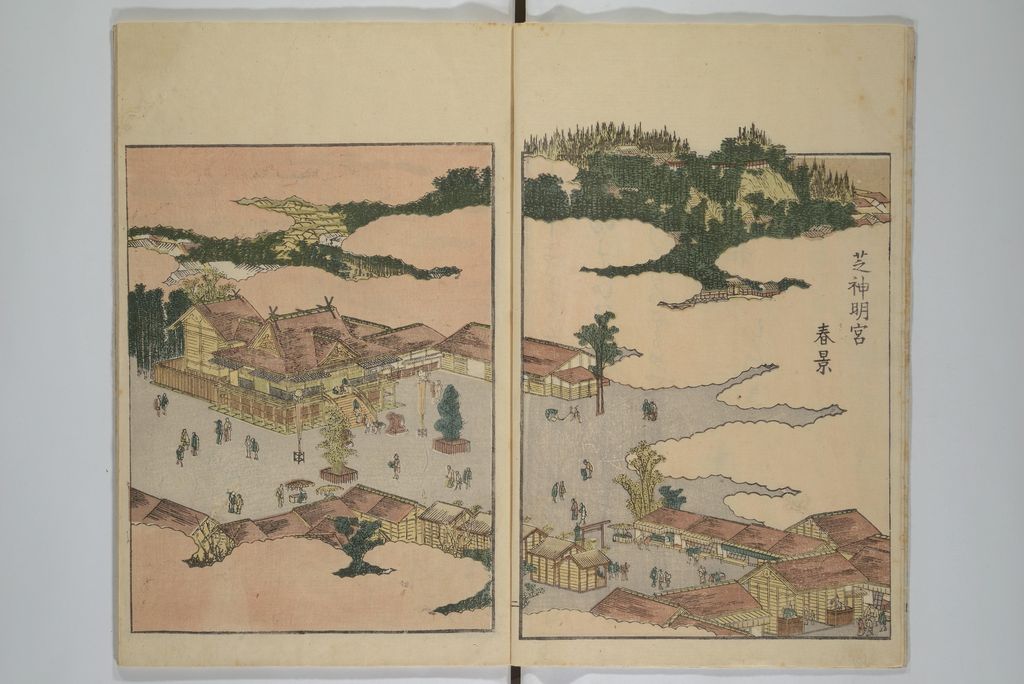
Hokusai Manga
From 1814Fuji Seen in the Distance from Senju Pleasure Quarter
ca. 1830–32Annotated Details from Fuji Seen in the Distance from Senju Pleasure Quarter
The Metropolitan Museum of Art, JP1326. [1]
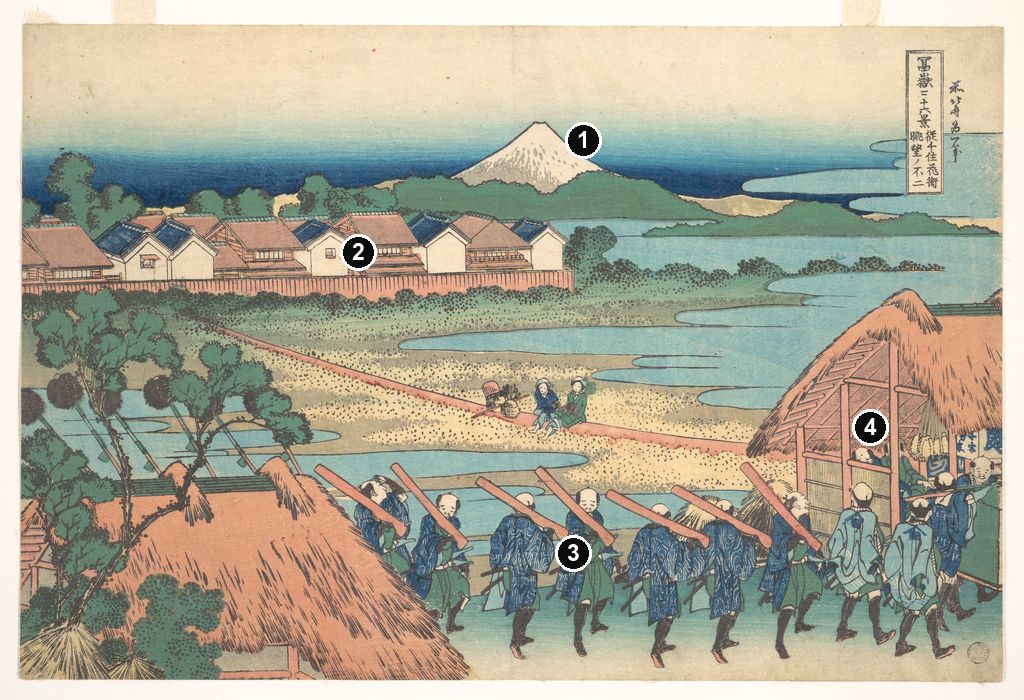
Details from FUJI SEEN IN THE DISTANCE FROM SENJU PLEASURE QUARTER
Select a detail to look closely.
Fuji rises beyond a low horizon
The small peak remains identifiable in a narrow strip above the buildings. Its compact outline offsets the longer lines of the fields and road. [1]
Houses form a band across the middle
Roofs and walls repeat at successive intervals. This low row separates the foreground road from the far mountain. [1]
People move along the near road
Several figures form a broad band underneath the fields. Their bodies are large enough to carry the course of the route across the print. [1]
A foreground roof interrupts the view
The angled mass at right cuts across the horizontal passages behind it. Its size puts the settlement in a different plane from Fuji. [1]
Explore Hokusai’s works
Discussion
Look again at the images and ideas explored in Fuji Seen in the Distance from Senju Pleasure Quarter. These editorial prompts invite your observations.
Reader Insights
Which foreground lines carry your eye through the settlement?
What separates the view of Fuji from the activities nearer the road?
Join the Conversation
Share a detail, comparison or question about Fuji Seen in the Distance from Senju Pleasure Quarter below.
References
- The Metropolitan Museum of Art, Fuji Seen in the Distance from Senju Pleasure Quarter, JP1326. View source.
- Tokyo Fuji Art Museum, Thirty-six Views of Mount Fuji: Mt. Fuji from Pleasure Quarter at Senju, object 06203 and Japanese curatorial commentary. View source.
- Tokyo Fuji Art Museum via Cultural Heritage Online, Fuji Seen in the Distance from Senju Pleasure Quarter (冨嶽三十六景《従千住花街眺望ノ不二》), object description and comparison of margins and signature variants. View source.
- The Metropolitan Museum of Art, Sekiya Village on the Sumida River, impression and curatorial account of the riders. View source.
- The Metropolitan Museum of Art, Senju in Musashi Province, JP2988. View source.
- The Metropolitan Museum of Art, Fuji Seen in the Distance from Senju Pleasure Quarter, JP2989. View source.
- Edo-Tokyo Museum via Tokyo Museum Collection, Thirty-six Views of Mt. Fuji: Fuji from the Senju Pleasure Quarter, 92202780. View source.
- The National Museum of Western Art, Tokyo, Hokusai: Thirty-six Views of Mt. Fuji, exhibition checklist, including no. 40, 従千住花街眺望ノ不二. View source.







