


 by Tom Gurney
Tom Gurney BSc (Hons) is an art history expert with over 20 years experience
Published on June 19, 2020 / Updated on November 20, 2026
Email: tomgurney1@gmail.com / Phone: +44 7429 011000
Orange Orchids
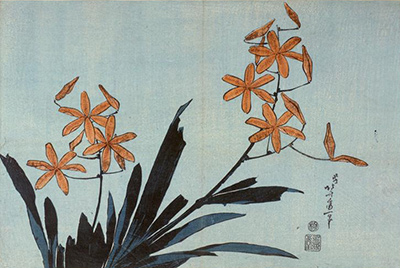
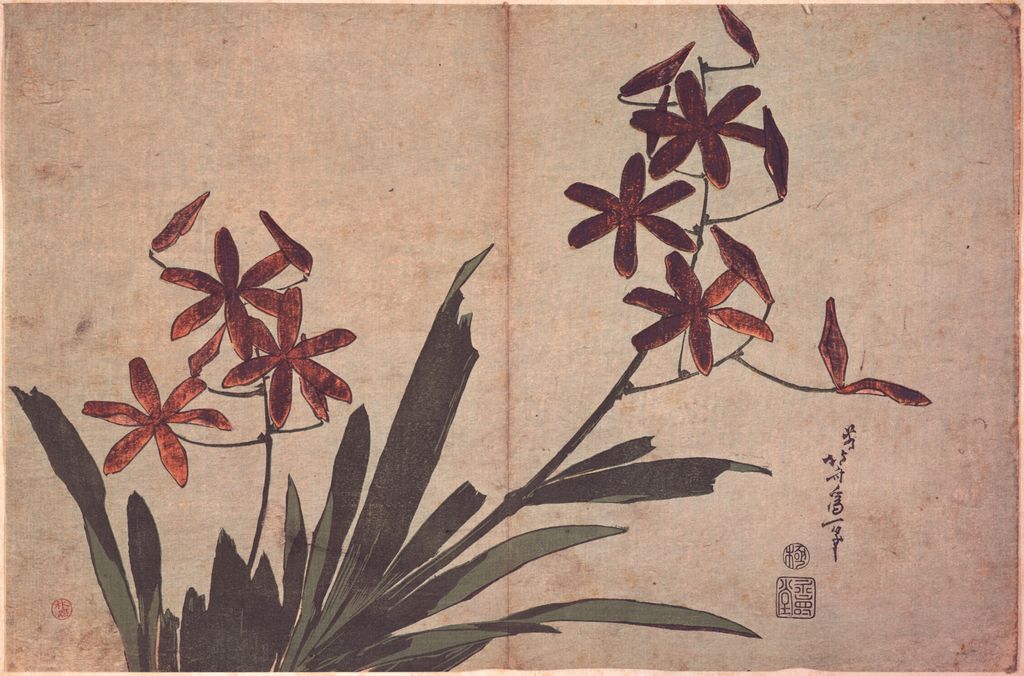
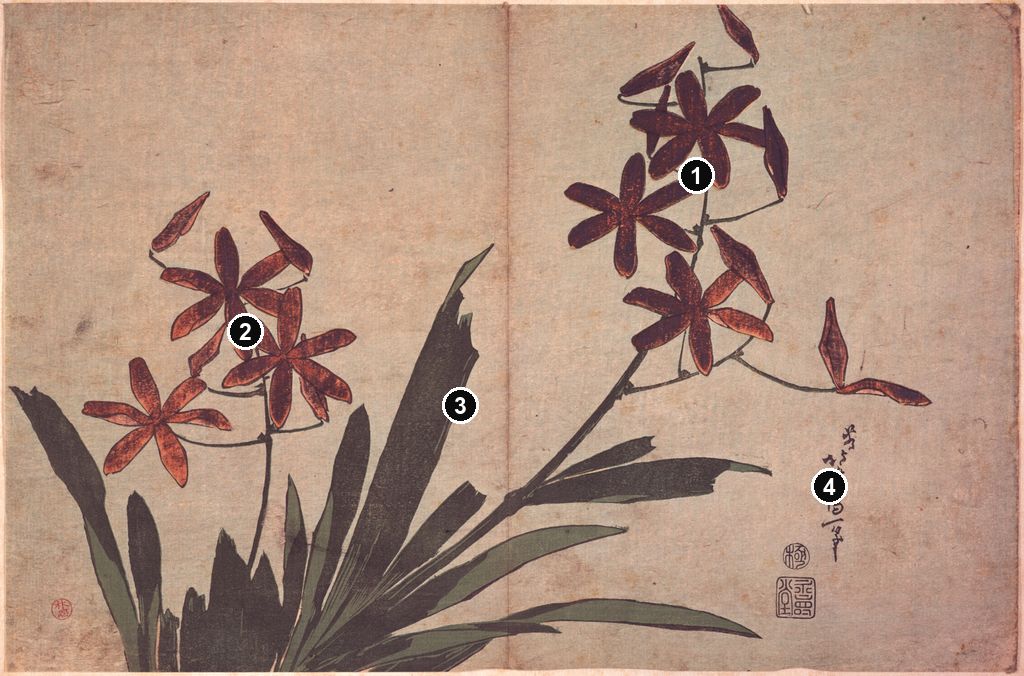
A spray of dark leaves rises from the lower edge of Katsushika Hokusai’s Orange Orchids. Above it, small star-shaped flowers open on two stems. The taller stem leans right, then turns up almost to the top of the sheet. Its flowers are widely spaced, and a slender side branch extends beyond them into empty paper. The shorter spray at left is more compact. Its blossoms crowd close enough for their edges to touch. The two sprays seem to grow at different speeds, even though their stems lead the eye back to the same group of leaves. [1] [2]
The Tokyo National Museum calls its impression Hiōgi-bana (桧扇花). The Minneapolis Institute of Art now calls its sheet Blackberry Lily. The same Minneapolis sheet formerly appeared in a museum-supplied catalogue as Orange Orchids. The pattern of stems, open flowers, leaves and buds shows that these prints share one design. The different titles are part of its cataloguing history, and the plant's habit gives the viewer a way into the Japanese name. [1] [2] [3] [4]
At a Glance
- ArtistKatsushika Hokusai
- DateEarly 1830s
- MediumColour woodblock print
- SeriesLarge Flowers
Contents
A fan of leaves
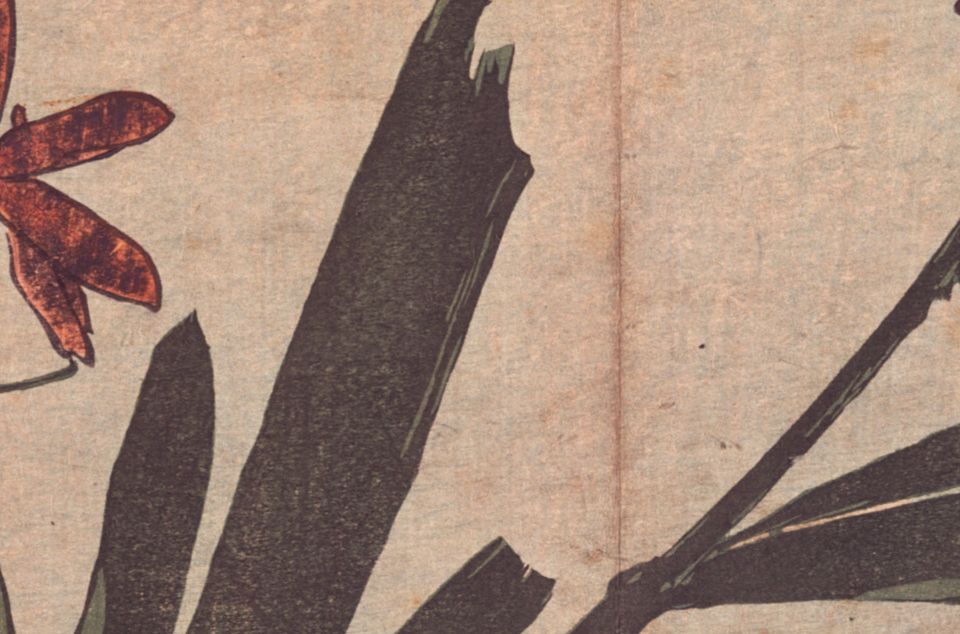
Look first at the broad leaf near the middle of the sheet. It climbs diagonally through the gap between the two sprays, then breaks briefly at one edge before coming to a point. Its silhouette divides the low flowers at left from the taller group at right. Below it, leaves seem to peel away from the same crowded base. One swings so far right that it lies almost horizontal. Another ends sooner and has a sharp interruption along its upper edge. With so little ground shown around them, the contrast in their length and angle makes it possible to follow where one leaf emerges from behind another. [1]
At the lower left a blade reaches away from the mass of foliage. It marks the outside of a broad fan whose other boundary extends across the bottom half of the print. Some blades look wide and flat, while others show a narrow surface before tapering to a point. The heavy shapes almost touch in the lower centre. Above them, a few thin lines support the rounder, much less crowded forms of the flowers. The plant changes scale between the base and the tips, from broad dark surfaces to stalks fine enough to disappear into the contours of a bloom. [1]
The Kyoto Botanical Garden identifies the plant called hiōgi as Iris domestica. It notes that the broad, sword-shaped leaves prompted a comparison with the cypress fans used at court. In English, the Missouri Botanical Garden explains the name blackberry lily through a different feature. Its ripe pods expose a cluster of dark seeds with the appearance of a blackberry. The part of the plant that most obviously fits a common name in Hokusai’s print is the fan of leaves. The spray at the right puts considerable distance between that leafy base and the thin stalks and small forms at its extremities. [1] [5] [6]
Open flowers and turned buds
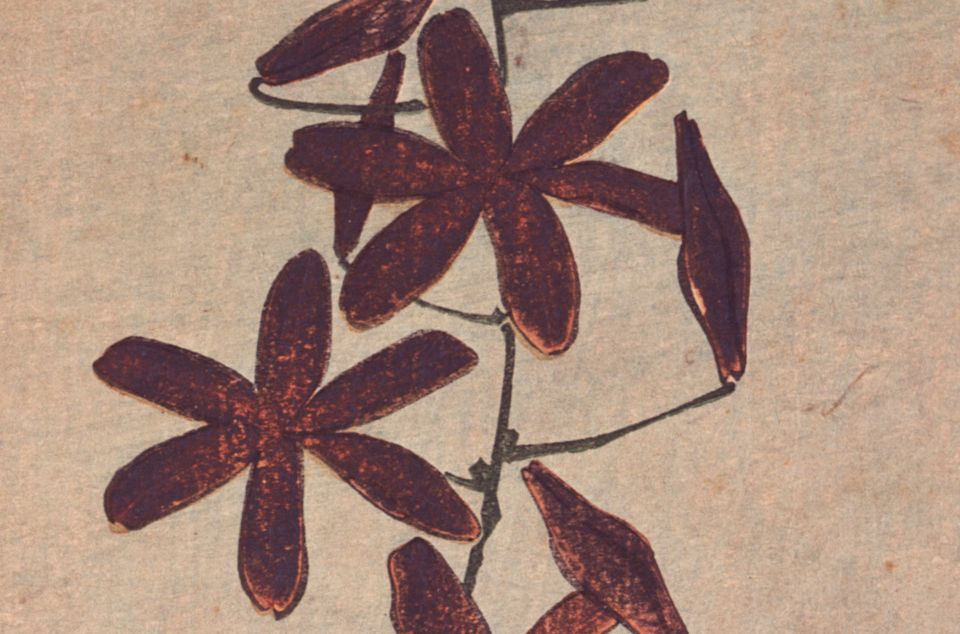
The right spray gives the eye three different encounters with an open flower. The lowest turns toward the viewer and radiates from a compact centre. In the next one up, the lobes make an oblique star with a short arm and a conspicuously long downward one. At the top, the open shape sits among several darker, narrow forms. Trace the branches around it and it becomes easier to see which forms join the flower and which belong to separate buds. A small gap near the upper edge lets the very last pointed shape stand by itself. [1]
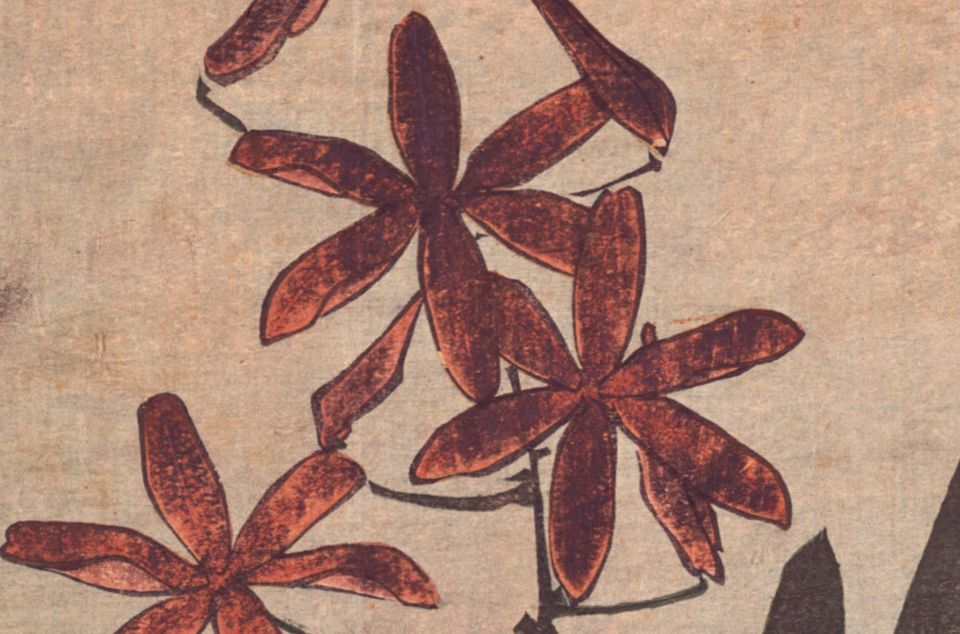
On the left, the arrangement is tighter. The lowest blossom extends into a pocket of bare paper above the outermost leaf. The two flowers behind it are higher, with the narrow stem threading between their lobes. Viewed at this scale, the marks within the flowers give the petals more variation than their simple outer shapes suggest. The lower left blossom retains conspicuous fine spots in the Tokyo photograph. Similar markings in the higher, darker flowers require a closer look. The distribution of light and dark means that different blossoms may come forward even within the same impression. [1]
One branch on the right continues sideways after it leaves the open flowers. It divides into two narrow shapes, one rising sharply and the other turning back toward the margin. Their silhouettes are easiest to see in the gap beyond the lowest bloom of the tall spray. They bring a little of the uneven spacing of the flowers into an otherwise open area. Far below, a leaf stretches in approximately the same direction, with the signature occupying the space between the two. The right edge is mostly empty, but these ends of the plant and the inscription give the viewer three points of entry into it. [1]
What two impressions show
The Tokyo archive lists its sheet, A-10569-2790, as a nineteenth-century work of the Edo period in the horizontal ōban, or large-sheet format. The Minneapolis catalogue identifies its own impression, 74.1.209, as a colour woodblock print, with an image and sheet measuring 25 by 36.4 centimetres. It associates the sheet with the untitled group commonly called Large Flowers, names Nishimuraya Yohachi as publisher and dates it to about 1833–34. Minneapolis's earlier AMICA record identifies the same accession and credit line under the title Orange Orchids and gives a date of about 1830. The public records document a change in title and dating for one physical object. Tokyo’s broader date applies to its own impression. [2] [3] [4]
The Tokyo photograph gives the background a warm, muted tone. Its upper flowers look deep red, and the edge of one flower nearly merges with the dark form hanging near it. In the Minneapolis reproduction, a cooler ground and brighter orange flowers make the star shapes clearer from a distance. The angled leaf in the middle, the bud at the far right and the low cluster at the left keep their positions. The warm and cool surroundings also change how the leaf tips stand out. Small gaps between the tips are particularly easy to see against the pale right side of the Minneapolis image. Reproductions can register differences in printing, paper condition or photography, and these two images alone cannot establish the specific cause or sequence. [1] [3] [7]
In the Tokyo photograph, a thin vertical line bisects the sheet. It crosses the dull, largely unbroken ground, passes to the right of the highest leaf and meets the main stem low down. The line keeps its straight course where the stalk and leaves turn. In the smaller Minneapolis photograph it does not divide the field in the same conspicuous way. Looking from the line to the outline of the leaves gives a practical way to distinguish the features shared by the prints from the appearance of one particular sheet. [1] [7]
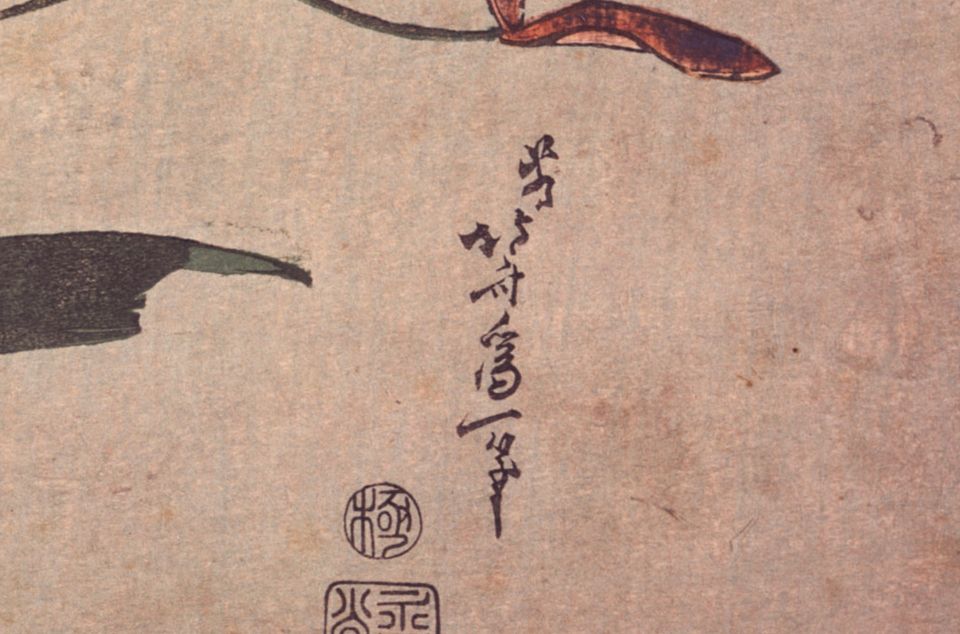
The writing and seals offer another point of reference. Tokyo’s reproduction shows the narrow vertical signature below the side branch and a round mark above a square one, set slightly to its left. Minneapolis transcribes the signature as Saki no Hokusai Iitsu hitsu, in which Hokusai refers to his former name and uses the name Iitsu. The record also identifies a kiwame censor seal on its own impression. The marks are easiest to find by following the right branch out from the flower and looking down into the strip of clear ground beneath it. Unlike the leaf and flower shapes, the writing holds to a nearly upright course. [1] [3] [7]
The scale of Hokusai’s large flower prints
The Sumida Hokusai Museum describes Hokusai’s large flower prints as part of the output of Nishimuraya Yohachi, who also published designs from the Mount Fuji and waterfall series. This sheet shows what Hokusai could do with the width of a large print when the subject was a single plant. The fan of blades spreads across the same field in which the smaller flowers open. A viewer can read the silhouette at a distance, then come closer and see the spots on a petal and the line where a broad leaf folds. The difference in scale runs through the whole picture. [1] [3] [8]
In Lilies, Hokusai again allows the leaves and blossoms to run beyond the sheet, but the trumpet-shaped flowers are broader and come forward almost as far as the leaves. The bent flower at upper right has a weight and a rounded length of its own. In Orange Orchids, the top of the print is filled by a succession of much smaller shapes on a branching stem. It draws attention to the intervals between blooms and to the points where each flower turns back toward the stem. The two prints give viewers different ways of moving from the large silhouette of a plant to the structure of an individual bloom. [1] [9]
The Sumida Hokusai Museum’s account of woodblock printing describes a division of labour among the artist, the carver and the printer, with the publisher organising their work. The visible result here depends on the way broad colour shapes and much finer lines fit together. A small flower would still be recognisable by its star-shaped outline, yet the fine printed pattern inside it adds something that the outline cannot carry. Likewise, the sharp contour of a long blade is legible even where its interior change in tone is subtle. Move from the broad central leaf to the spotted flower on the far left and both registers of the print come into view within a very short distance. [1] [10]
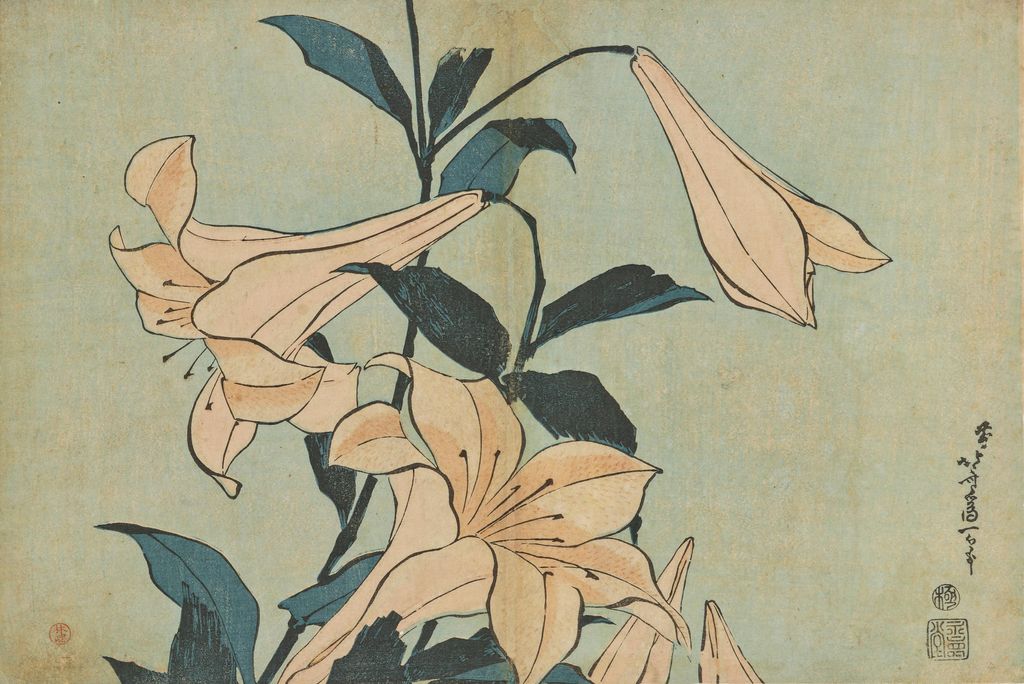
Image comparison
Where this work sits in Hokusai’s career
Annotated Details from Blackberry Lily (Orange Orchids)
Tokyo National Museum via ColBase, A-10569-2790. Adapted with markers and detail crops under the ColBase terms. [1]
Details from BLACKBERRY LILY (ORANGE ORCHIDS)
Select a detail to look closely.
The upper spray opens in stages
Flowers and buds emerge at intervals from the thin stem. Their angled petals make separate shapes against the open ground. [1]
A lower group leans to the left
The low cluster has more overlap than the tall spray. Its stems carry the eye across to the long leaves at the centre. [1]
Long blades rise like a fan
The pointed leaves spread from a crowded base into the open ground. Their broad lines give a firmer shape to the plant beneath the sprays. [1]
The signature occupies the margin
A thin line of writing stands almost at right angles to the horizontal stem. A small seal sits directly beneath the characters. [1]
Explore Hokusai’s works
Discussion
Look again at the images and ideas explored in Orange Orchids. These editorial prompts invite your observations.
Reader Insights
Which spaces make the two flower sprays read separately?
Where do the leaves turn from vertical to almost horizontal?
Join the Conversation
Share a detail, comparison or question about Orange Orchids below.
References
- Tokyo National Museum via ColBase, Hiōgi-bana (桧扇花), photograph of A-10569-2790. View source.
- Tokyo National Museum, Hiōgi-bana (桧扇花), image archive record C0006377, accession A-10569-2790. View source.
- Minneapolis Institute of Art, Blackberry Lily, 74.1.209, museum collection data. View source.
- Minneapolis Institute of Art, Orange Orchids, 74.1.209, museum record contributed to the Art Museum Image Consortium. View source.
- Kyoto Botanical Garden, weekly plant observations, Hiōgi (Iris domestica). View source.
- Missouri Botanical Garden, Iris domestica, Plant Finder. View source.
- Minneapolis Institute of Art, Blackberry Lily, 74.1.209, collection photograph. View source.
- Sumida Hokusai Museum, Hokusai’s Floral Glory, exhibition notes on the Large Flowers and Nishimuraya Yohachi. View source.
- Agency for Cultural Affairs, Japan, Lilies (百合), Tokyo National Museum impression. View source.
- Sumida Hokusai Museum, Wow, Hokusai! See, Examine, and Discover Ukiyo-e, section on the woodblock workshop. View source.







