


 by Tom Gurney
Tom Gurney BSc (Hons) is an art history expert with over 20 years experience
Published on June 19, 2020 / Updated on November 20, 2026
Email: tomgurney1@gmail.com / Phone: +44 7429 011000
Masculine Wave by Katsushika Hokusai
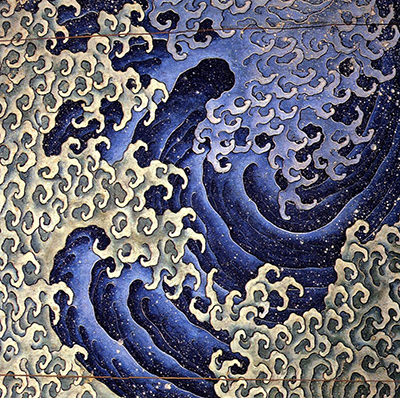
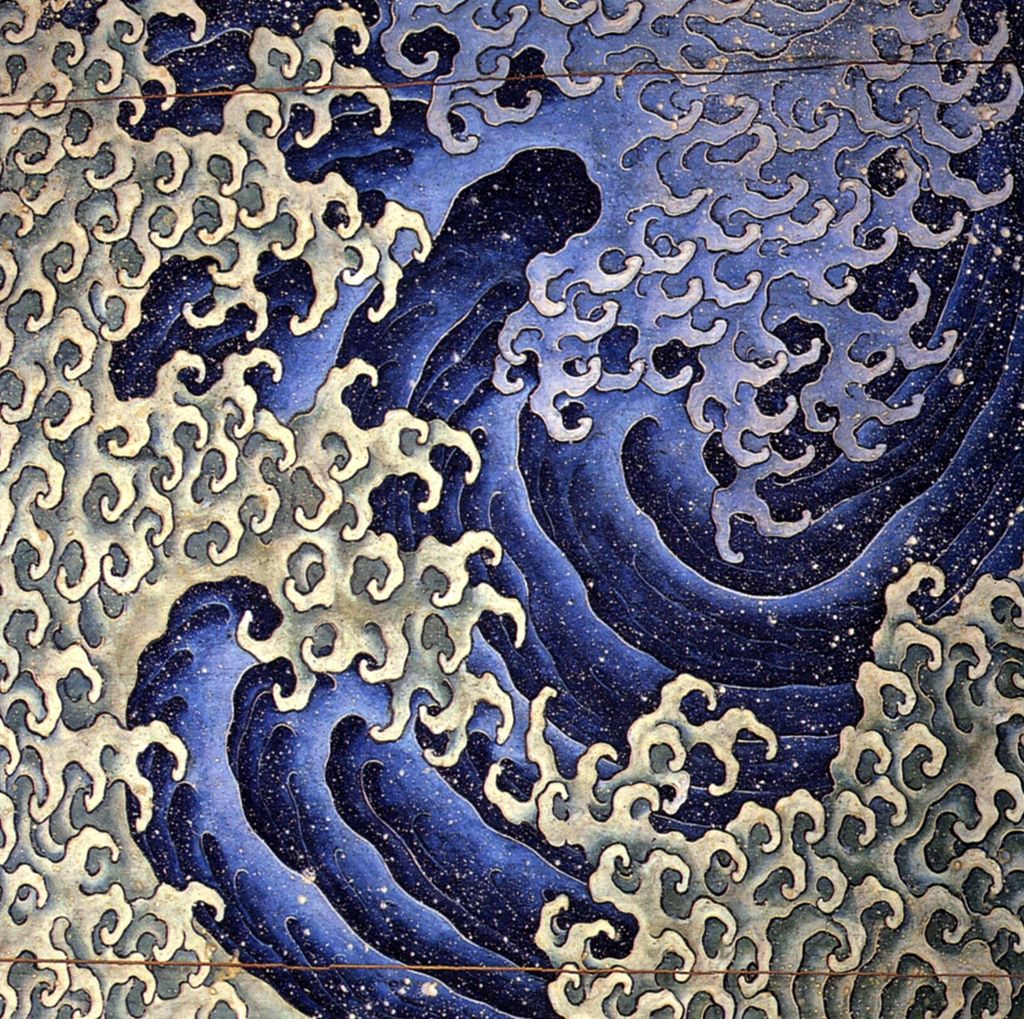
After the crest breaks in Katsushika Hokusai’s Masculine Wave, there seems to be scarcely any room for the water to go. Deep blue bands curl up through the centre of the panel, while pale foam presses in from the left and lower edges. Small curls of spray gather around the larger turns. A viewer can follow a surge for a short distance before it disappears into another part of the pattern. Hokusai painted this panel for the ceiling of the Kanmachi festival float in Obuse. The Hokusai Museum in Obuse groups it with its companion, Feminine Wave, under the title Angry Waves (Dotō zu, 怒濤図). [1] [2]
At a Glance
- ArtistKatsushika Hokusai
- Date1845
- MediumColour on paulownia panel
- CommissionKanmachi festival float
Contents
The blue currents and the small curls of foam
Look first at the deep blue shape near the middle of the reproduced panel. Its outer edge rises in a continuous arc before turning back towards the centre. Inside that turn, narrower bands repeat the movement at intervals. They are far enough apart to suggest volume, like folds that belong to one mass of water. The pale foam touches the edge of the blue in short, irregular segments. A thicker passage of it pushes across the composition from below, breaking up the blue shapes that might otherwise read as one uninterrupted sweep. [2]
On the left, the pattern is tighter. Several small curls turn inward on themselves, while others carry their hooked tips into a patch of dark water. The opening inside each curl gives the foam a different weight from the long lines through the centre. Openings among the light marks also let the blue show through in small isolated patches. At a distance, the pattern gathers into broad areas of light and dark. Up close, it breaks into overlapping hooks, rings and short streaks. The same water has a large movement that one can see at a glance and a smaller movement that takes longer to follow. [2]
The long curves change in width. One of the lower blue bands starts as a broad, dark passage and narrows as it turns into the pale edge around it. Other ridges run close to one another and open apart again. The changing intervals make parts of the water look compressed, as though each band advances at a different speed. At the upper edge, the foam breaks into a field of smaller forms, some edged with dark outlines and others separated mainly by colour. The work keeps moving between the clear direction of one curve and the difficulty of telling where its smaller disturbances end. [2]
Look towards the corners and the contrast between water and spray becomes especially important. Small patches of the cream foam seem to float inside the blue, while the largest passages of pale colour are broken by blue hollows. This exchange keeps the eye from treating the foam as a border drawn around a fixed outline. The foam is also a way to feel how much water has rolled over itself. Where the pale areas thicken, the broad movement temporarily disappears. A glimpse of blue then brings the viewer back to the weight of the current. [2]
Painted for a ceiling
The Sumida Hokusai Museum’s exhibition catalogue identifies Masculine Wave, or Onami (男浪), as a panel painted in colour on paulownia wood, about 1845. The Hokusai Museum in Obuse dates the pair to 1845 in its gallery account and describes work on the two panels and the wider float decoration extending from 1845 into the following year. The float was commissioned and financed by Takai Kōzan. According to the Obuse catalogue, he also coloured the painted surrounds from Hokusai’s designs. The panel belongs to a larger decorated object, with responsibilities that can be distinguished even when looking at a photograph of its central field. [1] [3]
A ceiling presents an unusual problem for a painter of water. A framed seascape at eye level can use a horizontal line between sky and sea to establish a clear position for its viewer. In Masculine Wave, the water spreads across the field, and the panel was meant to be seen by a person looking upwards. Depending on where that person stands, the curls can be approached from different sides. The short hooks around the edges remain recognizable, even when the angle changes and one stretch of painting is foreshortened. The long curves bring the eye back towards the centre without asking it to find a level shore or any other fixed point in the scene. [1] [2]
The geometry of the mounted work matters too. A viewer can see in the reproduction how the water is cut off at the edges of the field. Some pale lines arrive at the boundary with their curves still open. On the float, that arrest meets the physical join between the painting and its surround. The rectangular reproduction makes the cut edges particularly easy to notice. Seen in the structure, those same edges belong to a designed ceiling, with painted and carved elements distributed around it. The museum records, for example, a carved winged dragon installed under a beam of the Kanmachi float. The painted water shares space with objects that have their own depth and movement. [1] [2]
The format also helps to explain the change in scale across the panel. Several blue arcs occupy a substantial part of its field. The smallest pale hooks can almost vanish in a quick view from below, leaving their concentration visible as a mottled band. As viewers look more closely, the pale colour resolves into separate curls. Many of the smaller ones echo the outline of a broader wave. The painting invites both a distant reading of the overall movement and the pleasure of following one part of its surface at a time. [1] [2]
Two ways of giving water a shape
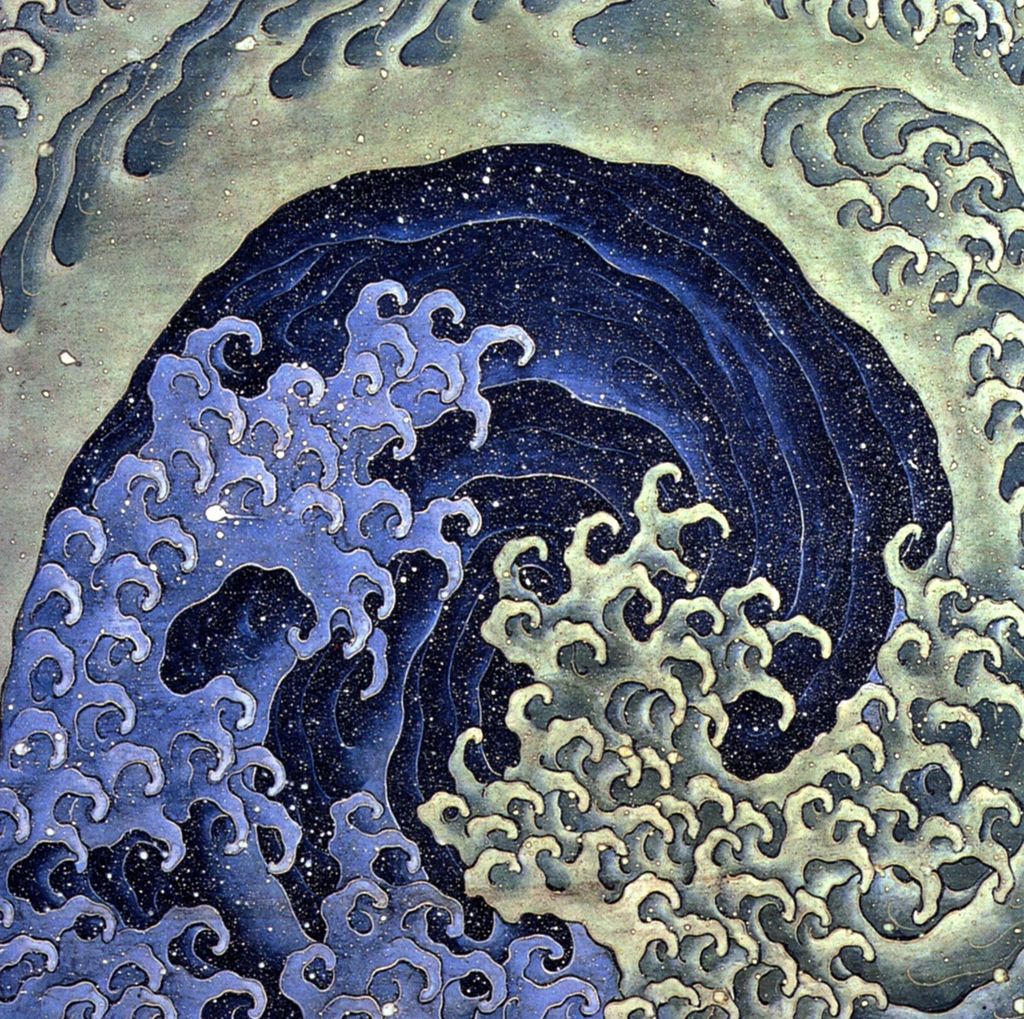
Feminine Wave shares the same ceiling, and the two panels give the eye different ways into their water. In its reproduced orientation, the companion has a broad, dark crest that arches over a dense bank of pale curls. One large outline encloses much of what happens below it. In Masculine Wave, comparable darkness is separated into several curling runs, with a wide disturbance of pale foam between them. The two paintings use the contrast between blue water and spray to different ends. The companion gathers the movement under a single large arc, while Masculine Wave keeps dividing it as it approaches the edges. [1] [2] [4]
The likeness between them is equally important. Both use recurring foam shapes to make a surge legible, and both give some small curls the same inward turn as a much larger crest. Seen as a pair, they show how much Hokusai could vary the balance between a long sweep of colour and a closely worked edge. Their conventional Japanese and English names distinguish the panels. The visible patterns provide their own grounds for comparison, from the larger divisions of the blue to the places where pale spray advances into a hollow. That comparison holds whether the eye starts at a corner or follows an uninterrupted curve across the central part of a panel. [1] [2] [3] [4]
From a printed wave to painted water
In The Great Wave off Kanagawa, a sharp ridge of foam hangs over the boats and frames the distant Mount Fuji. Those other elements give the wave its scale and make its direction unusually clear. The crest has something below it to overtake, and the mountain stays visible through the opening. In Masculine Wave, scale comes from the relationship of one breaker or curl to another. A narrow line of foam can look immense when it is set against the flecks around it, then become only one strand when the eye follows the larger blue arc. The ceiling panel allows that shift to happen repeatedly across the picture. [2] [5]
The Hokusai Museum in Obuse traces his interest in waves through several formats, including pictures for illustrated books. Its example from The Crescent Moon, the illustrated tale of the warrior Tametomo, shows successive waves crowding around a boat and its occupants. The sea there has figures and a vessel to contend with, as it does in the famous print, while the story gives the reader a reason to turn to the next episode. In the ceiling panel the disturbances across the field supply their own sequence. One can start with the foam at an edge, follow it until it opens around a dark ridge, and then pick up the swell farther in. [2] [5] [6]
The museum’s 2024 exhibition placed the wave panels in the context of these changes and listed them together in the festival-float gallery. The same checklist separately lists the earlier dragon and phoenix panels for the Higashimachi float. In those works the movement of an animal supplies a centre for the surrounding decoration. On the Kanmachi ceiling, the water supplies both the central subject and the restless pattern around it, and the two panels allow the viewer to see that arrangement played out twice. [1] [2] [4] [7]
The woodblock print and the ceiling painting also make different uses of their supports. The Met’s Great Wave is ink and colour printed on paper. The panel in Obuse uses painted colour on wood and occupies a place above the viewer. The recurring blue and pale contours make the two recognizably related without making them look alike at every scale. In the print, the curling crest stands out partly because of the expanse of sky behind it. In the panel, narrow seams of dark water between the pale shapes make the spray visible against more water. Follow the strongest curl away from the centre, and its apparent boundary becomes the beginning of another movement. [1] [2] [3] [5]
Where this work sits in Hokusai’s career
Masculine Wave
1845Annotated Details from Masculine Wave
Hokusai Museum, Obuse. Reproduction via Visipix and Wikimedia Commons. [1]
Details from MASCULINE WAVE
Select a detail to look closely.
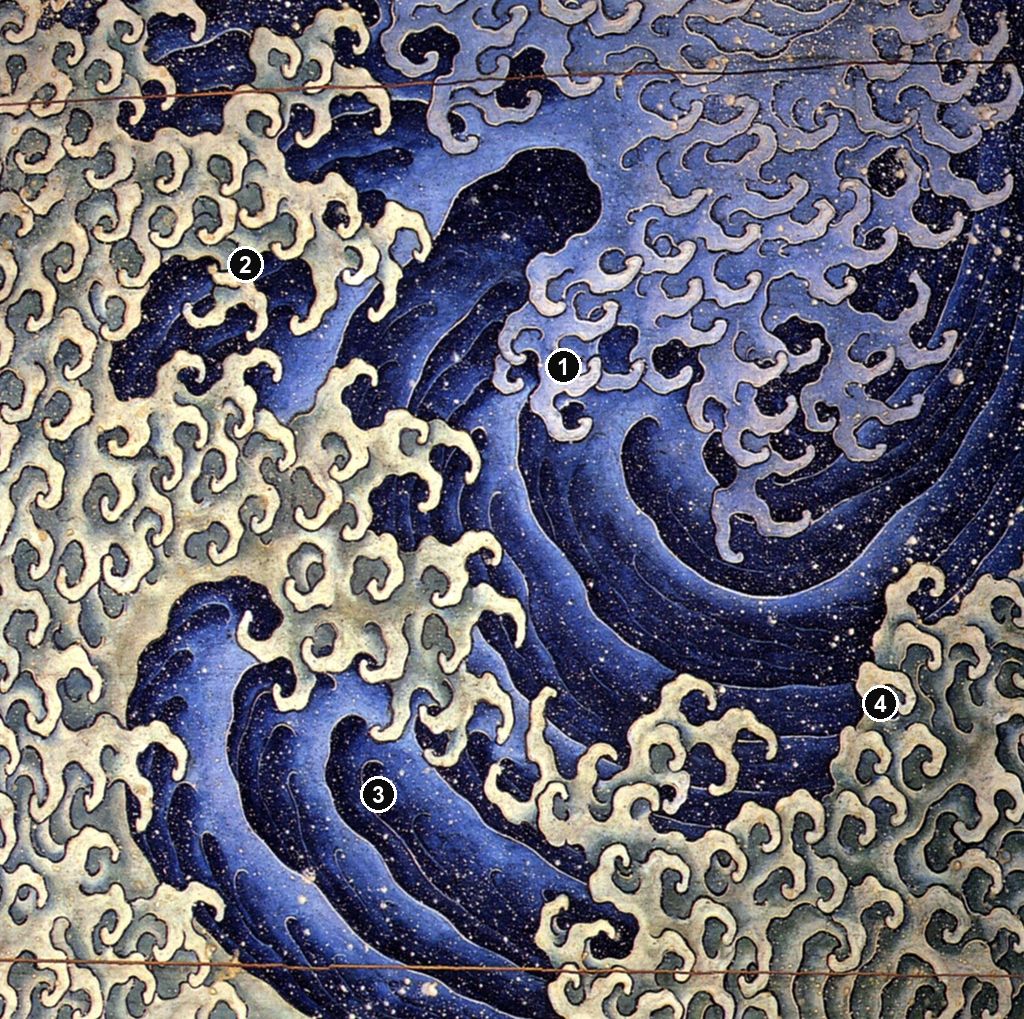
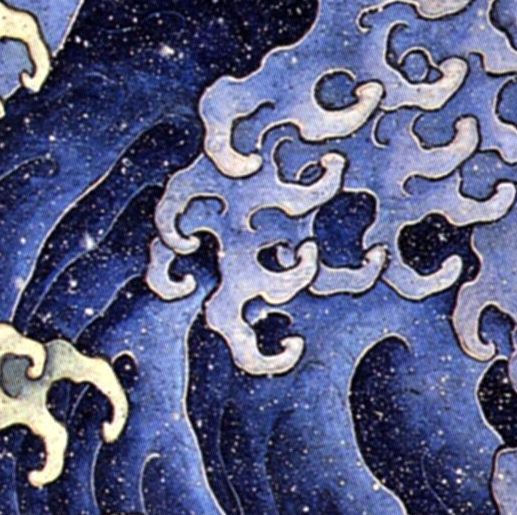
A deep blue mass turns below the foam
The crest’s outline comes in and out of view among crowded curls. Dark blue carries the larger movement underneath them. [1]
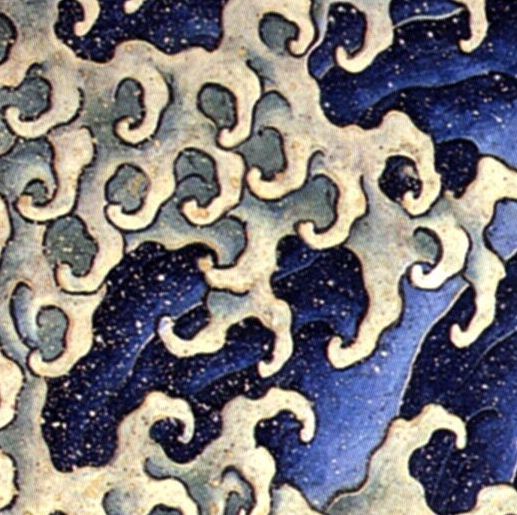
Pale hooks cross one another
Foam spreads in short hooks with darker gaps between them. Their small turns mark different directions within the larger flow. [1]
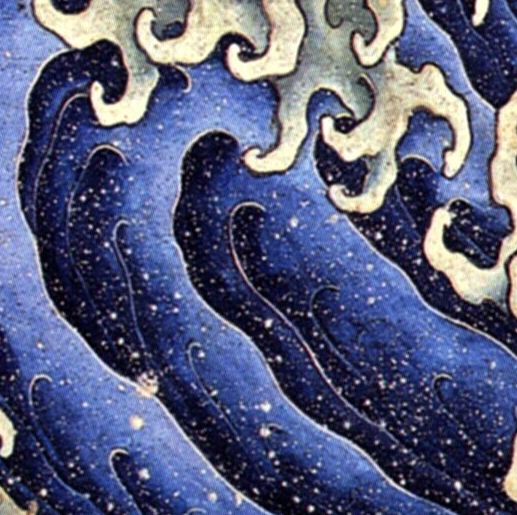
Lower waves gather into ridges
Several thick blues rise in parallel from the lower region. The repeated crests sustain a broad movement through the smaller froth. [1]
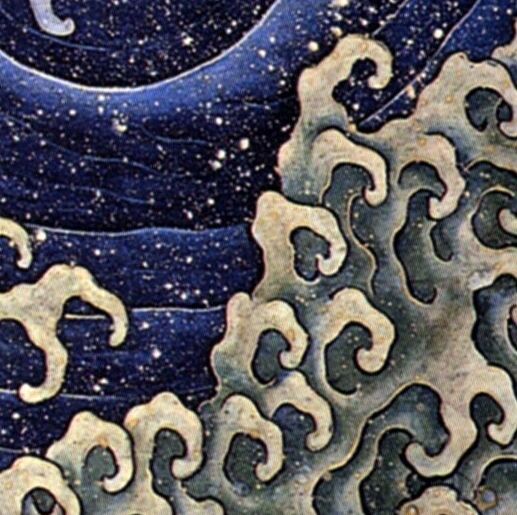
Foam crowds the edge of the field
Interlocking bubbles overlap where the dark water opens towards the edge. The dark gaps keep the curls separate as they accumulate. [1]
Explore Hokusai’s works
Discussion
Look again at the images and ideas explored in Masculine Wave by Katsushika Hokusai. These editorial prompts invite your observations.
Reader Insights
Where do you first notice the largest movement in the waves?
What happens to the wave on reaching the painted edge?
Join the Conversation
Share a detail, comparison or question about Masculine Wave by Katsushika Hokusai below.
References
- Hokusai Museum, Obuse, Kanmachi Festival Float, permanent collection record with panel dates, decoration and attributions. View source.
- Hokusai Museum, Obuse, Masculine Wave, reproduction of the Kanmachi ceiling panel via Visipix and Wikimedia Commons. View source.
- Sumida Hokusai Museum, Visual Magic: Exhibition of Masterpieces from the Hokusai Museum, Obuse, exhibition catalogue, no. 2, object title, date and support. View source.
- Hokusai Museum, Obuse, Feminine Wave, reproduction of the companion ceiling panel via Visipix and Wikimedia Commons. View source.
- The Metropolitan Museum of Art, Under the Wave off Kanagawa, JP1847, object record and reproduction. View source.
- Hokusai Museum, Obuse, Hokusai’s Evolving Waves (進化を続けた北斎の「波」), museum essay on waves in books, prints and float ceilings. View source.
- Hokusai Museum, Obuse, Hokusai’s Evolution, 2024 exhibition checklist, festival-float gallery, nos. 1–2. View source.









