


 by Tom Gurney
Tom Gurney BSc (Hons) is an art history expert with over 20 years experience
Published on June 19, 2020 / Updated on November 20, 2026
Email: tomgurney1@gmail.com / Phone: +44 7429 011000
The Lake at Hakone in Sagami Province
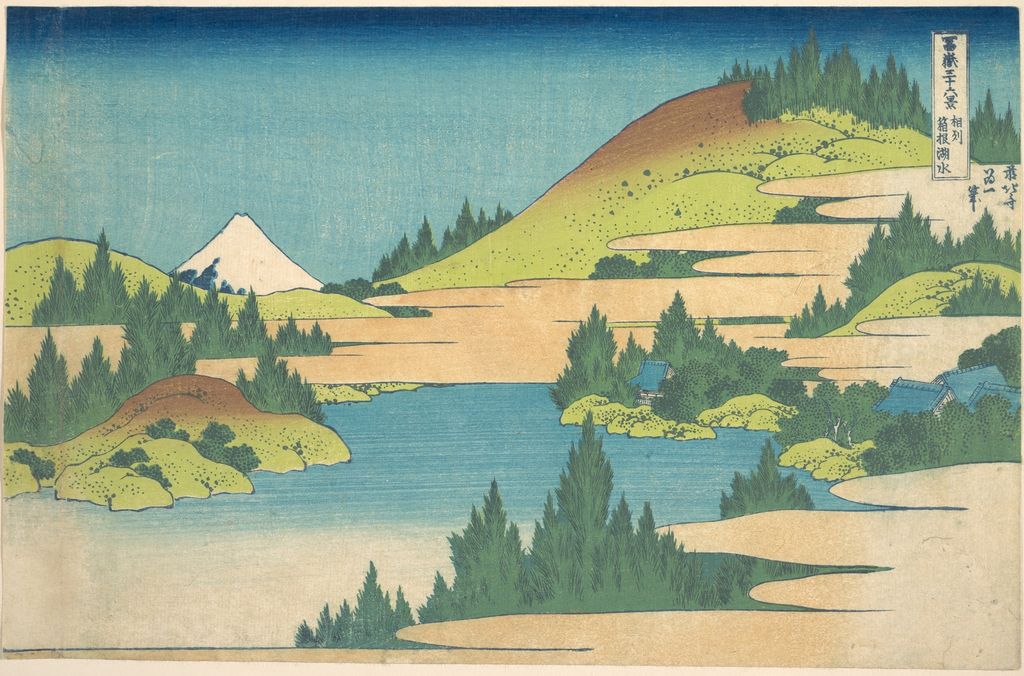
Mount Fuji rises at the left of Katsushika Hokusai’s The Lake at Hakone in Sagami Province, with a larger, wooded height climbing towards the opposite corner. A deep band of water occupies the centre and lower part of the sheet. Here and there, small roofs show through the dark trees. The Metropolitan Museum of Art dates its colour woodblock impression JP2980 to about 1830–32. The National Museum of Western Art’s checklist of the Iuchi Collection records the design as no. 29 under the Japanese title 相州箱根湖水, Sōshū Hakone kosui. [1] [2]
At a Glance
- ArtistKatsushika Hokusai
- Dateca. 1830–32
- MediumColour woodblock print
- SeriesThirty-six Views of Mount Fuji
Contents
Lake Ashi and the shrine
The Sumida Hokusai Museum identifies the water as Lake Ashi, or Ashinoko, in modern Hakone, Kanagawa Prefecture. The lake lies close to the old Tōkaidō route, where a government checkpoint regulated who could pass. The National Gallery of Victoria discusses that history in its exhibition label for the Japan Ukiyo-e Museum impression, then points to an unusual feature of the design. Hokusai shows no travellers. The gallery identifies the roofs at the water’s edge as belonging to Hakone Shrine. Their small scale makes the site easy to miss in a print whose title draws the eye to the landscape. [3] [4]
Begin on the right, where a roof with a clearly angled gable emerges among the trees. There is a lower roof to its left and a smaller, more isolated one further along the shore, near the centre of the sheet. Each is made from a few simple outlines. The dark foliage surrounds them so closely that the roofs seem to take on some of the colour of the water. In JP2980 the strongest clue that they are buildings is their geometry. Straight ends and changes of angle interrupt the irregular edges of the wooded bank, even when their blue is close to the colours nearby. [1] [4]
The roofs supply a scale for the ground behind them. What looks at first like one continuous woodland breaks into distinct places where the colour passes from blue-green trees to lighter banks and slopes. A hill rises high above the roofs, its flank broad enough to carry several long cloud forms. The print gives the shrine immediate surroundings while leaving the upper part of the hill free of built features. The eye has to make a considerable upward journey from one to the other. This is part of what gives the lake its sense of enclosure. [1]
How the ridge and clouds organise the view
The high ridge is strongest on the right. Its pale green flank rises diagonally from near the middle, turns brown towards the top, and then meets a dark crest of trees. Small flecks in the green suggest growth spread thinly across one part of the slope. The trees around the crest form distinct peaks of their own. The Sumida Hokusai Museum calls attention to the contrast between rounded mountains and sharp trees. Here the contrast is visible within a single hill, where the relatively smooth incline is interrupted by pointed silhouettes at its upper edge. [1] [3]
The distant Fuji is smaller and occupies a clear opening just above a low hill. The top of the mountain is close to the height of the longest clouds, but the space immediately above it is blue. A small dark group of trees climbs into the white area at the left base. That overlap gives the mountain depth without hiding its pointed outline. The larger ridge could easily dominate everything beside it. Hokusai keeps the white peak legible by giving it an uninterrupted stretch of sky and a tight, dark contour. [1]
The long, light shapes are part of the way the space is built. The Met’s account of impression JP17 describes the stylised stretches of cloud or mist, called suyari gasumi, as a traditional form Hokusai uses to frame the mountain. The bands are broader where they enter from the right, then narrow to rounded ends. Some cross the big ridge high up. Others break the view of the wooded slopes below it. The pattern encourages the eye to travel across the picture in stages and to notice how much distance lies between the near trees and the small summit. [1] [5]
At the bottom right, two pale intervals cut across closely packed trees. From the left bank, clumps of shrubs spread into the lake in rounder shapes than the tall trees behind them. The long sweep of the water is the most continuous horizontal in the lower half. At the far shore its upper edge is sharply defined. Near the bottom of the sheet the blue fades into a paler tone. That movement from a defined edge to a gradually lightening area makes the same body of water seem to extend from the distant shore towards the viewer. [1]
The colour at the left bank also helps distinguish land that might otherwise appear joined. The nearer rounded promontory has brown across its top, with patches of lighter foliage at the foot. Behind it a more angular line of trees rises across a light band. Follow successive breaks in the greenery and the shore turns into a series of short, overlapping edges. Along the right bank the light strips work in the opposite direction, widening on the way out of the frame. The two shores meet the water differently, and those asymmetrical edges keep the wide blue centre from reading as an unbroken rectangle. [1]
Two impressions of the same landscape
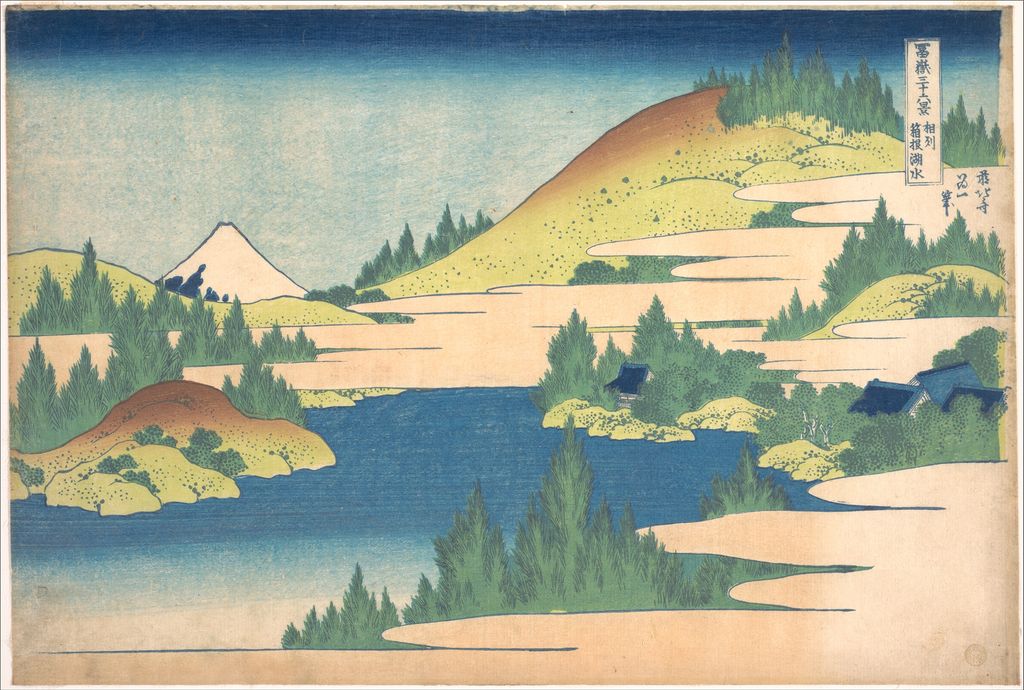
The Met gives JP2980’s dimensions as 24.8 × 37.8 centimetres. Its other impression, JP17, measures 25.7 × 38.1 centimetres and is also dated about 1830–32. The foothills, cloud bands and title cartouche occupy corresponding positions in the two sheets. So do the flecks on the high green ridge and the blue roofs near the right-hand edge. In both, a narrow band of much darker blue runs along the very top. It sets off the treetops above the brown crest while leaving more open sky around Fuji. [1] [5]
Set the photographs side by side and compare the blue immediately below that band. JP2980 shows a broad, relatively even turquoise beneath it. In the photograph of JP17 the transition continues into a lighter zone, most apparent above and to the left of Fuji. The colour in the lower part of the lake differs as well. In JP2980 a lighter turquoise unites most of the water, shading gently towards the bottom. In JP17 the upper part of the lake is a much deeper blue and the fade towards the foreground is more striking. The dark lake pulls the near strips of mist into stronger contrast. [1] [5]
The roofs also stand out more strongly in the JP17 photograph. One dark gable near the middle right is particularly clear against the shrubs. In JP2980, keeping sight of the same roof among greens and blues takes more attention. These are differences in the photographs of surviving impressions. The images let us compare how strongly colour separates the same shapes, while a sequence of printing would require further evidence. The crisp pale summit and the long cloud forms remain easy to follow in both. [1] [5]
Look at the upper right of JP2980 before turning to another design. The rectangular title cartouche sits partly against the dark trees and partly over the pale shapes below. The lettering names the lake even though the cartouche is furthest away from the largest area of water. It can be read together with the thin vertical lines of the trees, which help carry the eye from the top of the sheet down towards the roofs. [1]
Two artists at Hakone
Utagawa Hiroshige gives Lake Ashi a different role in the Hōeidō edition of his Fifty-three Stations of the Tōkaidō. The Tokyo Fuji Art Museum’s impression of The Lake at Hakone crowds a tall, multicoloured mass of rock into the centre and right. The lake runs through the left, with a distant white mountain above it. Look down from the steep ridge and the clustered figures on the right become visible. Their pace and direction give the slope a purpose. Hiroshige makes the ascent or descent part of the experience of seeing the site. [6] [7]
Hokusai’s lake is more open in the centre, so it is possible to follow the edge of the water for longer. Both artists use a large rise to make Fuji seem distant. In Hiroshige’s print, the abrupt changes of colour across the rock and the human procession draw attention to the place as a difficult stretch of the highway. In Hokusai’s view the roofs sit among the trees, and the broad, curling ends of the mist help slow a viewer’s progress across the sheet. The two titles also belong to different series. Hokusai’s design takes its place among views centred on Fuji, and Hiroshige’s names one stop along a road. [1] [6] [7]
In Hokusai’s Lake Suwa in Shinano Province, a shrine offers another way into a lake scene. The Suwa print sets a thatched structure near the lower centre, with two foreground pines cutting across the view and a boat on the open water. At Hakone, the roofs are much further back and the main ridge supplies much of the foreground’s visual weight. A reader returning to the Thirty-six Views of Mount Fuji can follow that variety across designs. Look once more for the roofs at Hakone, then for the summit at the left. The changing scale of those features gives this lake view its particular depth. [1] [4] [8]
Where this work sits in Hokusai’s career
Annotated Details from Hakone Lake in Sagami Province
The Metropolitan Museum of Art, JP2980. [1]
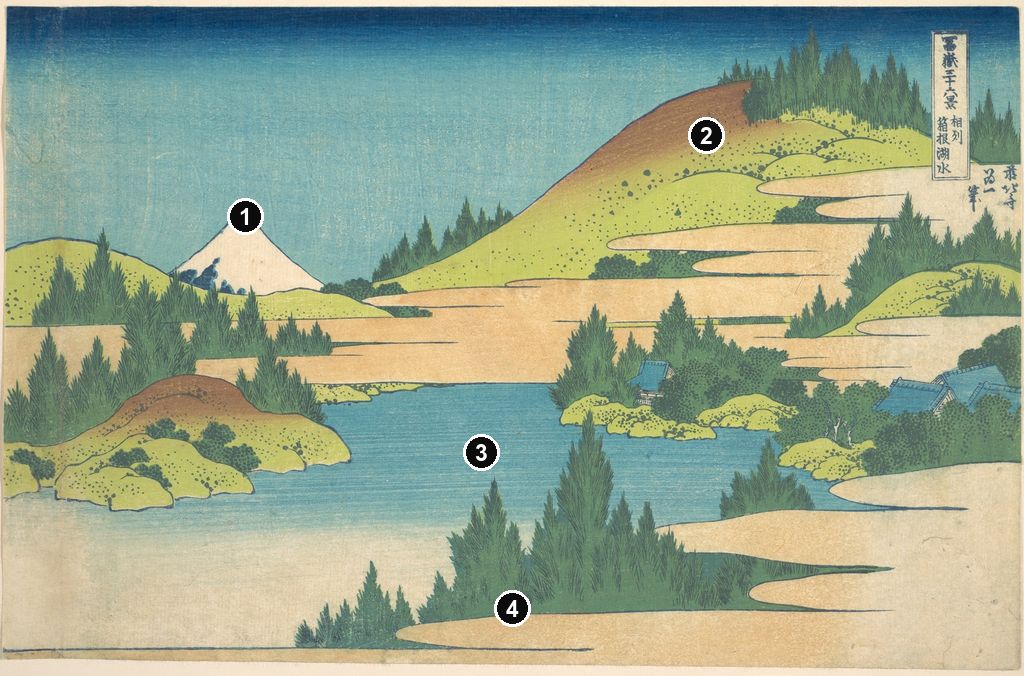
Details from HAKONE LAKE IN SAGAMI PROVINCE
Select a detail to look closely.
Fuji rises in a narrow opening
The white peak emerges behind lower forms. It is small in relation to both the hillside at right and the water below. [1]
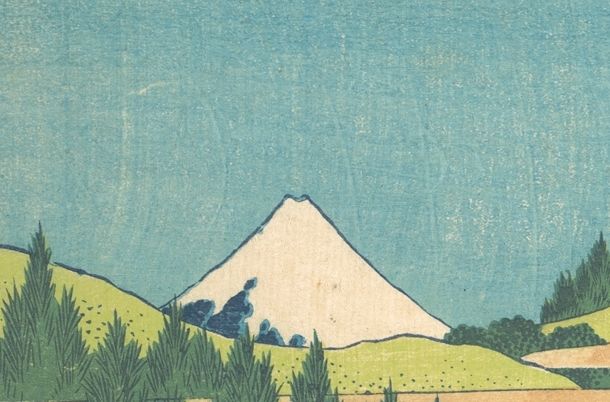
A hillside fills the right
Blocks of greens and browns lay out the slope. The broad diagonal leads from high ground towards the shore. [1]
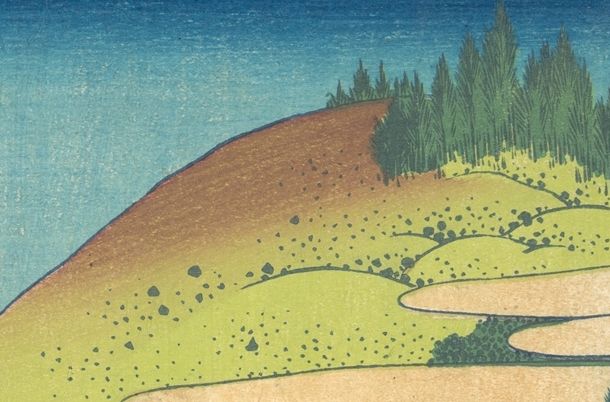
The lake opens between the wooded banks
Dark and light bands of water turn between tree-covered points. They separate the shores across the picture. [1]
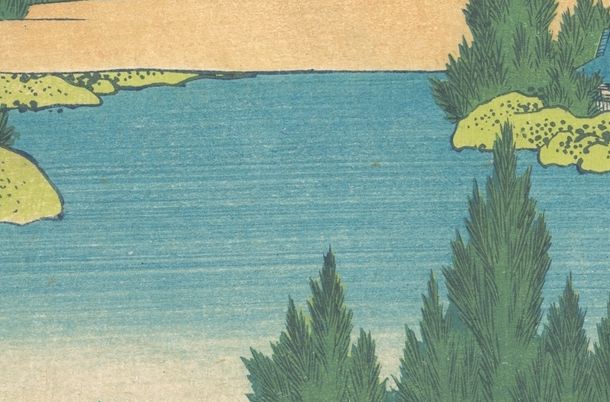
Tall trees stand on a strip of land
The sharply cut profiles repeat at several distances. The near silhouettes are larger and more distinct. [1]
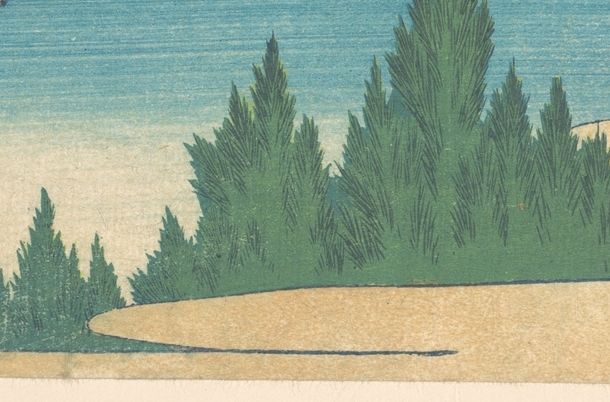
Explore Hokusai’s works
Discussion
Look again at the images and ideas explored in The Lake at Hakone in Sagami Province. These editorial prompts invite your observations.
Reader Insights
How do the trees divide the near shore from the far one?
Which shapes lead towards the small white peak?
Join the Conversation
Share a detail, comparison or question about The Lake at Hakone in Sagami Province below.
References
- The Metropolitan Museum of Art, The Lake at Hakone in Sagami Province (Sōshū Hakone kosui), impression JP2980, collection record and photograph. View source.
- National Museum of Western Art, Iuchi Collection exhibition checklist, no. 29, 相州箱根湖水. View source.
- Sumida Hokusai Museum, 冨嶽三十六景 相州箱根湖水, collection record and Japanese commentary. View source.
- National Gallery of Victoria, Hokusai large-print exhibition labels, Lake of Hakone in Sagami Province and Lake Suwa in Shinano Province. View source.
- The Metropolitan Museum of Art, The Lake at Hakone in Sagami Province (Sōshū Hakone kosui), impression JP17, collection record, photograph and cloud-form commentary. View source.
- Tokyo Fuji Art Museum, Utagawa Hiroshige, Fifty-three Stations on the Tokaido: The Lake at Hakone, collection record 04331 and photograph. View source.
- Town of Hakone, Japanese historical plan, section on woodblock prints of the old road, showing both Hakone designs and identifying the Hōeidō edition. View source.
- The Metropolitan Museum of Art, Lake Suwa in Shinano Province (Shinshū Suwako), impression JP2965, collection record and photograph. View source.







