


 by Tom Gurney
Tom Gurney BSc (Hons) is an art history expert with over 20 years experience
Published on June 19, 2020 / Updated on November 20, 2026
Email: tomgurney1@gmail.com / Phone: +44 7429 011000
Tatekawa at Honjō
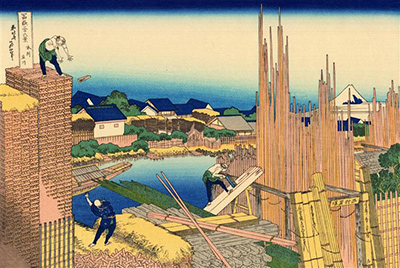
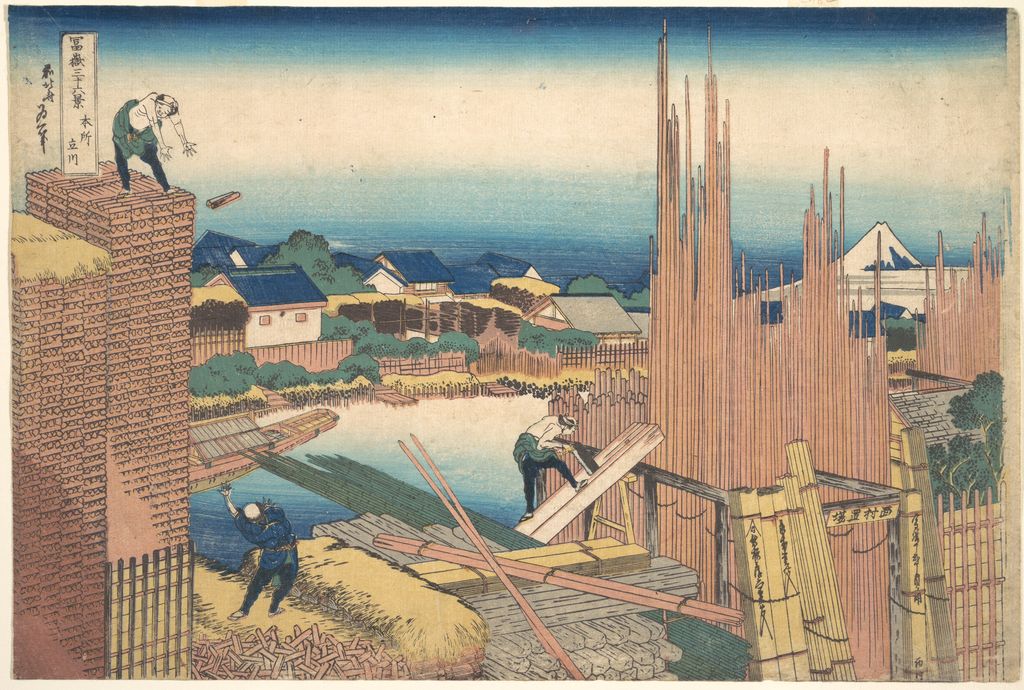
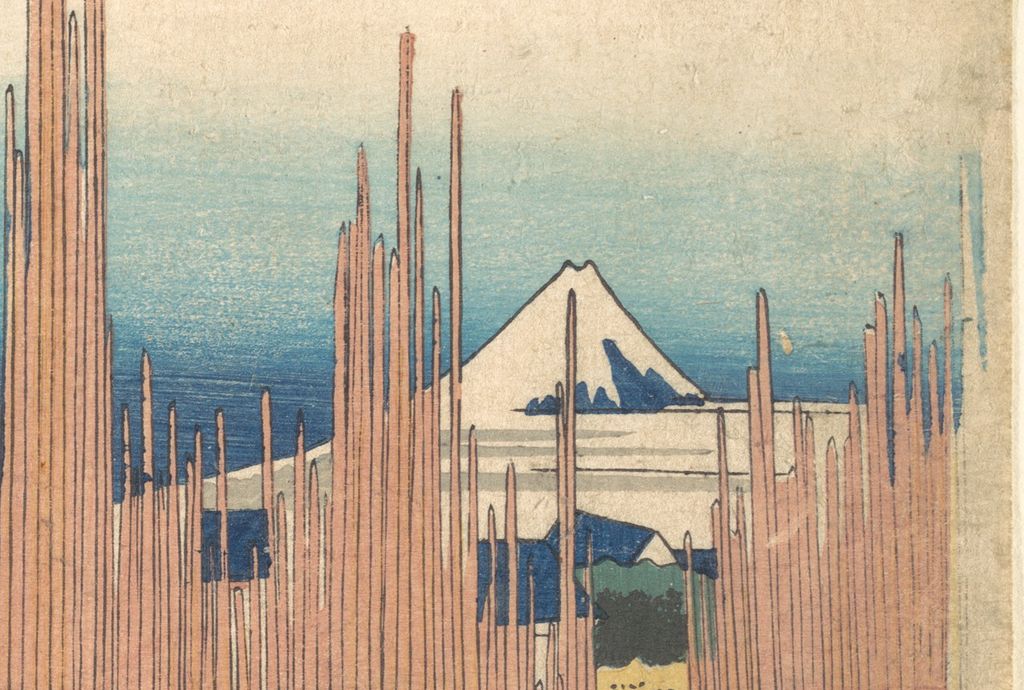
A short piece of wood hangs in the air above a timberyard in Katsushika Hokusai’s Tatekawa at Honjō. The man who has just thrown it stands on a tall stack at the left. Another worker waits below, reaching up beside the water. Farther right, a sawyer bends over a slanting plank. Beyond him, through the uprights of the yard, the white top of Mount Fuji emerges above the roofs. All this activity takes place between two accumulations of wood, each of which nearly reaches the upper edge of the sheet. The opening between them lets us see across the canal and into the distance. [1]
The Metropolitan Museum of Art dates its impression JP2982 to about 1830–32. The colour woodblock print measures 25.6 by 38.1 centimetres. Its Japanese title, 本所立川, names Tatekawa in Honjō, an area of Edo. The place matters because the people who work there give this view of Fuji its particular shape. The upright stock screens part of the mountain, while the work itself makes us look up the stack, down towards the bank and back across the water. In this sheet from Thirty-six Views of Mount Fuji, seeing the summit means looking through the spaces of a working yard. [1] [2]
At a Glance
- ArtistKatsushika Hokusai
- Dateca. 1830–32
- MediumColour woodblock print
- SeriesThirty-six Views of Mount Fuji
Contents
Three ways of handling timber
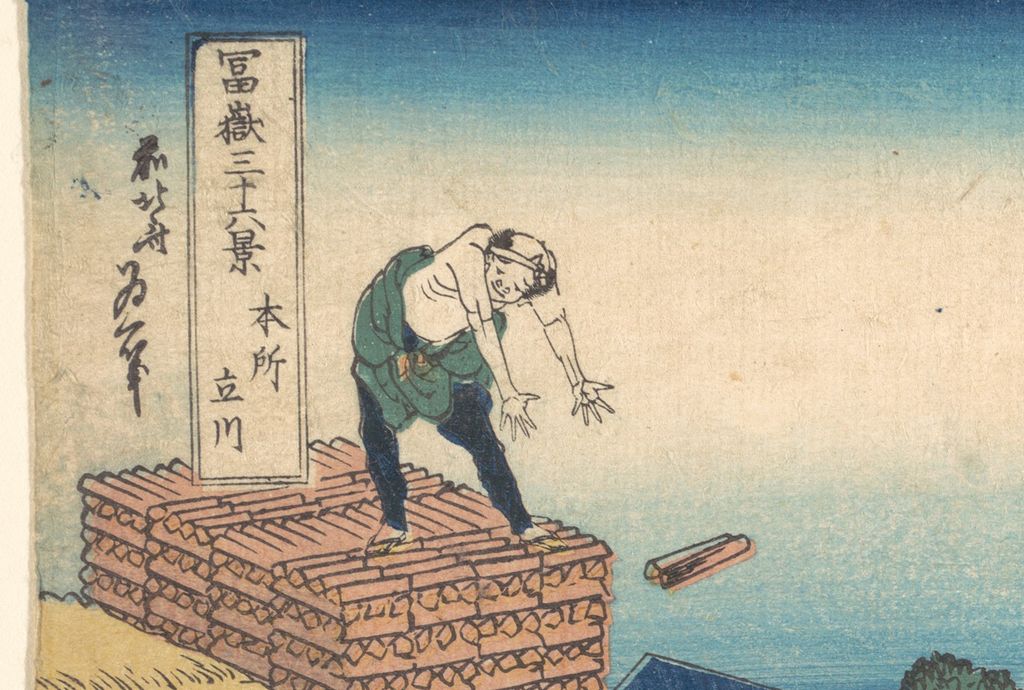
Start with the worker on the upper left. The pieces below his feet repeat in rows, with small dark outlines around their ends. That pattern keeps the pile building upwards even as the man leans out over the edge. The airborne piece departs from the pattern. It is isolated against the sky, short enough to identify as one part of the much larger stock. The worker’s bent legs and lowered arms show the movement at its point of release. Look down again and the stack turns into a measure of the distance through which the piece must fall. [1]
The man below handles the same action from another position. His body rises against a narrow opening between the stack and the sawyer’s part of the yard, and his raised arm breaks its profile. The water behind him provides a relatively uncluttered field for the gesture. The Tokyo Fuji Art Museum identifies the two workers as throwing and receiving wood. Hokusai has spaced them far apart vertically, with the piece of wood near the upper man. Our eye completes a movement that the print can only show at one moment. [1] [3]
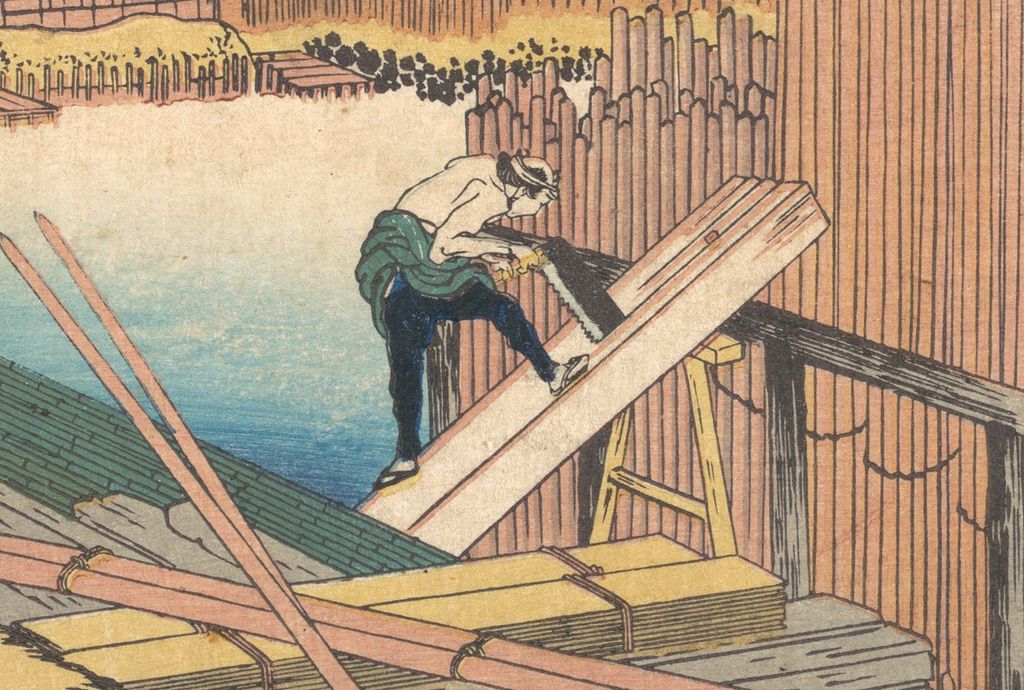
The sawyer nearer the middle stands beside boards at another angle. He bends over his work and brings his hands together at the inclined plank. Long straight edges surround him, while the bent upper body makes a short interruption in those lines. Below the plank, offcuts and longer pieces lie across each other. Following the raised board back into that lower group makes the work look continuous. Material is stacked, passed and cut within a few strides. The three figures divide the scene into tasks, each legible by the scale of the wood and the position of the body. [1] [3]
The worker in In the Mountains of Tōtōmi Province also bends to cut wood. In that print, a beam crosses the whole composition on a steep diagonal, and the supports beneath it frame the distant mountain. Here the diagonal plank belongs to a yard full of tall, straight stock. The space between the timber piles makes the water visible, while the upright pieces at right begin to screen the view again. Seeing the two prints together shows how Hokusai gives different visual consequences to similar labour. A single beam sets the principal direction in Tōtōmi. At Honjō, attention passes repeatedly between the people, the horizontal canal and the vertical stock. [1] [4]
The canal between the yard and the roofs
The Sumida Hokusai Museum identifies Tatekawa with the vicinity of the present-day Katagawa canal in southern Sumida and describes timber wholesalers along the water. It places Honjō Warigesui, where Hokusai grew up, nearby. Its account gives some specificity to a print whose title names the locality without detailing the occupations. The Met’s account also locates the yard by the canal. In the image, the proximity is visible in the way the shoreline turns just beyond the workers. Open water begins behind a stack of boards and runs straight into a different set of buildings across the view. [1] [2]
On the far bank, low roofs and fences extend across the middle of the paper. Darker foliage rises behind and between them. The roof slopes and uneven clumps of green give that shore its own rhythm, gentler than the rapid repetition of cut ends on the left or narrow, almost parallel uprights on the right. The pale surface of the canal is broad enough to keep the far bank distinct. Look across it from the receiving worker and several horizontal bands become easy to follow. Look towards the sawyer and the tall boards take over. The position of the eye keeps changing even though the foreground is crowded into a fairly narrow space. [1]
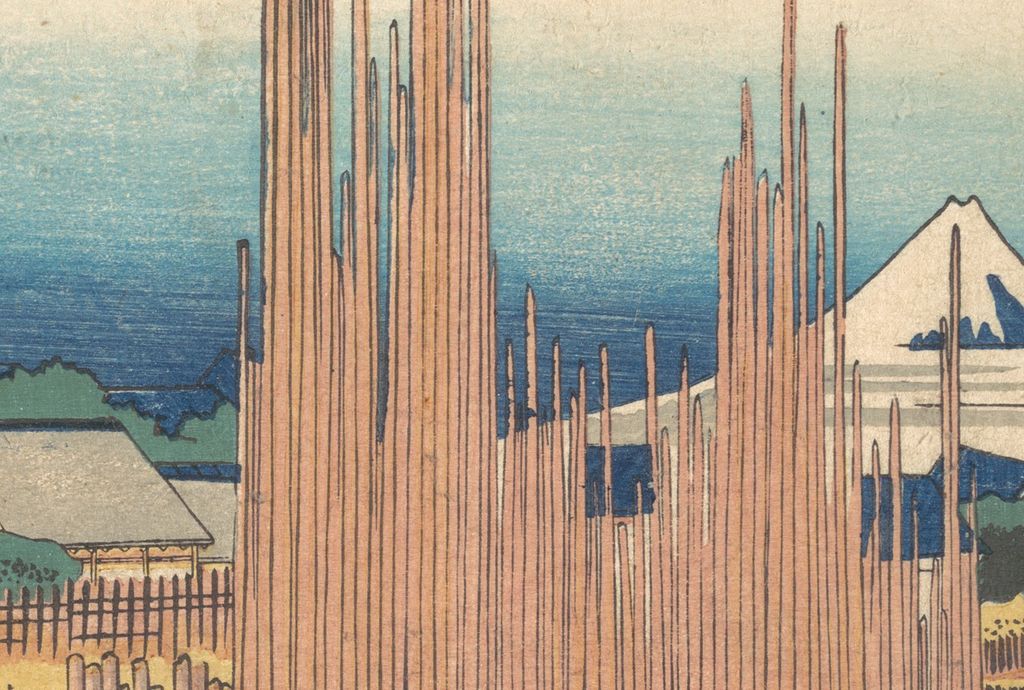
Fuji forms a small light triangle near the right of the print. Its near side begins above the dark run of roofs, but tall pieces of timber interrupt the surrounding view. Look at one of those poles and it seems to extend much farther through the sky than the mountain can. Follow the pale edge of the peak and the relation reverses. The poles are close enough to obscure a landscape far larger than the yard. Since the peak is only a small element in an opening, its whiteness and spare contour do more work than a detailed description of its slopes would. [1]
At the near edge of the canal, long boards project into the pale opening from the left. Short dark strokes along their ends separate them from the water. Across the channel, a fence runs horizontally without the same interruptions. These two edges, one projecting and the other receding, make it possible to read the width of the water between them. [1]
Writing on the wood
The lower right is another place to slow down. In front of the upright stock, boards and a frame carry dark lines of writing. From a distance the lettering stays part of the yard. Up close it yields clues to the business that published the print. The Met reads references to Nishimura’s storehouse, the stock of Eijudō and the new edition of the Fuji views. The MOA Museum of Art also reads an address at the corner of the second block of Bakurochō. These inscriptions place the publisher’s name and stock inside a scene about goods being stored and worked. Meanwhile the tall title cartouche and Hokusai’s signature sit apart at the upper left, beside the man on the stack. [1] [5]
The Bibliothèque nationale de France identifies Eijudō as Nishimuraya Yohachi in the record for its impression, which it dates approximately 1831–34. That record also gives the designer’s signature in Japanese as 前北斎為一筆. The identity of the publisher comes from documents such as these as well as the lettering in the picture. The wood carries writing that can be looked at as part of the design in its own right. Its lines follow the shapes of the boards and the angle of the frame. That physical placement gives the advertisement much of its wit. A reference to the print series appears inside a picture the series’ publisher is selling. [1] [5] [6]
Looking at two impressions
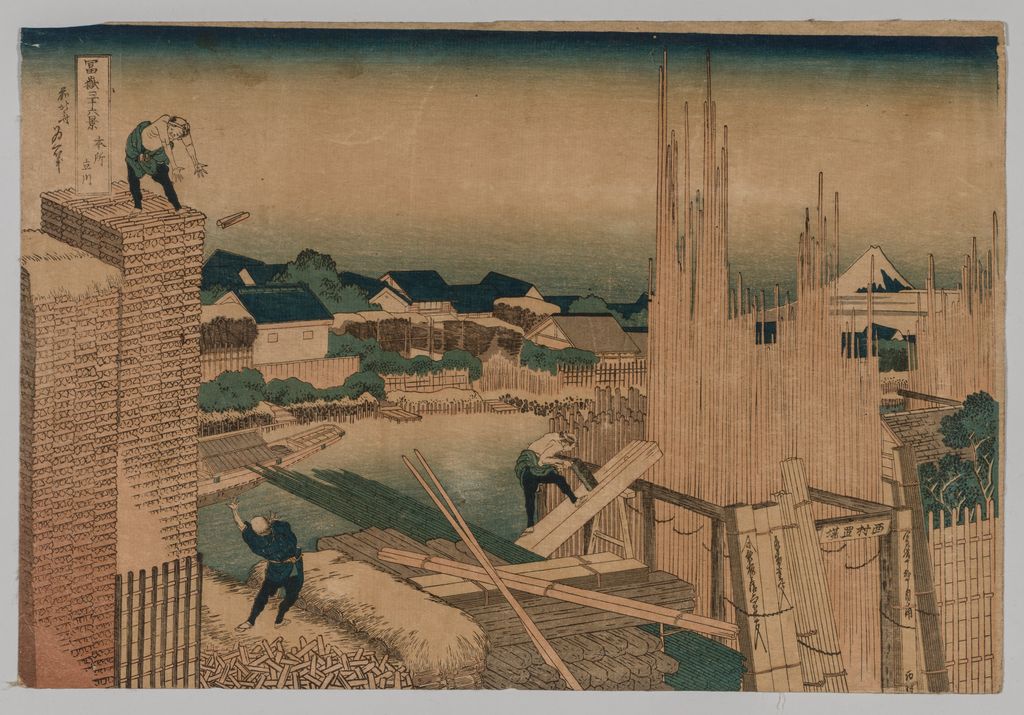
The Met’s JP1285 measures 24.8 by 35.9 centimetres. Its online photograph shows the same raised stack, three men and opening towards Fuji as JP2982. After looking at one impression, it is possible to find the loose piece of wood immediately in the other. Small places are particularly useful for comparison. The dark gap between the thrower and the top of the boards, the slant of the sawyer’s work and the tips of the tallest timbers all recur. Those features establish where to look before the eye begins following the larger areas of colour. [1] [7]
The two photographs give different weight to those areas. In JP2982 the blue band at the top is dark and becomes lighter towards the broad strip of open sky. In JP1285 it appears thinner and more blue-green. The tall timber at right is also comparatively pale in the latter photograph, leaving the grain-like lines and edges clearer against the sky above the roofs. In both, another band of blue lower down picks out the distant shore. Thickness and intensity in one band can change how strongly the eye separates the open sky from that lower distance. The images show the differences in appearance. A printing sequence or explanation for every change in colour would require other evidence about the sheets and their history. [1] [7]
The Iuchi Collection exhibition checklist includes another impression under Tatekawa in Honjo, no. 44. That title describes one design with several surviving sheets. Their differences give us reasons to return to the parts of the view that remain steady. Start with the corner of the stack, follow the piece of wood into the air and then cross to the pale mountain between the boards. The route through the picture takes in a hand movement, distances across the water and the opening between two pieces of timber. Hokusai makes each of those intervals large enough to notice, even in a place full of people and things. [1] [7] [8]
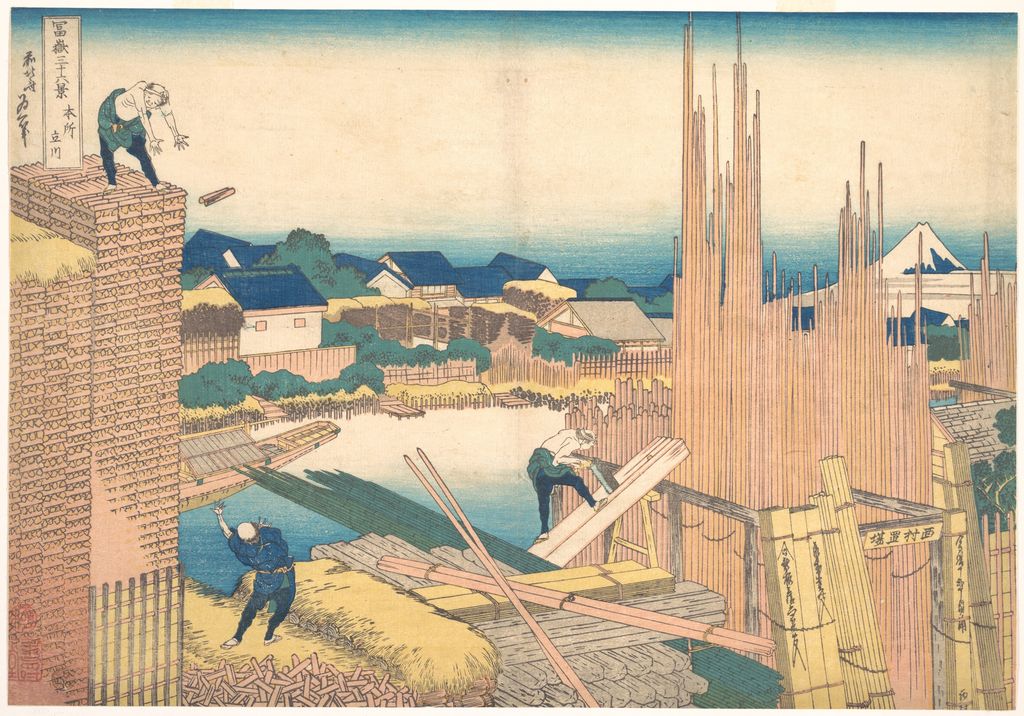
Image comparison
Where this work sits in Hokusai’s career
Annotated Details from Tatekawa at Honjo
The Metropolitan Museum of Art, JP2982. [1]
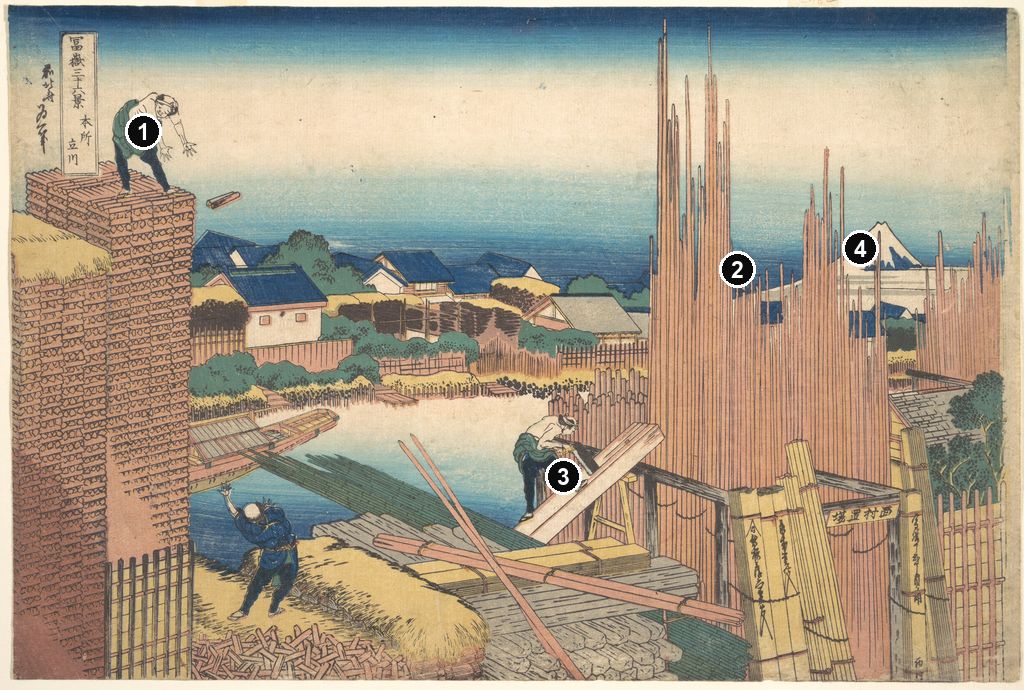
Details from TATEKAWA AT HONJO
Select a detail to look closely.
A worker stands high among the timber
The figure occupies a small, exposed place above the lower buildings. The stacked wood supplies a clear measure of height. [1]
Tall boards divide the opening
The uprights form a screen, leaving narrow openings through to the buildings and sky. [1]
A sloping board crosses the near yard
The long piece runs diagonally through the packed timber. A nearby figure helps set its scale. [1]
Fuji makes a small break in the horizon
The mountain appears briefly in an opening among straight edges. Its short slopes contrast with the large vertical boards. [1]
Explore Hokusai’s works
Discussion
Look again at the images and ideas explored in Tatekawa at Honjō. These editorial prompts invite your observations.
Reader Insights
Which stacks of timber guide you towards the tiny mountain?
Where can you distinguish a worker from the outlines of the wood?
Join the Conversation
Share a detail, comparison or question about Tatekawa at Honjō below.
References
- The Metropolitan Museum of Art, Tatekawa in Honjō (Honjō Tatekawa), accession JP2982, object record and photograph. View source.
- Sumida Hokusai Museum, Thirty-six Views of Mount Fuji: Tatekawa at Honjo (冨嶽三十六景 本所立川), Japanese collection commentary. View source.
- Tokyo Fuji Art Museum, Thirty-six Views of Mount Fuji: Timberyard at Honjo, object 06279 and Japanese curatorial description. View source.
- The Metropolitan Museum of Art, In the Mountains of Tōtomi Province (Tōtomi sanchū), accession JP2966. View source.
- MOA Museum of Art, Hokusai: Thirty-six Views of Mount Fuji Digital Remix, entry for 本所立川 and transcription of the publisher’s advertisements. View source.
- Bibliothèque nationale de France, Honjo Tatekawa (本所立川), catalogue record of signature and publisher. View source.
- The Metropolitan Museum of Art, Tatekawa in Honjō (Honjō Tatekawa), accession JP1285, object record and photograph. View source.
- National Museum of Western Art, Tokyo, Hokusai: Thirty-six Views of Mt. Fuji, Iuchi Collection exhibition checklist, no. 44. View source.







