


 by Tom Gurney
Tom Gurney BSc (Hons) is an art history expert with over 20 years experience
Published on June 19, 2020 / Updated on November 20, 2026
Email: tomgurney1@gmail.com / Phone: +44 7429 011000
Yoshida on the Tōkaidō
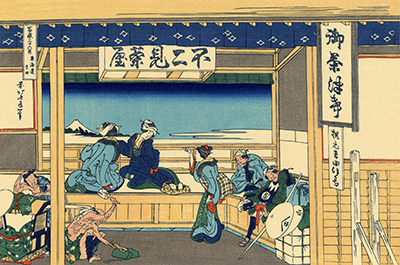
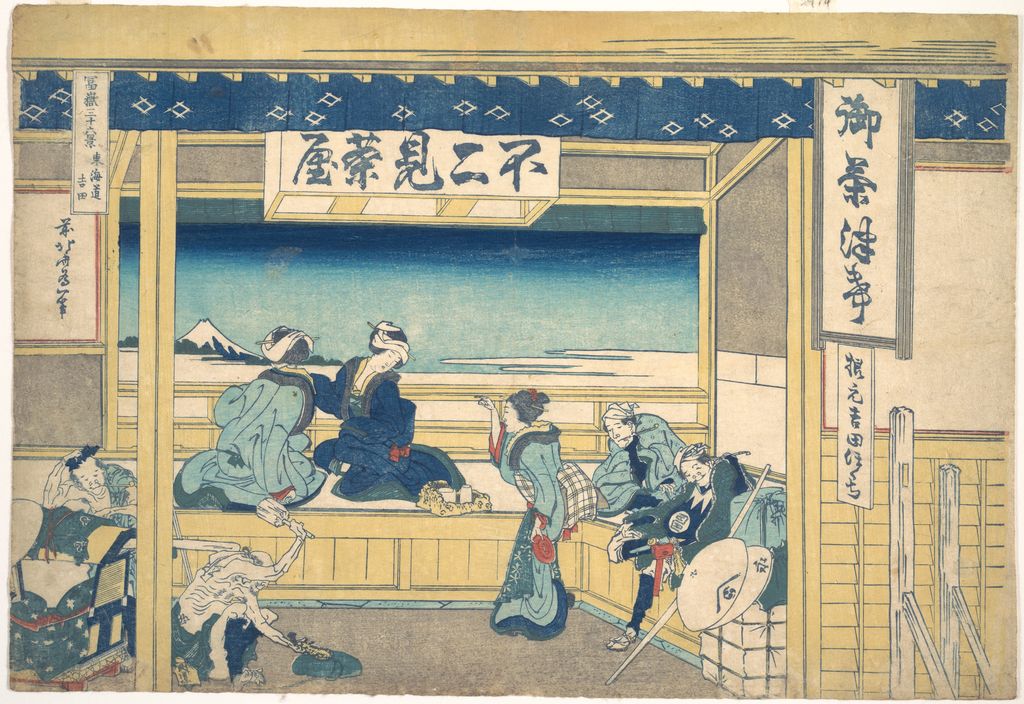
Above the heads of travellers in Katsushika Hokusai’s Yoshida on the Tōkaidō hangs a board announcing a view of Mount Fuji. The mountain occupies a small corner of the opening behind them. A woman raises her hand towards it, while a man close to the foreground lifts a mallet over a sandal. The teahouse’s boards, beams and partitions are nearly as conspicuous as the people inside it. The Met dates its colour woodblock impression JP2974 to about 1830–32. The National Museum of Western Art lists the design as item 25 in its Iuchi Collection exhibition checklist, under the title 東海道吉田. [1] [2] [3]
At a Glance
- ArtistKatsushika Hokusai
- Dateca. 1830–32
- MediumColour woodblock print
- SeriesThirty-six Views of Mount Fuji
Contents
An advertised view at a post town
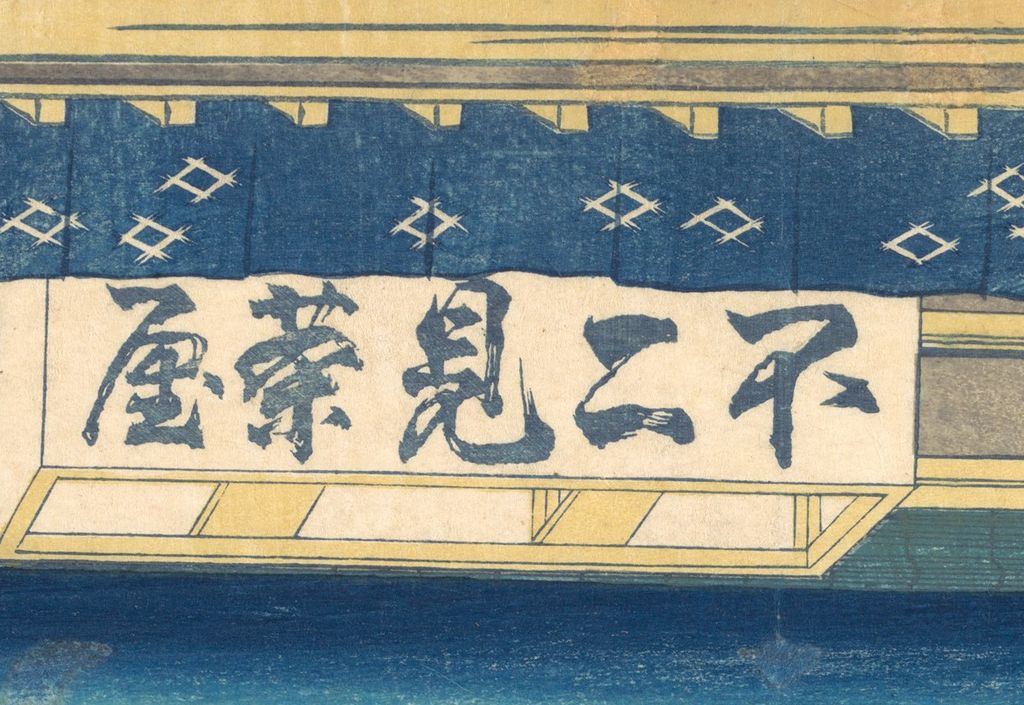
The large sign under the eaves reads 不二見茶屋, Fujimi chaya, or Fuji View Teahouse. The characters read from right to left across the board. Their dark, broad strokes have room to spread across a surface roughly parallel to the viewer. The picture’s tall title cartouche is much smaller and sits on a post at the upper left. Once you have found both inscriptions, you can see that the name of the teahouse belongs to the building and the title to the print. The name hangs just over the opening that fulfils its promise. [1] [3] [4] [10]
The Yoshida in the title was a post town on the road between Edo and Kyoto, in what is now Toyohashi in Aichi Prefecture. Toyohashi City records the town’s development along the Tōkaidō near Yoshida Castle. Its guide places the station thirty-fourth from Nihonbashi in Edo and describes shops and townhouses lining parts of the route. The town had its own traffic and trades, as is apparent from historic district names recorded by the city, including names linked to fish, textiles and metalworking. Hokusai concentrates the activity of that road into a single stop. The title gives the post town, and the arrangement of the room tells you what kind of place he wants you to notice there. [2] [4] [5]
The smaller boards on the right bring a second purpose to the room. Tokyo Fuji Art Museum reads the larger of the pair as advertising ochazuke, rice served with tea, and the strip beneath it as advertising Yoshida hokuchi. The latter was tinder, a local speciality used to catch a spark from a flint. The rice and tinder point to two different needs, one met at the stop and one a traveller might carry away. On the sheet the two boards hang where a person approaching the entrance could see them. The advertised mountain, the food and the tinder all belong to the same short stretch of frontage. [1] [6]
What the room lets you see
A dark strip of fabric with small pale diamonds runs almost the whole width of the upper part of the print. Below it, a post rises close to the left edge of the view and another divides the opening from the wall on the right. The central sign extends down from the first bank of crossbeams. Farther down, the low sill sets an abrupt limit to the landscape. Look at the broad, still bands of sky within these edges. They are long enough for the mountain to stand apart from the dark hats and garments in the room even though its summit rises only slightly above them. [1]
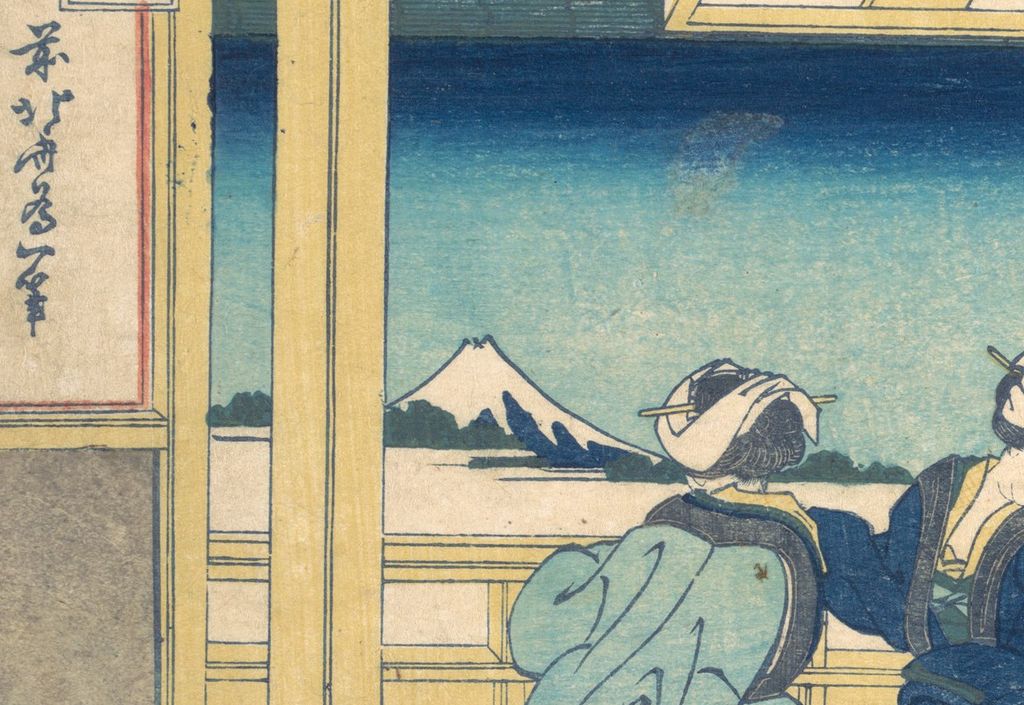
The mountain sits towards the left end of the opening. A small point of white catches the eye first, and then an irregular blue-green strip below it makes the slope easier to follow. At right the blue of the sky gives way to long pale shapes that extend in from the edge. Almost everything between the building and the distant peak has been reduced to a few low strips. The Ōta Memorial Museum of Art likens the effect of the wide rectangular opening to a picture frame. Hokusai’s choice to set the mountain near one end keeps that rectangle open for the gestures and the clothing that overlap it. [1] [7]
The floor makes the building feel deeper than the opening alone would suggest. At right, straight lines on the wall and along the seating turn inwards. Across the centre, the raised platform shows a face of narrow vertical boards. A corner of flooring carries those lines around the feet of the standing woman and back towards the entrance. The Met sees a triangular arrangement of figures echoing the shape of Fuji. The room supplies the long straight divisions, and the figures give the little peak a second set of shapes to answer. [1] [3]
Looking out and taking a rest
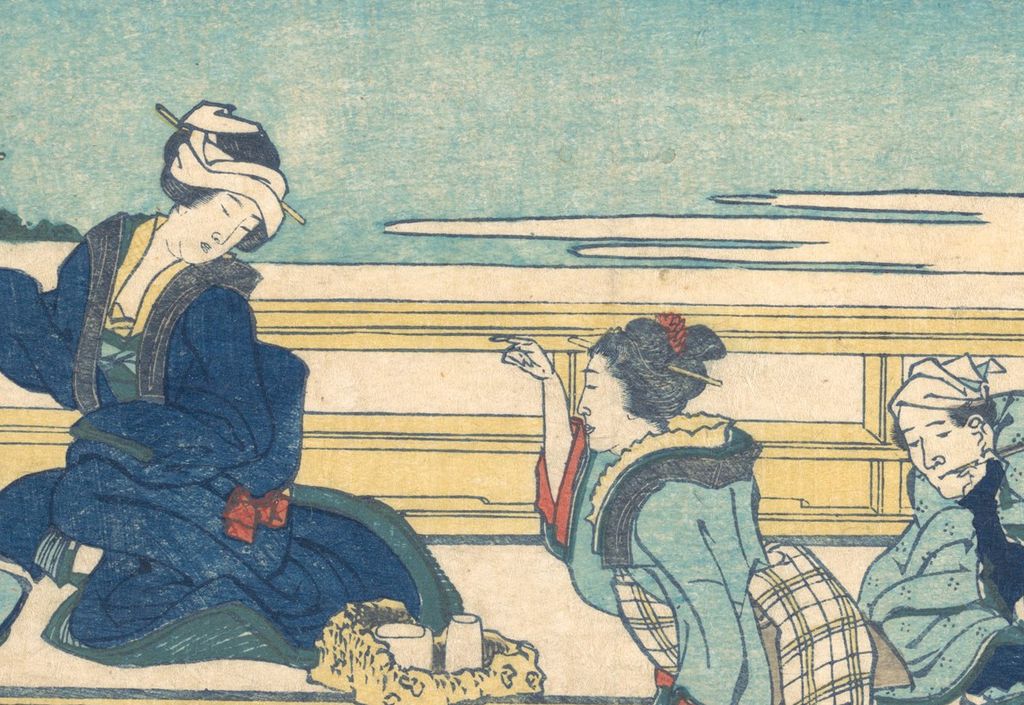
The two seated women are close enough to the window to interrupt its lower edge. One turns away from us, her broad light robe falling across the platform, and the other inclines her head towards the standing woman. The Ōta museum reads the standing figure as a teahouse attendant describing the view. Her hand rises near the sill, in front of the pale lower strip of the landscape. Follow the direction of her fingers towards the left and Fuji becomes the end of a gesture as well as the point reached by looking through the opening. [1] [7]
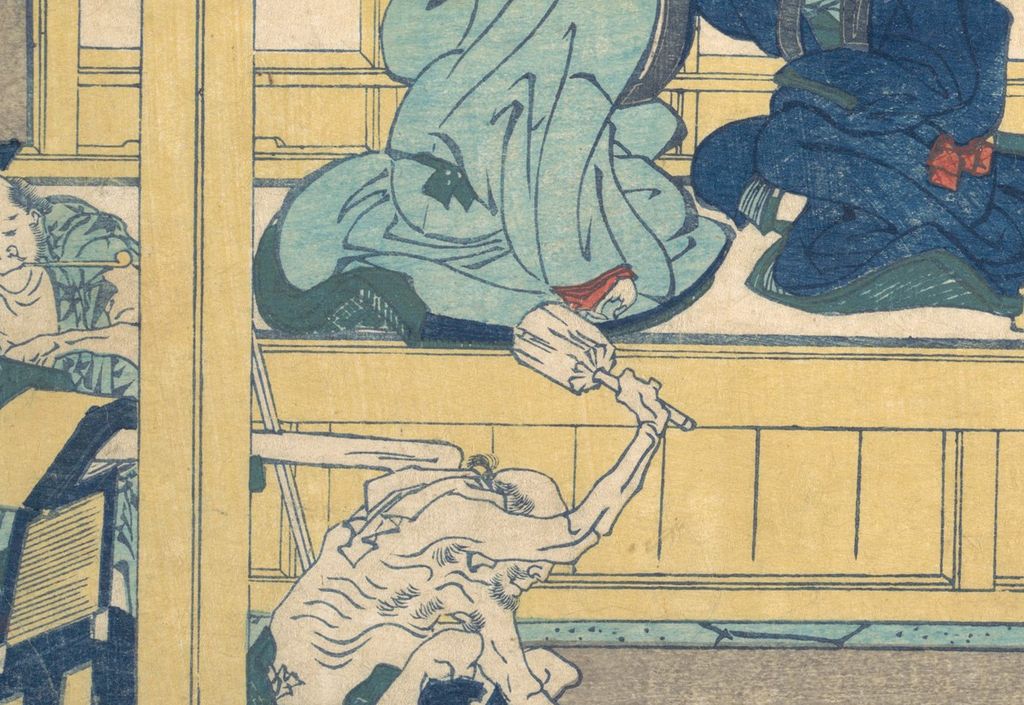
At the lower left a figure crouches and raises a short mallet. Tokyo Fuji Art Museum and a Met bulletin both identify the object under his other hand as a straw sandal and explain that he is softening it. Above him another traveller leans against a bundle. On the right the round hat, tied load and long pole lie close to the resting men. The hard-to-miss angle of the pole cuts through all the upright and horizontal lines of the building. These objects are visible at the point where the travellers have stopped long enough to set down their loads and tend to their gear. [1] [6] [8]
The Shimane Art Museum draws attention to the difference between the women interested in the mountain and the men who appear tired. Hokusai gives the difference a visible form. The hand that directs attention to Fuji rises open and poised above the seated figures. The hand holding the mallet works down towards the floor. At both sides the dropped shoulders and bent heads follow the surfaces of the bench and the luggage. The gestures set different speeds within the room, from a quick indication to a period of occupation and rest. [1] [4] [8]
A small pale vessel sits on the raised floor between the woman in the dark robe and the standing attendant. Around it, the fabric and other small objects form an uneven mass against the straight rim of the platform. The print shows several kinds of closeness within the same space. The visitors at the opening gather near enough to hear the attendant. The worker at lower left bends much closer to the object in hand, and the travellers at right are so near the wall and their packs that the forms begin to overlap. The opening gives these clustered figures a long view out of the room. [1]
Two impressions of the teahouse
The Met dates JP2974 and JP1324 to the same period. It lists JP2974 at 26.4 × 38.4 centimetres and JP1324 at 25.7 × 38.7 centimetres. The two photographs agree closely on the alignment of the window, the hanging signs and the figures. Compare the strip at the bottom of the opening. In JP2974 it appears creamier and merges more gradually into the blue, while in JP1324 its edge against the turquoise looks firmer. The lower floor looks darker in the photograph of JP2974. In JP1324 it is a lighter, more even patch beside the dark hems and the grey shadows near the walls. [1] [3]
At the lower right of JP1324 there is a faint circular mark near the foot of the wall. That mark is easier to spot than any corresponding circle in the JP2974 photograph, especially when you look along the pale edge just left of the angled rail. The dark passages at the top of the opening and across the fabric still divide the image in much the same way in both impressions. These visible differences help you distinguish the sheets. The catalogues share a date range, and the photographs alone leave the order of printing open. [1] [3]
Another teahouse in the Fuji series
Morning after the Snow at Koishikawa in Edo uses a similar gesture in a different arrangement. The Met identifies a waitress showing visitors the mountain from a balcony. The building gathers the figures to one side and the mountain rises across a broad winter landscape. At Yoshida the window gives the landscape its own shape within the building. The effect of the Yoshida composition is especially easy to see by following the line around the opening. As soon as it is closed by the post and the sill, a distant peak becomes a sight the people inside can share. [1] [9]
The Thirty-six Views of Mount Fuji include many situations in which a mountain comes into view as part of a day’s work or journey. The advertised view at Yoshida attracts just some of the people in the room. The other figures and the worn things around them tell us what it costs in effort to reach a place and why a pause matters. Look once more from the lifted hand to the white point at the edge of the opening, then down to the sandal. Hokusai has put a traveller’s need to rest and a visitor’s pleasure in looking within a few inches of paper. [1] [4]
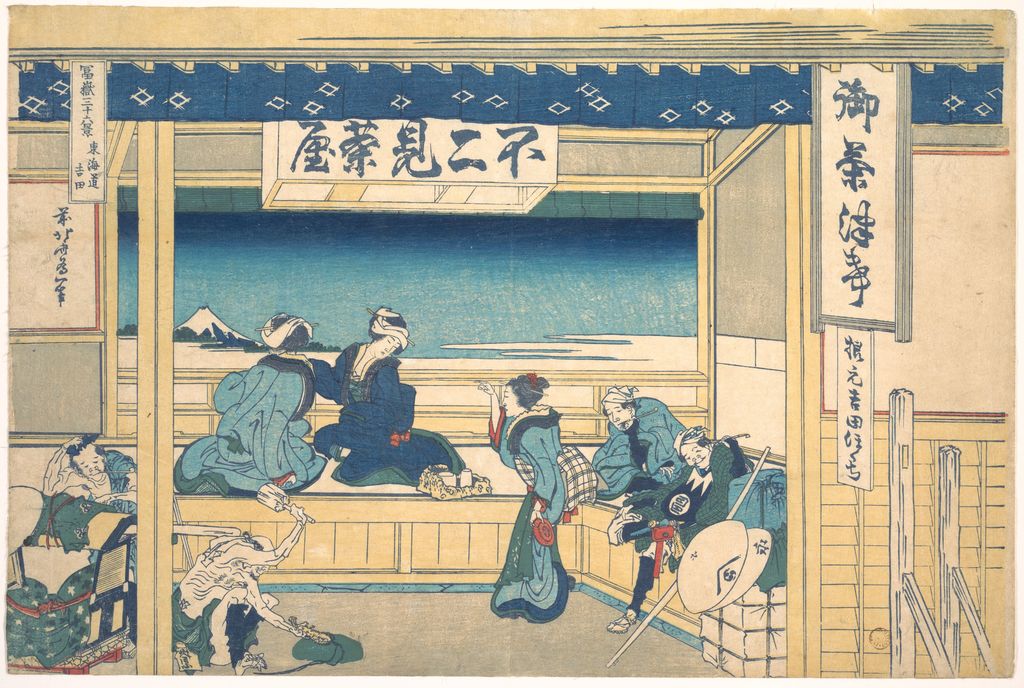
Image comparison
Where this work sits in Hokusai’s career
Annotated Details from Yoshida on the Tōkaidō Road
The Metropolitan Museum of Art, JP2974. [1]
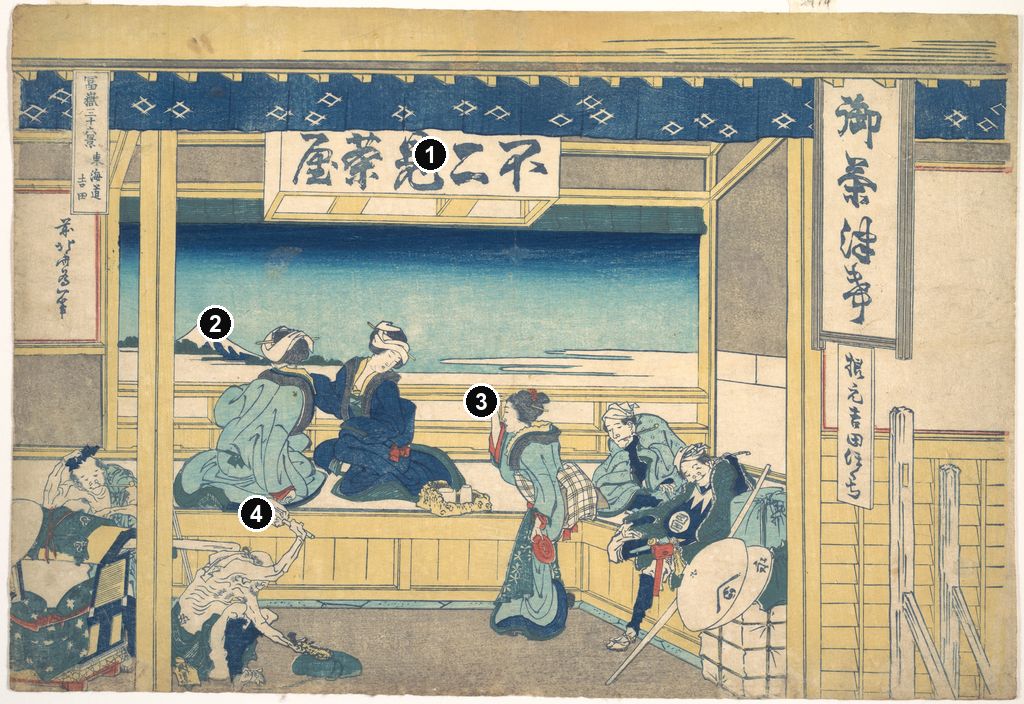
Details from YOSHIDA ON THE TŌKAIDŌ ROAD
Select a detail to look closely.
A sign hangs over the opening
The horizontal panel makes the view of Fuji part of the identity of the teahouse. [1]
The room frames the mountain
Fuji appears in the open band behind the people, between the long support and the roof edge. [1]
A raised hand directs attention outwards
One gesture carries the eye from the people in the room out towards the landscape. [1]
Repair work takes place near the floor
The lower part of the print holds a small action close to the wooden threshold. [1]
Explore Hokusai’s works
Discussion
Look again at the images and ideas explored in Yoshida on the Tōkaidō. These editorial prompts invite your observations.
Reader Insights
Where do the edges of the room frame Fuji?
Which traveller or worker do you notice first?
Join the Conversation
Share a detail, comparison or question about Yoshida on the Tōkaidō below.
References
- The Metropolitan Museum of Art, Yoshida on the Tōkaidō (Tōkaidō Yoshida), impression JP2974, collection record and photograph. View source.
- National Museum of Western Art, Iuchi Collection exhibition checklist, item 25, Yoshida on the Tokaido Highway. View source.
- The Metropolitan Museum of Art, Yoshida on the Tōkaidō (Tōkaidō Yoshida), impression JP1324, collection commentary and photograph. View source.
- Shimane Art Museum, A tea house at Yoshida on the Tōkaidō road, Nagata Seiji Collection, Japanese collection commentary. View source.
- Toyohashi City, Yoshida-juku historical guide and map. View source.
- Tokyo Fuji Art Museum, Yoshida on the Tokaido Road, record 06145, Japanese collection commentary. View source.
- Ōta Memorial Museum of Art, Hokusai and His Rivals, online exhibition commentary, object 6. View source.
- The Metropolitan Museum of Art, Hokusai, Bulletin 43, no. 1 (1985), commentary and illustration of JP1324, pp. 42–43. View source.
- The Metropolitan Museum of Art, Morning after the Snow at Koishikawa in Edo, impression JP2957, collection commentary and photograph. View source.
- Sumida Hokusai Museum, Yoshida on the Tōkaidō Road, Japanese collection commentary, record 854. View source.







