


 by Tom Gurney
Tom Gurney BSc (Hons) is an art history expert with over 20 years experience
Published on June 19, 2020 / Updated on November 20, 2026
Email: tomgurney1@gmail.com / Phone: +44 7429 011000
Sekiya Village on the Sumida River
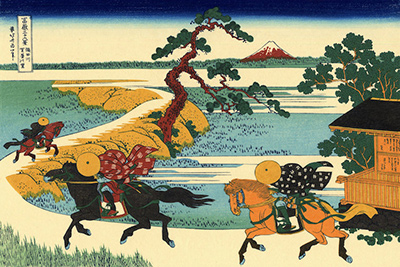
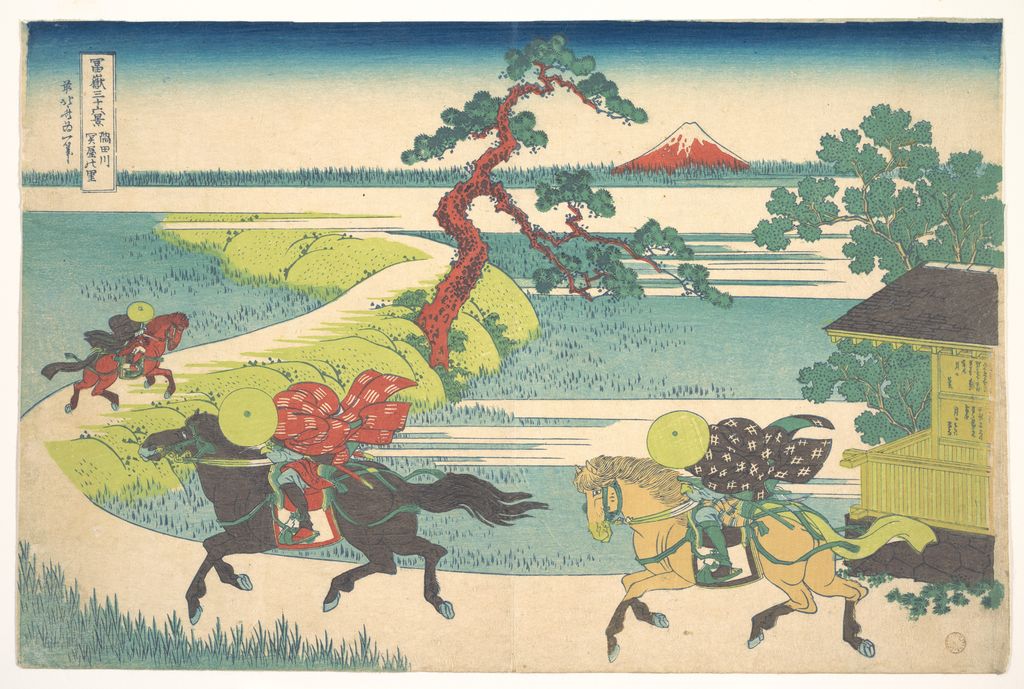
Three riders gallop along a raised road in Katsushika Hokusai’s Sekiya Village on the Sumida River. The two at the bottom of the print bend low over their horses. A third, drawn at a much smaller scale, approaches the bend at the left. The road curves away behind them and a red-barked pine turns back across it. Farther off, the red and white peak of Mount Fuji stands above a line of trees. Lifting hooves, clothes streaming behind the riders and the changing direction of the road give the scene its speed. Fuji is the still point beyond them. [1]
The Japanese title is 隅田川関屋の里, Sumidagawa Sekiya no sato. The Metropolitan Museum of Art dates its impression JP1338 to about 1830–32. Its catalogue draws attention to the way the trees and road lead the eye towards the distant mountain, while the print’s human action sends our attention in another direction. Looking closely at the riders makes that difference easier to feel. Each moves along the same road, but we see a different part of the journey in each figure. [1]
At a Glance
- ArtistKatsushika Hokusai
- Dateca. 1830–32
- MediumColour woodblock print
- SeriesThirty-six Views of Mount Fuji
Contents
Three riders at the bend
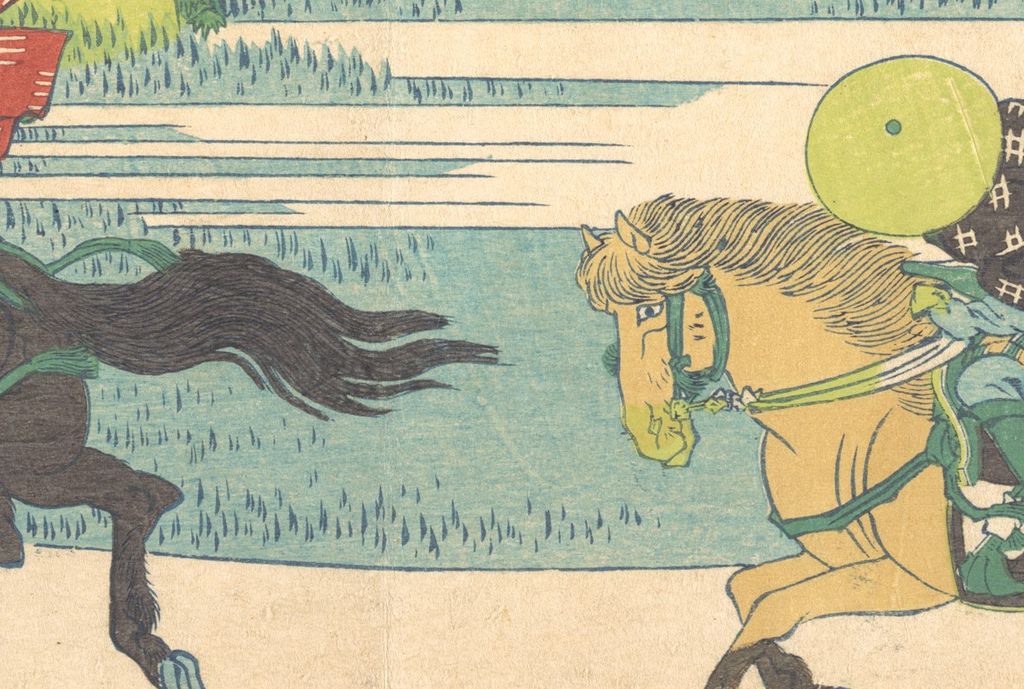
Start with the black horse at lower left. Its body is almost horizontal and its legs are lifted in several directions at once, with the rear hooves far behind the rider. The red pattern above the saddle makes a separate shape from the horse’s dark body. The rider’s round yellow hat is tipped towards the horse’s head, and the dark tail streams back towards the second rider. There is little indication of the rider’s face. His position, his clothes and the closely packed lines around the reins are what convey the urgency. [1]
The nearer horse at right is printed in warmer colours. Its head dips, and the forelegs reach well towards the lower edge of the sheet. The body takes up more space, and the rider’s dark patterned clothing curls back towards the tail. Look at his hat alongside the other yellow disc. The repeat ties the riders together even though the woods, road and horse colours change between them. The front horses seem to be covering a wide stretch of ground, yet the gap between them is narrow enough to make sense of them as part of the same rush. [1]
The third rider appears around the farther bend at left. The red clothing and round hat are visible in miniature, with the horse and rider fitted into a thin strip of light road. Here the horse’s head points more nearly across the page, as the road is changing direction. Following that smaller rider to the two in front gives us something of the turn and the distance the horses have to cover. Museum of Fine Arts, Boston curator Sarah E. Thompson suggests the figures are probably couriers carrying urgent messages towards Edo. The pace of the horses makes that reading persuasive, while the image leaves the precise errand open. [1] [2]
A raised road between fields
Thompson describes the route as a road built atop an embankment through rice paddies on the east bank of the Sumida, below the bridge at Senju. In JP1338, the light track broadens at the bottom and tightens as it reaches the smaller rider. Short strokes at the edges suggest vegetation gripping the sloping sides. Near the trees, horizontal bands of light and blue-green cut across the curving route. They give the view much of its breadth. The movement of the road makes sense in relation to those quieter, lower stretches of ground. [1] [2]
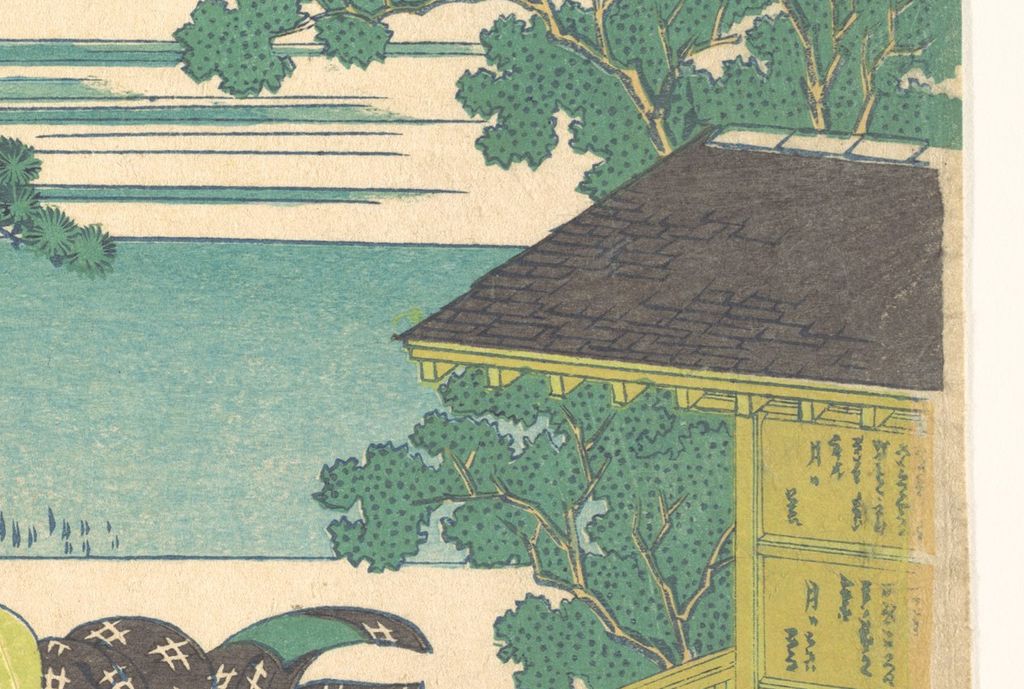
The roofed structure cut off by the right-hand edge looks substantial beside the small far-off rider. Its dark roof sits above an orderly rectangle of lines. Thompson identifies it as a public notice board, a place where official regulations were posted. The Sumida Hokusai Museum likewise describes it as a kōsatsuba. The board gives the road a fixed feature and a connection to the people who used it. Because the horses pass at the foot of the board, its upright lines and level roof make the movement of their bodies especially legible. [1] [2] [3]
The Sumida museum associates Sekiya with the east bank upstream, north of present-day Sumida ward. Its location guide describes the name in relation to a stretch of the river extending towards Senju. The Tokyo Fuji Art Museum’s record in Cultural Heritage Online connects the area to what is now the vicinity of Keisei Sekiya and Ushida stations. Such accounts make the title more specific, without requiring the print to show the current course of a road or a precisely locatable viewpoint. Hokusai lets the viewer grasp the land through the difference between the track, the low fields and long stretches of pale distance. [3] [4] [5]
The pine and Fuji
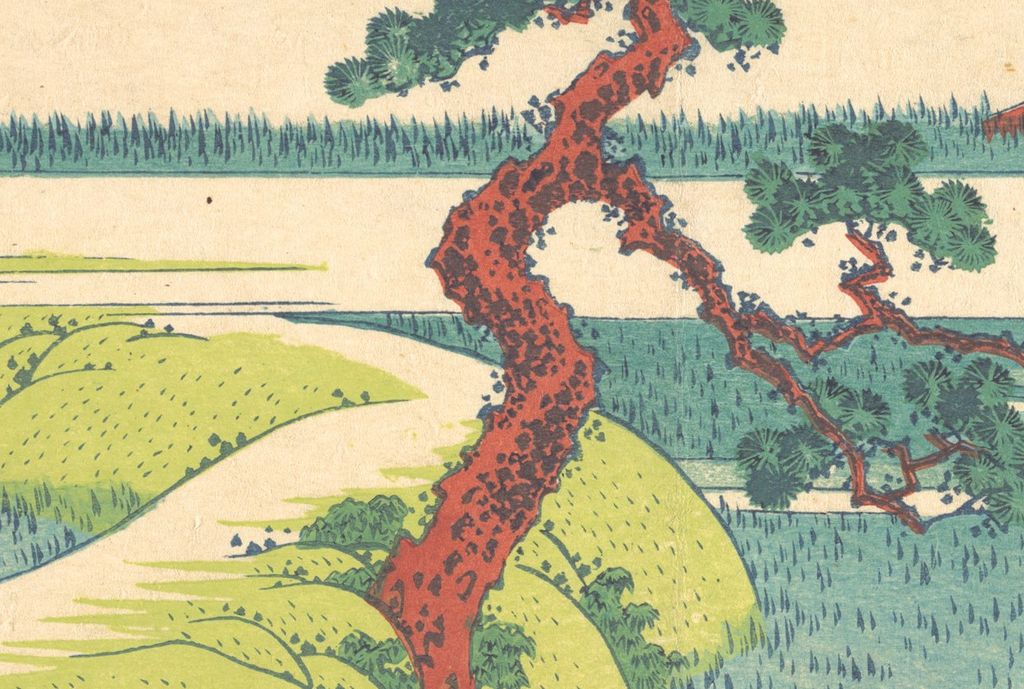
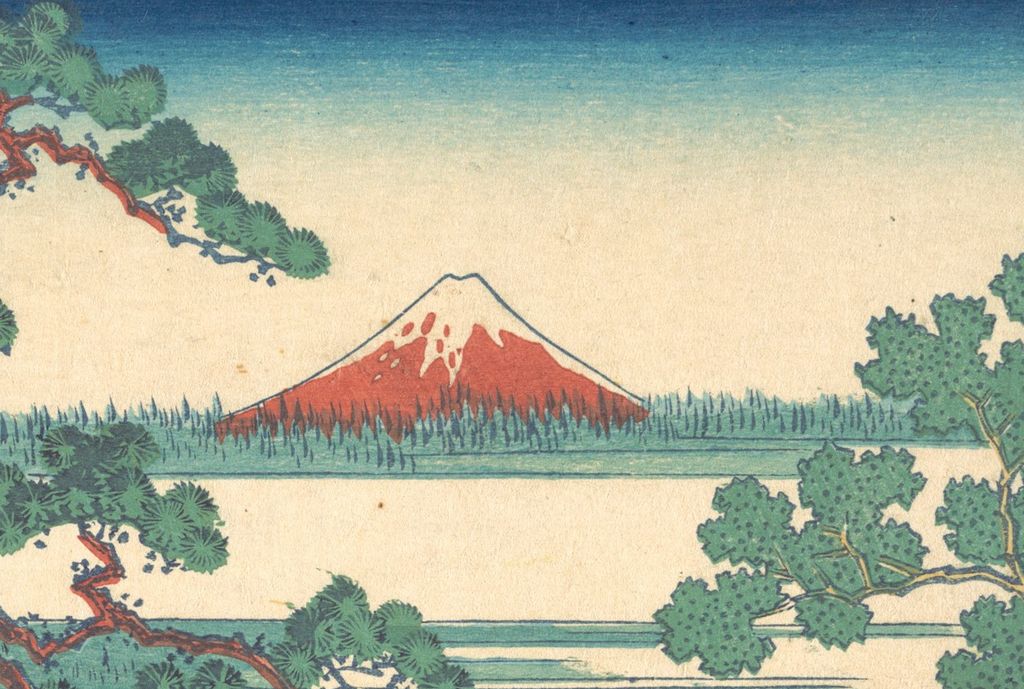
The central pine stands on the inner side of the bend. Its trunk twists sharply, while its crown extends to the right and opens a view towards Fuji. Arranged around the trunk are small bunches of foliage, separated by stretches of bare paper and pale sky. At the far right another group of trees presses against the edge above the notice board. Between the two groups, there is enough open space for Fuji’s shallow triangular shape to stand out. The mountain is much smaller than either of the near riders, but the spacing makes it an immediate part of the scene. [1]
Look below the crown, where a thinner branch dips across the middle of the landscape. Its needles interrupt several pale horizontal bands in succession. The branches above the horizon are seen against sky, while those below it are seen against long stretches of field and low ground. We can follow the same tree across the two zones without mistaking one zone for the other. [1]
A blue band deepens near the top of the print and lightens towards the open sky. Fuji’s snow lies just above the dark line of far vegetation, and the small red flanks give the page a note of colour not unlike the red in the nearest rider’s clothing. In its catalogue for JP2998, another impression, the Met describes the mountain reddening at dawn as the riders race along the embankment. The different size of the patches of red matters here. One is part of a passing person, another part of the trunk at the turn, and the smallest touches the horizon. They let the eye cross a great distance in only a few steps. [1] [6]
Comparing the Met impressions
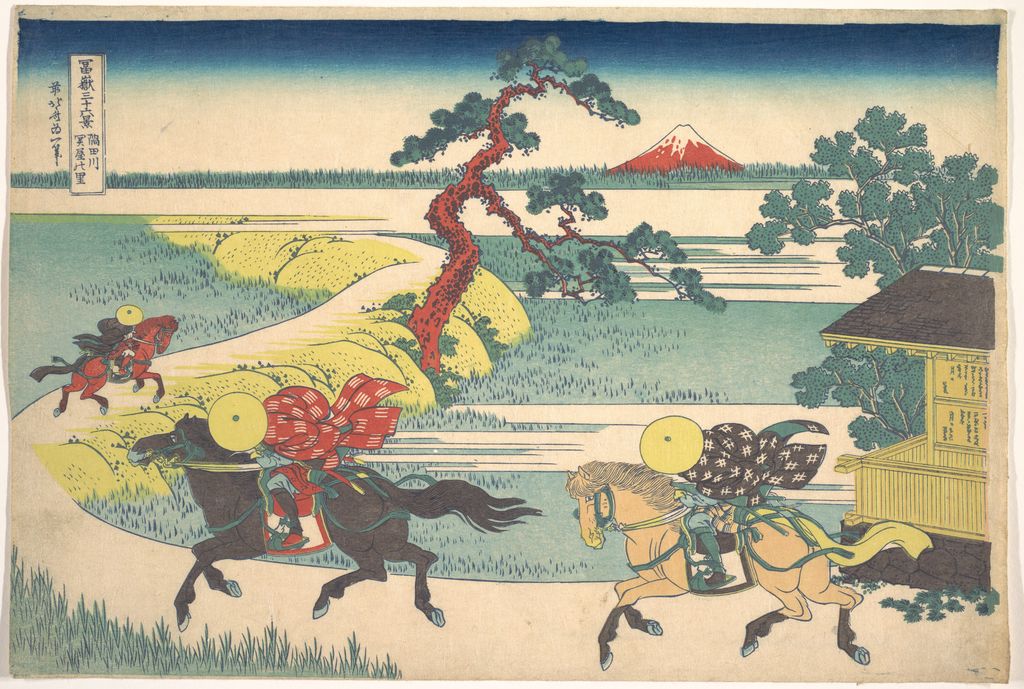
JP1338 measures 25.4 by 38.7 centimetres. JP2998 is catalogued at 26 by 38.4 centimetres. Both are woodblock prints in ink and colour on paper, dated about 1830–32. The two museum photographs show the same arrangement of riders, road and mountain. On JP2998 the left brow of Fuji has a slightly clearer break between the red of the flank and the green of the distant trees. The right-hand board reads as a stronger yellow against the darker roof. The photo of JP1338 gives more emphasis to the green in the nearby grass and to the paleness of the road alongside it. [1] [6]
The borders give a further point of comparison. The pale space around the edges is uneven in both photographs, and the lower strip of the JP2998 sheet includes a visibly darker band of paper. JP1338 shows a distinct small mark near the lower right edge beyond the horse. The outlines of the horses and the riverbank let us compare corresponding areas even where the surrounding paper or colours differ. These details concern particular sheets and their photographs. They do not by themselves establish which impression was printed first. [1] [6]
The Sumida Hokusai Museum also points to an afterlife for the print’s composition. It identifies the arrangement of the notice board, embankment and galloping riders as a model for an illustration in volume two of Philipp Franz von Siebold’s Nippon. The features the museum singles out are the ones that make Sekiya identifiable even at a distance from the original sheet. The title tells us which reach of the river to consider, while the configuration of a road, board and three riders allows the view to be recognised by sight. [3]
Three views around Senju
In Fuji Seen in the Distance from Senju Pleasure Quarter, the people near us form a line on foot that draws our eye along the lower edge of the sheet. The road at Sekiya leaves that level and bends back into the depth of the image. In Senju in Musashi Province, upright structures on the land and by the water arrest the eye, while a horse and figures occupy the crossing near at hand. All three belong to Thirty-six Views of Mount Fuji. What they make the viewer notice is distinct. The Senju pleasure-quarter impression gives the march of a procession a broad foreground, while Sekiya reduces the human action to three figures whose spacing tells us how fast they are travelling. [1] [7] [8]
Return to the clearing between the central pine and the trees on the right. It is possible to see the small peak first, then work back through the pine, the fields and the riders. In that direction the picture feels quite different. The mountain seems to hold its place while the near edge grows crowded with movement. Following the horses first makes the far country appear only after we have followed the curve. Looking in either direction reveals how much of this apparently spacious view depends on where Hokusai cuts the road and which parts of it he allows us to see. [1]
Where this work sits in Hokusai’s career
Annotated Details from Sekiya Village on the Sumida River
The Metropolitan Museum of Art, JP1338. [1]
Details from SEKIYA VILLAGE ON THE SUMIDA RIVER
Select a detail to look closely.
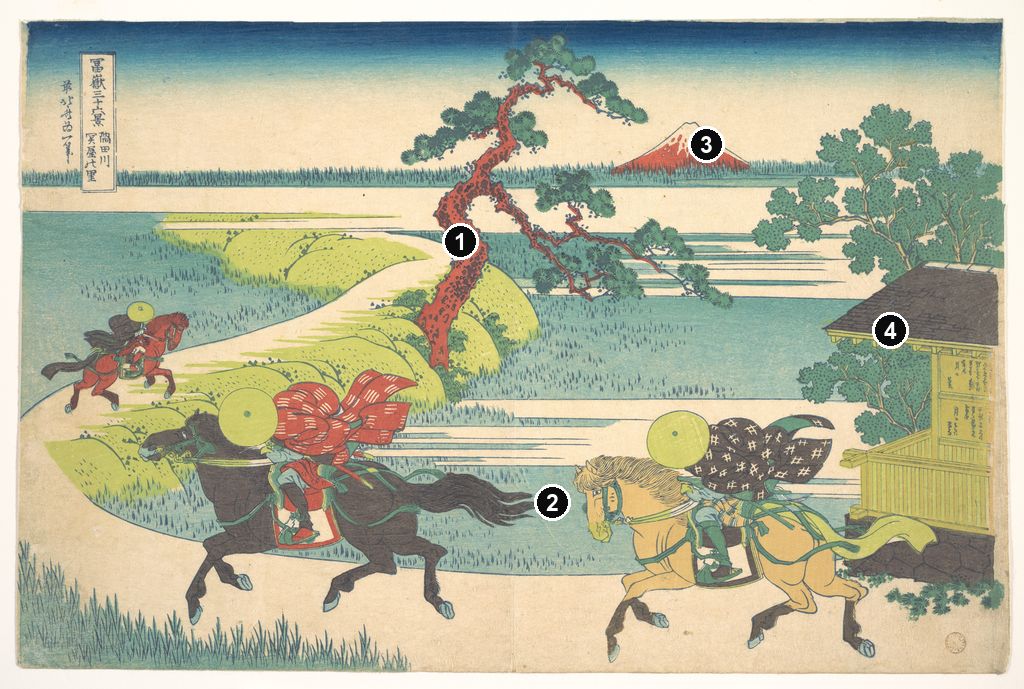
A single trunk breaks the open landscape
The twisting trunk remains upright among the layered horizontal fields. It sets the intervals between the passing riders. [1]
The riders lean into their route
The horses and riders extend their limbs and bodies along the road. The foreground scale makes their repeated motion visible. [1]
The distant peak takes a little colour
A small triangular silhouette interrupts the horizon. Its colour differs from the blue and green in the nearer landscape. [1]
The notice structure stands by the roadside
Straight edges mark a fixed point beside the road. The nearer forms around it continue in a broad horizontal band. [1]
Explore Hokusai’s works
Discussion
Look again at the images and ideas explored in Sekiya Village on the Sumida River. These editorial prompts invite your observations.
Reader Insights
How do the horses make the road’s course visible?
Where does Fuji interrupt the horizontal landscape?
Join the Conversation
Share a detail, comparison or question about Sekiya Village on the Sumida River below.
References
- The Metropolitan Museum of Art, Sekiya Village on the Sumida River, accession JP1338, object record and photograph. View source.
- Sarah E. Thompson, Hokusai’s Landscapes, Museum of Fine Arts, Boston, catalogue no. 32, p. 64. View source.
- Sumida Hokusai Museum, Thirty-six Views of Mount Fuji: Sekiya Village on the Sumida River, collection record and Japanese commentary. View source.
- Sumida Hokusai Museum, Map of Places Associated with Hokusai, Sekiya entry. View source.
- Tokyo Fuji Art Museum via Cultural Heritage Online, Sekiya Village on the Sumida River, Japanese catalogue description. View source.
- The Metropolitan Museum of Art, Sekiya Village on the Sumida River, accession JP2998, object record, dawn interpretation and photograph. View source.
- The Metropolitan Museum of Art, Fuji Seen in the Distance from Senju Pleasure Quarter, accession JP1326. View source.
- The Metropolitan Museum of Art, Senju in Musashi Province, accession JP2988. View source.







