


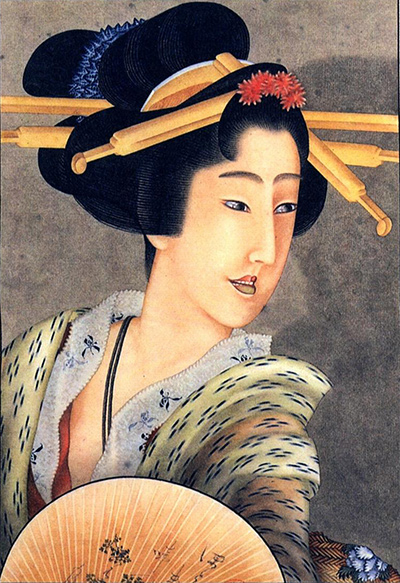
Merchant’s Daughter (Fille de marchand), school of Hokusai. Bibliothèque nationale de France, Japonais 382 (3).
Buy Art Prints Nowfrom Amazon
* As an Amazon Associate I earn from qualifying purchases.
 by Tom Gurney
Tom Gurney BSc (Hons) is an art history expert with over 20 years experience
Published on June 19, 2020 / Updated on November 20, 2026
Email: tomgurney1@gmail.com / Phone: +44 7429 011000
Merchant’s Daughter, School of Hokusai
A young woman turns her face towards the right as the upper curve of a fan rises into the picture below her. Long pale hair ornaments extend from the dense dark shape of her hair. Red flowers sit just above the brow, and fine marks begin to gather in the folds of the garment at her shoulder. The work has circulated as Portrait of a Woman Holding a Fan. The Bibliothèque nationale de France records this same image as Fille de marchand (Merchant’s Daughter), an unsigned nineteenth-century colour wash attributed to the school of Katsushika Hokusai. It belongs to the library’s Department of Manuscripts, where it is catalogued as Japonais 382 (3). [1] [2]
The catalogue title offers a way to read the sitter within a collection of painted portraits, occupations and customs. It gives a relationship to a merchant household. The image itself offers no written name for her. The face, hair, fabric and fan make the figure strikingly particular without telling us whether the artist had an individual sitter in mind. That question is especially worth keeping open when the woman is viewed beside other figures catalogued under titles such as Merchant and Warrior. [1] [3] [4]
At a Glance
- ArtistSchool of Hokusai
- Date19th century
- MediumColour wash
- CollectionJaponais 382 (3), Bibliothèque nationale de France
Contents
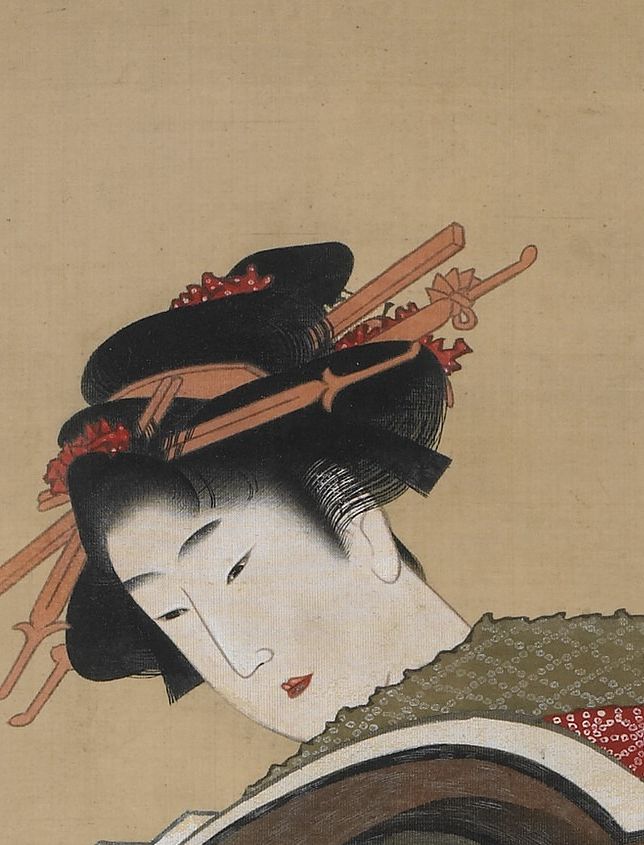
Hair ornaments and the turn of the head
The face is set on a diagonal. Its left edge follows the hair down towards the neck, while the nose, mouth and chin project towards open space at the right. The eyebrows and eyes are drawn with close attention to the turn. They differ slightly in their angle and apparent length as they run around the shape of the face. Colour gathers around the eyelids and in the cheek, and a darker passage runs down towards the jaw. The marks around the mouth stay small enough to register as part of the expression. A viewer can follow the line of the gaze without seeing the thing that caught it. [1]
The hair has an almost opposite treatment. Broad dark shapes form several rounded masses, with finer marks visible along the edges. Against these darker areas the long ornaments cut across one another. Some extend horizontally towards the sides of the picture and others point diagonally towards the flowers. Their shape and direction are easy to follow even when the eye loses the narrow boundaries between sections of hair. The result is a carefully organised set of crossings just above the much subtler modelling of the face. The red ornaments have a small surface area, but their colour and closeness to the brow make them conspicuous. The juxtaposition makes the gesture of the head readable before the fabric or fan supplies any context. [1]
The painting gives the hair a different relationship to the background in different places. Along the upper left, the dark shape stands out against the grey field almost without interruption. Further down, the hair and the side of the face meet in a sharper contrast. At the right, the long ornaments extend into the vacant field and break up the edge of the coiffure. The space around them is part of the composition. It gives the arms of the ornaments a distance to travel, and lets the head seem momentarily arrested in its turn. [1]
The fan and the edge of the picture
The fan enters at the lower edge. Its rounded top and the fine lines spreading across the pale warm surface make it legible even though the lower part falls outside the painted view. There is just room for a few small marks on the face of the fan, while the upper curve interrupts the costume in front. The framing concentrates attention on the upper half of the fan. The lower part, including the place where a hand would ordinarily support it, lies outside the visible field. What remains is sufficient to give the accessory a role in the picture. Its rows of lines soften the transition between the woman’s shoulder and the bottom edge. [1]
The fabric that surrounds it shifts in two different ways. At the collar, small motifs sit on a pale inner layer and follow a narrow opening down from the neck. Farther to the right, short, dark marks gather along several raised folds of the greenish garment. Bands of colour become more pronounced as the folds approach the right edge. It is possible to follow the fabric by its changes of tone as well as by the pattern. Under the fan, comparatively little of the body can be traced. The object conceals that part of the costume and makes the viewer read the figure in sections, from the ornaments and expression to the shoulder and cropped arc. [1]
The painted field provides few clues to a room, a street or a season. An accessory could carry practical, social or decorative meanings in Japan, where fans served in daily life, ceremonial settings and performance. The Ōta Memorial Museum of Art also describes folding fans as a small, portable surface for painting. That range of uses helps explain why a fan is such a legible motif without assigning a specific occasion to this picture. Here the immediate evidence is the way the accessory takes up space close to the figure, alongside the patterns of her dress. [1] [5]
Other figures in the Sturler collection
The BnF’s Femme de guerrier (Warrior’s Wife), Japonais 382 (4), also places a large fan in the foreground. A broad pale head covering gives her silhouette a different shape, and the raised fan occupies more of the field beneath the face. Side by side, the two pictures invite the eye to compare the headwear, the angles of the face and the proportion of the clothing visible below the shoulder. They are closely related as catalogue objects, but each picture gives its sitter a different arrangement of forms. The collection titles supply the familial or social labels. The paintings make those categories visible through particular figures, gestures and dress without explaining the relationships among individual sitters. [1] [4]
The nearby Warrior, Japonais 382 (1), likewise brings a pale object into the lower part of the picture. Its comparatively straight sides and the fingers resting against it offer another way to interrupt the body’s contour. In Merchant’s Daughter a curved edge takes on a similar job, and the sitter’s hand remains out of sight. The Merchant in Japonais 382 (2) gives the face a downward inclination and wraps the figure in broader areas of dark cloth. The similarity of format makes these choices easy to compare. The shared setting in a group of portraits and occupations brings out differences that a later descriptive title about a fan might leave unnoticed. [1] [3] [4]
The paintings came from the collection of Johan Willem de Sturler. The manuscript record names his son, Willem Louis de Sturler, as donor and records their entry on 29 August 1855. The parent catalogue groups the unsigned washes with a larger body of material that also includes prints. On the individual exhibition page, the library uses the more specific attribution to the school of Hokusai. That distinction helps a reader understand why a collection associated with Hokusai’s name can preserve a painting whose individual maker is unknown. The BnF later devoted a conference to the Sturler paintings, a record of continued study of the group. [1] [2] [6]
A different woman with a fan in the Freer collection
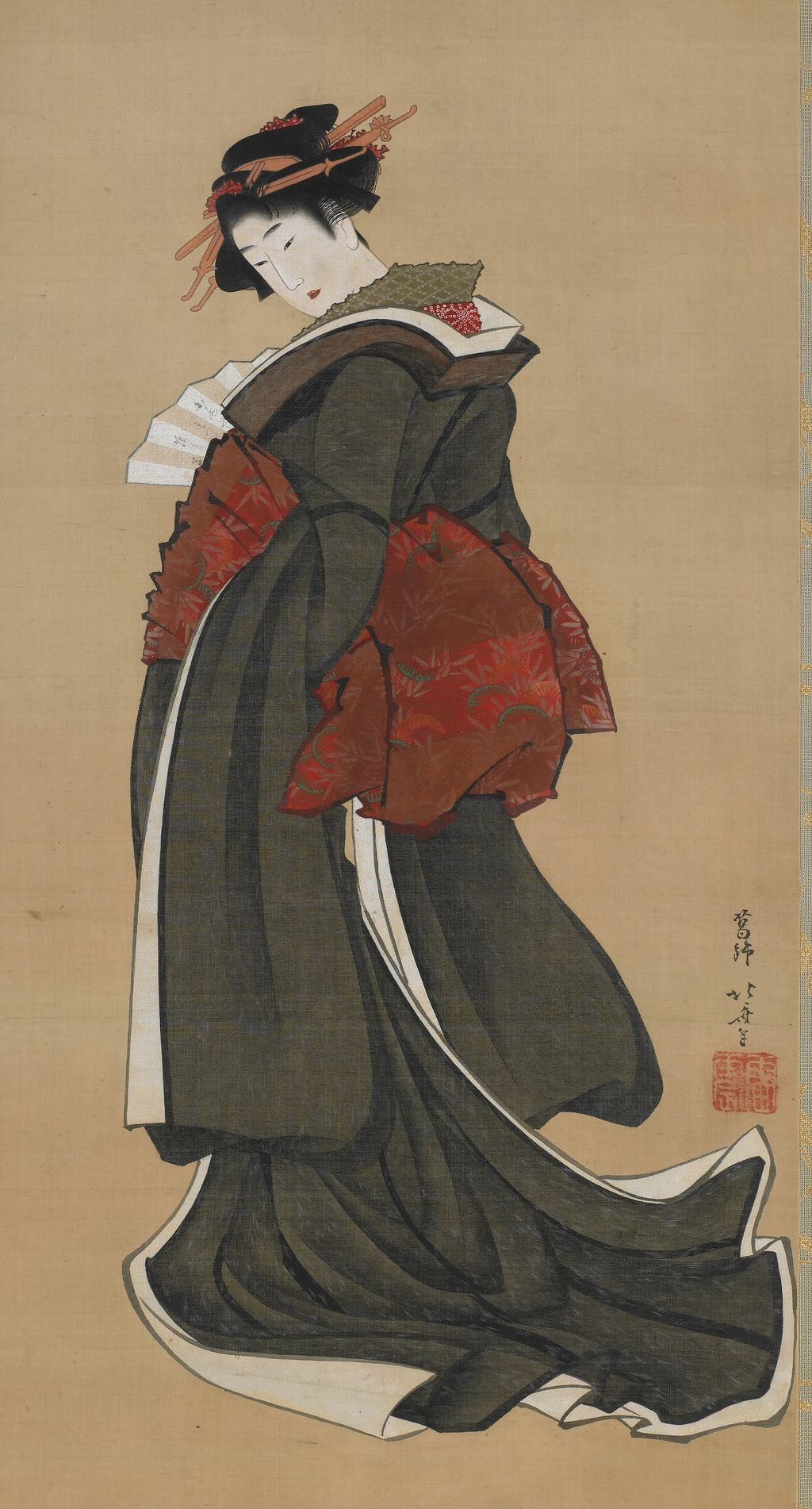
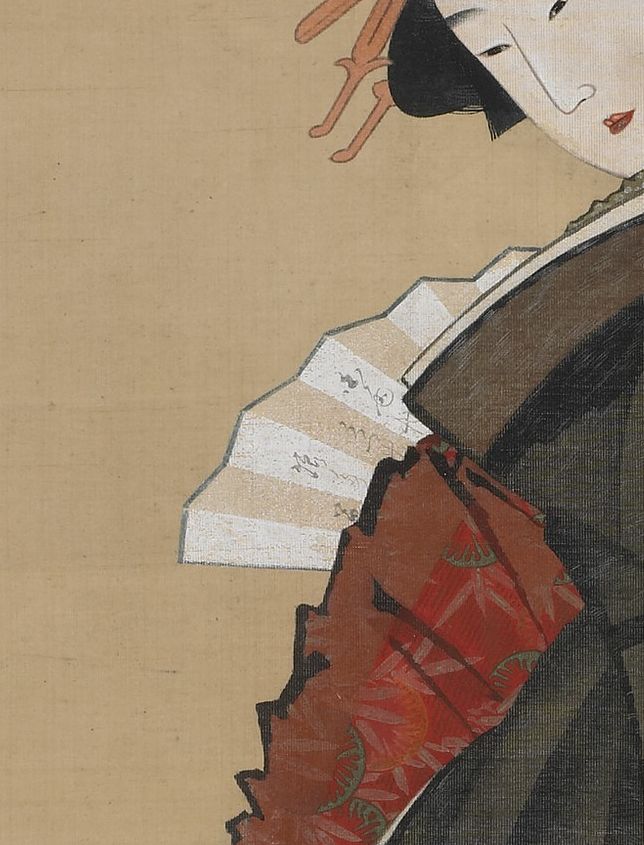
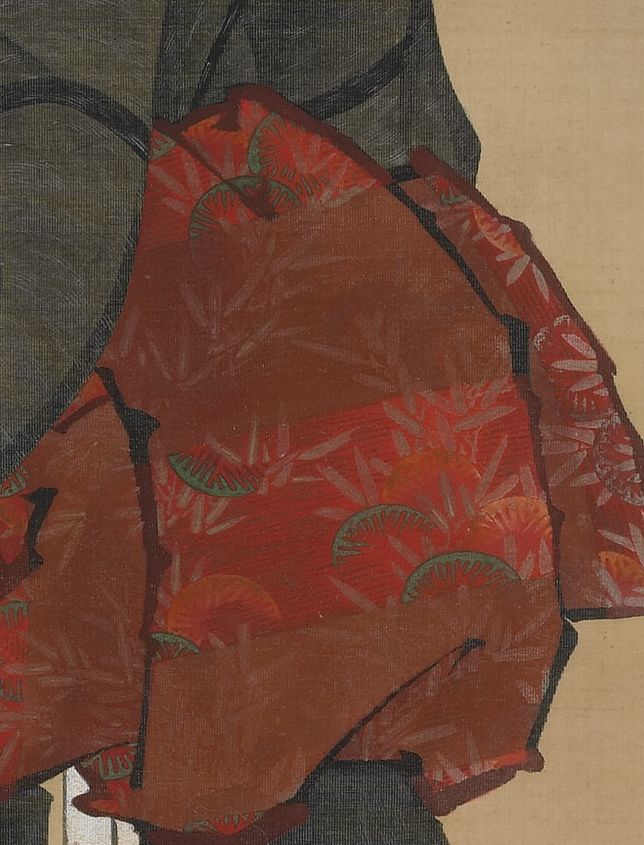
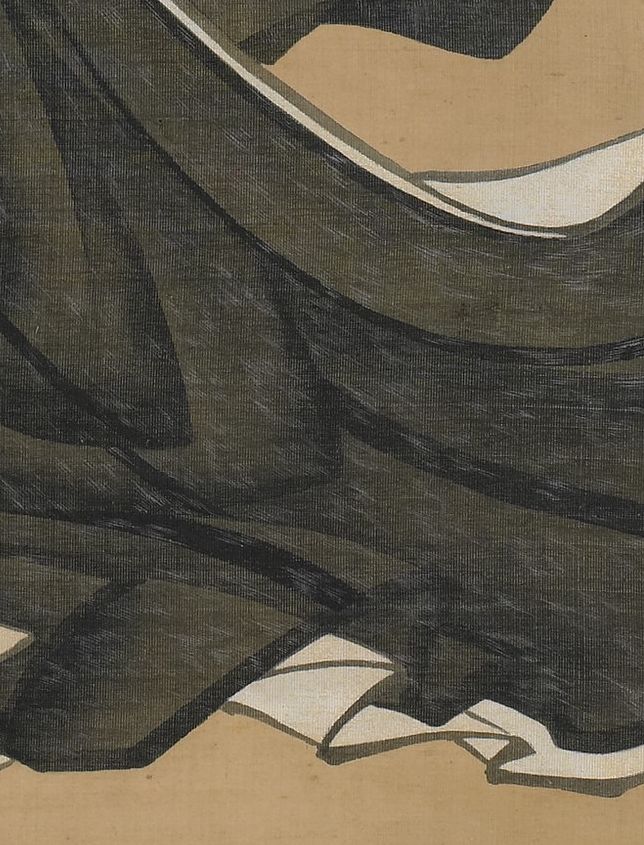
The Freer Gallery of Art has a separate Woman Holding a Fan, accession F1904.183. It identifies Katsushika Hokusai as the artist, dates the work to about 1810–11 and describes ink and colour on silk. This picture shows a full figure rather than a close view of the head and shoulders. The woman tilts her head down towards a pale folding fan which opens at the edge of her shoulder. A broad, dark robe falls away below it and spreads at the bottom, where a light lining follows the change in direction. The vivid red sash provides another interruption between otherwise long passages of fabric. These elements allow the eye to move the entire length of the scroll. [7]
The scroll was exhibited in Tokyo in 1900. Ernest Fenollosa’s catalogue read the gesture as a young woman opening her fan, described the work as signed Katsushika Hokusai and put it around 1813. The Smithsonian’s present date is a little earlier. The painting’s later history is also separate from that of the wash in Paris. The dealer Bunshichi Kobayashi had the Freer scroll by 1904, when Charles Lang Freer bought it from him in Detroit. The records of these two works establish more than the similar English descriptions suggest, from the structure of each picture to its authorship and collection history. [2] [7] [8]
Return to the BnF wash and follow the fan along its curved upper edge. There is no long trailing hem to draw the eye down. The round form gives way to the shoulder and collar, bringing attention right back to the woman’s face and the pins that extend above it. In the Freer scroll the fan marks a pause within the length of a full figure, while in Merchant’s Daughter it helps define the short distance between the figure and the frame. That difference in the use of space is what makes the two pictures especially revealing to look at together. [1] [7]
Where this work sits in Hokusai’s career
Annotated Details from Woman Holding a Fan, a separate painting by Hokusai
Smithsonian National Museum of Asian Art, Freer Gallery of Art, F1904.183. CC0. [7]
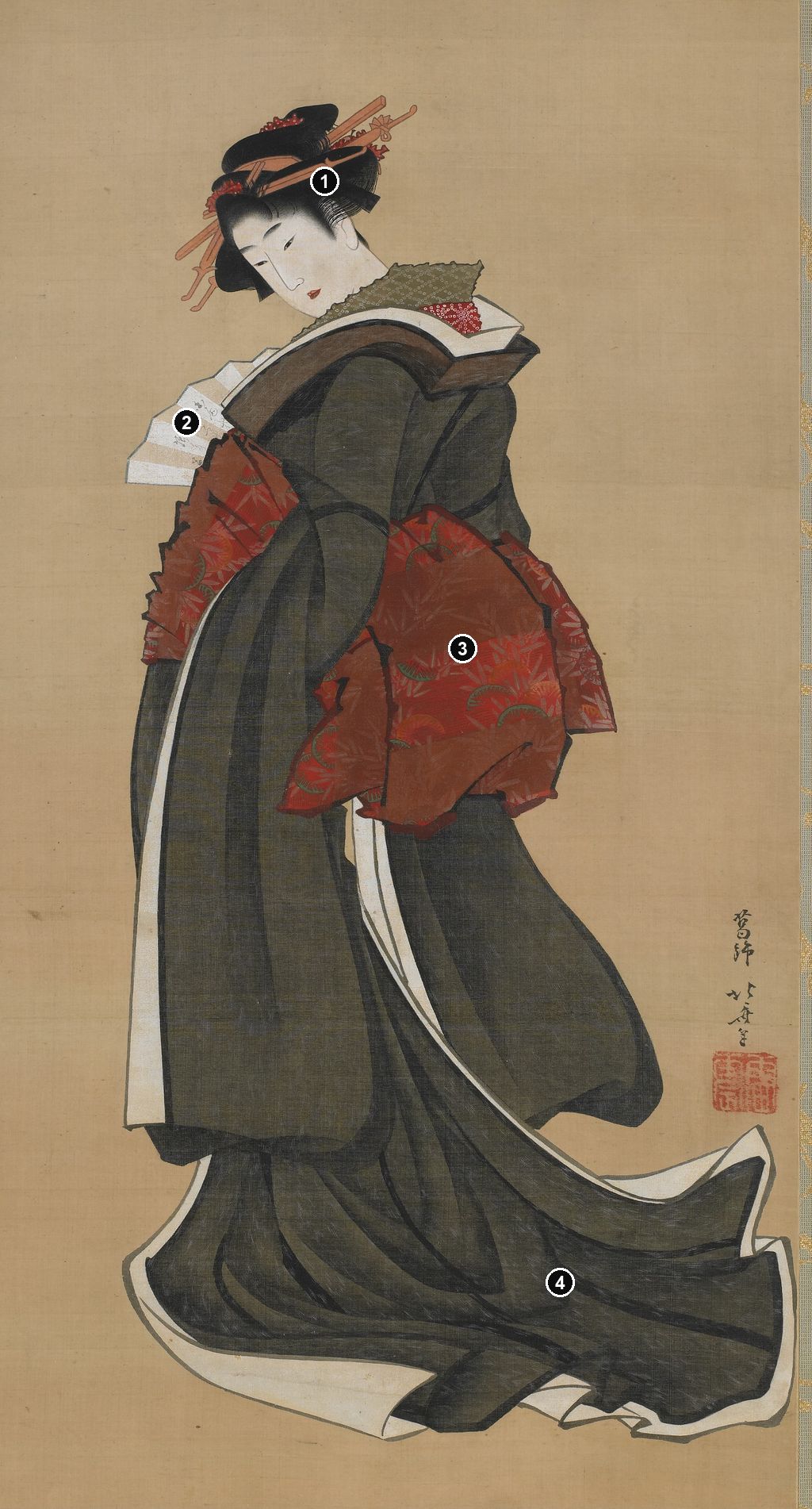
Details from WOMAN HOLDING A FAN, A SEPARATE PAINTING BY HOKUSAI
Select a detail to look closely.
Long hairpins cross the hair
Their straight diagonals interrupt the dark curved outline of the hairstyle. [7]
The open fan emerges from the sleeve
Its pale folds contrast with the layers of clothing beside it. [7]
Red textile gathers at the waist
The vivid folds provide a point of focus between the fan and the long garment. [7]
A pale hem follows the dark cloth
Long curves at the lower edge carry the eye through the standing figure’s turn. [7]
Explore Hokusai’s works
Discussion
Look again at the images and ideas explored in Merchant’s Daughter, School of Hokusai. These editorial prompts invite your observations.
Reader Insights
How does the fan’s arc set off the figure?
How does the treatment of the fan differ in the Freer painting?
Join the Conversation
Share a detail, comparison or question about Merchant’s Daughter, School of Hokusai below.
References
- Bibliothèque nationale de France, Fille de marchand, Japonais 382 (3), individual image and school attribution. View source.
- Bibliothèque nationale de France via Biblissima, Japonais 382, collection description, provenance and Gallica manifest. View source.
- Bibliothèque nationale de France, Guerrier, Japonais 382 (1), and Marchand, Japonais 382 (2). Warrior · Merchant View source 1. View source 2.
- Bibliothèque nationale de France, Femme de guerrier, Japonais 382 (4), and the album of paintings from Hokusai’s school. Warrior’s Wife · Album View source 1. View source 2.
- Ōta Memorial Museum of Art, The Beauty of Fans: The Kōnoike Collection. View source.
- Bibliothèque nationale de France, Hokusai à la rencontre de l’Occident: les peintures de la collection Sturler, conference of 23 January 2018. View source.
- Smithsonian National Museum of Asian Art, Woman Holding a Fan, Freer Gallery of Art F1904.183, collection record and CC0 image. View source.
- Ernest Francisco Fenollosa, Catalogue of the Exhibition of Paintings of Hokusai, no. 56, pp. 47–48 and illustrated plate. Published by Bunshichi Kobayashi, 1901. View source.







