


 by Tom Gurney
Tom Gurney BSc (Hons) is an art history expert with over 20 years experience
Published on June 19, 2020 / Updated on November 20, 2026
Email: tomgurney1@gmail.com / Phone: +44 7429 011000
Bluebells and Dragonflies
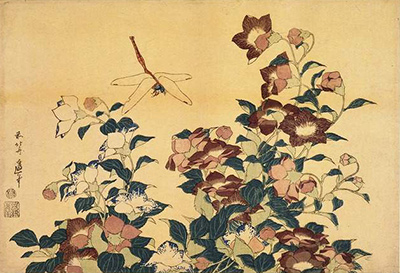
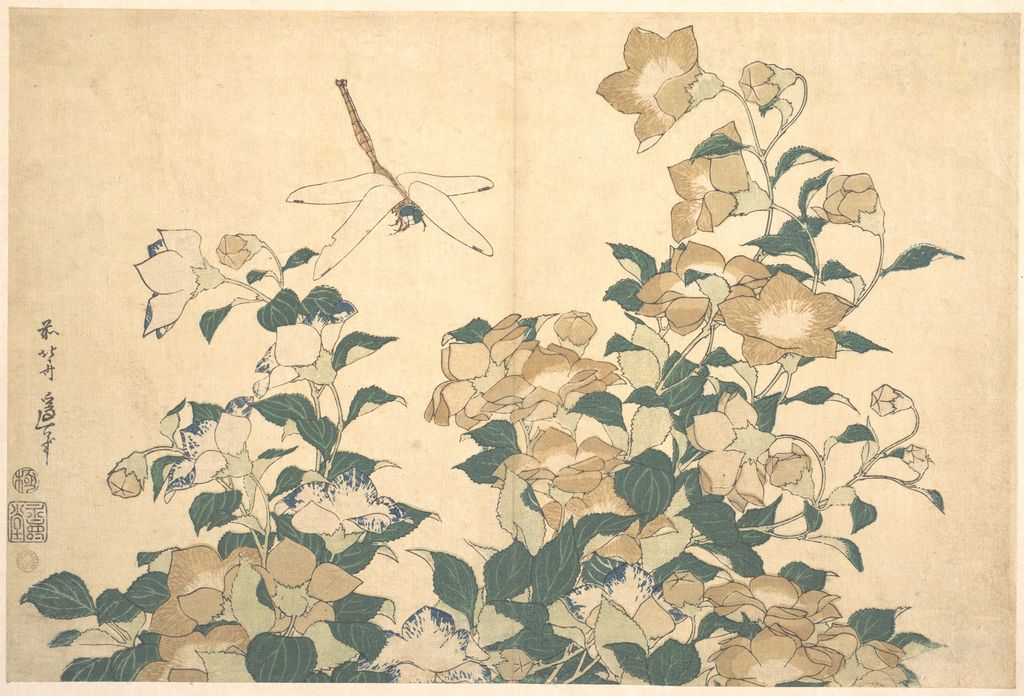
A single dragonfly crosses the open space above a mass of bellflowers in Katsushika Hokusai’s colour woodblock design Bluebells and Dragonflies. From its raised abdomen, the insect’s body descends diagonally to a small dark head. Four thin wings reach out across the pale background. Below, branches carrying flowers in different stages of opening rise from the lower edge. The right-hand stems reach higher than the left-hand stems, making a gap into which the dragonfly appears to fly. The Met and Art Platform Japan catalogue their respective impressions as Dragonfly and Bellflower. The Japanese title, Kikyō ni tonbo (桔梗にとんぼ), names the two subjects. [1] [2]
At a Glance
- ArtistKatsushika Hokusai
- DateLate 1820s (Met JP746)
- MediumColour woodblock print
- SeriesLarge Flowers
Contents
An insect in open space
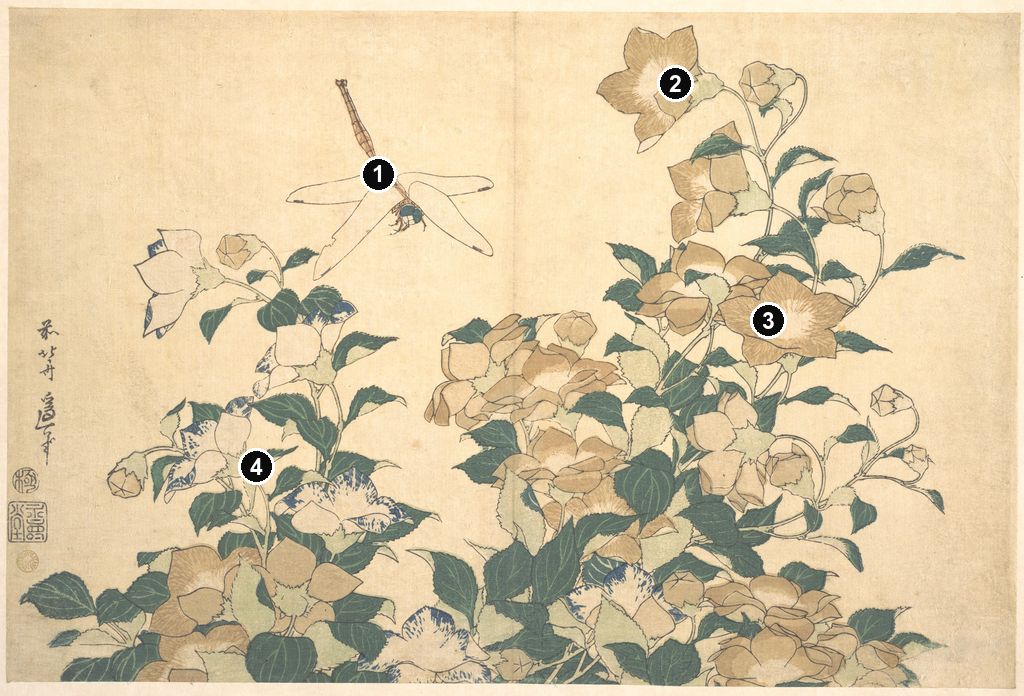
The dragonfly is quite small in relation to the plant. On the Metropolitan Museum of Art’s impression, JP746, its wings take up a good deal more space than its body. The upper pair extends left and right in a relatively shallow arc. The lower pair opens downwards at steeper angles, with the left wing pointing towards the end of a rising branch. Because the ground is almost the same colour inside and outside the wings, their shape depends on the thinness and continuity of the outline. Dark marks near the tips and the denser lines where the wings join help hold the insect together. The Sumida Hokusai Museum calls attention to the wing veins and the small dark markings near the wing ends in its own impression. [1] [3]
The line from the tail to the head is steeper than either pair of wings. The abdomen, marked with short divisions, lies against an area almost free of competing lines. At the other end, the dark head and the small cluster of legs stand out against the lightly drawn wings. The contrast shows how much Hokusai could do with a change in the weight of a mark. You can follow the length of the insect from the tail and then read the wings almost independently, as the shapes spread into the space over the flowers. [1] [3]
The gap under the insect gives its flight a direction. A stem at the left bends away, carrying a blossom that faces out of the main cluster. Across the gap, the larger group of flowers rises and spreads towards the right edge. Neither branch touches the dragonfly. Its lower wing approaches the leaves on the left, while an expanse of pale ground separates the right wing from the tallest flowers. That uneven spacing makes the insect seem to be passing through a place it will soon leave. Hokusai leaves the upper corners almost empty, extending the area through which it might move. [1] [4]
From a closed bud to an open flower
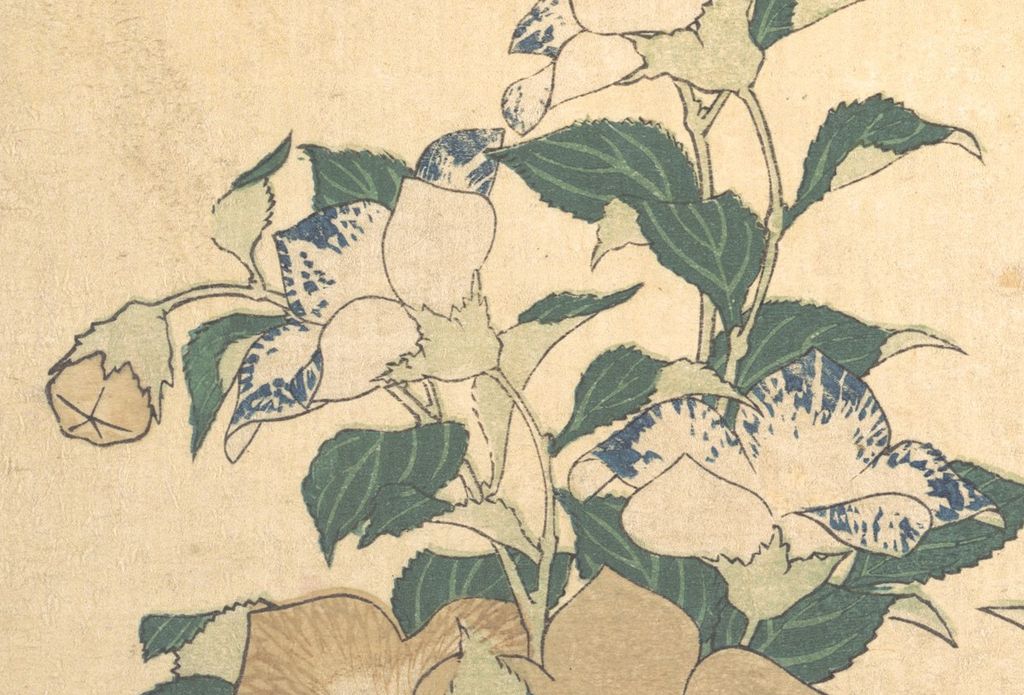
The Sumida Hokusai Museum calls the flowers Chinese bellflowers. In this context kikyō refers to Platycodon grandiflorus, which Kew records as native across parts of eastern Asia, including Japan. The common name “bluebells” gives only a partial idea of what appears on the sheet. In its discussion of the design, Sumida identifies three kinds of flowers, including reddish single blooms, blooms with several layers of petals and blooms variegated with blue. Hokusai sets these variations among buds that are still closed and others that have begun to open. [3] [5]
On the Met impression, several closed buds look like small folded packages. Their edges meet in angular joints, with short lines showing where the folds come together. A branch near the right edge offers a clear place to see this. Its buds stand apart from the darker foliage, one visible from the side and another showing more of its end. Look higher and the uppermost flower opens outward into five broad points. Its wide surface makes room for finer lines that run from the pale centre towards the edge. Within the height of a single stem, the form changes from a tight enclosure to a broad plane. [1] [3]
Other flowers collect their petals in overlapping layers. Near the bottom of the print, the lower edge cuts through some of the densest masses, leaving parts of the petals and leaves outside the image. The middle of the sheet offers a different pattern. Larger leaves jut into the spaces between the blossoms, with slender lines branching from their central veins. A few turn over along the stem, exposing a paler side that helps distinguish one leaf from the next. In the blue-variegated flowers, small touches of blue break into the pale area from the petal edges. The Sumida museum’s detail photograph makes the irregular boundary particularly easy to see. The outlines of two flowers can be similar while their interiors send the eye in quite different directions. [1] [3]
Compare the grouping with Hokusai’s Hydrangea and Swallow. There the flowers accumulate into rounded heads, each made up of many small outlined forms, and the bird makes a compact, dark silhouette beside them. In the bellflower design, the flowers break into more widely separated shapes, and the body of the insect is surrounded by wings whose interiors remain largely pale. Both designs give the creature room to move, although the hydrangea makes the swallow stand out by mass and the bellflowers leave the dragonfly legible by line. The difference is particularly clear if you start at the plant’s edge and follow the nearest wing. [1] [3] [6]
What three impressions show
The print at the Met and the Tokyo National Museum’s impression, A-10569-2782, agree closely in their outlines. The raised tail, the uppermost five-pointed flower and the two buds reaching towards the right edge each fall in the same place. In the Tokyo National Museum’s archival photograph, the flowers at the upper right and lower centre have a much redder appearance than the corresponding flowers in the Met photograph, where they look more muted and ochre. In Sumida’s photograph the leaves look a brighter green, and its published detail makes the blue at the flower edges distinctly visible. These differences describe what the museum photographs show. Establishing which changes arose from printing, ageing or photography would require closer evidence. [1] [2] [3] [4]
The bottom left of the Met photograph offers another useful comparison. On the left of the flowers there is a vertical signature with marks below it. The Tokyo photograph shows the same arrangement, separated from the lower foliage by a small area of empty ground. The detail asks for a careful reading of where one kind of information ends and another begins. The drawn stems, the signature and the seals all meet the same background, but each has a different scale and orientation. On a wide sheet the writing can run down beside the narrow left branch, leaving the strongest rise of the flowers free to occupy the other side. [1] [4]
The flowers also show what close alignment can contribute to Hokusai’s ukiyo-e woodblock prints. In the general process described by the Met, the printer used registration guides to bring the impressions of several different blocks together on the same sheet. Here you can follow the thin outer line of a petal around a coloured passage, then see the outline open onto the pale ground. In a dark leaf the larger shape has to remain readable alongside the narrow markings inside it. Those relationships are visible even in photographs whose colours differ. They explain why the design can still be recognised when the impressions seem to have rather different palettes. [1] [3] [4] [7]
How the museums catalogue the print
The Met dates JP746 to the late 1820s and lists it as a surimono, printed in ink and colour on paper. It records dimensions of 24.8 by 36 centimetres. Tokyo’s description gives a broader nineteenth-century date and records the Tokyo sheet as a horizontal ōban nishiki-e, a large colour woodblock print. The Sumida Hokusai Museum dates its example to around the beginning of the Tenpō era, which began in 1830. It catalogues its sheet as an ōban nishiki-e and presents the design among Hokusai’s large-format flower-and-bird prints. The dates and descriptions belong with the examples to which the individual museums attach them. [1] [2] [3] [8]
The distinction matters because the terms answer different questions. Ōban describes sheet format and nishiki-e refers to polychrome printing. In the Met’s account of its Spring Rain Surimono Album, surimono refers to privately issued prints, often commissioned by poets or poetry groups and frequently made for an occasion. Its use in the JP746 record therefore carries implications about publication that a size description alone cannot address. Sumida’s exhibition on Hokusai’s bird subjects identifies Nishimuraya Yohachi as the publisher of his large-format and medium-format bird-and-flower series in the Tenpō era. That provides the context for the large-format grouping, while the Met record describes its own object with a different label and date. [1] [7] [8] [9] [10]
The title Dragonfly and Chinese Bellflowers, used in the Sumida exhibition list, brings the design back to the proportions of what we see. There are many flowers and one insect. The different shapes of the buds and petals hold attention near the lower edge, and the dragonfly can be found almost immediately when the eye returns to the pale space above. Once you have traced the thinnest wing all the way to its tip, return to the broad top flower and follow one vein from its centre. Each subject takes up space in its own way, and Hokusai lets that difference do much of the work of conveying scale. [1] [3] [8]
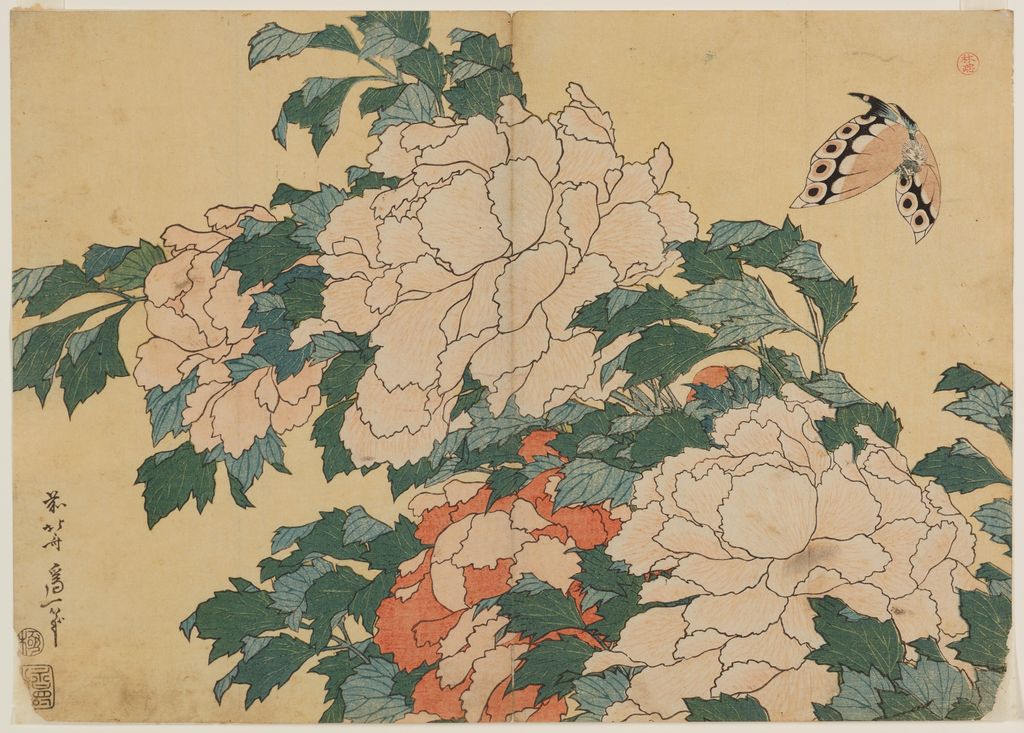
Image comparison
Where this work sits in Hokusai’s career
Annotated Details from Dragonfly and Bellflower
The Metropolitan Museum of Art, JP746. [1]
Details from DRAGONFLY AND BELLFLOWER
Select a detail to look closely.
The dragonfly hangs above the stalks
The insect’s thin body and outspread wings cross a gap in the foliage. The unprinted ground keeps its finer marks visible. [1]
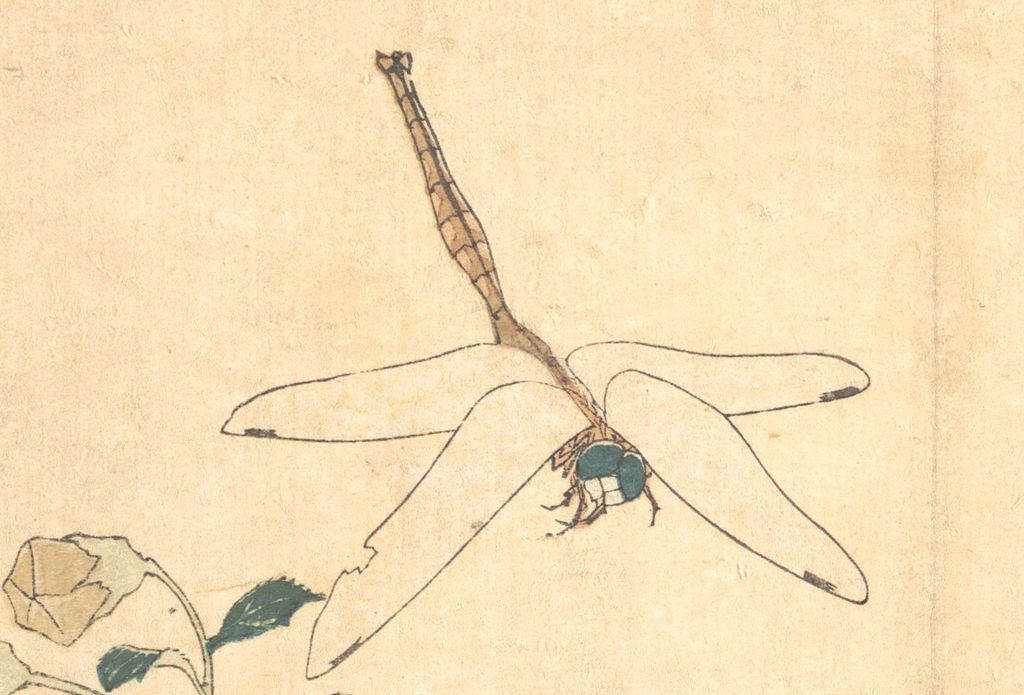
The upper flower turns away
The stalk carries the flowers to different heights and angles. The upper blossom partly hides its interior, giving it a silhouette of its own. [1]
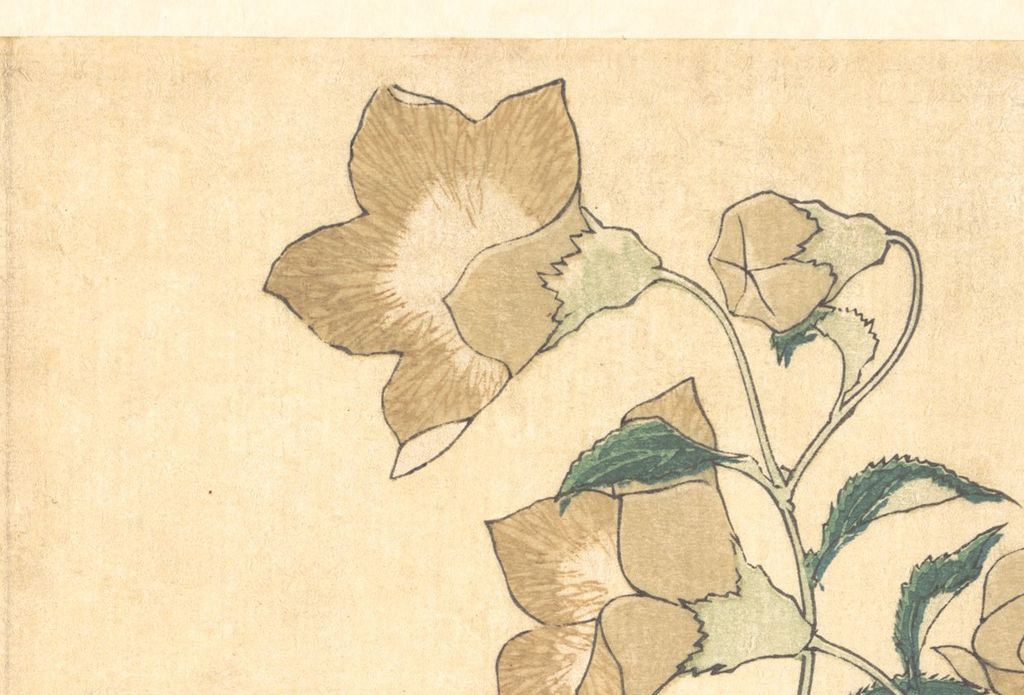
Leaves turn into the open space
Several sharp leaf forms project from the upright stalk. They make recurring changes of direction around the more rounded flower shapes. [1]
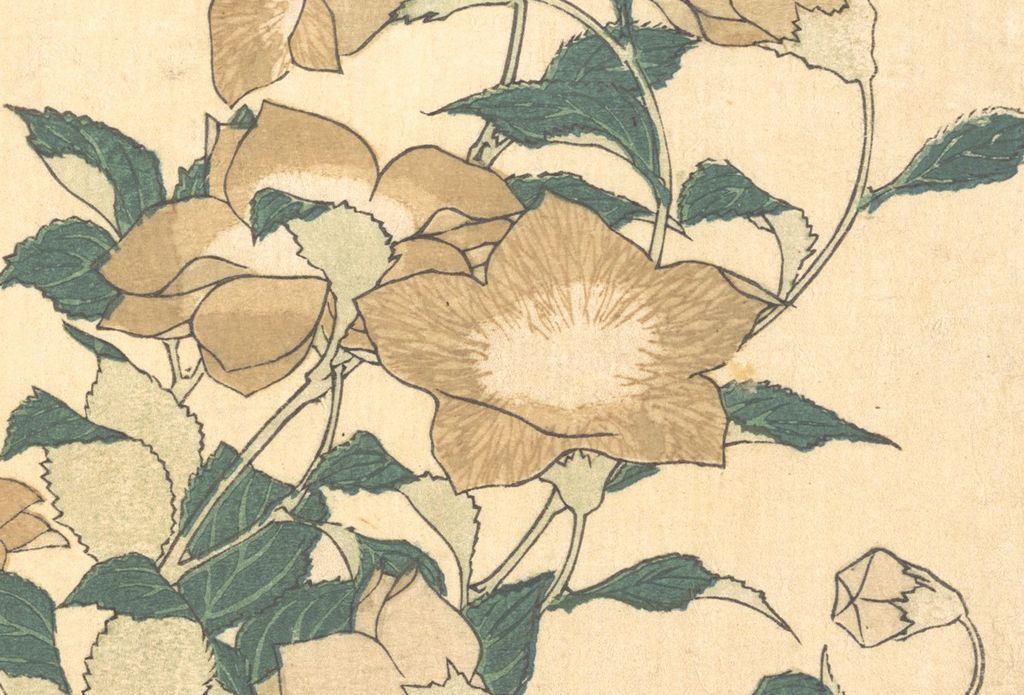
Lower stems spread apart
The darker foliage breaks into several small clusters. Open paper between them lets the eye trace branches that would otherwise merge. [1]
Explore Hokusai’s works
Discussion
Look again at the images and ideas explored in Bluebells and Dragonflies. These editorial prompts invite your observations.
Reader Insights
Where does the hovering insect seem to meet the plant?
What do the different positions of the flowers contribute?
Join the Conversation
Share a detail, comparison or question about Bluebells and Dragonflies below.
References
- The Metropolitan Museum of Art, Dragonfly and Bellflower, JP746. View source.
- Art Platform Japan, Dragonfly and Bellflower (桔梗にとんぼ), Tokyo National Museum accession A-10569-2782. View source.
- Sumida Hokusai Museum, Hokusai’s Flowers in Full Bloom (北斎花らんまん), section on Chinese bellflowers and images of the museum’s impression. View source.
- Tokyo National Museum, Bellflowers and Dragonfly (桔梗花蜻蛉), image record C0028341 for A-10569-2782. View source.
- Royal Botanic Gardens, Kew, Platycodon grandiflorus (Jacq.) A.DC., Plants of the World Online, distribution and vernacular names. View source.
- Agency for Cultural Affairs, Japan, Hydrangea and Swallow (紫陽花に燕), Tokyo National Museum impression, Cultural Heritage Online record 446576. View source.
- The Metropolitan Museum of Art, Department of Asian Art, Woodblock Prints in the Ukiyo-e Style. View source.
- Sumida Hokusai Museum, Hokusai’s Flowers in Full Bloom, exhibition checklist, entry 67, Dragonfly and Chinese Bellflowers. View source.
- The Metropolitan Museum of Art, Kubo Shunman, Japanese White-eyes with Plum Tree and Willow, from Spring Rain Surimono Album, catalogue discussion of private publication. View source.
- Sumida Hokusai Museum, The Hokusai Bird Park (北斎バードパーク), exhibition account of Hokusai’s large- and medium-format bird-and-flower prints. View source.







