



 by Tom Gurney
Tom Gurney BSc (Hons) is an art history expert with over 20 years experience
Published on June 19, 2020 / Updated on November 20, 2026
Email: tomgurney1@gmail.com / Phone: +44 7429 011000
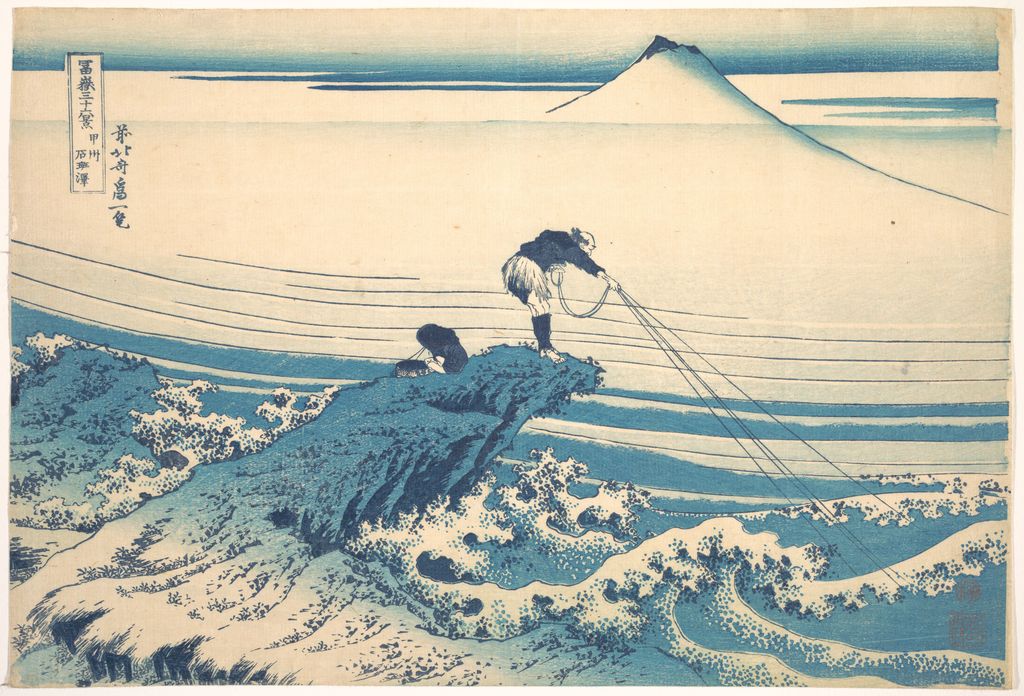
Kajikazawa in Kai Province by Katsushika Hokusai
A fisherman bends over a rocky ledge, bracing himself against the pull of his gear. Fine lines run from his hands into a stretch of broken water. Behind him, a smaller figure stoops beside a basket. Mount Fuji appears above them, its two flanks spreading out across a pale sky. In Kajikazawa in Kai Province, Hokusai gives nearly as much attention to the small triangle made by the fisherman and his lines as he does to the mountain. One shape comes from a moment of exertion. The other gives that moment the scale of a landscape. [1] [2]
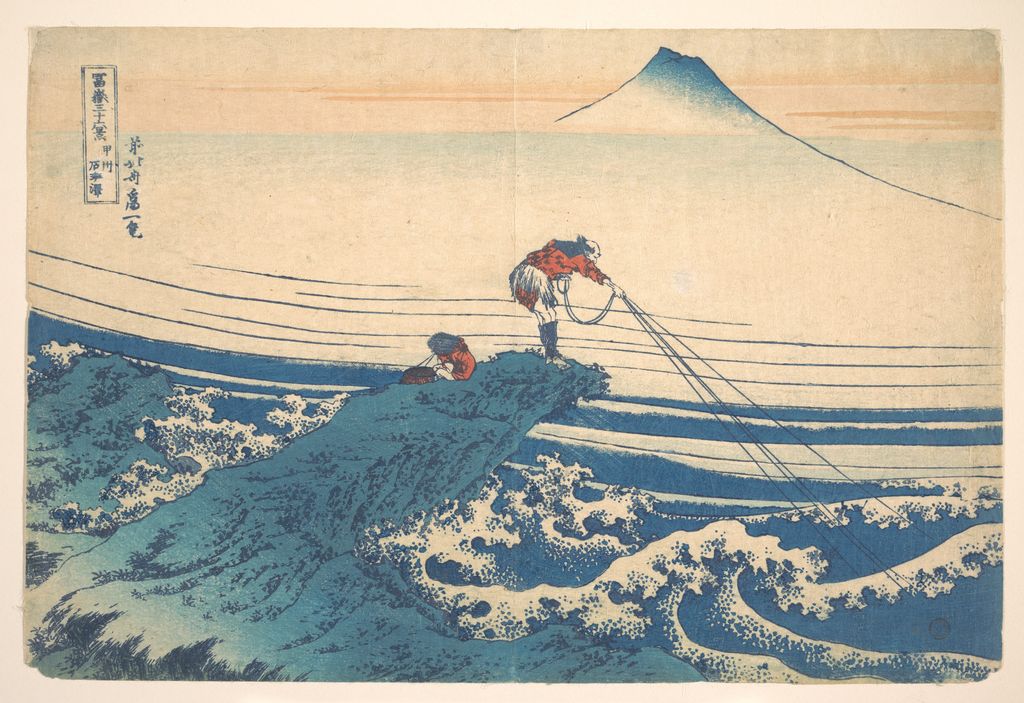
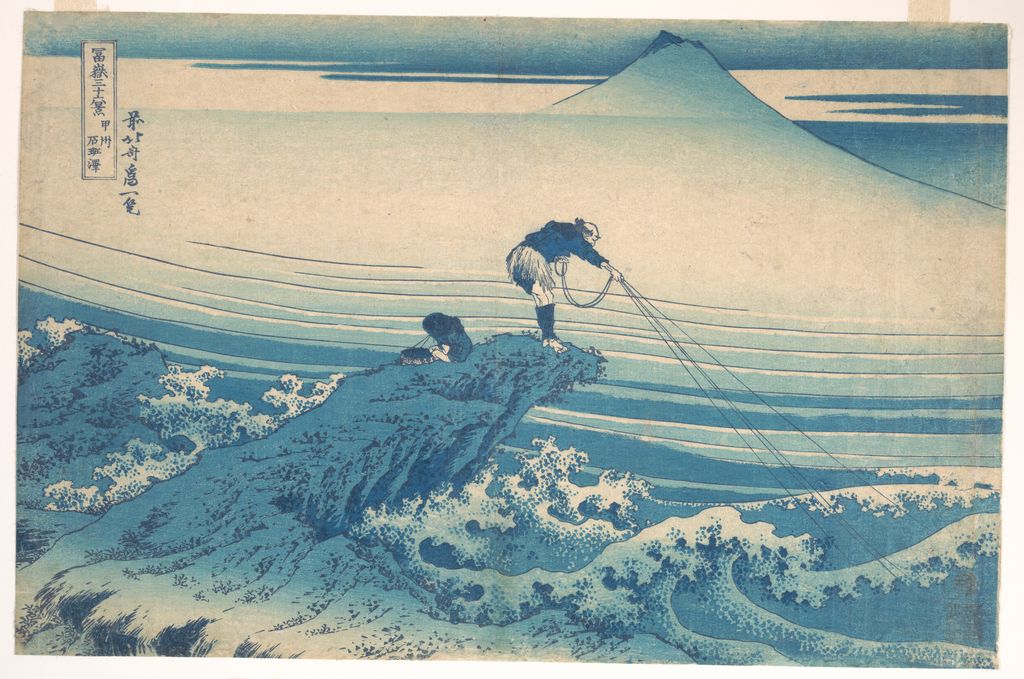
Hokusai designed Kajikazawa for Thirty-six Views of Mount Fuji, the landscape series published by Nishimuraya Yohachi. The Metropolitan Museum of Art dates its impression JP2986 to about 1830–32 and gives its dimensions as 26 × 38.4 cm. New York, Tokyo and Amsterdam all hold impressions of the design. Their colours and some of their printed details differ, so it helps to establish which sheet we are looking at before describing the work. [1] [3] [4] [5]
At a Glance
- ArtistKatsushika Hokusai (1760–1849)
- Japanese title甲州石班澤, Kōshū Kajikazawa, also catalogued as 甲州石班沢
- SeriesThirty-six Views of Mount Fuji (Fugaku sanjūrokkei)
- DateEarly 1830s
- MediumHorizontal ōban woodblock print on paper
- PublisherNishimuraya Yohachi
- Impression described hereMetropolitan Museum of Art, JP2986, Henry L. Phillips Collection
Contents
The fisherman on the ledge
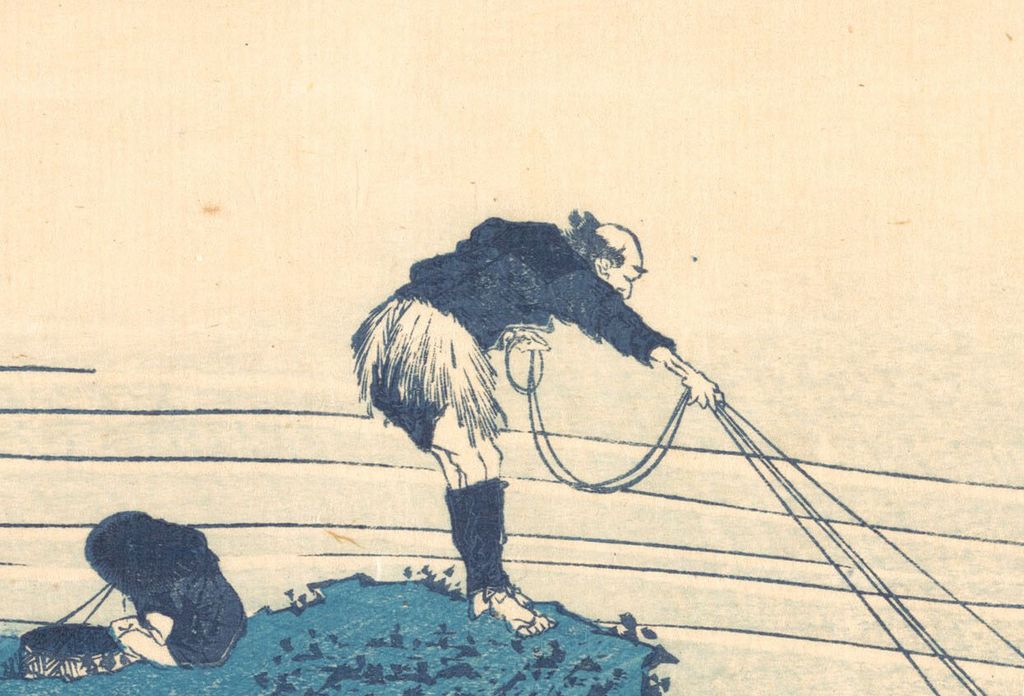
In the Met’s JP2986, the fisherman occupies a narrow foothold near the tip of a rock that rises from the lower left. Even at a small scale, the silhouette is easy to follow. The back rises in a short curve, the arms shoot forward and the legs return almost vertically to the rock. His upper body projects beyond his standing leg. That distance makes the pose feel precarious. His feet have a limited patch of ground, and the taut lines lead out over water that would be hard to stand in. [1]
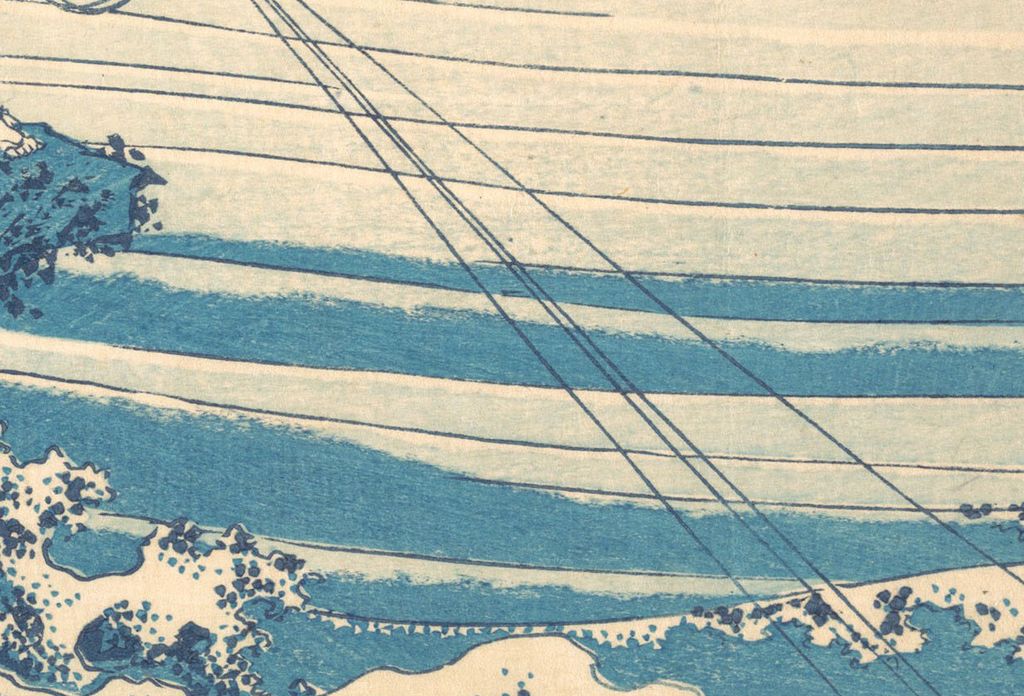
Look between his sleeves and knees and you can see a loose loop of cord. The loop hangs toward him while the longer lengths run away in straight diagonals. Hokusai uses two behaviours of the same material to make the figure’s effort legible. The slack part curves under its own weight. The taut lines carry the eye through the broad bands of current and farther down toward the foam. In several places they nearly disappear against the water. The light gaps between them keep the bundle from reading as one heavy stroke. The Sumida and Tokyo Fuji museums both describe fishing with a net. The cords in the foreground communicate more of the work than the net itself, which we do not see clearly beneath the water. [1] [2] [3]
The companion crouches behind him at a lower level, close enough to reach toward the basket without standing out at the end of the rock. The Tokyo Fuji Art Museum describes the child as the fisherman’s son, gathering the catch. The print gives us the relative size of the figures and the contrast in what they are doing. One puts his weight into a pull while the other bends close to the equipment. Their positions show two different ways of working on the same uneven surface. For a moment you can judge the edge of the ledge from where they set their feet and knees. [1] [3]
A river drawn on two scales
In the lower part of JP2986, patches of unprinted paper break up the dark water at the base of the ledge. Small hooked shapes and clusters of dots follow the larger curves. A little farther back, the river resolves into long bands that sweep from left to right with comparatively few interruptions. Reading the image from the foreground up, the difference between those marks creates distance. The foam is busy enough to make the rock feel close. The smooth bands allow the fisherman’s dark jacket and the loop by his hands to stand out. [1]
The Japanese title names Kajikazawa in the old province of Kai, in present-day Yamanashi. Sumida’s account relates the site to the meeting of the Kamanashi and Fuefuki rivers and to the upper Fuji River, which continues toward Suruga Bay. The quick current is therefore a feature of the place named by the print as well as a source for its design. The foam can initially look like a coastal breaker. The title, the fishing figures and the absence of a seaward horizon bring us back to an inland river. Hokusai leaves the opposite bank largely indeterminate, so the title and the view of Fuji do much of the work of locating the scene. [1] [2] [3]
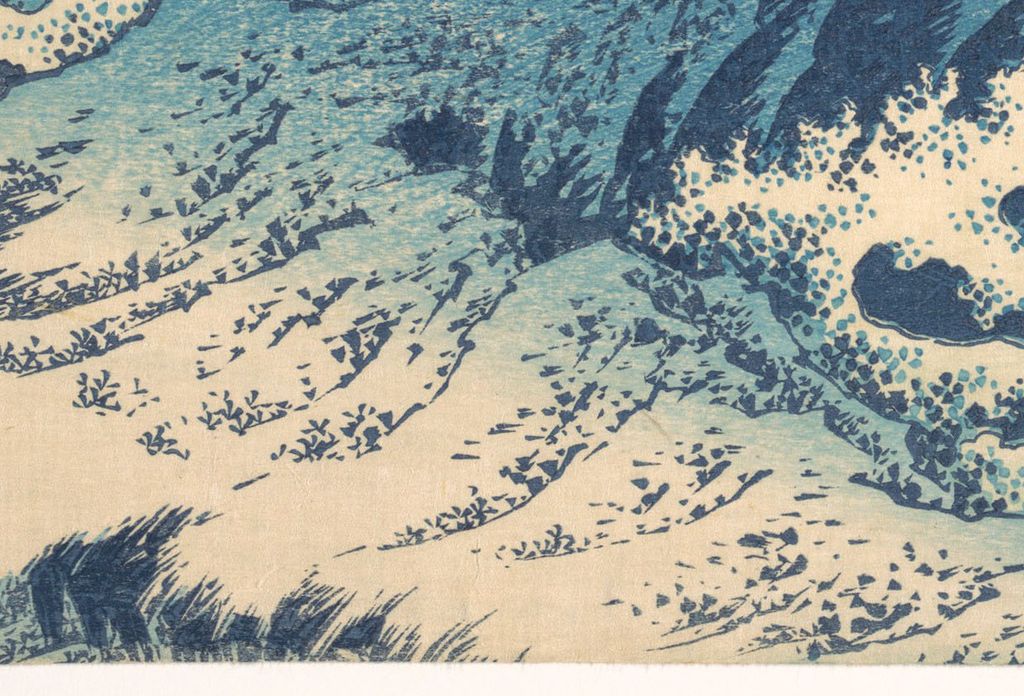
The rock also has two scales of description. Near the bottom, brush-like textures and dark ridges mark the slope. Up by the workers, a broken edge gives way abruptly to open water. These features give the broad diagonal a usable surface. The more time you spend looking at the fisherman’s tiny footing, the more of the rock’s weight you feel beneath it. The moving river and the steep bank are clear enough to understand without a detailed map of the site. [1]
The triangle of Fuji
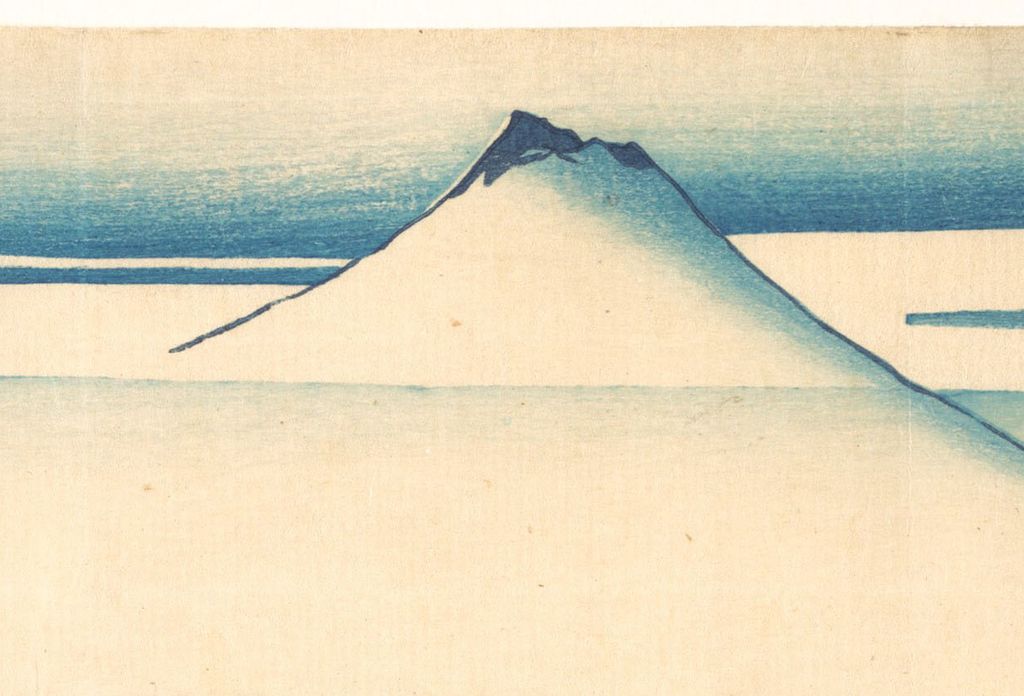
In JP2986, the mountain’s summit appears near the upper right. One flank climbs out of a pale interval, while the other drops in a long arc toward the right edge. Near the top, a darker passage marks the summit and thins into a softer wash as the slope descends. The rest of the lower mountain loses definition against the surrounding light. A few flat strips of blue behind the peak let it advance and recede depending on where you look. [1]
Sumida’s catalogue draws attention to the resemblance between the angular figure bending into the net and Fuji itself. The Tokyo Fuji Art Museum also points to the triangle formed by the placement of the elements around the ledge. You can trace a broad shape up the sloping rock, through the high point of the bent fisherman and back down along the lines. The nearer triangle is irregular, with a man’s head and hands projecting from it. Fuji’s summit has its own uneven outline, but the mountain’s long flanks carry the shape across a greater distance. Once you notice the resemblance, the longer you look at either side of the print, the more readily the other shape comes into view. [1] [2] [3]
A comparison with The Great Wave off Kanagawa shows how freely Hokusai could change the scale and placement of the same mountain. In the marine print, the great curl of water rises in front of Fuji, and the crews seem caught in its hollow. In Kajikazawa, the fisherman’s cords draw an exposed line between a person and the current. Fuji is close enough in shape to the figures’ predicament to help hold the composition together. The river’s agitation has a different source from the approaching swell at Kanagawa. We see it in the water breaking around a fixed ledge and in the work of drawing fishing gear through the current. [1] [2] [6]
Blue impressions and a red jacket
The blue of JP2986 does several jobs. It makes a dark mass of the fisherman’s jacket, describes lighter stretches of water and gives the air around Fuji a soft gradation. Light paper is part of this scheme. It separates the thin cords, carries the brighter curves of the foam and opens a space around the lower slope of the mountain. Sumida describes its Peter Morse Collection sheet as an aizuri impression, printed in shades of blue. Aizuri describes the colour scheme. Identifying the substance that makes each blue requires different evidence. [1] [2]
Compare JP2986 with the Met’s JP1327. The second sheet gives the fisherman a reddish jacket and introduces a warm line in the sky above the distant water. It also gives the crouching companion a warmer accent. The red shifts attention toward the two figures. In JP2986, the dark blue of the jacket keeps the man visually connected to the rock and the water. A further blue impression, the Met’s JP2581, preserves the basic arrangement but has a stronger blue passage behind the peak on the right. At a glance, the relationship between the mountain and the sky is different in all three, even before you look at the small lines. [1] [7] [8]
The Rijksmuseum describes its sheet AK-MAK-941 as a colour woodblock impression with a black line block. Comparing editions of a design involves more than deciding which colour appears darkest. A printer could change how a block was inked or how a colour gradation was applied. Changes could also result from damage or alterations to the blocks. Conservation researcher Capucine Korenberg shows how tracing the same tiny contour across a group of impressions can help establish a printing sequence. Looking at a digital image tells us how the sheets differ in appearance. It takes evidence from the objects to sort the effects of printing from changes to the paper or colour since it was printed. [4] [9]
Kajikazawa before the Fuji series
The place already interested Hokusai before the famous print. The Ōta Memorial Museum of Art’s 2025 exhibition checklist includes Kajikazawa in Kai from the seventh volume of Hokusai Manga, alongside two impressions of the Fuji-series design. It dates the book entry to 1817. The National Diet Library also catalogues the seventh volume under a distinct book record. This earlier use of the subject places Kajikazawa in Hokusai’s work with printed books well before he took it up for the large landscape series. The volume number is a piece of publishing history for the book and does not tell us where the later sheet appeared in the sequence of Fuji designs. [10] [11]
The same place could have different uses in two formats. A reader of an illustrated book encounters one scene as they work through a sequence of openings. The large, single-sheet landscape offers room to extend the rock, the river and the direction of the fishing cords across most of the paper. It gives Mount Fuji the distance it needs to look remote while leaving the fisherman's small loop of cord visible. Even without tracing any particular line from a book illustration to the later print, the recurrence tells us that Hokusai could return to a place and ask a different question of it. [1] [10]
In the 2026 exhibition of the Iuchi Collection at the National Museum of Western Art in Tokyo, Kajikazawa was represented by one of the series’ forty-six designs. Looking for the mountain across the group is a way to see how the same motif can do a different job in each print. Here Fuji repeats something the two figures are making in front of us with their bodies and their gear. Follow the slack loop at the fisherman’s knees out along the straight cords and then back up to the two sides of the mountain. What first looks like empty air between them becomes the distance over which those shapes answer each other. [1] [5]
Where this work sits in Hokusai’s career
Hokusai Manga
From 1814Kajikazawa in Kai Province by Katsushika Hokusai
ca. 1830–32Annotated Details from Kajikazawa in Kai Province
The numbered view uses the Metropolitan Museum of Art’s impression JP2986. Look for the same features in the complete sheet before opening the details below. [1]
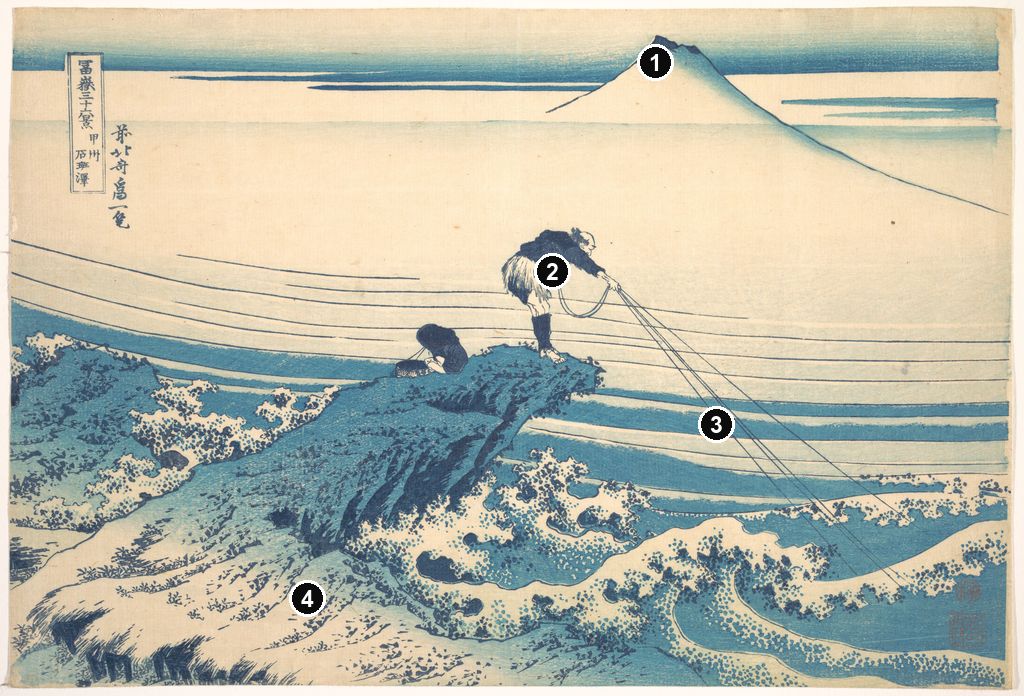
Details from KAJIKAZAWA IN KAI PROVINCE
The details show how the parts of the design work together.
Fuji above the horizon
Fuji sits high and far beyond the ledge. Its low outline answers the slopes made by the figures and their gear in the foreground. [1]
The fisher’s footing
The fisher leans forward where the rock projects over the water. The smaller figure sits below, closer to the ledge. [1]
Lines above the current
Slanting lines extend from the fisher to the river. Their narrow geometry sets off the mottled waves and spray beneath. [1]
The rock in the current
The solid ledge gives the figures purchase above sharp changes in the water. The pale and dark marks separate its surface from the turbulent current. [1]
Explore Hokusai’s works
Discussion
Look again at the images and ideas explored in Kajikazawa in Kai Province by Katsushika Hokusai. These editorial prompts invite your observations.
Reader Insights
Where do the lines of the tackle and the mountain seem to meet?
How does comparing the impressions change the figure’s prominence?
Join the Conversation
Share a detail, comparison or question about Kajikazawa in Kai Province by Katsushika Hokusai below.
References
- The Metropolitan Museum of Art, Kajikazawa in Kai Province (Kōshū Kajikazawa), JP2986. View source.
- Sumida Hokusai Museum, Thirty-six Views of Mount Fuji: Kajikazawa in Kai Province (冨嶽三十六景 甲州石班沢), Peter Morse Collection. View source.
- Tokyo Fuji Art Museum, Thirty-six Views of Mount Fuji: Kajikazawa in Kai Province. View source.
- Rijksmuseum, Kajikasawa in de provincie Kai, AK-MAK-941. View source.
- The National Museum of Western Art, Tokyo, Hokusai: Thirty-six Views of Mt. Fuji from the Iuchi Collection, exhibition checklist, 2026, no. 16. View source.
- The Metropolitan Museum of Art, Under the Wave off Kanagawa (Kanagawa oki nami ura), JP1847. View source.
- The Metropolitan Museum of Art, Kajikazawa in Kai Province (Kōshū Kajikazawa), JP1327. View source.
- The Metropolitan Museum of Art, Kajikazawa in Kai Province (Kōshū Kajikazawa), JP2581. View source.
- Capucine Korenberg, “How to determine the production chronology of a Japanese woodblock print,” Andon, 2022, British Museum research repository. View source.
- Ōta Memorial Museum of Art, Hokusai: Thirty-six Views of Mount Fuji, exhibition checklist, 2025, including Hokusai Manga, vol. 7, 甲斐鰍沢. View source.
- National Diet Library, Hokusai Manga, volume 7, collection record. View source.






