


 by Tom Gurney
Tom Gurney BSc (Hons) is an art history expert with over 20 years experience
Published on June 19, 2020 / Updated on November 20, 2026
Email: tomgurney1@gmail.com / Phone: +44 7429 011000
Enoshima in Sagami Province
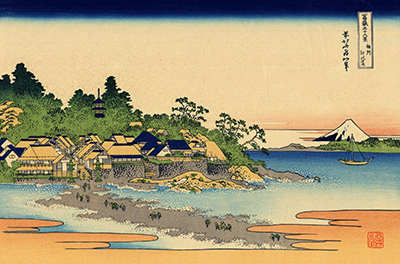
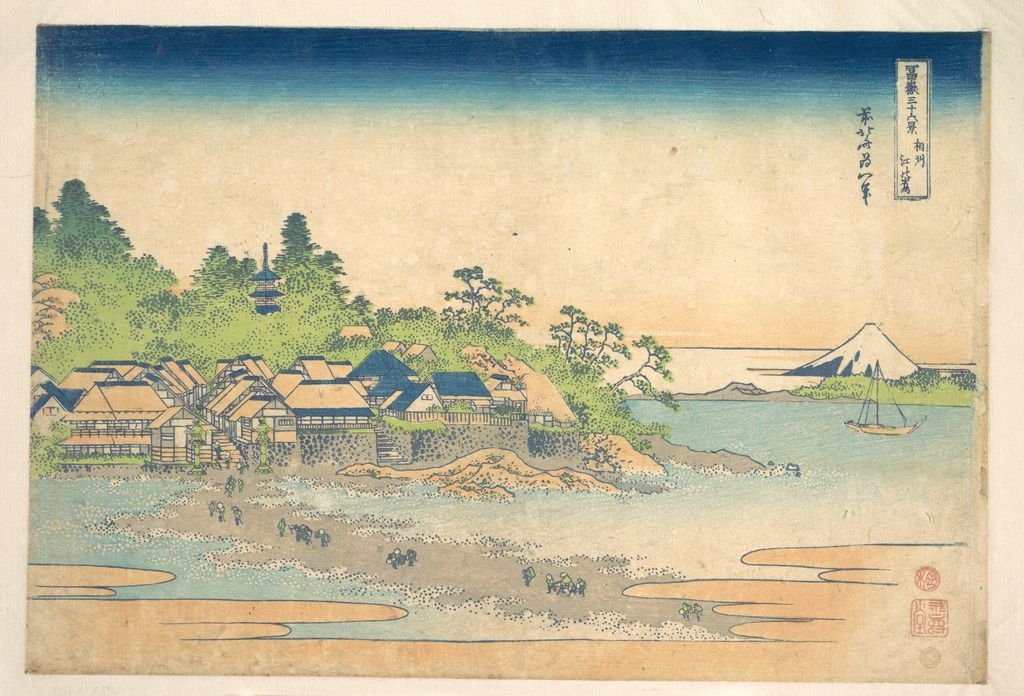
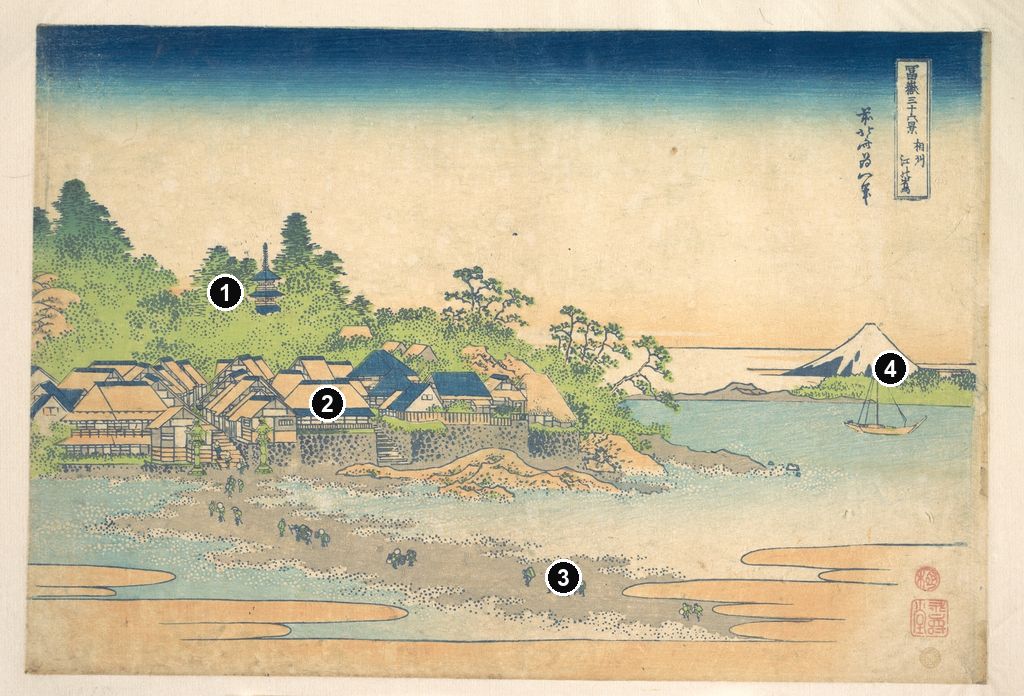
A line of travellers crosses the shallows beneath the roofs of Enoshima. Some have reached the island and others are spread out along the uneven bank still exposed by the tide. In Katsushika Hokusai’s Enoshima in Sagami Province, the people are hardly taller than the flecks of ink beside them. Their spacing makes it possible to follow the crossing from the lower right to the foot of a street on the left. Mount Fuji rises across an open reach of water, its pale slopes above a single sailing boat.
The Metropolitan Museum of Art dates its impression JP22 to about 1830–32. It is a colour woodblock print, 25.7 by 37.8 centimetres, from Thirty-six Views of Mount Fuji. The cartouche at upper right carries the series and design titles, and the artist’s signature sits beside it in the open sky. The National Museum of Western Art in Tokyo lists a separate impression from the Iuchi Collection under number 35 in its exhibition checklist. [1] [2]
At a Glance
- ArtistKatsushika Hokusai
- Dateca. 1830–32
- MediumColour woodblock print
- SeriesThirty-six Views of Mount Fuji
Contents
The crossing at low tide
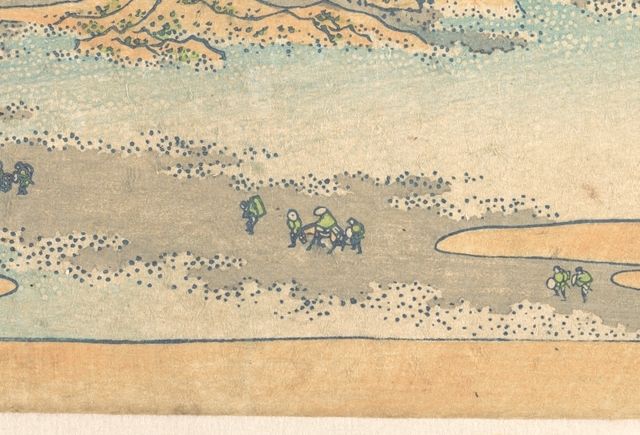
The crossing first appears low in the composition, where the flattened ochre shapes along the edge open onto a pale strip of exposed ground. The strip curves leftward through the blue and gathers width as it approaches the settlement. Its irregular margins are worked in small dots. A few lighter areas break into the grey where a viewer might expect a smooth road. The people follow that uneven surface in pairs and clusters. As they get closer to the houses, more of them are set apart from one another. Hokusai gives the eye enough ground to see the distance between the groups, as though each had found a way across at a slightly different pace. [1]
Enoshima lies off the coast of what is now Fujisawa in Kanagawa Prefecture. The Tokyo Fuji Art Museum’s entry explains that the crossing was made on foot when the tide uncovered the sandbar. The walkers were travelling to an island known both for its scenery and for worship of Benzaiten. The museum sees a sense of haste in their movements, in keeping with a crossing possible for a limited part of the day. Hokusai makes the path feel temporary by putting water close to the feet of the figures along much of its length. [3]
Follow the walkers to the island and their progress changes direction. The strip that led across the lower half of the sheet converges with a channel between buildings. The roofs step down the hillside on either side, and several tiny figures can be distinguished in the opening between them. The Tokyo Fuji Art Museum identifies a large stone lantern at the beginning of the approach and the buildings alongside the approach as shops. The thickest concentration of houses is directly above the point where the walkers come ashore. The crossing and the buildings therefore read as consecutive parts of the same journey. [1] [3]
The Fujisawa City Archives documents Enoshima as a place of pilgrimage and sightseeing. Its collection includes a travel board game in which a route from Nihonbashi leads along the Tōkaidō and takes in Kamakura and Enoshima before returning to Edo by another route. The game gives some sense of the island’s place in the imagined journeys of city dwellers. It also helps explain how the approach itself could be recognisable print subject matter. The details nearest the viewer are the shifting sand and the streams of visitors, with the hillside above offering only glimpses of what drew them onward. [4]
Roofs, sails and mountain slopes
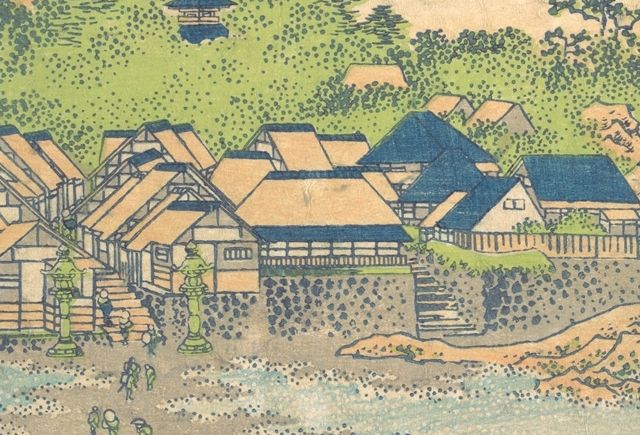
On the left, alternating light and dark roofs have much the same slant even where they belong to buildings facing different ways. Their slopes make a set of jagged edges that can be followed uphill before the trees take over. Along the front of the settlement, a stone-faced wall holds the row of buildings above the water. Its pattern of small dark marks is coarser than those along the sandbar, and the closely set outlines of the buildings give the hill visual weight. At the right end, the wall and the roofs give way to exposed, rounded rock and a thin point of shore. [1]
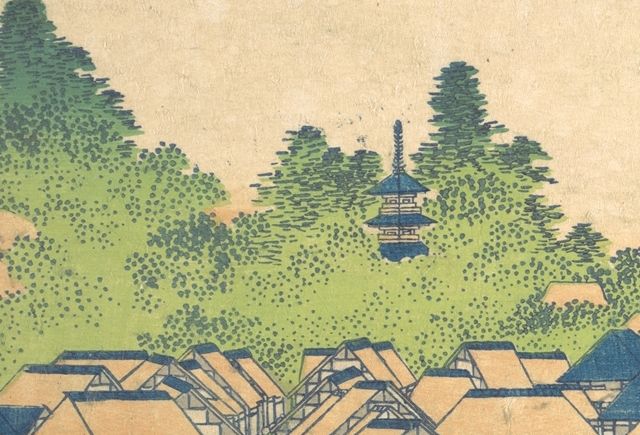
There is another upright above the roofs, where the tip of a tower breaks the foliage and several layers of its eaves remain visible in the darker trees. Below it, scattered warm patches among the greens break up the slope. At the island’s right edge, more of the open sky shows between the trees. The foliage there is represented by small clusters held on long, thin branches. As the shoreline turns away beneath them, the shape of the island is marked by the same blue water that the travellers cross below. [1]
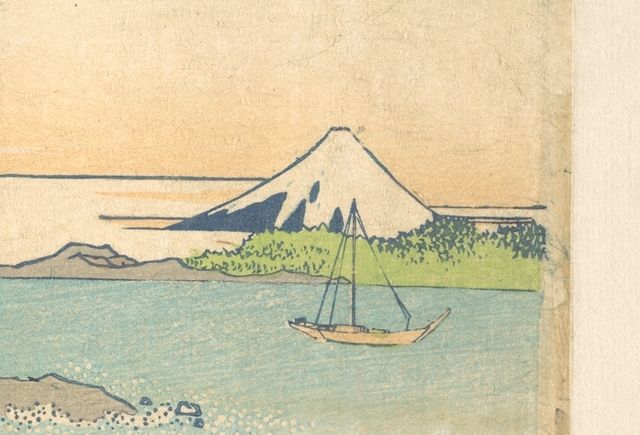
The most distant triangle is also the palest. Fuji’s summit sits to the right of the island and below the upper edge of its wooded hill, even though the mountain is immense. Short dark passages at its base leave long pale areas rising to the peak. A low coastline partly screens the foot of the mountain, and two thin horizontal traces extend to the left above that coast. The open ground of the sky makes the upper outline easy to find. The angular roofs and small triangles in the boat’s rigging set up echoes of the mountain, which can be seen one after another across the print. [1]
The boat on the right is one of the few marks in that wide area of water. Its hull is a shallow curve, with thin lines reaching upward towards the base of Fuji. The shoreline behind it supplies a nearly horizontal reference for those lines. Low in the composition the ochre shapes stretch in from both sides, leaving relatively little space for the walkers. Near the boat there is enough space to draw its form nearly on its own. The print thus gives a sense of the bay’s breadth within the same view that makes the human crossing look crowded. [1]
What two impressions reveal
Another Met impression, JP2559, measures 25.7 by 37.5 centimetres. Compare the water on the right between the boat and the distant shore. In JP22, blue extends behind the boat towards the base of the far land. In JP2559, the area beyond the boat is pale, making the hull read more clearly against the open water. The blue is stronger lower down, especially around the irregular edges of the crossing. Dense colour there picks out the sandbar’s small points and bays. Both sheets retain the same path through the composition, from the ochre shapes below to the dark trees and the sky. [1] [5]
Conservation researcher Capucine Korenberg used Enoshima in Sagami Province to investigate how woodblock prints change over successive printings. Her comparison drew on photographs of 39 impressions. She studied recurring breaks in lines such as the border of the title cartouche and the slopes of Fuji, where damage to the carved block can interrupt the printed outline. Her study distinguishes seven states. She places JP22 in state five and JP2559 in a variant of state seven, where the light blue beyond the boat was left unprinted. The reddish seals that are visible near the lower right of JP22 were also omitted from that variant. [6]
Those distinctions depend on several parts of the design being examined together. Fading, uneven printing and later treatment can each complicate the reading of a single mark. In JP2559, Korenberg notes that breaks in the outlines appear to have been filled in, possibly during conservation treatment in the twentieth century. A comparison of the two Met photographs makes the broad difference in water colour easy to see. Korenberg’s work supplies the additional evidence needed to place those two sheets in a sequence of printings. [1] [5] [6]
Enoshima in other views
Hokusai also pictured this stretch of coast in Shichirigahama Beach in Sagami Province, another design in the Fuji series. The Sumida Hokusai Museum describes that composition as an elevated view from the beach’s hillside towards Koyurugi Cape and Enoshima, with Fuji behind. The Chiba City Museum of Art also notes uncertainty over whether the conspicuous wooded form in the middle distance represents the island or the cape. In either reading, the landforms dominate the design and there are no walkers. In Enoshima in Sagami Province, the exposed crossing reaches forward into the picture, inviting the viewer to take the same route as the people in it. [7] [8]
There is an earlier design still, Spring at Enoshima, made in 1797 for the poetry album Yanagi no ito. The National Gallery of Victoria describes its high view of both Enoshima and Fuji, with people down on the beach. Breaking waves and people occupy the near shore, with the island and mountain higher in the image. In the Fuji-series Enoshima, made more than thirty years later, the foreground has a direct connection to the island through the sandbar. The small people make the width of that approach visible, and the buildings show where the movement leads. [3] [9]
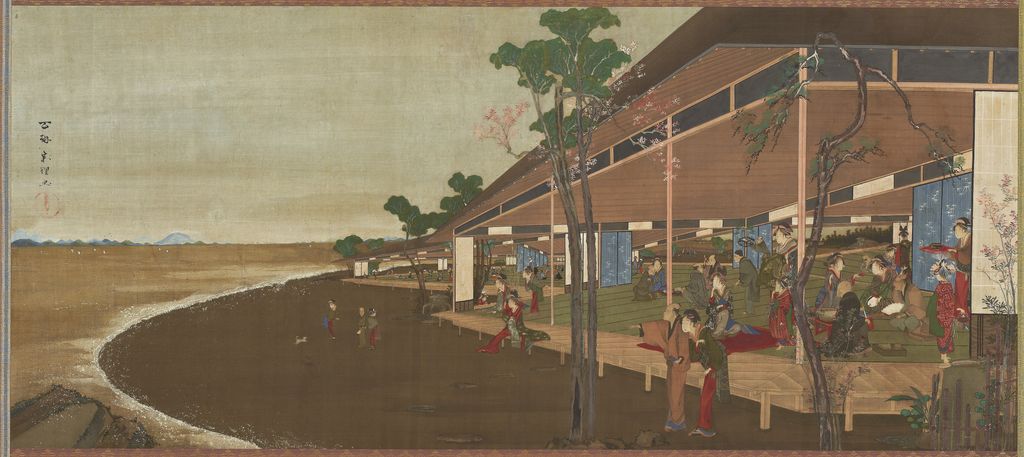
In an untitled print from the early 1800s discussed in the same museum essay, Hokusai brought the island forward on the left and set the distant shoreline and Fuji on the right. The print was a surimono, a privately commissioned woodblock print. Enoshima’s size relative to Fuji in that earlier work anticipates the 1830s landscape. In the later design the shore, buildings and visitors fill in the intervening space, giving an elevated view of the island as well as a path through the scene. [9]
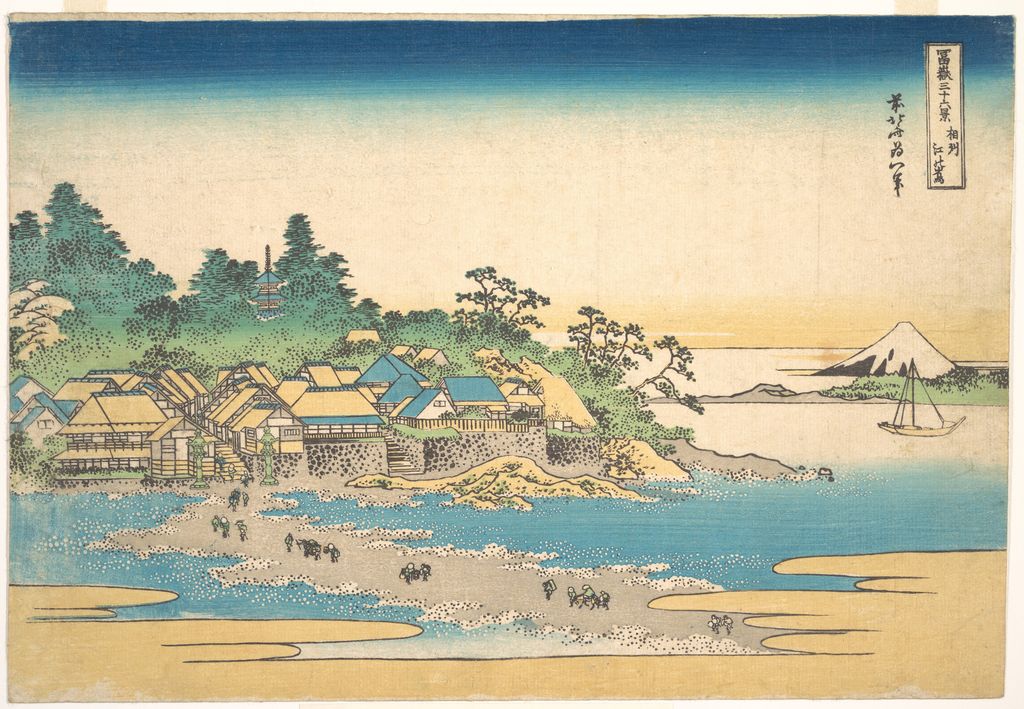
Image comparison
Where this work sits in Hokusai’s career
Annotated Details from Enoshima in Sagami Province
The Metropolitan Museum of Art, JP22. [1]
Details from ENOSHIMA IN SAGAMI PROVINCE
Select a detail to look closely.
Trees mark the silhouette of Enoshima
The island extends from the left. Trees and slopes rise well above the shore and the buildings. [1]
Roofs follow the edge of the island
Angular roofs stand out where the slope meets the lighter foreground. [1]
Small travellers cross the tidal flats
The dark strokes are short and widely spaced across the pale surface. They give the crossing a human scale. [1]
A distant Fuji rises to the right
A pale triangular outline interrupts the horizontal edge of the distant shore. [1]
Explore Hokusai’s works
Discussion
Look again at the images and ideas explored in Enoshima in Sagami Province. These editorial prompts invite your observations.
Reader Insights
Where do the travellers leave the open sands?
How does the slope of the island lead towards the mountain?
Join the Conversation
Share a detail, comparison or question about Enoshima in Sagami Province below.
References
- The Metropolitan Museum of Art, Enoshima in Sagami Province (Sōshū Enoshima), accession JP22, collection record and photograph. View source.
- National Museum of Western Art, Tokyo, Hokusai: Thirty-six Views of Mt. Fuji, Iuchi Collection exhibition checklist, item 35. View source.
- Tokyo Fuji Art Museum, Thirty-six Views of Mount Fuji: Enoshima Island in Sagami Province, Japanese-language collection record and commentary. View source.
- Fujisawa City Archives, 祈念の島 — 中世文書にみる江島弁才天信仰, exhibition on the island’s Benzaiten worship and associated travel. View source.
- The Metropolitan Museum of Art, Enoshima in Sagami Province (Sōshū Enoshima), accession JP2559, collection record and photograph. View source.
- Capucine Korenberg, “How to determine the production chronology of a Japanese woodblock print,” Andon 113 (2022), pp. 42–60, especially figure 18 and table 2. View source.
- Sumida Hokusai Museum, Thirty-six Views of Mount Fuji: Shichirigahama Beach in Sagami Province, Japanese-language collection commentary. View source.
- Chiba City Museum of Art, Shichirigahama Beach in Sagami Province, accession 2903020, collection record and commentary. View source.
- National Gallery of Victoria, “The Old Man, Mount Fuji and the Sea,” discussion and illustration of Spring at Enoshima, 1797. View source.







