


 by Tom Gurney
Tom Gurney BSc (Hons) is an art history expert with over 20 years experience
Published on June 19, 2020 / Updated on November 20, 2026
Email: tomgurney1@gmail.com / Phone: +44 7429 011000
Snowy Morning at Koishikawa by Katsushika Hokusai
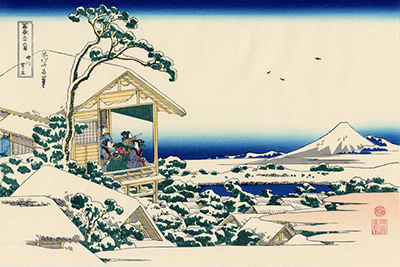
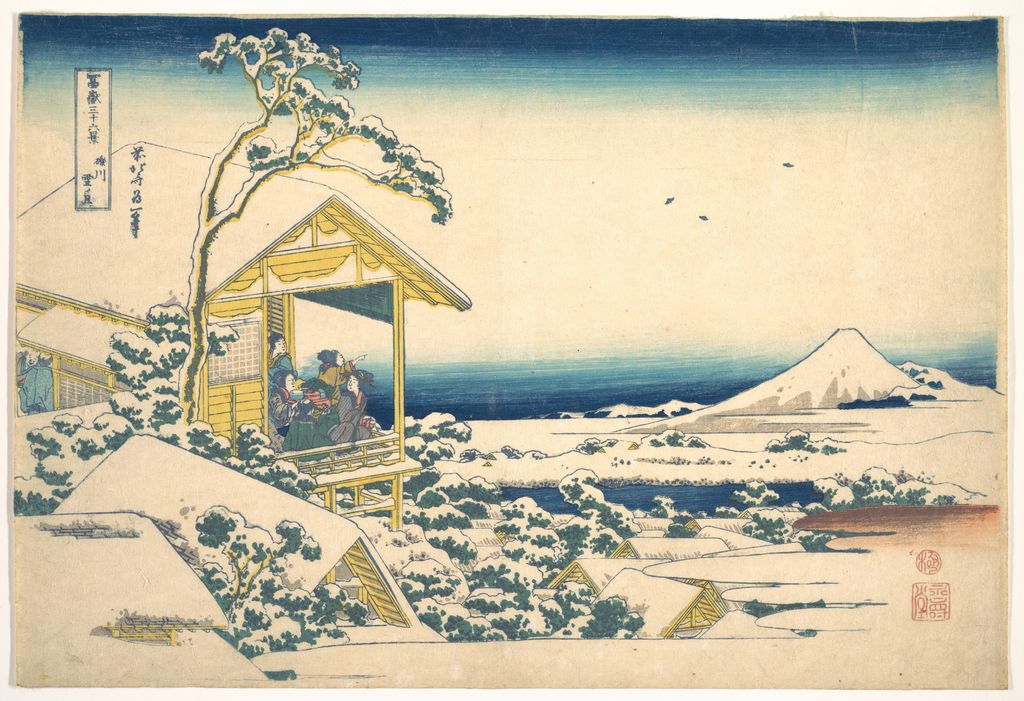
A woman on a teahouse veranda points into the winter sky. Her companions sit with trays and dishes within a narrow opening, framed by posts and a roof. In front of them, snow lies over the roofs and trees of Koishikawa. A little farther along the line of the woman’s arm, three birds cross the open sky. Mount Fuji rises on the right, its white slopes so close in tone to the snow on the nearest roof that the two may catch your eye almost together. Hokusai gives the teahouse and the mountain very different scales, then asks one small gesture to connect them. The Metropolitan Museum of Art calls this colour woodblock print Morning after the Snow at Koishikawa in Edo and dates its impression JP2957 to about 1830–32. [1] [2]
At a Glance
- ArtistKatsushika Hokusai
- Dateca. 1830–32
- MediumColour woodblock print
- SeriesThirty-six Views of Mount Fuji
Contents
Looking out from the veranda
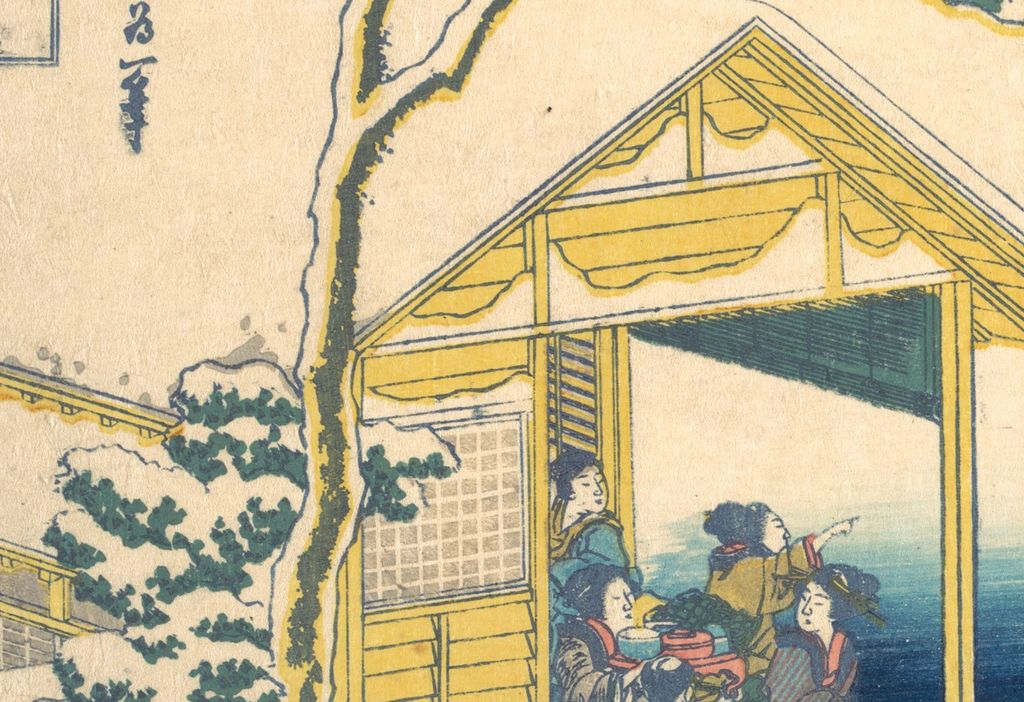
The building occupies much of the left side of the print. Its pitched roof pushes into the sky, and slender posts run from the gable to the balcony. Underneath, the rails and supports remain visible from a little below. We seem close to the height of the balcony without quite joining the party. The group occupies a small rectangle where bright patterns and dark sleeves touch. Farther down, the roofs of other buildings rise into the foreground and hide their own walls, as if we were looking over the tops of houses from the upper part of the hill. The veranda supplies both the height from which the scene can be understood and a place where somebody has stopped to look. [1] [3]
Study the grouping around the opening. A figure brings a tray with dishes towards the other people. One of the seated figures has turned her head back towards the tray. Behind them, the woman in a yellow garment leans out and raises an arm across the edge of the group. There are several directions of attention in this small space. The meal and conversation keep some of it inside, while the pointing hand carries it into the rest of the picture. The Met describes the rectangular opening as a small composition in its own right. Its label identifies the pointing figure as a waitress directing the visitors towards Fuji. The Ōta Memorial Museum of Art instead describes a guest and considers whether she is pointing to the mountain or to the birds. The action is visible whichever identification we follow. [1] [4]
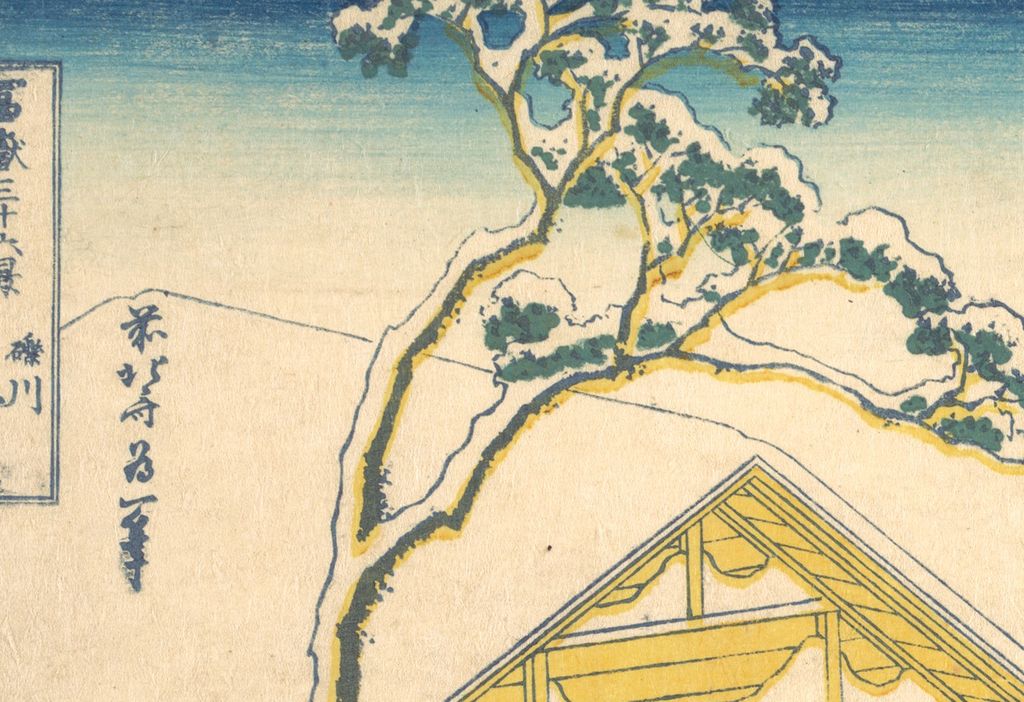
The large tree complicates the transition from house to sky. Its trunk bends through the near roofs and then grows above the teahouse. Dark clusters of foliage carry caps and narrow streaks of white. At the top the branches reach right into the pale part of the sky in JP2957. The tree makes an angular route across the left half of the sheet, while the woman’s hand takes a much shorter one. Both push attention away from the dense foreground, where the building and the snow-laden foliage have so many small lines to look at. [1]
Three birds over a snowy city
The birds are small enough to look at first like stray marks on the paper. In the Met’s JP2957, two fly near one another and the third is higher and farther to the right. The Ōta curator Kenji Hinohara reproduces a detail of the birds in his discussion of the print. Their spread across the sky gives the eye something to follow between the activity on the left and the peak on the right. The Sumida Hokusai Museum reads the figure as pointing at the birds and describes how their small scale extends the space of the image towards Fuji. Look at them from a distance and they register together. Look closely and the spaces between them matter as much as their individual shapes. [1] [2] [4]
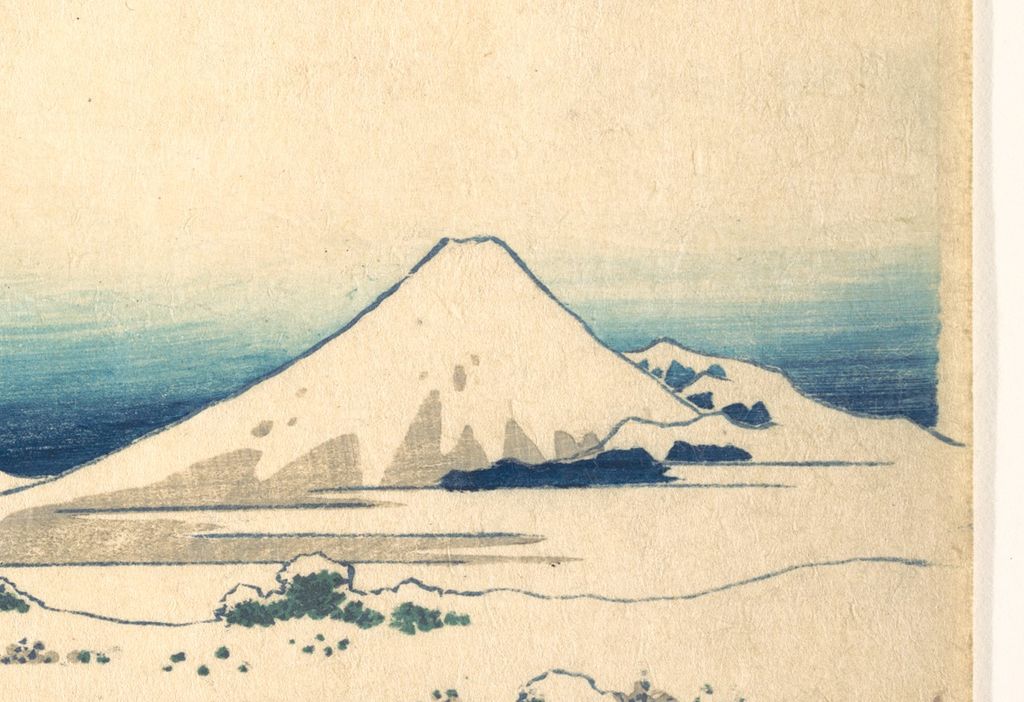
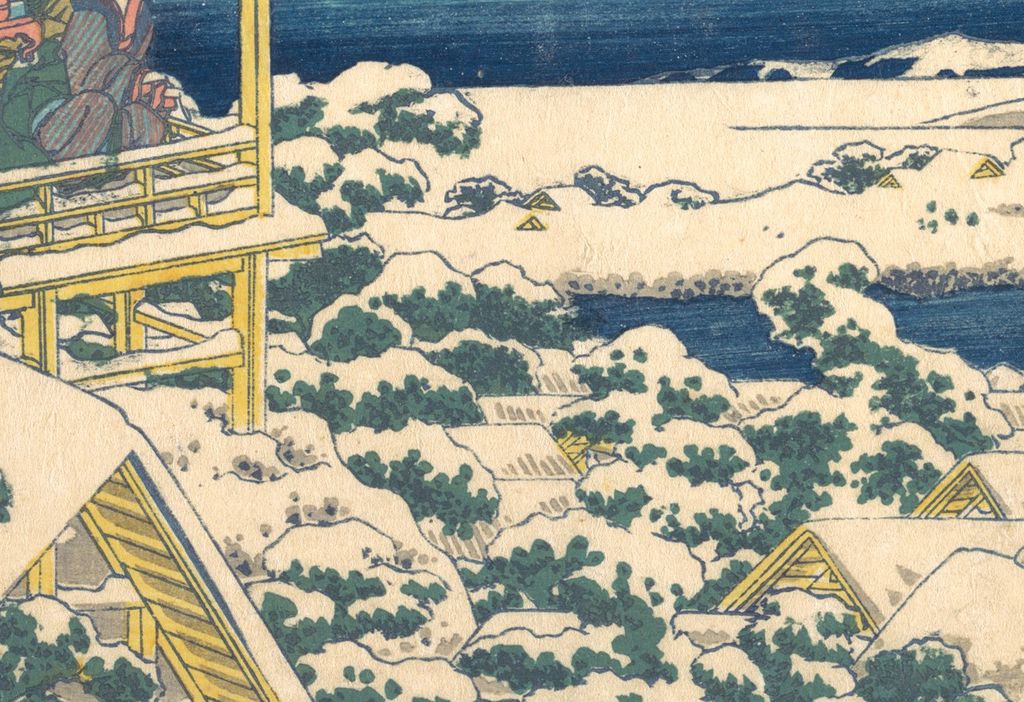
Below the birds, the roof nearest the bottom left is a broad pale shape with a sharply sloping edge. Smaller gables repeat that shape among blue shrubs and trees. On some roofs, a little of the yellow or ochre face remains visible beneath the pale cover. On the lower right, a comparatively open passage of snow runs towards the unprinted-looking margin. Fuji’s white summit comes after several such changes of scale. The print makes snow legible through what borders it. The pale areas on the roofs acquire their weight from the ridge and eaves. On trees, they perch on irregular clusters. On Fuji they sit within a long outline that is partly broken by darker marks on the lower slopes. Those bordering forms are the clearest evidence in the photograph for how Hokusai made the light areas read as snow. [1]
The view also uses horizontal bands. The land immediately behind the teahouse runs across the composition in narrow stretches of light and dark. The blue at the horizon is deepest just where Fuji rises out of it. That gives the mountain a firm lower setting even though the sides are pale. The Met’s record for its impression JP1330 describes a view of the mountain beyond the Edo River. From the balcony, the combination of foreground roofs, a broken middle ground and clear stretches of distance makes the height of the viewpoint feel plausible, even with so little space available to represent the city. [1] [5]
The lower part of the scene changes direction more often than these long bands suggest. A ridge below the veranda runs diagonally down towards the centre, and another roof enters from the bottom edge at a different angle. Further back, individual shapes are flattened until their edges almost merge with the bands. The farther our eye travels, the less it has to turn to read the land. Fuji then breaks that run of horizontal lines with a single broad triangle. [1] [5]
Where the view may have been taken
Koishikawa survives as a place name in present-day Bunkyō, Tokyo. The Tokyo Fuji Art Museum describes the scene as a view from an upper floor of a teahouse on high ground. Hinohara proposes the vicinity of the present Ushitenjin Kitano Shrine in Kasuga. He draws on volume four of the illustrated Edo Meisho Zue, which shows the shrine on elevated ground. In his account, the western side dropped away and had teahouses with views in the direction of Fuji. This helps explain Hokusai’s placement of the veranda above nearby roofs. It leaves open the identity of the particular building, and the print itself gives the district in its title. [2] [3] [4]
Tokyo Fuji and Ōta both single this work out as the snow scene in Thirty-six Views of Mount Fuji. The interest here is in what a snowfall has done to a familiar view. It reduces whole roofs to planes of light and records the slope of the ground in the different heights of their ridges. Hokusai’s Rainstorm Beneath the Summit gives weather a different role. It brings the mountain close, with a charged dark slope and lightning below the summit. In the Koishikawa print the weather is legible at a different moment, in the accumulation left on the town, the trees and the mountain. The people on the balcony are part of how that change enters the scene. [1] [3] [4] [6]
The sky across two impressions
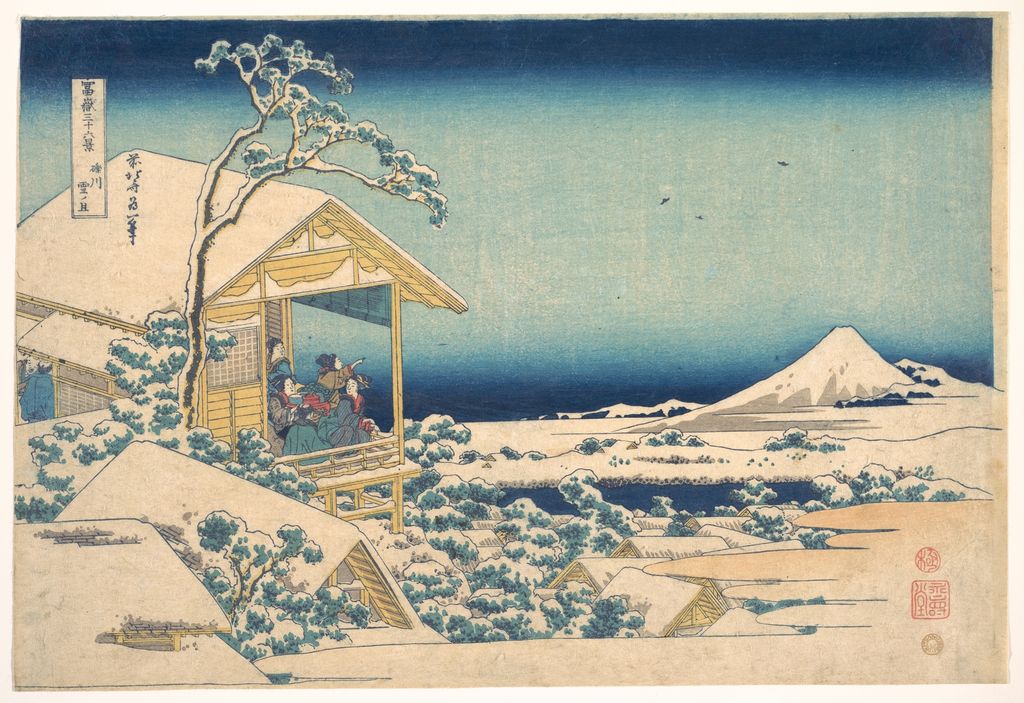
The Met’s JP2957 and JP1330 preserve the same arrangement of roof lines, branches, figures and birds. Their recorded dimensions are close. JP2957 measures 25.7 by 38.1 centimetres, and JP1330 measures 25.7 by 38.3. The most conspicuous difference in their museum photographs is the central part of the sky. In JP2957 the deep blue at the top gives way to a large pale field, before blue reappears at the horizon. In JP1330 a cooler blue-green middle tone extends much farther through that field. Fuji’s white summit stands more distinctly against it. The contrast around the pointing figure also changes. In JP2957 the light expanse above the horizon makes the transition from the veranda to the birds particularly easy to follow, while the stronger colour in JP1330 keeps the eye in the sky for longer. [1] [5]
Colour near the ground differs too. At the lower right in JP2957 there is a small wash with a reddish-brown cast above the two red marks. JP1330 has a paler brown passage in this area, and another faint mark is visible below the red pair. These are features of particular sheets and reproductions. The Met identifies both impressions as ink and colour on paper and assigns them the same approximate date range. The photographs support a comparison of the sheets as they appear today. Establishing printing sequence or pigment would require other evidence. [1] [5]
The morning in the title
The inscription sits high on the left, close to the building and tree. The smallest line gives the snow morning of the title. The last character on both Met sheets has the appearance of 且. That is how the Iuchi Collection exhibition checklist transcribes it in entry 26. Tokyo Fuji also catalogues the print with 且 and explains that it is understood as a mistaken form of 旦, the character for dawn or morning. The Met and Sumida use 旦 in their title records. Ōta’s discussion prints 旦 in its heading and distinguishes it from what can actually be seen in the cartouche. Its curator leaves open whether the odd form entered the design in writing or cutting. The English renderings agree on the essential subject. After the snowfall, people have gathered to look across a clear morning. [1] [2] [3] [4] [5] [7]
Where this work sits in Hokusai’s career
Hokusai Manga
From 1814Snowy Morning at Koishikawa by Katsushika Hokusai
ca. 1830–32Annotated Details from Morning after the Snow at Koishikawa
The Metropolitan Museum of Art, JP2957. [1]
Details from MORNING AFTER THE SNOW AT KOISHIKAWA
Select a detail to look closely.
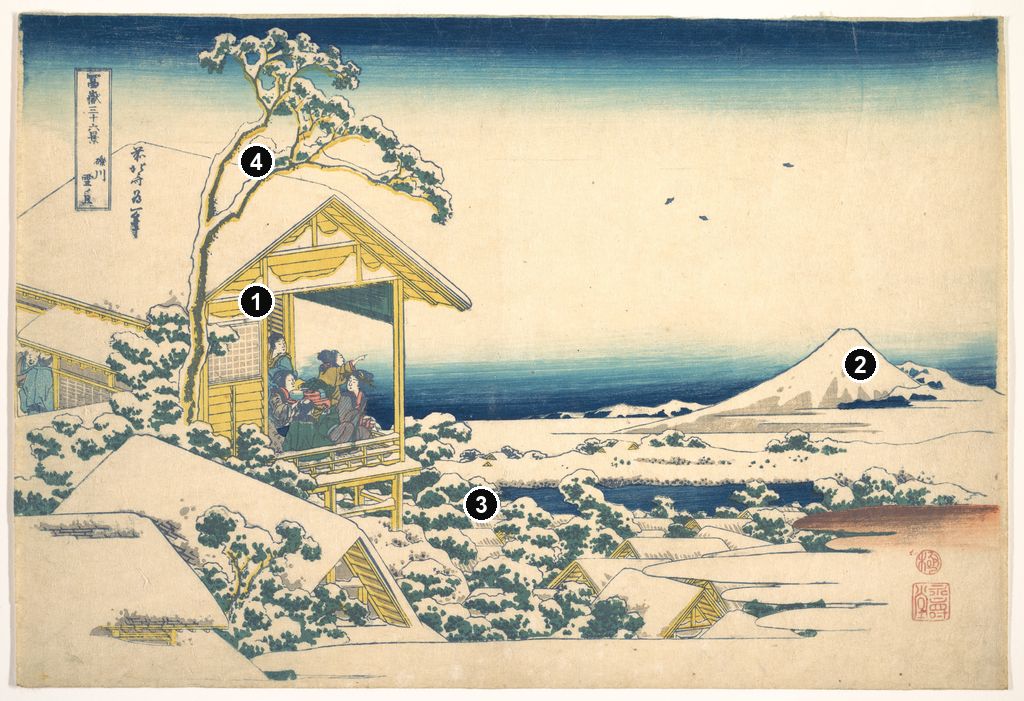
The veranda opens onto the view
The near building establishes a place for the people at left to look out from. The edge of the roof directs attention across the open landscape. [1]
A pale summit beyond the roofs
A thin line and the dark distance distinguish Fuji from the sky. The mountain repeats the pale surfaces nearer the viewer on a much larger scale. [1]
Roof edges divide the snow below
Dark shapes and thin branches interrupt the lightly printed gaps. The density of these interruptions makes the town read as nearer than the mountain. [1]
Branches interrupt the open sky
A high tree projects over the roof at left. Its irregular marks stand out against the horizontal colour above the distant view. [1]
Explore Hokusai’s works
Discussion
Look again at the images and ideas explored in Snowy Morning at Koishikawa by Katsushika Hokusai. These editorial prompts invite your observations.
Reader Insights
Where does the veranda guide your eye across the snowy roofs?
How is the white of the distant mountain set apart from the sky?
Join the Conversation
Share a detail, comparison or question about Snowy Morning at Koishikawa by Katsushika Hokusai below.
References
- The Metropolitan Museum of Art, Morning after the Snow at Koishikawa in Edo, accession JP2957, collection record, label and photograph. View source.
- Sumida Hokusai Museum, Thirty-six Views of Mount Fuji: Snowy Morning at Koishikawa (冨嶽三十六景 礫川雪ノ旦), collection commentary on the title, figure and birds. View source.
- Tokyo Fuji Art Museum, Thirty-six Views of Mount Fuji: Snowy Morning at Koishikawa (冨嶽三十六景 礫川雪の且), collection record 06256. View source.
- Kenji Hinohara, Ōta Memorial Museum of Art, The Sky on a Clear Morning after Snow (雪晴れの朝の空), museum essay and images. View source.
- The Metropolitan Museum of Art, Morning after the Snow at Koishikawa in Edo, accession JP1330, collection record, label and photograph. View source.
- The Metropolitan Museum of Art, Storm below Mount Fuji, accession JP2567, collection record and photograph. View source.
- National Museum of Western Art, Tokyo, Thirty-six Views of Mt. Fuji: Works from the Iuchi Collection, exhibition checklist, entry 26, Morning after a Snowfall at Koishikawa (礫川雪ノ且). View source.







