


 by Tom Gurney
Tom Gurney BSc (Hons) is an art history expert with over 20 years experience
Published on June 19, 2020 / Updated on November 20, 2026
Email: tomgurney1@gmail.com / Phone: +44 7429 011000
Lily
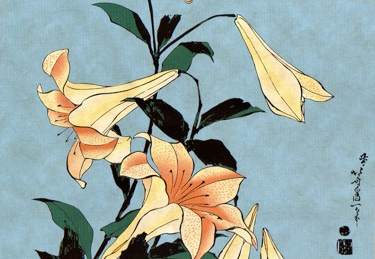
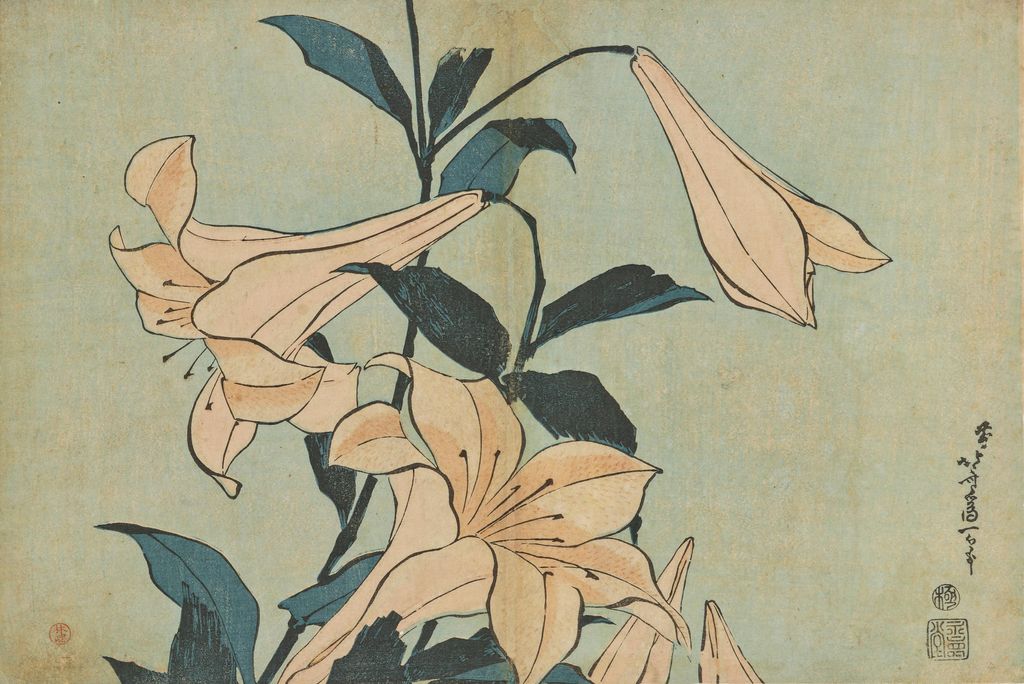
A curved stalk carries a lily high into the open right half of Katsushika Hokusai’s print. The flower hangs down, its narrow end attached to the stem and its broad edges beginning to turn apart. At the left, another lily opens sideways. Lower in the sheet a third presents its throat, with fine lines running out across the petals and dark marks at the ends of the stamens. The flowers are close enough to belong to one patch of growth, but their different angles give the viewer three ways to see a lily in the same glance. [1]
The Tokyo National Museum calls its impression Yuri (百合), or Lilies in English. Tokyo’s A-10569-2786 is a nineteenth-century Japanese colour woodblock print in the horizontal ōban, or large-sheet, format. Boston and Minneapolis hold impressions with the same conspicuous drooping flower at the upper right and the wide-open flower below. Each sheet gives the lilies most of the available field. There is no vase or strip of visible ground to define the distance between the plant and the viewer. [1] [2] [3] [4]
At a Glance
- ArtistKatsushika Hokusai
- DateEarly 1830s
- MediumColour woodblock print
- SeriesLarge Flowers
Contents
Three views of a flower
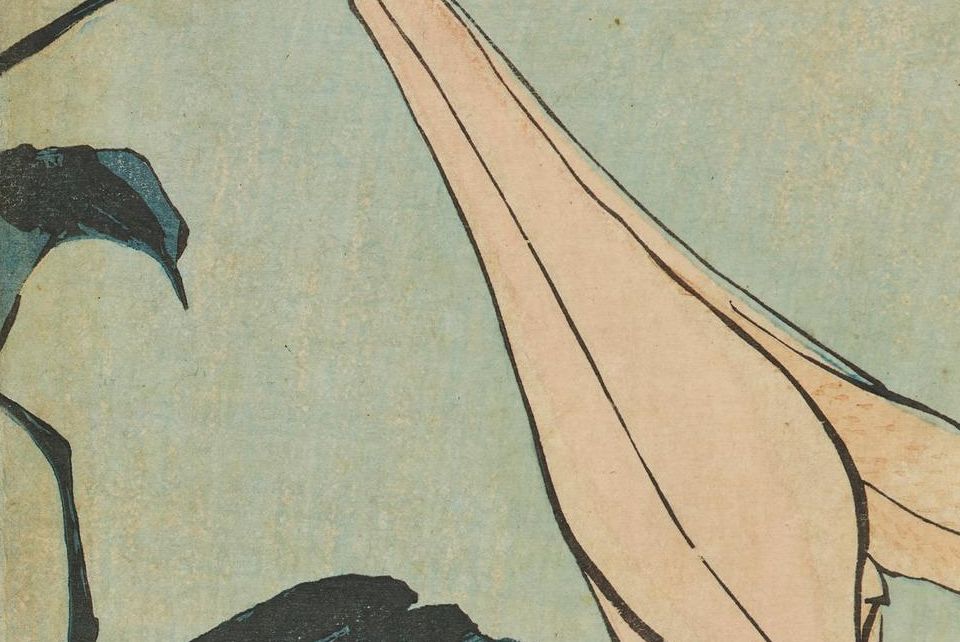
The upper flower has the simplest outline. It hangs from a slim hook in the stalk, leaving a gap between the blossom and the dark leaf below it. Follow the lines from the point where the flower begins. They spread slowly through the long form, then separate more rapidly near the ends. Two lobes turn away at different angles, making the right edge less regular than the left. Even where the outline is broadest, the interior of this flower is mostly sheltered from view. The open space around it makes the little variations in contour easy to follow. [1] [3]
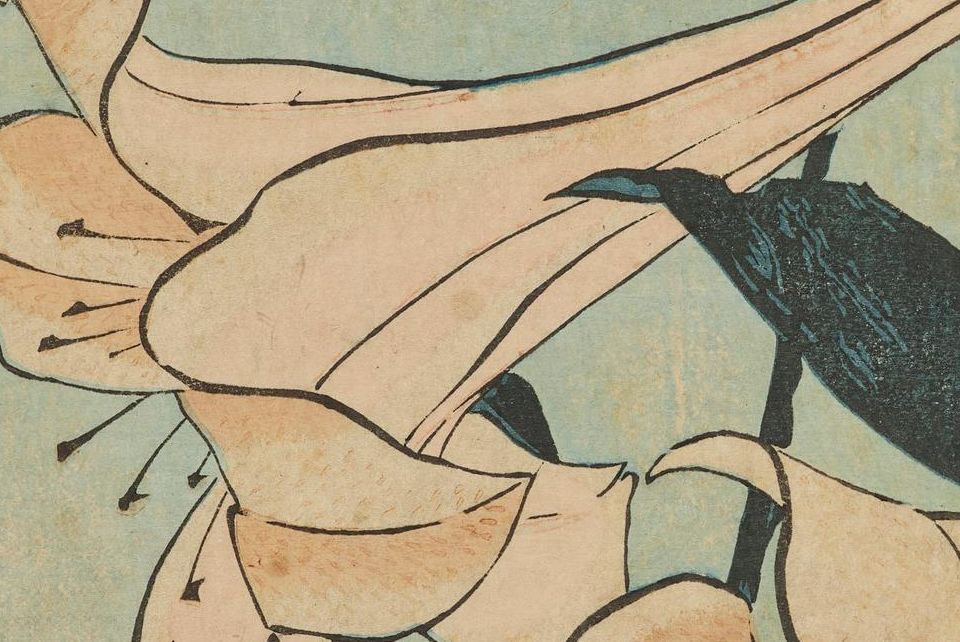
At the left, Hokusai gives the trumpet a length across the width of the sheet. It tapers towards the cluster of stalks, then opens into several curved surfaces. One tip at the upper left bends back like a small flap. Below it, other petals overlap so that their inner and outer surfaces alternate. A few fine lines project beyond the edge of the opening. These marks are easy to miss if the eye jumps straight from the pale shape of the flower to the lower cluster, where the stamens are much more conspicuous. The side view gives a sense of a deep tube narrowing behind the petal tips. [1] [3]
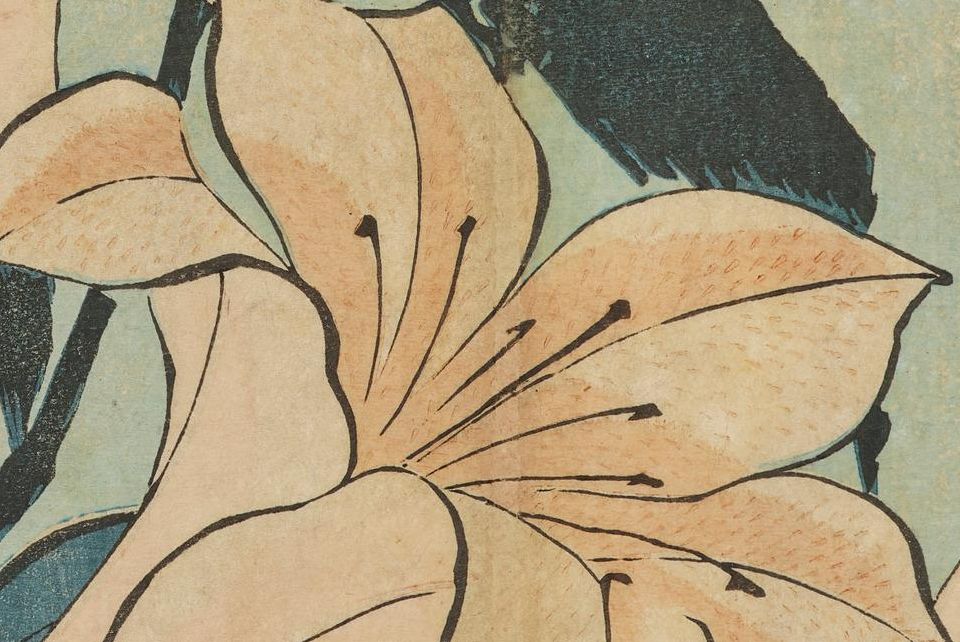
The open flower below brings the viewer much closer to the throat. Several long stamens spread from a tight centre. Their thin lines cross the lightly coloured interior, and the darker ends provide a series of small stopping points. The petal edges bend out from that centre on a wider scale. One rises into a point to the right. Another turns down and passes close to the lower margin. Where the edges fold, the outline helps separate one petal from the next. The eye can trace the structure outwards from the thin stamens and then back again around the much larger shapes that contain them. [1] [3] [4]
These flowers share the same basic structure. The narrow length of the side-facing trumpet helps explain what lies behind the open centre below. The bending tips of the upper flower lead towards the more visible folds on the left. In each case, Hokusai lets the viewer see a different amount of the interior. Taken together, the flowers suggest a plant changing over time, though each is fixed in its own position. Tokyo’s catalogue identifies the lily as a summer flower and singles out the pale red areas inside the petals as evidence of Hokusai’s close observation. [1]
The leaves and the edge of the sheet
The dark leaves are easiest to read where they spread clear of the flowers. Above the side-facing lily, a broad leaf points left while a narrower one angles upwards. Together they draw the eye towards the top edge, where the stem continues out of sight. Farther down, one narrow leaf leads to the right, close to the space beneath the hanging flower. The repeated taper of these forms gives the stem a direction every time the stalk itself is obscured by a blossom. [1] [3]
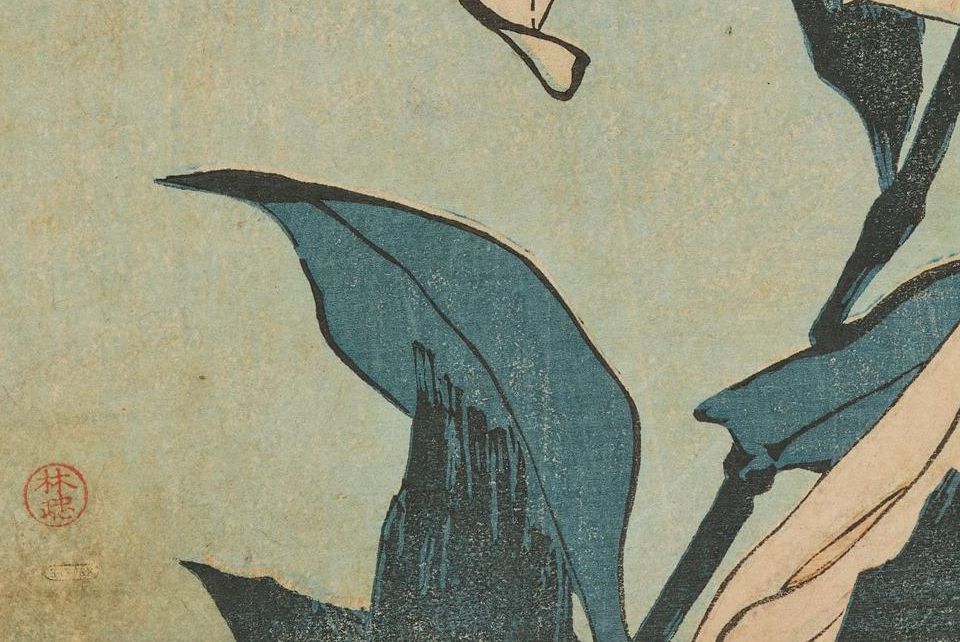
At the lower left, a large leaf turns towards the viewer. Its pointed tip and broad face take up much more space than the stalk that carries it. The adjoining leaves and petals are close enough to pass in front of one another, creating depth through overlaps across a short distance. Several shapes are cut off at the lower edge. The viewer can see where the visible parts join without being given the base of the plant. The top and lower edges therefore suggest growth extending in both directions, while the open right half lets the upper flower hang free. [1] [3] [4]
The darkest leaves gather where the three flowers nearly meet. A broad leaf behind the left trumpet stops short of its curled petals, while one above the open flower makes a dark edge against a long, pale fold. These contacts draw the eye to the middle of the sheet before the flowers pull it in different directions again. [1] [3]
The reserved area on the right also gives the inscriptions a clear place. The vertical signature is below the tip of the hanging blossom, well away from the tight intersection of flowers and leaves at the middle. Two seals sit below the signature on the Minneapolis sheet. The small marks are carried by the same open field as the distant tip of the flower, but their regular downward sequence has a different pace from the curves of the stem. The print offers a little pause between looking at the plant and reading the marks that identify the design and its publication. [1] [4]
What the three impressions show
Tokyo’s online photograph gives the lilies a pale peach appearance against a subdued greenish ground. Boston’s photograph of 11.17598 shows stronger red-orange along several petal folds and radiating from the throat of the open flower. The leaves in both pictures retain broad blue-green areas, interrupted by passages dark enough to make an overlapping edge stand out. The Minneapolis reproduction of 74.1.214 shows a lighter blue-green ground and warm areas spreading across the centre of the largest flower. Small dots near that flower’s throat can be picked out especially readily there. [1] [3] [4]
Start with an outline when comparing the sheets. The top stalk makes the same shallow arc before meeting the hanging flower in all three, and a small pointed petal at the right reaches beyond its neighbour. In the lower flower, the long petal at the right edge of the open throat has the same outline even where the warm interior reads differently. By following these features, the viewer can keep the composition fixed in mind while looking at what the colour does in each reproduction. A narrow strip of stronger colour can make a fold easier to find without altering the drawing of the petal around it. [1] [3] [4]
The differences visible online belong to photographs of separate objects. The paper and printed colour have individual histories, and lighting and photography affect how those colours appear on a screen. The images show where an emphasis is stronger or weaker. Establishing whether a printer applied the colour differently, or whether a particular colour has changed with time, would require direct evidence from the sheets. Boston and Minneapolis both date their examples about 1833–34. Tokyo lists its sheet more broadly as nineteenth century. These catalogue dates do not establish a sequence among the impressions. [1] [2] [3] [4]
Minneapolis records its impression as ink and colour on paper, measuring 24.9 by 36.1 centimetres. It reads the signature as Saki no Hokusai Iitsu hitsu and identifies the kiwame censor seal and the Eijudō publisher’s seal. Eijudō was associated with the publisher Nishimuraya Yohachi, who is explicitly named in the catalogue of another impression. In a colour woodblock print, printed areas of colour have to align with the fine contours and with one another. Here the pale outer face of a petal and the stronger patch inside it meet within an outline thin enough to follow almost to the point. The records identify the publisher and the design signature without naming the people who carved the blocks and pulled these particular sheets. [4] [5] [6]
A close view in the Large Flowers group
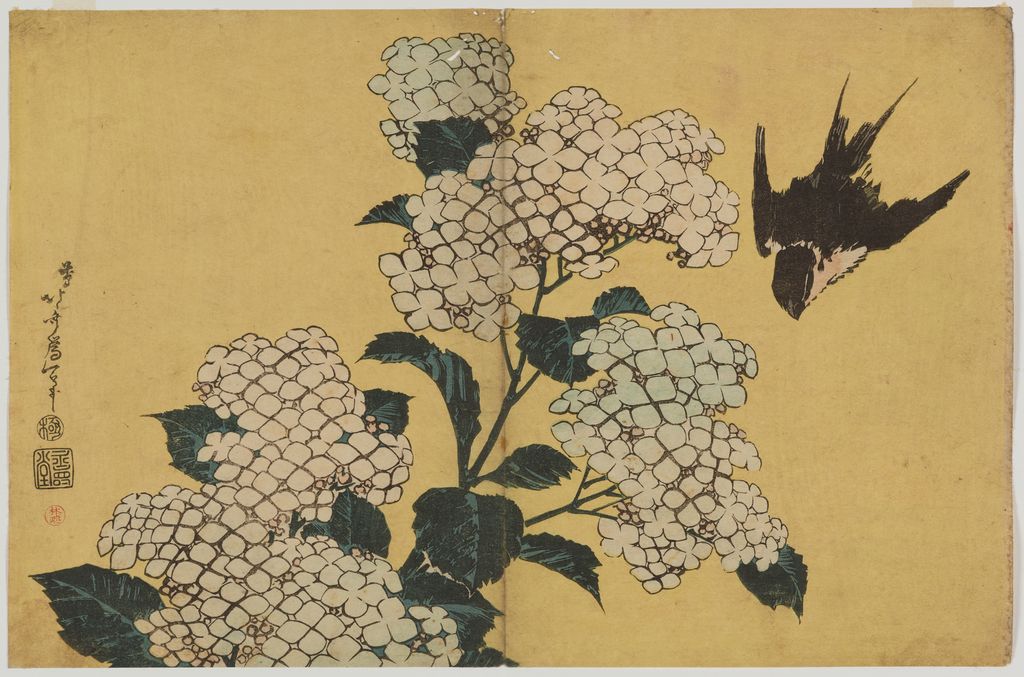
Museums use Large Flowers as a name for this untitled group of designs. The National Gallery of Victoria notes the wide ōban format and the frequent pairing of a flower with a small animal. The Minneapolis Institute of Art traces the group’s subject to Chinese bird-and-flower painting and draws attention to the bold scale and close framing of the vegetation. In Lily, attention settles on a single kind of flower. The visible variation comes from the turn of the blossoms, the opening of the petals and the way the leaves divide the field. [3] [4] [7] [8]
Compare the print with Poppies, another large horizontal design. The poppies lean above foliage with jagged edges. Their bent stems and different heights let the viewer infer a passing gust. The smooth curves of the lily petals direct attention to gradual changes in angle within each flower. The two designs also use different kinds of open space. The pale field to the right in Lily concentrates attention on a single hanging flower, while the bends and gaps in Poppies give several blooms room to appear to move. Look again from the highest lily to the lowest. For a moment, the interval between the two matters as much as the size of either flower. [1] [4] [9]
Where this work sits in Hokusai’s career
Annotated Details from Lilies
Tokyo National Museum via ColBase, A-10569-2786. Adapted with numbered markers and detail crops under the ColBase terms. [1]
Details from LILIES
Select a detail to look closely.
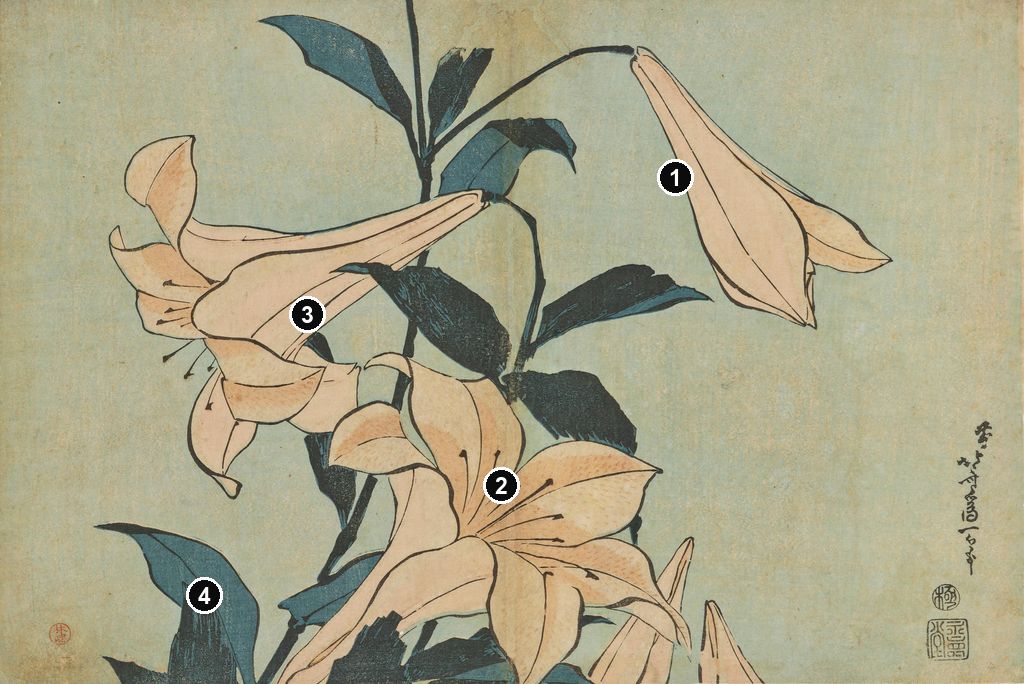
The bud bends away
A long stalk lifts the solitary bud clear of the other flowers, then bends so its point hangs into the open ground. [1]
An open flower at the centre
The petals turn around the flower’s centre in different directions. The long lines make the open flower read quite differently from the closed bud. [1]
Another flower seen from the side
A second bloom stretches toward the left margin. Its side-on angle extends the mass of flowers across the sheet. [1]
Leaves continue past the edge
Dark leaves overlap the lighter flowers near the bottom. Several forms meet the edge of the image before their outlines are complete. [1]
Explore Hokusai’s works
Discussion
Look again at the images and ideas explored in Lily. These editorial prompts invite your observations.
Reader Insights
Where do the stems and leaves lead beyond the visible sheet?
How does the weight of the open flower compare with the bent bud?
Join the Conversation
Share a detail, comparison or question about Lily below.
References
- Japan Agency for Cultural Affairs, Lilies (百合), Tokyo National Museum impression, Cultural Heritage Online record 464115. View source.
- Art Platform Japan, Lilies, Tokyo National Museum accession A-10569-2786. View source.
- Museum of Fine Arts, Boston, Lilies, from an untitled series known as Large Flowers, accession 11.17598, institutional reproduction catalogue. View source.
- Minneapolis Institute of Art, Lilies, accession 74.1.214, collection documentation and reproduction. Collection data. View source 1. View source 2.
- Christie’s, Katsushika Hokusai, Lilies, lot 6362264, former Henri Vever impression and publisher identification. View source.
- Sumida Hokusai Museum, Wow, Hokusai! See, Examine, and Discover Ukiyo-e, exhibition introduction and colour woodblock production. View source.
- National Gallery of Victoria, Hokusai, exhibition introduction and Large Flowers format. View source.
- Minneapolis Institute of Art, Hokusai | Monet, exhibition announcement and curatorial account of Large Flowers. View source.
- The Metropolitan Museum of Art, Poppies in the Wind, accession JP1860. View source.







