


 by Tom Gurney
Tom Gurney BSc (Hons) is an art history expert with over 20 years experience
Published on June 19, 2020 / Updated on November 20, 2026
Email: tomgurney1@gmail.com / Phone: +44 7429 011000
Nihonbashi Bridge in Edo
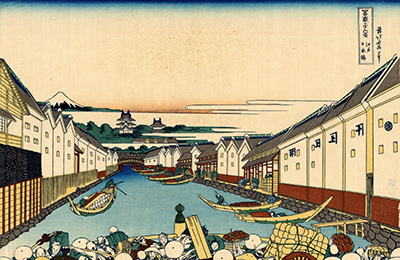
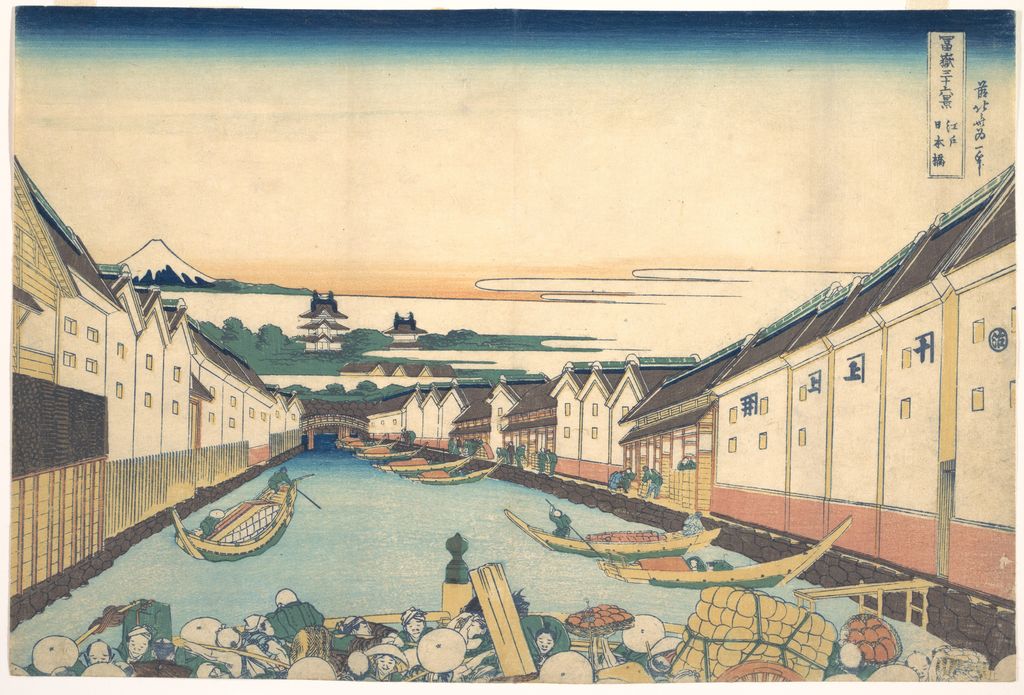
A crowd crosses the bottom edge of Katsushika Hokusai’s Nihonbashi Bridge in Edo. Some people are visible only by their hats. Beyond a dark finial on the railing, boats move along a canal lined with white-walled storehouses. The repeated roofs on the two banks draw the eye towards a second bridge and the towers of Edo Castle. Mount Fuji stands to the left, where low land and a pale strip of sky leave room for its outline. Hokusai makes the bridge the place from which we see the city, even though he shows very little of its structure. [1] [2]
The Metropolitan Museum of Art dates its colour woodblock impression JP2993 to around 1830–32. The sheet measures 25.1 by 37.5 centimetres. Its title panel at upper right names Edo Nihonbashi and the series, Thirty-six Views of Mount Fuji. The National Museum of Western Art’s Japanese and English checklist lists a separate impression from the Iuchi Collection as exhibit 28 under the title 江戸日本橋. In this design, a well-known crossing lends its name to a scene in which people, water, buildings and the mountain pull the eye in different directions. [1] [3]
Beside the rectangular title panel, a separate line of writing gives Hokusai’s signature. The Bibliothèque nationale de France transcribes it as Zen Hokusai Iitsu hitsu, identifying Iitsu as the name he used here and Hokusai as the earlier one. The library names Nishimuraya Yohachi’s Eijudō as the publisher of its impression. The Edo-Tokyo Museum also names Nishimuraya for its sheet. The writing sits against open sky near the right edge of the print. It is easy to locate once the tall roof that rises beneath it has led the eye away from the crowd. [1] [9] [10]
At a Glance
- ArtistKatsushika Hokusai
- Dateca. 1830–32
- MediumColour woodblock print
- SeriesThirty-six Views of Mount Fuji
Contents
The crowd at the bottom of the sheet
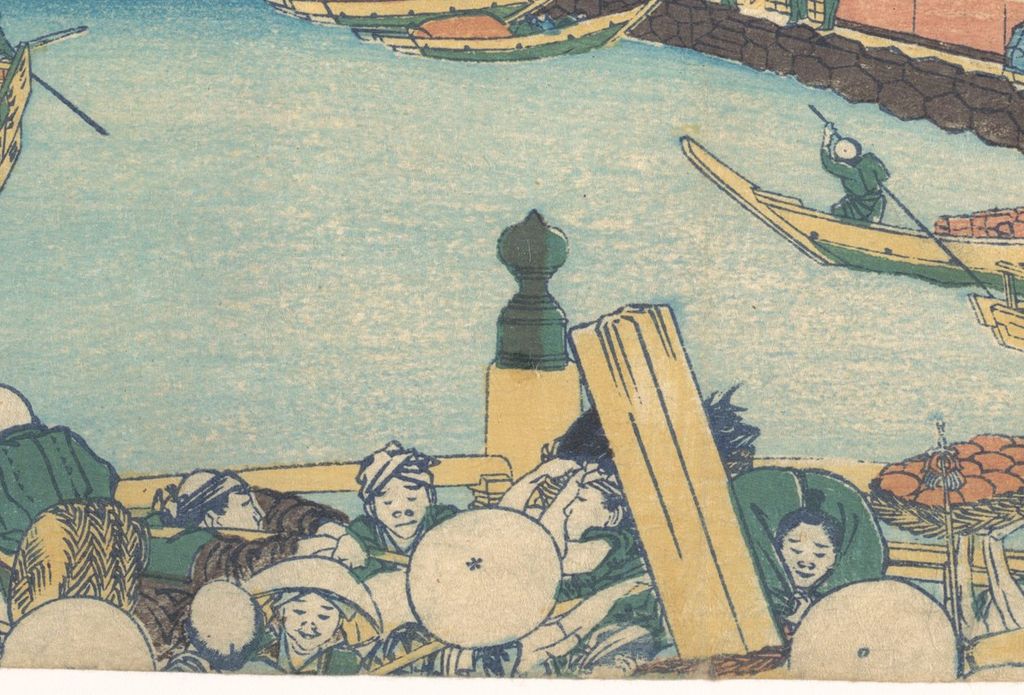
The posts and the people establish the nearest plane of the print. Just below the centre of JP2993, a railing post rises above the heads and ends in a dark finial. The Sumida Hokusai Museum identifies these ornamental caps, called gibōshi, as a feature of the bridge. A short length of railing on the right and a similar cap near the edge help place the viewer at this crossing. Below the rail many bodies drop out of sight. The print still gives enough space to rounded hats, patterned clothing and raised loads for us to distinguish one part of the crowd from another. [1] [2]
At left some heads turn towards neighbouring figures, while round hats appear beside shoulders and the folds of clothing. To the right of the central post, two pale boards rise at a slant through the knot of figures. Farther over, a large bundled load is held in a net of dark lines. A basket with a raised rim and a smaller rounded bundle interrupt the gap between the two largest loads. The height of the boards and of the netted pack gives the lower strip a lively profile, even though the feet and most of the deck lie below the picture. [1]
The Met’s note for impression JP1295 draws attention to the strength of the crop. The bowed outline of Nihonbashi is familiar from other views, but Hokusai lets the people press against the bottom of the picture. A full view of the arch would have made the shape of the bridge clear. The view from the edge of the crowd makes the crossing legible as a place of heavy traffic and puts the canal within sight of those passing over it. [1] [4]
Boats below the bridge
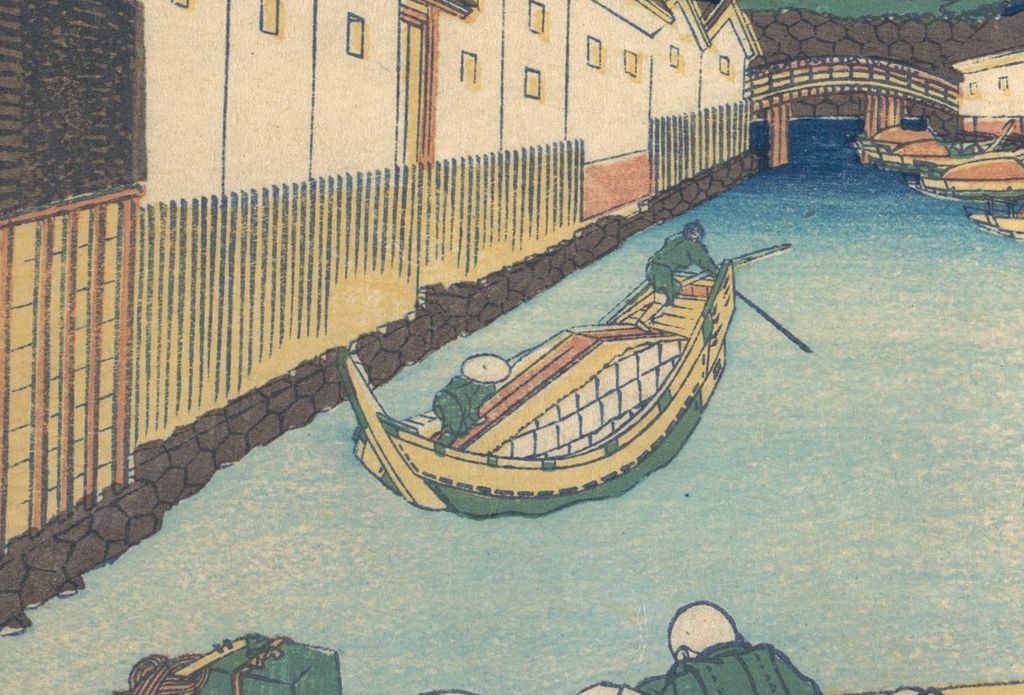
Beyond the figures, the canal opens into a broad stretch of blue. On the left, a boat with sharply rising ends lies diagonally against the stone bank. Dark lines separate its long interior into narrow bands. Two boats closer to the right wall overlap, their raised ends curving back towards open water. Low heaps interrupt their profiles, and upright figures are small but visible where the boats turn towards the middle of the channel. Farther away, hulls appear as thin bands beside the buildings. Hokusai can reduce them to a few strokes because the larger vessels in the foreground establish what those strokes represent. [1]
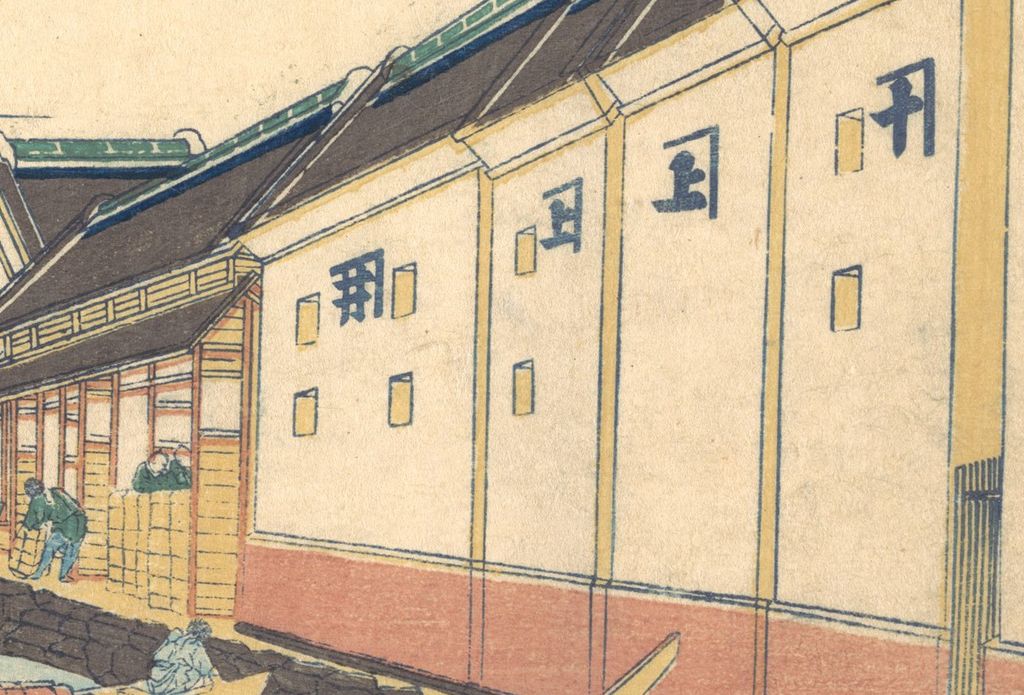
The National Diet Library describes Nihonbashi as the starting point for the Five Highways and the bridge’s neighbourhood as a centre of commerce. It locates fish markets on the north side and describes the high arched deck that let boat traffic pass underneath. The goods on the bridge and the boats below give a sense of how freight and people arrived by different means. The market was part of this setting, though the illustration itself gives only a partial account of what the boats carried. The most legible labels here are painted on buildings along the water. [1] [5]
The warehouses extend back from both edges of the sheet. On the left side, closely spaced vertical lines run along a pale fence above the stone bank. On the right, the main building shows a much larger expanse of white wall beneath its roof. Window openings, blocklike signs and the border where the wall changes colour give its surface a varied rhythm. Small roofed structures and people on the bank become easier to see once the eye moves past that closest wall. At the bottom of the canal, the sharp turn of the two foreground hulls interrupts the much steadier recession of the masonry. [1] [2]
From the canal to Edo Castle and Fuji
Follow the banks into the distance and the space narrows around a low crossing. The Sumida Hokusai Museum identifies it as Ikkokubashi. The successive lines of windows, walls and roofs all pull towards that crossing. Beyond it, the towers of Edo Castle break up the low stands of trees and level bands of mist. The taller tower is a compact stack of eaves and pale walls. The eye can pick it out by the same pattern it has just followed through the warehouses, though the castle stands free of the rows of buildings on the canal. [1] [2]
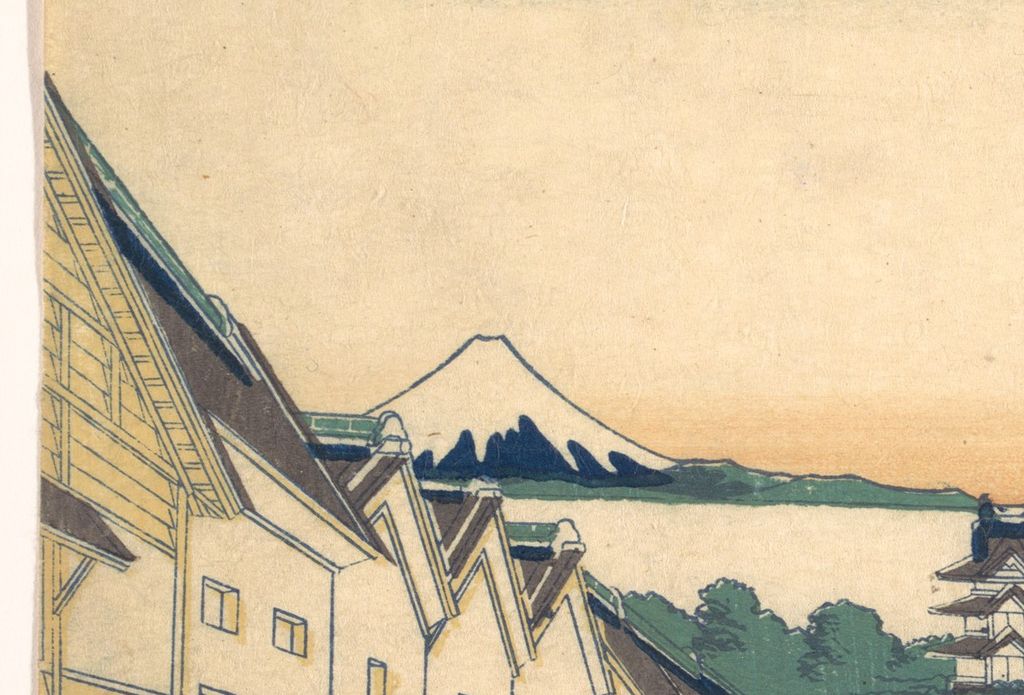
Fuji is farther left and higher in the frame. Part of one slope disappears behind the buildings at left. Enough of the summit and its uneven blue base remain clear to set it apart from the roofs below. Long outlines of clouds stretch across the opposite side of the sky, where they break off behind the near roofline. The contrast of the curved blue slope with the flat cloud bands makes the mountain easy to recover after the stronger diagonals have taken the eye along the water. [1]
The museum in Sumida reports that the mountain would lie farther left when looking from Nihonbashi towards Edo Castle and would fall outside this particular composition. It suggests that Hokusai adjusted the view to bring Fuji into the image. That reading makes sense of the relation between the bridge and the mountain. The canal dominates the picture nearest the viewer, with enough depth to carry the eye to the city’s landmarks. The mountain occupies an opening to one side of that route rather than sitting squarely at its end. [1] [2]
Two impressions of the same view
The Met’s JP1295 measures 25.4 by 36.8 centimetres. Its photograph shows a deeper band of blue at the top of the sheet than JP2993, grading more slowly into the pale sky. In the photograph of JP2993, the same transition takes up less height and the warm tint near the horizon is clearer. At the bottom, more of several heads and loads is visible within the picture area of JP1295. In both, the central railing cap stands at much the same level relative to the boats. The deepest blue attracts attention upwards in JP1295, while the concentration of heads and goods continues to hold the lower edge in both impressions. [1] [4]
The paired photographs also make the strongest parts of the design easier to locate. The tilted boards beside the post, the curves of the boat ends and the sharply rising lines of the closest roofs hold their places as the tone and visible edges vary. The canal makes a broad, fairly continuous patch across an otherwise intricate lower half. The sky has the same simplifying effect above the buildings. Those open areas give the viewer time to move between the distinct forms concentrated at the foreground, the centre of the city and the horizon. [1] [4]
Other ways to picture Nihonbashi
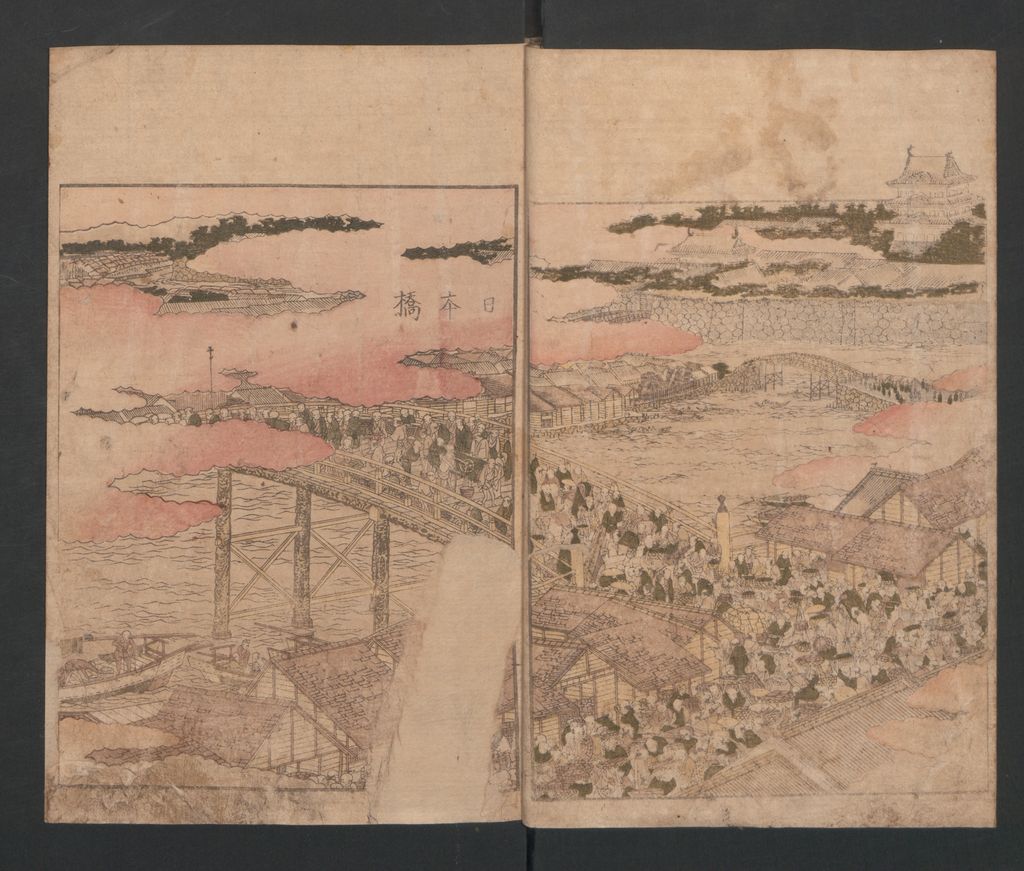
The bridge appears in other prints by Hokusai and by Utagawa Hiroshige. An 1804 view in the Spencer Museum of Art, Hokusai’s Nihonbashi (The Nihon Bridge), belongs to his small-format Tōkaidō series. The Met’s later Nihon bashi by Hiroshige, JP751, also begins a Tōkaidō series. In that later view the span of the bridge crosses the picture in full and gives viewers a clearer sense of its profile. The foreground crop, the narrowing canal and the way the towers share the horizon with Fuji identify Hokusai’s view in the Fuji series. [1] [6] [7]
Hokusai takes another high view nearby in The Mitsui Shop at Surugachō in Edo. There the buildings are much closer and a gap between them opens directly towards Fuji. The slopes of the shop roofs echo the mountain. At Nihonbashi, the successive roofs carry the eye into the city first. The view towards Fuji remains open to the left, just far enough from the canal’s direction to invite a second look after the castle towers come into focus. [1] [8]
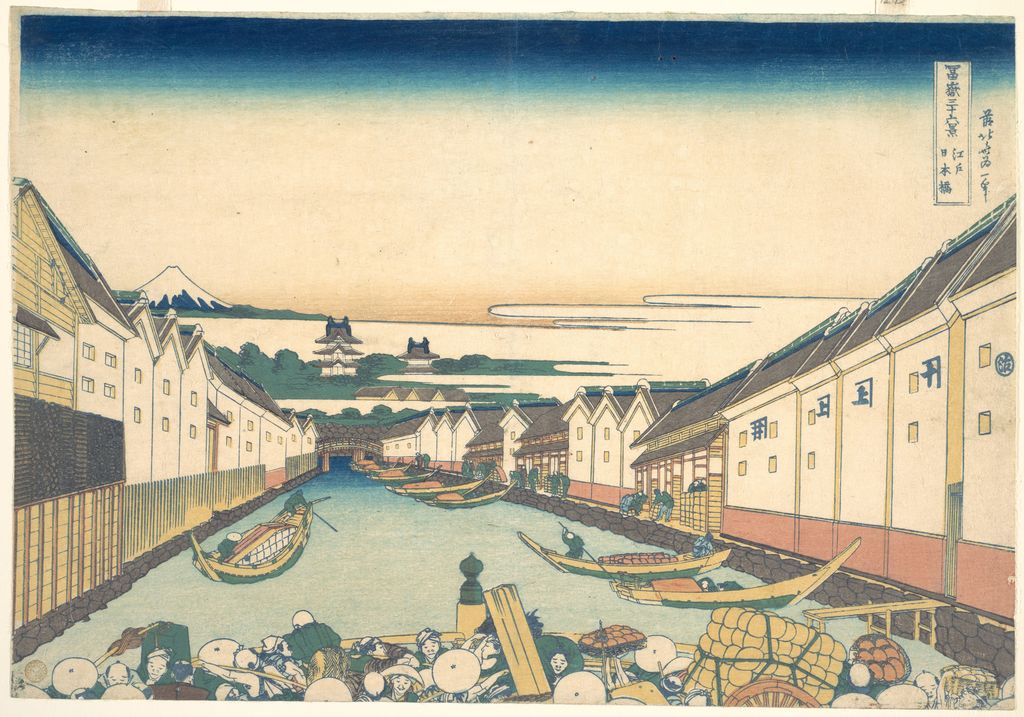
Image comparison
Where this work sits in Hokusai’s career
Annotated Details from Nihonbashi Bridge in Edo
The Metropolitan Museum of Art, JP2993. [1]
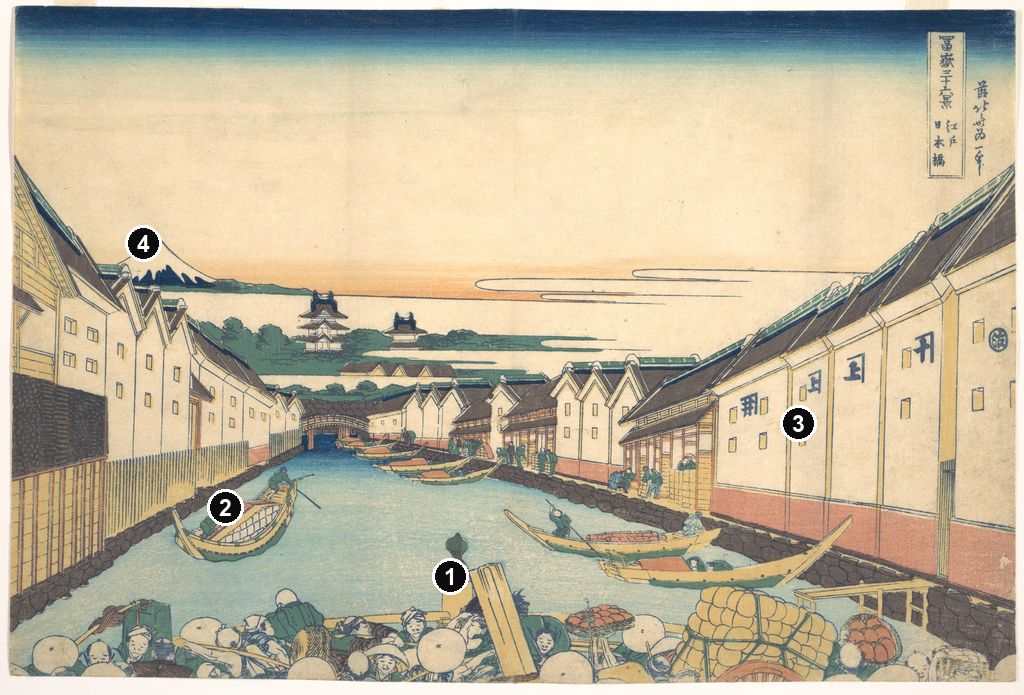
Details from NIHONBASHI BRIDGE IN EDO
Select a detail to look closely.
The near bridge has a large finial
Its dark cap rises above the hats and heads at the bottom of the print. The close view of the bridge gives the composition its starting point. [1]
Boats occupy the canal
The canal narrows between banks and buildings. Boats and their loads reinforce the change in scale from foreground to distance. [1]
Repeating roofs recede
The walls and eaves on either bank form lines that lead towards the middle of the view. [1]
Fuji rises beyond the city
A pale summit is visible near the buildings on the left. Follow the upper edge of the city to find it. [1]
Explore Hokusai’s works
Discussion
Look again at the images and ideas explored in Nihonbashi Bridge in Edo. These editorial prompts invite your observations.
Reader Insights
Where do the roof lines draw your eye?
How do the smallest figures and boats suggest distance?
Join the Conversation
Share a detail, comparison or question about Nihonbashi Bridge in Edo below.
References
- The Metropolitan Museum of Art, Katsushika Hokusai, Nihonbashi in Edo (Edo Nihonbashi), impression JP2993, collection record and photograph. View source.
- Sumida Hokusai Museum, Nihonbashi Bridge in Edo, Japanese collection description. View source.
- National Museum of Western Art, Iuchi Collection exhibition checklist, item 28, 江戸日本橋. View source.
- The Metropolitan Museum of Art, Katsushika Hokusai, Nihonbashi in Edo (Edo Nihonbashi), impression JP1295, collection record and photograph. View source.
- National Diet Library, Nihon-bashi Bridge, in Exploring Japanese Landmarks in Nishiki-e and Photographs. View source.
- Spencer Museum of Art, Katsushika Hokusai, Nihonbashi (The Nihon Bridge), from The Fifty-three Stations of the Tōkaidō, collection record. View source.
- The Metropolitan Museum of Art, Utagawa Hiroshige, Nihon bashi, impression JP751, collection record and photograph. View source.
- The Metropolitan Museum of Art, Katsushika Hokusai, Mitsui Shop at Surugachō in Edo, impression JP1329, collection record and photograph. View source.
- Bibliothèque nationale de France, Edo Nihonbashi, catalogue record with signature transcription and publication details. View source.
- Edo-Tokyo Museum, Thirty-six Views of Mount Fuji: Nihonbashi, Edo, digital archives record. View source.







