


 by Tom Gurney
Tom Gurney BSc (Hons) is an art history expert with over 20 years experience
Published on June 19, 2020 / Updated on November 20, 2026
Email: tomgurney1@gmail.com / Phone: +44 7429 011000
View from the Other Side of Fuji from the Minobu River
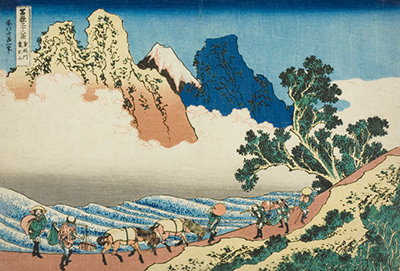
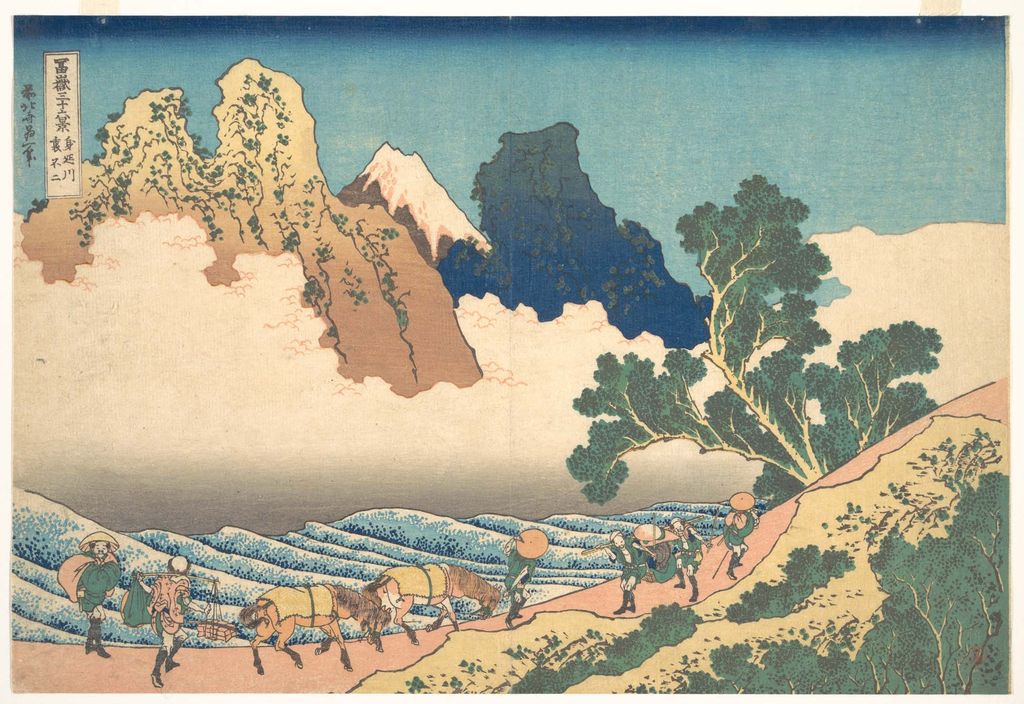
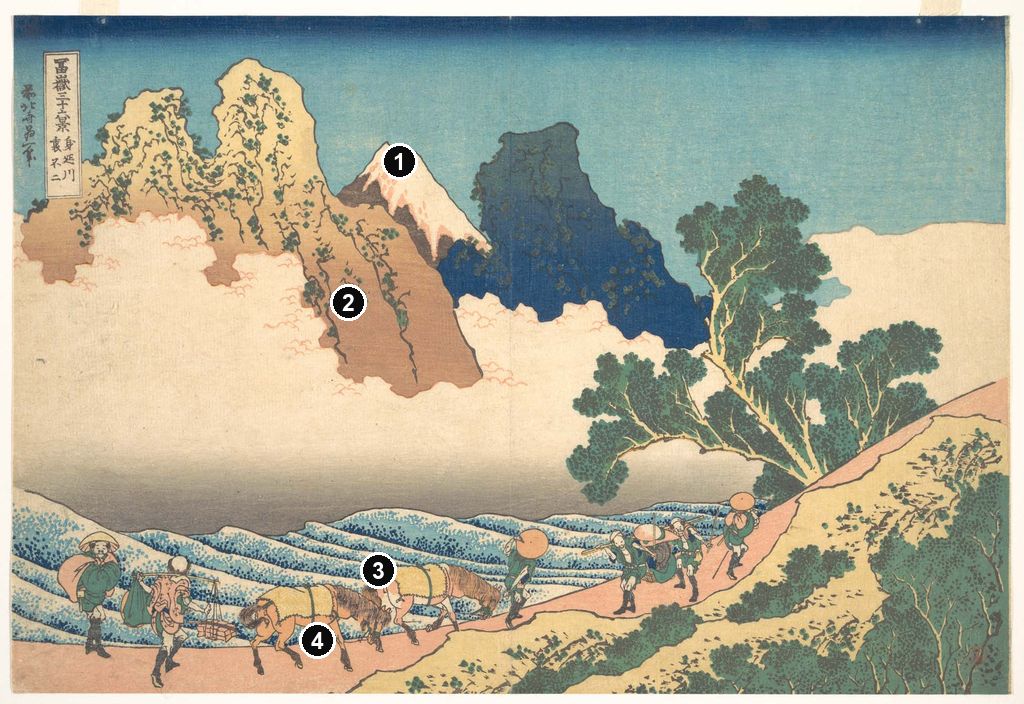
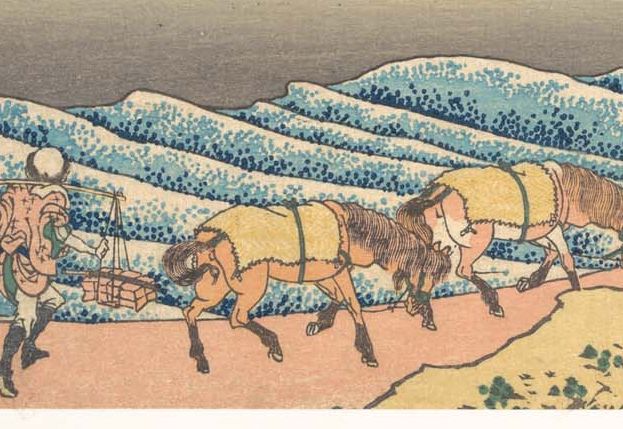
Two packhorses follow a narrow path above turbulent water in Katsushika Hokusai’s View from the Other Side of Fuji from the Minobu River. The slope rises towards a tree at the right. Across the valley, near the centre of the sky, Fuji is squeezed between much larger formations. Its pale peak is easy to recognise once found, though the people travelling beside the river have plenty of terrain to negotiate before it comes into view. The Metropolitan Museum of Art dates its impression JP2959 to about 1830–32. The National Museum of Western Art records this design as item 39 in its Iuchi Collection checklist, under the Japanese title 身延川裏不二, Minobugawa ura Fuji. [1] [2]
At a Glance
- ArtistKatsushika Hokusai
- Dateca. 1830–32
- MediumColour woodblock print
- SeriesThirty-six Views of Mount Fuji
Contents
A path above the rapids
The path cuts across the lower part of the print, close to the bottom edge on the left and considerably higher on the right. Its warm surface stays legible against the blue water beside it. Parts of the horses and travellers overlap the edge between the two. Near the left, the ground is narrow enough that the line of figures nearly fills it. Farther along, patches of green occupy the slope below the path and carry the eye towards the tree. The route is still visible through this change in terrain, though its continuation beyond the right edge remains out of sight. [1]
Look at the horses near the bottom. Their rounded loads rise above their backs, and the bundles register as a series of compact shapes. Below that line, individual legs and hooves distinguish the animals from the people around them. The people farther up the incline are closer together, with one rounded hat appearing well above the crowd at the bottom. This difference in height gives the slope substance. The walkers and their loads make the viewer measure the rise in a way the path alone would not. [1]
The river sets a different rhythm. Long ridges in the current are packed close together, with small dots visible across the slopes between them. These points and curves give the water a broken, active surface. At the bend where the river slips behind the bank on the right, the gently rising path and the more nearly horizontal bands of water begin to diverge. The Sumida Hokusai Museum singles out the stippled current as part of the design’s steep valley setting. The water looks restless even where only a narrow section remains visible between the path and the broad cloud bank. [1] [3]
The mountains above the clouds
From the front of the print, the tree offers a way into its upper half. Its trunk grows out of the near slope and breaks into several spreading limbs. Narrow light lines remain visible as the branches pass through patches of dark foliage. Some outer branches are easy to separate from the pale ground behind them, while other groups of leaves almost touch the darker mountain. The tree stands on our side of the river. Its silhouette overlaps shapes across the valley and connects the foreground with the peaks behind it. [1]
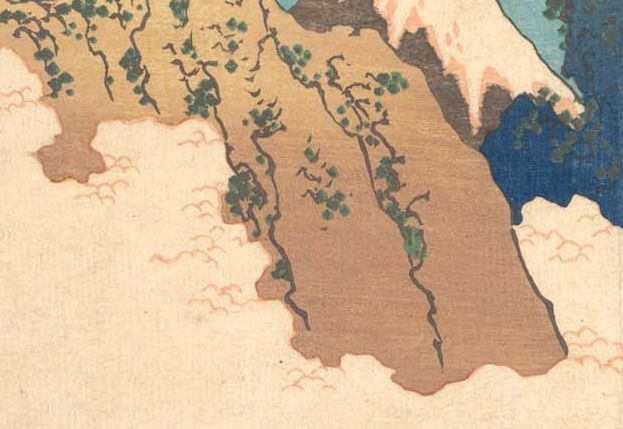
The rocks on the left have flatter planes and sharper changes in direction. A high point towards the upper left curves into a series of shoulders and descends almost to the centre of the print. Short, dark marks cling to portions of the surface, remaining sparse where wider areas of colour open out. On the right of Fuji, a tall blue formation makes a different silhouette, with a broad top and steep sides. The pale bank of cloud interrupts both formations near their bases. With the lower slopes obscured, the formations appear to rise straight out of the cloud. [1]
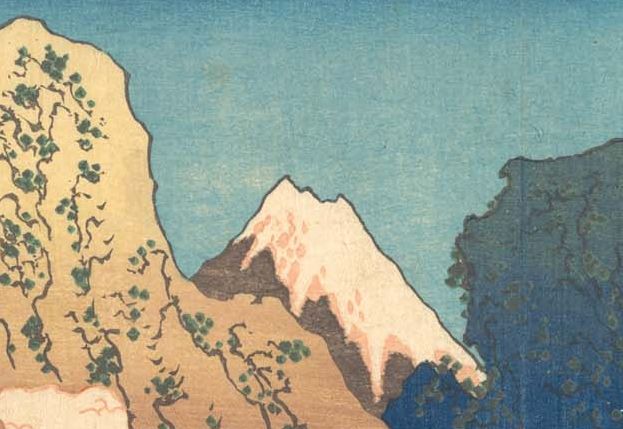
Fuji’s snow is set between those two uneven outlines. In JP2959 its lower edge has several points of uneven length where light and darker slopes meet. Part of the mountain is hidden behind the rock on the left, and the blue formation cuts across the other side. Compare the little white peak to the patch of sky above it. Both are open shapes, and both depend on the bounding edges of the larger formations. Fuji is the most immediately recognisable mountain once the eye locates it, yet Hokusai lets the near masses establish its scale. The same print that makes the summit an unmistakable landmark makes much of the route to it disappear from sight. [1]
The upper edge introduces a scale that has little to do with distance. The cartouche at the left is a slender column of upright writing placed beside the irregular outline of the cliff. Its pale ground is related in tone to Fuji and the clouds, although its rectangular border keeps the title separate from the landscape. The cartouche is also one of the few elements whose edges run parallel to a side of the paper. As the eye moves from the lettering towards the centre of the sheet, the cliff begins to fall away and the long strip of open sky becomes visible. [1]
What the title tells us about the location
The Tokyo Fuji Art Museum explains ura Fuji as a name used for Fuji seen from the Kai side, west of the mountain. Kai corresponds to present-day Yamanashi Prefecture. The precise watercourse meant by Minobugawa has been interpreted in more than one way. The Tokyo museum records an older interpretation linking the title to the Fuji River and also notes the possibility of a river near Kuonji. The Sumida Hokusai Museum identifies the water as the Minobu River fed from Mount Minobu, with people following the road towards the temple. These accounts situate the scene around Minobu and the western approach to Fuji without settling a position from which every ridge would line up. [3] [4]
The temple gives the journey a historical destination. Kuonji’s account traces the site to the Buddhist teacher Nichiren, who settled at Mount Minobu in 1274 and later established a temple there. The present precincts stand at the site to which the institution moved in 1475, according to the temple’s history. That tradition helps explain why the road to Kuonji could be a subject for a landscape centred on movement through the mountains. The temple is absent from the view. The travellers bend their way across the slope with packhorses, without inscriptions on the figures that specify their purposes. [1] [3] [5]
Sumida also notes that the way Hokusai set severe cliffs between Minobu and Fuji does not correspond to actual terrain. It suggests the rock shapes may exaggerate mountains close to the viewer. That reading makes sense of the space across the river. The steep formations require very little printed area at their bases to appear imposing. Meanwhile the mountain that gives the print its title occupies a narrow remainder of that space. [1] [3] [4]
Three impressions of the same design
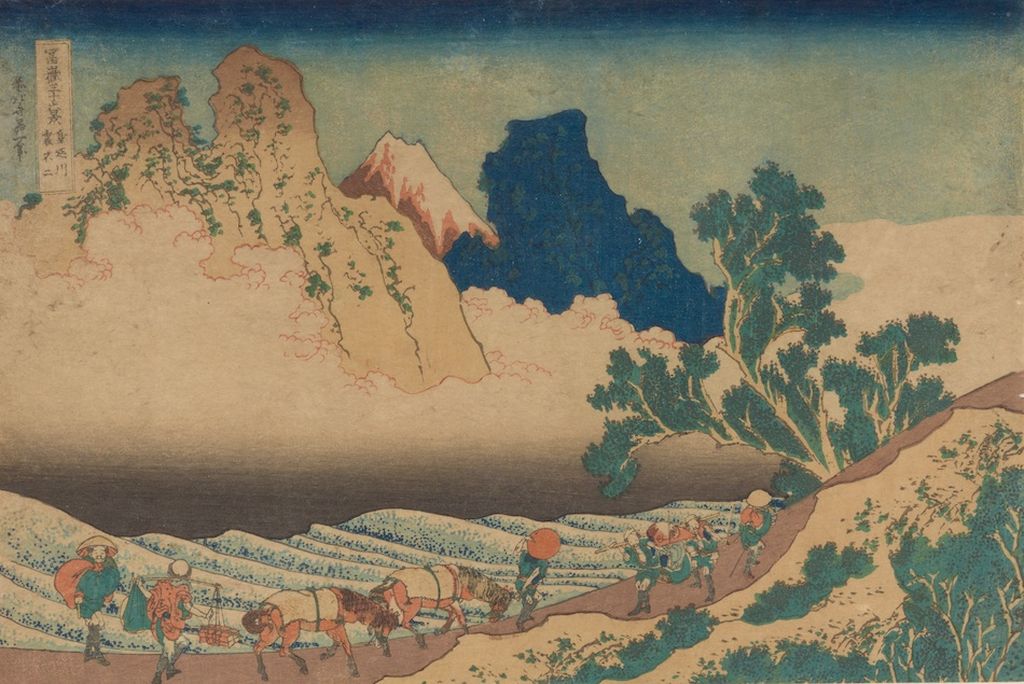
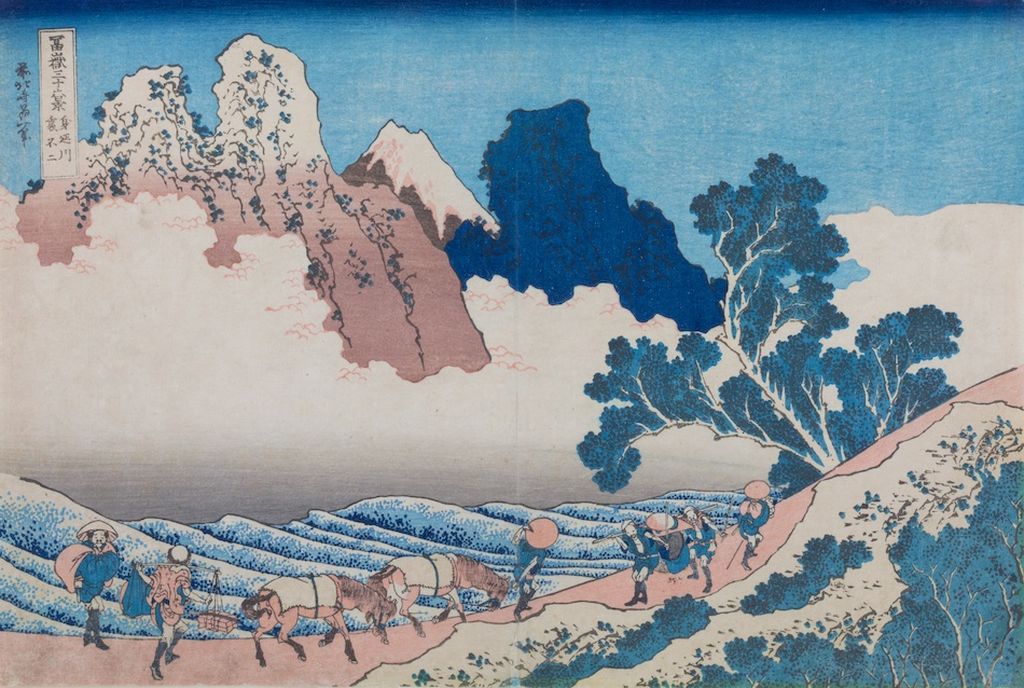
The Met records JP2959 as a colour woodblock print on paper measuring 25.4 × 37.1 centimetres. The Tokyo Fuji Art Museum holds two other impressions of the same design. Across their three photographs, the riverbank, the line of travellers and the intricately divided cliffs keep their positions. The colour gives each view a different balance. In the photograph of JP2959, a turquoise sky lies below a dark upper band, and warm patches fill parts of the cliff to the left of Fuji. Tokyo’s record 06269 shows a deeper blue to the right of the summit and several reddish or purple-brown passages among the rocks. In the photograph associated with 06158, the same bank of cloud has a much darker base and the cliff reads as an arrangement of darker and lighter brown areas. [1] [4] [6]
The Tokyo museum singles out a more precise difference between its sheets. It describes the arrangement of brown on the precipitous face left of Fuji as reversed in the impression shown under record 06158 compared with its other impression, and suggests that 06158 may be a later printing variant. This observation concerns the relationship between those two museum objects. It gives the viewer something specific to compare across the cliff, where the light and dark areas meet, and leaves the sequence of the Met impression open. The photographs let us compare the distribution of colour and the perceived strength of each passage. They offer less evidence about the identity of the colourants. [1] [4] [6]
Two formats for a river landscape
Hokusai addressed the Minobu River in a separate design whose title names Kai Province. The Tokyo National Museum records its sheet A-10569-4788 as a colour print in the shape of a rigid fan, from the series Curious Views of Scenic Landscapes. Sumida lists examples of the two designs consecutively in its mountain exhibition, dating the Thirty-six Views design around 1831 and the fan design to 1834 or later. The same river name labels a different viewing surface. In the rectangular sheet discussed here, the corners let Hokusai hold the upper sky at left against the climbing ground at right. The format leaves enough space for the road and river to run together for much of the width of the print before they part. [3] [7] [8]
In Kajikazawa in Kai Province, a man on a rock tends fishing lines that stretch out over the water. The slopes of his body and the lines beneath him draw the eye into a narrow, angular arrangement. Fuji in the distance gives that arrangement a recognisable counterpart. In the Minobu design, the figures form a procession and the leading lines keep changing direction. There are more separate intervals between a traveller, the near vegetation and the mountain. Seen alongside other works in Thirty-six Views of Mount Fuji, the Minobu sheet uses those interruptions to give the western view its particular character. [1] [9]
Where this work sits in Hokusai’s career
Hokusai Manga
From 1814View from the Other Side of Fuji from the Minobu River
ca. 1830–32Annotated Details from Back View of Mount Fuji from the Minobugawa River
The Metropolitan Museum of Art, JP2959. [1]
Details from BACK VIEW OF MOUNT FUJI FROM THE MINOBUGAWA RIVER
Select a detail to look closely.
A white peak appears between the rock faces
Steep near formations surround a smaller triangle. The interval is just wide enough to reveal Fuji. [1]
A steep face rises from the river valley
Repeated spots and short lines mark the exposed rock. The face takes up much more space than the distant summit. [1]
The river runs through the lower part of the view
Curved marks collect in a narrow space below the broad passage of cloud or mist. [1]
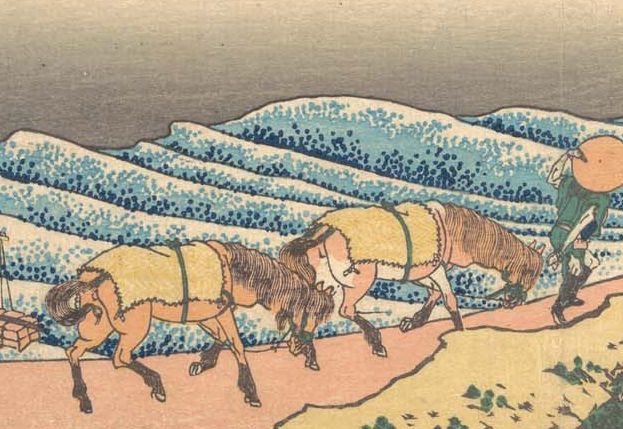
Travellers pass along the low path
The small figures and loads form a broken line along the water. They give the cliffs above a measure of height. [1]
Explore Hokusai’s works
Discussion
Look again at the images and ideas explored in View from the Other Side of Fuji from the Minobu River. These editorial prompts invite your observations.
Reader Insights
Where does the path turn against the river?
How do the near rock faces frame Fuji?
Join the Conversation
Share a detail, comparison or question about View from the Other Side of Fuji from the Minobu River below.
References
- The Metropolitan Museum of Art, View from the Other Side of Fuji from the Minobu River (Minobugawa ura Fuji), impression JP2959. View source.
- National Museum of Western Art, Iuchi Collection exhibition checklist, no. 39, 身延川裏不二. View source.
- Sumida Hokusai Museum, 冨嶽三十六景 身延川裏不二, object record and Japanese commentary. View source.
- Tokyo Fuji Art Museum, 冨嶽三十六景 身延川裏不二, collection record 06269 and Japanese commentary. View source.
- Minobusan Kuonji Temple, History of Kuonji, institutional account of Nichiren and the temple sites. View source.
- Tokyo Fuji Art Museum, 冨嶽三十六景 身延川裏不二, collection record 06158 and Japanese printing comparison. View source.
- Tokyo National Museum, exhibition checklist, Curious Views of Scenic Landscapes: The Minobu River in Kai Province, A-10569-4788. View source.
- Sumida Hokusai Museum, Hokusai and the Landscapes of Mountains exhibition checklist, nos. 53 and 54. View source.
- The Metropolitan Museum of Art, Kajikazawa in Kai Province, impression JP2986, collection record and photograph. View source.







