


 by Tom Gurney
Tom Gurney BSc (Hons) is an art history expert with over 20 years experience
Published on June 19, 2020 / Updated on November 20, 2026
Email: tomgurney1@gmail.com / Phone: +44 7429 011000
Carp and Turtles
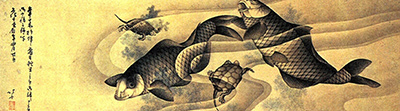
Two carp fill the middle of Katsushika Hokusai’s Carp and Turtles. One head turns down towards the lower left. The other rises near the upper edge of the painted field, its body bending back towards the right. Between them is a turtle seen from above, and farther to the left a smaller turtle swims across a light band. The animals share a stretch of water that can be followed almost from end to end of the painting. As they turn, large parts of their bodies disappear behind one another or give way to the lighter marks of the current. [1]
The Saitama Prefectural Museum of History and Folklore holds the painting, which Saitama City records as colour on paper in a single scroll. The published 26.8 by 91.8 centimetres refer to the painted field. Its width is more than three times its height. The official reproduction centres on that field and gives an idea of its proportions. The two fish have room to curve sideways, while the head of the fish at the right comes close to the top. Hokusai makes the width of the painting felt through this difference between the freedom of the tails and the pressure on the higher head. [1]
At a Glance
- ArtistKatsushika Hokusai
- Date1813
- MediumColour on paper
- FormatMounted painting
Contents
How the two carp share the water
Follow the nearer fish from its broad head on the left. Its shoulders are dark, and the lighter marks of its flank draw the eye into the pattern of the scales. Its body narrows and turns near the middle, where the two fish meet. The turn makes portions of the fish visible at quite different angles. The head comes forward while the row of scales changes direction farther back. Even in a small photograph, that change carries a sense of weight. A broad passage of dark colour becomes a rounded form as soon as the lighter scales show the direction of its surface. [1]
The larger shape towards the right is easier to read first as an outline. A long curve leads from the raised head past the flank to the fork of the tail. The tail has room to spread. Between those extremes the curve tightens and the body becomes difficult to follow for a moment. The two distinctions that help are the different angles of the heads and the way the marked scales appear and disappear on each turning body. At the left, the head seems almost to look out at us. At the right, the eye follows the body over a longer distance before reaching its end. [1]
Hokusai gives the two fish related tones and patterns. He also gives them distinct paths through the picture. If the fish had been shown side by side at the same level, the repeated scales might have made them read as parallel shapes. Here the overlap makes it possible to read one flank against the edge of the other. It is a way of showing two large animals turning within a shallow painted space. The gaps between their bodies help, particularly where a narrow strip of pale water appears and then broadens again. [1]
The turtles and the current
The larger turtle sits below the meeting of the fish. Its shell can be read almost as a plan, with a series of dark divisions around its curved outside edge. Its head and limbs extend beyond the shell in several directions, making its motion legible at a smaller scale than that of the carp. The fish need space for their long curves. The turtle’s shape is concentrated, and a much shorter stretch of paper is enough to describe its change of direction. [1]
The other turtle is set higher and farther left. It is small enough to see in one glance and lies at a different angle, with a narrow head and splayed limbs giving it some of the quality of a silhouette. The pale band below it makes the outline clear. Follow that band and it rounds the left end of the group before passing back across the painting. The broad areas of toned paper between these pale ribbons suggest the water’s depth without using a separate horizon or bank. The animals remain our chief guides to the space. [1]
Near the fish and the smaller turtle, uneven dark and pale patches add another scale of mark. Seen against the paired sweeps of the water, these shorter forms give the surface variety. The painting uses the differences among the shapes of fish, shell and plant as much as it uses the marks of the current itself. The animals appear in water because the surrounding forms pass around them and because one animal can occupy a depth or angle unavailable to the next. [1]
A dated inscription at the left
The vertical writing occupies paper beyond the busiest part of the image. Seen from the right, the eye reaches it after passing the raised head, the overlap and the darker carp at the left. Seen from the left, the thin columns and small seal give the painting a firm edge before the open water begins. The writing is quite different in scale from the bodies of the fish, but it too works across dark and light. There is enough open paper around its strokes for them to remain visible at a distance. [1]
Saitama’s catalogue dates the painting to Bunka 10, or 1813, and explains that the inscription records Hokusai giving away the seal he had used, written 亀毛蛇足. The city’s English description glosses the expression as hair on a turtle and legs on a snake, and relates it to the folly of adding needless strokes. The date is useful independently of that verbal association. It attaches a point in Hokusai’s career to an actual painting, with a document written directly on the same paper as the fish and turtles. [1] [2]
The Chiba City Museum of Art’s study of Hokusai’s seals gives the inscription’s date as the twenty-fifth day of the fourth month of Bunka 10. That is the inscription’s calendrical wording, rather than a date in April on the modern calendar. Chiba also explains the evidence behind the name of the recipient. The inscription itself does not supply it. The presence of the same seal with Katsushika Hokumei’s name on other material supports the identification of the disciple, whom the Sumida Hokusai Museum also names. The distinction matters because the inscription records the act of passing on the seal, while comparison across objects helps identify the person who received it. [3] [4]
Another carp, another shape of paper
The Freer Gallery of Art’s Swimming Carp is an ink-on-paper album leaf attributed to Hokusai. It gives one fish a separate study. The body bends from the broad head at lower left towards the raised tail, with individual scales set down in an open pattern. Long, spaced curves pass across the sheet and interrupt parts of the fish. The uniformity of the ink line makes it easy to see where Hokusai describes one small feature at a time and where he leaves the paper open. Saitama’s painting uses a much wider field, added colour and more closely modelled bodies. Both images use changes of contour and the relation of a fish to marks across its body to put it into water. [1] [5]
The two formats encourage different movements of the eye. The Freer fish turns back sharply at the tail, so its curving shape can be grasped from head to tip and back. The Saitama fish spread their movement across the space between the inscription and the larger tail. Looking from one work to the other makes it easier to see how Hokusai varies the scale of a mark according to the demands of the picture. A row of scales can draw a person forwards along a body, or it can slow the eye at the point where the same body turns. [1] [5]
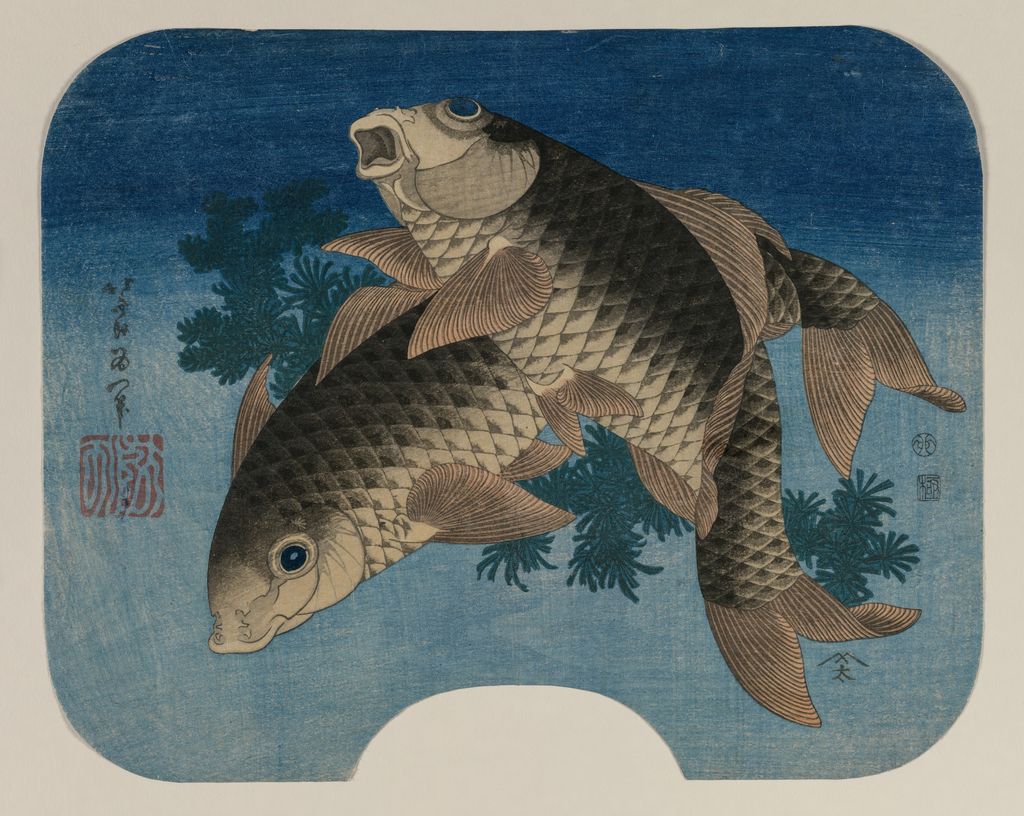
The Rijksmuseum’s Two Carp is different again. Its 1831 impression is a colour woodcut in a fan shape, with blue water around two grey fish. The painted and printed pairs share a pattern of movement. One head points down and left and the other rises with its mouth open. Overlapping flanks carry the eye between them. The relationship is easiest to see by comparing the two heads first and then following the marked scales towards the crossing point. [1] [6]
The borders give that arrangement different proportions in the two works. In the print the blue field has a rounded upper edge and a cutout at its base, with pale paper outside it in the Rijksmuseum photograph. The fish are drawn close together over the cutout and the plants continue behind them. In the scroll, broad changes of tone distinguish passages of water, and the turtles pull the eye outward from the overlap. The printed pair fit inside a compact curve. The painted pair have room to become part of a longer movement, from the tail at the far right to the inscription at the far left. [1] [6]
Those contrasts bring out what is particular about Carp and Turtles among Hokusai’s paintings. The two large fish set the breadth of the composition, and the smaller animals make it possible to feel that breadth from within the scene. The painting leaves space where a turn needs to be seen, brings outlines together where the fish pass, and gives its written record room at the edge. Returning to the junction of the fish, look at the shrinking rows of scales and then at the nearest shell. The change in scale between them does much of the work of making the water feel inhabited. [1]
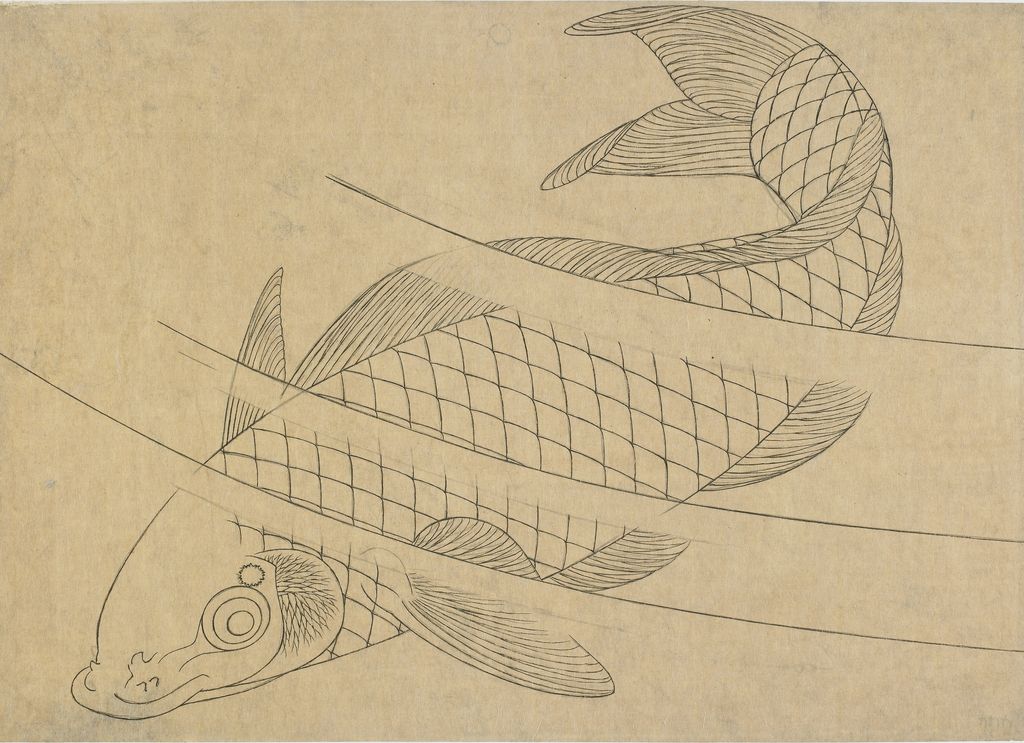
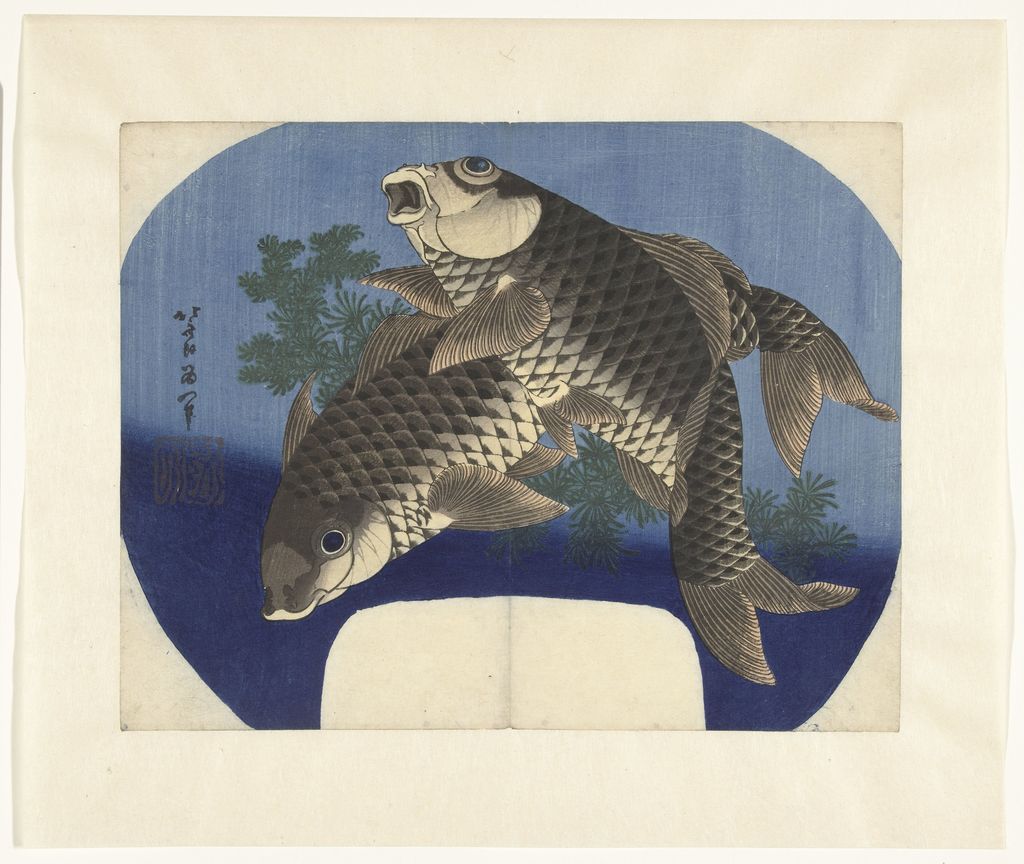
Image comparison
Where this work sits in Hokusai’s career
Carp and Turtles
1813Hokusai Manga
From 1814Thirty-six Views of Mount Fuji
Early 1830sExplore Hokusai’s works
Discussion
Look again at the images and ideas explored in Carp and Turtles. These editorial prompts invite your observations.
Reader Insights
Which lines make the fish appear to overlap?
How do the turtles give the horizontal scene a different sense of scale?
Join the Conversation
Share a detail, comparison or question about Carp and Turtles below.
References
- City of Saitama, Illustration of Carp and Turtles by Katsushika Hokusai (Color on Paper), municipal cultural property record and reproduction. View source.
- Saitama Prefectural Museum of History and Folklore, Annual Report, Fiscal 2024, printed p. 45, collection register for Carp and Turtles. View source.
- Chiba City Museum of Art, study of Hokusai’s 亀毛蛇足 seal in Siren, entry 59 and transcription of the inscription on Carp and Turtles. View source.
- Sumida Hokusai Museum, Hokusai: The Teacher-Student Showdown!, exhibition account of the transfer of the seal to Katsushika Hokumei. View source.
- Smithsonian National Museum of Asian Art, Swimming Carp, accession F1904.427, object record and reproduction. View source.
- Rijksmuseum, Two Carp, RP-P-1960-3, object record and reproduction. View source.







