


 by Tom Gurney
Tom Gurney BSc (Hons) is an art history expert with over 20 years experience
Published on June 19, 2020 / Updated on November 20, 2026
Email: tomgurney1@gmail.com / Phone: +44 7429 011000
Fuji from the Katakura Tea Fields in Suruga
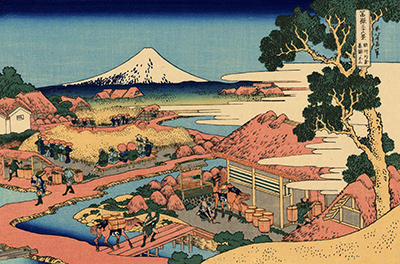
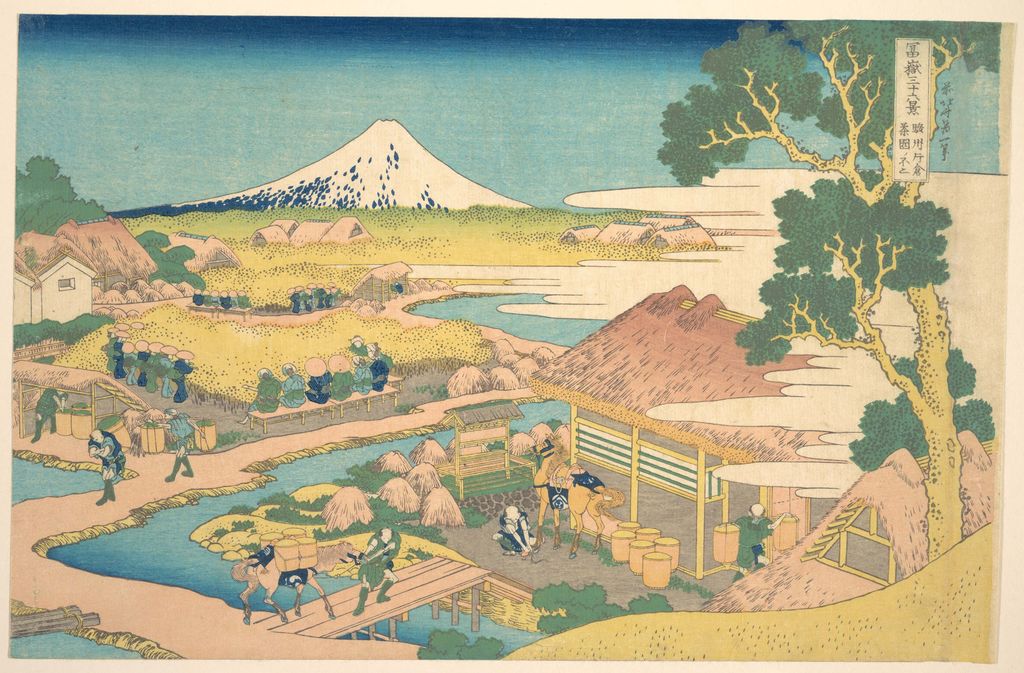
In Katsushika Hokusai’s Fuji from the Katakura Tea Fields in Suruga, a loaded horse sets one hoof on a plank bridge. A man leans back to draw it across. Beyond them, people work in groups among low plants, and the whitish slopes of Mount Fuji rise over a string of thatched roofs. The Metropolitan Museum of Art dates its colour woodblock impression JP2955 to about 1830–32. The Japanese title, 駿州片倉茶園ノ不二 (Sunshū Katakura chaen no Fuji), appears under item 41 in the National Museum of Western Art’s exhibition checklist for the Iuchi Collection. [1] [2]
At a Glance
- ArtistKatsushika Hokusai
- Dateca. 1830–32
- MediumColour woodblock print
- SeriesThirty-six Views of Mount Fuji
Contents
From the tea bushes to the bridge
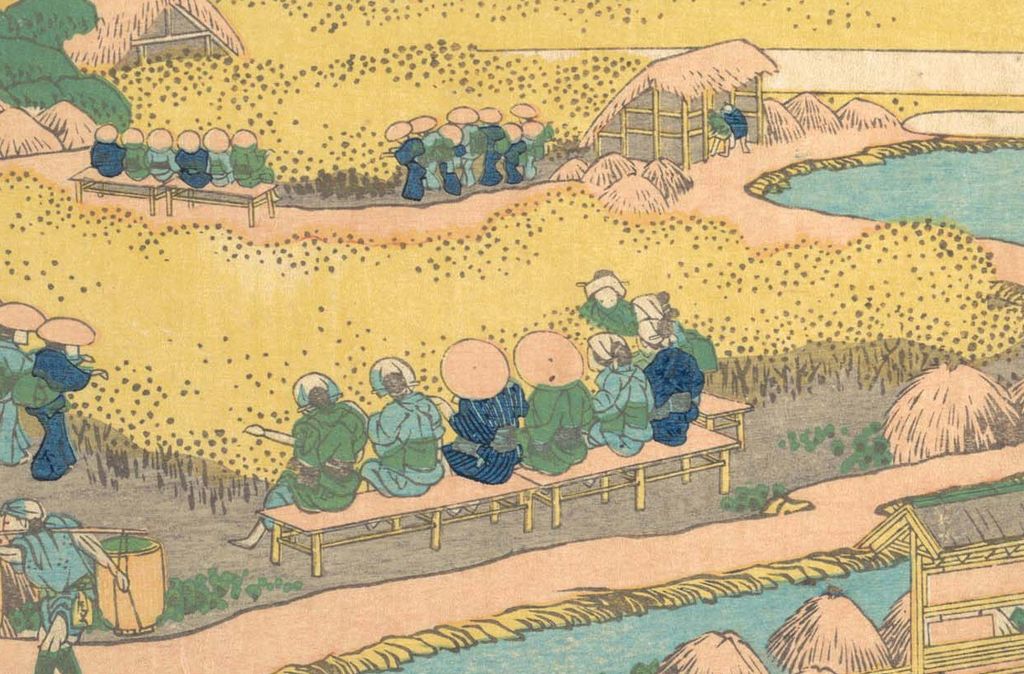
Look first at the workers above the path on the left. A row of rounded hats tilts towards the light field, and dark sleeves and skirts interrupt the texture of the planting. Around the centre, another group brings several people together at the margin of a plot. Some sit or crouch low enough that their round hats are the first thing visible. Behind them, much smaller figures appear near the edge of a roof. Their bodies scarcely break the horizontal division between the crops and the path. The rows of workers make the extent of the fields easier to judge, even where the bushes themselves are indicated by little more than regular dots. [1]
Shimane Art Museum describes women picking the leaves in the farther plots and men taking the harvested tea away. The National Gallery of Victoria also identifies the pickers, some seated and some standing, by their postures and by the hats or headcloths visible on the impression it exhibited. Hokusai gives each group a different outline. Compare the compact row of crouched figures along the plot’s near edge with the people walking on the pale path below. The walkers have more room around them, and their bent legs and carried loads make their direction of travel easier to read. The smaller details give the harvest several stages, from tending the crop to moving it around the site. [1] [3] [4]
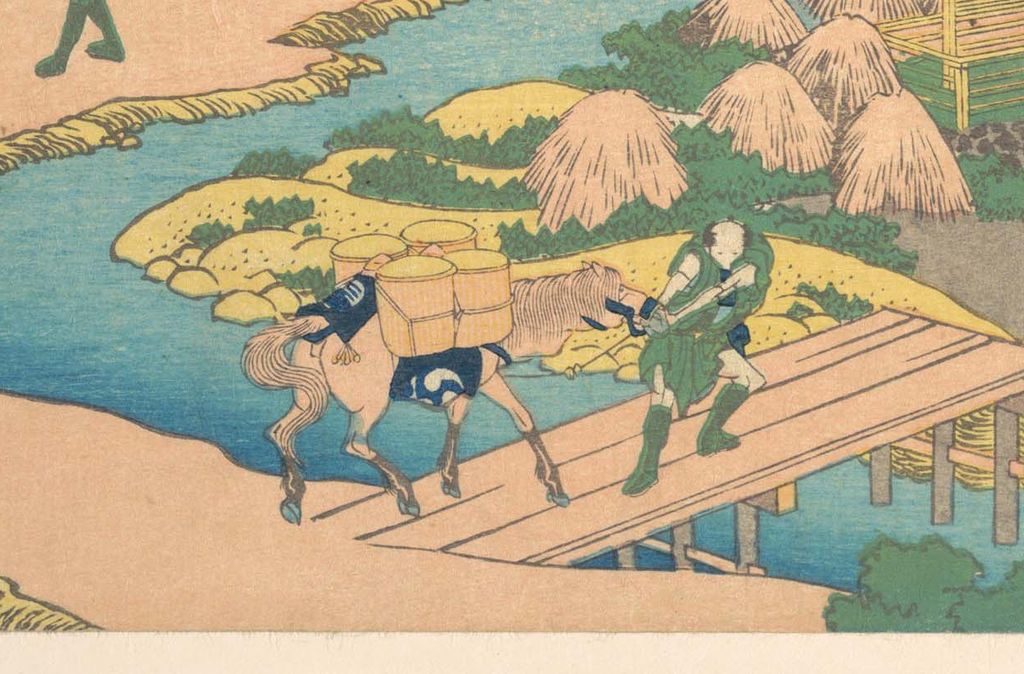
Two horses make that work more visible. The first stands low in the picture, its load projecting above its back in rounded containers. The person on the bridge braces on the sloping planks while the horse holds its head back. Shimane’s curator reads this encounter as a man coaxing a horse reluctant to cross. The pale boards carry the eye from the animal and its load towards a roofed space on the right. There, a second horse stands next to two people, near a line of vessels. One person stoops low, where the dark shape of the body meets the horse’s legs. Each group has its own arrangement of hands, feet and equipment, even though the print offers only a few strokes for any one figure. [1] [3]
The roof on the right shades an area with upright posts, striped wall panels and containers arranged near the outside. A person carries vessels just beyond that row, beside a smaller roof at the lower edge. Farther left, people and bulky containers gather beneath a much smaller shelter. The scene shows several places where loads pause or change hands. The figures are small enough that the use of every vessel or shelter remains open. The clearer contrasts are between standing and stooping, people walking with a burden and people working at a fixed spot, and the different ways goods can move across the field. [1]
The National Gallery of Victoria reads the covered area in the foreground as a place for sorting or steaming leaves, with men or horses bringing the baskets along a causeway. That interpretation follows the path Hokusai draws. The two banks of the stream pinch together at the bridge, and the planks lead almost directly to the place where the containers stand. Looking from the bridge towards the shed, the wide pale path gives way to a darker surface enclosed by the roofs. That passage sets off work inside or at the edge of the buildings from the scattered work in the open fields. It also makes the single wooden crossing a small but important part of the route between them. [1] [4]
How the landscape holds the work
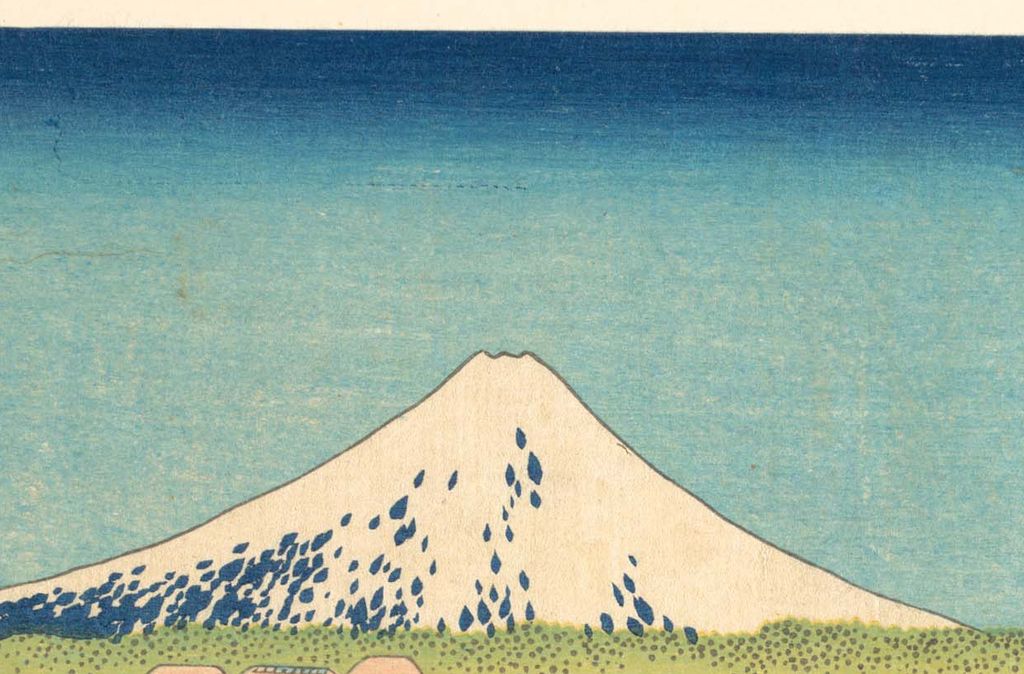
Fuji’s pale slope spans the upper part of the scene, but it is considerably narrower than the range of fields and roofs below. Its long left flank starts low and rises gently into the summit before the shorter, steeper descent on the right. The blue marks on the slope become sparse near the peak. Below them, much smaller dark dots multiply across the plantation. The distance between those two patterns gives the mountain room to stand clear of the buildings, while the broad white summit makes it easy to find again after looking closely at the smaller figures. [1]
Below the summit, the crop spreads in irregular shapes broken by roof ridges, footpaths and darker patches of vegetation. The large tree at the right edge appears on a different scale. Its near trunk branches in yellow lines among solid patches of dark foliage. Several pale bands with rounded ends interrupt the detail of the hills and houses on this side. Their horizontal movement contrasts with the diagonal of the bridge and the darker channel that bends beneath it. From the lower left, follow the pale route past the people, then find where it reappears farther back among the roofs. The paths matter as much as the fields in explaining how the plot is used. [1]
In In the Mountains of Tōtōmi Province, Hokusai also makes the people at work central to the view of Fuji. There, the long diagonal of a timber and the scale of the sawyers concentrate attention on one task. At Katakura, labour is dispersed across the sheet. It occurs along a path, in groups in the fields, at a crossing and below the eaves of a building. The difference in scale changes the viewing experience. The sawyers can be taken in almost at once. At Katakura the eye has to move around the scene to discover how many different actions are taking place. [1] [5]
Two readings of the name Katakura
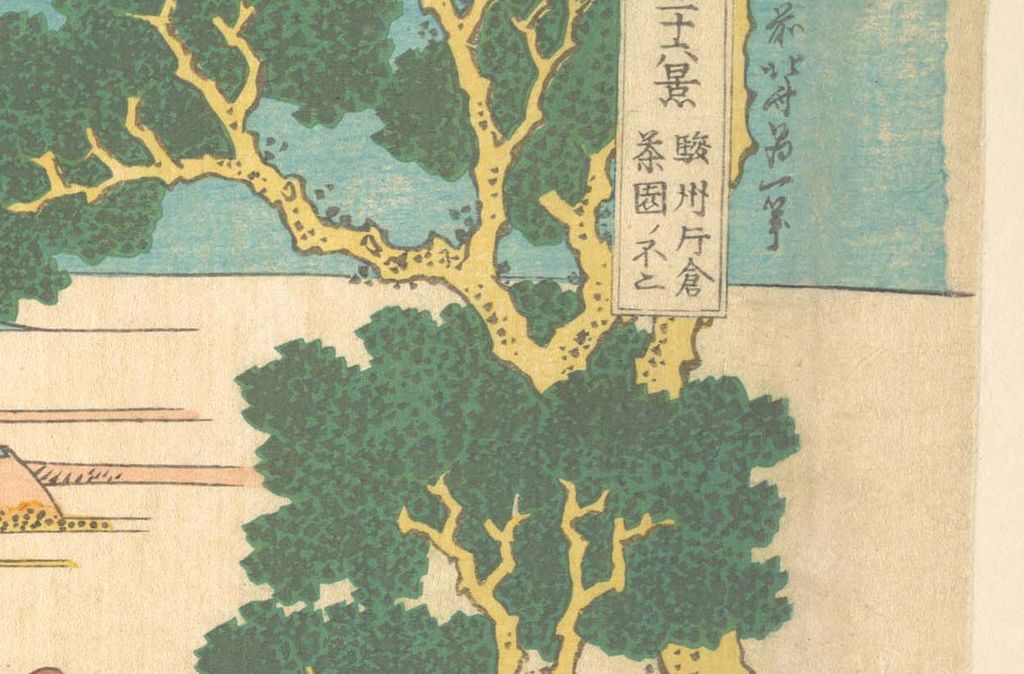
The title names Katakura in Suruga, an old province in what is now Shizuoka Prefecture. The Tokyo Fuji Art Museum’s catalogue raises the possibility that the characters for Katakura may represent a mistake for Tokura, in present-day Shimizu in Suntō District. The Sumida Hokusai Museum records a different proposal, identifying the place named in the title with a Katakura in the former Nakano village, in present-day Fuji City. Those accounts begin with the same inscription and give different explanations of the historical place-name. Both retain Katakura in the title of the design. On the print the title sits high among the branches, with the artist’s signature written outside the cartouche. A viewer can read the place name before looking for its features in the landscape. [2] [3] [6] [7]
Fuji City points to the survival of the name Katakura in its Ōbuchi district. Its geographical account shows a modern view with tea fields, the Denbōzawa valley and Fuji beyond, from near the municipal sports park. The overlap in features explains the appeal of the comparison. It leaves room for Hokusai’s arrangement of the bridge, the buildings and the mountain within the sheet. The foreground offers a clear set of local activities and structures, but none of the buildings is named in the print. You can recognise the shape of the landscape associated with the title while allowing for more than one account of its location. [1] [8]
What changes between two impressions
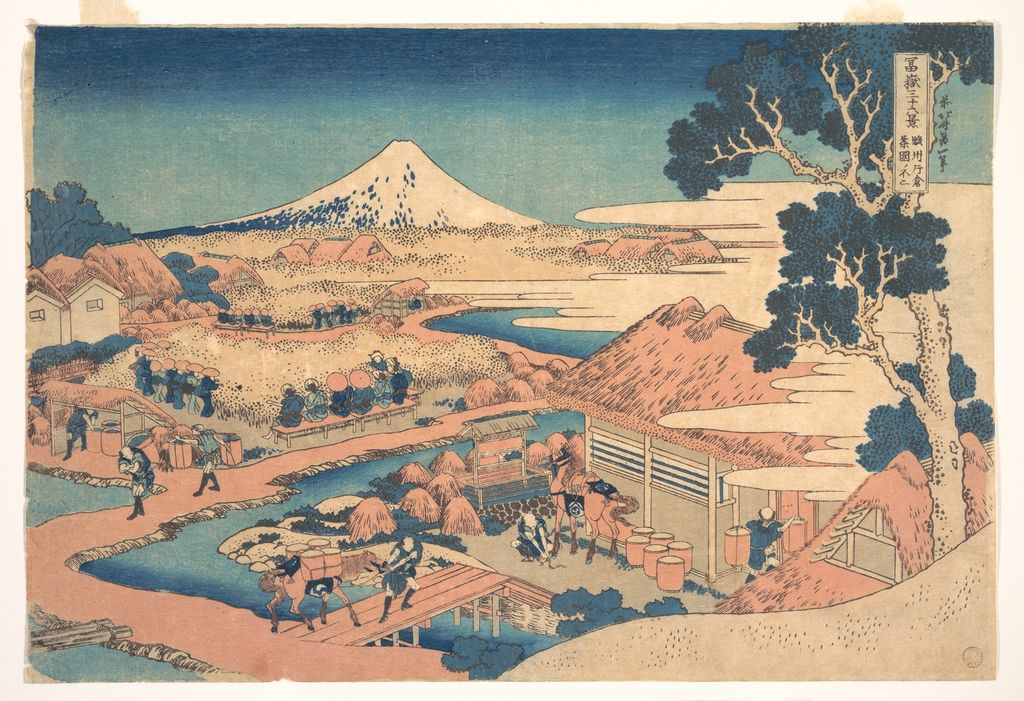
The Met’s impressions JP2955 and JP1334 offer two versions of the design. It catalogues both as colour woodblock prints on paper, dating them to about 1830–32. JP2955 came from the Henry L. Phillips Collection, while JP1334 entered by the Rogers Fund in 1922. In both, the peak, branching tree, plank bridge and clustered harvesters have the same configuration. Even the small space left between the horse and the edge of the bridge is repeated. Those correspondences matter because the surface of each photographed sheet has a character of its own. [1] [9]
In the photograph of JP2955, the blue at the top grades down across the sky in a relatively even band, leaving a pale area behind the mountain. In JP1334, a faint vertical trace drops from the middle of the upper edge. It is easiest to see in the darker blue. In that image a small circular mark is also legible at the lower right, within the sloping stretch of light ground. The mark falls away from the picture’s busiest activity and has no clear counterpart in the photograph of JP2955. The stream and the roof on the right are useful fixed points for comparison. Their outlines match closely even where the photographed tones differ. The visible differences are enough to distinguish the sheets. Colour or reproduction tone alone gives little basis for putting them in printing order. [1] [9]
Among the Thirty-six Views of Mount Fuji, the Katakura print is especially rewarding to look at in more than one pass. Begin above, where the open sky makes the long slope of the mountain legible. Then start again with the horse on the bridge and trace the path between the different groups. A route through the picture emerges from the same details that describe a working tea field. The load has weight, the planks offer a narrow crossing, and each group takes up a different position beside the crops. Fuji stays in view as those smaller actions lead the eye across the ground beneath it. [1] [3] [4]
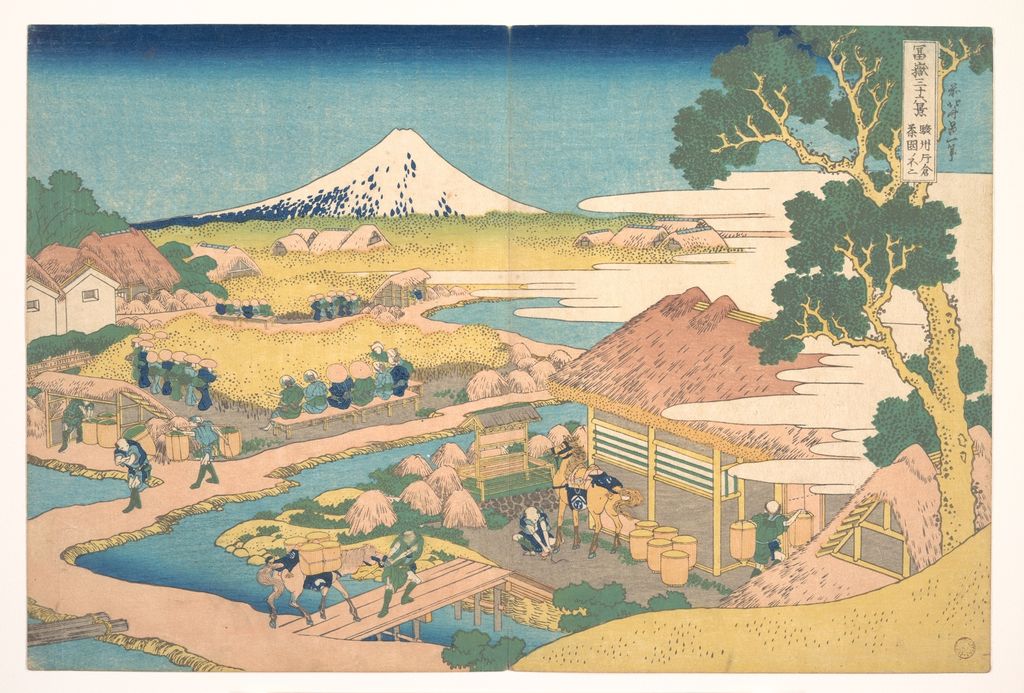
Image comparison
Where this work sits in Hokusai’s career
Annotated Details from Mount Fuji from the Tea Plantation at Katakura in Suruga Province
The Metropolitan Museum of Art, JP2955. [1]
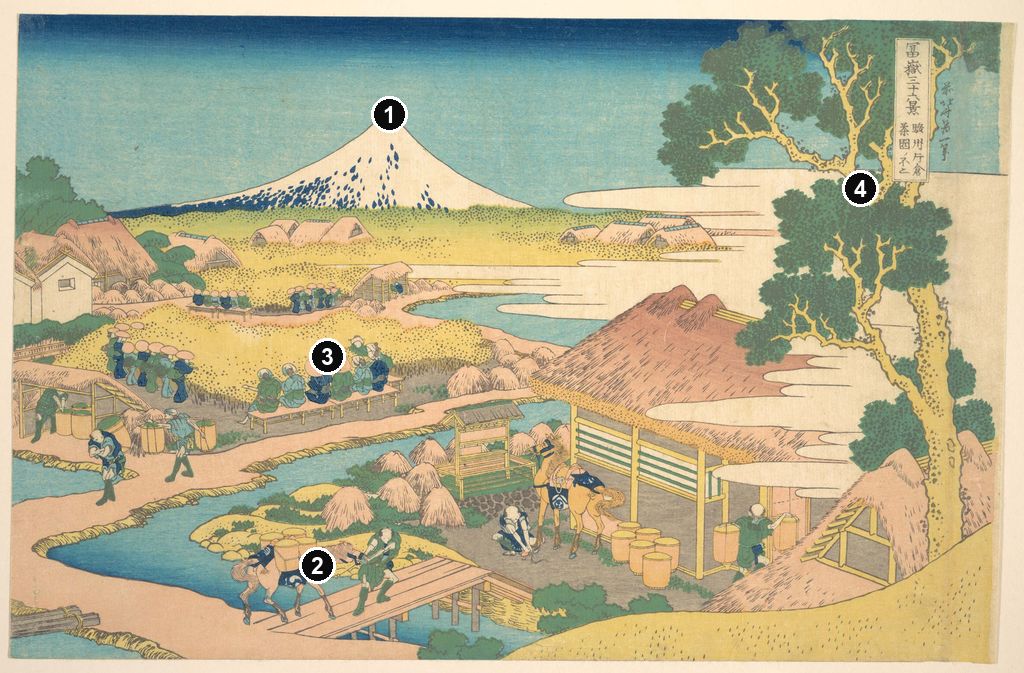
Details from MOUNT FUJI FROM THE TEA PLANTATION AT KATAKURA IN SURUGA PROVINCE
Select a detail to look closely.
Fuji rises above the tea fields
The light summit lies above several horizontal bands of planting and paths. [1]
A horse crosses a plank bridge
The small crossing carries the pale path through a band of blue. The figure and animal are part of the movement between the harvested plots. [1]
Workers stand among the low plants
The small figures recur across the fields, making the stretches of planting legible. [1]
A tree closes the right-hand edge
The near trunk is much larger in scale than the workers and acts as a frame for the distant mountain. [1]
Explore Hokusai’s works
Discussion
Look again at the images and ideas explored in Fuji from the Katakura Tea Fields in Suruga. These editorial prompts invite your observations.
Reader Insights
Where does the tea harvest take place?
How do the paths lead between groups of workers?
Join the Conversation
Share a detail, comparison or question about Fuji from the Katakura Tea Fields in Suruga below.
References
- The Metropolitan Museum of Art, Fuji from the Katakura Tea Fields in Suruga (Sunshū Katakura chaen no Fuji), impression JP2955, collection record and photograph. View source.
- National Museum of Western Art, Iuchi Collection exhibition checklist, item 41, Japanese and English titles. View source.
- Shimane Art Museum, Mt. Fuji seen from the Katakura tea plantation in Suruga province, Nagata Seiji Collection, curatorial account of harvesting and transport. View source.
- National Gallery of Victoria, Hokusai, exhibition label for Fuji from the tea plantation of Katakura in Suruga Province. View source.
- The Metropolitan Museum of Art, In the Mountains of Tōtōmi Province, impression JP2966, collection record and photograph. View source.
- Tokyo Fuji Art Museum, Mt. Fuji from Tea Plantation of Katakura in Suruga Province, collection no. 06200, Japanese account of the Tokura proposal. View source.
- Sumida Hokusai Museum, Japanese collection record for 駿州片倉茶園ノ不二, including the former Nakano village proposal. View source.
- Fuji City, Landscapes of Fuji City depicted by Katsushika Hokusai, geographical account and modern photographs. View source.
- The Metropolitan Museum of Art, Fuji from the Katakura Tea Fields in Suruga, impression JP1334, collection record and photograph. View source.







