


 by Tom Gurney
Tom Gurney BSc (Hons) is an art history expert with over 20 years experience
Published on June 19, 2020 / Updated on November 20, 2026
Email: tomgurney1@gmail.com / Phone: +44 7429 011000
Dragon on the Higashimachi Festival Float
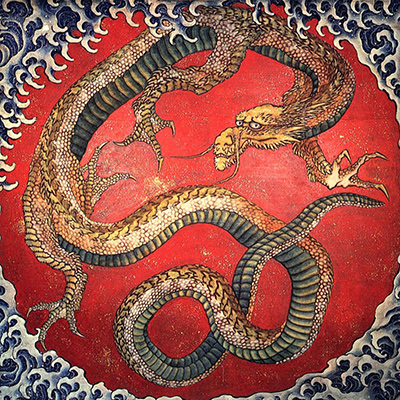
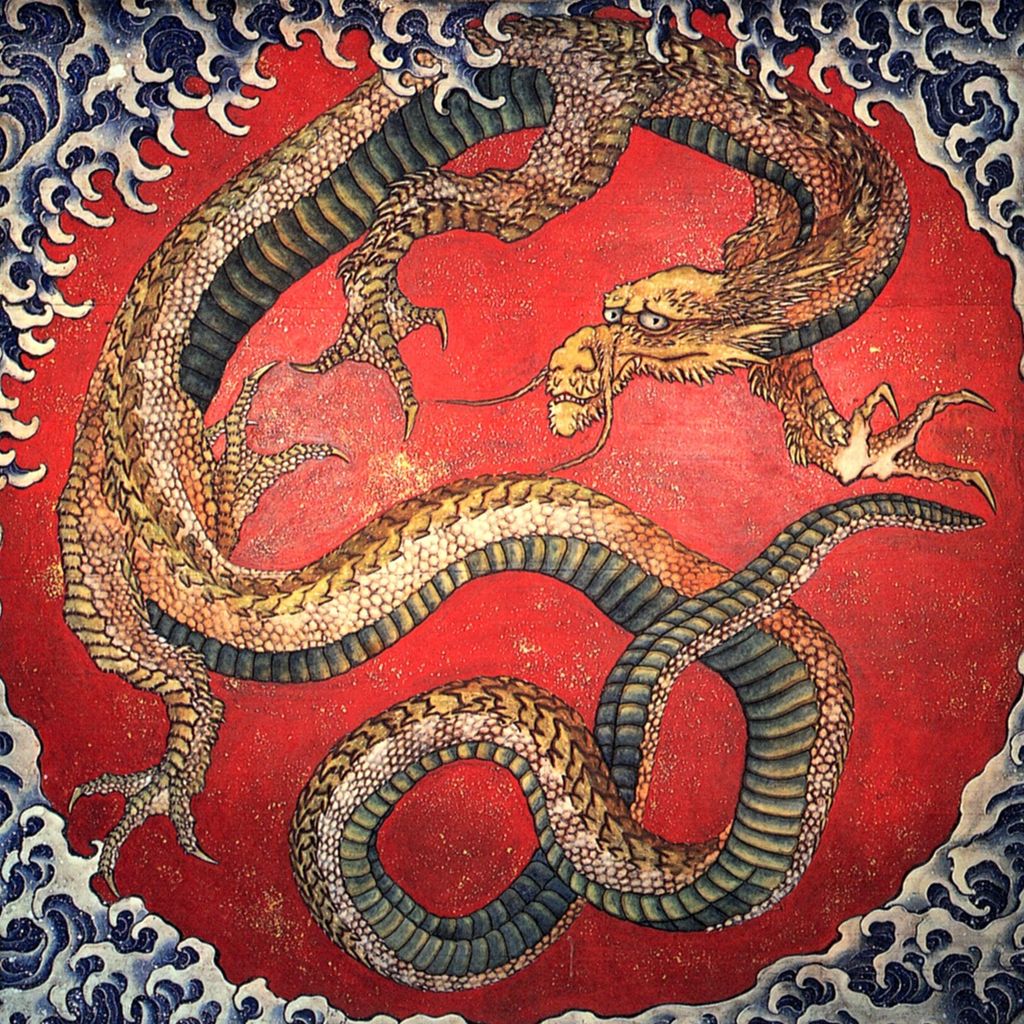
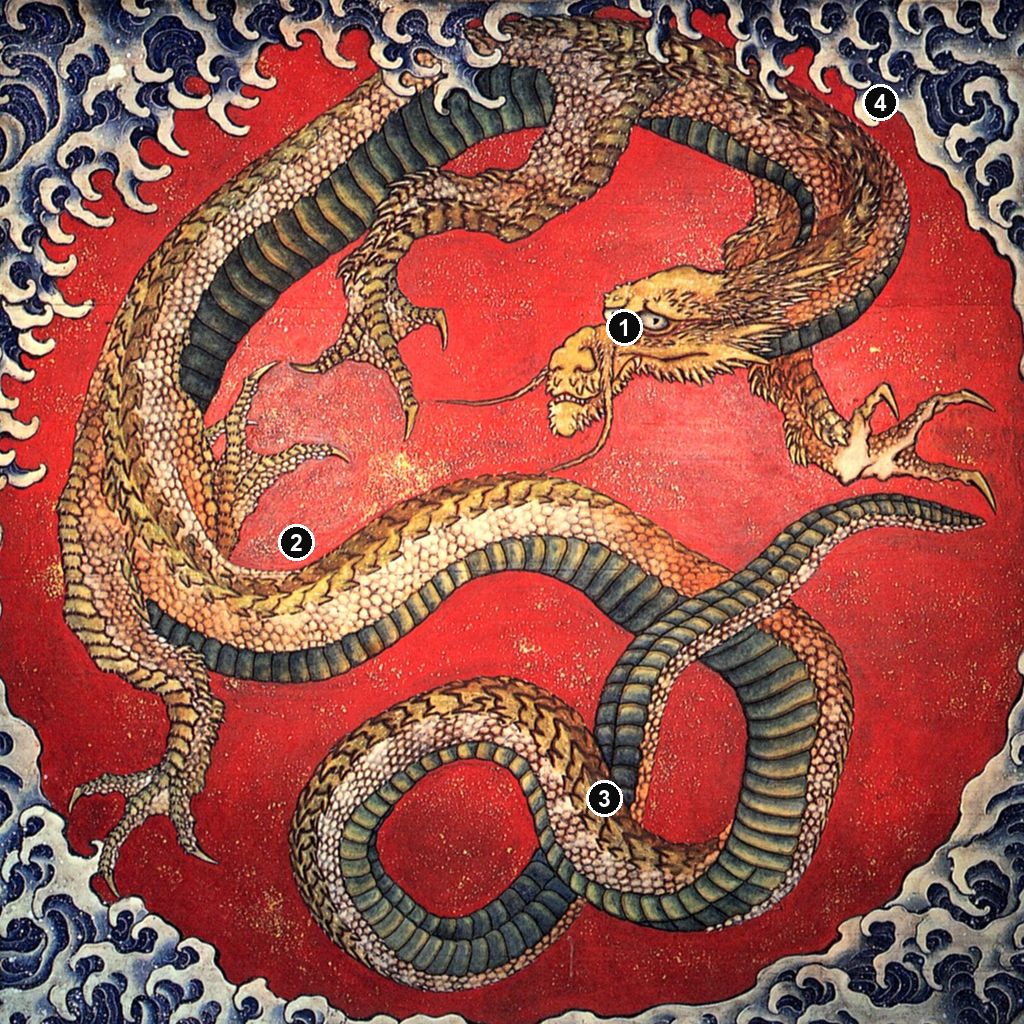
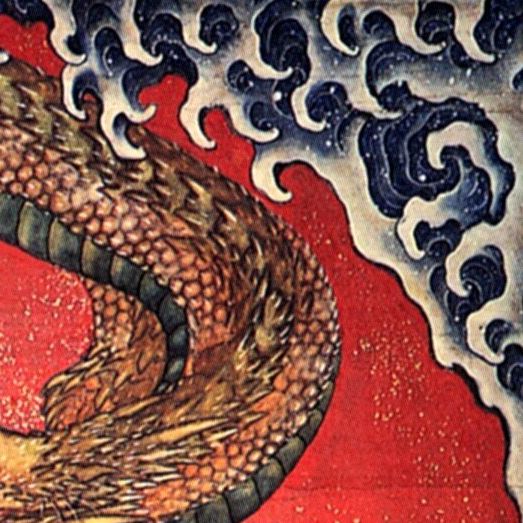
Katsushika Hokusai’s dragon curls across a fiery red field. Its head turns in from the upper right as the body sweeps along the left edge and doubles back into two loops below. The animal is almost as broad as the painted field, yet red openings separate its coils and make each change of direction legible. Hokusai painted it in 1844 for the ceiling of the Higashimachi neighbourhood’s festival float in Obuse. Once fitted above the float’s stage, the painting put the creature overhead, where it could seem to wheel in the space beneath the roof. [1] [2]
The float was already several decades old when Takai Kōzan commissioned Hokusai to paint Dragon and its companion, Phoenix. The roofed structure and the two paintings can be seen together at the Hokusai-kan Museum in Obuse. Looking first at the single image and then at the float helps explain how the bright field, the dark belly and the uneven ring of waves would have guided someone looking up at it. [1] [2]
At a Glance
- ArtistKatsushika Hokusai
- Date1844
- MediumColour on paulownia panel
- CommissionHigashimachi festival float
Contents
How the dragon folds into the red field
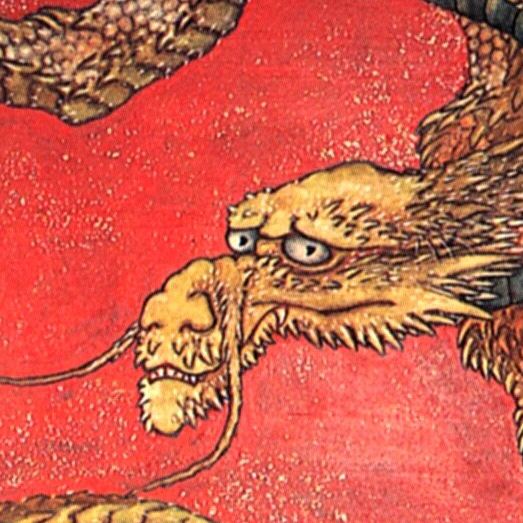
Start with the head. Its warm colour brings it forward against the red, while the eye and mouth are picked out in dark lines. The snout points back into the turn of the neck. At this angle the head looks as though it could move straight into the opening between the coils. The limbs provide shorter changes of direction. Their outlines break away from the longer body and spread across the open red. There is enough space between the claws and the curving trunk to read the gestures individually, even with so much of the panel occupied by the same animal. [1] [2]
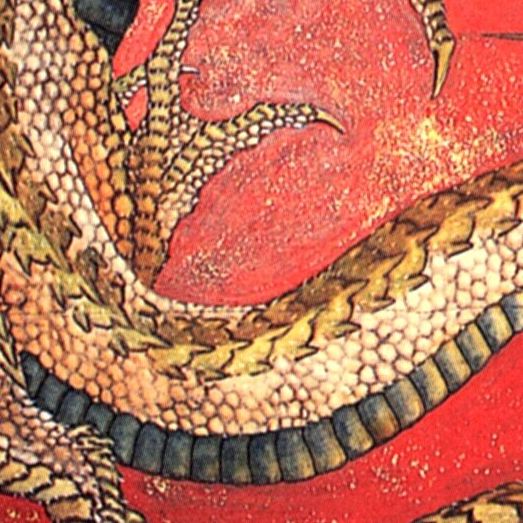
The back and belly give different accounts of the same turn. Small marks across the back make the scales read as a dense, finely worked surface. Larger, dark-edged bands along the underside spread like ribs. The bands grow more conspicuous wherever the body turns to show its belly. Follow them around the inside of the lower loops and the shape changes from a bending line into a body twisting in space. Hokusai uses these changes in the direction and width of the markings to suggest how much of the dragon’s surface is turned towards us. [2]
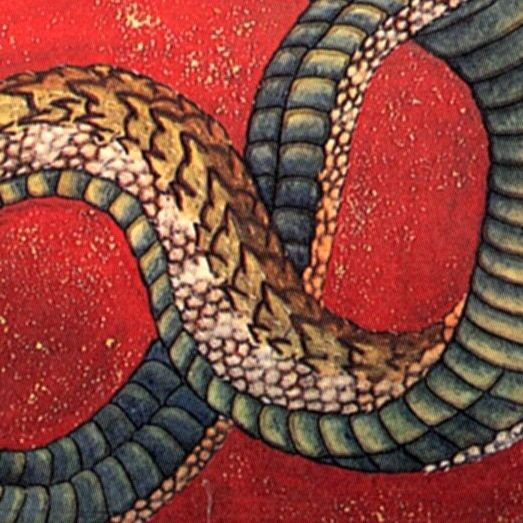
There is a broad stretch of belly at upper left and another along the sweeping bend across the middle. Between these, details disappear and return where one passage crosses another. The narrower lower body rounds a series of tighter corners. By the time it reaches the branch of red that separates the lower loops, the bend has become so tight that a small space of exposed background serves as a centre. Try following that red opening back towards the head. It connects the lower pattern of coils to the area around the face, where the turns are wider and freer. [2]
At the edges, short blue and white curls repeat on a smaller scale. Some have knuckled tips, some hook back on themselves, and others make narrow passages of white around the blue. They almost close around the red field, though the irregular meeting of the colours keeps its boundary from feeling ruled. The dragon’s broad lower turns and the small recurring curls at the edge are different ways of showing motion. The red gives room to the dragon’s limbs and keeps the pale extremities visible. Around it, the waves make the creature seem to occupy a limited area in which it can still turn. The edge in the image is part of the visible decoration around the dragon, while the roof and supports are separate parts of the vehicle. [1] [2]
Looking up at the festival float
The Hokusai-kan gives 1806 as the construction date of the Higashimachi float. The 2023 account of its digitisation dates the renovation to 1843 and the ceiling paintings to 1844. The museum explains that the existing ceiling was altered to accommodate the two pictures and that Kōzan brought the commission to Hokusai in response to the wishes of local people. Seen together, those facts give the painting two histories. Hokusai was working on a new composition, and the neighbourhood was making room for it in a structure that had already served a public purpose. [1] [2]
The photograph of the vehicle shows a pitched roof carried on tall posts, with a rail enclosing the stage below. From outside the rail the ceiling is partly screened by the roof and the beams. Moving closer changes the angle at which the painting becomes visible. The foreshortening would be greater when the recessed ceiling was seen from one side than when viewed from beneath the centre. Under those conditions the red expanse and the major bends make good points of orientation. The smaller marks, such as the bands along the belly or the breaking tips of the waves, come into clearer relation when the viewer has time to look. A front-facing photograph gives a different experience since it shows the whole perimeter and all of the coils at once. [1] [2]
Other details of the surviving float make it clear how many kinds of work went into its decoration. The collection record lists a green winged dragon on one gable and a green dragon with a child figure on the other. It also lists a carved subject involving a warrior, dragon and rough waves among the ornamental panels. The painted dragon therefore takes its place among dragon forms that viewers can encounter from the outside. The ceiling image uses painted contours and areas of colour to suggest a body in motion, while three-dimensional decoration projects from the structure. On the separately commissioned Kanmachi float, the museum identifies Kōzan as the colourist of the borders around Hokusai’s two wave paintings. The museum’s Higashimachi account credits Hokusai with the two paintings and describes the alteration of the ceiling that received them. [1] [3]
The museum dates both Higashimachi paintings to the fifteenth year of the Tenpō era. Its description gives Hokusai’s age as eighty-five by traditional Japanese reckoning and says that the two paintings occupied him for about half a year. The 2024 exhibition checklist lists the pair together and separately records the two waves made for Kanmachi the following year. The two commissions gave Hokusai repeated opportunities to work at the scale of a festival float. [1] [4]
A bright ceiling beside a dark one
Hokusai gave each ceiling panel one large creature. In the Phoenix, the bird’s widespread feathers form a turning mass against a dark, indigo-toned field. In the Dragon, the red remains exposed in the spaces where limbs, scales and the line of the belly meet. Each painting has enough internal detail to sustain a close look, while its ground establishes its place in the pair at a distance. The Hokusai-kan reads the contrast between bright and dark in relation to Chinese ideas of yin and yang. Seen in the float, that contrast also works as a practical way of making two adjacent painted surfaces read separately. [1] [2] [5]
The museum discussed the creatures together as auspicious beings in its 2026 exhibition on dragons and phoenixes. In that account, dragons in Japan are associated with the governance of water, while the phoenix is associated with peace and good fortune. The waves around the dragon make that connection to water tangible here. The painting gives the motif a visible setting through the meeting of the blue and white border, the open red and the twisting body. No single direction of travel governs the figure. It can be followed through several turns and returned to the face, a useful quality in a painting intended to be seen from changing angles. [2] [5]
Another dragon, another way of looking
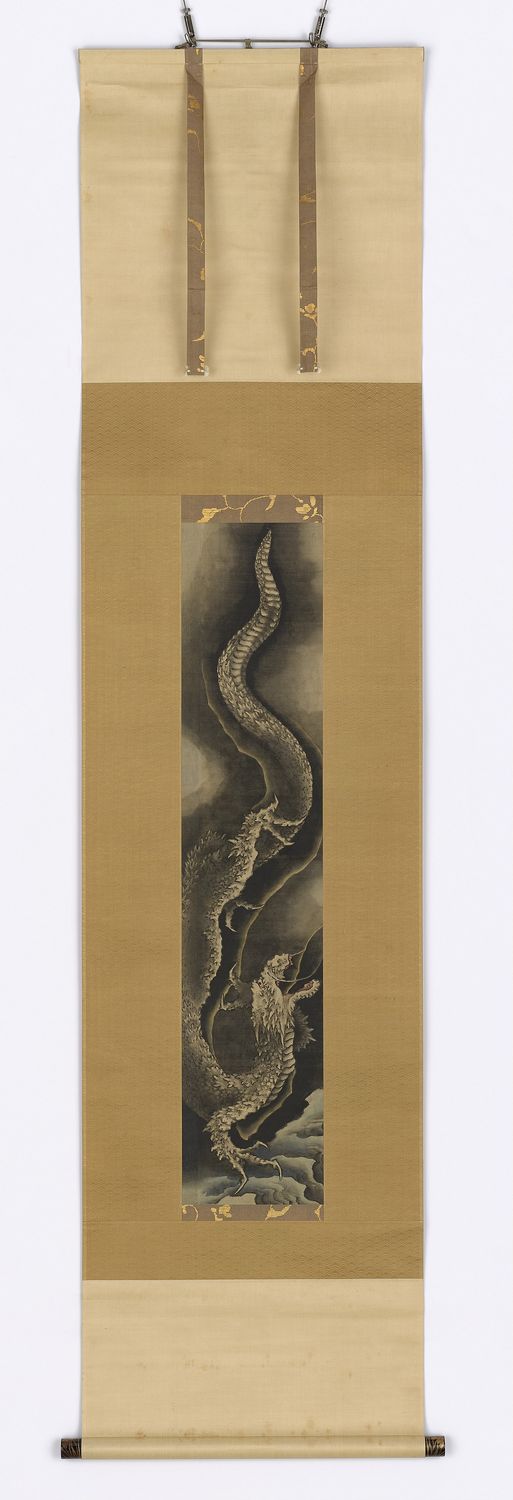
In 1849 Hokusai painted Dragon Flying over Mount Fuji, a separate work now held by the same museum. The exhibition catalogue identifies it as a hanging scroll in ink and pigments on silk. The dragon ascends beside Fuji in a narrow vertical composition, partly merged with the darkness of the clouds. The outline of the mountain and the dark plume lead the eye upwards. The older ceiling panel spreads the action across a compact field and lets the contours of the animal stand in full view. The two works show how much the direction of a dragon’s movement depends on the surface Hokusai gave it. [4] [5] [6]
The float painting belongs to the part of Hokusai’s work that came directly from his brush. A print such as Under the Wave off Kanagawa gives the wave a course across paper in one direction, with the fingers of foam poised above boats. Around the dragon, there are small breaking crests on several sides of the red field, so the movement stays active when the viewer approaches from another direction. The gaps between strokes keep both surfaces readable. In each work, the eye can pick a single edge to follow, then step back to see how the smaller movements serve the whole composition. [2] [7]
The neighbourhood associations deposited both floats with the Hokusai-kan, where they have been displayed since the museum opened in 1976. The pair received Nagano Prefecture’s designation in 1979. In 2023 the surfaces of the four ceiling paintings and the structures of the two floats were digitally recorded. Those records make it possible to examine the change of direction along a scale or a curl, while the assembled vehicle shows how such details were positioned overhead. The surviving float is the scale reference for the painting. The beams, posts and railing help a modern viewer imagine the distance and angle from which the dragon first made its impression. [2] [8]
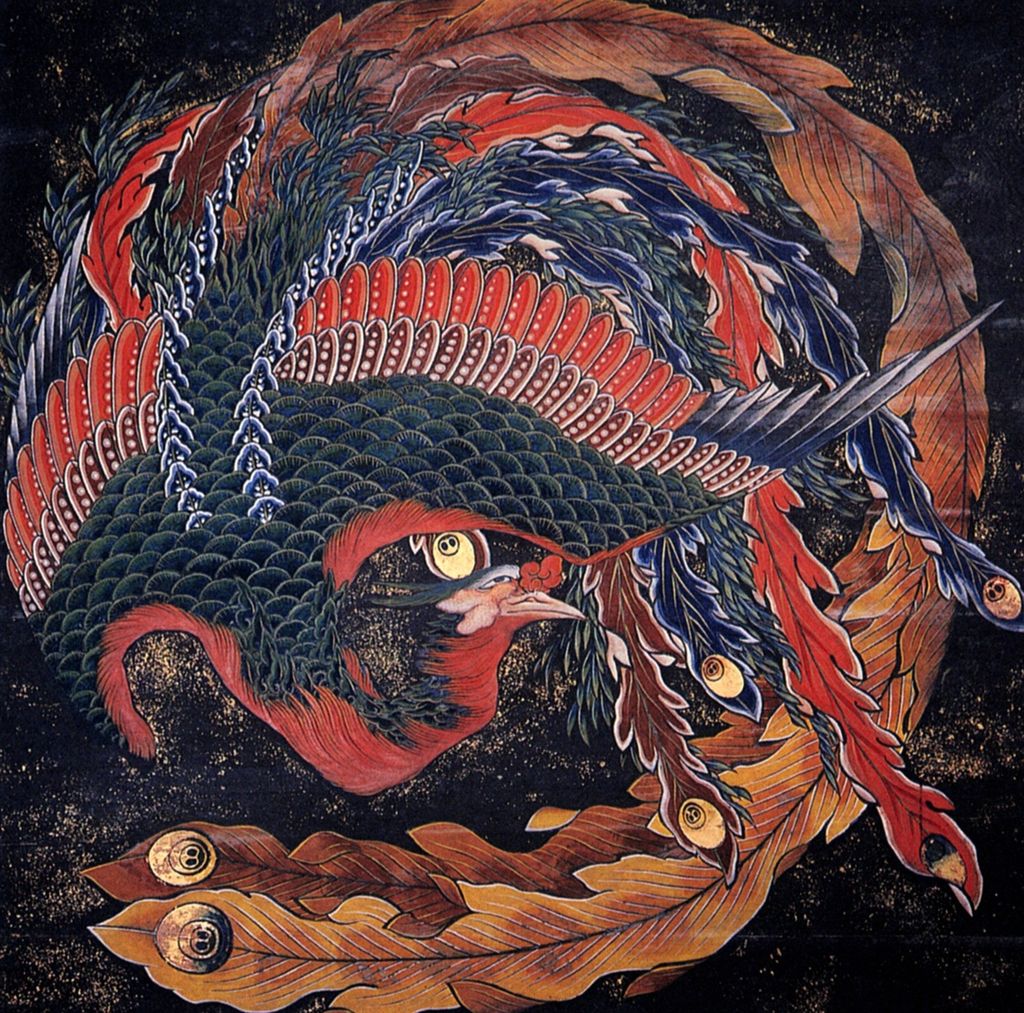
Image comparison
Where this work sits in Hokusai’s career
Dragon
1844Annotated Details from Dragon
Hokusai Museum, Obuse. Reproduction via Visipix and Wikimedia Commons. [1]
Details from DRAGON
Select a detail to look closely.
The head turns into the coil
The yellow-brown face comes out of the longer sweep of the body. Its forward features guide the eye into the red space at the centre. [1]
The body changes direction
Rows of scales bend around the curve. The light underside emerges on a contrasting path through the longer dark-backed shape. [1]
The lower loops tighten
The body doubles back and crosses. The curved lengths of red between the loops show which part of the body passes in front. [1]
Blue and white surround the red
Curved white tips border a dark blue field at the edge. Their rhythm contrasts with the longer bends of the dragon. [1]
Explore Hokusai’s works
Discussion
Look again at the images and ideas explored in Dragon on the Higashimachi Festival Float. These editorial prompts invite your observations.
Reader Insights
How do you follow the dragon’s body through its change of direction?
What happens where the surrounding waves touch the red field?
Join the Conversation
Share a detail, comparison or question about Dragon on the Higashimachi Festival Float below.
References
- Hokusai-kan Museum, Obuse, Higashimachi Festival Float (東町祭屋台), permanent collection record. View source.
- NTT East and NTT ArtTechnology, High-definition digitisation of the Higashimachi and Kanmachi festival floats, project announcement and Hokusai-kan photographs, 25 September 2023, section 1. View source.
- Hokusai-kan Museum, Obuse, Kanmachi Festival Float (上町祭屋台), permanent collection record, section on the wave paintings and their borders. View source.
- Hokusai-kan Museum, Obuse, Hokusai’s Evolution, 2024 exhibition checklist, Exhibition Room 3, no. 15. View source.
- Hokusai-kan Museum, Obuse, The Flying Dragon and Phoenix Hokusai Left in Obuse (北斎が小布施に残した傑作 天舞う龍と鳳凰), exhibition essay and illustrations, 30 January 2026. View source.
- Château des ducs de Bretagne, Musée d’histoire de Nantes, Hokusai (1760–1849), chefs-d’œuvre du musée Hokusai-kan d’Obuse, 2025 exhibition dossier, entry for Dragon volant au-dessus du mont Fuji. View source.
- The Metropolitan Museum of Art, Under the Wave off Kanagawa, JP1847, collection record and photograph. View source.
- Town of Obuse, Cultural Properties of the Town, register entry for the two festival floats. View source.









