


 by Tom Gurney
Tom Gurney BSc (Hons) is an art history expert with over 20 years experience
Published on June 19, 2020 / Updated on November 20, 2026
Email: tomgurney1@gmail.com / Phone: +44 7429 011000
Onikojima Yatarō and Saihō-in Akabōzu by Katsushika Hokusai
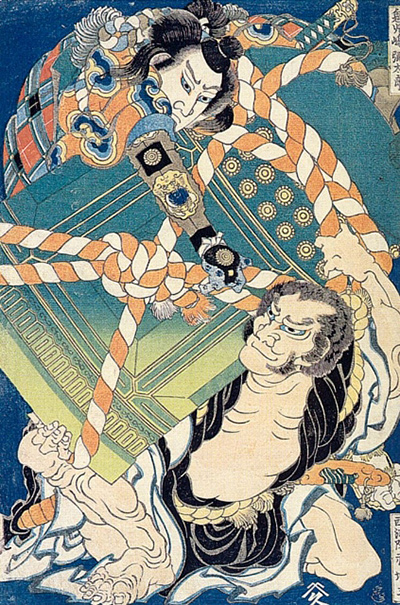
A temple bell takes up most of Katsushika Hokusai’s colour woodblock print Onikojima Yatarō and Saihō-in Akabōzu. It is tilted across the upright sheet, with the armoured Yatarō leaning over it from above and his opponent, Akabōzu, looking up from below. Red and pale strands of rope cross the bell’s surface and lead between their hands. The Shimane Art Museum dates its impression to around 1833–34 and places the composition in Hokusai’s untitled series of warriors in combat. [1]
The print pictures a struggle to recover the bell. Hokusai has cut away nearly all of the surrounding world, leaving the two characters, the object and just enough dark blue to mark their silhouettes. He illustrated the same pair in a book published in 1850. That opening gives the bell a different position and gives the figures room to brace themselves. Seen together, the two designs show the range of choices Hokusai made when adapting an encounter for different formats. [2] [3] [5] [6]
At a Glance
- ArtistKatsushika Hokusai
- Dateca. 1834
- MediumColour woodblock print
- SubjectWarriors and heroic tales
Contents
The warrior, the bell and the legend
The Sumida Hokusai Museum describes Yatarō as a reputed retainer of Uesugi Kenshin. The museum notes that his deeds appear in military tales and that he may be fictional. It explains the “oni” in Onikojima as a reference to his strength. This makes sense of the seemingly unusual pairing of names. The warrior has a nickname that likens him to a formidable being, and the being he meets is said to be a yōkai. Their expressions and their places in the frame can be distinguished even before reading the labels. [3]
In the tradition summarised by Sumida, Akabōzu stole a hanging bell from the family temple of the Nagao, Kenshin’s family. Kenshin charged Yatarō with dealing with the creature, and the bell was recovered. The museum leaves the underlying source of this account open. The print pictures one episode within that tradition, the moment when Akabōzu tries to lift the bell and Yatarō hangs on in an effort to take it. The recovery belongs to the story after this moment. On the sheet, the bell still occupies the space between them. [3]
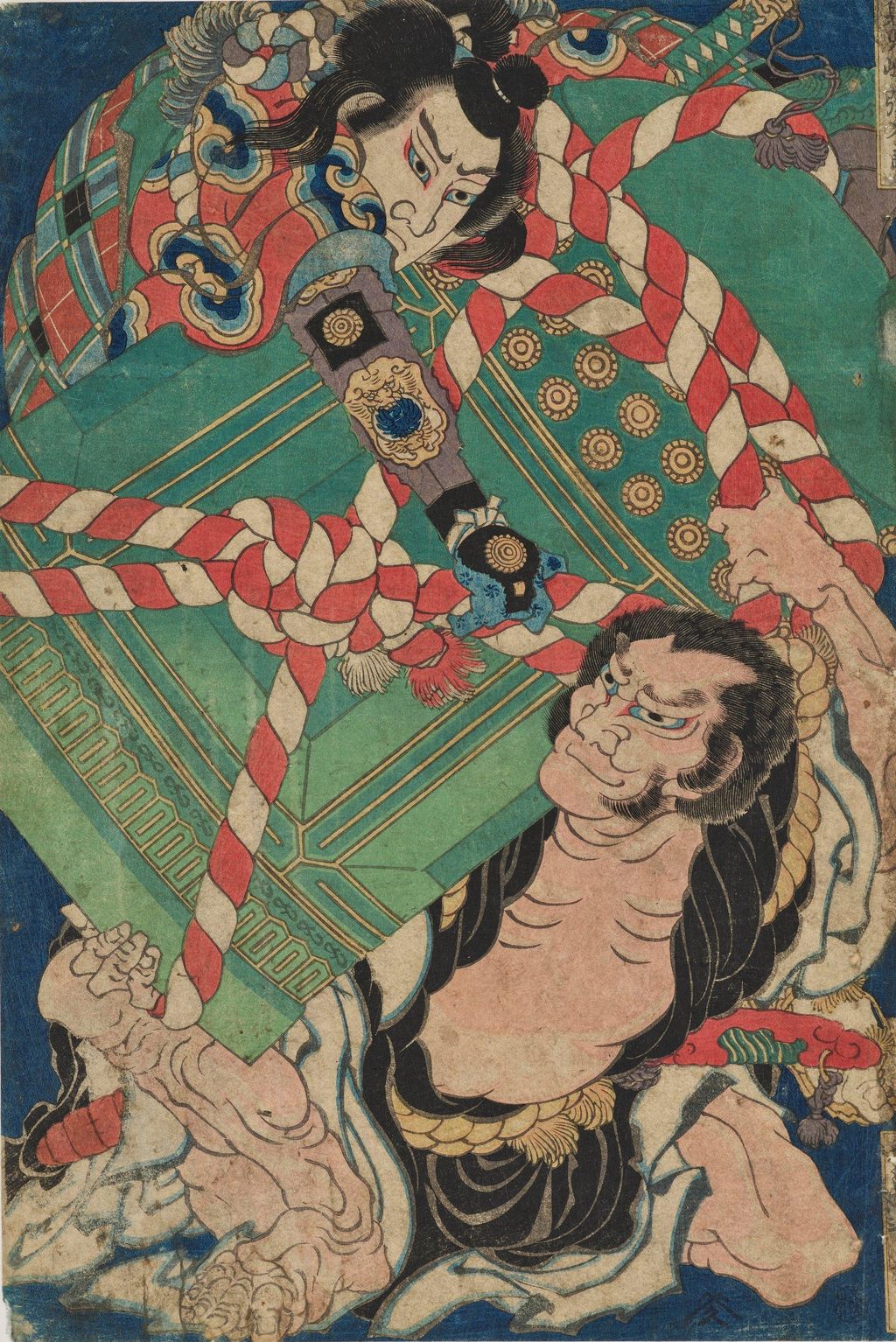
The Japanese title names both figures as 鬼児嶋弥太郎 and 西法院赤坊主 in the Shimane record. The museum gives the reading Saihō-in Akabōzu. Tokyo National Museum’s impression is listed in Art Platform Japan as Onikojima Yataro and Nishihoin Akabozu, and the English checklist for Sumida’s Hokusai and the Samurai World also uses Seihōin Akabōzu for the colour print. These are catalogue variants for the same pair of characters. The name cards at the right edge have a practical role in the design. One is up by the upper figure and the other is down by the crouching figure, which places each name at the appropriate height without interrupting the bell. [1] [4] [5]
How to read the struggle
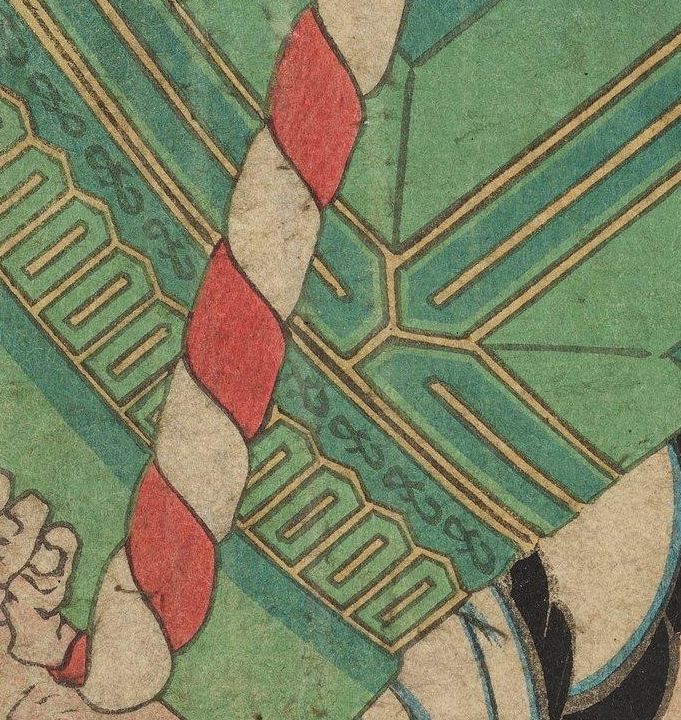
Begin with the bell’s broad green side. Its straight ornamental lines hold together a shape partly covered by Yatarō, Akabōzu and the rope. The rows of round bosses are especially helpful because they keep the orientation of the bell legible where the striped rope curves across it. Lower down, the band near the rim turns a corner and sweeps towards the bare arm. The object looks heavy before the viewer has worked out all the overlapping limbs. The green also supplies a comparatively broad expanse between the intricate clothing and the patches of bare skin. [1] [2]
The rope offers a second route through the image. It enters from the left in several lengths, meets in the tightly wound knot and fans out again. Near the upper right it curves back on itself. Akabōzu’s raised hand closes around it along the right edge, while another length descends past his opposite arm. Hokusai keeps the alternation of red and pale sections going through most of the changes of direction. The viewer can follow a strand as a single line across other activity in the print. A tassel at the knot hangs away from the larger turn of the rope and makes the central tangle easier to read. [1] [2] [4]
Yatarō looks down from above the bell. The curved parts of his armour and sleeve ornament take up much of the upper left, leaving a small area around his eyes and nose. His downturned face and the line of his arm direct attention back towards the knot. Akabōzu’s face is lower and to the right. The sweep of hair beside his cheek continues down alongside the open robe, whose strong folds frame a broad bare chest. Their eyes are close enough to form a diagonal across the bell, which gives them a direct connection even though a great part of the sheet is occupied by things they wear or hold. [1] [2] [4]
Near the bottom, Akabōzu’s toes and bent leg help explain the effort of the upper body. The feet are low in the frame, with only a strip of blue below. The shoulder, curled fingers and partly hidden folds of the costume look more animated because the lower shapes are so tightly compressed against the edge. Hokusai gives the bell its own firm outline and keeps the bodies visibly under strain. Shifting attention from one to the other produces the feeling that the action is poised to tip. [1] [2]
The crossings behave differently depending on what lies under them. Where the rope covers the bell, the strong edges of the bell resume beyond it and hold the whole object together. At the shoulders and hands the overlaps have a bodily consequence. A sleeve turns away, fingers close around a strand, or a forearm runs to the edge. In that small interval between the knot and each face, Hokusai shows how a thing held in common can determine the pose of both figures. [1] [2]
A large colour print from a small group
Shimane describes the series as Hokusai’s only set of large-format warrior prints and records five known designs. Its account picks out two qualities they share, a dark blue background printed as a broad flat field and two figures locked in close combat. Here, only patches of the blue are visible, especially below the figures and around the upper corners. The uninterrupted colour fills what remains of the sheet and allows the heavily patterned clothing to run right up to it. Hokusai uses the upright format to stack the bodies as well as fit the bell between them. [2]
The Nagata Collection impression at Shimane is a single ōban nishiki-e, a large-format colour woodblock sheet measuring 37.2 by 25.2 centimetres. Tokyo National Museum catalogues its own impression as a nineteenth-century colour print and records Hokusai’s Iitsu signature. The Tokyo file shows the same positions of both figures, the knot and the design on the bell. Its right margin is tighter in the online image, particularly around the name cards, than in Shimane’s published view. This is a useful difference when comparing reproductions. The larger file brings out details in the shoulders and hands, while the broader view makes the position of the two labels easier to see. [1] [2] [4]
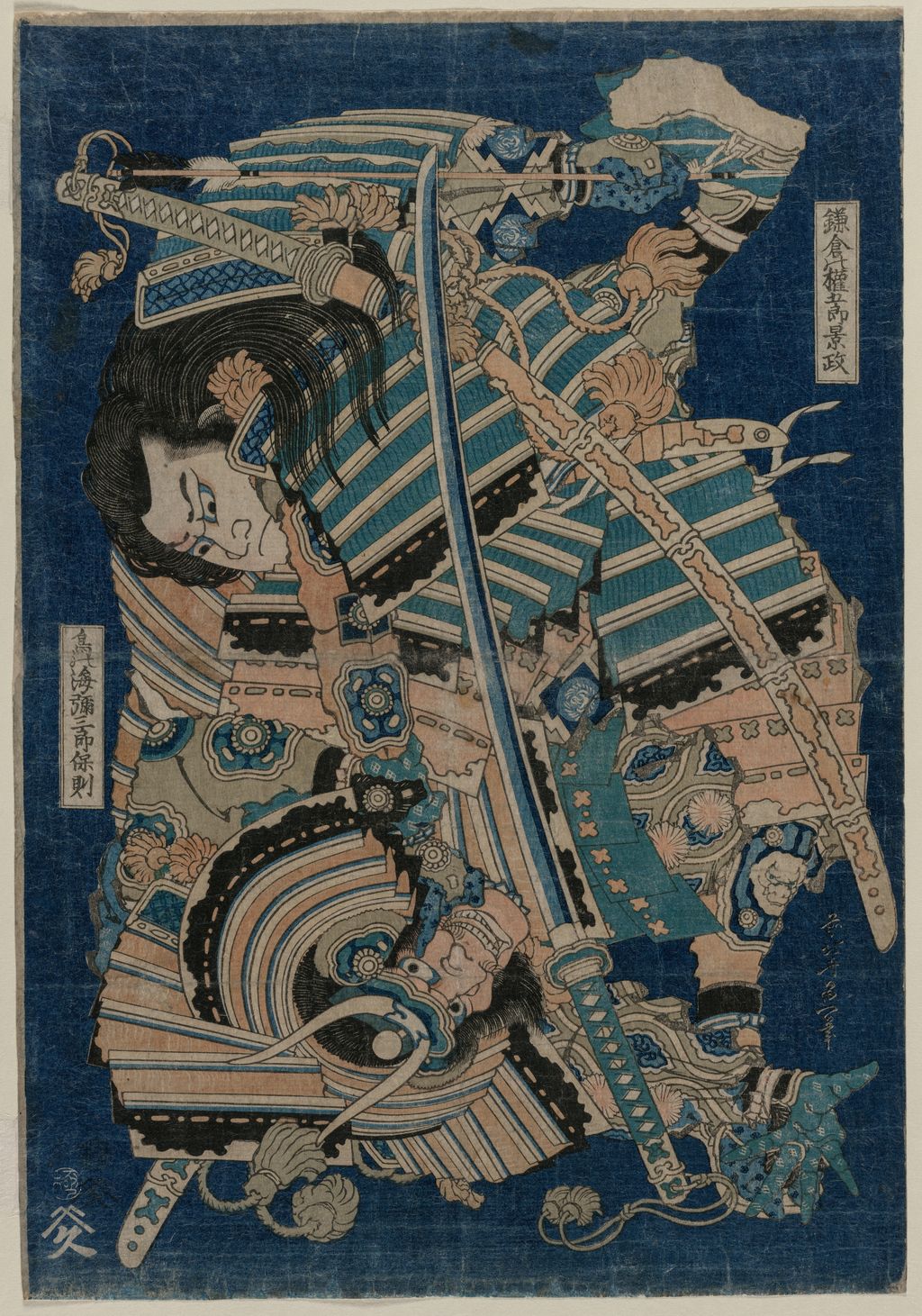
The group belongs to the early 1830s, the same broad period as Hokusai’s Thirty-six Views of Mount Fuji. A useful comparison is the role of scale. Many of the landscapes give the eye a long distance to travel before it reaches the mountain. This sheet gives the eye almost nowhere to go except back through the objects at close range. The bell’s rim and the two faces are enough to establish direction and distance within the space available. [1] [2]
The same encounter in an illustrated book
The Sumida exhibition checklist records the colour sheet and a separate appearance of the scene in Ehon wakan no homare, a picture book of heroes of China and Japan. The Metropolitan Museum of Art dates the book’s design to about 1836 and its posthumous publication to 1850. In its copy, accession 2013.882, the matching opening is digitised as image 28. It is a wide, monochrome composition read across two pages, with the bell above the figures and the fold running through the middle of the bell. Akabōzu stands at the left and Yatarō at the right. Their bodies bend inward, toward the long horizontal implement across the lower part of the opening. [5] [6]
The book makes their stance particularly clear. Each man plants his feet and leans his weight towards the centre, with enough unmarked paper beneath him to describe how the legs are arranged. A line of rope crosses the left side of the opening on an angle. The bell’s rim and rectangular panels are recognisable, but the bell is presented farther back in the space. Instead of the uninterrupted dark field of the large colour sheet, the open paper around the feet gives the reader pauses between the different lines of action. The two names are placed in the upper portion of the spread near the corresponding sides. Looking from one side of the fold to the other becomes part of following the encounter. [5] [6]
The designs also reward looking at different distances. From across a room the red and pale coils tell you where the bodies are meeting in the colour print. Up close, the book supplies the narrow bands and small gestures that can be followed across the gutter. The people and their bell are recognisable in both versions, with markedly different arrangements of the feet, rope and field around them. The book’s 1850 publication documents Hokusai’s reuse of the characters in a different print format and gives a comparison for the earlier sheet. Sumida’s account of the legend still leaves the original written source of the episode undetermined. [3] [5] [6]
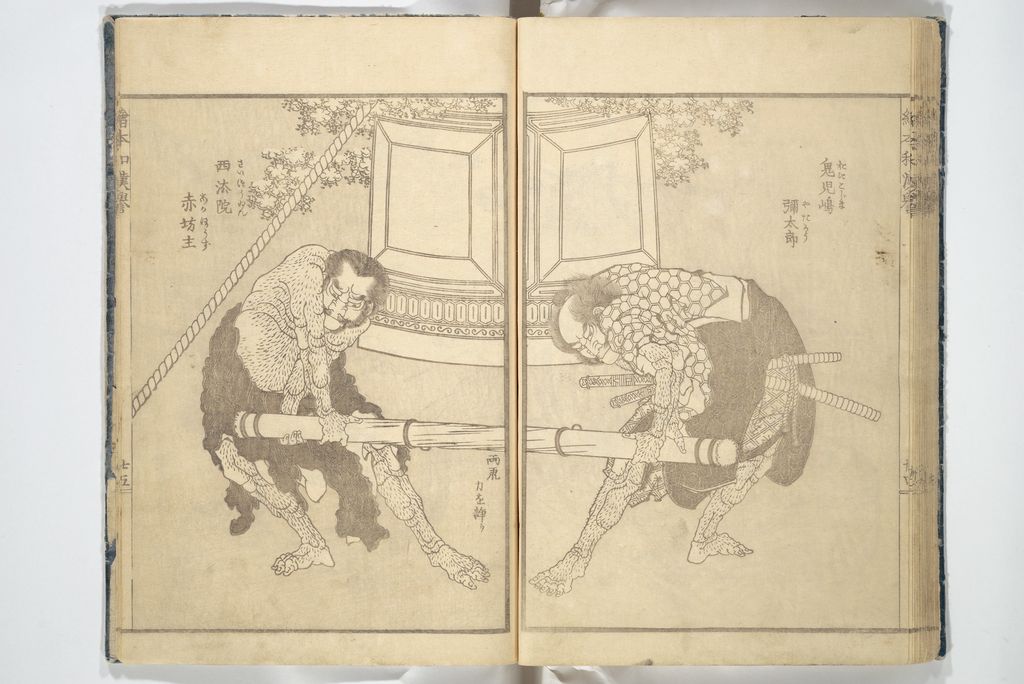
Image comparison
Where this work sits in Hokusai’s career
Hokusai Manga
From 1814Onikojima Yatarō and Saihō-in Akabōzu by Katsushika Hokusai
ca. 1834Annotated Details from Onikojima Yatarō and Saihō-in Akabōzu
Tokyo National Museum, A-10569-2813, via ColBase. CC BY 4.0. Detail crops from the original. [4]
Details from ONIKOJIMA YATARŌ AND SAIHŌ-IN AKABŌZU
Select a detail to look closely.
Yatarō looks down
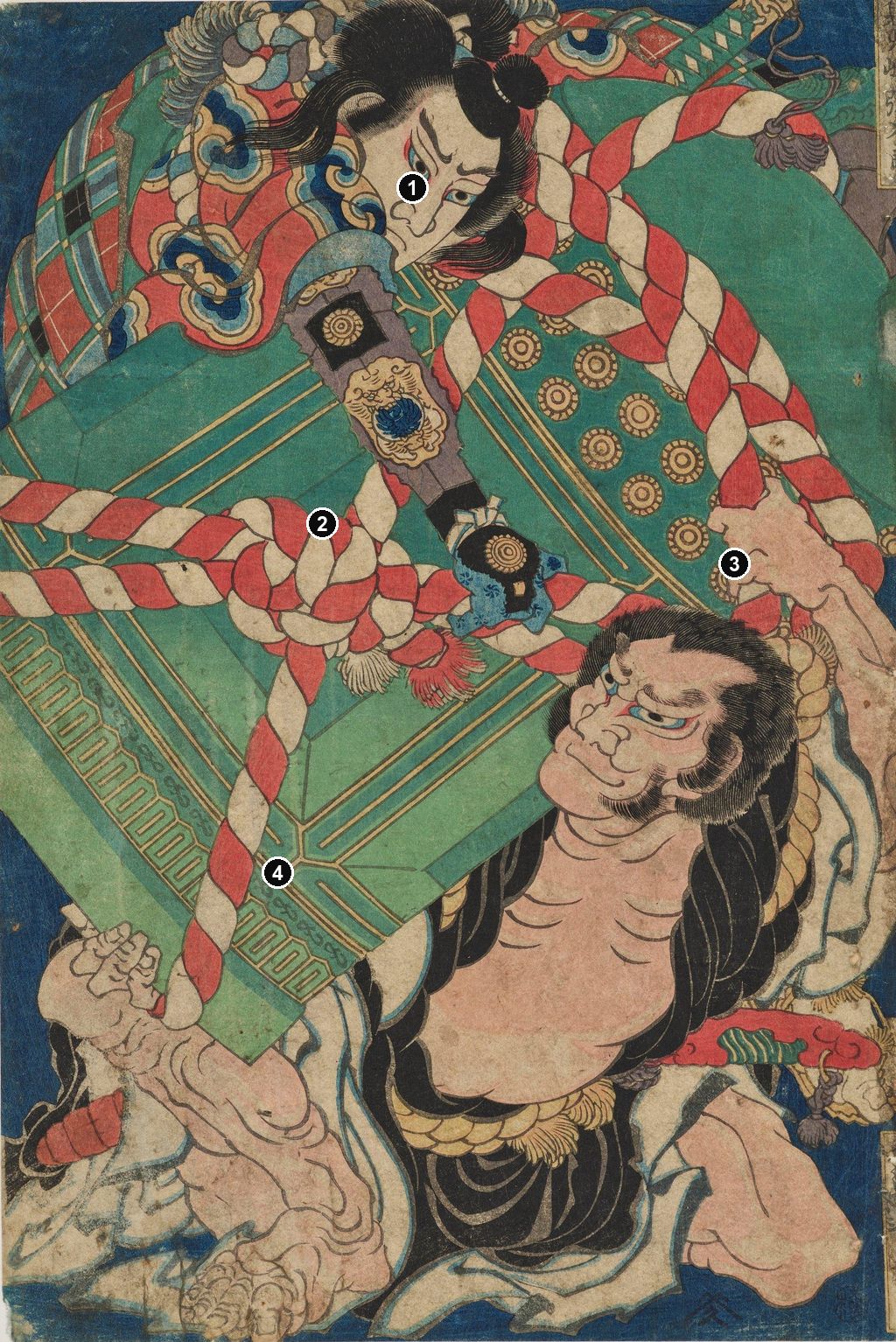
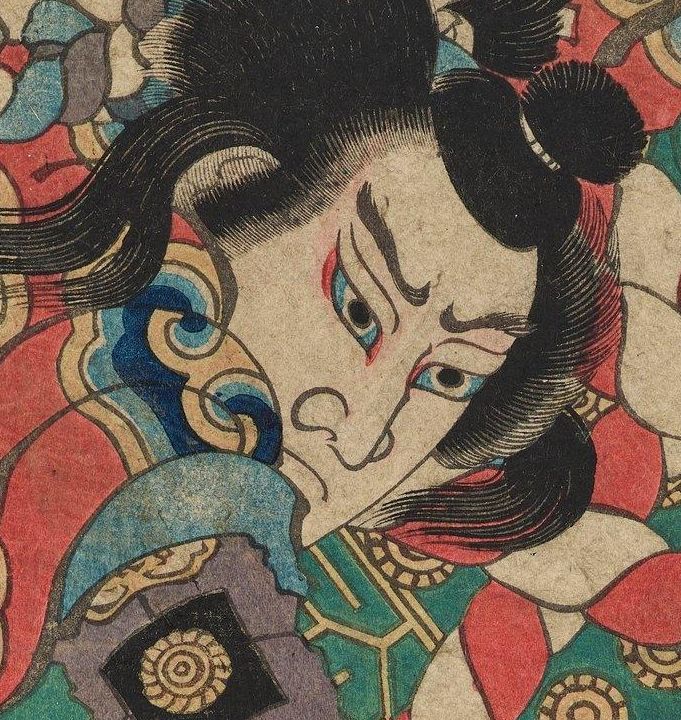
His eyes follow the angle of his head down into the space where the men meet. [4]
The rope tightens into a knot
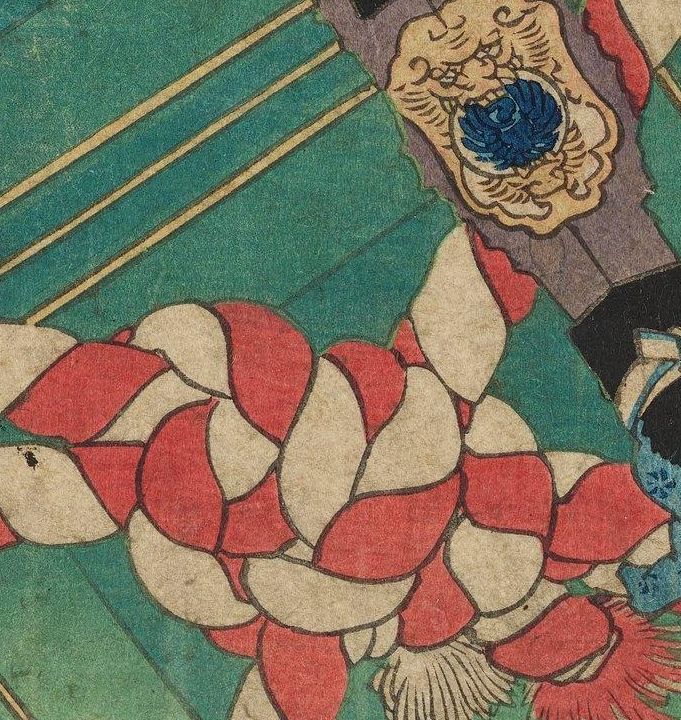
The strands double back near the middle of the page and gather the diagonals together. [4]
Akabōzu grips the rope
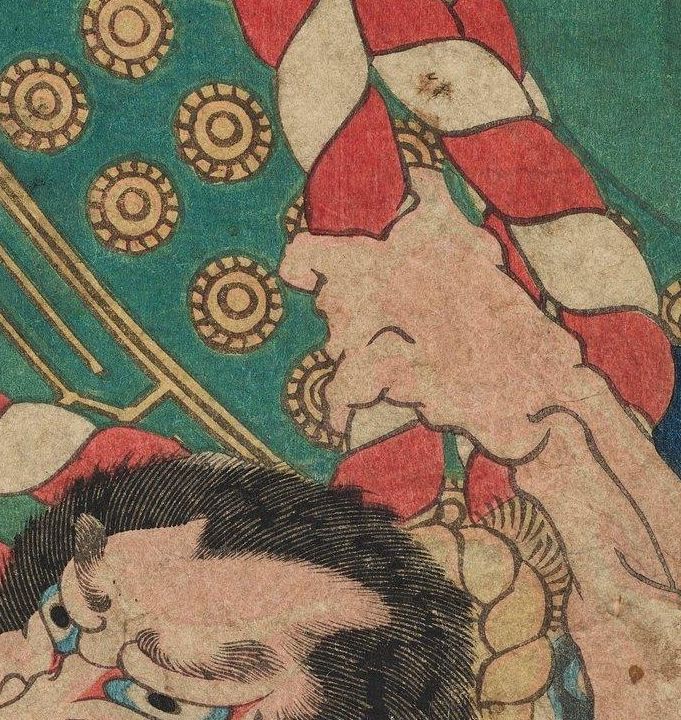
The hand wraps around a striped length at the right as the rope runs across the image. [4]
The bell rim runs beneath the rope
The large form continues beyond the men and makes their struggle part of a scene centred on the bell. [4]
Explore Hokusai’s works
Discussion
Look again at the images and ideas explored in Onikojima Yatarō and Saihō-in Akabōzu by Katsushika Hokusai. These editorial prompts invite your observations.
Reader Insights
Where does the rope change direction?
What changes between the colour sheet and the book opening?
Join the Conversation
Share a detail, comparison or question about Onikojima Yatarō and Saihō-in Akabōzu by Katsushika Hokusai below.
References
- Shimane Art Museum, Onikojima Yatarō and Saihō-in Akabōzu, nagataⅠ(628). Object record, date, size, medium and reading. View source.
- Shimane Art Museum, Nagata Collection catalogue entry. Reproduction and discussion of the five related designs. View source.
- Sumida Hokusai Museum, Onikojima Yatarō and Saihō-in Akabōzu. Character identifications, bell narrative and limits of the source evidence. View source.
- Art Platform Japan, Tokyo National Museum impression A-10569-2813. Independent impression record, alternate reading, medium and signature. The Japan Search record links the Tokyo impression to its ColBase image. View source 1. View source 2.
- Sumida Hokusai Museum, Hokusai and the Samurai World exhibition checklist. Separate entries for the print and the book opening. View source.
- The Metropolitan Museum of Art, Picture Book on Heroes of China and Japan, 2013.882. Date and format. Digitised opening showing the two figures and the bell. View source 1. View source 2.







