


 by Tom Gurney
Tom Gurney BSc (Hons) is an art history expert with over 20 years experience
Published on June 19, 2020 / Updated on November 20, 2026
Email: tomgurney1@gmail.com / Phone: +44 7429 011000
Fujimigahara in Owari Province
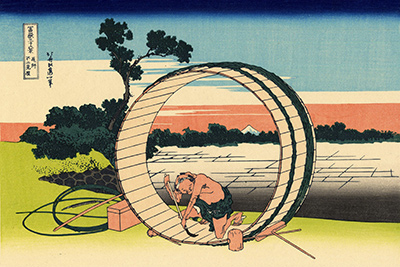
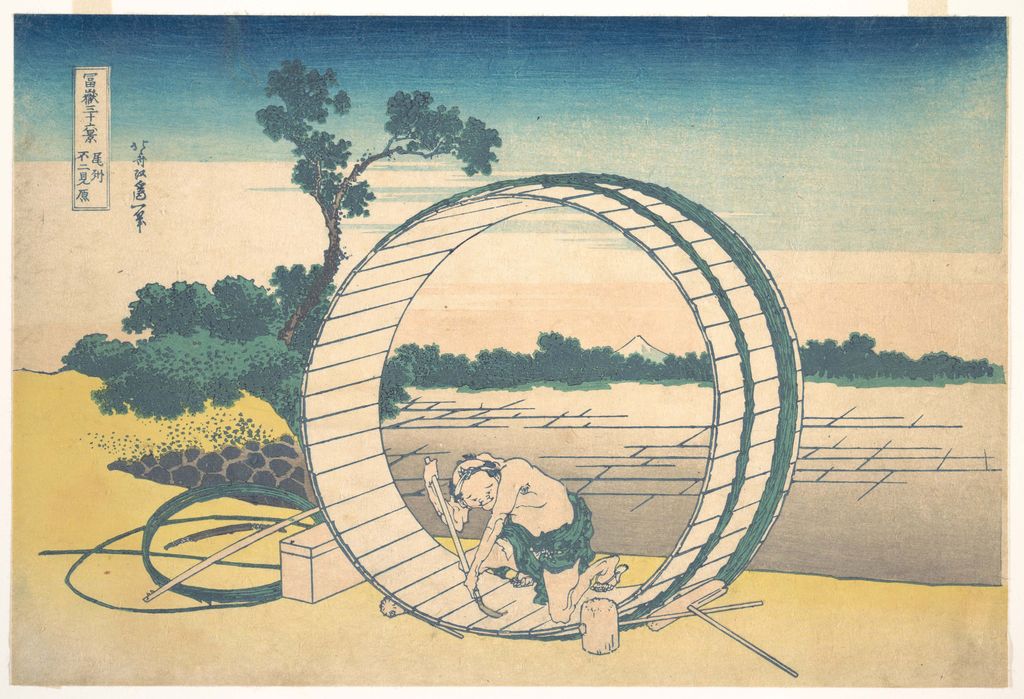
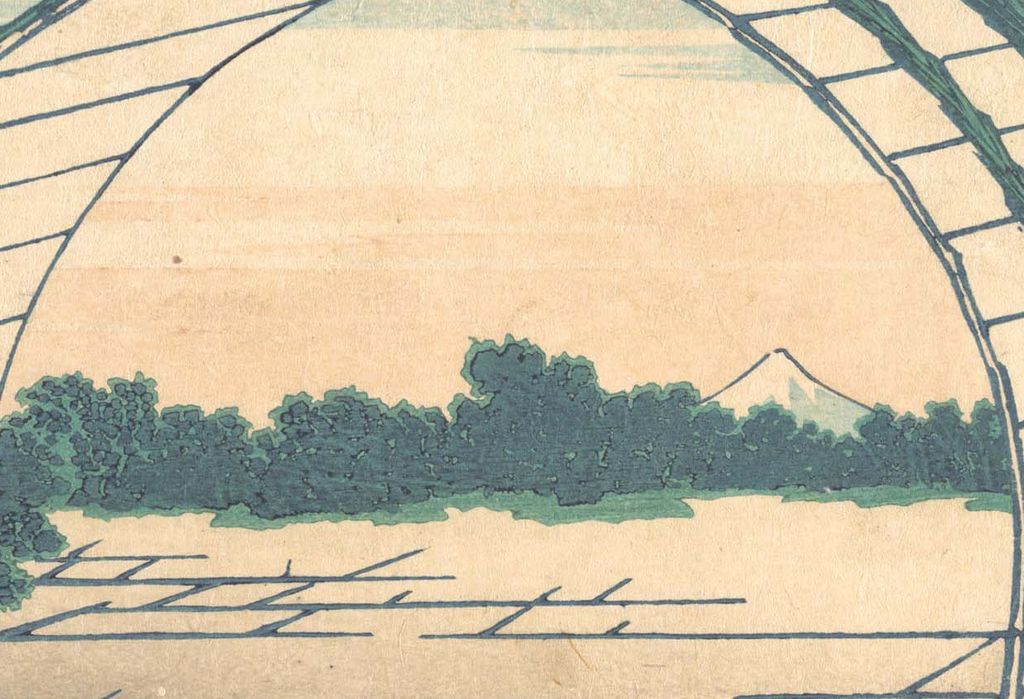
Mount Fuji is easy to miss in Hokusai’s view of Owari. Find the barrel first and follow the line of trees through its opening. Just above the trees, a fine angle rises in the pale sky. The mountain fits into a gap above a cooper who is shaving the inside of the barrel. The craftsman has his head down, his hands close together at the bottom of the staves. We can see farther through the object he is making than he can from his working position. [1] [2]
The print is known as Bishū Fujimigahara (尾州不二見原), commonly translated as Fuji-view Fields in Owari Province. Bishū is another name for Owari, and Fujimigahara names the place associated with viewing Fuji. The National Museum of Western Art’s Iuchi Collection exhibition list gives the English variant Fujimihara [Fuji-view Moor] in Owari Province. The Metropolitan Museum of Art dates its impression JP2956 to about 1830–32 and gives its dimensions as 25.6 by 37.8 centimetres. The close reading here starts from that impression. [1] [2] [3]
At a Glance
- ArtistKatsushika Hokusai
- Dateca. 1830–32
- MediumColour woodblock print
- SeriesThirty-six Views of Mount Fuji
Contents
How the barrel frames the field
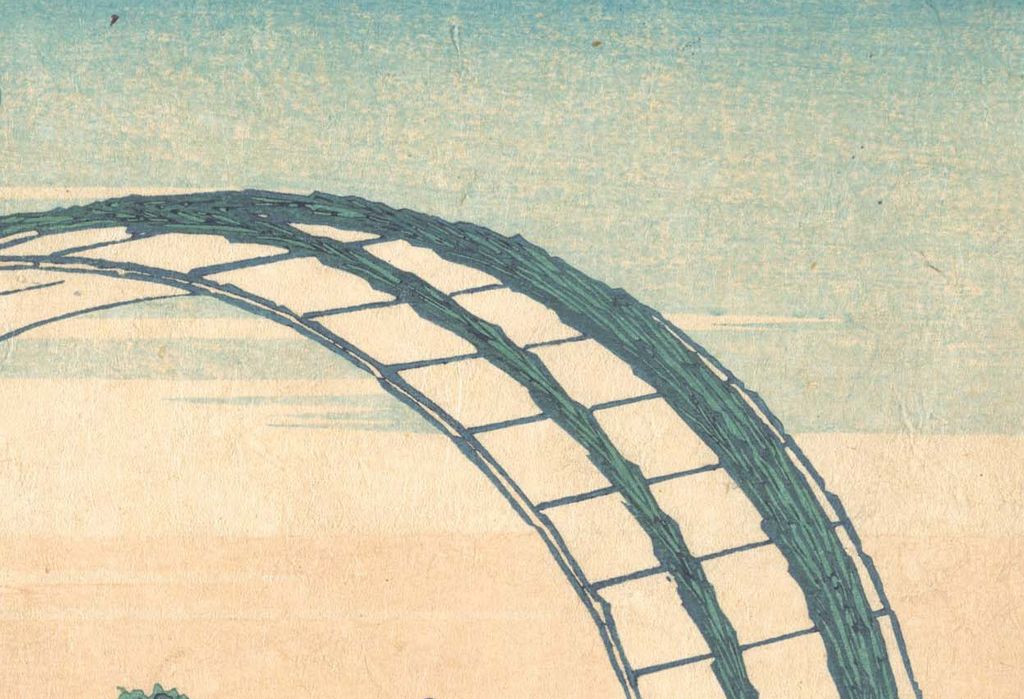
The upright opening occupies most of the height of the print. The near lip forms a thin curve, and a second, offset curve shows how far the barrel extends back. Lines joining the two curves mark the edges of the staves. On the left, their short runs are spaced well apart where the inside wall is visible. On the right, the outer hoops lie close together and carry a darker outline. Those differences let us see both the mouth of the barrel and the length of its body. Its rounded shape would be much flatter without them. [1]
Behind the barrel, the land runs across the sheet. Long lines divide the fields, with shorter ones meeting them at a diagonal. The lines disappear behind the wall of the barrel and show again on the far right. Try following the long one nearest the cooper’s shoulders. It crosses the space within the barrel and runs through the image beyond it. The barrel divides the view without changing the direction of the land, as a doorway can divide a single room from the yard outside. [1]
The tree near the left edge of the opening grows in an opposite direction. Its trunk bends up through several dark masses of foliage, with smaller clusters branching to the right. Where the crown approaches the barrel, they nearly touch. The space below that meeting point gives the inside of the barrel a broad stretch of light sky. Beyond it, a lower strip of trees gives Fuji its immediate setting. Hokusai draws that range of distances with a few changes in scale, from the cooper’s large body through the low horizon to a peak whose outline is as fine as some of the seams in the wood. [1]
The cooper and his tools
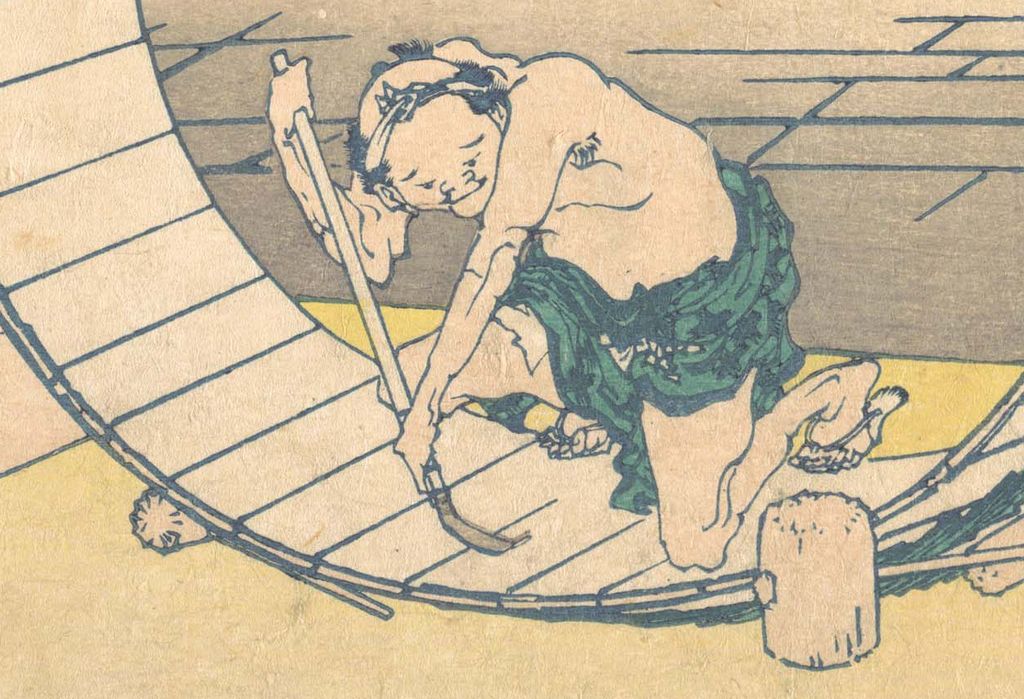
Kenji Hinohara of the Ōta Memorial Museum of Art identifies the tool in the cooper’s hands as a spear plane, a long-handled tool for shaving wood. In the Met impression the upper end rises past the cooper’s face. His hands work much lower, down near the inside curve where the barrel meets the ground. One arm stretches towards that point. The other bends, leaving his head close to his hands and his back raised. There is very little distance between the man and the wood where he is working, even though the opening around him is large enough to contain a landscape. [1] [2]
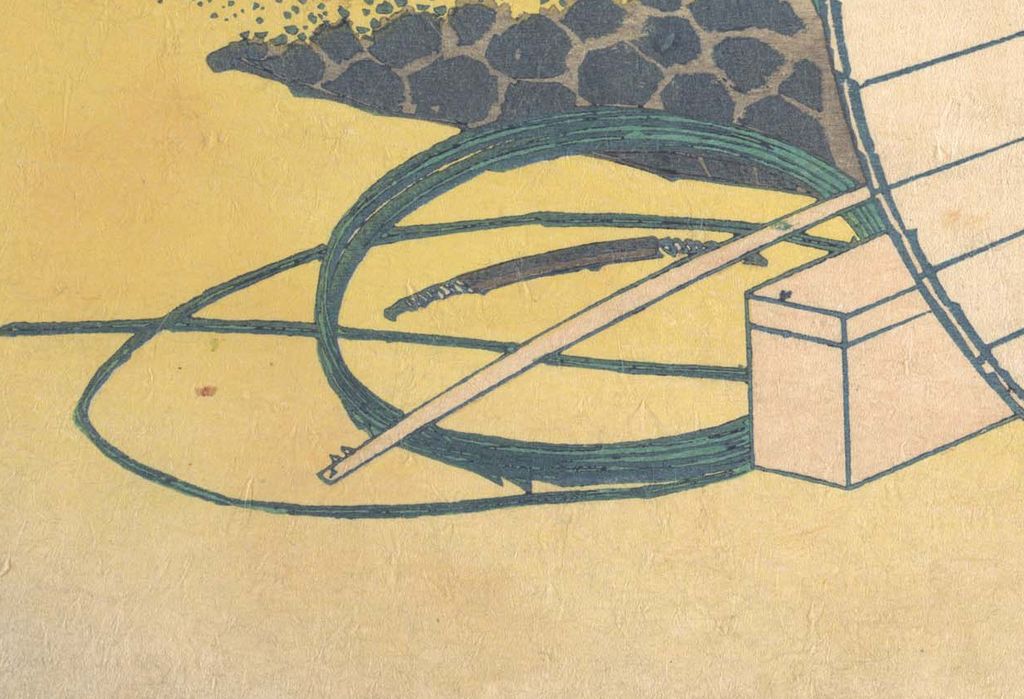
The ground beside him shows other parts of the work. A dark loop and several slender lengths lie on the left. On the right, two narrow pieces cross the line of the vessel. A small upright object sits in front of its rim. Their different curves and lengths matter even where the purpose of an individual item is uncertain. The loose loop on the left repeats the curve of the fixed hoops and looks as though it could be set in motion. The little rectangular block beside it offers a short, straight edge against the round wall. The print sets the unassembled pieces and tools beside the object as it takes shape. [1]
The man’s dark clothing makes a compact shape among those thin lines. Look at the bend of his knee and the ridge formed by his back, then at the open outline of Fuji. The Met compares the two triangular forms. Their sizes and orientations differ, and one belongs to the figure’s temporary posture while the other seems settled in place. The likeness is easiest to find when the figure and the mountain are viewed together inside the barrel. The MOA Museum of Art also points to the cooper’s expressive face and compares it with figure drawings in the third volume of the Hokusai Manga. The face is worth a look at full size. The lowered brow and compressed features give the bent body a specific task and a moment of concentration. [1] [4]
What could be seen from Fujimigahara?
The locality has been associated with present-day Fujimi-chō in Nagoya. Hinohara notes that Hokusai stayed in Nagoya in 1812 and 1817, so a visit to Fujimigahara is possible. The view itself has a separate history. Hinohara describes records that credit the locality with a view of Fuji and cites research published by the Nagoya City Museum identifying the mountain seen from there as Mount Hijiri. The print therefore gives visual form to an association between a place and Fuji that residents and readers could recognise from the name, even though the sightline has been challenged. The landscape makes that association unusually direct. A person could look through this hand-built frame and see what the place name promised. [2] [4]
Inside the barrel’s opening, Fuji has very little descriptive detail. It is difficult to separate the lower mountain from the tree line. Hokusai reserves the cleanest portion of its profile for the space just above the foliage. The effect depends on the viewer knowing what that outline can signify in the Thirty-six Views of Mount Fuji. The work is listed in the Iuchi exhibition’s Group A, alongside prints that give the mountain much more space. In the Owari design, a reader who has seen one of the larger views can bring that recognition to an outline of just a few strokes. The fields and the circular frame establish which tiny interruption of the horizon is worth looking at twice. [1] [3]
In The Waterwheel at Onden, another design from the series, a curved wooden structure sits at the edge of the view and the flow of water gives it a purpose. The two designs allow different ways to imagine the labour. At Onden the wheel is part of a system in use, with people, running water and a building around it. At Owari the curved object is being worked on and its interior remains accessible. The print invites us to see a still-open vessel at the moment when its shape happens to make the distant view legible. [1] [5]
In In the Mountains of Tōtōmi Province, Hokusai places a massive timber on a slant across the picture. One worker balances above it, while another stands below with his arms raised. The timber determines where each man must stand to work. It also separates stretches of the landscape in a way that recalls the barrel in Owari. The diagonal sends the eye along the length of the timber, whereas the opening at Owari lets the eye pass directly through the woodwork. In each view, the position of Fuji depends on the space left open by the timber. [1] [4] [6]
Looking at two Met impressions
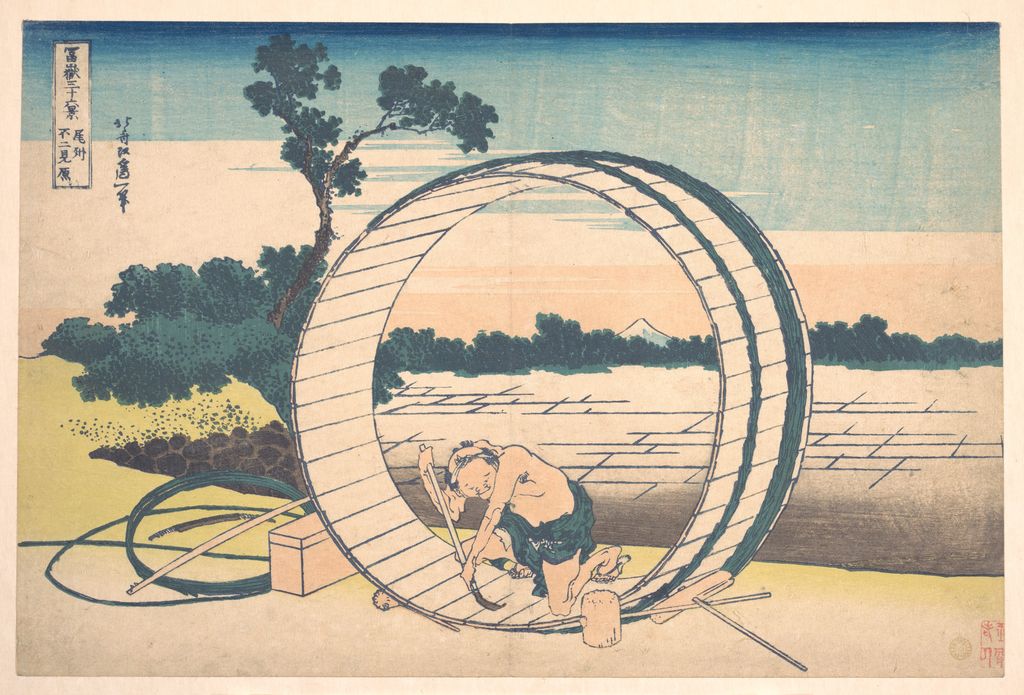
The Met also holds the impression JP19, which it dates to about 1830–32 and measures at 24.1 by 38.9 centimetres. The museum photographs show the same fine divisions in the field and the same reach of the cooper’s arms. The sky in the JP2956 photograph moves from a broad dark blue at the upper edge into a lighter area whose lower boundary softens above the trees. The JP19 photograph shows a narrower dark band at the top, followed by a much paler blue with a horizontal edge towards the right. The lower sky in JP19 looks pinker in reproduction. Both preserve a quiet area immediately above the hill line, but the depth and placement of the blue change the way the taller tree stands out. [1] [7]
The cartouche and signature occupy the left side of the sky on both sheets. The National Gallery of Victoria also records the inscription at the upper left of its impression 425-2 and specifies that it is printed in blue. Its transcription gives the series title, the place and Hokusai’s signature using the name Iitsu. A reader can inspect the shape of the blue characters alongside the blue of other marks in the print, while relying on the object record for the wording. The different photographs show how much a reading of colour depends on the impression in hand. The continuity of the design is easier to follow in the steady contours of the barrel, the recessed field lines and the position of the peak above them. [1] [7] [8]
Look through the opening once more, then move your eye down from Fuji to the blade near the cooper’s hands. The staves carry that movement across nearly the full height of the design. Hokusai gives enough space to watch someone work and enough distance to let a mountain recede almost out of sight. The vessel keeps those two scales visible at once. [1]
Where this work sits in Hokusai’s career
Annotated Details from Fujimigahara in Owari Province
The Metropolitan Museum of Art, JP2956. [1]
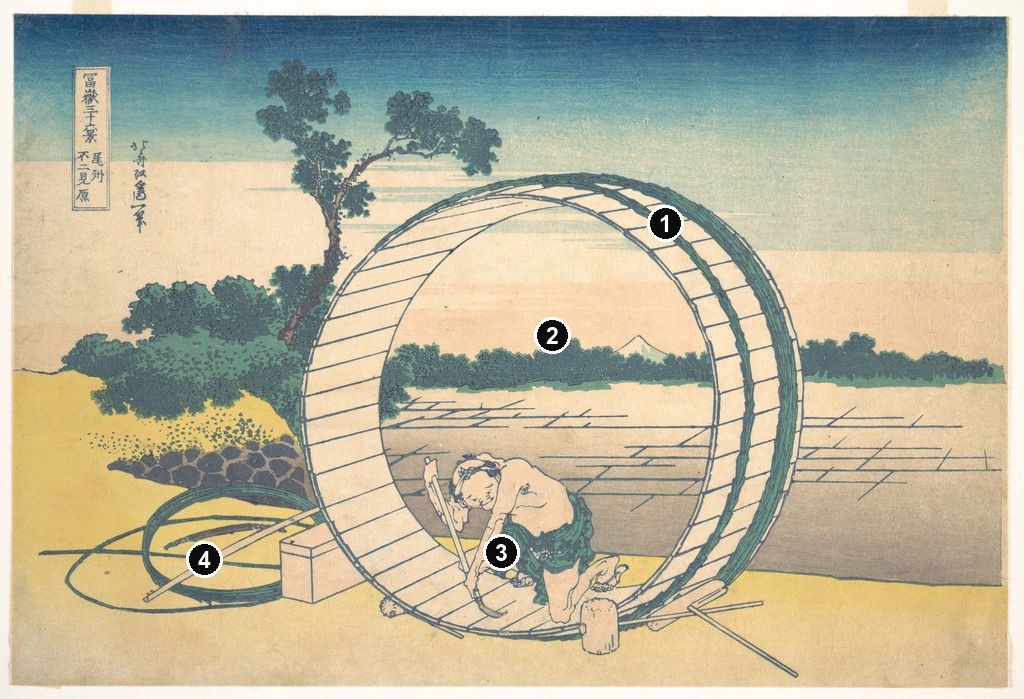
Details from FUJIMIGAHARA IN OWARI PROVINCE
Select a detail to look closely.
The tub’s curved rim
Several dark arcs describe the mouth of the vessel. The light band alongside them shows how its edge turns towards the viewer. [1]
A small summit inside the opening
The horizon runs through the middle of the open vessel. A slight triangular peak interrupts it beside a low line of trees. [1]
The worker inside the frame
A crouching figure takes up part of the lower opening. The tub surrounds the worker as completely as it surrounds the distant view. [1]
Curves lying on the ground
Long curved pieces lie below the vessel. They echo the major arc of the tub and carry it into the open ground at left. [1]
Explore Hokusai’s works
Discussion
Look again at the images and ideas explored in Fujimigahara in Owari Province. These editorial prompts invite your observations.
Reader Insights
Where does the tub make an opening for the mountain?
What changes when the worker becomes the first figure you notice?
Join the Conversation
Share a detail, comparison or question about Fujimigahara in Owari Province below.
References
- The Metropolitan Museum of Art, Fujimigahara in Owari Province (Bishū Fujimigahara), JP2956. View source.
- Kenji Hinohara, Ōta Memorial Museum of Art, How far away can you see Mount Fuji? I asked Hokusai and Hiroshige, Owari section. View source.
- National Museum of Western Art, Tokyo, Hokusai: Thirty-six Views of Mt. Fuji, exhibition list, Group A no. 7. View source.
- MOA Museum of Art, Hokusai’s Thirty-Six Views of Mt. Fuji, Owari exhibition entry. View source.
- The Metropolitan Museum of Art, The Waterwheel at Onden (Onden no suisha), JP2967. View source.
- The Metropolitan Museum of Art, In the Mountains of Tōtōmi Province, JP2966. View source.
- The Metropolitan Museum of Art, Fujimigahara in Owari Province (Bishū Fujimigahara), JP19. View source.
- National Gallery of Victoria, Fuji-view fields in the province of Owari, 425-2, inscription and object record. View source.







