


 by Tom Gurney
Tom Gurney BSc (Hons) is an art history expert with over 20 years experience
Published on June 19, 2020 / Updated on November 20, 2026
Email: tomgurney1@gmail.com / Phone: +44 7429 011000
Sea Lane off Kazusa Province
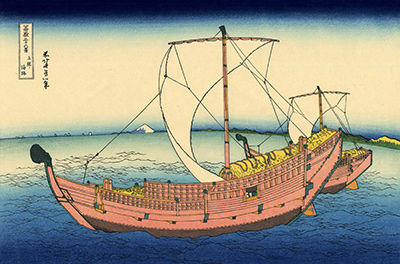
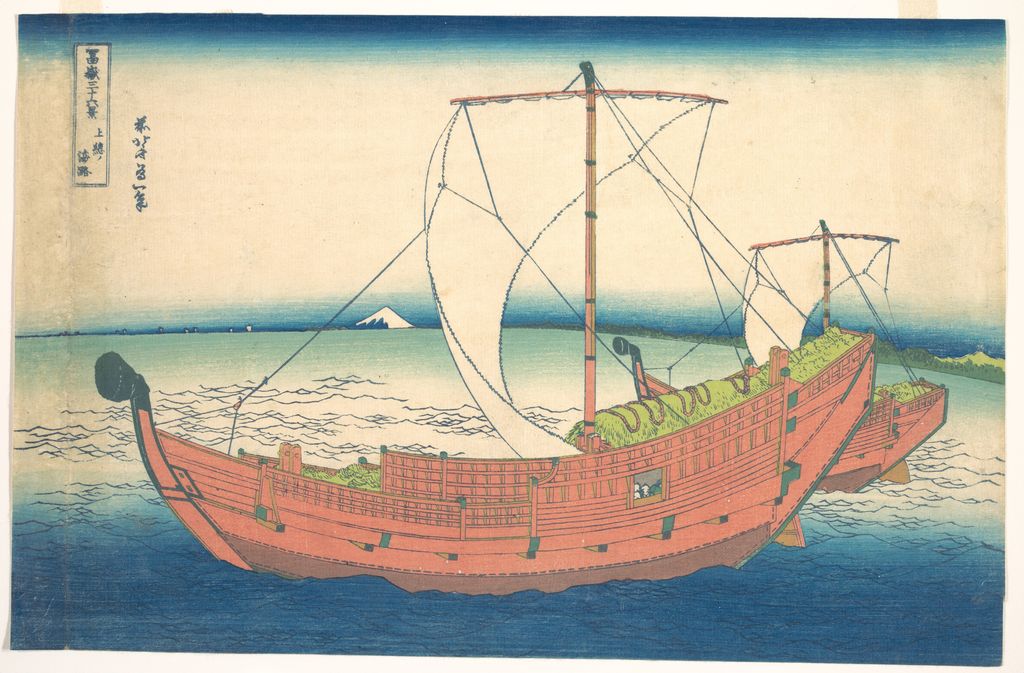
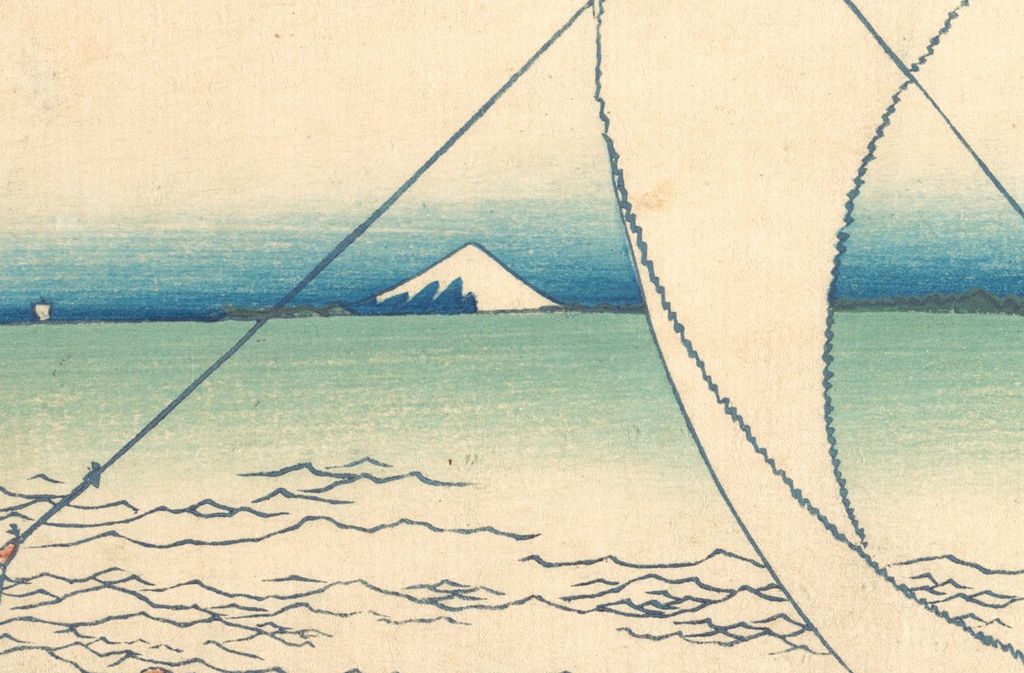
The biggest thing in Katsushika Hokusai’s Sea Lane off Kazusa Province is a wooden hull, broad enough to stretch across nearly the whole sheet. Above it the sail opens in a pale sweep, its curved edges almost the same colour as the sky. Fuji comes into view through a gap to the left of this sail. The mountain is so low that its snowy summit could be missed among the marks along the horizon. Once you see it, the ropes and the curved hull start to look like parts of a composition built around that small opening. [1] [2]
The Metropolitan Museum of Art calls the design At Sea off Kazusa and dates its impression JP2963 to about 1830–32. The sheet measures 24.1 by 37.8 centimetres, and the image is a colour woodblock print. The title cartouche at upper left names the series and the route. The National Museum of Western Art in Tokyo, which lists an Iuchi Collection impression as item 24, gives the Japanese title as 上総ノ海路, Kazusa no kairo. Like the other prints in Thirty-six Views of Mount Fuji, this sheet asks the viewer to locate a familiar mountain under particular circumstances. Here those circumstances are a crossing on busy water and a vessel seen close enough to study its construction. [1] [3]
At a Glance
- ArtistKatsushika Hokusai
- Dateca. 1830–32
- MediumColour woodblock print
- SeriesThirty-six Views of Mount Fuji
Contents
How the boat opens a view of Fuji
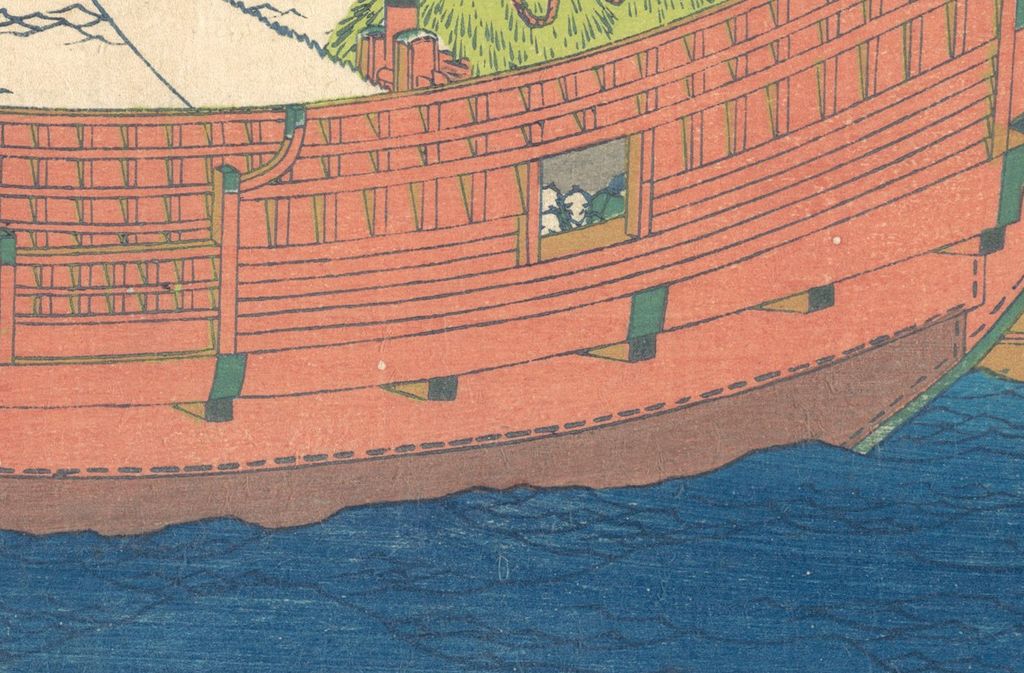
The hull curves down from a tall end on the left, runs low across the water and rises more gradually on the right. Hokusai gives that long sweep weight with closely spaced lines that track the plankwork. Near the left end, dark strokes turn sharply where the shape of the hull changes. Near the right, small green fittings punctuate the long planks and pick out the steepening edge. Much of this detail follows the same curve. Even while the boat stretches from one side of the print to the other, the parts look as though they belong to a single piece of construction. [1]
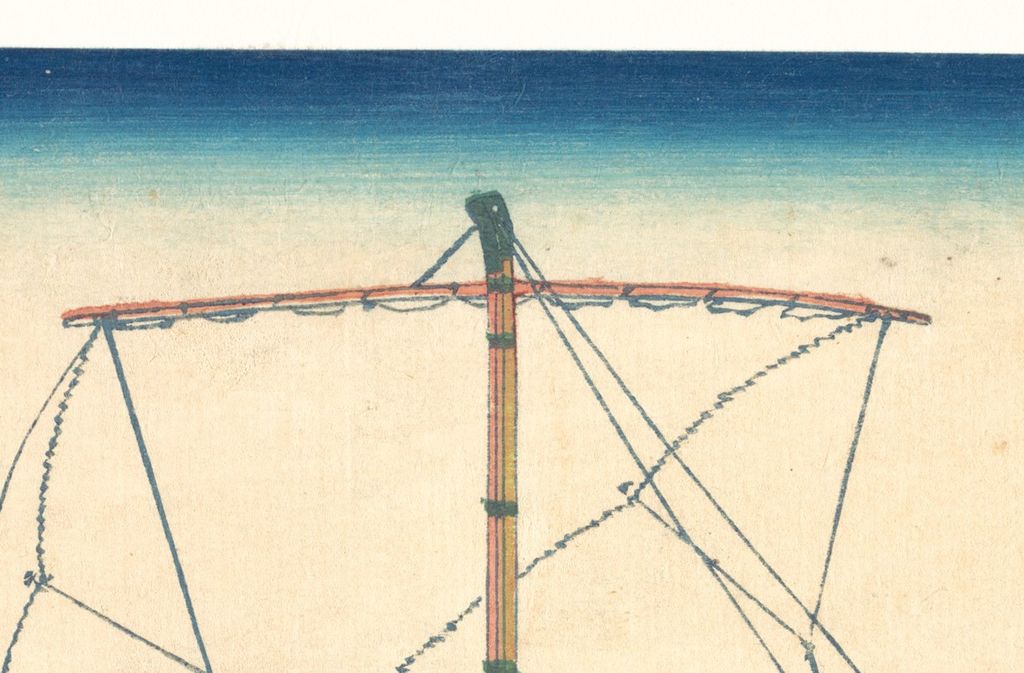
Look above the hull and the pattern changes. A near-vertical mast rises almost to the top of the sheet. The yard, the horizontal spar at its head, carries little loops along its length. Long ropes depart from high on the mast and take the eye out towards the ends of the boat. From the left side of the hull, one line rises towards a corner of the sail, crossing the horizon well to the left of Fuji. The sail’s swelling edge comes down on the mountain’s right. Between the rope and the cloth there is just enough room for the outline of the summit to remain clear. The Sumida Hokusai Museum draws attention to the triangular space made by the sail, rope and boat around the smaller triangle of Fuji. [1] [2]
The cloth is easiest to see from its edges. Dark, almost scalloped strokes describe the tensioned curves, while much of the cloth and the space around it stay light. At the horizon that similarity disappears. Pale sailcloth overlaps the blue band with an edge sharp enough to hold its shape against the water beyond. The ropes are thinner than the lines of the hull and easier to lose as they cross one another. Following each one separately makes the impression of a solid boat carrying an open lattice overhead especially clear. [1]
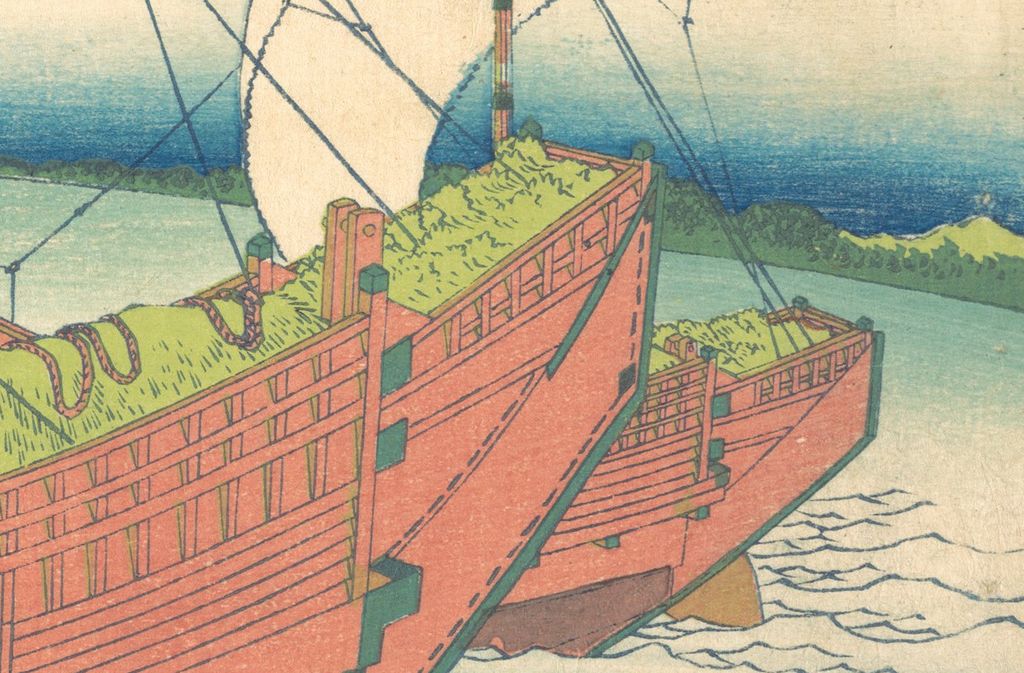
The second vessel is partially hidden behind the first on the right. Its mast and yard are visible, and its sail has a similarly pale belly. The closer hull overlaps the farther one deeply enough to leave little of the latter’s side in view. At a glance, those two repeated groups of mast, cloth and curved timber establish two distances. Beyond them come the still smaller sailboats on the horizon, which the Met points out in its account of another impression. The contrast is particularly sharp at the left of Fuji, where the marks for those far-off boats rise scarcely above the blue line. [1] [4]
The sea route and its boats
Kazusa corresponds broadly to the central and southern part of present-day Chiba Prefecture. Maritime traffic linked settlements on that shore with Edo. The Tokyo Fuji Art Museum suggests that Hokusai’s view is from the vicinity of the Uraga Channel, at the mouth of the bay. The long view across water is consistent with that reading. The print gives the name of a sea route, while the shapes of a far-off shore and a tiny summit offer few landmarks with which to recover a precise observation point. Even the curved horizon is worth noticing first as a visible feature of the print. The curve follows the hull loosely and carries the eye across a much greater width than the nearby boat. [1] [2] [5]
The Sumida Hokusai Museum identifies the vessels as Kisarazu-bune, which travelled between Kisarazu and Edo. The Tokyo Fuji Art Museum’s description on Japan’s Cultural Heritage Online likewise proposes boats of the Kisarazu route and explains that they transported both people and goods. The Shimane Art Museum uses the designation bezaisen, an Edo-period type of cargo vessel, for the pair in its Nagata Collection impression. Those accounts supply historical settings for what the image shows. They differ in how narrowly they identify the boats, and neither the destination of these particular vessels nor the contents of the load can be established from the picture. [2] [5] [6] [7]
There is plenty to see on board before trying to name the cargo. Dark loops run over a ridged mass along the higher part of the deck. The Tokyo Fuji Art Museum also notes three faces in an opening on the side of its impression and suggests they may be passengers. In JP2963, look halfway up the planking, to the right of the mast, for a small opening with pale faces. Their scale is striking beside the timbers and the sail. The broad hull that initially seems to fill the print turns out to contain a human detail scarcely bigger than the marks for the boats in the distance. [1] [5]
The Shimane Art Museum connects the composition to an illustration of a similarly arranged boat in Hokusai’s Azuma asobi, published in 1799. The comparison places this large, sharply observed hull in a longer interest in the way boats are built and shown. From the printed book to the later landscape series, the vessel can carry much of the visual interest on its own. In the Kazusa design it also does something more particular. Its standing mast and spreading rig create the shape through which the mountain appears. [1] [7]
What changes between two impressions
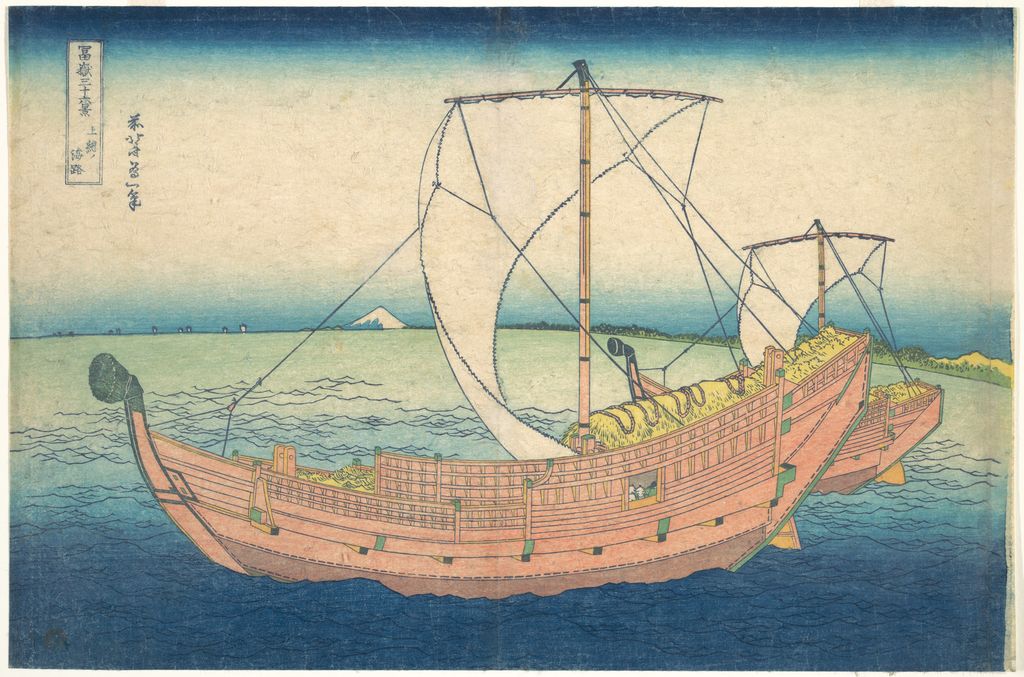
The Met dates JP2963 and JP1482 to the same approximate period. The two differ in listed size, with JP1482 measuring 25.1 by 38.3 centimetres. The principal contours, including the main sail, its rigging and the small summit below, occupy the same relative positions. Differences become clearer in the broad areas between those lines. In the photograph of JP2963, the foreground hull is a stronger reddish colour and the deck load reads as green. In the photograph of JP1482, the equivalent hull is lighter and the load appears yellow. The viewer can recognise the same hoops and the same uneven profile of the load in both. [1] [4]
In both sheets a separate band of dark blue at the top softens as it descends into the pale sky. It draws attention back up to the spars and the inscription after the eye has passed down the rigging. The water also looks different. In JP2963, dark marks on the surface stand out especially clearly against a pale zone behind the boat. That light band separates the dark blue foreground from the land and sky. In JP1482, more blue shows through the area of the wave marks behind the hull. The blue near the horizon appears somewhat broader there, and the mountain’s white top is set against a more continuous background of colour. Viewed together, these photographs show how shifting the strength of a few areas can change which edges stand out at first glance. Printing, condition and photography can all affect these colours. The photographs alone leave the sequence of printing and the pigments responsible open. [1] [4]
A different approach to busy water
In Tsukudajima in Musashi Province, Hokusai again brings a laden vessel into the foreground. The Met identifies the load in its JP2990 impression as cotton bales and points out the resemblance between the boat’s shape and the distant Fuji. Smaller craft spread across the water towards the island of Tsukuda. Those boats provide more steps in the distance between the large vessel and the low shore. In Kazusa, the partly hidden ship is the closest counterpart to the big boat, and most of the distance to Fuji opens quickly beyond its sail. [1] [8]
The places named in the two prints help guide that difference. At Tsukuda the island is part of the traffic the picture lets you follow, with boats around it and another approaching. Off Kazusa there is more open water, and the farther edge of the bay seems to slip behind the rigging. Return to the main sail and follow the diagonal rope down towards the left side of the boat. The rope crosses the horizon, the white summit sits just to its right, and the running pattern of ripples picks up in the space below. The large boat has brought a faraway mountain into an opening small enough to overlook. [1] [2] [8]
Where this work sits in Hokusai’s career
Annotated Details from Sea Lane off Kazusa Province
The Metropolitan Museum of Art, JP2963. [1]
Details from SEA LANE OFF KAZUSA PROVINCE
Select a detail to look closely.
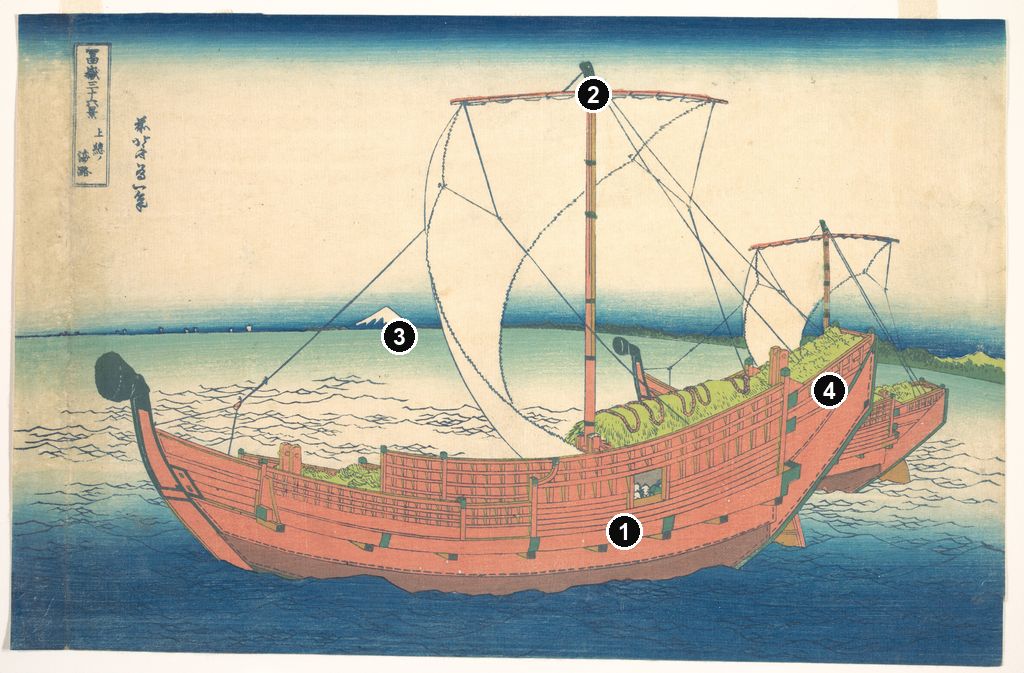
The hull spans much of the sheet
The tall sides hold an uninterrupted stretch of warm colour above the blue water. [1]
Rigging breaks the open sky into shapes
Lines and spars cross between the masts. Some of their intervals open on to the horizon. [1]
Fuji appears in a low opening
A pale summit sits just above a blue strip of distant land. Look between the rigging and the low horizon. [1]
The raised end of the boat gathers detail
The tilted edge carries small built forms and marks. The steep rise makes the warm shape of the vessel legible against the pale ground. [1]
Explore Hokusai’s works
Discussion
Look again at the images and ideas explored in Sea Lane off Kazusa Province. These editorial prompts invite your observations.
Reader Insights
How many times does a rope or spar cross the sky?
Where can you see Fuji through the rigging?
Join the Conversation
Share a detail, comparison or question about Sea Lane off Kazusa Province below.
References
- The Metropolitan Museum of Art, Katsushika Hokusai, At Sea off Kazusa (Kazusa no kairo), accession JP2963, collection record and photograph. View source.
- Sumida Hokusai Museum, 冨嶽三十六景 上総ノ海路, Japanese collection commentary. View source.
- National Museum of Western Art, Tokyo, Hokusai: Thirty-six Views of Mt. Fuji, Iuchi Collection checklist, item 24. View source.
- The Metropolitan Museum of Art, Katsushika Hokusai, At Sea off Kazusa (Kazusa no kairo), accession JP1482, collection record and photograph. View source.
- Tokyo Fuji Art Museum, Katsushika Hokusai, 冨嶽三十六景 上総ノ海路, Japanese collection record and commentary. View source.
- Tokyo Fuji Art Museum, Katsushika Hokusai, 冨嶽三十六景《上総ノ海路》, Japanese collection entry on Cultural Heritage Online. View source.
- Shimane Art Museum, Katsushika Hokusai, 冨嶽三十六景 上総ノ海路, Nagata Collection entry and related book illustration. View source.
- The Metropolitan Museum of Art, Katsushika Hokusai, Tsukudajima in Musashi Province (Buyō Tsukudajima), accession JP2990, collection record. View source.







