


 by Tom Gurney
Tom Gurney BSc (Hons) is an art history expert with over 20 years experience
Published on June 19, 2020 / Updated on November 20, 2026
Email: tomgurney1@gmail.com / Phone: +44 7429 011000
Two Carp in a Cascade
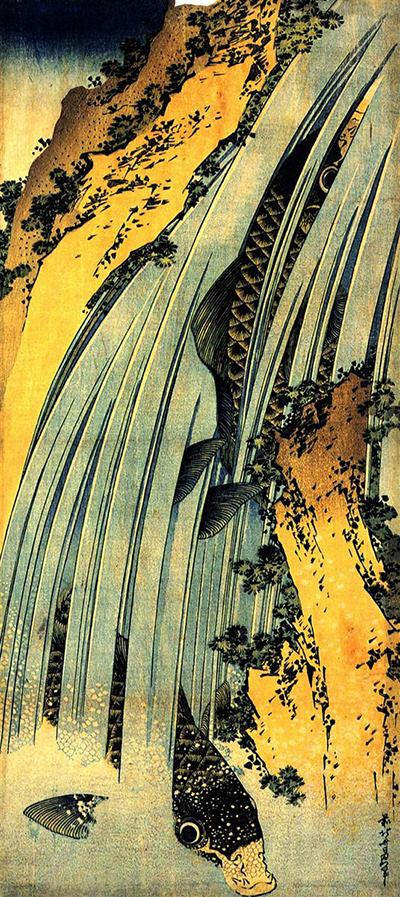
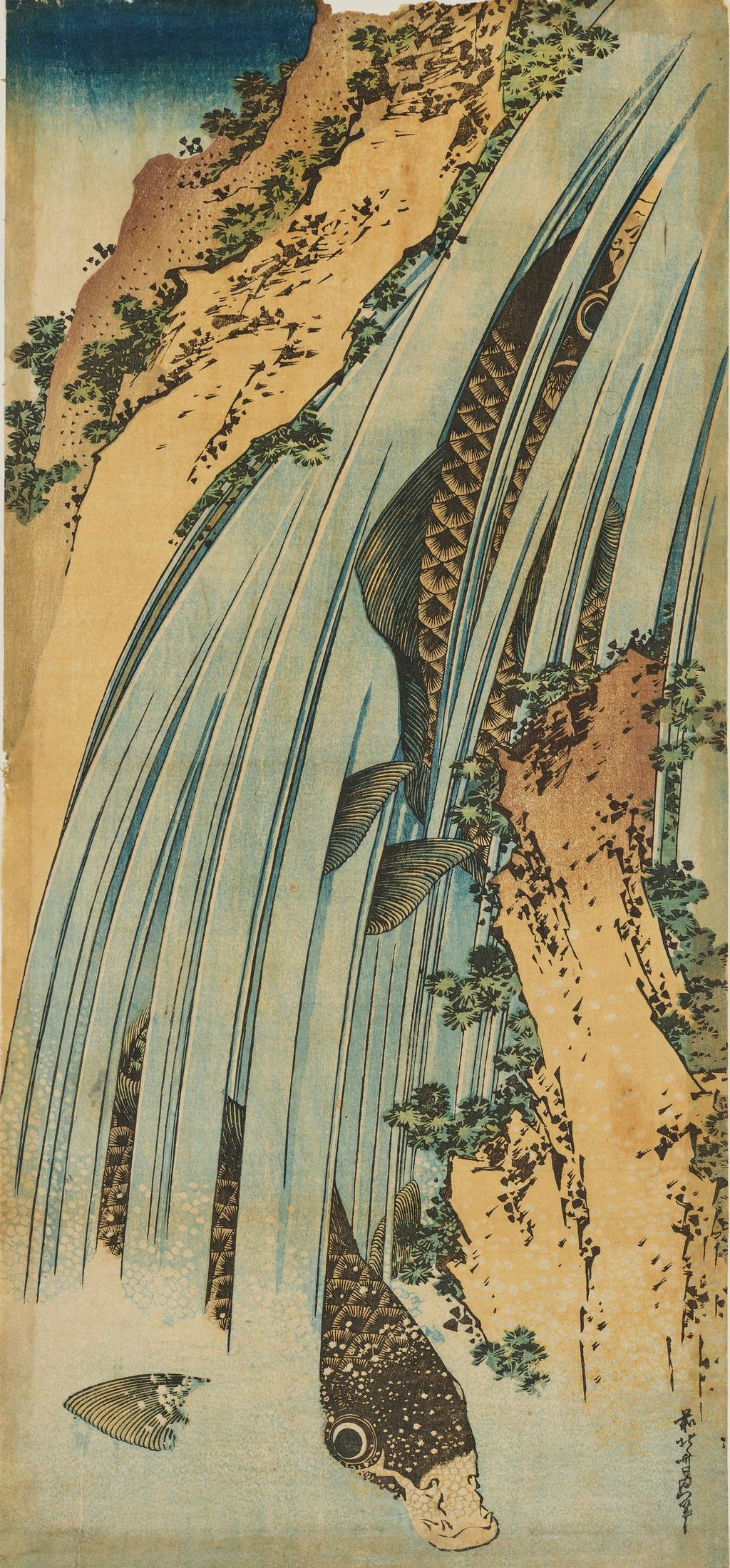
A carp climbs headfirst into the upper right of Hokusai’s waterfall. We see one bright ring around its eye, part of the mouth and a long curve of dark scales between the streams. At the bottom of the print, a second carp comes into view head down. Its nearer eye is much larger and its mouth almost meets the paper’s lower edge. The water drops between them in pale blue ribbons. Where it reaches the pool, the same torrent that makes it hard to see either fish from end to end gives away their positions in flecks of foam. [1] [2]
The Tokyo National Museum calls the print Carp Ascending a Waterfall, or Koi no takinobori (鯉の滝登り). Its impression, A-10569-659, measures 49.9 by 23.2 centimetres. The Museum of Fine Arts, Boston, calls its impression Two Carp in Waterfall. Dated to around 1834 in the Boston exhibition catalogue, the print also appeared as Carp in waterfall in a Suntory Museum of Art exhibition of works from the British Museum. These titles put the emphasis in different places. The upper fish provides the ascent. The lower one, which the Tokyo catalogue describes as taking the spray in the basin, gives that ascent its point of departure. [1] [2] [3] [4]
At a Glance
- ArtistKatsushika Hokusai
- DateEarly 1830s
- MediumColour woodblock print
- FormatTall print
Contents
Two directions through the water
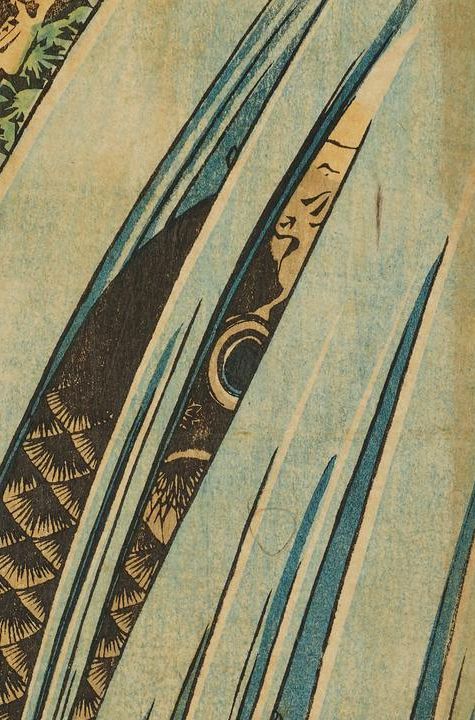
The upper carp swims almost along the same diagonal as the long streams. Its narrow contour becomes visible against the blue water, breaks off and turns up again several times as the eye follows it. Next to the head, finer dark lines travel past the eye without following the rounded shape of the face. Farther down, a strip of scales, with regularly spaced black edges, surfaces just left of a bright band of water. The eye has to connect these exposures to follow a single animal. The painterly sweep of the fall would be much easier to see as a flat motif if we did not also have to trace what lies behind it. [2]
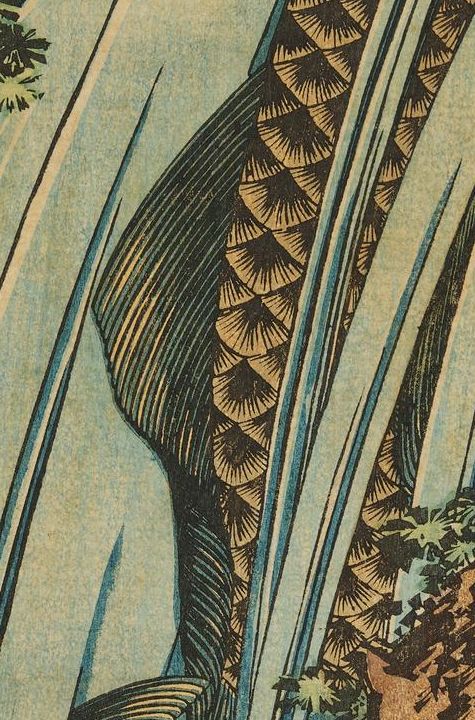
The scales and fins make different demands on a line. In the exposed sections of the upper carp’s flank, short marks repeat inside overlapping scales. The fins give way to longer, closely spaced lines that radiate and bend outward. At the middle of the sheet a broad fin emerges on the left side of the body. Farther down, two fin shapes extend into the pale water beside a promontory. The repeated fan of their lines makes them solid enough to interrupt the cascade. Each fin occupies a distinct patch of water, even where the fish’s body disappears behind the streams. [2]
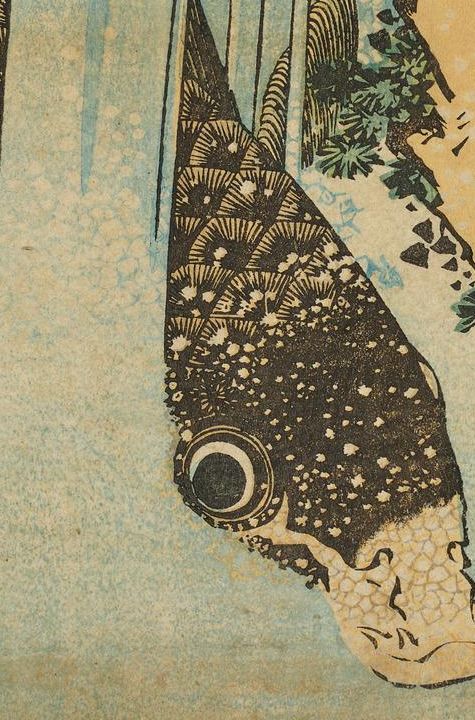
In the basin, the lower fish turns toward the right with its head angled down. Froth dots the dark zone around its eye. A separate ribbed shape below the veil of falling water at lower left lets the eye pick up a fin where most of the body is hidden. The strings of marks above it end in a band of loose stippling. That transition gives the basin a perceptible depth. One form can disappear behind foam and come back into view nearby, while the falling lines still tell us what passes in front of it. We meet the second carp at close range and see much less of its full outline. [1] [2]
How the rock shapes the fall
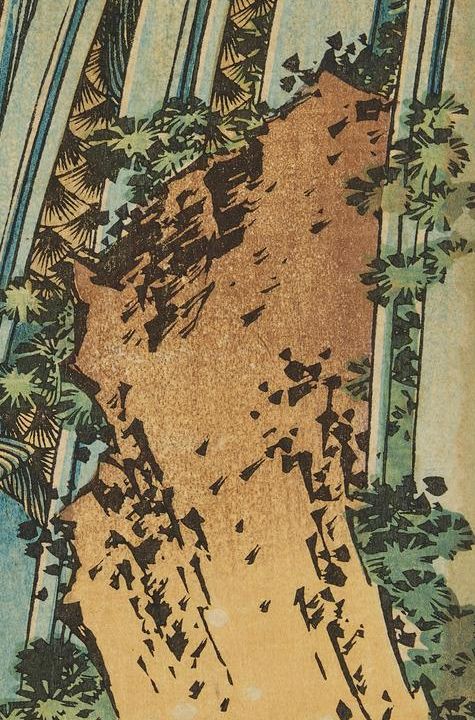
The two rock walls set up different kinds of pressure on the water. The rock at the upper left is large enough to establish the fall’s direction before we reach the first carp. Its sharp margin drives diagonally down as scattered plants hold to the edge. The lower rock projects from the right into the path of the water. Here vegetation collects around the edge of the ledge, and the pale strips continue past it on the left. The cliff’s ochre surface is interrupted by angular black marks, very different from the small repeated curves that describe the fish’s scales. [2]
Near the top, some strands of water taper into long points. In the middle they widen, cut across the fish and then stretch into thinner lines again. At the bottom, where the strips stop, pale circular marks do the work of showing spray. You can move through the print by following the water in the direction of the fall or by working upwards against it from the basin. Hokusai gives each route a different point of emphasis. The upper fish gradually comes together from intermittent glimpses, while the lower fish’s large eye appears almost at once. [2]
In Hokusai’s Kirifuri Waterfall, the pale fall separates into branching courses over a cliff. Small onlookers along the sides help establish the size of the site. Two Carp in a Cascade gives the fish that job. The lower carp’s head fills a space that would swallow a small figure on the Kirifuri sheet. The tall sheet also narrows the visible setting so sharply that the waterfall’s starting point lies outside the picture. The scale is set by the relation between the bodies, the gaps in the water and the plants clinging to the rock. [2] [5]
Comparing the Tokyo, London and Boston sheets
The Tokyo print is a colour woodblock print in a tall large-sheet format. Boston catalogues its own impression as a vertical nagaban, measuring 52 by 23.7 centimetres. A comparison of the reproductions shows the same essentials in all three impressions. The head at the bottom turns down and right, the high fish rises through streaks of water, and a ledge cuts into the right side between them. The British Museum’s photograph also shows colour and tonal distinctions worth looking at closely. Its fall reads as cooler blue against a pale upper bank. In the Tokyo image, the ochre bank is more persistent almost to the edge of the water, and some of the bands through the fall look greener. Boston’s published reproduction makes the fish read as dark, intermittent masses across the light blue passage. [1] [2] [3] [4] [6]
The margins are another reason to work from named examples. London’s digitization shows the sheet against a pale surround. Boston’s exhibition catalogue gives dimensions for the impression it owns, while Tokyo supplies the measurements of a different sheet. In the Tokyo photograph the lower right retains a narrow vertical signature beside the descending marks of the rock. The extra space around a photograph, or a change in how it is cropped for reproduction, can shift the apparent position of that signature and even the perceived proportions of the design. Variations in visible colour may involve printing, condition or reproduction. The catalogues and images give us several impressions to compare without establishing a sequence of printing for them. [1] [2] [3] [6]
A carp that might become a dragon
The Agency for Cultural Affairs connects the unusually large fish in the basin with the appearance of a carp streamer. That resemblance gives a useful sense of what the drawing does. As part of the fish’s flank is screened by the torrent, the prominent eye and the elaborate pattern of scales sustain the animal’s presence. There is also a longer history behind the subject of the climbing carp. A Chinese inkstone in the Metropolitan Museum of Art pairs a fish and a dragon to invoke the story of the carp becoming a dragon after passing the Dragon Gate on the Yellow River. The museum explains how that transformation could stand for success in the civil service examinations. [1] [2] [7]
The Japanese title gives the action of climbing a waterfall, and knowledge of that story gives the difficulty of the climb a particular resonance. Hokusai concentrates on the effort implied by fish moving through running water. The high animal is already well above the pool, but the sheet stops before we can see the end of its climb. The lower one still has its head in the spray. Both retain the sharply observed features of fish, including the conspicuous ring at the eye, the ridges of the fins and the repeating scales. A viewer can recognize a story about transformation and still take time to follow how the printed lines make a carp visible inside the fall. [1] [2] [7]
How Hokusai fitted carp into other shapes
The two animals in Hokusai’s Two Carp occupy a fan-shaped surface. The Rijksmuseum dates that colour print to 1831. There, the fish and aquatic plants can be read against a broad field, and the shape of the outer rim sets a limit on their movement. In the cascade, the viewing space is more than twice as high as it is wide. Water and fish both use the long axis, with one against the current and the other turning through its spray. On the fan, the spacing between the fish lets a viewer follow their relationship across the width. Changing the proportions and use of the paper changes what two carp can do in a picture. [2] [8]
Hokusai’s Carp and Turtles in Saitama uses another arrangement. In that horizontal painting the animals have room to glide along the long field. The fish and turtles offer several ways to see a body in water, while the inscription occupies space at the left. The tall waterfall print makes concealment more insistent. Start with the part of the upper fish you can see, then trace one uninterrupted stream down to the basin. At the bottom the lines give way to spray and the firm outline of the carp’s face. There the water has changed its movement, and Hokusai asks us to change the way we look. [2] [9]
Where this work sits in Hokusai’s career
Annotated Details from Carp Ascending a Waterfall
Tokyo National Museum via ColBase, A-10569-659. Markers and cropped details are adaptations under the ColBase terms. [2]
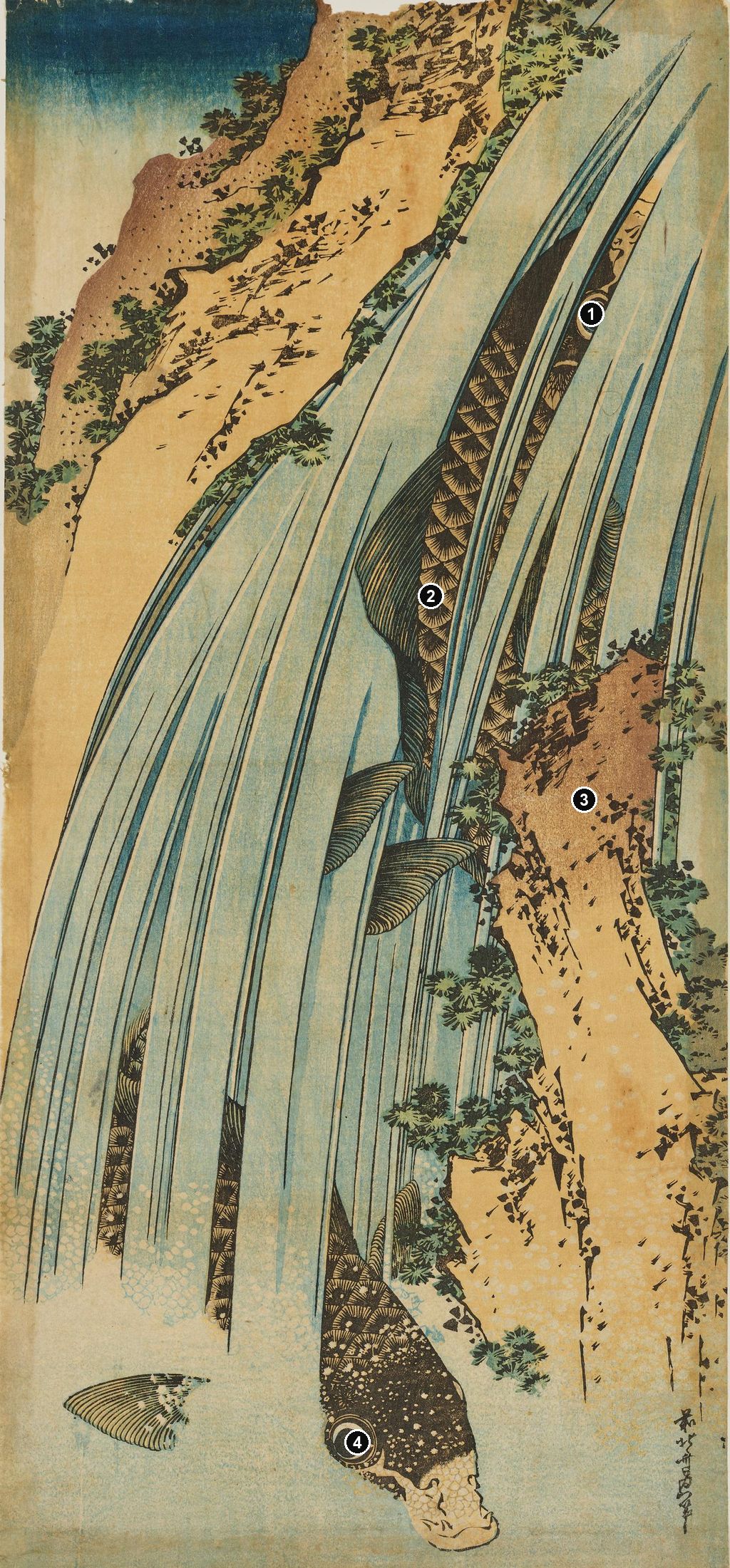
Details from CARP ASCENDING A WATERFALL
Select a detail to look closely.
The upper fish rises into the current
The fish’s eye and narrow outline stand against the falling ribbons. The current crosses much of its body. [2]
A fin interrupts the falling water
The fin and flank form a small break in the long lines that run down the face of the drop. [2]
Rock and vegetation project from the edge
Dark vegetation interrupts the ochre rock. Both occupy a different plane from the pale curving water. [2]
A second fish appears low in the sheet
The lower fish is visible near the water’s turn. Its position sets up a second direction of movement. [2]
Explore Hokusai’s works
Discussion
Look again at the images and ideas explored in Two Carp in a Cascade. These editorial prompts invite your observations.
Reader Insights
What distinguishes each fish from the water around it?
Where does the direction of the current change across the sheet?
Join the Conversation
Share a detail, comparison or question about Two Carp in a Cascade below.
References
- Agency for Cultural Affairs, Japan, Carp Ascending a Waterfall (鯉の滝登り), Tokyo National Museum impression and catalogue commentary. View source.
- Tokyo National Museum via ColBase, Carp Ascending a Waterfall, A-10569-659, photograph E0173297. View source.
- Museum of Fine Arts, Boston, Hokusai: Inspiration and Influence, exhibition catalogue no. 80, Two Carp in Waterfall, impression 11.19647. View catalogue · View museum reproduction. View source 1. View source 2.
- Suntory Museum of Art, Hokusai from the British Museum, exhibition checklist no. 63, Carp in waterfall. View source.
- The Metropolitan Museum of Art, Kirifuri Waterfall at Kurokami Mountain in Shimotsuke, JP2924. View source.
- The British Museum via Ukiyo-e Search, catalogue-linked reproduction of impression 1927,0413,0.14. View source.
- The Metropolitan Museum of Art, Inkstone with dragon and carp, 2020.332, catalogue commentary on the Dragon Gate legend. View source.
- Rijksmuseum, Two Carp, RP-P-1960-3. View source.
- Saitama City, Saitama Prefectural Museum of History and Folklore, profile and reproduction of Carp and Turtles. View source.







