


 by Tom Gurney
Tom Gurney BSc (Hons) is an art history expert with over 20 years experience
Published on June 19, 2020 / Updated on November 20, 2026
Email: tomgurney1@gmail.com / Phone: +44 7429 011000
Umezawa Manor in Sagami Province
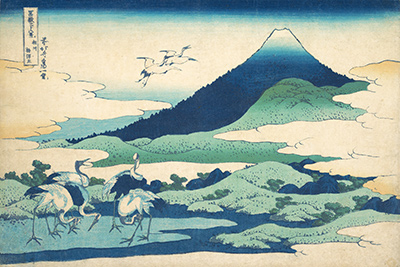
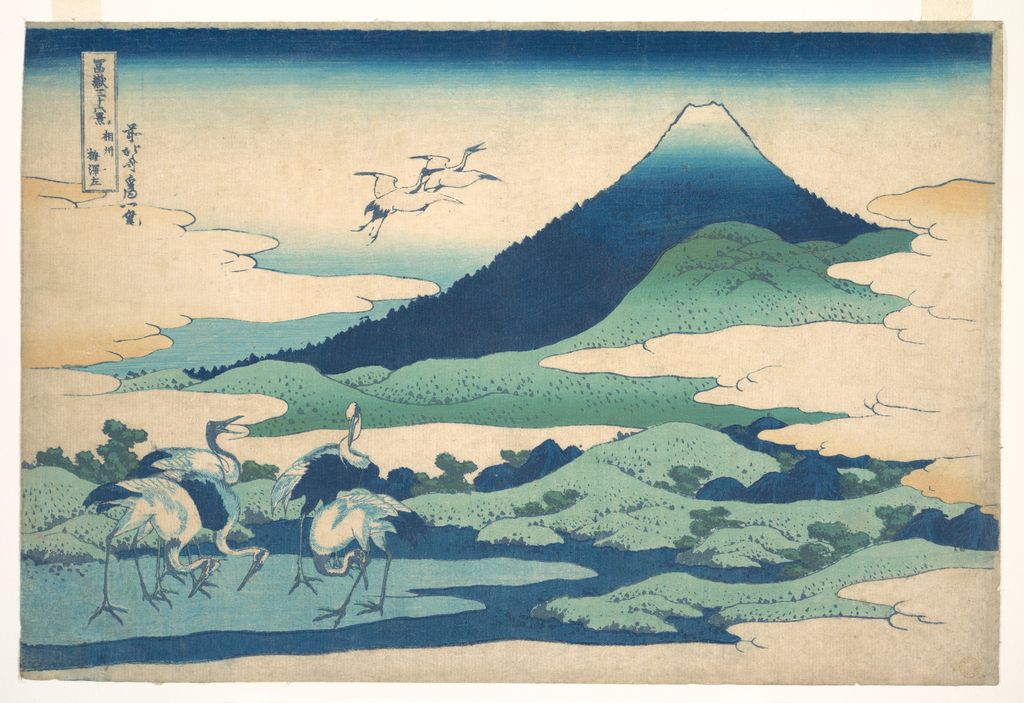
Five cranes gather beside the water in Katsushika Hokusai’s Umezawa Manor in Sagami Province. Two more fly above them, just to the left of Mount Fuji. At this scale their wings take up only a few strokes, but they cross a light patch of sky that lets us follow them all the way to the long slope of the mountain. The cranes below have the opposite effect. Their pale bodies overlap, and some of the finest lines in the print trace the ways they bend, stand and feed. The mountain and the birds are easy to recognise at a glance. The landscape between them takes longer to see. [1] [2]
The Metropolitan Museum of Art dates its colour woodblock impression JP20 to about 1830–32. It measures 25.7 by 38.4 centimetres. The design belongs to Thirty-six Views of Mount Fuji, a series that varies the apparent size of the mountain and the amount of activity around it. Here the summit stands well above most of the landscape, while the lower slopes run nearly the length of the print. Very little interrupts that outline. The marks of motion belong chiefly to the cranes. [1] [2]
At a Glance
- ArtistKatsushika Hokusai
- Dateca. 1830–32
- MediumColour woodblock print
- SeriesThirty-six Views of Mount Fuji
Contents
The cranes at the water’s edge
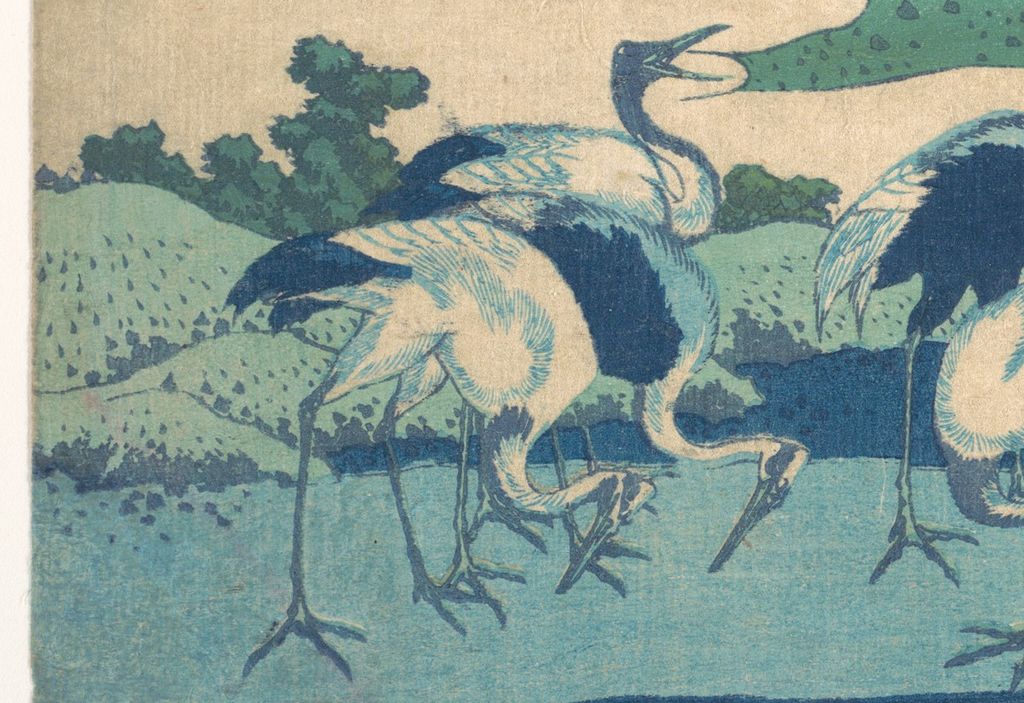
The birds on the ground are crowded into the lower left of the design. A downward curve of neck leads into a sharp bill, and fine strokes spread over the body to suggest the lay of feathers. There are several such curves within a small space. On the left, a bird’s light back is edged by the darker tip of a folded wing. Nearby, two low bills point into the same open area beneath the overlapping bodies. Long legs carry the eye farther down, and the short forks of the feet bring those curves to a stop. At the rear of the group, upright necks rise above the line of backs. Hokusai gives the birds enough shared traits for the flock to read as a whole and enough difference in posture for the eye to pick apart the group. [1]
The rightmost bird is particularly easy to isolate. Its rounded body catches the light against a dark strip, and its head bends inwards almost as far as its feet. There is open ground beyond it. Hokusai uses that space to give the final bird a clear edge, then leaves the greater part of the foreground to the changing shape of the water. A bend of dark blue passes behind the cranes’ legs and opens out below them as a broader band. The legs are drawn over pale blue and green. Their fine lines stay legible against those lighter areas even though the bigger shapes above are dark. [1]
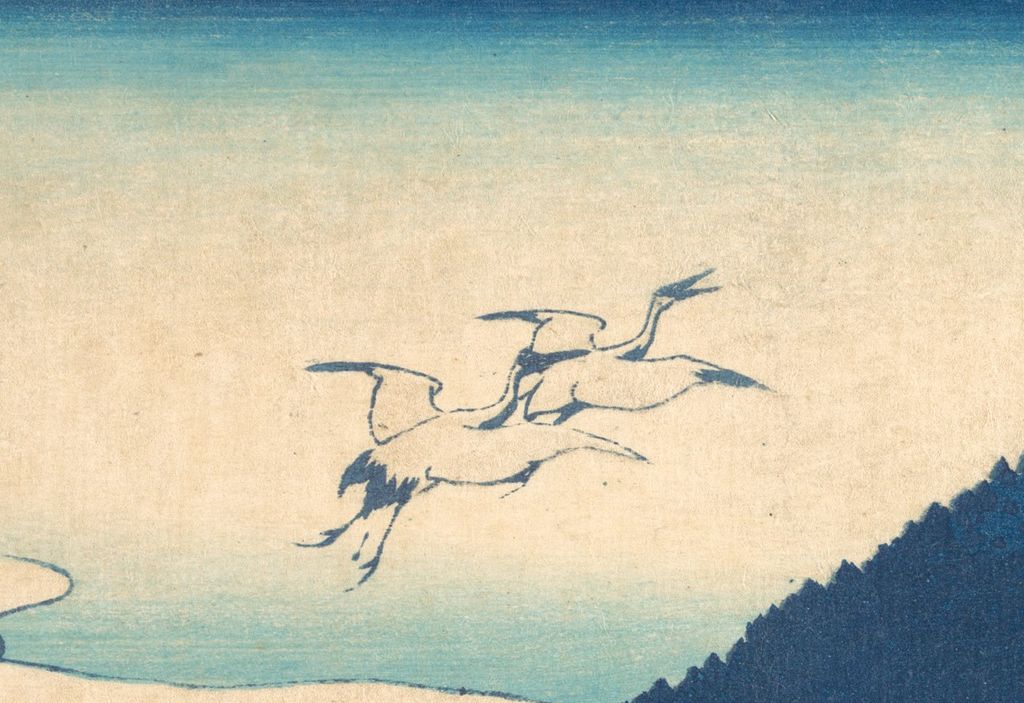
The cranes in the air are drawn on a different scale. Look between the left-hand mist and the foot of the summit and the two figures resolve into light bodies and fine outlines. One bird is slightly higher and farther right. Their extended wings and necks give the pair a direction, with enough separation to distinguish them from each other. The ground flock has a dark landscape behind it and feet planted along an irregular edge. The flying birds need only a clear interval of sky. They show how far the landscape extends in a few strokes that are smaller and lighter than the markings on the wings below. [1] [3]
The Sumida Hokusai Museum reads the combination of cranes and Fuji as auspicious. Bristol Museums also discusses the association of cranes with good fortune and longevity. Both accounts give the birds a reason to matter beyond the description of a wet place. The composition gives them that prominence too. Hokusai puts them at the front of the scene, spreads their pale bodies against patches of dark blue, and places the pair in flight where they draw the eye towards Fuji. A viewer unfamiliar with the association can still see how much of the print’s energy comes from the birds. [1] [3] [4]
Looking through the mist
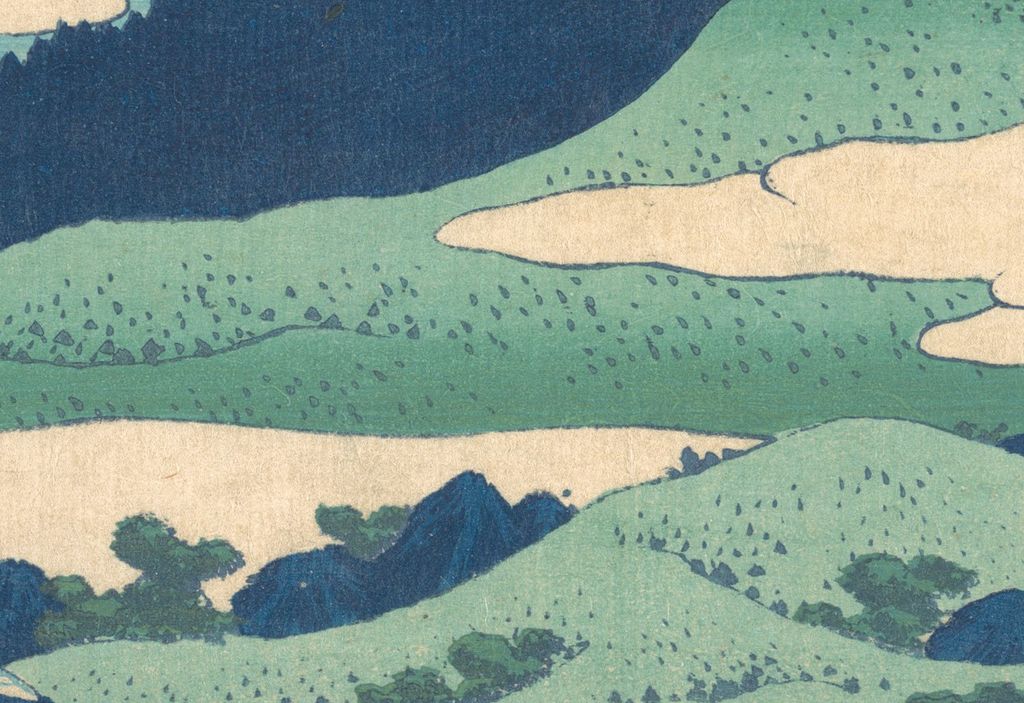
Starting with the cranes, follow the bands of blue across the foreground. Their edges turn, widen and then narrow between small areas of lighter colour. The little pointed and rounded marks along these edges suggest vegetation. Higher in the picture, the contours lengthen and the details thin out. A low hill rises from the middle of the sheet, and farther right a larger green slope overlaps Fuji. The slopes each take up more room than the cranes, but the print gives them fewer lines. This change in the scale and density of the marks helps put distance between the foreground and the skyline. [1]
Mist interrupts the landscape from both sides. On the left below the cartouche, long, pale shapes advance towards the mountain with small turns along the edges. On the right, an even broader pale shape covers the foot of the nearer slope. Several smaller openings allow the green and blue land to reappear. The light areas resemble each other in colour, so the contours do much of the work of telling us what lies in front of what. Try tracing one of the hills from its highest point downwards. Somewhere along the way its edge stops or disappears into a light interval, while another edge starts farther back. The hills seem to extend beyond the parts we can see. [1] [4]
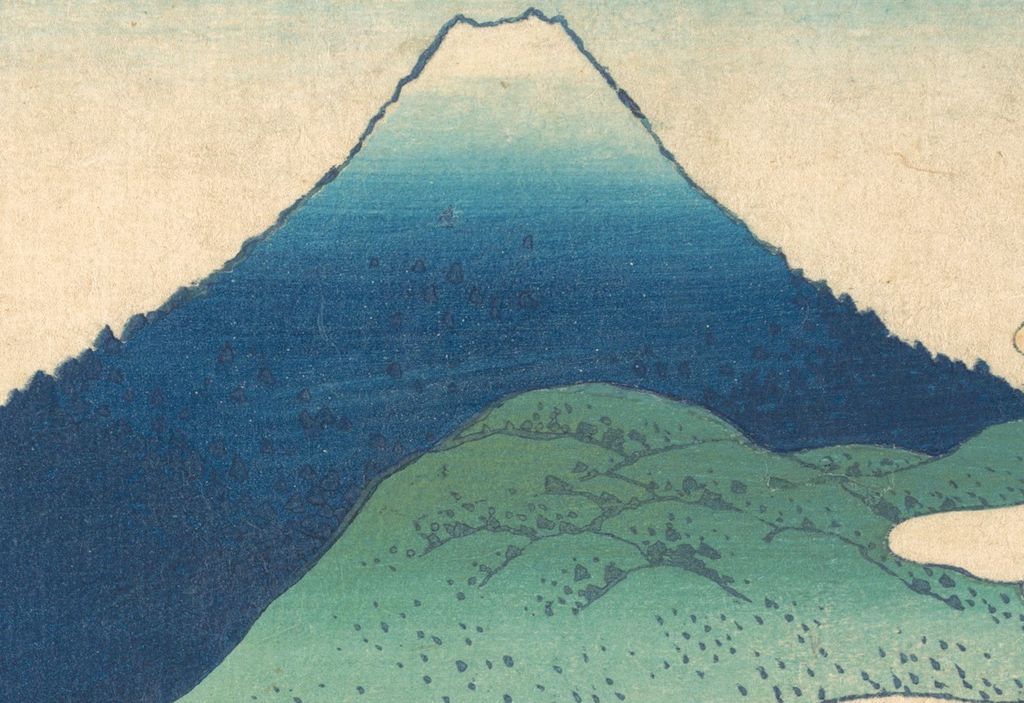
Fuji has a more continuous contour. Its ridge rises from just above the low mist on the left to a short uneven crest, then descends to the right until it meets a pale bank. On the left of the mountain, small jagged marks catch the eye where hillside meets sky. Close to the summit, a gradual transition gives the pale peak relief against the darker flank. The difference between this soft transition and the crisp contour is especially clear around the crest. The broad wash of blue across the top of the print frames the mountain without touching its summit. A narrow gap of light keeps the outline distinct. [1]
The title on the print
The cartouche in the upper left names the series and the view. The Met and Sumida transcribe the place title as 相州梅沢左, and the National Museum of Western Art uses the same characters for item 22 in its checklist of Iuchi Collection impressions. The final character, 左, ordinarily means “left.” Sumida and the Tokyo Fuji Art Museum discuss the possibility that it was cut in error for 庄 or 在. The Met gives the reading Sōshū Umezawa zai while retaining 左 in its Japanese transcription. The familiar English title Umezawa Manor in Sagami Province is therefore one way of handling a name with an unresolved last character. [1] [3] [5] [6]
Sumida places Umezawa in what is now part of Ninomiya, Kanagawa Prefecture, between the historic Tōkaidō stations of Ōiso and Odawara. That fixes the broad setting in which a buyer might have understood the title. It leaves open the question of a precise vantage point. The print gives most of its space to the movement of the birds, overlapping slopes and water. Buildings and a road would give a different kind of evidence for locating an individual view. In Hokusai’s Hodogaya on the Tōkaidō, travellers and roadside pines occupy much of the foreground, making the road an immediate part of the scene. At Umezawa the five birds fill the comparable position, and the foreground opens out into water. [1] [3] [7]
Two impressions at the Met
Another Metropolitan Museum impression, JP2981, measures 25.7 by 38.1 centimetres and carries the same approximate date as JP20. The two museum photographs show the same design, down to the long foot of the mountain, the scalloped mist and the outline of the bird at the right of the foreground group. The main differences are in the way the tones read. JP20’s mountain looks more uniformly dark below the pale summit. JP2981 has a wider passage of visibly textured blue in the upper flank. The green slope that overlaps Fuji also stands out more sharply from the surrounding light areas in JP2981. [1] [2]
The foreground offers a second comparison. JP20 has a cool blue-green passage around the feet of the cranes. In JP2981 the corresponding area appears a softer green and the dark channel below seems more sharply defined against it. Several pale areas in both photographs have a warm cast, with the warmth particularly apparent across the large mist bank on the right in JP2981. The line of the mist bank stays in place, yet the difference in hue changes how much of the right side reads as open space. These are differences visible in photographs of particular sheets. Assigning them to the printing, the paper’s condition or the photography would require better evidence than their appearance on screen. [1] [2]
The Met discusses JP20 in terms of aizuri, printing in which blue predominates. Here deep blue sets out the largest shapes, turquoise and green articulate the nearer terrain, and the light paper and warmer passages separate the hills. Look at the outside edge of the water below the cranes, then the upward edge of Fuji. Both register first as dark blue, but their lines behave differently. One turns across the print in a series of shallow bends, while the other rises on an extended diagonal. The limited range of colour makes this kinship easier to see. The pair of cranes in flight links those shapes by carrying the eye from the water and its dark curves towards the slope and the light above it. [1] [2]
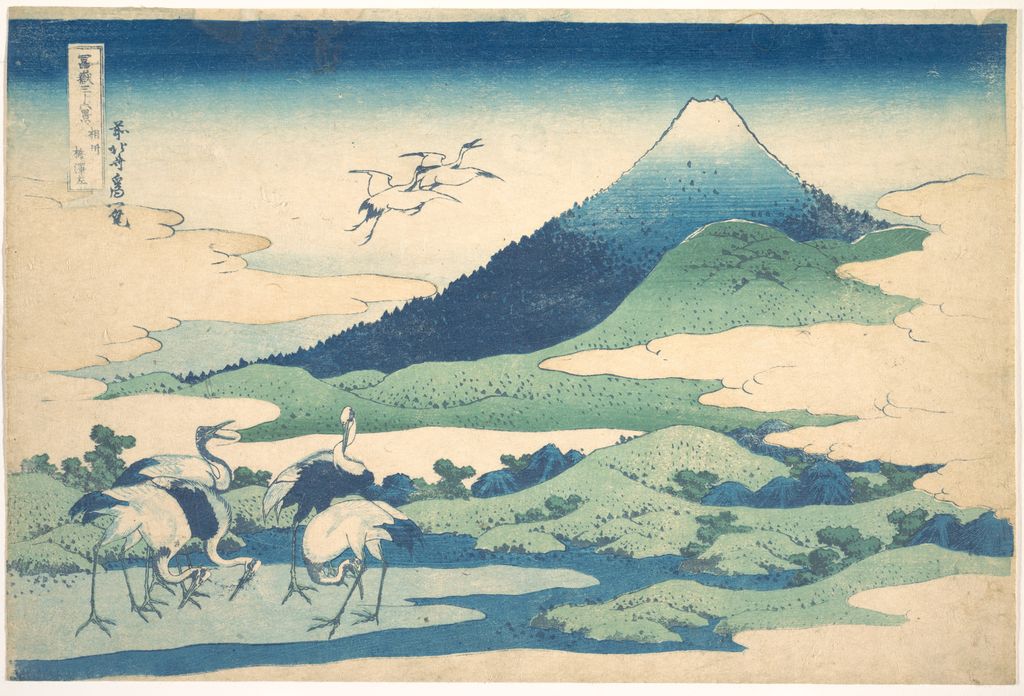
Image comparison
Where this work sits in Hokusai’s career
Annotated Details from Umezawa Manor in Sagami Province
The Metropolitan Museum of Art, JP20. [1]
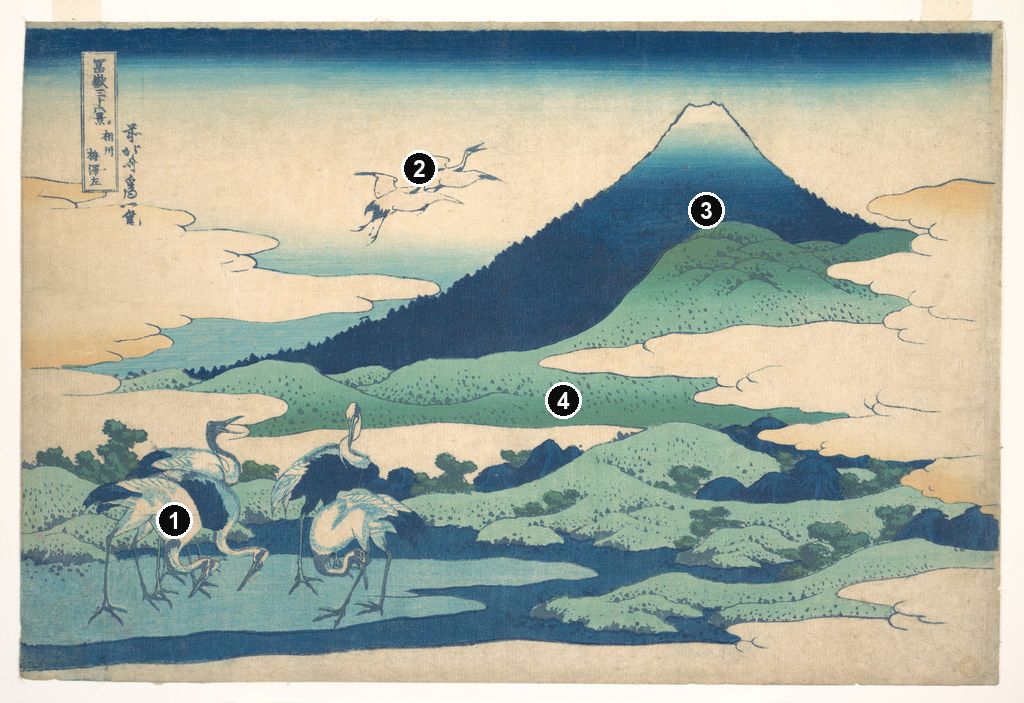
Details from UMEZAWA MANOR IN SAGAMI PROVINCE
Select a detail to look closely.
Cranes gather close to the shore
Light plumage and slender legs stand out against the low blue-green line of land. [1]
Two cranes cross the open sky
The flying birds occupy a small interval above the lower flank of the mountain. [1]
Fuji fills much of the upper half
A dark slope descends towards the left. A band of lighter colour crosses its lower reaches. [1]
Successive bands cross the landscape
Alternating flat shapes and open intervals mark the space between the foreground and the mountain. [1]
Explore Hokusai’s works
Discussion
Look again at the images and ideas explored in Umezawa Manor in Sagami Province. These editorial prompts invite your observations.
Reader Insights
How do the flying cranes lead you towards Fuji?
Which bands of colour separate the three groups of forms?
Join the Conversation
Share a detail, comparison or question about Umezawa Manor in Sagami Province below.
References
- The Metropolitan Museum of Art, Umezawa Manor in Sagami Province (Sōshū Umezawa zai), JP20. View source.
- The Metropolitan Museum of Art, Umezawa Manor in Sagami Province (Sōshū Umezawa zai), JP2981. View source.
- The Sumida Hokusai Museum, 冨嶽三十六景 相州梅沢左, Japanese collection entry. View source.
- Bristol Museums, Hokusai and Hiroshige Landscapes, entry for Umezawa Manor in Sagami Province, Mb4508. View source.
- Tokyo Fuji Art Museum, 冨嶽三十六景 相州梅沢左, Japanese collection entry. View source.
- The National Museum of Western Art, Tokyo, exhibition checklist, Iuchi Collection entry 22. View source.
- The Metropolitan Museum of Art, Hodogaya on the Tōkaidō (Tōkaidō Hodogaya), JP2562. View source.







