


 by Tom Gurney
Tom Gurney BSc (Hons) is an art history expert with over 20 years experience
Published on June 19, 2020 / Updated on November 20, 2026
Email: tomgurney1@gmail.com / Phone: +44 7429 011000
Tsukuda Island in Musashi Province
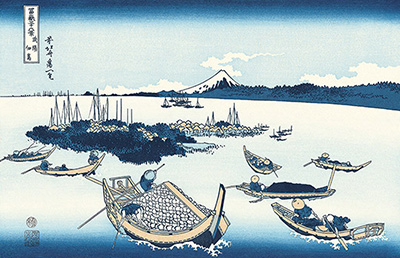
A boat heaped with bales comes into view at the foot of Katsushika Hokusai’s Tsukuda Island in Musashi Province. Its sides curve out around the load, and white flecks mark the water at its raised end. Behind it, a low island sits across the mouth of the Sumida River. Roofs and slender masts are visible above the shoreline, though the people who live and work there are harder to make out than the people on the boats. Mount Fuji appears farther away, where the outline of its summit interrupts the horizon. It is small enough to overlook at first. The cargo in the foreground gives the eye an unexpected way back to it. [1] [2]
At a Glance
- ArtistKatsushika Hokusai
- Dateca. 1830–32
- MediumColour woodblock print
- SeriesThirty-six Views of Mount Fuji
Contents
The weight in the foreground
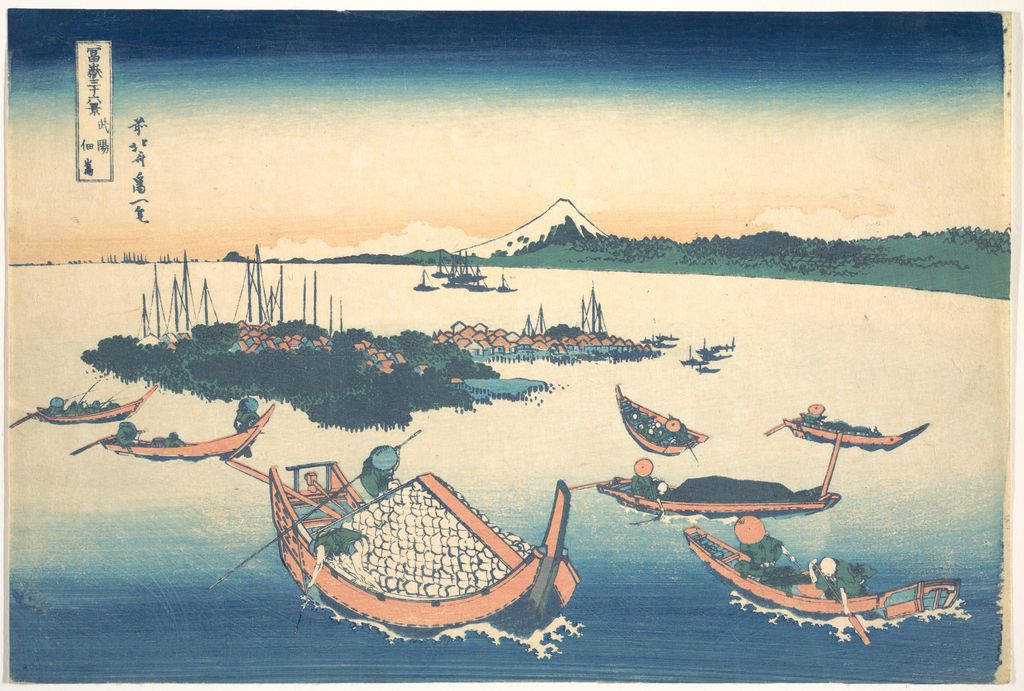
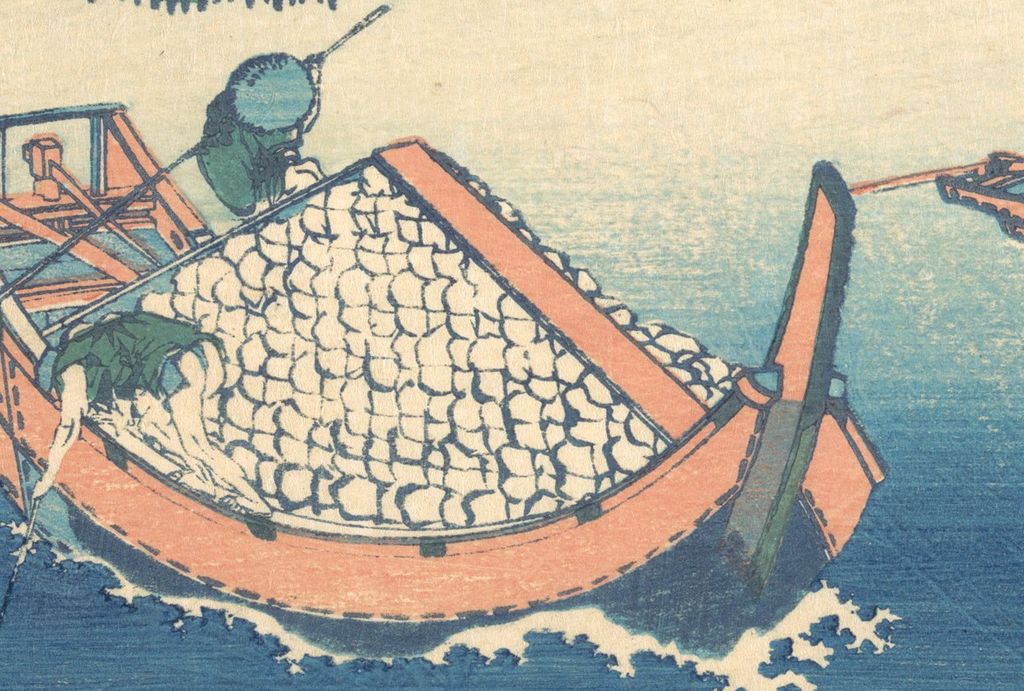
The Metropolitan Museum of Art identifies the load as cotton bales. In its impression JP2990, their pale forms are packed closely enough that they read first as one large shape. A closer look shows the curved edges and short internal marks of individual bundles. They are stacked higher toward the middle of the boat, and their mass falls away to either side. Narrow rails flank the cargo, so its pale mound has a frame almost as clearly defined as the dark outline of the hull. Fuji presents a similar rise and fall. The two forms have very different surfaces, but each shows how much Hokusai can do with a slope. [1]
The boat reveals its depth in the space the cargo leaves unfilled. At the upper left of the vessel, a figure appears beyond the mound and another dark figure is visible beside it. A long shaft reaches down across the water from the left side. Follow that diagonal back toward the crew and it is possible to see how closely their working space lies against the bundles. The sides of the boat rise to hold the cargo, then taper around the lower rim. A jagged edge of white appears against the blue below. The intervals of white along the hull and the cluster near its raised end are some of the sharpest contrasts in the print. [1]
A second large boat at lower right carries a group of smaller forms along an exposed stretch of its interior. Two figures are prominent there, one nearer the middle and the other low against the side. Rails and ribs mark off a small space at the right end. The load and crew are seen at a different angle from those of the cotton boat, and the two vessels make a loose angle with each other across the surface of the water. Behind them, a longer, lower vessel cuts across the print almost horizontally. Its dark, rounded load and narrow warm hull are distinguishable even though they take up much less of the sheet. [1]
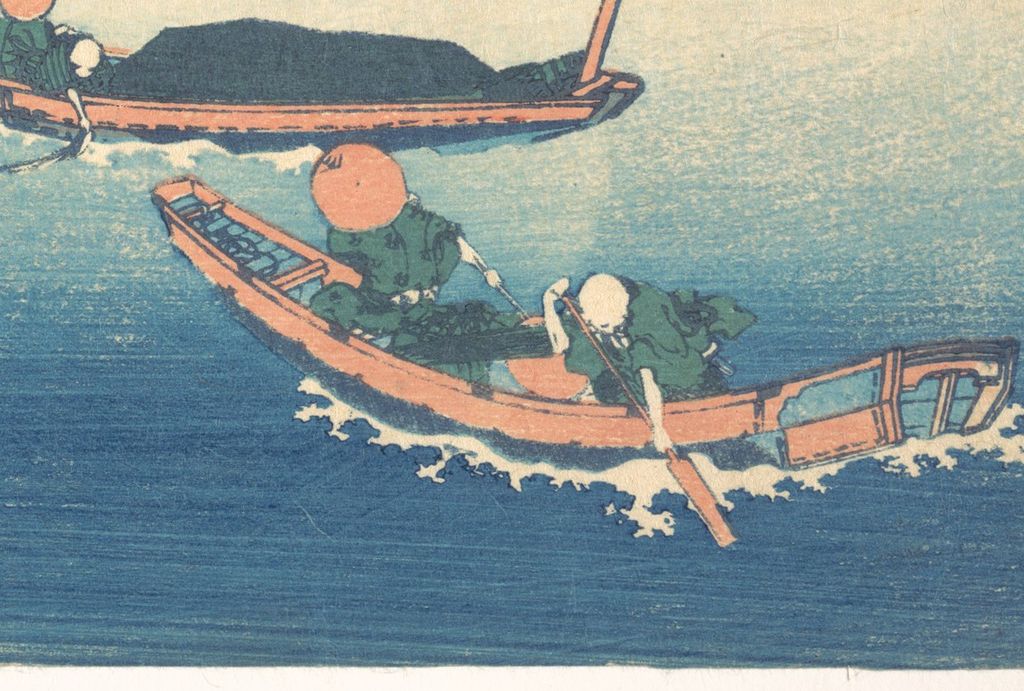
A small boat near the middle of the right half is particularly easy to miss. Its curved side tilts down toward a little knot of figures and rounded shapes. The gap between it and the flat, dark-topped vessel below makes it possible to see the entire outside edge of its hull. On the latter boat, a figure at left interrupts the line of the load and a long pole or oar rises obliquely at right. That pole draws our attention back toward the smaller boats. There is no single direction for the traffic to follow across the picture. The spaces the boats leave between them are as useful as the outlines for seeing how much activity Hokusai fits into the channel. [1]
A small island in busy water
Hokusai gives each stretch of water its own pattern of traffic. At the left edge, two narrow boats pass near the dark shore. In the space to the right of the island, shorter strokes describe boats with room around them to suggest movement in more than one direction. Farther back, a few slender uprights and dark marks are enough to make vessels legible below the mountain. The MOA Museum of Art reads the scene as a mixture of cargo boats, ferries, shared angling boats and fishing vessels. The distinction matters because the water serves several kinds of work at once. The broad cargo boat has open water around three of its sides, while the two boats at left sit close against the island’s profile. [1] [2]
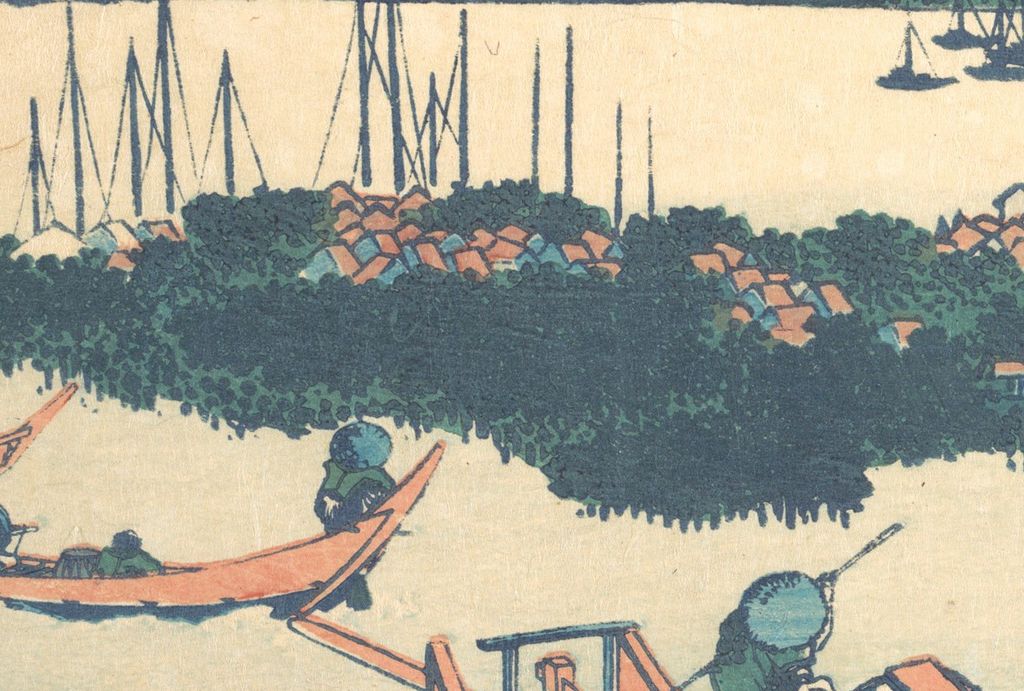
The island is easiest to trace from its dark left shore. Broad masses of foliage there give way to clusters of roof shapes. Farther right, roofs appear again beyond an opening and are picked out against lighter water. Many of the thin upright marks are close-set near these settlements. Some have crosspieces or run down into the lower marks near the water, where masts and moored vessels can be seen in profile. The longer views across the channel bring these marks almost to a single line. The island’s low profile is compact compared with the clustered freight boat, even though the strip of shore represents a larger space. [1]
The Japanese Agency for Cultural Affairs describes Tsukuda as a sandbar at the mouth of the Sumida. Its account relates the island to fishers brought to Edo from Tsukuda village in Settsu, in the area of modern Osaka, and to reclamation on the river delta. It also records the local importance of whitebait fishing and the preferential fishing rights traditionally associated with the community. The print’s title, Buyō Tsukudajima, places the island in Musashi Province. In the image, the quantities of open water and the mix of craft make sense of why a small settlement could be important to a much larger city. The curatorial identifications of fishing and freight add some of the detail that the distant roofs alone could never give us. [1] [2] [3] [4]
The skyline establishes a distance beyond the island. To the left of Fuji, a nearly level strip carries a few marks too small to separate confidently. At right, a more substantial dark band rises and falls irregularly and thickens toward the edge of the sheet. The two shores differ in height, but the long course of the open water ties them together. The title cartouche and signature sit high on the left, well away from the dense marks of the boats. The horizontal distance from that block of writing to the little mountain helps the sky feel unusually broad above the busy water. [1]
Blue water and two skies
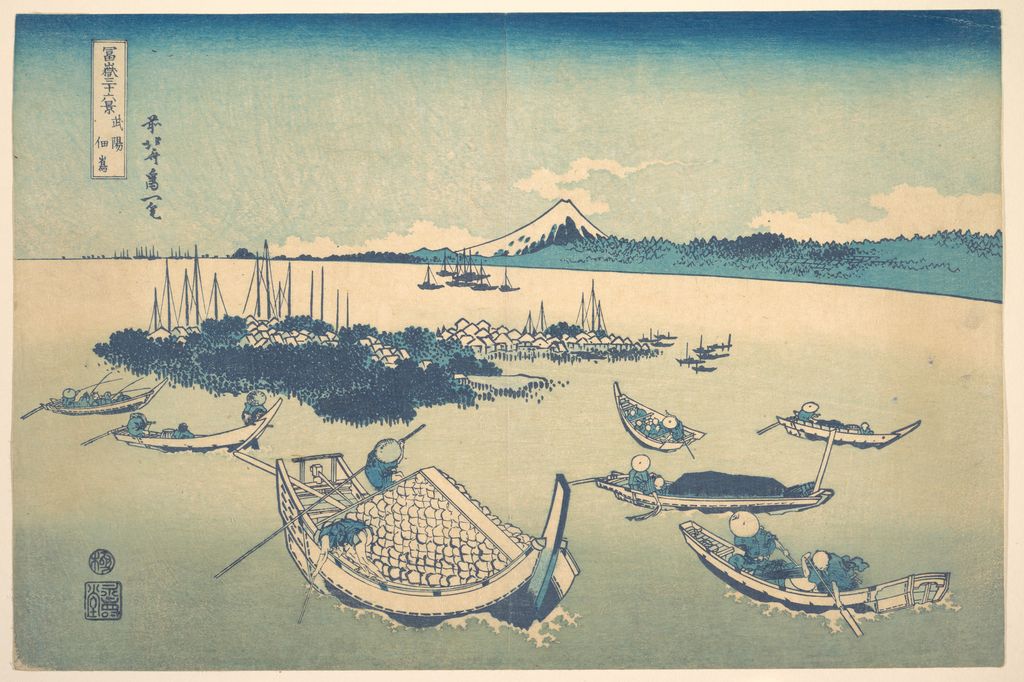
The Met dates both JP2990 and JP2563 to about 1830–32. The Phillips impression, JP2990, measures 25.7 by 38.1 centimetres. JP2563, formerly in the Howard Mansfield Collection, measures 25.4 by 38.7 centimetres. In the photograph of JP2990, strong dark blue along the upper edge gives way to a large pale expanse, with a warm tone low in the sky. A second blue passage occupies the lowest part of the print. The red-orange sides of the boats stand well apart from both the blue and the pale cargo. Blue recurs at the island, the distant wooded shore, and the foreground, but the amount of colour around each object varies enough to place it at a different depth. [1] [5]
The photograph of JP2563 gives the sky a more continuous blue-green tone. Well above the low bank of clouds, a pale wisp passes over the summit and trails to its right. It is readily apparent on this sheet, while the sky immediately above Fuji in JP2990 looks nearly open. The warm colour on the sides of the boats is also much less conspicuous. Two marks near the lower left, a small round one and a larger square one beneath it, are visible in JP2563. The cargo retains its contours and its relationship to Fuji in both photographs. The eye is drawn more strongly to the sides of the boats in the warmer impression and to the cloud and far shore in the cooler one. [1] [5]
The Agency for Cultural Affairs also describes a separate Tokyo Fuji Art Museum impression. It links the design to an advertisement for single-sheet blue prints from the series that named a view from Tsukuda Island, and describes the sky in the Tokyo sheet as a later treatment with sunset colour. This account gives a historical basis for looking closely at the way the sky was printed. In the two Met photographs the cloud forms, general tones and boat colours are clear enough to compare. The catalogue’s account of the Tokyo impression supplies evidence about that sheet and about the series’ advertising. [1] [3] [5]
Finding Fuji among the boats
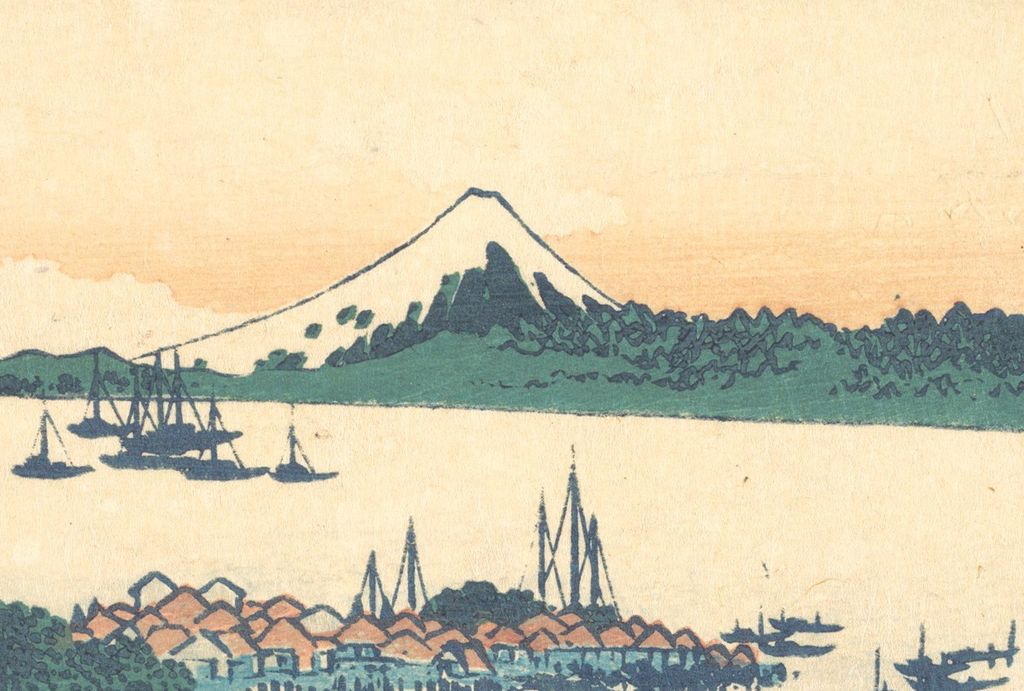
Once the cotton bales catch the eye, their pale peak can direct attention toward the skyline. Fuji’s left edge rises gradually at first, then meets the short descent from the summit. Dark shapes along the base partly absorb its lower outline into the land. Around the cargo, the open space between the hull and the fairly uniform surface of the water makes the shape easier to trace. There is a band of nearly empty water between the island and the far shore. Looking from the load to the peak means crossing that band, passing from marks that distinguish one bale from another to the few lines that identify the mountain. [1]
The National Museum of Western Art’s Iuchi Collection exhibition checklist identifies this design as no. 14 in the exhibition. Other prints in Hokusai’s Thirty-six Views of Mount Fuji use boats to reach the mountain by a different path. In Sea Lane off Kazusa Province, the high side of one vessel occupies much of the foreground. Its sail edges and rigging suspend triangular shapes in the sky above a small Fuji. At Tsukuda, the corresponding shape remains closer to the level of the water. It begins in the stack of bales and rises only as the viewer looks beyond the separate boats and across the low strip of land. [1] [4] [6]
Where this work sits in Hokusai’s career
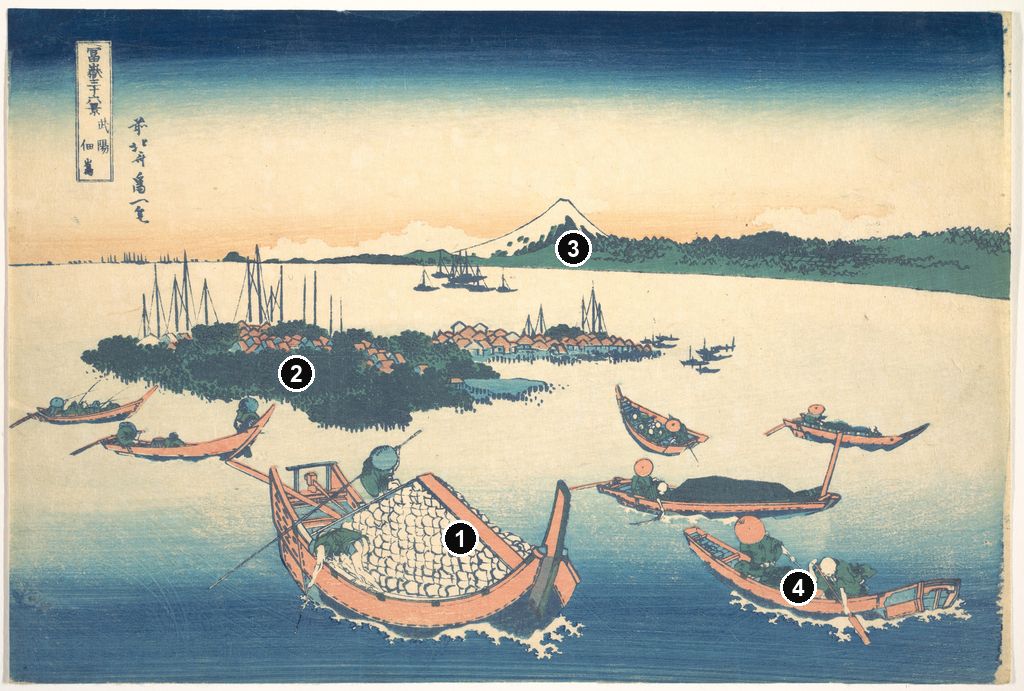
Annotated Details from Tsukudajima Island in Musashi Province
The Metropolitan Museum of Art, JP2990. [1]
Details from TSUKUDAJIMA ISLAND IN MUSASHI PROVINCE
Select a detail to look closely.
The largest boat carries bales
Curved sides enclose the pale load. Diagonals across the cargo help it read as a tightly packed mass. [1]
The island is a low strip
Dark forms cluster along the shore. A series of thin uprights rises just above them. [1]
The mountain breaks the thin horizon
Fuji appears above the distant land. The narrow band of shoreline emphasises how little height the peak takes up. [1]
A small boat crosses the near water
Its long, narrow shape contrasts with the broad curve of the laden vessel. [1]
Explore Hokusai’s works
Discussion
Look again at the images and ideas explored in Tsukuda Island in Musashi Province. These editorial prompts invite your observations.
Reader Insights
Which marks make the island appear far off?
What does the largest boat reveal about work on this waterway?
Join the Conversation
Share a detail, comparison or question about Tsukuda Island in Musashi Province below.
References
- The Metropolitan Museum of Art, Tsukudajima in Musashi Province (Buyō Tsukudajima), impression JP2990, collection record and photograph. View source.
- MOA Museum of Art, Hokusai: Thirty-six Views of Mount Fuji Digital Remix, Japanese gallery notes, no. 59, 武陽佃嶌. View source.
- Agency for Cultural Affairs, Japan, Thirty-six Views of Mount Fuji: Tsukuda Island in Musashi Province, Cultural Heritage Online record for the Tokyo Fuji Art Museum impression. View source.
- National Museum of Western Art, Japanese and English exhibition checklist for the Iuchi Collection, no. 14. View source.
- The Metropolitan Museum of Art, Tsukudajima in Musashi Province (Buyō Tsukudajima), impression JP2563, collection record and photograph. View source.
- The Metropolitan Museum of Art, At Sea off Kazusa (Kazusa no kairo), impression JP2963, collection record and photograph. View source.







