


 by Tom Gurney
Tom Gurney BSc (Hons) is an art history expert with over 20 years experience
Published on June 19, 2020 / Updated on November 20, 2026
Email: tomgurney1@gmail.com / Phone: +44 7429 011000
Dawn at Isawa in Kai Province
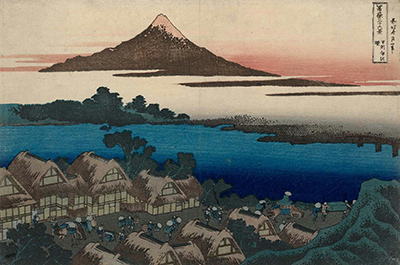
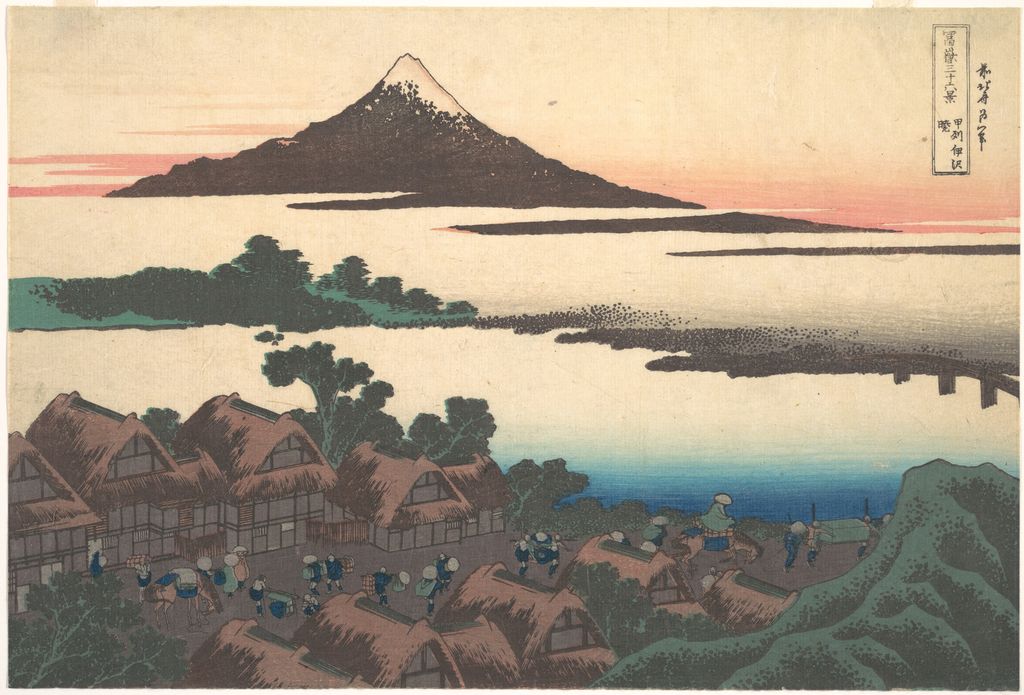
Fuji’s upper slopes are already light when the people below leave Isawa. In Katsushika Hokusai’s Dawn at Isawa in Kai Province, the roof ridges are dark enough to merge with the trees, and the travellers’ hats catch the eye as a string of pale marks in the street. A rose band lies low in the sky above the almost black mountain slopes. The sun stays outside the picture. We recognise the hour through the different amounts of light that have reached the roofs, the water and the summit. The Metropolitan Museum of Art dates its colour woodblock impression JP2971 to about 1830–32. [1]
At a Glance
- ArtistKatsushika Hokusai
- Dateca. 1830–32
- MediumColour woodblock print
- SeriesThirty-six Views of Mount Fuji
Contents
Where the road passes through Isawa
The title is 甲州伊沢暁, Kōshū Isawa no akatsuki. The National Museum of Western Art lists it under that title as number 43 in its exhibition checklist of prints from the Iuchi Collection. Kōshū refers to Kai Province. Tokyo Fuji Art Museum identifies the Isawa written 伊沢 in the print with present-day Isawa, written 石和, in Fuefuki, Yamanashi Prefecture. It identifies the river between the town and the mountain as the Fuefuki. A municipal account uses the historic local name Ukai River for that stretch of what is now called the Fuefuki. [2] [3] [4]
Isawa was a post town on the Kōshū Kaidō. The Japanese transport ministry describes this highway as extending from Nihonbashi in Edo to Shimosuwa, where it joined the Nakasendō. The Yamanashi historic-road project identifies Isawa as a junction for roads running south and southwest, with a landing that gave access by the Fuefuki to the Fuji River transport system. Rice collected as tax and other goods travelled downstream. That history gives the road in the picture a practical setting. Hokusai shows a place where a group on foot could pass between houses and out towards a river crossing, at an hour when the buildings themselves still look shut. [1] [5] [6]
The roofs are seen from high enough up that several rows fit into the foreground. The smallest details of the street, by contrast, are easy to lose at first glance. The eye has to come down from the clean profile of the mountain and pass through broad intervals of river and shore before it can distinguish an individual traveller. This arrangement lets the print suggest the continuation of a public route without marking a precise place for the viewer to stand. Hokusai gives us enough of the town to follow the movement through it. [1] [3]
The roofs and the people beneath them
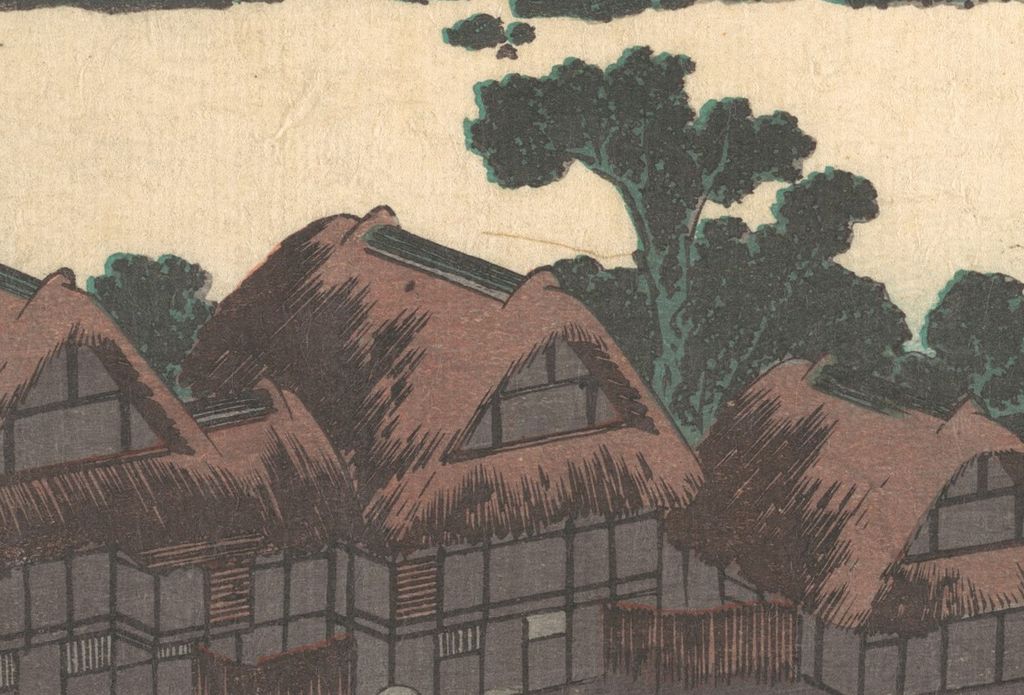
Begin with the roofs on the left. Their thatch falls in dark strokes over triangular gables. Pairs of roofs overlap, and the ridge of one building almost meets the rising side of another. Beneath that dense patch, fine straight strokes divide the street fronts into posts, doors and low panels. The lighter gable faces are some of the few places where a regular architectural shape remains easy to pick out. Then there is a break in the near row of roofs, and the people below come into view. [1]
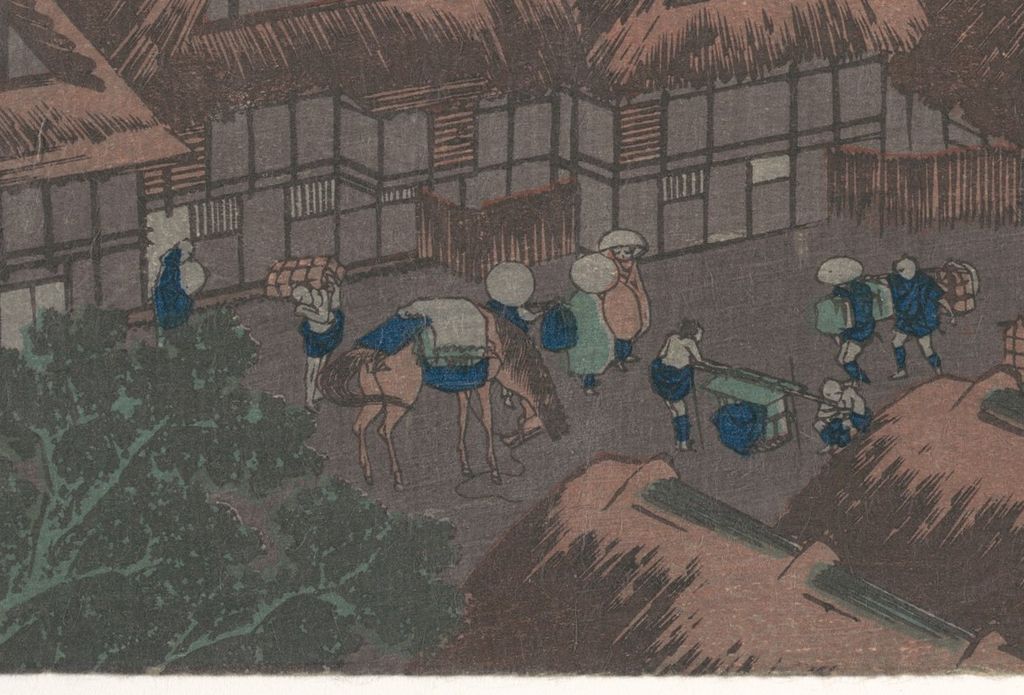
Some figures are hardly more than a light disk above a dark blue body. Those disks repeat at different heights. Tilted hats, bent legs and projecting bundles make the people distinct from one another even when their faces are barely visible. Several bunch together at the lower left. Farther along, the figures are spaced out and pass behind ridges or small patches of greenery. There is a brief interruption where the road runs beside the water, then more figures appear towards the right. Hokusai makes the route readable by letting us lose sight of people and find them again. [1]
The Met reads the travellers as a party heading for the bridge. Sumida Hokusai Museum places the emphasis on the early start from the post town as well as on the light awaiting the travellers outside it. In JP2971, the visible section of the bridge is on the right. Several dark supports stand out against the pale surface of the water. The land in the extreme foreground rises on that side of the print and partly screens the way forward. We can see where the crossing lies before we can follow all of the road that leads to it. [1] [7]
How dawn divides the view
The river has a different range of light from the sky. Near the buildings a blue band is quite dense. It lightens upwards into a broad open stretch, so that a viewer has room to follow the water to the far bank. Banks and trees fix the course of the river where the colours change gradually. Near the middle, small dark marks gather into the edge of a bar or bank. Toward the bridge the pale water remains clear between strips of almost level land. The shift from denser blue to lighter water gives depth to those horizontal shapes. [1]
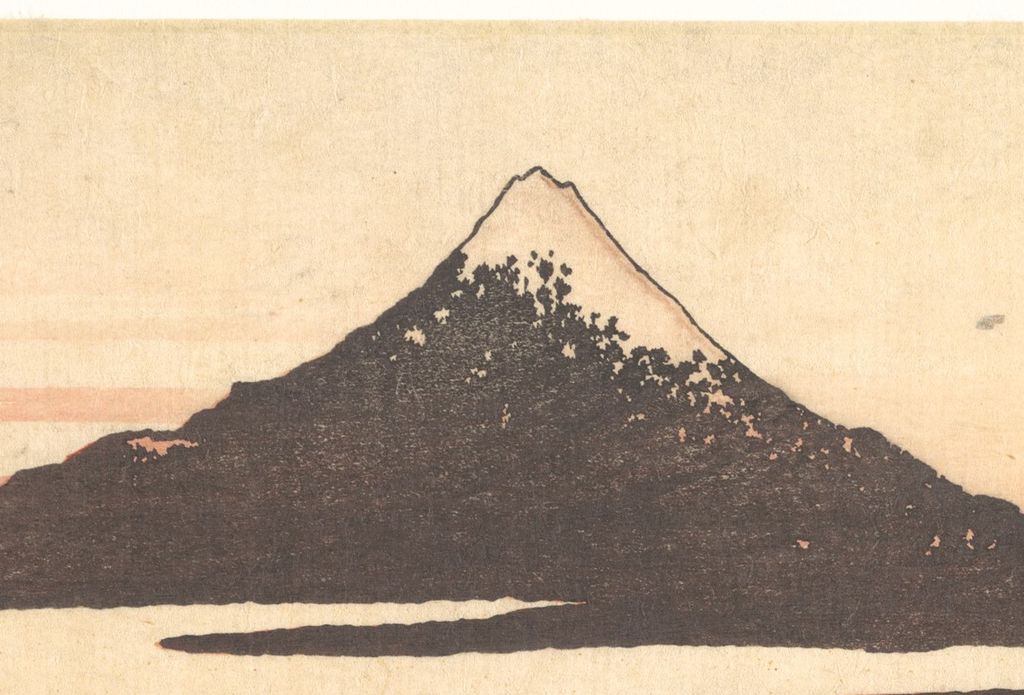
Above the river, strips of low ground and haze intervene before the mountain. Fuji’s outline is easy to follow from the far left towards the summit and down the longer flank at right. Its upper edge is drawn as a fine line, with the light peak set against a pale sky. Below it, flecks of pale colour break into the much darker slope. At the base the silhouette reaches into a long warm band, whose colour is clearest towards the right. Sumida describes the summit in its impression as beginning to catch reddish morning light. In JP2971 the position of the rose tone low in the sky gives a separate reason to read the scene as daybreak. [1] [7]
Hokusai uses dark areas differently in the foreground and at the mountain. In the town, one small roof or tree overlaps another, making it possible to judge what sits nearer and what stands behind it. At Fuji the outer edge matters more. There is little inside that broad flank to measure the intervening distance. The clear summit makes the peak immediately visible from the town, while the thin lines of land and water give a sense of how much lies between them. [1]
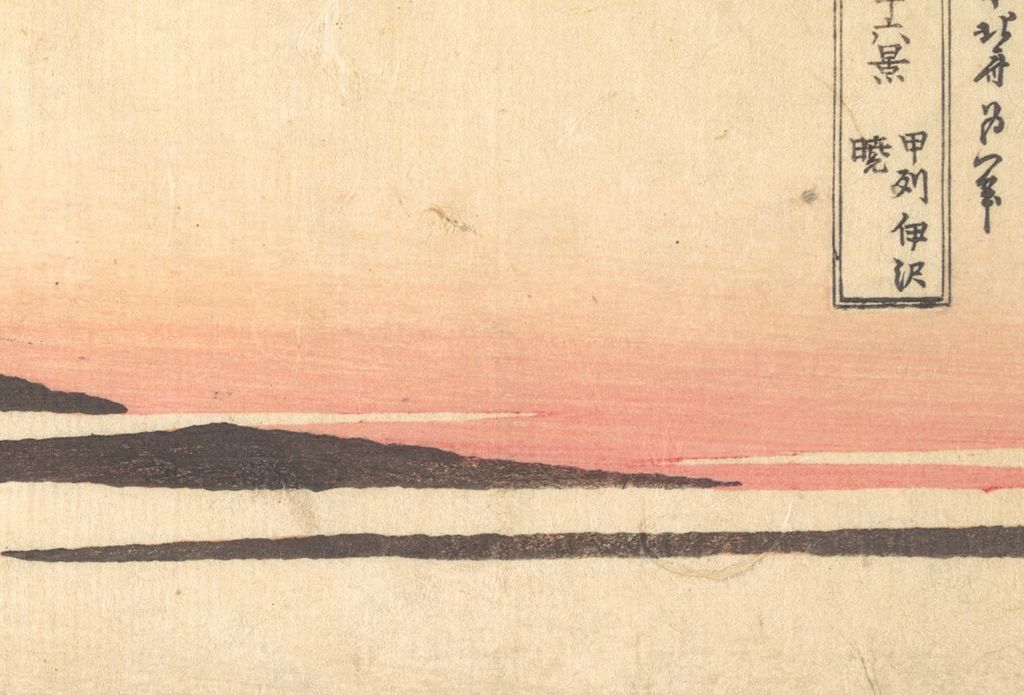
The upper right corner is particularly open. The title cartouche and signature stand in that light area well above the crossing. The upright frame of the cartouche gives the right edge a firm accent. Almost everything else at that height runs across the picture, from the narrow pink lines on the left to the band below the cartouche. It is an economical way to make a large sky feel like part of the landscape rather than a blank above it. [1]
Two impressions of Isawa
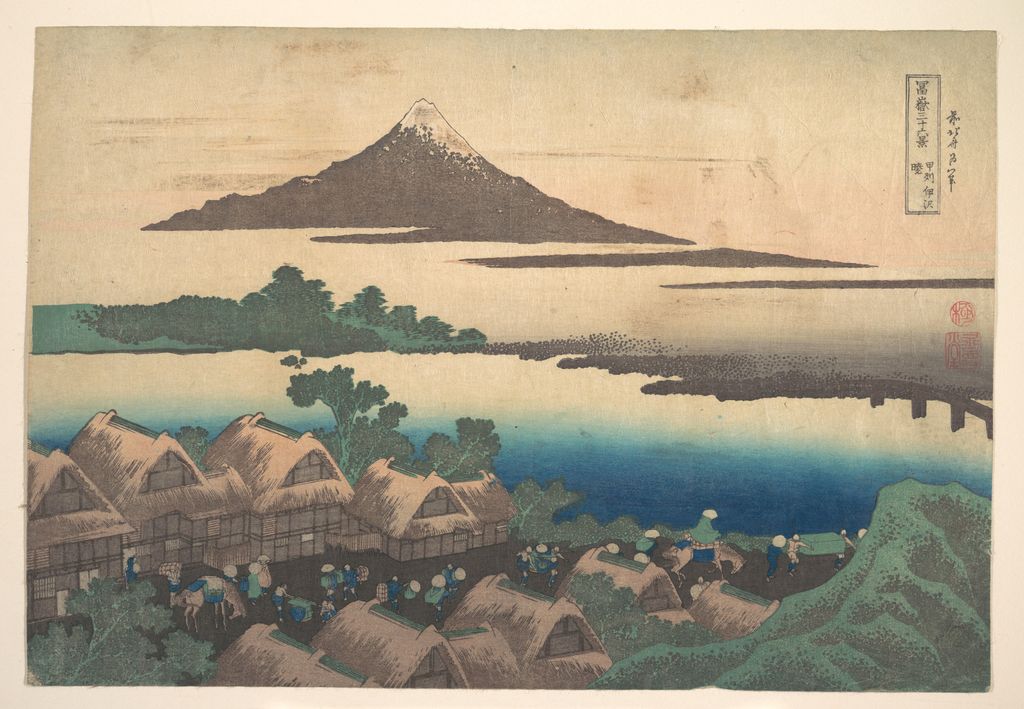
The Met’s impressions JP2971 and JP1328 are both catalogued as woodblock prints in ink and colour on paper, dated about 1830–32. The museum measures JP2971 at 25.1 by 37.1 centimetres and JP1328 at 26.2 by 38.1 centimetres. The shapes agree closely when the photographs are set side by side. The row of thatched gables, the pale opening between the tree clusters, the projection of the bridge and the small changes of angle along Fuji’s flank provide points of comparison from the bottom of the sheet to the top. [1] [8]
The different appearance of the sky changes where one first notices the dawn. JP2971 has conspicuous narrow pink streaks on the left and a broader rose passage to the right of Fuji. The corresponding marks are faint in the photograph of JP1328, where the sky has a more even buff tone. In that impression the blue reach of the water is more conspicuous immediately above the houses. It stretches across much of the scene and brings out the different heights of the roofs. The pale water beyond it still stands apart from the dark trees and bridge supports. [1] [8]
The houses also give a direct comparison. The upper surfaces of the roofs on the left are relatively light in JP1328. Individual lines of thatch stand out, and the upper row of roofs is easier to follow from the left edge into the centre. In JP2971 the roofs look browner and their shaded faces lie closer to the tone of the street. More plain paper is visible around the image of JP1328, and two red marks appear near its right edge. Those differences concern the appearance of the individual photographed sheets. Comparing them establishes where a change of tone or margin alters the reading, while the Met’s shared date range leaves their printing sequence open. [1] [8]
A journey seen from above
In Mishima Pass in Kai Province, Hokusai sets a huge tree between the travellers and a view of the mountain. The people come together immediately at the foot of that trunk. At Isawa the nearest buildings spread across most of the width and the travellers are distributed across the lane. Instead of an encounter at a single object, the subject is a departure. The eye can pick out the stages of the movement, from the denser cluster among the houses towards the opening by the river. The two designs use the same province and the same peak to measure very different experiences of distance. [1] [9]
Within Thirty-six Views of Mount Fuji, Isawa is a view in which the hour of the day is also a way of organising the landscape. Follow the last visible people on the street towards the dark bridge supports, then look directly above them at the thin band of early light. Hokusai lets those separated details occupy the same view. The town is barely light enough to see its doors and faces, yet beyond the river the summit is already legible. [1]
Where this work sits in Hokusai’s career
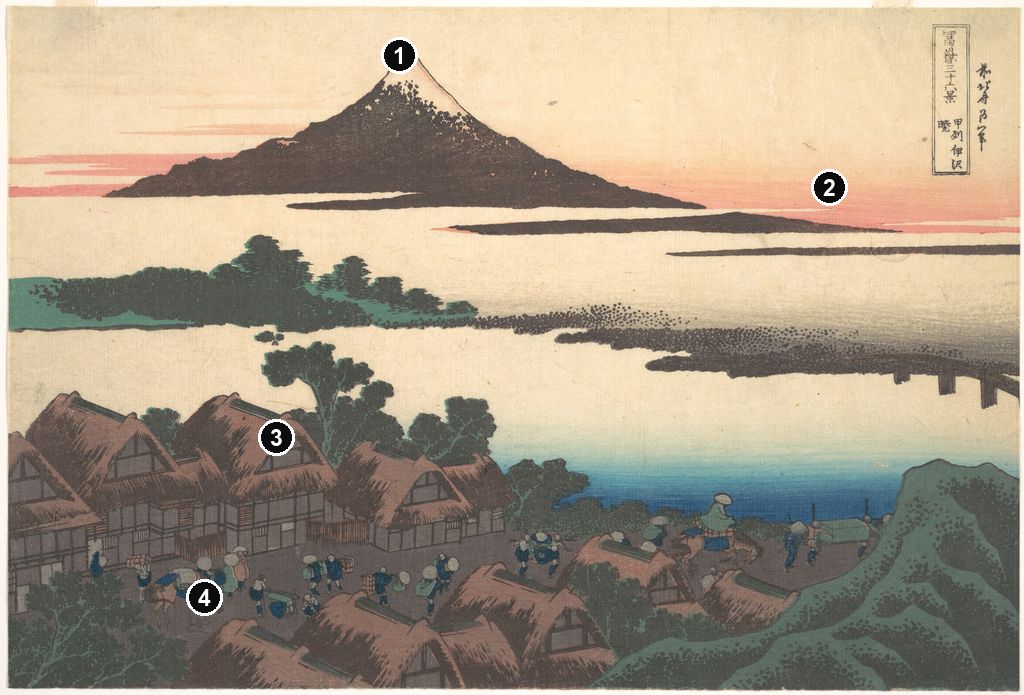
Annotated Details from Dawn at Isawa in Kai Province
The Metropolitan Museum of Art, JP2971. [1]
Details from DAWN AT ISAWA IN KAI PROVINCE
Select a detail to look closely.
Fuji stands against a pale sky
The peak rises above a dark tapering slope. A thin line separates the summit from the light behind it. [1]
A low band of colour follows the land
Long marks across the distance run below the upper sky. They contrast with the short, crowded shapes below. [1]
The settlement lies near the water
Near roofs and trees rise above the lower foreground. More open space appears beyond them. [1]
People move among the roofs
Small upright marks interrupt the area of dark buildings and vegetation. They give the town a human scale. [1]
Explore Hokusai’s works
Discussion
Look again at the images and ideas explored in Dawn at Isawa in Kai Province. These editorial prompts invite your observations.
Reader Insights
Where do the travellers enter the view?
Which edges suggest the first light of the day?
Join the Conversation
Share a detail, comparison or question about Dawn at Isawa in Kai Province below.
References
- The Metropolitan Museum of Art, Dawn at Isawa in Kai Province (Kōshū Isawa no akatsuki), impression JP2971, collection record and photograph. View source.
- National Museum of Western Art, Iuchi Collection exhibition checklist, no. 43, 甲州伊沢暁. View source.
- Tokyo Fuji Art Museum, 冨嶽三十六景 甲州伊沢暁, collection record 06315 and Japanese commentary. View source.
- Fuefuki City, municipal feature on Fuji and Dawn at Isawa, with identification of the historic Ukai River and present Fuefuki River. View source.
- Ministry of Land, Infrastructure, Transport and Tourism, 山梨を拓く甲州街道とともに, official history of the Kōshū Kaidō. View source.
- Yamanashi Historical Road Tourism, 石和宿, post town, road junction and water transport. View source.
- Sumida Hokusai Museum, 冨嶽三十六景 甲州伊沢暁, collection record and Japanese commentary. View source.
- The Metropolitan Museum of Art, Dawn at Isawa in Kai Province (Kōshū Isawa no akatsuki), impression JP1328, collection record and photograph. View source.
- The Metropolitan Museum of Art, Mishima Pass in Kai Province (Kōshū Mishima goe), impression JP2970. View source.







