


 by Tom Gurney
Tom Gurney BSc (Hons) is an art history expert with over 20 years experience
Published on June 19, 2020 / Updated on November 20, 2026
Email: tomgurney1@gmail.com / Phone: +44 7429 011000
The Laughing Hannya
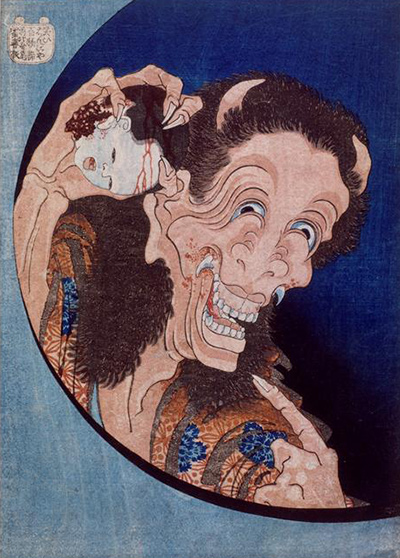
In Katsushika Hokusai’s The Laughing Hannya, the demon inclines her head until one horn nearly meets the fingers holding a child’s head beside her. Her mouth opens wide enough to expose two rows of teeth. Deep folds around the eyes have the shape of a laugh, while the long nails and firm grip give the expression its menace. Hokusai keeps the gesture and the face equally close to the viewer. The picture belongs to One Hundred Ghost Stories (Hyaku monogatari), a series of color woodblock prints from the early 1830s that also includes The Ghost of Oiwa. [1] [2] [3]
At a Glance
- ArtistKatsushika Hokusai
- Dateca. 1831–32
- MediumColour woodblock print
- SeriesOne Hundred Ghost Stories
Contents
The print and its title
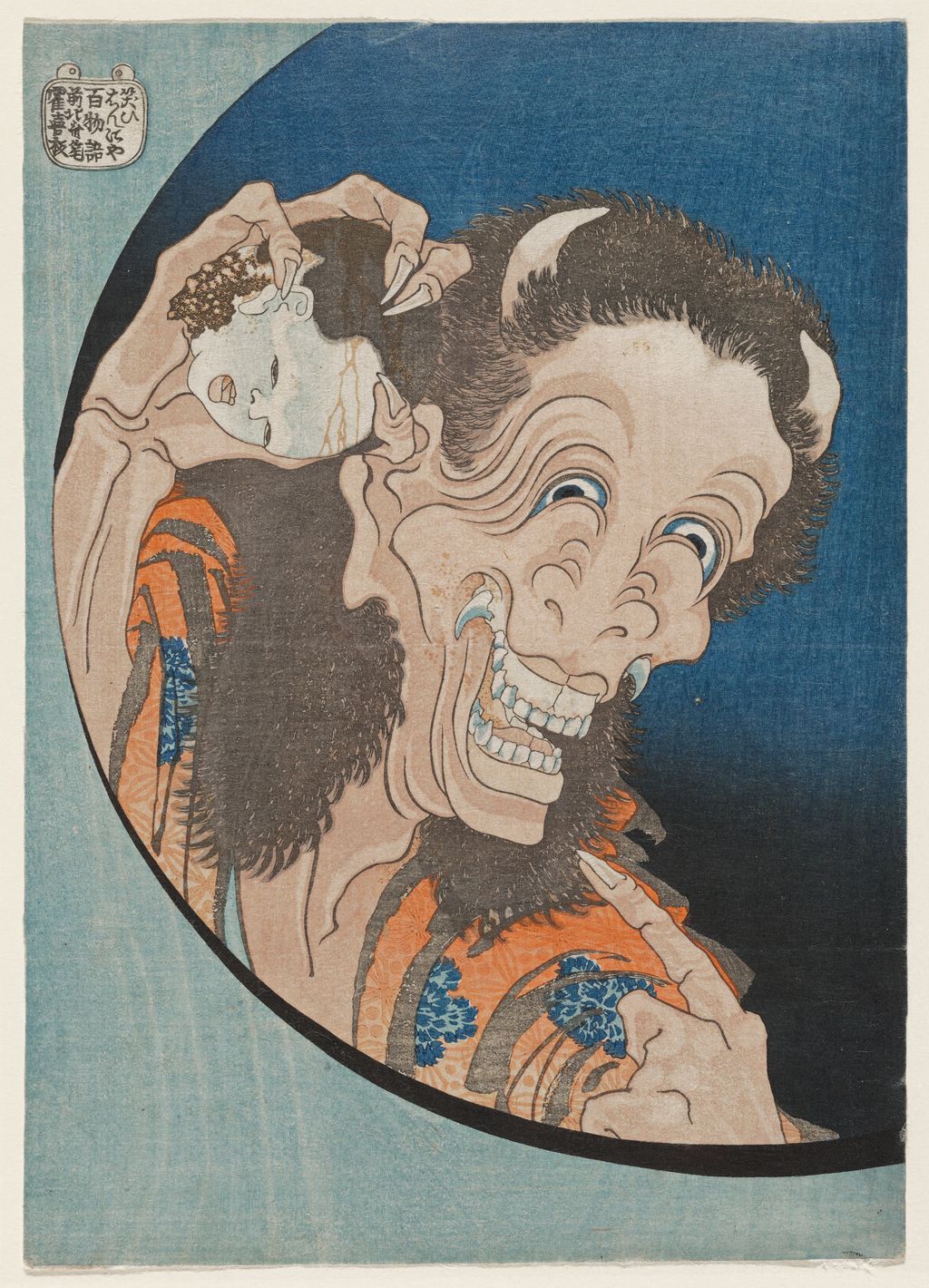
The Tokyo National Museum catalogs its impression as 百物語・笑ひはんにや, series title followed by the individual design’s title, Warai hannya. In English this appears as The Laughing Hannya, The Laughing Demon, and The Laughing Demoness. The Japanese title names the kind of creature as well as the action, so its reference is narrower than the English word “demon.” The Tokyo record describes a single chūban nishiki-e, a medium-format color woodblock print. The Minneapolis Institute of Art’s impression measures 26.2 by 18.5 centimeters. Its record names the publisher Tsuruya Kiemon and transcribes the signature as Saki no Hokusai hitsu, meaning “from the brush of the former Hokusai.” [1] [2] [3]
Minneapolis dates its sheet to about 1831–32. The Library of Congress gives 1831 or 1832 with question marks, and the Tokyo National Museum records the broader Edo-period, nineteenth-century attribution. Taken together, the records place the design in the early 1830s. Its nearly page-sized proportions help explain the impact of the scale Hokusai gives the face. In a sheet that can be held close, the eyes and mouth take up an unusually large share of the space, and the child’s features are small enough to prompt a second look. [1] [2] [3]
Where the laughter comes from
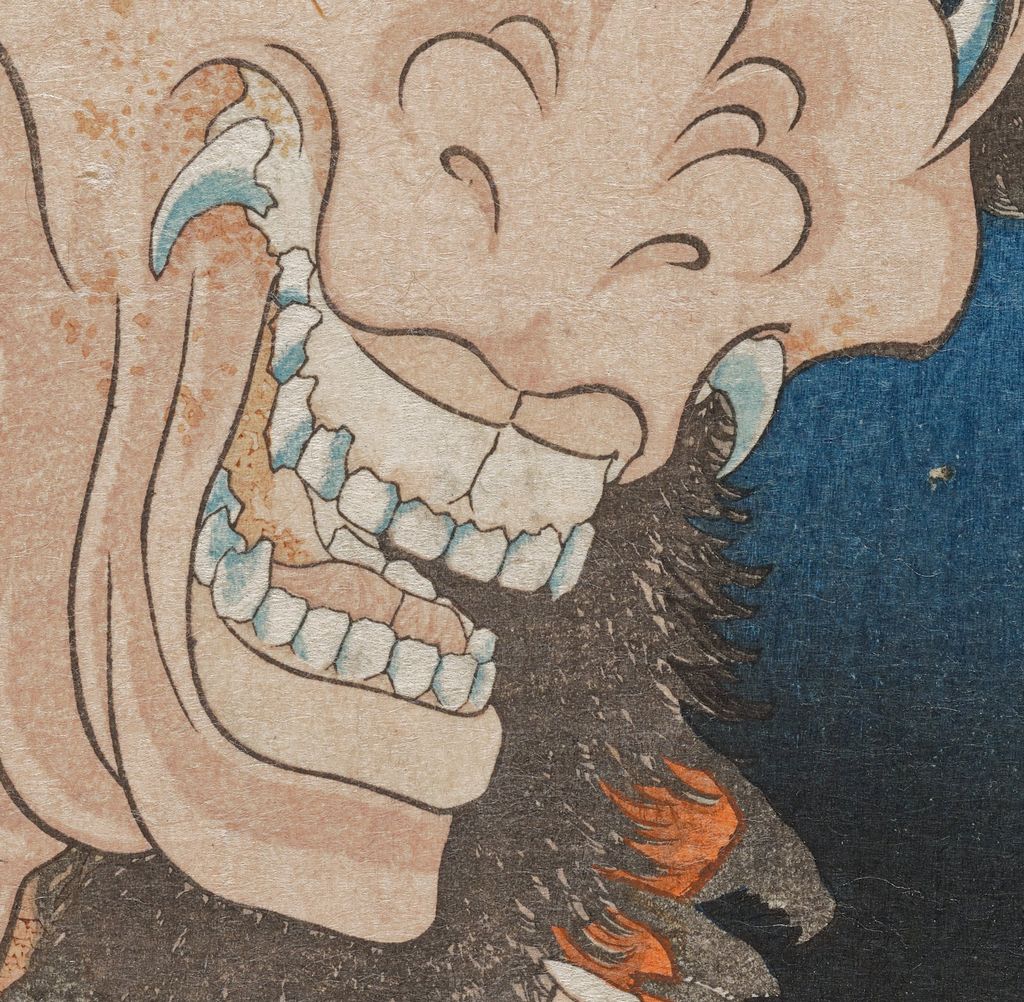
Start just above the mouth. A row of tight arcs surrounds each eye, then the lines sweep down across the cheeks. They lengthen as they approach the temples. The two eyes sit at different heights because the face is tilted, and the folds turn with it. That tilt keeps the design from settling into the symmetry of a face seen head-on. The horns emerge from the dark hair at either side of the forehead and make its turn easier to see. One projects into the space beside the raised hand. The other sits close against the dark blue field and the edge of the hair. [2] [3]
The teeth are worth following from one end of the mouth to the other. Their pale surfaces form two bowed rows bounded by darker lines, and the interior of the mouth widens near the corner. Wrinkles around the lower lip continue down toward the chin. Hokusai builds the laugh out of several connected movements in the face, from the squeezed eyes to the open jaw. The changes of direction make the expression legible even at a small size. Close up, the uneven shape of the mouth and the sharply separated teeth make that same expression difficult to regard as friendly. [2] [3]
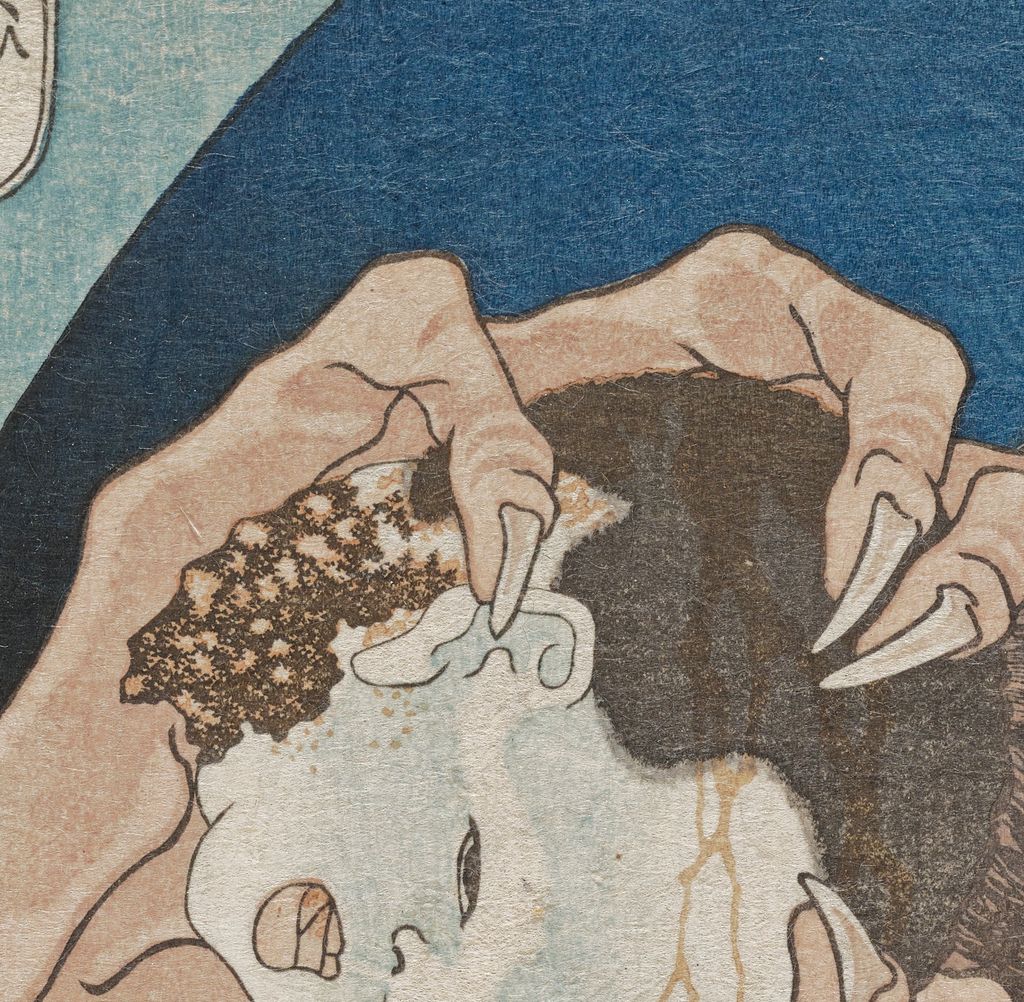
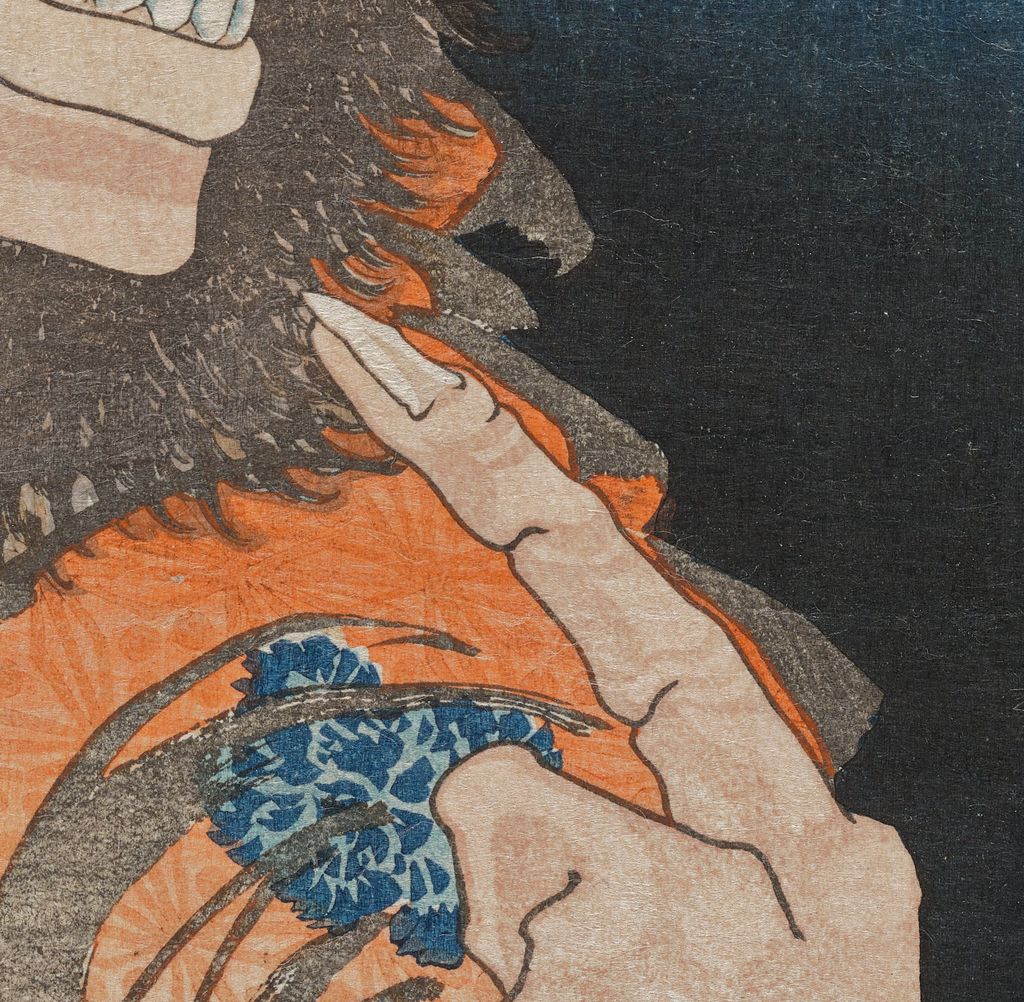
The fingers are just as important. Those raised at the left curl over the dark hair of the small head. A second hand appears below the demon’s chin, against the clothing, with a long nail aimed back toward her face. The two gestures enclose the grin from opposite sides. Follow the raised fingers inward and the child’s pale cheek comes into view. Its small nose and closed eyelid take longer to register than the demon’s open mouth. The difference in scale lets Hokusai make the laugh the first thing many viewers see, then supplies a reason to recoil from it. [2] [3] [4]
At the lower edge, the patterned fabric has a density of small shapes and colors absent from the broad areas around the figure. Red-brown folds hold patches of blue and dark ornament. The hair is dark enough to merge with the deepest parts of the space behind it, yet fine lines at the temple pull the hairline back into view. Outside the curved black boundary, a pale field runs along the left and bottom. The change between that light outer area and the darker area within makes the figure seem discovered in an opening. The curve does much of this work. The print leaves the setting spare enough for the viewer to concentrate on the hand and face. [2] [3]
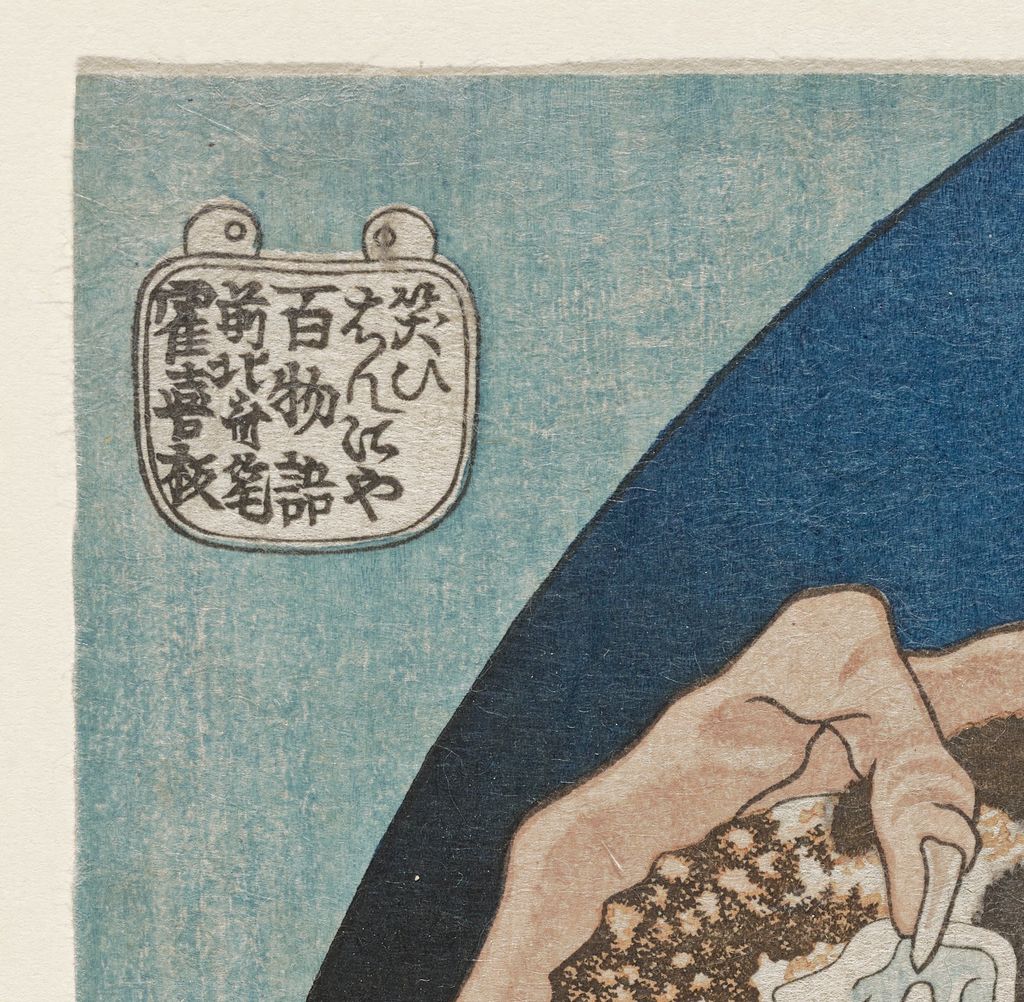
The small inscription at the upper left sits in the lighter area outside the curve. Its compressed vertical writing and pale surround stand apart from the sweeping contour of the picture. Before it can be read, it registers as a small patch against the larger forms. Once read, the title supplies the sound implied by the mouth. Hokusai gives the laugh a visible shape through the wrinkled cheeks and parted teeth, and the name on the sheet tells the viewer how to hear it. [1] [2] [3]
A hannya and a mountain woman
The Library of Congress interprets the figure as a combination of two kinds of supernatural being. The hannya is associated with a woman transformed by jealousy. The yamanba, also called yamauba, is a mountain woman associated in some stories with eating children. This pairing gives separate meanings to features the print brings together. The horns and expression suggest the hannya, while the child’s head gives the mountain-woman reading its force. The National Gallery of Victoria also presented the figure as a combination of the two. The story traditions account for the recognizable elements Hokusai draws together in a single figure. [3] [4] [5]
The hannya has a related life in Noh theatre. The Metropolitan Museum of Art describes a mask used for the jealous spirit of Lady Rokujō in Aoi no Ue, with horns, exposed teeth and an open mouth that can convey grief as well as rage. That mask offers a comparison for the way expression carries meaning in Hokusai’s print. The print turns the face to an angle, cuts the eyes into an emphatic squint, and gives the figure hands and an object to handle. A mask worn by a performer gains expression as its angle changes in the light. Hokusai works with one fixed angle and places the evidence of the laughter in the face itself. Aoi no Ue illustrates how audiences could recognize a hannya through its features. The child and the mountain-woman interpretation belong to the reading of this particular print. [3] [4] [6]
Five ghost designs and a different kind of face
The Library of Congress records five named designs together under Hyaku monogatari. Alongside The Laughing Hannya and The Ghost of Oiwa are The Ghost of Kohada Koheiji, The Plate Mansion (Sarayashiki), and Obsession (Shūnen). The title One Hundred Ghost Stories evokes a tradition of gathering to tell frightening tales, with a lamp extinguished after each story. The National Gallery of Victoria describes an Edo-period version that began with a hundred lamps and ended with the expectation of something supernatural in the dark. The five names establish the extent of the set documented by the library. The series title gives the gathering of separate tales a shared setting in the imagination. [5] [7]
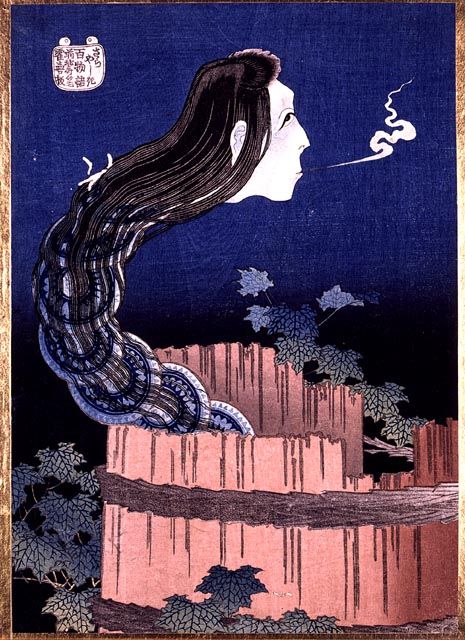
Hokusai’s Ghost of Oiwa is especially revealing beside the Hannya. Oiwa is the named ghost from the Yotsuya story familiar through Kabuki. Her disfigured face emerges from a torn paper lantern. Look for the ribs crossing the pale surface and the strands that descend below it. They make her features belong to the object as she appears. The demon in The Laughing Hannya has two visible hands and a mass of clothing as well as a face. In both prints, Hokusai crops the immediate surroundings to bring the apparition near. Oiwa’s lantern gives that apparition an ordinary household form, while the horned figure’s nearness allows the viewer to see what she holds. The two designs use the face to disclose different kinds of horror. [2] [3] [4] [8]
Kohada Koheiji gives the series a third kind of encounter. The dead man’s skull and bony fingers loom above a mosquito net, which he draws aside to look in on his killers. The net does what the curve in The Laughing Hannya does for a moment. It gives the eye a visible border to cross. For Koheiji that border is part of a bed and a story of revenge. In the Hannya, the curve frames an encounter whose violence can be understood from the hand and the small head alone. [3] [4] [5]
Image comparison
Comparing the surviving sheets
Different catalog entries sometimes use almost identical titles for very different physical objects. The Minneapolis, Tokyo and Library of Congress records document nineteenth-century sheets associated with Hokusai. Hamilton College holds a reproduction after Hokusai printed in 1920 and attributes that object to Enji Takamizawa. The two dates in Hamilton’s entry refer to the earlier design and to this later printing. Its image is another way of seeing the composition in circulation. The Minneapolis sheet provides the dimensions, signature and publisher information for the impression in that museum’s collection. [1] [2] [3] [9]
The enduring elements of the design can be followed across images of these sheets. The inscription sits beyond the black curve. The horns and folds of the face come into focus against the large dark field. The pale child’s head is almost surrounded by fingers and hair. Colors and proportions of the visible margins can vary between reproductions, so the location of those details within the design offers a steadier guide when comparing examples. Return to the mouth after tracing the hand. The curves still read clearly as a laugh, and now the gesture beside them makes it clear how much of the picture that word leaves unsaid. [1] [2] [3] [9]
Where this work sits in Hokusai’s career
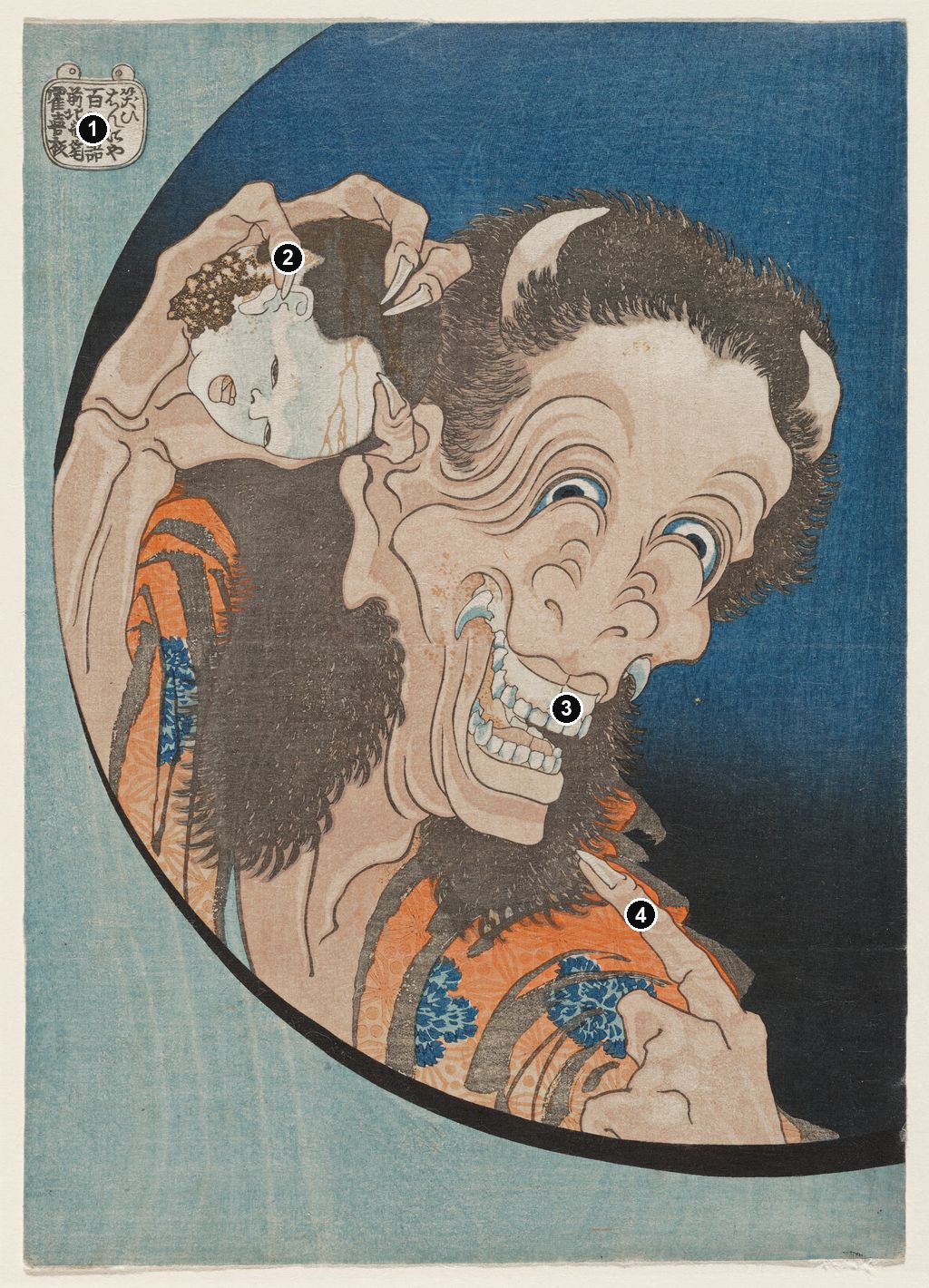
Annotated Details from The Laughing Hannya
Minneapolis Institute of Art, 56.52.2. Public domain. [2]
Details from THE LAUGHING HANNYA
Select a detail to look closely.
The title sits beyond the curved border
The cartouche occupies a pale corner beside the dark enclosure of the figures. [2]
Long nails curve over the child’s hair
The pale fingertips frame the small head beside the demon’s face. [2]
Two rows of teeth follow the open mouth
The folds at the cheek continue around the mouth and help carry the expression downwards. [2]
A finger points back towards the face
The lower hand echoes the long nails visible beside the child’s head. [2]
Explore Hokusai’s works
Discussion
Look again at the images and ideas explored in The Laughing Hannya. These editorial prompts invite your observations.
Reader Insights
Which lines make the expression read as laughter?
Where does the curved border open around the two faces?
Join the Conversation
Share a detail, comparison or question about The Laughing Hannya below.
References
- Japan Cultural Heritage, Art Platform Japan, Hyaku monogatari: Warai hannya, Tokyo National Museum A-10569-673. View source.
- Minneapolis Institute of Art, Laughing Demoness, 56.52.2 and museum collection data for object 65733. View source 1. View source 2.
- Library of Congress, Warai hannya, 2005678553. View source.
- Library of Congress, The Floating World of Ukiyo-e, Images and Literary Sources. View source.
- National Gallery of Victoria, Hokusai exhibition labels, Laughing demoness. View source.
- Metropolitan Museum of Art, The Tale of Genji: A Japanese Classic Illuminated, discussion of the hannya mask used in Aoi no Ue. View source.
- Library of Congress, Hyaku monogatari, 2012457439. View source.
- Museum of Fine Arts, Boston, The Ghost of Oiwa, RES.54.159. View source.
- Hamilton College, Warai-hannya, reproduction printed in 1920, S2025.2.5. View source.







