


 by Tom Gurney
Tom Gurney BSc (Hons) is an art history expert with over 20 years experience
Published on June 19, 2020 / Updated on November 20, 2026
Email: tomgurney1@gmail.com / Phone: +44 7429 011000
Yoshitsune’s Horse-washing Falls at Yoshino
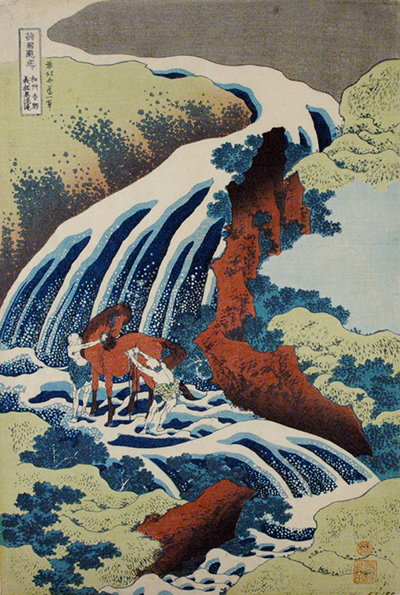
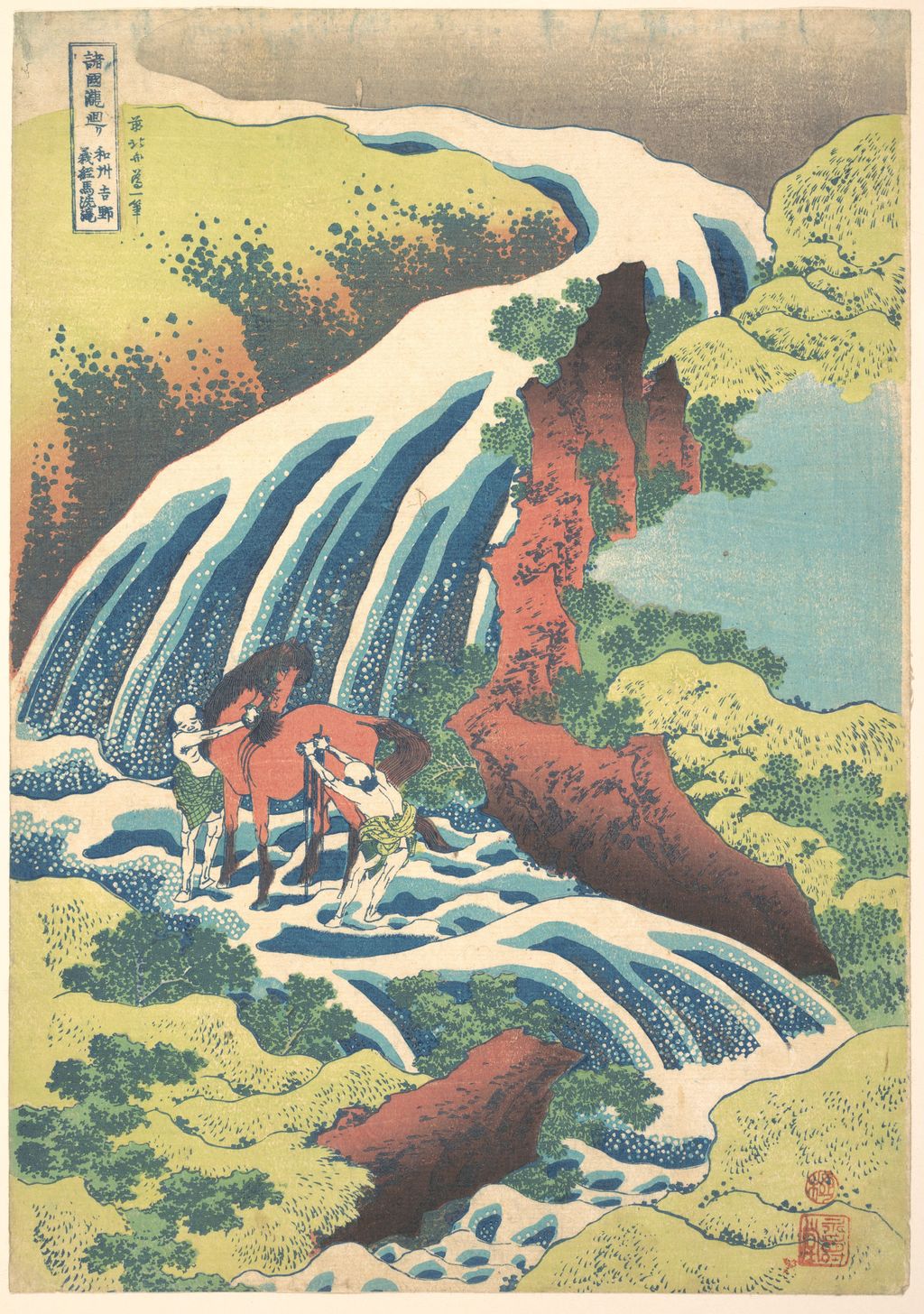
Two men tend a chestnut horse in the middle of Hokusai’s Yoshitsune’s Horse-washing Falls at Yoshino. The animal stands nearly sideways while water plunges behind its back and curls through the rocks at its feet. Nothing about the men’s posture suggests a heroic entrance. One reaches toward the horse’s head while the other bends beside its flank. The title brings the fugitive warrior Minamoto no Yoshitsune into this small scene of care. Hokusai lets the work of handling the horse take place at the very centre of a landscape that could easily swallow it whole. [1]
The print belongs to A Tour of Waterfalls in Various Provinces (Shokoku taki meguri), a set of eight designs from the early 1830s. The Metropolitan Museum of Art dates its impression JP2927 to about 1832. Its vertical sheet measures 37.1 by 26 centimetres. For all the speed implied by those slopes, the image keeps returning to a point of stillness. It is worth starting with the horse and following the water both ways from there. [1] [2]
At a Glance
- ArtistKatsushika Hokusai
- Dateca. 1832
- MediumColour woodblock print
- SeriesA Tour of Waterfalls in Various Provinces
Contents
The horse in the stream
In the Met’s impression, the horse’s body forms a broad patch of reddish colour against the steep blue and pale streaks of the fall. Its head turns back toward the man on the left, whose light arms stand out against its dark mane. The man on the right bends his knees and reaches up. His body and the horse’s legs are articulated against the pale shapes of the water. At that scale a dark stroke can do a great deal. The horse’s legs, hanging lines of tack and the men’s limbs remain distinct even where the design is busiest. [1]
The men occupy a brief shelf between two descents. Behind them the water falls in long blue bands. In front of them it spreads into broken, flatter marks before tipping away again to the right. The two directions meet below the horse’s belly. The animal seems almost to bridge that interval, its back a relatively steady horizontal in a composition full of slopes and turns. The scene feels precarious even though the horse stays planted. Each man has to negotiate the same ground that Hokusai asks the eye to cross. [1]
A red-brown mass of rock rises on the right and divides the water from the blue-green field beyond it. Its top edge breaks into nearly upright forms. Farther down, the rock pushes out over the nearest run of the stream. Seen in sequence, the bright horse and the warmer rock give the eye points to return to among repeated blues and greens. Their colour connects them even as their outlines tell very different stories. The horse is rounded, warm and capable of movement. The rock is an angular interruption that sends water around it. [1]
From the upper bend to the lower spill
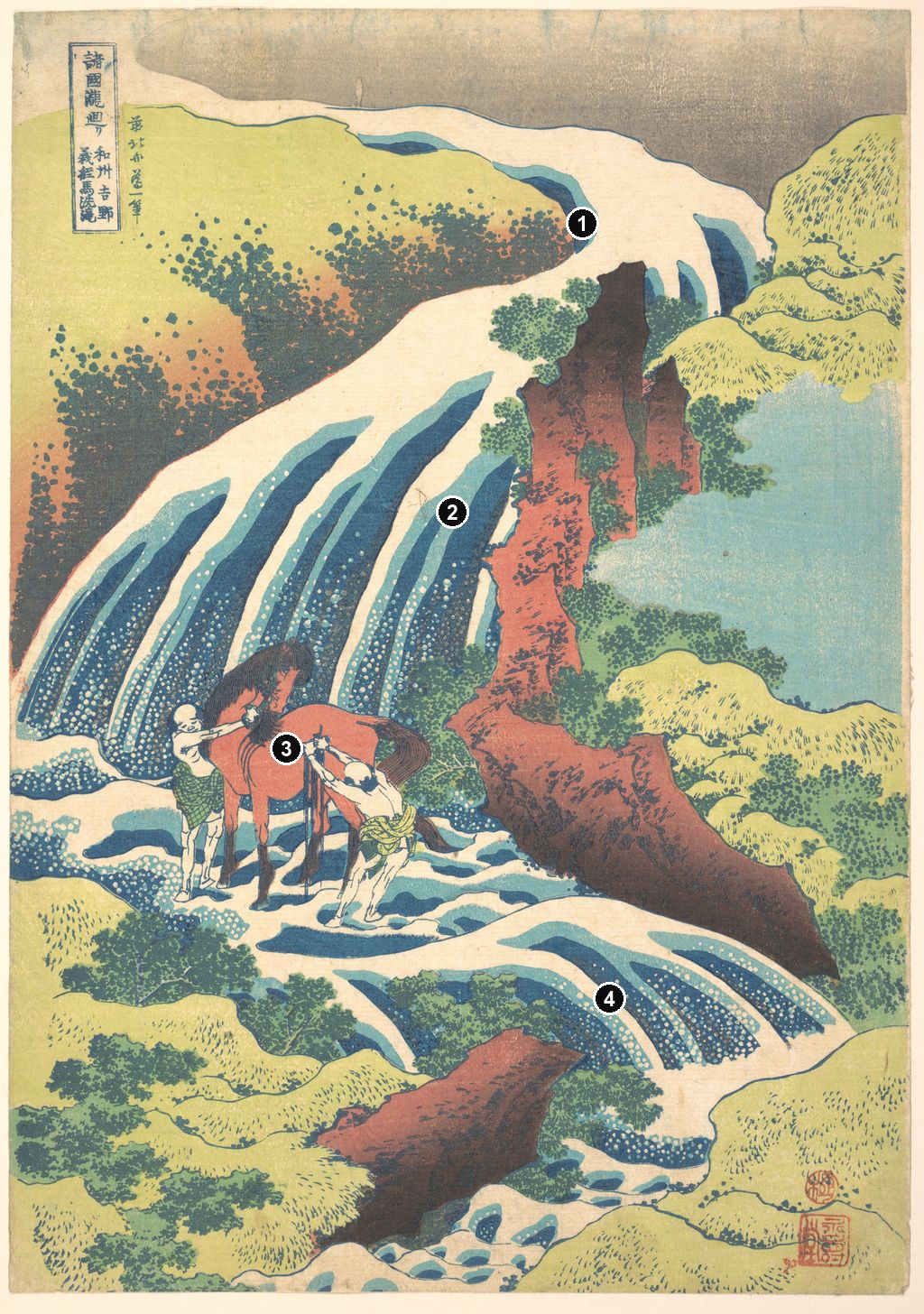
At the top of the Met sheet a pale band runs across a subdued grey field, almost gently at first. Near the upper right, the band widens and turns around yellow-green ground. A few dark shapes show through at the bend. The narrowing on either side of the broad pale stretch makes the change of direction clear before the viewer sees how far the water will fall. Farther down the sheet, the stream opens into several long blue strips with pale seams between them. The broad surface has become a series of uneven ribbons. [1]
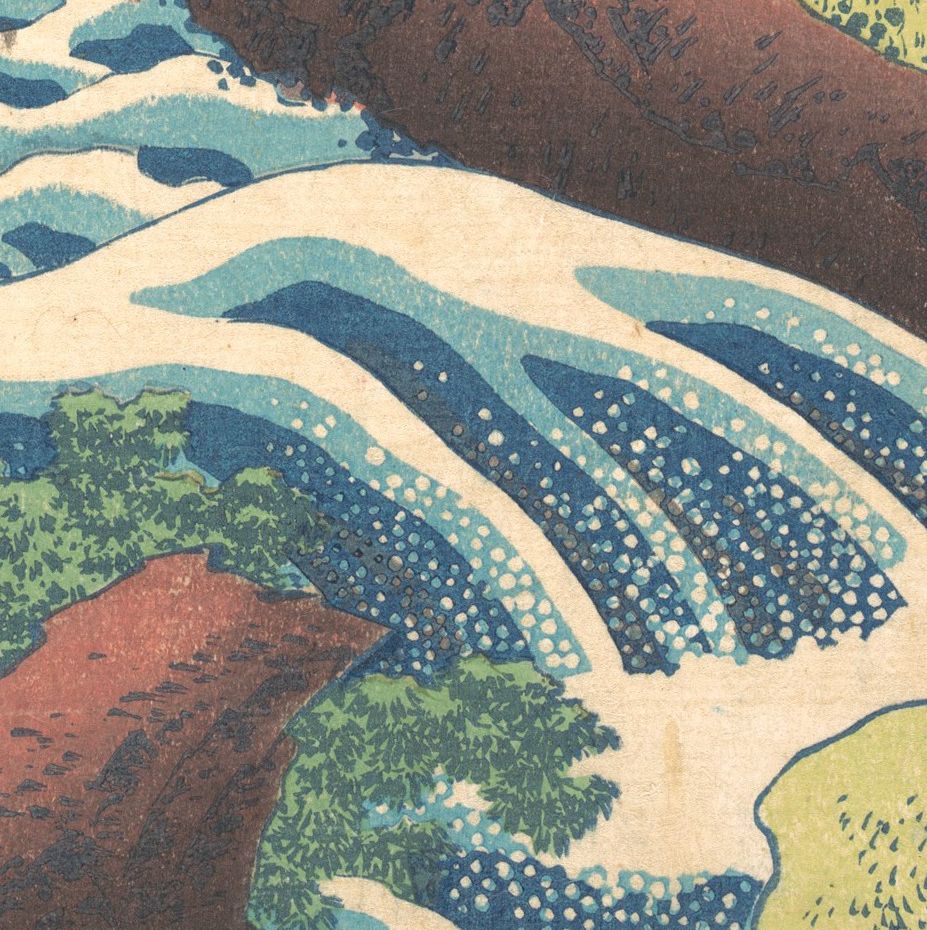
Hokusai makes the speed of the fall legible through the direction of its forms. The long bands slant down toward the left. The small pale dots within them become more noticeable as the water approaches the figures. On the banks, the marks are arranged differently. Groups of dark green dots edge one patch of land, while short strokes lie scattered across the brighter slopes. These textures give the terrain some grip. Their uneven groupings make the longer marks in the water feel as though they are slipping past. [1]
Below the horse, the stream turns again. The wide arc at the lower right briefly restores the pattern of blue bands bracketed by pale water. Then rocks and vegetation crowd in, and the last visible run breaks into small pools and white intervals near the lower edge. The tall sheet has room for these changes in pace. Across its height, the same stream can appear as a gently bending surface, a precipitous fall, a shallow crossing and a broken foreground channel. Following those changes makes the junction behind the horse feel more forceful each time the eye returns to it. [1]
Yoshitsune and the place named in the title
The Japanese title, Washū Yoshino Yoshitsune uma arai no taki, names Yoshino in Yamato Province and attaches the place to Yoshitsune’s horse. In its catalogue entry, the Bibliothèque nationale de France explicitly frames the washing as a legend. The Met’s account links it to stories of the general’s flight from his elder brother, Minamoto no Yoritomo, and describes a pause in which Yoshitsune tended his favourite horse. The title gives the scene the familiarity of a remembered episode, with enough information for the viewer to supply the larger story. [1] [3]
The historical Yoshitsune lived from 1159 to 1189 and fought on the Minamoto side in the war against the Taira. The story of his flight had a long life in performance. The Tokyo National Museum describes how the Noh play Funabenkei follows the fugitive Yoshitsune and his companions as they set out by sea. In that telling, a storm brings the ghost of the Taira warrior Tomomori to their boat. It offers a glimpse of how differently the same history could be told. Hokusai’s print gives its attention to a brief action on land. The horse needs to be handled, the men need a foothold in the stream, and the channel gives them little room. [1] [4]
The cartouche allows the viewer to recognise Yoshitsune’s story without requiring a firm identification of either man. The print gives no conspicuous court dress or battle gear to guide that choice. The National Gallery of Victoria interprets the landscape through the legend. Place, action and story are bound together in the title, while the actual location of the encounter and the identities of the two figures remain open. What Hokusai makes unusually specific is the horse’s physical presence. Above the thin dark legs, small changes in the line of the neck and head make it easy to imagine a handler keeping the animal’s attention. [1] [3] [5]
What an impression tells us
The publisher’s role becomes visible when the print is looked at as an object. The BnF catalogues its impression as an ōban nishiki-e, or multicolour woodblock print, issued by Eijudō, the publishing house of Nishimuraya Yohachi. The rectangular cartouche at the upper left contains the series and subject, and the catalogue records a kiwame censor’s seal. It also transcribes Hokusai’s signature, which invokes the name Iitsu and his earlier use of Hokusai. Taken together, these small marks indicate how someone acquiring the sheet could read it as a named scene from a recognised series by a known print designer. [3]
The making of a colour woodblock print brought together the designer, the engraver, the printer and the publisher. A printed outline could establish the shape of the falling water, while individually applied colour blocks added areas of blue, green and red. The engraved design and the working choices of the printer both affect the impression that survives. In JP2927, look at the meeting of darker and lighter blues in the fall and the different reds given to the horse and the rocks. The full forms are clear at a distance. Up close, the separate print colours make their margins easier to follow. [1] [6]
The date and measurements also depend on which impression is being described. The Met has another impression, JP1084, dated about 1832 and listed at 37.1 by 25.4 centimetres. Japan’s Art Platform dates the example it catalogues to 1833, and the Smithsonian dates F1974.68 to 1833 and records an overall size of 34.6 by 24.2 centimetres. These catalogue measurements describe separate surviving objects. In a display or reproduction, the amount of paper visible around the printed design affects the apparent scale of the image, so differences in dimensions alone leave open how the sheets came to differ. The dates place the design in the same early-1830s period even where institutions catalogue their sheets differently. [1] [7] [8] [9]
Yoshino and Kirifuri
The series makes room for different encounters with falling water. At Kirifuri Waterfall, Hokusai spreads pale streams over a steep wall of rock. Visitors appear at more than one height, their distance from one another helping to make the fall feel enormous. At Yoshino, the horse draws attention to the middle of a route through several drops. Travellers can look at the Kirifuri fall from its edges. The men at Yoshino are already busy in the current. That difference gives each waterfall its own human scale. [1] [2] [10]
Hokusai also uses the title differently at Yoshino. Kirifuri is one of the celebrated falls near Nikkō. The Yoshino title asks the viewer to remember an action, lending a particular reason for the figures to step into the water. It also leaves time to notice the terrain on its own. Look beneath the horse one last time and the little crossing looks less like a place set aside for the story than a pause made possible by the contour of the rocks. The figures have found a place to stand while the water goes on finding ways around them. [1] [2] [3]
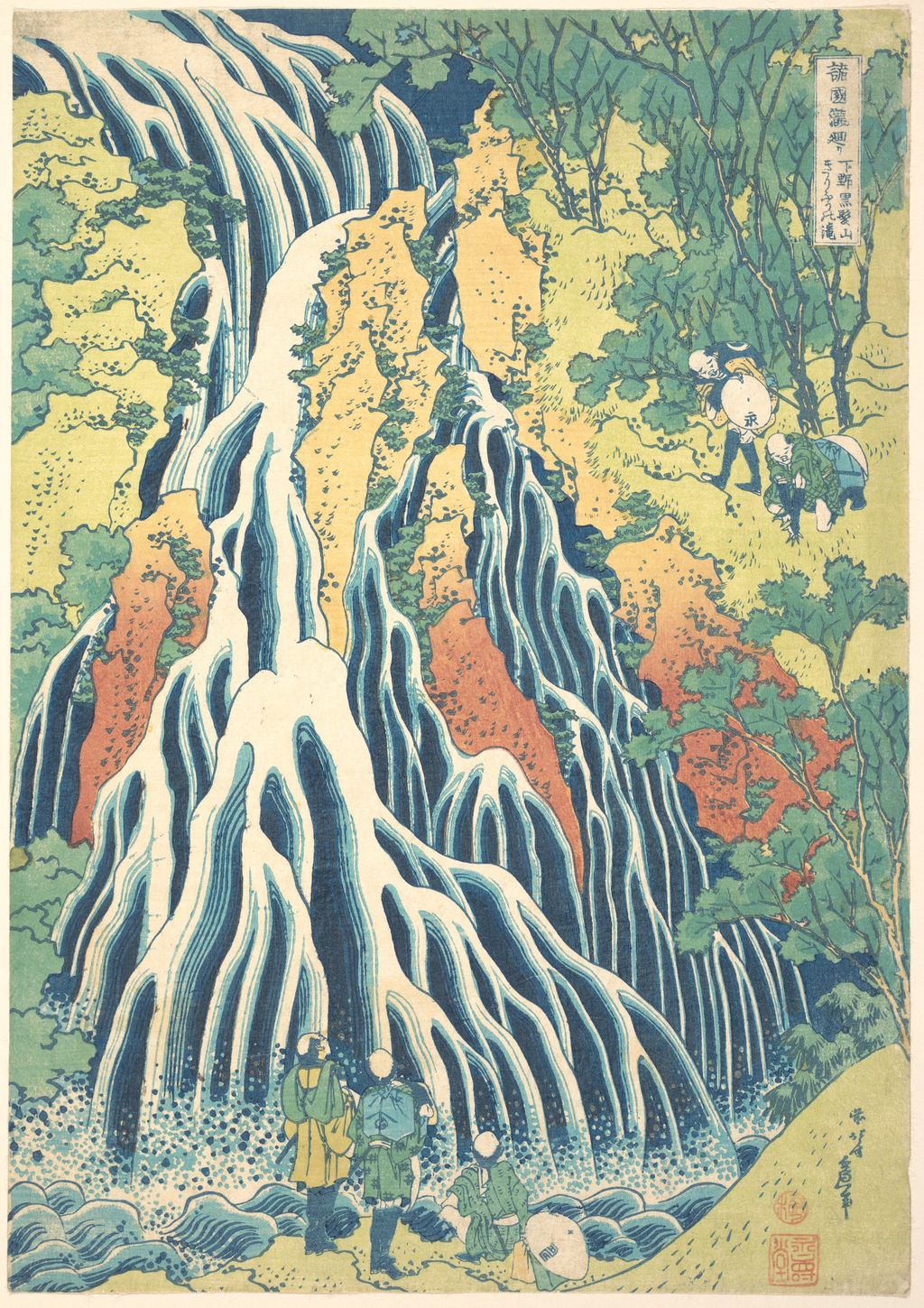
Image comparison
Where this work sits in Hokusai’s career
Annotated Details from Yoshitsune’s Horse-washing Falls at Yoshino
The numbered view uses the Metropolitan Museum of Art’s impression JP2927. Look for the same features in the complete sheet before opening the details below. [1]
Details from YOSHITSUNE’S HORSE-WASHING FALLS AT YOSHINO
The details show how the parts of the design work together.
The upper bend
The pale water rounds a bend at the top before long dark-blue ribbons lead the eye down the face of the fall. [1]
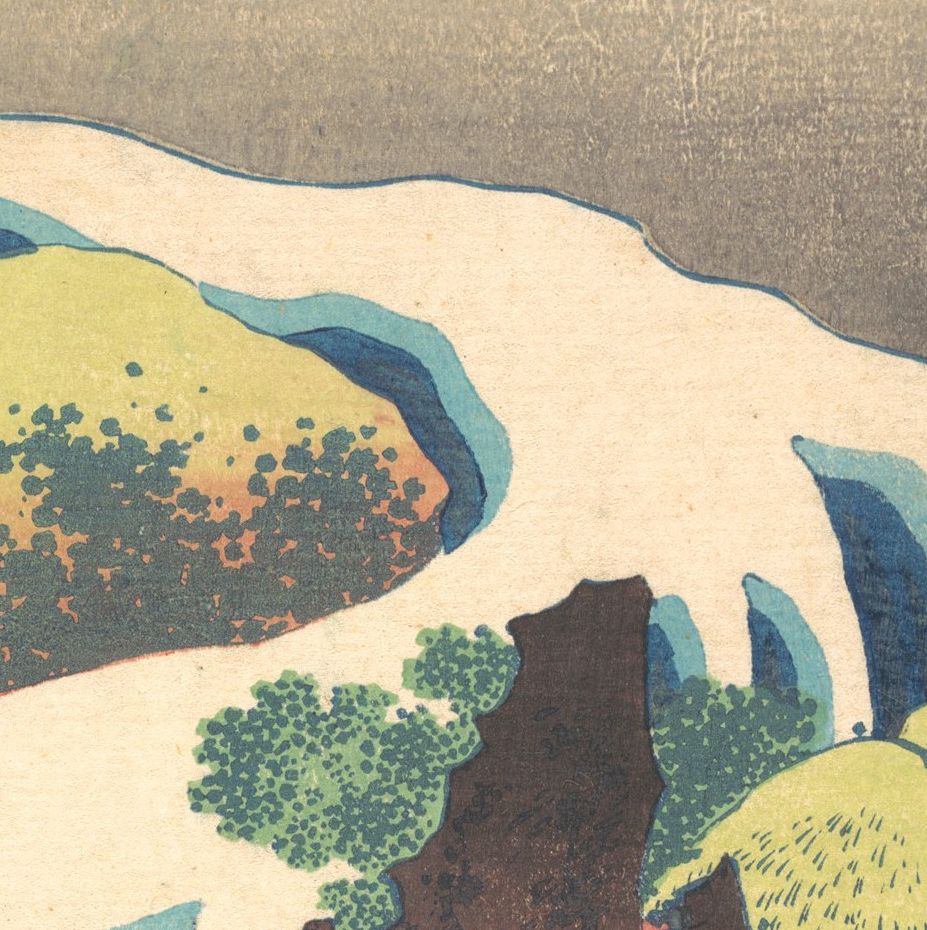
Rock and water at the drop
The red-brown bluff cuts into the blue and pale bands. Its irregular edge distinguishes the cliff from the streaming water. [1]
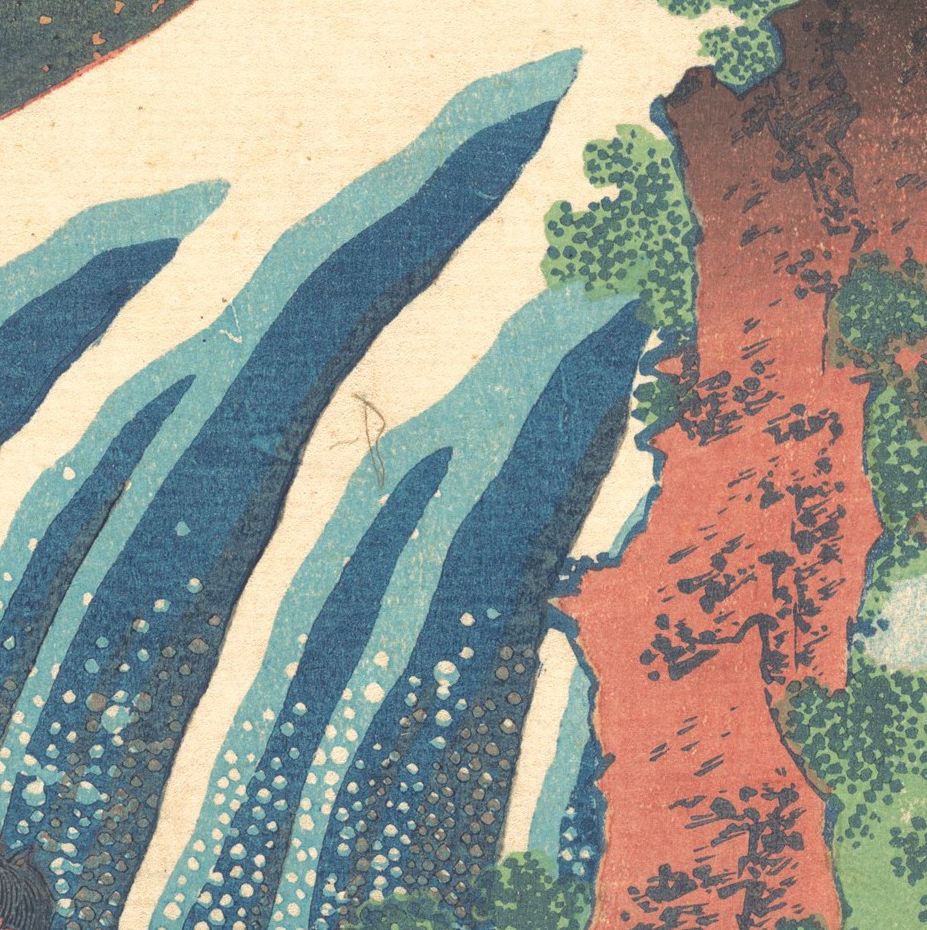
The horse and its handlers
The horse stands across the stream while two figures attend to it. The exact identities of the figures are left open by the image. [1]
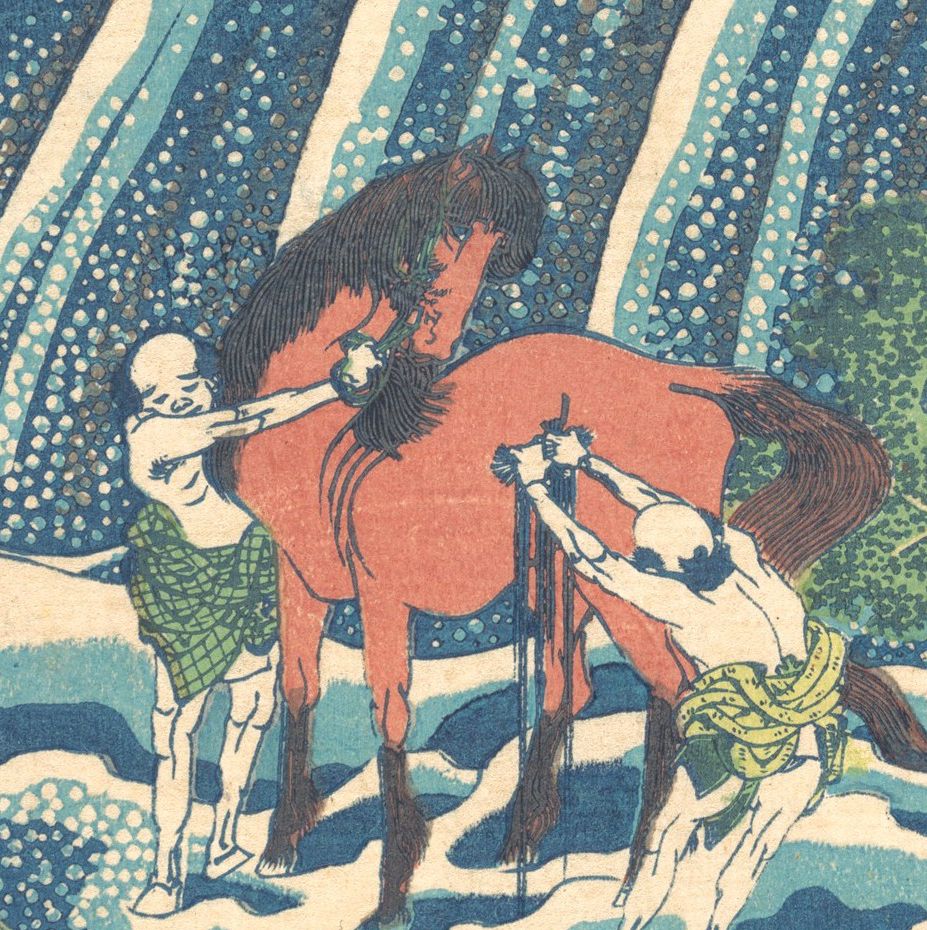
The lower spill
The water passes the horse and narrows into another drop. The changing direction carries the eye out through the bottom of the print. [1]
Explore Hokusai’s works
Discussion
Look again at the images and ideas explored in Yoshitsune’s Horse-washing Falls at Yoshino. These editorial prompts invite your observations.
Reader Insights
Where does the water slow visually around the horse?
What does the title add to what you see?
Join the Conversation
Share a detail, comparison or question about Yoshitsune’s Horse-washing Falls at Yoshino below.
References
- The Metropolitan Museum of Art, The Waterfall Where Yoshitsune Washed His Horse at Yoshino in Yamato Province, JP2927. View source.
- Shimane Art Museum, Kirifuri Waterfall at Kurokami Mountain in Shimotsuke, exhibition account of the eight waterfall designs. View source.
- Bibliothèque nationale de France, catalogue record for Washū Yoshino Yoshitsune uma arai no taki, notice cb437838491. View source.
- Tokyo National Museum, Masks and Costumes from the Noh Play Funabenkei. View source.
- National Gallery of Victoria, Hokusai, exhibition labels including Yoshitsune’s Horse-washing Falls at Yoshino in Yamato Province. View source.
- The Metropolitan Museum of Art, Woodblock Prints in the Ukiyo-e Style. View source.
- The Metropolitan Museum of Art, The Waterfall Where Yoshitsune Washed His Horse at Yoshino in Yamato Province, JP1084. View source.
- Art Platform Japan, Famous Waterfalls in Various Provinces: Yoshitsune Horse-Washing Fall at Yoshino in Yamato Province, W110923. View source.
- Smithsonian Institution, Yoshitsune’s Horse-washing Falls at Yoshino in Yamato Province, F1974.68. View source.
- The Metropolitan Museum of Art, Kirifuri Waterfall at Kurokami Mountain in Shimotsuke, JP2924. View source.







