


 by Tom Gurney
Tom Gurney BSc (Hons) is an art history expert with over 20 years experience
Published on June 19, 2020 / Updated on November 20, 2026
Email: tomgurney1@gmail.com / Phone: +44 7429 011000
Fuji from Gotenyama at Shinagawa on the Tōkaidō
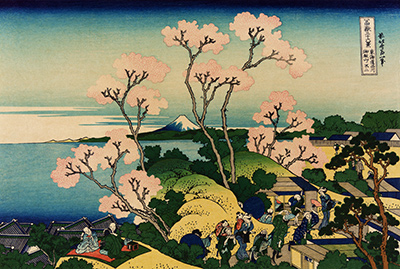
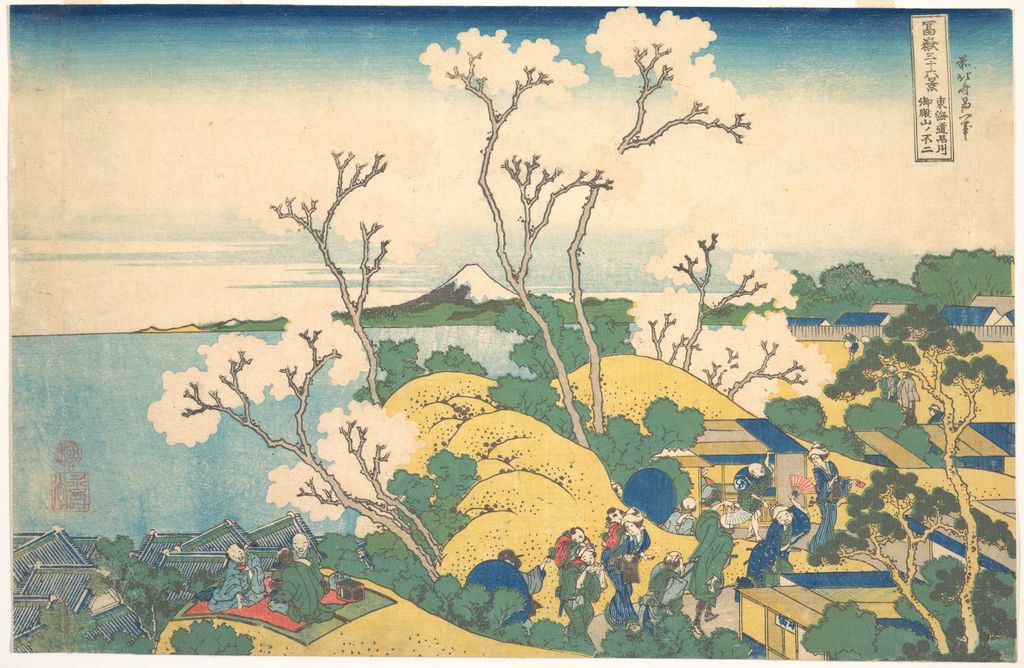
Mount Fuji appears just above a line of dark green in Hokusai’s view from Gotenyama. Two flowering trees leave a gap for the summit. Below them, three people sit on a mat and others climb towards a teahouse. A man lifts a child above the crowd on his shoulders. In this design for Thirty-six Views of Mount Fuji, the mountain takes up less space than a single crown of blossom. The view of the mountain is one of several things the visitors might notice on their way up the hill. [1] [2] [3]
Hokusai’s title, Tōkaidō Shinagawa Gotenyama no Fuji (東海道品川御殿山の不二), specifies the highway, the town and the hill. The Metropolitan Museum of Art dates its impression JP2992 to about 1830–32 and records it as ink and colour on paper, 25.1 by 37.8 centimetres. The account of the image below starts with that sheet. Its wide format gives Hokusai room to put a busy slope beside a long stretch of water and to set the small summit well back from both. [1]
At a Glance
- ArtistKatsushika Hokusai
- Dateca. 1830–32
- MediumColour woodblock print
- SeriesThirty-six Views of Mount Fuji
Contents
The hill above Shinagawa
Shinagawa was the first post town on the Tōkaidō for travellers leaving Edo. Gotenyama lay above the town on the southern edge of the city, in what is now Kita-Shinagawa in Tokyo. The Sumida Hokusai Museum traces the hill’s reputation for flower viewing to the intensive planting of cherry trees that began in the Kyōhō era (1716–36). The place offered two sights together, cherry blossom and the expanse of Edo Bay. Hokusai brings both into view. The trees push their branches well out over the left half of the sheet, where the water provides an open field behind them. [1] [3] [4] [5] [11]
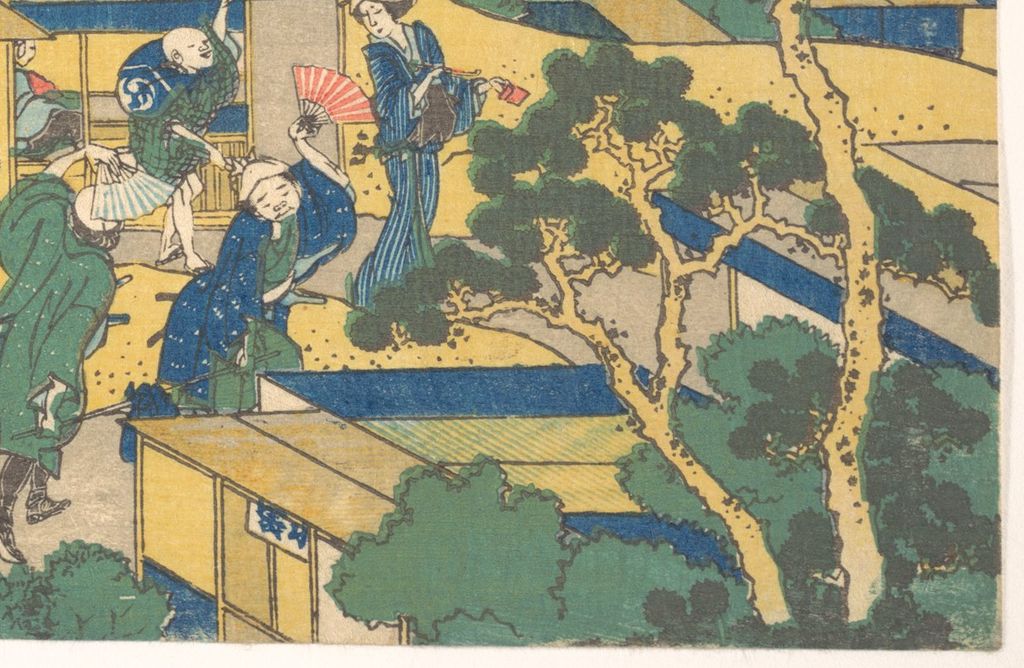
At the lower left, tiled rooftops overlap closely enough to obscure the streets below. The National Gallery of Victoria identifies them as the rooftops of Shinagawa. In the foreground the curves of the ground rise sharply above them. The print gives a sense of being high over the town even as the slope continues to rise to the right. The far shore makes a nearly horizontal line beyond the hills, and long streaks in the pale sky prolong that direction. The left side of the image lets the eye travel far with few interruptions. On the right it keeps meeting people, roofs and trees. [1] [4]
A guide preserved by the Shinagawa Historical Museum gives the outing another context. The museum dates Tokakusai Keizan’s illustrated guide to southern Edo’s cherry-blossom sites to approximately 1804–18. It links Gotenyama to a string of other places in Shinagawa and Ōi, as far south as Ikegami Honmon-ji, and associates viewing with the seasons for composing haiku. Gotenyama was an outing that a resident could plan and a site that could be grouped with others on paper. Hokusai’s title locates it with similar economy. Someone who knew the route could recognise the outing from the names alone. [1] [6]
A climb with several places to stop
The group on the left has laid a mat almost at the edge of a mound. Its red centre and green border sit on the yellow ground, with blue roofs at a lower level immediately behind it. No trunk divides the seated figures. They face in towards each other, with vessels beside them. The National Gallery of Victoria describes the group in its exhibition impression as men drinking sake. There is enough distance between them and the main path to give their gathering some quiet, though it remains within sight of the visitors on the other side. [1] [4]
At lower centre, visitors arrive among the bushes where the terrain and clothing partially hide their legs. One adult carries a child high on the shoulders and another carries a child on the back. The children’s red clothing is easy to pick out among the blue and green robes. A partly hidden visitor at the left of the group carries a round blue object. Another round patch of blue appears farther up where the slope and bushes give way to the buildings. The recurring shape helps the eye take the same upward course as the people. [1] [3]
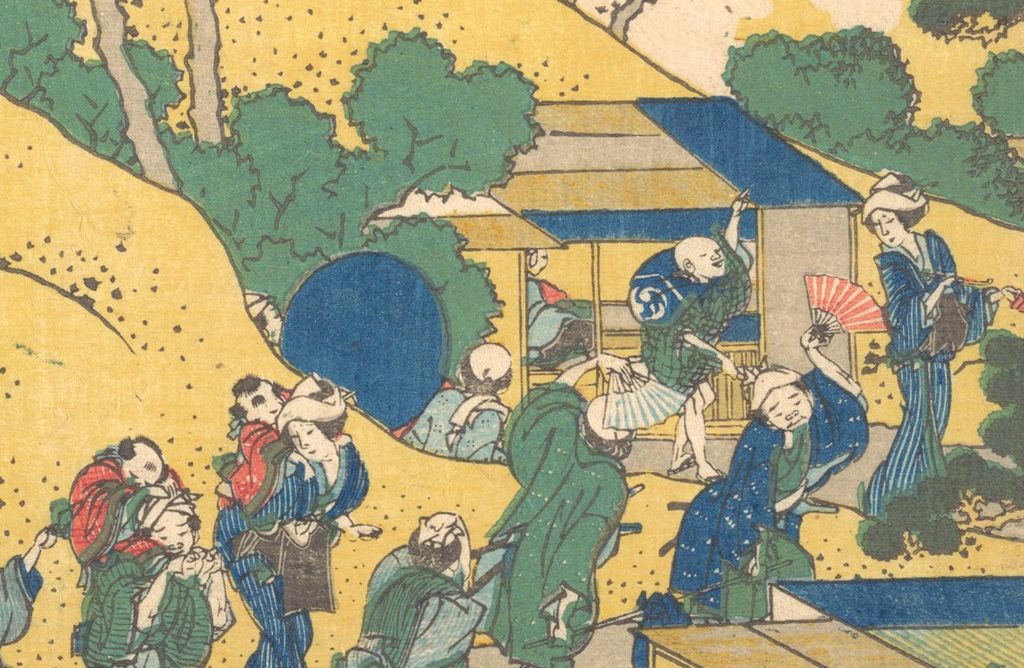
The terrace at the right is crowded enough that a gesture can be easier to read than a face. Folding fans open above the bent and turning figures. One fan flashes red against the nearby blue roof, bringing attention to a group beside the building that the exhibition label identifies as a teahouse. Farther up, the people become too small to read in the same way. A blue figure near the upper row of roofs is a much smaller mark than a sleeve lower down. Hokusai’s figures create a measure of the climb, from children who can still be picked out individually to visitors who almost merge with the buildings. [1] [4]
The summit between branches
The taller cherry trees do much of the work of arranging the view. One leans up from the lower left towards the round hills, then sends a branch back over the water. Dark twig ends sit inside pale clusters of flowers, so it is possible to trace several branches even where the blossoms gather densely. Farther up, two trunks leave an opening through which the white summit shows. The Tokyo Fuji Art Museum calls attention to the care with which the mountain appears between the trees. Moving a trunk a little towards the centre would have changed the reading of the peak. From its position in the opening, Fuji can be seen clearly without any increase in its scale. [1] [3]
The mountain’s slopes are also part of the frame. The left side descends towards a green strip just as the hill below begins to rise in a different direction. The branches break up the strip and give each stretch of shore a different length. The viewer can move visually from the far ridge to the nearer flowering branches and then down to the roofs. The tile edges provide their own sloping lines, short and closely repeated where Fuji offers a single long contour. The small mountain, angular roofs and rounded mounds remain distinct even when portions of them are hidden. [1]
In Ejiri in Suruga Province, another sheet in the series, the mountain is set beyond windblown travellers. Its spare outline is easy to see because the papers and hats in motion occupy other parts of the sky. At Gotenyama, the branches themselves cut into the sky and their blossoms gather near the mountaintop. The view feels like one that might open and close as a person moved along the path. Hokusai twice gives a distant Fuji a role in a scene full of people by deciding precisely what crosses the viewer’s line of sight. [1] [7]
Reading two impressions
Keio University Libraries records its sheet 200X@4-42 as an ōban nishiki-e, a large-format colour woodblock print, and names Nishimuraya Yohachi as its publisher. It transcribes the signature as 前北斎為一筆, identifying the designer by the name Iitsu and referring back to his name Hokusai. It also records the kiwame seal. In the Met’s JP2992 the tall cartouche occupies the right edge of the sky, with the signature beside it. The placement leaves room for the most upright trees in the design to reach the top without cutting across the lettering. [1] [8]
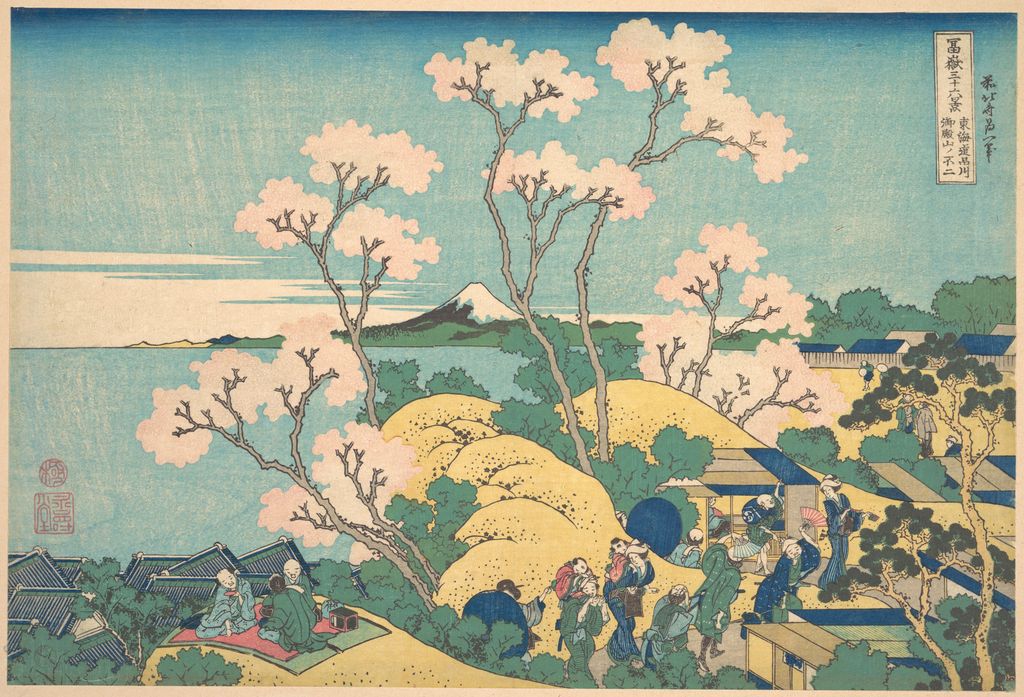
In JP2992 the upper edge of the sky is deep blue, which fades into a broad pale band behind the highest blossom clusters. In another Met impression, JP1850, the museum photograph shows a more continuous blue-green field behind the upper branches. Several blossoms stand out more distinctly against that field. The pale stripe near the horizon lies below them, close to the dark shape of the lower slopes. The outlines of the trunks, the near roofs and the path still identify the same design across both sheets. The museum measures JP1850 at 24.1 by 35.9 centimetres. Colour and margin differences belong to the comparison of these two objects and their reproductions. Assigning them a printing order would require evidence beyond the photographs. [1] [9]
Gotenyama before the shoreline works
Gotenyama recurs in Hokusai’s work. The Ōta Memorial Museum of Art lists an earlier Gotenyama at Shinagawa in the Eastern Capital (東都品川御殿山) from about 1804–18 separately from the later Fuji-series sheet. The Shinagawa Historical Museum also documents a brush-painted flower-viewing scene by Hokusai. The series title and the little summit between the trunks identify the design examined here. [1] [6] [10]
The landscape changed within a generation of the Fuji print. The Shinagawa Historical Museum records that soil and sand from Gotenyama went into the construction of the Shinagawa batteries after Perry’s fleet reached Edo Bay in 1853. In an 1856 view for One Hundred Famous Views of Edo, Utagawa Hiroshige placed a jagged cliff in front of the flowering grove. The Edo-Tokyo Museum identifies this exposed face with the digging for the batteries. The cliff in Hiroshige’s sheet and the rounded slopes in Hokusai’s invite a comparison, even though the artists composed their views from different positions. Hokusai gives his visitors several places to stop along the hillside. The shapes of the hills themselves are part of what brings those separate groups into view. [1] [11] [12]
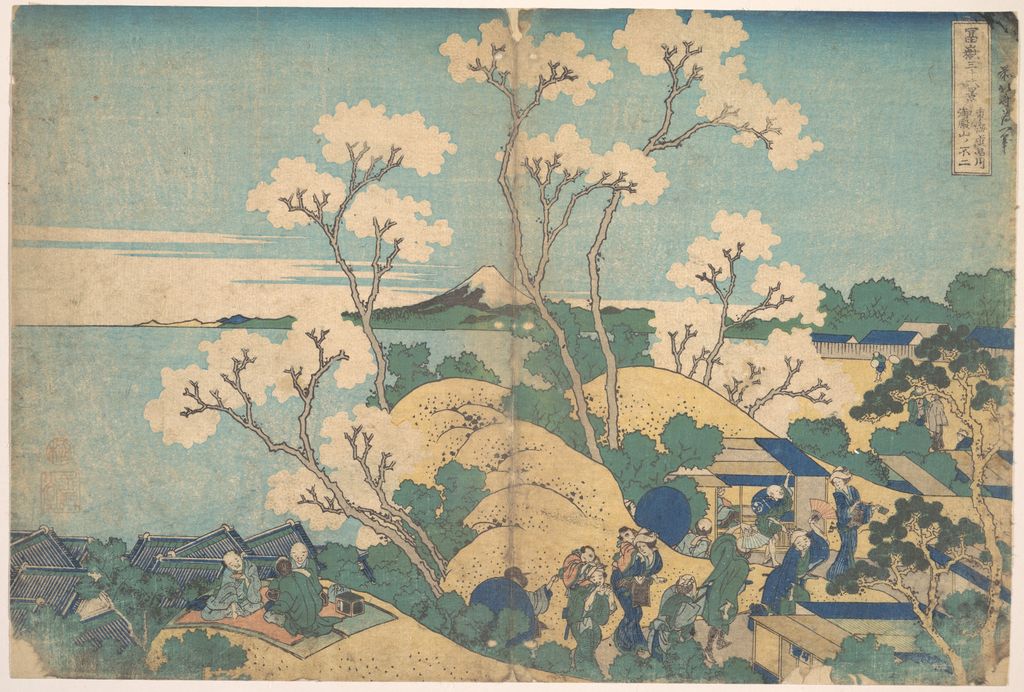
Image comparison
Where this work sits in Hokusai’s career
Hokusai Manga
From 1814Fuji from Gotenyama at Shinagawa on the Tōkaidō
ca. 1830–32Image comparison
Annotated Details from Fuji from Gotenyama at Shinagawa on the Tōkaidō
The Metropolitan Museum of Art, JP2992. [1]
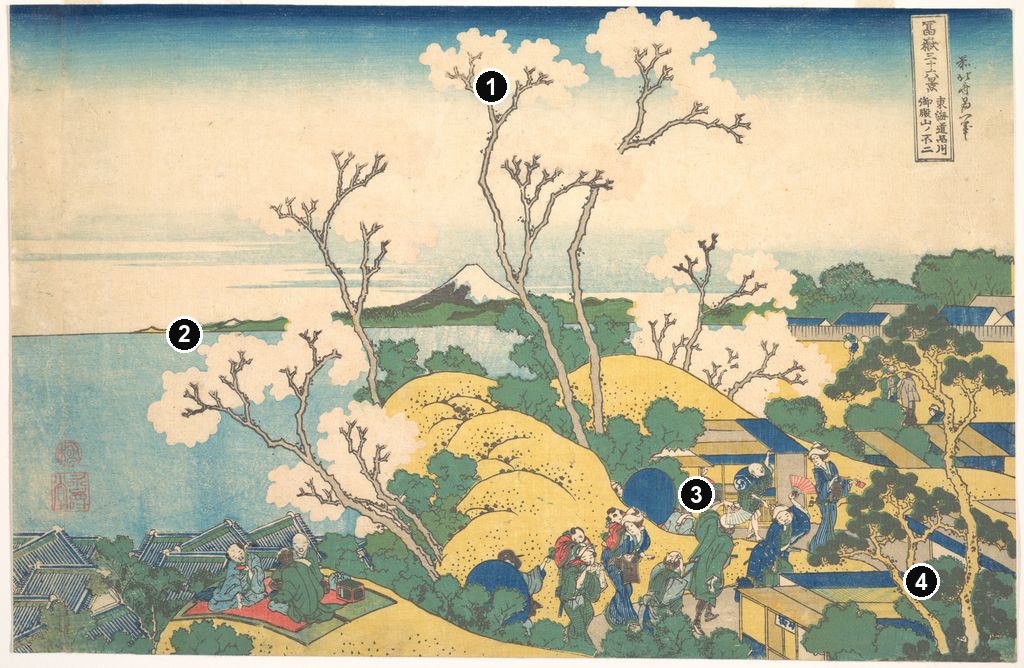
Details from FUJI FROM GOTENYAMA AT SHINAGAWA ON THE TŌKAIDŌ
Select a detail to look closely.
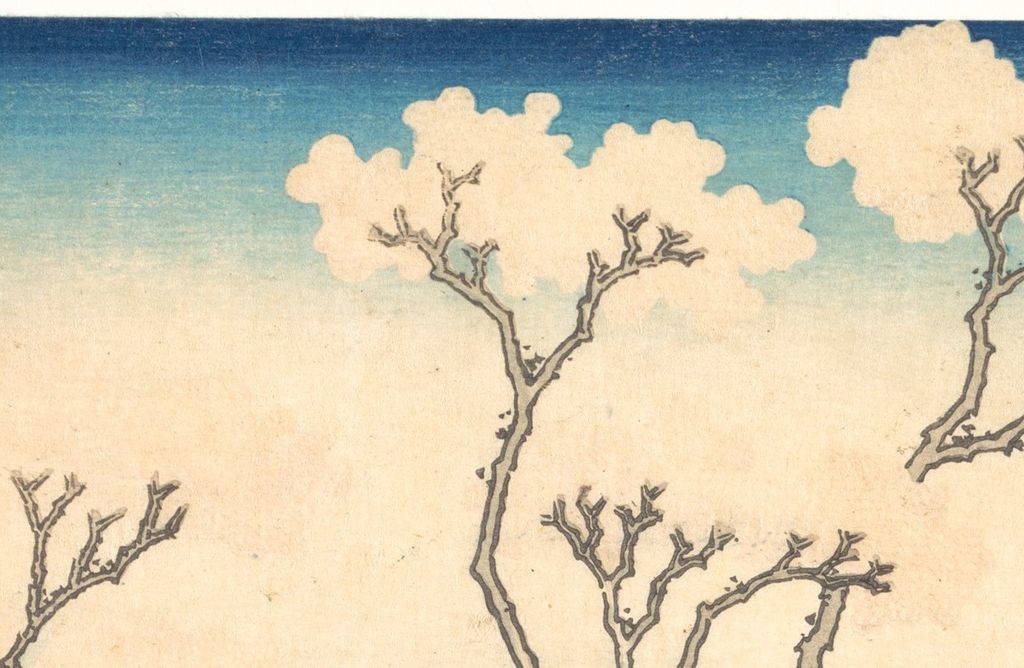
Blossoms over the open sky
A group of blossoms extends beyond the highest branches. Pale flowers cross the band where the blue at the top of the sheet grows lighter. [1]
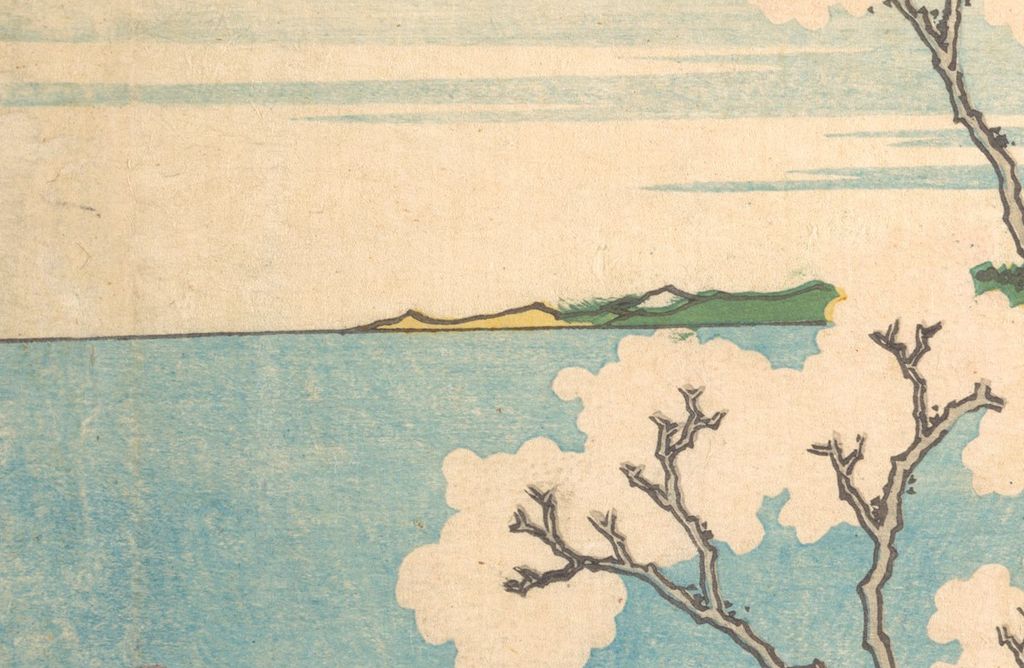
The bay below the hill
Broad, horizontal colour fields open beyond the rising foreground. The difference in direction gives a sense of how high the view is above the water. [1]
Visitors along the slope
People gather at several levels among the trunks. Their small figures make it possible to follow the changes of height across the foreground. [1]
Roofs near the lower edge
Angular rooftops sit below the uneven shapes of branches and blossoms. Their straight edges help separate the built foreground from the flowering slope. [1]
Explore Hokusai’s works
Discussion
Look again at the images and ideas explored in Fuji from Gotenyama at Shinagawa on the Tōkaidō. These editorial prompts invite your observations.
Reader Insights
What makes you look across Shinagawa Bay toward Fuji?
Where do you see two groups of visitors using the same slope differently?
Join the Conversation
Share a detail, comparison or question about Fuji from Gotenyama at Shinagawa on the Tōkaidō below.
References
- The Metropolitan Museum of Art, Fuji from Gotenyama at Shinagawa on the Tōkaidō, accession JP2992. View source.
- National Museum of Western Art, Tokyo, Hokusai: Thirty-six Views of Mt. Fuji, exhibition list, no. 42. View source.
- Tokyo Fuji Art Museum, Mt. Fuji from Gotenyama Hill in Shinagawa on the Tokaido, collection catalogue 01170. View source.
- National Gallery of Victoria, Hokusai exhibition labels, Fuji from Gotenyama at Shinagawa on the Tōkaidō, Japan Ukiyo-e Museum impression. View source.
- Sumida Hokusai Museum, Hokusai’s Floral Glory: The Flowers of the Four Seasons at Their Finest, spring exhibition notes. View source.
- Shinagawa Historical Museum, Famous Sites of Edo in Shinagawa, entries 1_03_01 and 1_03_03. View source.
- The Metropolitan Museum of Art, Ejiri in Suruga Province, accession JP12. View source.
- Keio University Libraries, Fuji Viewed from Gotenyama at Shinagawa on the Tokaido Highway, Takahashi Ukiyo-e Collection, 200X@4-42. View source.
- The Metropolitan Museum of Art, Fuji from Gotenyama at Shinagawa on the Tōkaidō, accession JP1850. View source.
- Ōta Memorial Museum of Art, Hokusai exhibition checklist, entries 東海道品川御殿山ノ不二 and 東都品川御殿山. View source.
- Edo-Tokyo Museum, One Hundred Famous Views of Edo: Gotenyama Hill at Shinagawa by Utagawa Hiroshige, Tokyo Museum Collection. View source.
- Shinagawa Historical Museum, Shinagawa Odaiba, commentary sheet on the construction of the harbour batteries. View source.







