


 by Tom Gurney
Tom Gurney BSc (Hons) is an art history expert with over 20 years experience
Published on June 19, 2020 / Updated on November 20, 2026
Email: tomgurney1@gmail.com / Phone: +44 7429 011000
Tengu in Hokusai Manga
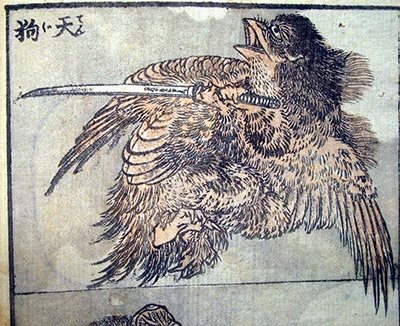
A bird-faced figure raises its head while holding a blade across its chest. One wing descends to the divider beneath it. Across the body, rows of overlapping feathers turn around its shoulder and fold into a dense mass. The two large characters near the top-left of the panel, read from right to left, give the creature its name, 天狗 (tengu). The image often called Drawing of a Tengu is a woodblock-printed illustration in the third volume of Katsushika Hokusai’s Manga. In the National Diet Library and Smithsonian copies it occupies the upper panel of the right-hand page of a spread devoted to extraordinary beings. [1] [2]
The Sumida Hokusai Museum identifies the beaked figure as a bird-form tengu, or karasu-tengu. The beak opens upward, the feathered body spreads out beneath it and the hand closed over the sword hilt has the recognisable shape of a human grip. There is no visible mountainside to tell us where any of this happens. The short inscription names the figure, and Hokusai makes the differences of shape and texture carry the encounter. The creatures beside and below it give a fuller account of what a reader would have seen when opening the book. [1] [2] [3]
At a Glance
- ArtistKatsushika Hokusai
- DateVolume three first published in 1815
- MediumWoodblock-printed book illustration
- BookHokusai Manga, volume three
Contents
The beak, blade and layers of feathers
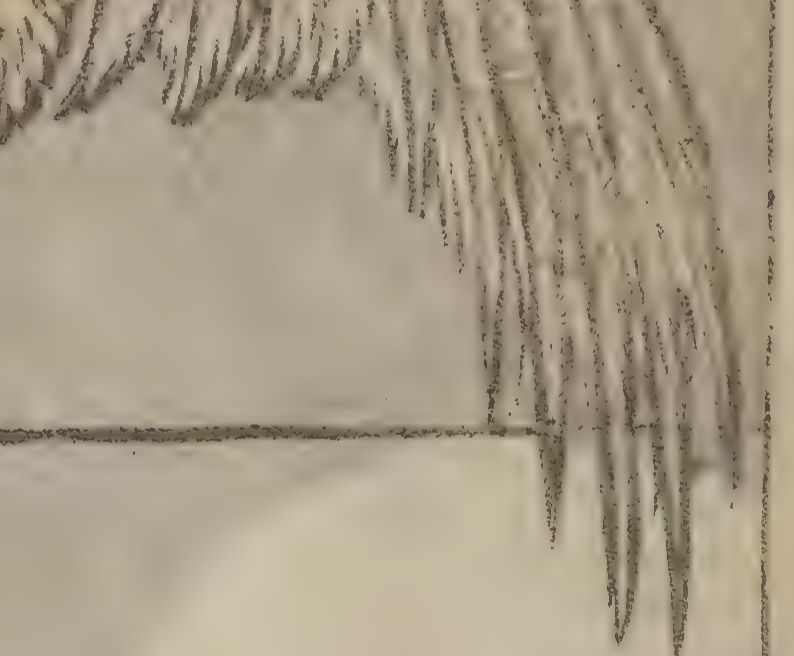
The beak is aimed towards the top rule. The upper and lower edges part sharply, and the dark strokes behind them thicken into the ruff around the head. The bare patch immediately beneath the open beak gives the angle of the neck a little breathing room. From that high point, the right wing falls in a series of narrow parallel tips. It reaches low enough to pass the horizontal rule separating this subject from the one below. The overlap is small compared with the size of the bird, but it shows how the rule and the contour work independently. The form briefly enters the lower panel without disturbing the identity of its neighbour. [1] [2]
The sword runs mostly sideways. Its light length can be followed from the narrow point at the left to the part held close to the chest. Around the hilt the fingers, handle and feathers have different edge patterns. The handle has a compact, repeated texture. The fingers curve around it, and the feathers beyond them fan out in separate directions. Farther along the blade, a small interval of open paper keeps its edge legible against the layered wing. Its comparatively straight path is especially clear beside the numerous curved lines of the shoulder. [1] [2]
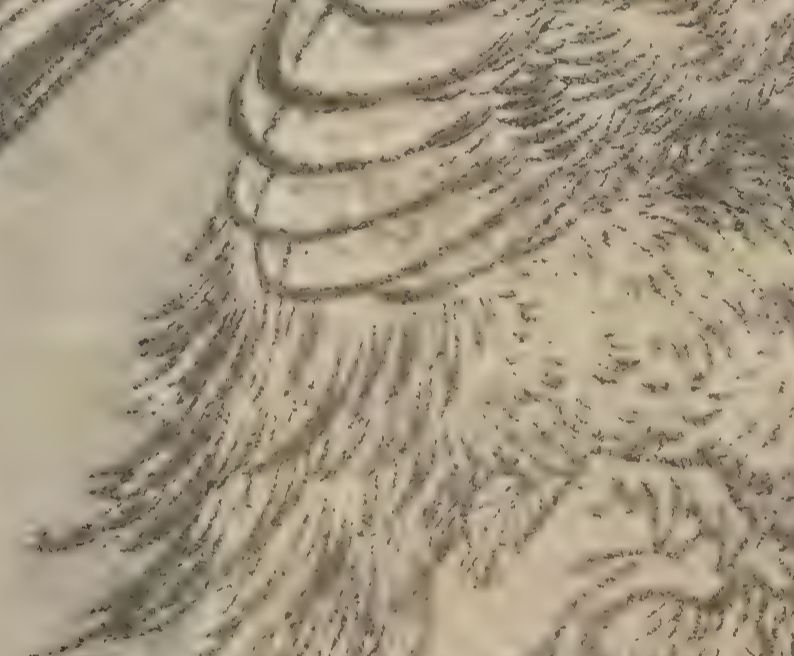
The feathering varies markedly across the body. Rounded groups over the wing look like overlapping plates. Shorter lines interrupt the surface around the chest and neck. At the edges, where the longest feathers can be traced from base to tip, the marks stretch and separate. These changes give a reader several ways to understand the body’s shape. The rounded groups tell us which surfaces face forward, while the long feather tips register the turn and fall of the wing. Look where the outswept feathers meet the blade. The two directions are close enough to be read together, while the edges let the eye follow either one around the figure. [1] [2]
An opening below the torso breaks into the shorter feathers around a bent limb. Its relatively light shape is easier to see after tracing the dense marks above it. These changes from pale to dark are still visible in the pronounced black-and-white National Diet Library scan. The Smithsonian reproduction preserves a warmer paper tone and lighter passages across the same parts of the body. That difference affects how quickly a feature stands out on screen. The agreement between the blade, feather edges and printed label establishes the design across the two photographs. [1] [2]
Four beings across an open book
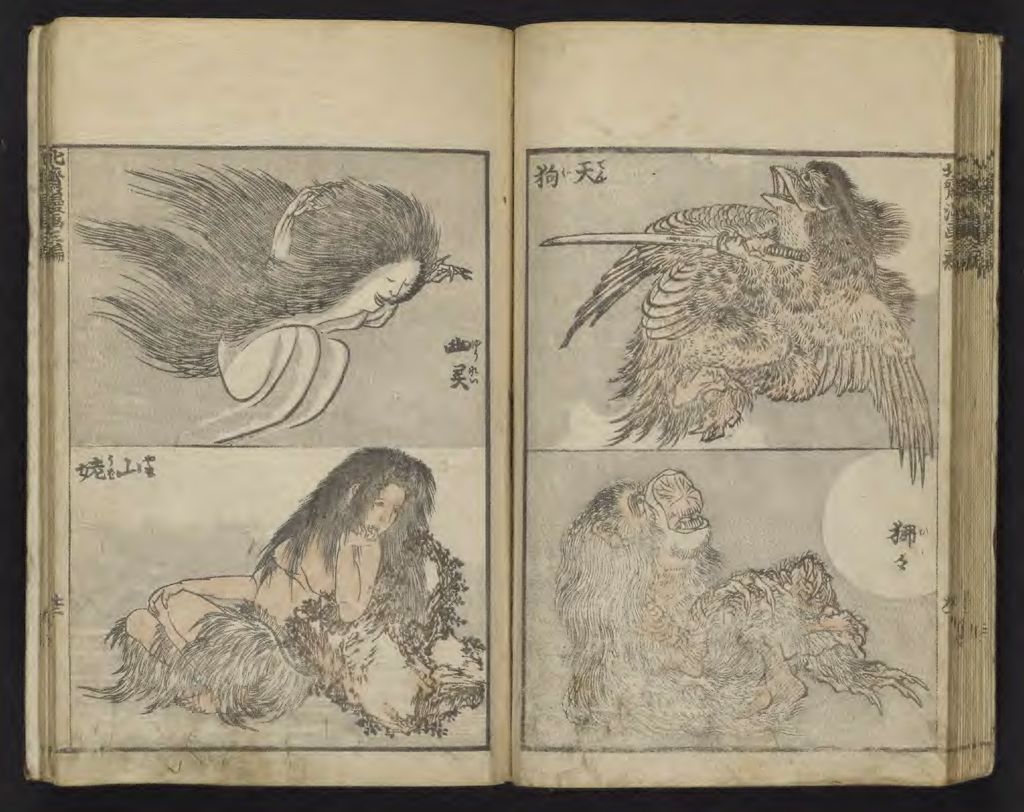
The book gives the tengu a neighbour directly below. This is the hihi, identified by the Sumida Hokusai Museum as a fantastic, ape-like being. It leans back, with its face turned upward and its hairy body folded around its legs. The tengu uses feathers and a rigid blade to occupy its rectangle. The hihi’s long hair follows the outline of the seated body, concentrating the action near its hands and upturned face. The two drawn bodies differ greatly in pose and silhouette, despite occupying compartments of similar size. Placing the images one above the other makes those differences easy to see. [1] [2] [3]
Across the gutter, the ghost floats into the upper-left panel with its hair sweeping towards the outer margin. In the lower panel the mountain woman, or yamauba, sits low with her hair falling forwards. The four figures draw attention to hair and plumage in different ways. The ghost’s long, fine lines spread broadly in one direction. The mountain woman’s hair descends around her head and shoulders. The tengu’s wing marks bend around the weight of its body before dividing into long tips. Each creature has a different outline and a distinctive way of filling the space between its name and the edge of its compartment. [1] [2] [3]
The Sumida Hokusai Museum grouped this spread under mountain legends in an exhibition on Hokusai’s images of mountains. Its commentary places the tengu, hihi and mountain woman in the wider imaginative geography of remote heights and forests. The ghost shares their opening, although the museum distinguishes its association with the mountains from theirs. As a book image, the spread accommodates those associations without setting the figures into one continuous landscape. The gutter and divisions preserve four encounters. Shifting the eye from the tengu to the ghost reveals an echo between the sweep of feathers and the sweep of hair that is visible even without reading the labels. [1] [2] [3]
The four inscriptions also occupy different positions. The tengu’s name is near the upper edge, in the clear space above the blade. The hihi’s name is set farther to the right, where it has room beside the animal’s upturned face. On the facing page, the ghost’s name stands near the gutter and the mountain woman’s near the outer edge. Each label shares a compartment with its subject and leaves the image enough room to establish its own direction. [1] [2]
Dating the illustration and the surviving books
The volume belongs to the early years of the Manga. A surviving wrapper of volume three in the Sumida exhibition checklist dates to 1815, or Bunka 12. The Edo-Tokyo Museum also associates the third volume with 1815 in its exhibition checklist. Its online collection record dates its physical copy, 06200463, to around the Tenpō era, 1830–44. The copy records Eirakuya Tōshirō as publisher and measures 22.9 by 15.9 centimetres. These dates refer to different things. The 1815 evidence places the volume in the publication history of the series. The collection record describes a surviving book from a later period of circulation. [4] [5] [6]
The book digitised by the National Diet Library is a separate copy, published by Katano Tōshirō in Meiji 11, or 1878. The Smithsonian spread belongs to another group of surviving volumes. Its catalogue describes the set as a combination of different imprints, gives a broad publication range of 1828–78 and records named booksellers in both Edo and Nagoya in the colophon of volume three. The two digitised spreads show the same placement of the four beings and the same major marks in their individual compartments. The cover, publisher’s information and bibliographic records still matter when describing the individual book that carries those marks. [1] [2] [7]
The Smithsonian catalogue also records folded double leaves in fukurotoji binding. On the photographed opening, the inner divide is plainly visible between the creatures on either side. The dark framing line belongs to the printed design within each page, while the area outside it belongs to the larger sheet of paper and to the opening of the book. The distance from the tengu’s head to the upper frame looks different when the blank paper above the frame is visible. The book puts a larger margin around the crowded subject and lets a reader move in and out of the little rectangle in which the creature seems to be moving. [2] [7]
Other faces of the tengu and Hokusai’s supernatural prints
The beaked figure is one interpretation of the tengu. In her study of Hokusai books in the Museum of Oriental Art in Venice, Silvia Vesco notes the variety of tengu forms in Japanese imagery and illustrates a separate group of tengu in volume twelve of the Manga. These are shown playing games with their long noses. The Venice copy she reproduces dates to 1878. In the volume-three design the raised beak and hilt make an emphatic angle at the small head. In volume twelve, the extended noses contribute to the action by linking one figure to another. The two volumes show different ways of picturing a being with the same name. [1] [2] [8]
The spread also offers another route into The Ghost of Oiwa, a later single-sheet print by Hokusai. In the Rijksmuseum impression a face appears in a damaged lantern, with smoke and reeds around it. The museum identifies the print with the series One Hundred Ghost Stories and dates its sheet to 1830. The ghost’s expression and the object it inhabits command the sheet. In the Manga the compact tengu panel sits within a set of four subjects, each with its own label and border. A reader can follow the feathered outline in isolation, then see how its descent across the divider echoes the other shapes across the opening. [1] [2] [9]
Where this work sits in Hokusai’s career
Annotated Details from Tengu in Hokusai Manga
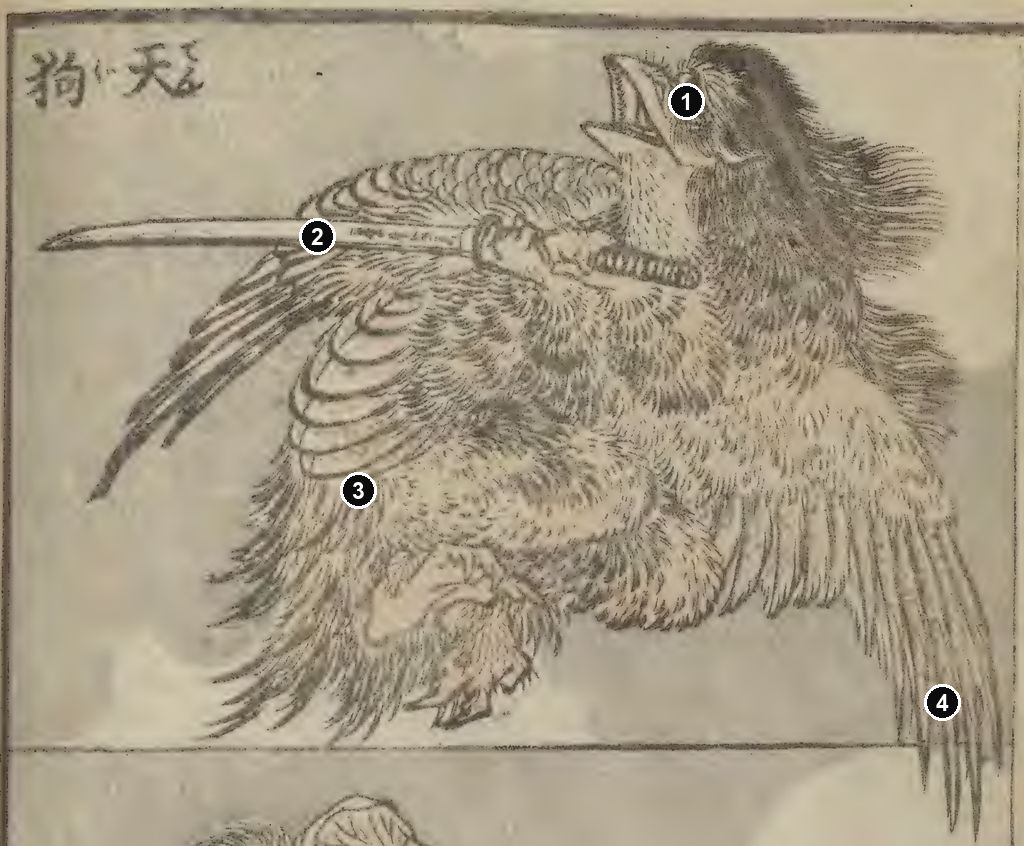
Smithsonian Libraries, Hokusai Manga, volume three. The marked overview is cropped from the full spread. [2]
Details from TENGU IN HOKUSAI MANGA
Select a detail to look closely.
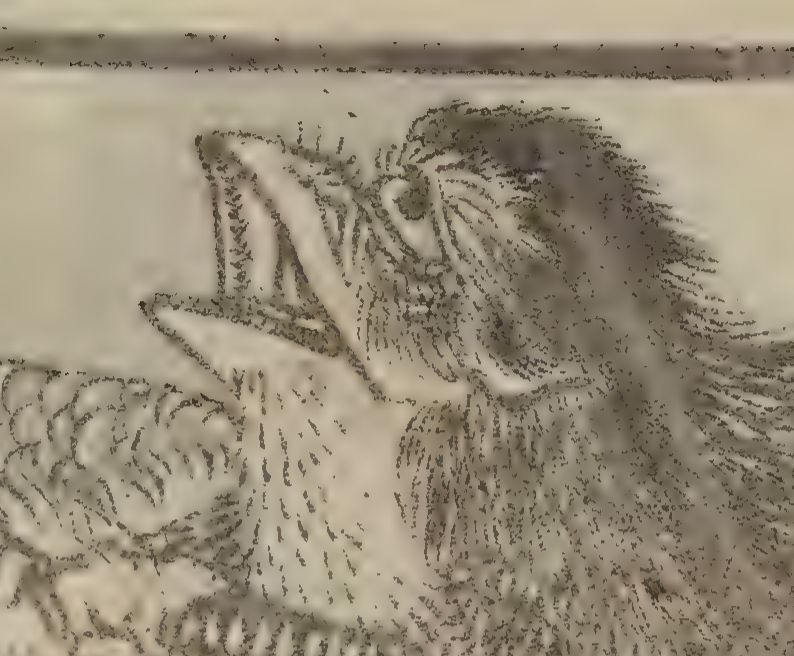
The head rises above the feathers
The bird-like beak opens and a dark head stands out against the light paper. Short marks merge into the longer feathers behind it. [2]
The sword runs towards the page edge
The long straight blade crosses beneath the head. Its narrow shape separates it from the layers of curved feathers. [2]
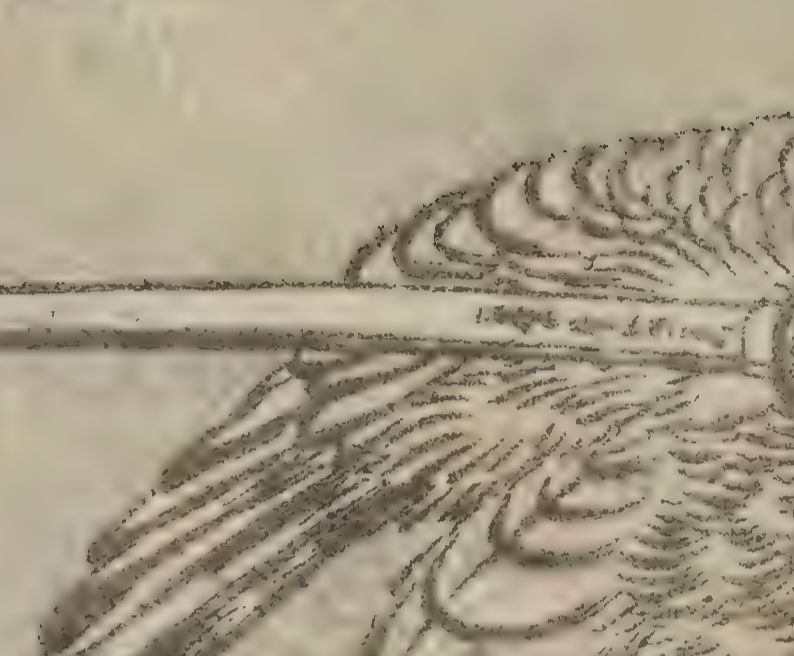
Rows of feathers turn in different directions
Overlapping bands give the wing its volume. The longer marks grow finer towards their tips. [2]
The wing reaches across the dividing line
Several of the longest feathers extend below the ruled boundary. The printed figure occupies a little of the space belonging to the next image. [2]
Explore Hokusai’s works
Discussion
Look again at the images and ideas explored in Tengu in Hokusai Manga. These editorial prompts invite your observations.
Reader Insights
What distinguishes the tengu’s silhouette from its layers of feathers?
How does seeing all four figures together change your reading of the tengu?
Join the Conversation
Share a detail, comparison or question about Tengu in Hokusai Manga below.
References
- National Diet Library, Hokusai Manga, volume three, call number 109-120, Katano Tōshirō edition, 1878, digital image 28. View source.
- Smithsonian Libraries and Archives, Denshin kaishu Hokusai manga, volume three, DOI 10.5479/sil.893300.39088019047844, PDF page 23. View source.
- Sumida Hokusai Museum, Hokusai and the Great Mountains, press material, pp. 6–7, illustrated opening with the tengu, hihi, ghost and mountain woman. View source.
- Sumida Hokusai Museum, Hokusai × Producers, exhibition checklist, no. 78, wrapper of Sketches by Hokusai, volume three. View source.
- Edo-Tokyo Museum, exhibition checklist for Hokusai and Hiroshige, no. 42, Sketch by Hokusai (Hokusai manga), vol. 3. View source.
- Edo-Tokyo Museum, Sketches by Hokusai, volume three, collection record 06200463. View source.
- Smithsonian Libraries and Archives, Denshin kaishu Hokusai manga, catalogue record 893300, physical description and colophon transcription. View source.
- Silvia Vesco, “An Analysis of Some Illustrated Books by Katsushika Hokusai (1760–1849) in the Museum of Oriental Art in Venice,” Annali di Ca’ Foscari. Serie orientale 56 (2020), pp. 640–642, note 33 and fig. 13. View source.
- Rijksmuseum, Katsushika Hokusai, O-Iwa het lantaarn spook, AK-MAK-930, collection record and photograph. View source.







