


 by Tom Gurney
Tom Gurney BSc (Hons) is an art history expert with over 20 years experience
Published on June 19, 2020 / Updated on November 20, 2026
Email: tomgurney1@gmail.com / Phone: +44 7429 011000
Fuji Seen from Kanaya on the Tōkaidō
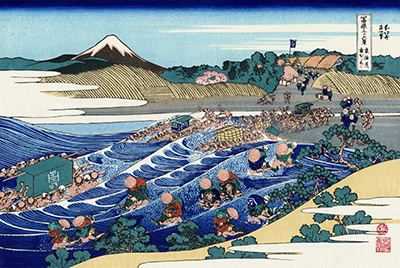
The road disappears into the Ōi River in Katsushika Hokusai’s Fuji Seen from Kanaya on the Tōkaidō. Travellers cross in groups, some balanced on shoulders and others borne above the water in litters. On the far side of the river, a path rises between rows of vegetation towards the roofs of a settlement. Mount Fuji stands in a small opening at the upper left. The Metropolitan Museum of Art dates its colour woodblock impression JP2975 to about 1830–32. The Japanese checklist of the Iuchi Collection records the design as no. 45, 東海道金谷ノ不二, Tōkaidō Kanaya no Fuji. It belongs to Hokusai’s Thirty-six Views of Mount Fuji. [1] [2]
At a Glance
- ArtistKatsushika Hokusai
- Dateca. 1830–32
- MediumColour woodblock print
- SeriesThirty-six Views of Mount Fuji
Contents
Between Kanaya and Shimada
The name Kanaya places this view at one of the Tōkaidō post towns on the road between Edo and Kyoto. Kanaya lay on the side of the Ōi in Tōtōmi Province. Shimada, across the river, was in Suruga Province. The Shimada City Museum explains that the shogunate prohibited bridges and ferry traffic at the crossing, in part because the river formed a provincial boundary. Travellers normally paid specialists to get themselves and their baggage across. If the water rose too high, passage stopped and travellers could be left waiting for days at either post town. [3]
The crossing was an organised service. In the system described by the city museum, an official measured the water each morning and the price of a crossing ticket depended on the depth and breadth of the river. Each ticket hired one carrier. A traveller who wanted a platform, called a rendai, bought additional tickets for its use and paid for the carriers it needed. There were plain platforms and more elaborate ones with railings. When someone crossed on a carrier’s shoulders, deeper water could call for an extra worker to steady them. The price and size of the crew could therefore change with the conditions and the mode of transport. [3]
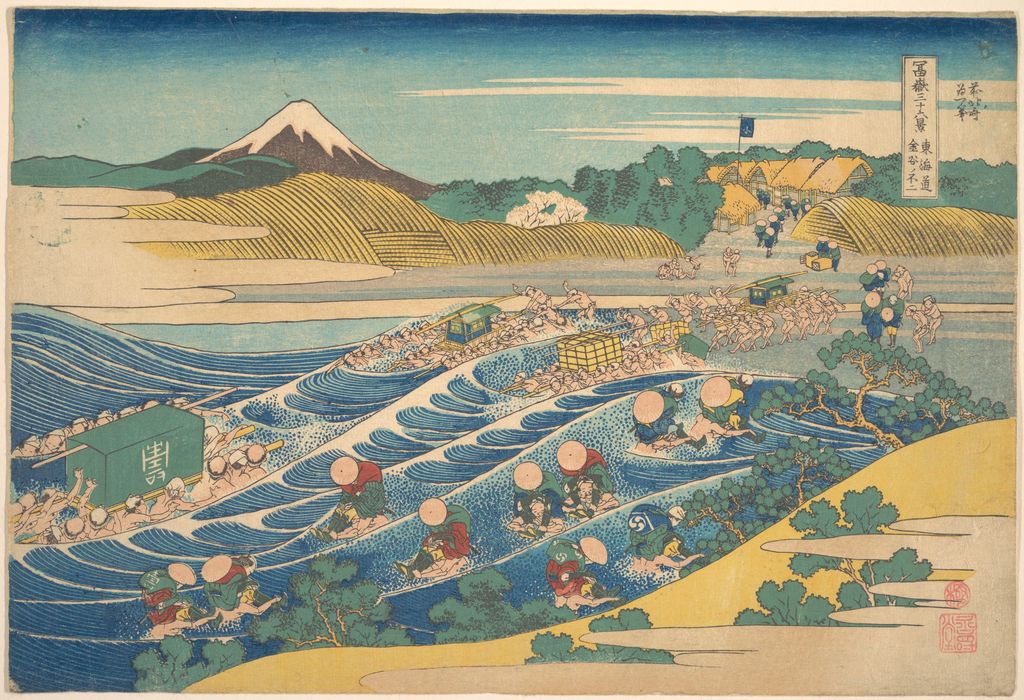
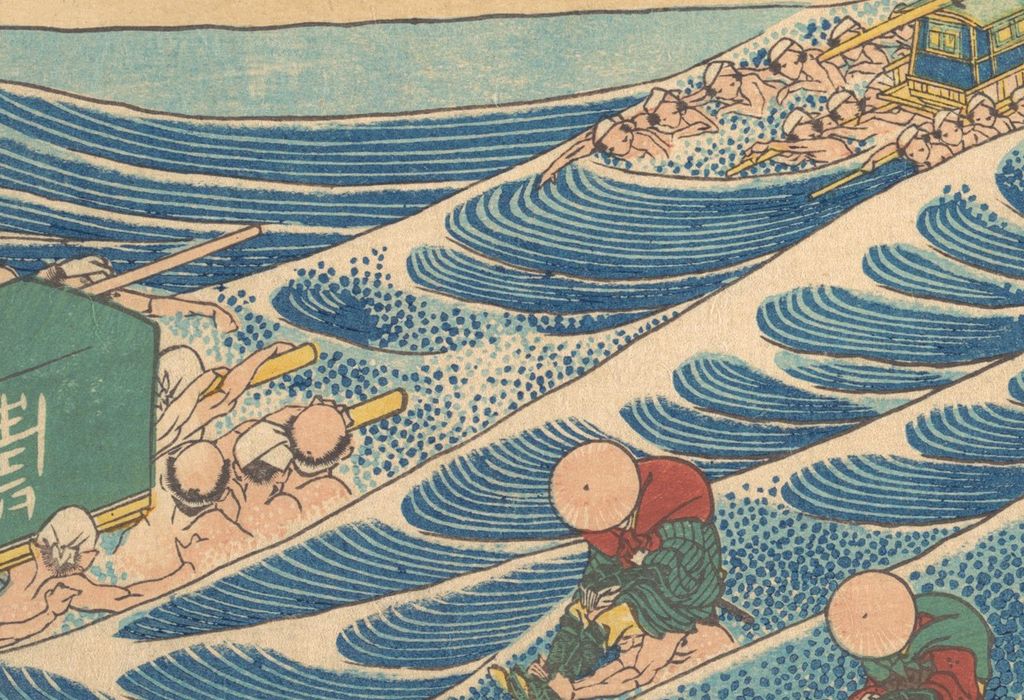
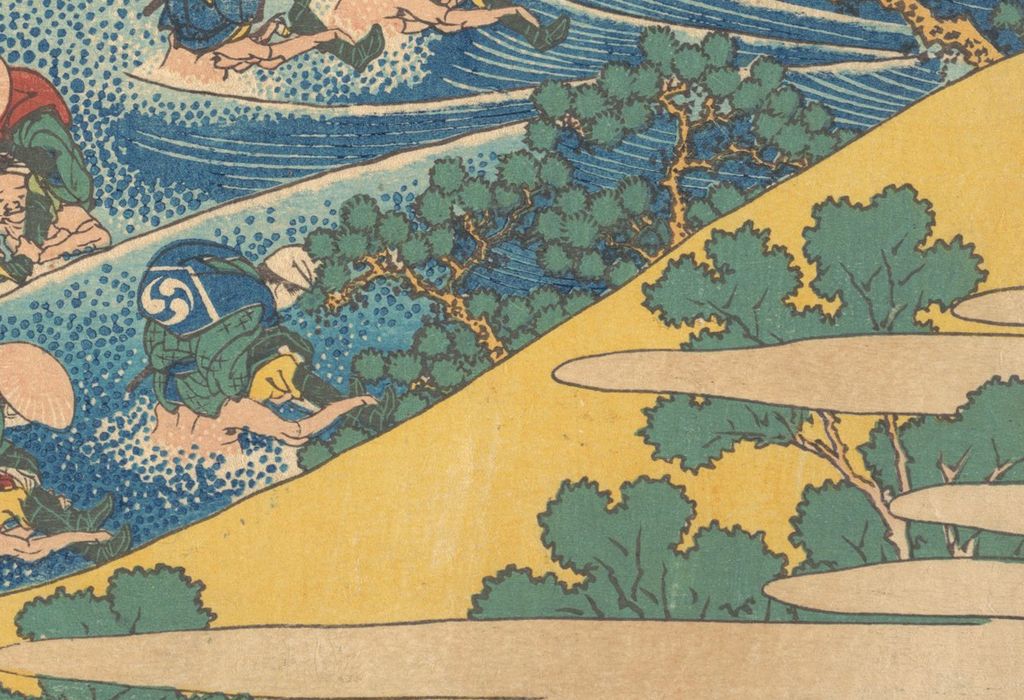
Hokusai gives that organisation a visible shape. Near the lower left, hands and bare backs appear around a green covered litter. The bodies cluster along the line of the poles, some almost swallowed by the parallel waves. Near the centre, a yellow rectangular load has a prominent lattice pattern that makes it easy to pick out above the current. Farther right, figures are small enough that hats, dark garments and pale heads often tell the viewer more than their faces. These distinctions make it possible to follow several journeys through one crowded stretch of water. The scene gives the carriers and their equipment as much attention as the people they are transporting. [1] [4]
The city museum’s account also explains what happened to the tickets in the water. They were treated with oil and tied to the carrier’s topknot or headband. The arrangement put the proof of payment where it could be kept while both hands were busy. The marks on the hats and heads in Hokusai’s print are too small to identify as tickets. The record nevertheless helps explain how the crossing brought the daily administrative work of a post town right into the channel. [1] [3]
How the current divides the crossing
The water moves through the foreground in long, bending bands. At the left edge, lines of blue sweep in broad curves, and increasingly tight curves shape the water around the central groups. Narrow strips of pale paper make those turns legible. Areas of fine blue dots break up some of the larger bands, especially where the water appears to lap up around a carrier. The wide curves could be read almost as paths in their own right. The people follow different lines within them, and their progress is regularly interrupted by the rise of a crest. [1]
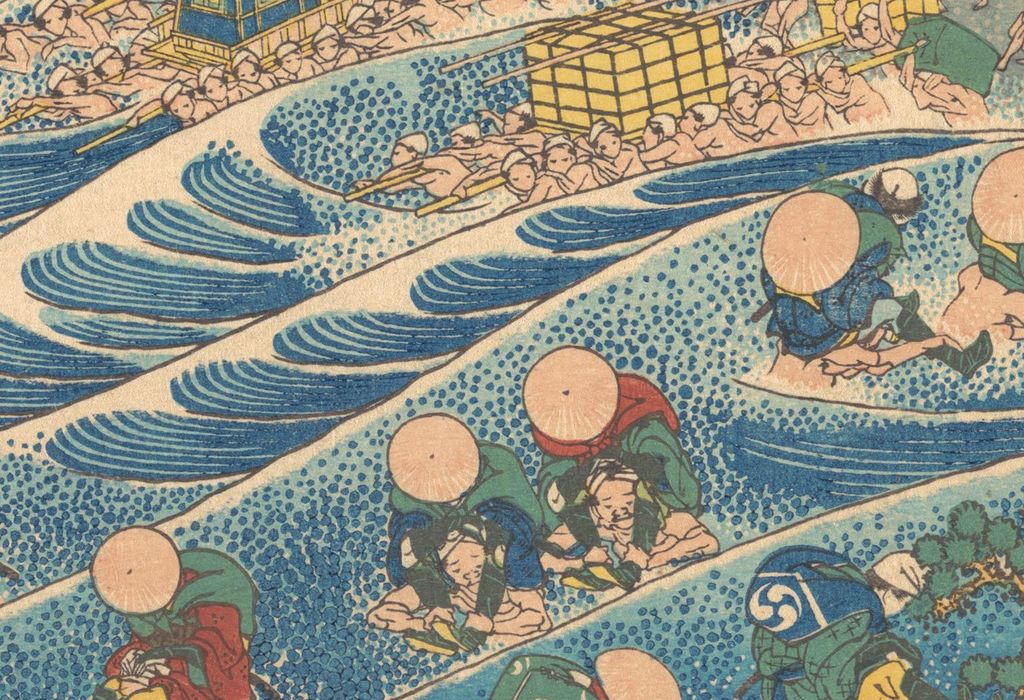
The circular hats create another rhythm. A hat close to the viewer is large enough to isolate from the person beneath it. Farther back, the circles crowd together and start to look like a broken chain. The MOA Museum of Art likewise draws attention to the succession of hats and the gathering of carriers, relating them to waves that look more like a rough sea than a quiet river. The groups appear to gain and lose height as the pale circles dip behind the blue. That play with apparent height puts the labour of crossing at the centre of the view. [1] [5]
The sweep of the river also separates several kinds of movement. At the far side, walkers on exposed ground can be picked out as whole figures. Wet ground and shallower channels cut across the route before them. Closer in, carriers emerge in pieces, a shoulder or a raised arm here and a pair of legs there. Hokusai lets the arrangement grow harder to read towards the viewer. As the foreground fills with waves, a straight approach to the opposite bank becomes almost impossible to trace. The city museum’s account of skilled carriers makes particular sense of a scene in which finding a passable line was part of the work. [1] [3]
The far bank and the small summit
The opposite shore changes the scale of the marks. Broad lines of bare ground separate the crossing from the settlement, while the hillocks behind them are built up from close, regular strokes. The Tokyo Fuji Art Museum’s catalogue entry draws attention to the way the curved embankments answer the swells of the Ōi. Seen from the crossing, the bank can look like one more rolling surface. Above it, most of the buildings are indicated by a short row of light roofs, a path and the dark shape of a flag. Those landmarks are enough to give the distant crowd a direction. [1] [4]
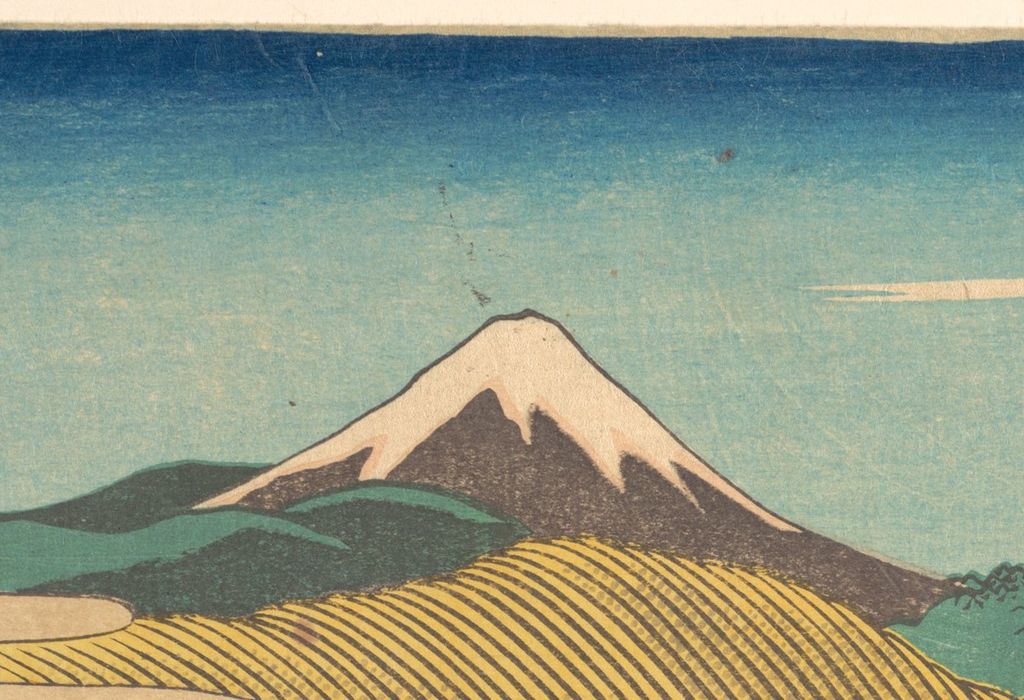
Fuji has a clearer profile than anything in the river. The pale summit descends in points over a dark flank, and several lower hills interrupt the base. Long horizontal clouds beside the peak draw the eye across the blue sky, while the mountain stays compact. The Met draws out the tension between the vigorously patterned crossing and the steady mass of Fuji. The mountain’s small scale is part of that effect. Although it is the named subject of the print, its silhouette has to compete with figures, waves and the bright expanse of the nearer bank. [1] [6]
Among the small details, the flag at the settlement and the wording on the large green load repay a closer look. The Tokyo Fuji Art Museum identifies the character 永 on the flag and 寿 on a chest and a traveller’s wrapping. The characters appear in the name Eijudō, the publishing house behind the series. The museum suggests that their repeated appearance may have served as publicity. One is placed high in the distance, and others appear among the transport of people and goods. They remain part of the landscape even for a reader who passes over their possible commercial meaning. [1] [4]
Two impressions at the Met
The Met records JP2975 as 26 × 38.7 centimetres and JP1294 as 25.4 × 36.8 centimetres. In both photographs the dark blue upper band grades into a much paler sky, the principal litters sit in the same channels, and a red mark appears near the lower right corner. The pattern of wave crests is recognisable from one sheet to the other. So are much smaller forms, including the long rectangular cartouche and the outlines of the rooftops above the crossing. Looking at these shared details makes it possible to distinguish the design from the appearance of each surviving printed sheet. [1] [6]
The bank in the lower right reads as a strong patch of yellow in the JP2975 photograph and as a quieter straw tone in JP1294. The hatched embankment behind the river also looks warmer in JP2975. With more yellow at the edge of the crossing, the vegetation and water on that sheet appear to meet a brighter field of colour. JP1294’s photograph leaves the same near edges legible, with less contrast between the bank and the pale ground around it. Those are differences visible in the museum images. The photographs by themselves give no order for the impressions or account of how much of the difference belongs to printing, condition or photography. [1] [6]
Other crossings on the road
Utagawa Hiroshige also showed the Ōi crossing in Kanaya: Distant Bank of the Ōi River, a colour print that the Tokyo Fuji Art Museum dates to 1833–34. Its lines of minute people thread across shallows and exposed ground beneath a distant ridge. A large open expanse separates the people from the ridgeline, and the line of travellers thins out as it moves away. Hiroshige’s print belongs to his Fifty-three Stations of the Tōkaidō. The shared location offers two ways to read a river crossing. Hiroshige follows a route across successive bands of landscape, while Hokusai makes the water around the bearers dominate the near view. [1] [7]
In Hokusai’s own Tama River in Musashi Province, a small ferry and a shoreline figure occupy separate parts of the view. A broad channel stays open around the boat, and a band of mist leaves Fuji standing clear above the far bank. At Kanaya the crowd inhabits the channel itself, and Fuji can feel quiet partly because the eye has had to work so hard through the foreground. Looking back from the mountain, notice how much of the crossing remains visible at once. The roofs, poles, hats and litter covers each provide a point of orientation where the road runs out. [1] [8]
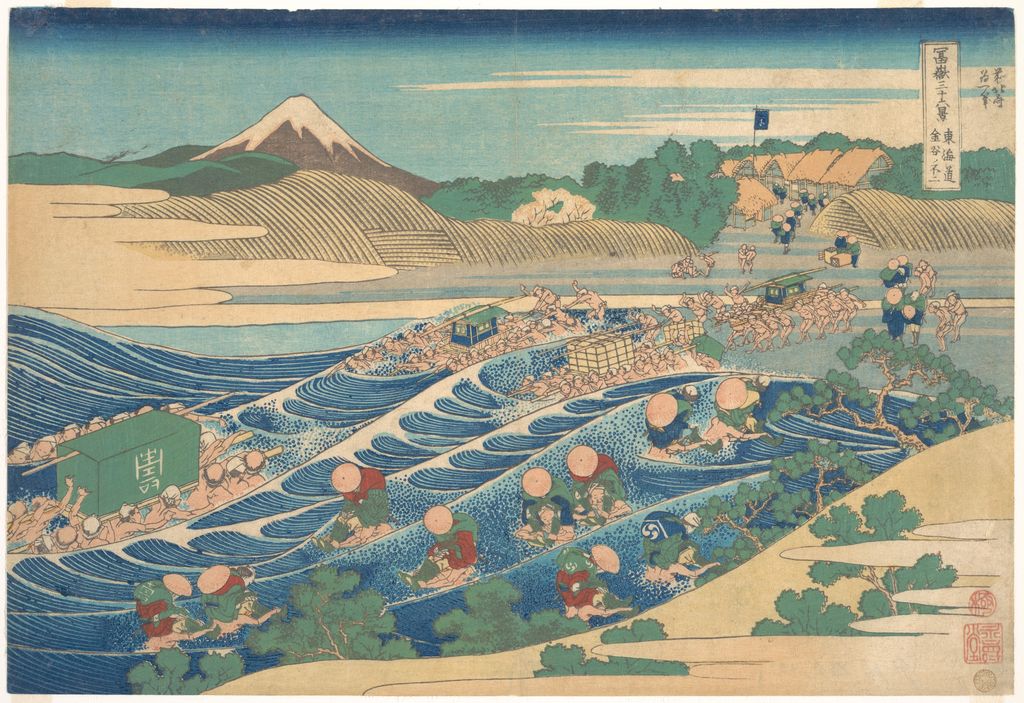
Image comparison
Where this work sits in Hokusai’s career
Annotated Details from Mount Fuji from Kanaya on the Tōkaidō Road
The Metropolitan Museum of Art, JP2975. [1]
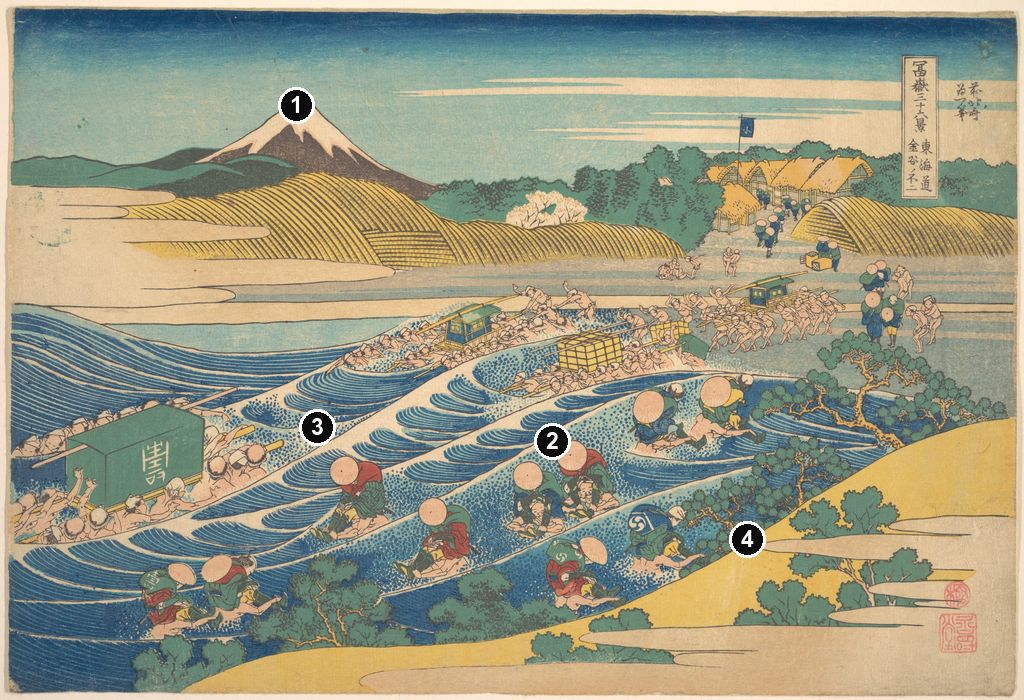
Details from MOUNT FUJI FROM KANAYA ON THE TŌKAIDŌ ROAD
Select a detail to look closely.
Fuji rises behind other ridges
The pale mountain appears above overlapping bands of land. Its steady silhouette contrasts with the water below. [1]
Travellers cross in groups
Hats and upright poles interrupt curved lines of water. Follow the small forms from one surge to the next. [1]
Blue channels divide the shallows
Dark, curving bands pull the eye sideways. They separate the groups crossing the river. [1]
A sandy bank projects into the water
The pale shape meets the darker current along a continuous edge. It provides a clear point of comparison with the shifting streaks in the river. [1]
Explore Hokusai’s works
Discussion
Look again at the images and ideas explored in Fuji Seen from Kanaya on the Tōkaidō. These editorial prompts invite your observations.
Reader Insights
What lets you follow the travellers through the water?
Where do the sweep of the current and the flat distance meet?
Join the Conversation
Share a detail, comparison or question about Fuji Seen from Kanaya on the Tōkaidō below.
References
- The Metropolitan Museum of Art, Fuji Seen from Kanaya on the Tōkaidō (Tōkaidō Kanaya no Fuji), impression JP2975, object record and photograph. View source.
- National Museum of Western Art, Japanese exhibition checklist, Iuchi Collection, no. 45. View source.
- Shimada City Museum, History of the River-Crossing System, Japanese municipal museum account of the Ōi crossing. View source.
- Tokyo Fuji Art Museum, Fuji from Kanaya on the Tōkaidō, Japanese catalogue commentary published by Cultural Heritage Online. View source.
- MOA Museum of Art, Thirty-six Views of Mount Fuji, gallery five entry no. 84, Japanese curatorial commentary. View source.
- The Metropolitan Museum of Art, Fuji Seen from Kanaya on the Tōkaidō, impression JP1294, object record and photograph. View source.
- Tokyo Fuji Art Museum, Utagawa Hiroshige, Tōtōmi Bank of the Ōi River near Kanaya, object record and photograph. View source.
- The Metropolitan Museum of Art, Tama River in Musashi Province, JP2991, object record and photograph. View source.







