


 by Tom Gurney
Tom Gurney BSc (Hons) is an art history expert with over 20 years experience
Published on June 19, 2020 / Updated on November 20, 2026
Email: tomgurney1@gmail.com / Phone: +44 7429 011000
Moonlight on the Yodo River
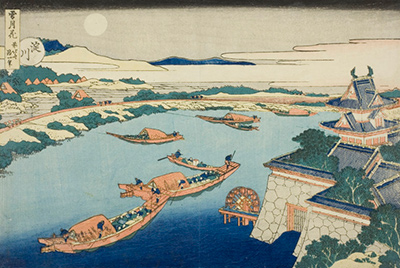
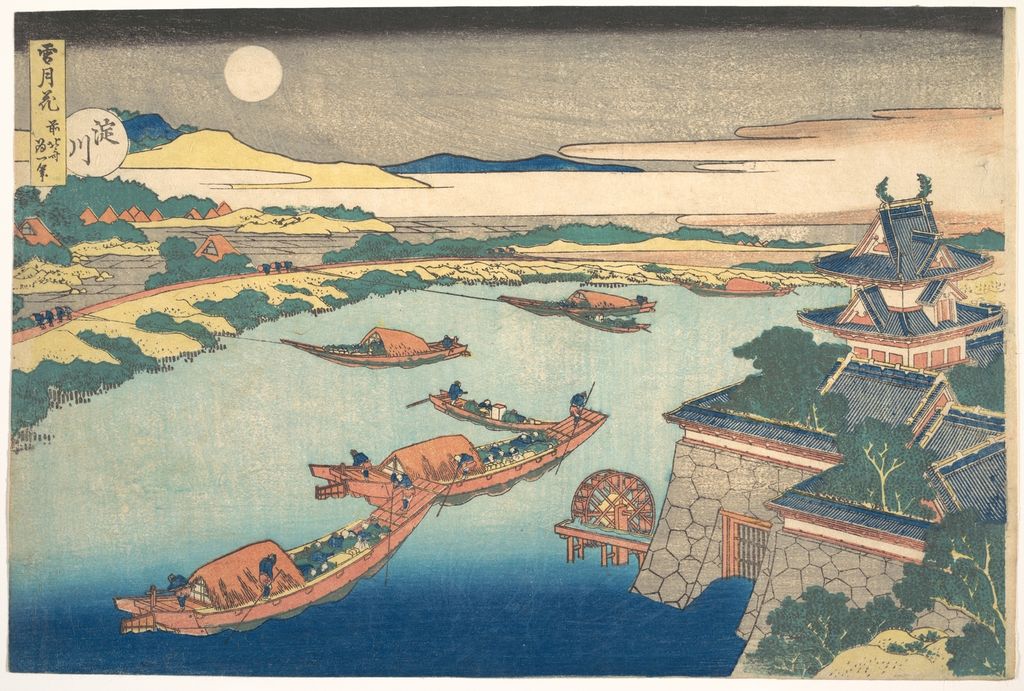
A full moon hangs over the Yodo River while boats pass a high stone wall. The moon occupies little of the sky. Its pale disk sets the hour for an entire scene of human activity. Under the dark edge of the sky, rooftops, trees and banks remain legible by their contours. The nearer boats carry their own patches of warm colour across otherwise cool water. Katsushika Hokusai drew the scene for a colour woodblock print in the series Snow, Moon, and Flowers. The Metropolitan Museum of Art dates its impression JP2922 to about 1833 and records it as ink and colour on paper, measuring 25.1 by 37.8 centimetres. [1]
At a Glance
- ArtistKatsushika Hokusai
- DateEarly 1830s
- MediumColour woodblock print
- SeriesSnow, Moon and Flowers
Contents
A moon above several distances
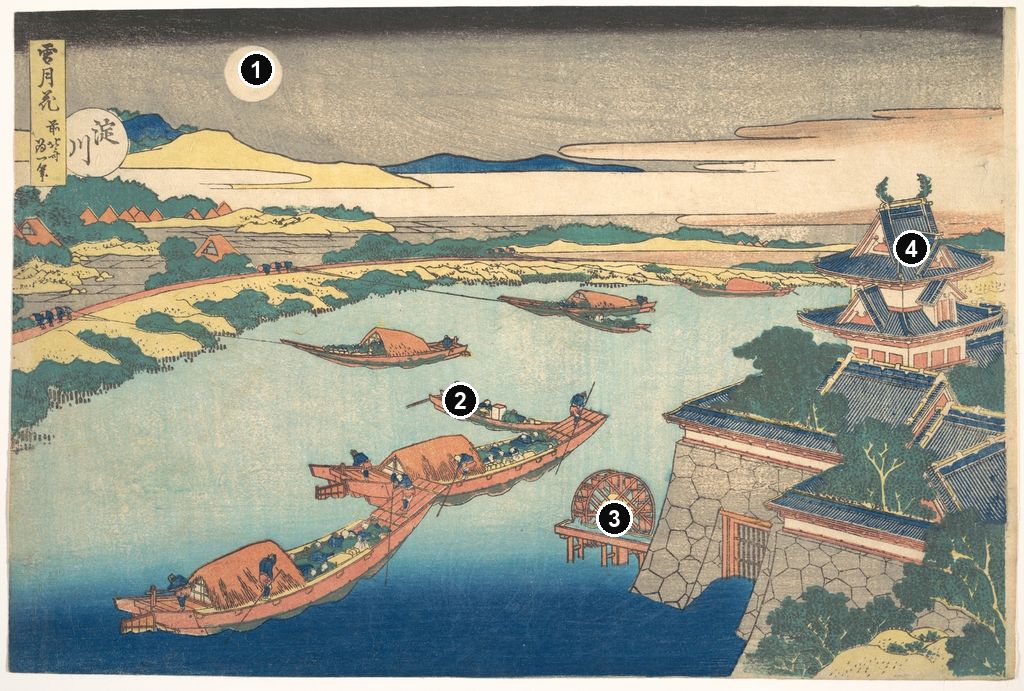
The disk sits near the upper left, a little way to the right of the rectangular cartouche. In JP2922 the sky around it is grainy and grey, and deepens towards the top edge. The moon’s interior is almost even in tone. There is no bright streak across the foreground water directly below it. Instead, light paper and lightly coloured passages recur at intervals throughout the composition. The same pale sky that surrounds the moon opens out beyond a long strip of clouds at right, while a low mountain ridge reads as a dark blue silhouette just below. The disk can remain small because it stands apart from those long horizontal forms. [1]
Hokusai lowers our attention in steps from the sky to the river. A pair of pointed slopes at left gives way to narrow bands of distant ground. Closer in, the roofs of houses begin to show, each with a short ridge and an angled edge. At the riverbank, individual marks divide bushes from fields and a pale path from both. The near water occupies much more of the sheet than any one distant band. Its clear expanse lets even a small foreground gesture, such as a person leaning towards the end of a boat, register against a fairly even field of colour. [1]
The night remains readable because the outlines change with distance. Far trees form an almost continuous edge, while the vegetation at the right rises in separate rounded masses among the buildings. Hokusai keeps the dark upper edge of the sky and the dark lower edge of the river apart. Each gives way to lighter colour nearer the middle, but in opposite directions. The lighter interval between them holds much of the traffic and building activity. The moon establishes the time of day, and that open interval allows the eye to travel across it. [1]
Boats below the wall
Begin with the boat at the lower left. Its pointed ends extend beyond a low cover with a curved top. The cover hides part of the interior, while the open sections give a glimpse of seated passengers and people at work around them. At the centre, the ends of two boats draw close in the picture. Their outlines meet or run alongside one another, and the diagonal of the nearer hull continues across the gap by way of the next boat. A narrower vessel higher up has more open space around it. Farther along the bank, boats become shallow patches of orange and black. The dwindling intervals between them help turn the broad field of water into a route. [1]
The Yodo was a transport link between Osaka and Fushimi, south of central Kyoto. Japan’s Ministry of Land, Infrastructure, Transport and Tourism records that the river carried timber, rice, salt and other goods, and that passenger boats known as sanjikkokubune operated between Fushimi and Osaka. Takatsuki’s account of the old boatmen’s songs describes downstream boats leaving at night and arriving in Osaka by morning. A journey made after dark would have belonged to the practical life of this river. The Tokyo National Museum identifies the boats in its impression of Hokusai’s design as sanjikkokubune and reads small figures following the bank as people towing boats upstream. Those figures are easy to overlook in the Met impression. Look along the narrow path at left, where a row of dark marks follows the curve of the bank. [1] [2] [3] [4]
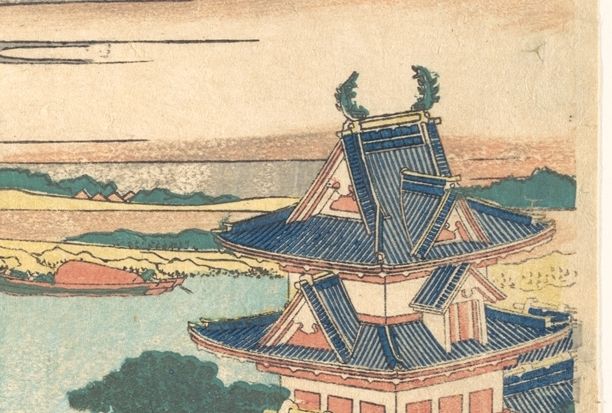
The high wall at right gives this traffic something solid to pass. Irregular joints divide the stone into close-fitting shapes. The lower edge intersects with the blue water, while a projecting wooden structure supports a wheel-like form with visible spokes. The buildings above it take up much of the right side. Layers of sloping blue roofs repeat the turn of the wall, and the topmost roof ends in two ornaments against the pale sky. This dense foreground closes off one side of the picture and makes the open river beside it seem wider. [1]
The building has received different catalogue identifications. Tokyo National Museum curator Kana Murase calls it Yodo Castle in her account of the museum’s impression. The Rijksmuseum describes the foreground structure in its own example as Osaka Castle. The repeated outlines across these impressions show the same design, while the two institutions’ names for its building differ. Its place in the composition is clear: from the corner of the wall, the view opens towards the opposite shore and beyond it to low hills. The structure gives the position of the nearest boat particular force. It is already passing down below us while the eye is still travelling across the far ground. [1] [2] [5]
Two impressions and the colours of night
The Met owns another impression, JP1429, which the museum also dates to about 1833. It is catalogued at 24.4 by 37 centimetres. In both sheets, the moon, the curving riverbank and the outlines of the boats hold the same positions relative to one another. The stone joints and roof lines largely repeat, as do the two ornaments at the top of the tallest roof. Small differences are easy to find by looking from the water to the edge of the sheet. In the published photograph of JP1429, two red marks are visible low on the left. The corresponding part of JP2922 shows no comparable marks. JP1429 also has wider areas of pale paper visible above and below the image. [1] [6]
The larger differences in the photographs are tonal. JP2922 has an especially deep, fairly saturated blue passage below the boats, giving way to a pale turquoise farther across the river. The warm colour of the boat covers and sides stands out quite strongly against it. In JP1429 the water is cooler and more even across the middle, and the boat covers look lighter. The two have the same gradation from darker foreground to lighter distance, but the balance between the blue and the warm accents shifts. That makes the lower boats particularly prominent in the photograph of JP2922, while the photograph of JP1429 brings out the thin edges of several distant boats against the water. These appearances concern the two museum photographs. They furnish no secure order for the printing of the sheets or identification of a particular blue pigment. [1] [6]
The moon among snow and flowers
The Allen Memorial Art Museum keeps its own impression, 1950.734, under the title Moon over the Yodo River in Osaka. It dates the sheet to the early 1830s, identifies the publisher as Nishimuraya Yohachi and records the horizontal ōban format. In its photograph, a thin towing line is particularly easy to see. It runs up and left from a pointed hull near the middle of the river to the group near the bend in the pale path. Another group, much smaller, stands farther along the bank. The rope cuts diagonally across a stretch of blue that otherwise carries very few marks. It makes the work taking place on land part of the boat’s motion and gives the distant people a role in the design beyond establishing scale. [2] [7]
The museum places it with Hokusai’s Snow on the Sumida River in Edo and Cherry Blossoms at Yoshino near Kyoto, also large horizontal prints. Each work gives one part of the three-part title to a particular place. On the Yodo, the full moon remains a small event in a landscape already occupied by travel. Snow and blossoms, by comparison, can alter the visible surfaces of a whole riverbank or hillside. [7] [8] [9]
A separate design can be found under a very similar English title. Tokyo National Museum accession A-10569-4617, catalogued in Japanese as Shōkei setsugekka: Settsu Yodogawa no tsuki, is a smaller horizontal colour print. Its composition has a slender crescent in the upper right, a vertical title near it and two low banks punctuated by houses. Several boats extend across the water, yet their arrangement, the curving masses of foliage and the shape and position of the moon all differ from the larger design. The Sumida Hokusai Museum’s seasonal exhibition checklist likewise catalogues the large Yodo view under Setsugekka and distinguishes the smaller format Shōkei setsugekka through its Sumida moon view. The Japanese cartouche, arrangement of boats and phase of the moon are useful ways to tell the two Yodo designs apart when the English titles nearly coincide. [1] [10] [11]
Hokusai returned to a nearby stretch of water in Tenma Bridge, where the span and the people upon it organise the view. In Moonlight on the Yodo River, the distant shore and the nearby stone wall instead hold the boats inside a broad bend. Both designs draw attention to how people use the water after daylight fades. The guide to Hokusai’s paintings, prints and books places these printed views alongside his work in other forms. [1]
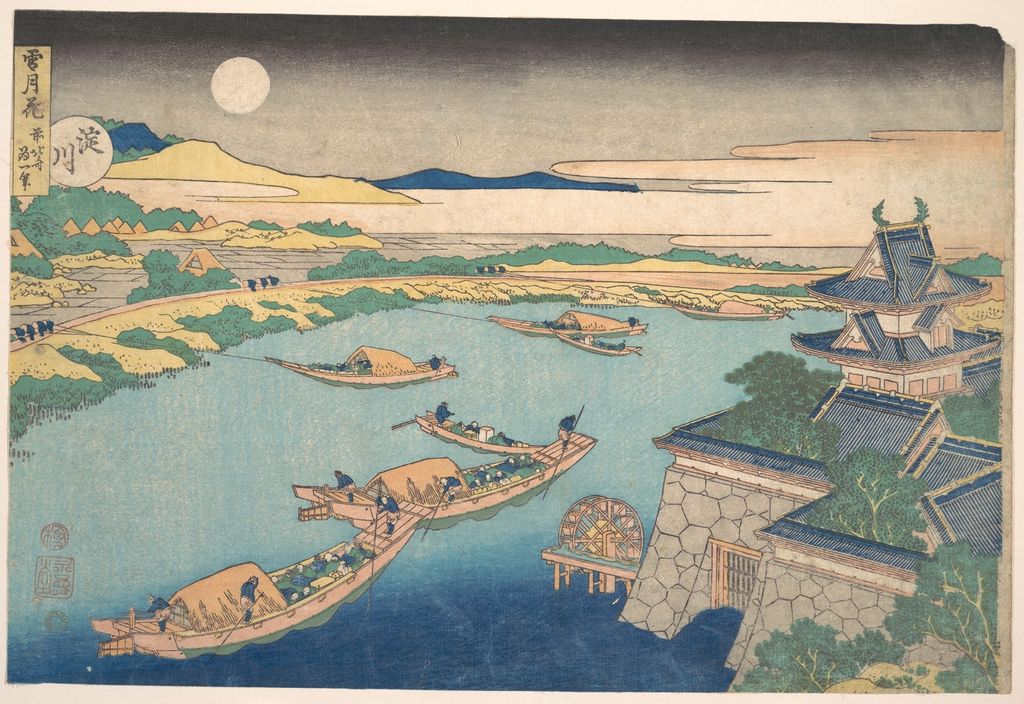
Image comparison
Where this work sits in Hokusai’s career
Annotated Details from Moonlight on the Yodo River
The Metropolitan Museum of Art, JP2922. [1]
Details from MOONLIGHT ON THE YODO RIVER
Select a detail to look closely.
The moon stands against a dark sky
The pale disk is a small point of light above the river. It has a clear margin of darker sky around it. [1]
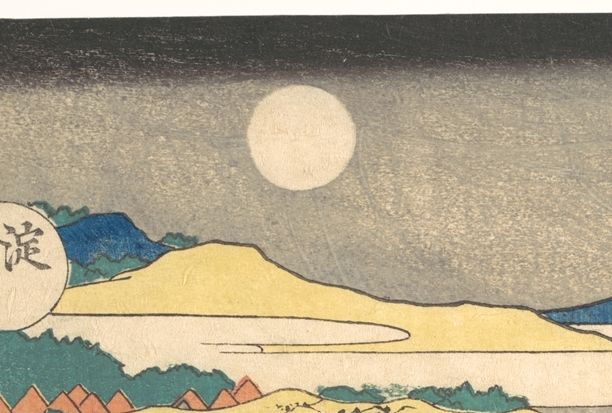
Boats follow a diagonal route
The larger boats in the foreground become smaller as they approach the far bend. Their repeated curved hulls connect near and far water. [1]
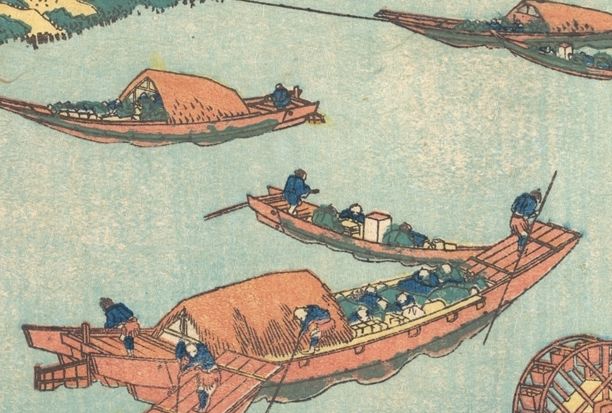
A wheel meets the water’s edge
The spoke-like lines recur around the curved form. Its position beside the large wall makes this stretch of river a place of work. [1]
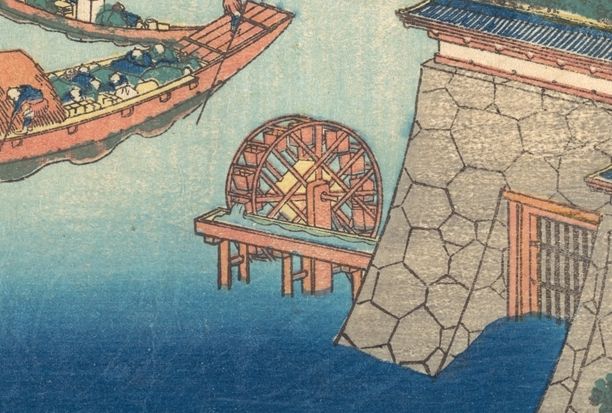
Several roofs rise over the bank
The layered eaves occupy much of the right edge. Their dark shapes interrupt the open course of the water. [1]
Explore Hokusai’s works
Discussion
Look again at the images and ideas explored in Moonlight on the Yodo River. These editorial prompts invite your observations.
Reader Insights
What makes the boats read as a line through the picture?
Which parts of the shore are easiest to see in the moonlight?
Join the Conversation
Share a detail, comparison or question about Moonlight on the Yodo River below.
References
- The Metropolitan Museum of Art, Moonlight on the Yodo River (Yodogawa), accession JP2922, collection record and photograph. View source.
- Kana Murase, Tokyo National Museum, Japanese curator’s essay on Itō Jakuchū’s Pleasures of the Journey, with the museum’s photograph and interpretation of Hokusai’s Yodo design. View source.
- Kinki Regional Development Bureau, Ministry of Land, Infrastructure, Transport and Tourism, Japanese account of goods and passengers carried on the Yodo. View source.
- Takatsuki City, Japanese account of the sanjikkokubune, downstream night passage and the Yodo boatmen’s songs. View source.
- Rijksmuseum, De Yodo rivier in maanlicht, accession RP-P-1980-4, Dutch catalogue description and photograph. View source.
- The Metropolitan Museum of Art, Moonlight on the Yodo River (Yodogawa), accession JP1429, collection record and photograph. View source.
- Allen Memorial Art Museum, Moon over the Yodo River in Osaka, accession 1950.734. View source.
- Allen Memorial Art Museum, Snow on the Sumida River in Edo, accession 1950.733. View source.
- Allen Memorial Art Museum, Cherry Blossoms at Yoshino near Kyoto, accession 1950.735. View source.
- Tokyo National Museum via Cultural Heritage Online, Moon at Yodogawa in Settsu Province, with Japanese catalogue data and photograph of the smaller design. View source.
- Sumida Hokusai Museum, exhibition checklist on seasonal customs in Edo, nos. 89–90. View source.







